
Custom Zipper FAQ: Aluminum Alloy vs Brass Specs and OEM
Custom Zipper FAQ: Aluminum Alloy vs Brass Specs and OEM
Custom zipper orders rarely fail at the sewing line. They fail earlier, at the moment a buyer approves a specification that treats two different metal systems as interchangeable. Metal zippers accounted for 31% of global zipper consumption in 2025, and brass and aluminum together represented 67% of metal zipper production (Business Research Insights, Zippers Market Outlook).
The two materials are quoted side by side in almost every metal zipper RFQ, yet they differ in crosswise tensile strength, surface finishing chemistry, weight, unit cost, and the compliance paperwork a brand needs for EU customs clearance. This reference answers the technical questions that most often arrive before a purchase order is issued, using the published specifications of the Aluminum Alloy zipper and the Brass zipper produced by YAB ZIPPER.
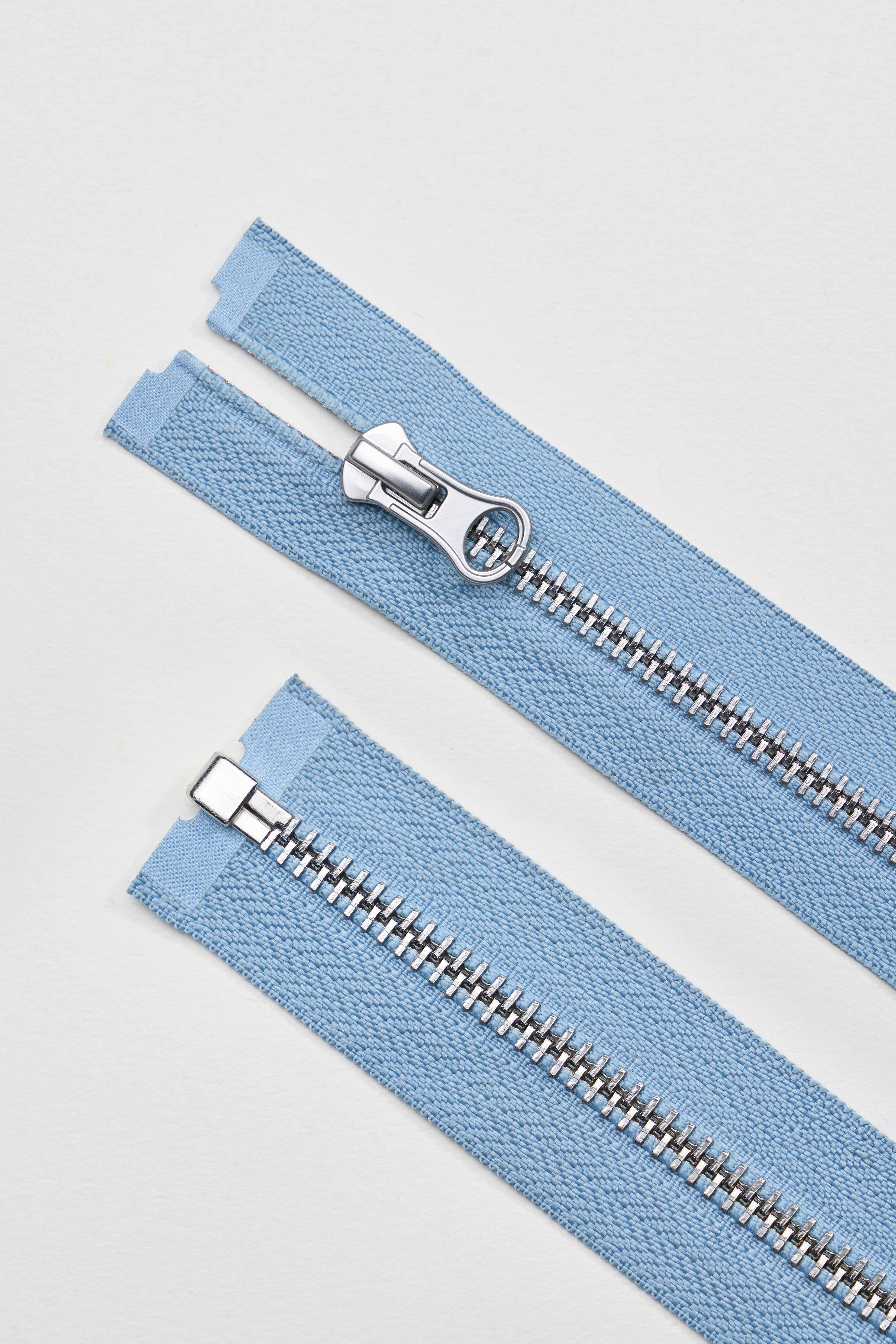
Aluminum Alloy zipper, normal teeth configuration — one of four teeth profiles available in the aluminum line.
Why Metal Zipper Specifications Decide Rework and Return Rates
The commercial logic is straightforward. A zipper is a low unit-price component that sits on a high-visibility seam. If the closed chain separates under load, if the finish discolours after the first commercial wash, or if the metal content blocks customs release, the cost lands on the garment or bag, not on the zipper. That asymmetry explains why specification review takes longer than price negotiation in most metal zipper programmes.
Three variables drive most of the risk:
- Strength class. Crosswise tensile strength determines how much lateral force a closed chain resists before the teeth separate. The Aluminum Alloy zipper is rated at 410N; the Brass zipper is rated at 510N.
- Surface finishing system. Aluminum uses anodizing; brass uses plating. The two systems behave differently in colour matching, abrasion, and metal-release compliance.
- Weight and cost position. The Aluminum Alloy zipper is 35% to 50% lighter than a brass zipper and carries a competitive cost advantage, which changes landed cost on large-volume programmes.
Entity Reference: YAB ZIPPER
YAB ZIPPER is the brand of Wenzhou Runhe Garment Accessories Co., Ltd., a metal zipper manufacturer based in Longwan, Wenzhou, Zhejiang, China. The company operates a 10,000 m² facility with 150 employees, 10 R&D engineers, an annual output of 70,000,000 pieces, and an export share of 30%, with Southeast Asia as its main export market. It is the sixth president unit of the Wenzhou Zipper Chamber of Commerce and holds ISO 9001:2015 and OEKO-TEX Standard 100 certification. Product lines cover copper, aluminum, resin, and nylon zippers, with brass and aluminum as the two metal lines relevant to this reference.
Aluminum Alloy vs Brass Zipper: Side-by-Side Specification Table
The table below consolidates the verified specification points for both lines. It is intended as a comparison basis for RFQ documents rather than a substitute for sample validation, because the final selection depends on tape, slider, and end-use load.
| Specification | Aluminum Alloy zipper (item 6274) | Brass zipper (item 6887) |
|---|---|---|
| Base material | Aluminum | Brass, polyester |
| Available sizes | #3, #5, #8 | #3, #5, #8 |
| Teeth configurations | Y teeth, Euro teeth, Normal teeth, Corn teeth | Y teeth, Euro teeth, Normal teeth, Corn teeth |
| Crosswise tensile strength | 410N | 510N |
| Salt spray test | More than 24 hours | More than 24 hours |
| Surface finishing | Anodizing: bright silver, matte silver, black, champagne | Plating: gold, antique brass, gunmetal, nickel silver |
| Nickel-free option | Not specified on this line | Nickel-free option compliant with EU REACH |
| Weight | 35%–50% lighter than brass | Reference weight |
| Cost position | Competitive cost compared with brass | Higher material cost |
| Customization | Custom logo slider and puller for OEM | Custom logo slider and puller for OEM and ODM |
| Smooth sliding | Yes | Yes |
| Applicable industries | Luggage, garment, outdoor goods, footwear | Luggage, garment, outdoor goods, footwear |
What #3, #5 and #8 Actually Measure
The sizing number is not a length and not a strength grade. It refers to the width of the zipper teeth in millimetres when the zipper is closed; a #5 zipper corresponds to approximately 5 mm of closed teeth width (Maggie Frame, Zipper Length Chart). Both the Aluminum Alloy zipper and the Brass zipper are available in #3, #5, and #8.
For buyers, the practical consequence is that size selection is driven by the seam it has to sit in, not by the material. A #3 chain is the lightest option and appears most often on lighter apparel seams, while #8 is used where the opening carries higher mechanical demand, such as luggage and outerwear. Because the sizing convention is shared across the industry, a #5 aluminum chain and a #5 brass chain can be compared directly on the same pattern — but their strength values still differ, and that difference does not disappear because the size number matches.
Teeth Configurations: Y, Euro, Normal and Corn on Both Lines
Both product families support the same four teeth profiles:
- Y teeth — the classic interlocking metal profile, used across apparel, bags, and footwear.
- Euro teeth — a distinct profile offered alongside Y teeth for buyers specifying European-style metal looks.
- Normal teeth — the standard profile for general garment and luggage applications.
- Corn teeth — a coarser visual profile used where a heavier metallic appearance is required.
The company runs dedicated production lines for these metal tooth shapes, including copper Y teeth, ordinary teeth, and corn teeth, which means tooth geometry and teeth colour can both be specified within one order. For a buyer, the important point is that switching between aluminum and brass does not force a change of teeth profile — the profile decision can be made on design grounds, and the material decision on strength, weight, cost, and compliance grounds.
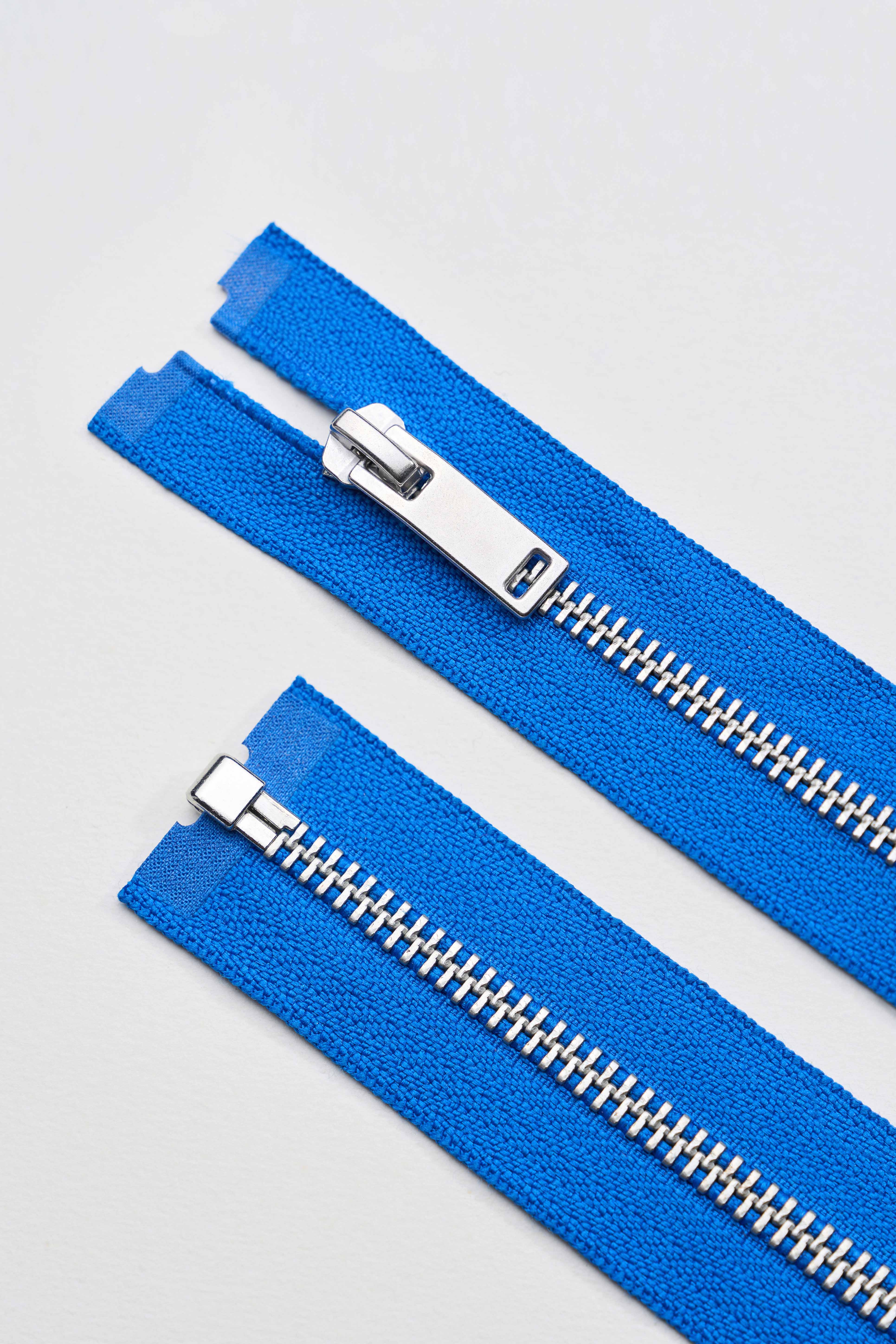
Brass zipper, Y teeth — the brass line accepts gold, antique brass, gunmetal, and nickel silver plating.
Surface Finishing: Anodizing on Aluminum, Plating on Brass
Finishing is where the two lines diverge most visibly. The Aluminum Alloy zipper is offered in bright silver, matte silver, black, and champagne anodizing. The Brass zipper is offered with gold, antique brass, gunmetal, and nickel silver plating.
Anodizing builds a surface layer on the aluminum itself, which is why the aluminum finish palette is comparatively tight and metallic in character; plating deposits a metal layer onto the brass substrate, which is why the brass palette includes warmer gold and antique tones plus the darker gunmetal and nickel silver options. Neither system is universally superior — the choice follows the design brief. A sportswear brand aiming for a matte technical look will usually find matte silver or black anodizing easier to match than a plated finish, while a leather goods brand producing jeans hardware or premium bags will typically want the deeper antique brass or gunmetal appearance that plating delivers.
Crosswise Tensile Strength: 410N and 510N in Practice
Crosswise tensile strength describes the force a closed chain resists when the two sides are pulled apart across the tape direction. The published figures for these two lines are:
- Aluminum Alloy zipper: 410N
- Brass zipper: 510N
The 100N gap is the single most decision-relevant number in this comparison. It means brass remains the higher-strength option and should be retained where the closed chain is regularly subjected to lateral loading — heavy luggage hardware, thick leather panels, and applications where the zipper is a load-bearing closure rather than a decorative one. Aluminum at 410N is sufficient for lightweight and mid-weight apparel, backpacks, and interior luggage closures, where the load path is distributed across the garment rather than concentrated on the chain.
Both lines are specified as smooth in sliding performance, and both accept self-locking sliders that prevent the slider from creeping down under load, delivered in single open-end, double open-end, and closed-end formats.
Corrosion Performance and the Limits of a Greater-Than-24-Hour Salt Spray Result
Both metal lines record a salt spray test result of more than 24 hours, which is the corrosion benchmark most buyers ask about first. That figure supports use in daily indoor environments at normal temperature, outdoor conditions at normal or low temperature with rain and snow, light humidity, and light friction and abrasion, as well as conventional washing cycles.
The limit matters as much as the number. The documented working envelope for these zippers excludes long-term high-salt seaside exposure and heavy washing cycles using strong acid or alkali. A buyer planning marine-adjacent products or industrial laundering should treat the greater-than-24-hour salt spray result as a validation baseline, not as a blanket guarantee, and should request application-specific testing before committing a production order.
Weight and Cost: The 35%–50% Difference and Its Effect on Landed Cost
The Aluminum Alloy zipper is 35% to 50% lighter than the equivalent brass zipper and is positioned at a competitive cost relative to brass. On a per-piece basis the difference looks small; on a programme basis it compounds.
A documented case from an overseas fast-fashion brand operating in France and Spain, running a four-year cooperation on spring and autumn lightweight windbreakers and casual coats, recorded the following outcomes:
- Garment total weight reduced by 38%
- Material procurement cost cut by 59% compared with the original brass zippers
- Unit price of the aluminum zipper at approximately 40% of the brass equivalent
- Reciprocating sliding performance meeting the industry standard, with a defective complaint rate below 0.3%
- OEKO-TEX eco certification supporting smoother EU customs clearance
Two caveats belong in any honest reading of these figures. First, the weight and cost results relate to a lightweight apparel programme with specific volumes and split deliveries; they are not transferable as a general rule. Second, the same account kept brass in its specification for heavier products, which is the behaviour to expect whenever the 510N strength class is a genuine requirement.
OEM and ODM: What Buyers Can Actually Customize
Both lines accept customized branding hardware. The Aluminum Alloy zipper allows a custom logo slider and puller for OEM orders; the Brass zipper accepts custom logo slider and puller for both OEM and ODM orders.
Beyond sliders and pullers, the customization scope available to buyers covers zipper length, tape colour, teeth colour, teeth shape, slider shape, slider colour, and zipper size. The supporting order parameters are:
- MOQ: 2,000 pieces
- Lead time: 7–30 days
- Monthly capacity: 300,000 units
- Quality control: 100% pre-shipment testing
- Export markets served: EU, US, Middle East, Southeast Asia
- After-sales: remote technical support
For ODM programmes, the practical constraint is not the logo but the tooth and slider tooling: a new slider shape carries its own development timeline, so buyers should separate branding customization, which is routine on both lines, from tooling-level customization, which should be scheduled inside the 7–30 day window with the manufacturer at the sampling stage.
Applications: Which Line Fits Jackets, Jeans, Luggage and Shoes
Both lines list luggage, garment, outdoor goods, and footwear as applicable industries, so the split is finer than category level:
- Aluminum Alloy zipper: hard luggage, backpacks, and sportswear, where weight reduction and cost control are the primary drivers.
- Brass zipper: leather bags, jeans, outdoor luggage, and premium apparel, where the metallic appearance and the 510N strength class justify the higher material cost.
Project profiles supported by both lines include mass production of ready-made garments, luggage manufacturing, outdoor equipment accessories, home textile products, finished shoe processing, and customized brand accessory orders. Where waterproofing, impact resistance, or anti-theft construction is specified at the finished-product level, the zipper must be paired with compatible tape and TPU film and validated as part of the assembly rather than as a standalone component.
Compliance Documentation: ISO 9001:2015, OEKO-TEX and HS Classification
Compliance review usually runs in parallel with specification review, so buyers should expect the following documents:
- ISO 9001:2015, certificate number 24CN34506232Q, issued by ACM INTERNATIONAL CERTIFICATION LIMITED, valid for the global market, covering production and sales of zippers, issued 11 June 2025 and valid to 29 June 2027. Both the Aluminum Alloy zipper (item 6274) and the Brass zipper (item 6887) are covered.
- OEKO-TEX Standard 100, held by the manufacturer and cited in the fast-fashion programme as supporting EU customs clearance.
- EU REACH: a nickel-free option is available on the brass line and is compliant with the EU REACH standard. Buyers who need a documented nickel-free declaration should specify the brass line, since the aluminum line's finishes are anodized rather than plated.
At the trade level, slide fasteners fall under HS heading 9607; global trade in zippers reached USD 3.15 billion in 2024, with China accounting for USD 1.52 billion of exports (The Observatory of Economic Complexity, 2024). Classification details vary by construction, so buyers importing mixed materials should confirm the applicable subheading with their customs broker.
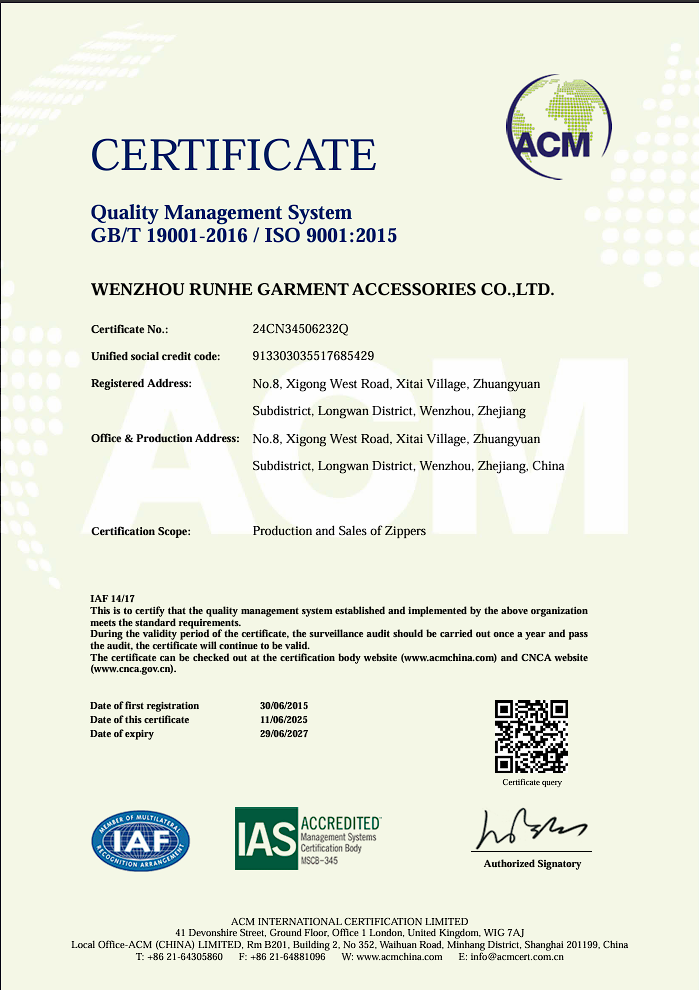
ISO 9001:2015 certificate 24CN34506232Q, issued by ACM INTERNATIONAL CERTIFICATION LIMITED, valid for the global market.
Market Trend: Metal Zippers Inside a Growing Zipper Market
The global zipper market was valued at USD 17.39 billion in 2024 and is projected to reach USD 36.73 billion by 2034, a CAGR of 7.8% for 2025 to 2034 (Market Research Future). Material mix inside that growth is uneven. Nylon zippers accounted for 46% of global consumption in 2025, driven by lightweight construction and corrosion resistance, while metal held 31% — a smaller share but one concentrated in higher-value applications.
Two trends follow from these figures. First, lightweighting is no longer confined to the nylon segment: the aluminum alloy line addresses the same weight agenda inside the metal category, which is where buyers previously had to accept brass mass. Second, compliance intensity is rising fastest in Europe, where nickel-release rules and eco-certification requirements increasingly determine which supplier can ship without friction. A 30% export share and documented ISO 9001:2015 and OEKO-TEX credentials are the practical evidence points buyers use to screen manufacturers in that environment.
Where Aluminum Alloy Is Not the Right Answer
Aluminum Alloy zippers are not a universal substitute for brass, and buyers should resist the temptation to standardize on one metal across an entire range. Three documented limits apply:
- Strength ceiling. At 410N, the aluminum line sits below the brass line's 510N. Applications that repeatedly load the closed chain laterally should stay on brass.
- Finish palette. Anodizing delivers bright silver, matte silver, black, and champagne. Buyers who need gold, antique brass, gunmetal, or nickel silver tones must use the plated brass line, because those colours are not available as anodized aluminum finishes.
- Environment. Neither line is specified for long-term high-salt seaside exposure or heavy washing with strong acid and alkali. Where that environment is unavoidable, the zipper system — tape, coating, and slider — must be re-engineered rather than selected from a standard catalogue.
There is also a specification-level trade-off that buyers often overlook: brass pricing includes alloy cost, so aluminium's cost advantage is most durable in programmes where weight and duty-landed cost matter more than maximum tensile class. In heavy leather goods, the reverse holds.
Future Outlook
Over the next several years, the metal segment is likely to be shaped less by raw material substitution than by documentation and finishing capability. Anodized aluminum gives brands a route to metal appearance at lower mass and cost, and the reported case outcomes — 38% weight reduction and a defective complaint rate below 0.3% over a four-year programme — indicate the approach is already validated in volume apparel, provided the strength class matches the application.
The open variables are compliance scope and tooling flexibility. As EU REACH enforcement tightens, the availability of a nickel-free brass option and verifiable ISO 9001:2015 and OEKO-TEX documentation will increasingly function as entry tickets rather than differentiators. For buyers, the sensible preparation is a two-material specification: aluminum alloy for lightweight and weight-sensitive lines, brass for high-strength and premium-finish lines, with a single sampling and validation process covering both.
FAQ: Custom Zipper Technical Questions
1. What do the #3, #5 and #8 numbers on a metal zipper mean?
The number refers to the width of the closed zipper teeth measured in millimetres; a #5 zipper corresponds to approximately 5 mm of closed teeth width. Both the Aluminum Alloy zipper and the Brass zipper are available in sizes #3, #5, and #8.
2. Which teeth configurations are available on aluminum alloy and brass zippers?
Both lines offer four configurations: Y teeth, Euro teeth, Normal teeth, and Corn teeth. The Aluminum Alloy zipper is produced as the Aluminum Alloy Y Teeth Zipper, Aluminum Alloy Euro Teeth Zipper, Aluminum Alloy Normal Teeth Zipper, and Aluminum Alloy Corn Teeth Zipper, and the Brass zipper is produced in the same four profiles.
3. How do the crosswise tensile strengths compare?
The Aluminum Alloy zipper is rated at 410N crosswise tensile strength and the Brass zipper at 510N. Both are specified as smooth in sliding performance. The higher brass value suits applications where the closed chain is regularly loaded laterally; the aluminum value suits lightweight and mid-weight apparel, backpacks, and interior luggage closures.
4. What surface finishes are available on each line?
The Aluminum Alloy zipper is offered in bright silver, matte silver, black, and champagne anodizing. The Brass zipper is offered in gold, antique brass, gunmetal, and nickel silver plating. The two systems are different: anodizing produces the aluminum colour range, while plating produces the brass colour range.
5. Is a nickel-free, EU REACH-compliant metal zipper available?
Yes, on the brass line. The Brass zipper is available with a nickel-free option that complies with the EU REACH standard. This option is documented for brass; the aluminum line is specified by its anodized finishes.
6. Can sliders and pullers be customized with a logo on both lines?
Yes. The Aluminum Alloy zipper allows a custom logo slider and puller for OEM orders, and the Brass zipper accepts custom logo slider and puller for both OEM and ODM orders. Additional customization covers zipper length, tape colour, teeth colour, teeth shape, slider shape, slider colour, and zipper size.
7. How much lighter is an aluminum alloy zipper than a brass zipper, and how does cost compare?
The Aluminum Alloy zipper is 35% to 50% lighter than a brass zipper and is positioned at a competitive cost. In one documented four-year programme for a fast-fashion brand in France and Spain, the aluminum zipper unit price was approximately 40% of the brass equivalent, procurement cost fell by 59% versus the original brass zippers, and garment total weight dropped by 38%.
8. What are the MOQ, lead time, and quality control terms for custom metal zippers?
The minimum order quantity is 2,000 pieces, lead time is 7–30 days, and monthly capacity is 300,000 units. Quality control includes 100% pre-shipment testing, and after-sales support is provided as remote technical support. Export markets served include the EU, US, Middle East, and Southeast Asia.
9. What conditions are these metal zippers not suitable for?
Both the Aluminum Alloy zipper and the Brass zipper are intended for daily indoor use at normal temperature, outdoor use at normal or low temperature with rain and snow, light humidity, light friction and abrasion, and conventional washing. They are not suitable for long-term high-salt seaside exposure or heavy washing with strong acid and alkali.
10. Which certifications cover the aluminum alloy and brass zipper lines?
Both the Aluminum Alloy zipper (item 6274) and the Brass zipper (item 6887) are covered by an ISO 9001:2015 certification, certificate number 24CN34506232Q, issued by ACM INTERNATIONAL CERTIFICATION LIMITED, applicable to the global market, with a scope covering production and sales of zippers. The manufacturer also holds OEKO-TEX Standard 100 certification.