
Custom Zipper Supplier Evidence: A Brass and Aluminum Audit Checklist
Metal zippers accounted for 31% of global zipper consumption in 2025, and brass and aluminum together represented 67% of metal zipper production, according to Business Research Insights' 2025 zipper market outlook. That split shapes most sourcing conversations: a metal zipper decision is usually a brass-or-aluminum decision, and it is usually made on the evidence a supplier is willing to put in writing.
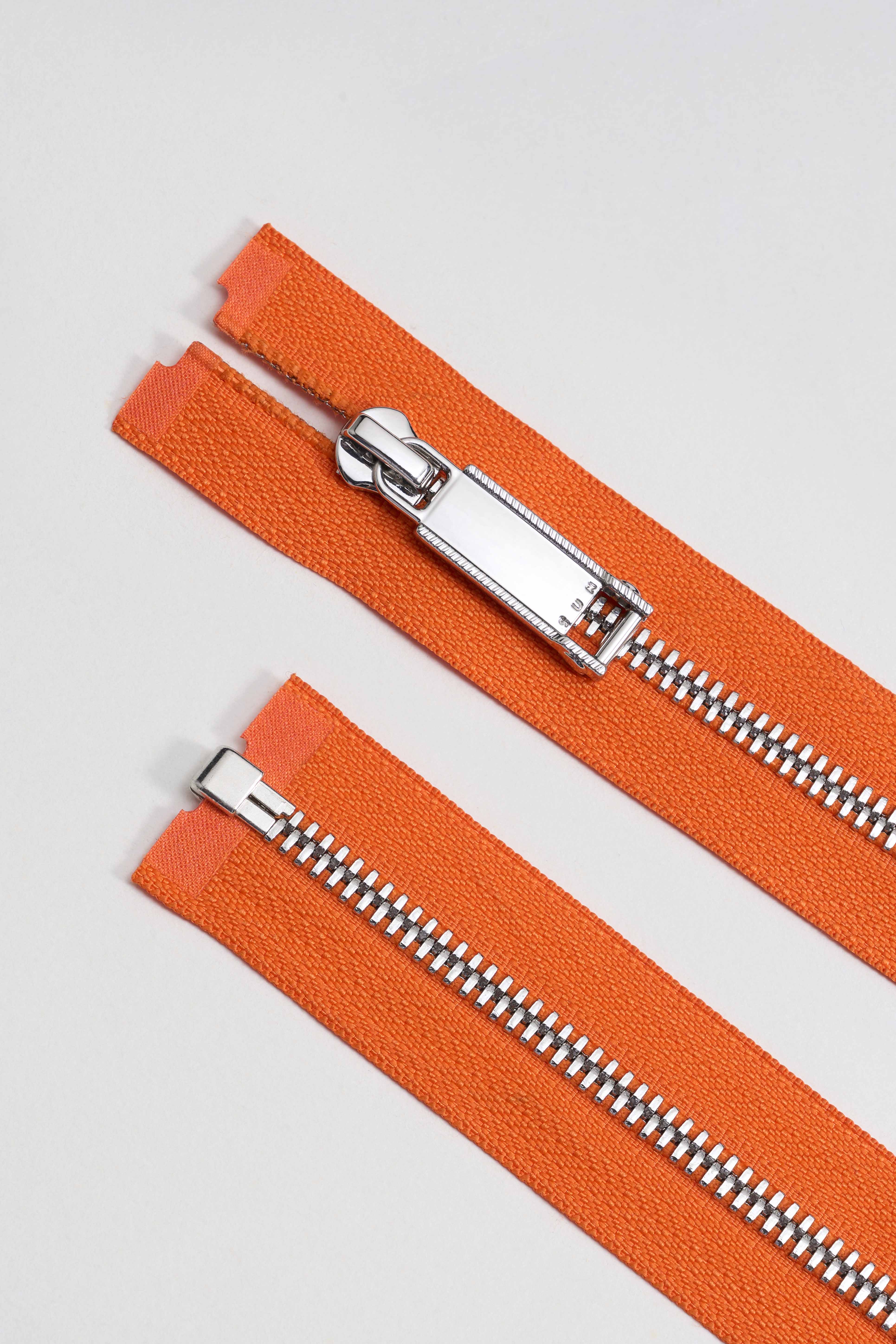
Aluminum Alloy zipper in a corn-teeth configuration — one of the two product families covered by the audit checklist in this article.
The audit problem: a curated sample is not capability evidence
A zipper sample that arrives in a courier box has been selected, checked and probably polished before it left the factory. It demonstrates that a supplier can produce one good unit. It does not demonstrate that the same tensile value, finish and alloy will repeat across a 2,000-piece order, a second production run six months later, or a colour-matching exercise across three tape lots.
Capability evidence is different. It is a set of declared values with conditions attached, a certificate whose scope can be read, and a documented description of how customization variables are controlled. For brass and aluminum zippers, that evidence set is small enough to check in a single supplier review — which is exactly why a structured checklist is more useful than a longer questionnaire.
YAB ZIPPER is the brand of Wenzhou Runhe Garment Accessories Co., Ltd., a zipper manufacturer based in Wenzhou, Zhejiang, China, producing copper, aluminum, resin and nylon zippers and holding ISO 9001:2015 certification for the production and sales of zippers. Its two metal product lines — Brass zipper and Aluminum Alloy zipper — provide a concrete, checkable example of what a complete evidence pack looks like for a custom zipper programme.
The brass and aluminum evidence baseline
Before comparing suppliers, buyers need the internal baseline: what each material is officially declared to deliver. The table below consolidates the declared values for the two metal product families in this article and can be used as a reference column in a supplier comparison sheet.
| Audit field | Brass zipper | Aluminum Alloy zipper |
|---|---|---|
| Base material | Brass alloy with polyester tape | Aluminum |
| Sizes | #3, #5, #8 | #3, #5, #8 (stock sizes) |
| Teeth configurations | Y teeth, Euro teeth, corn teeth, normal teeth | Y teeth, Euro teeth, corn teeth, normal teeth |
| Crosswise tensile strength | 510N | 410N |
| Salt spray test | >24h | >24h |
| Sliding performance | Smooth | Smooth |
| Weight | Reference weight | 35%–50% lighter than brass |
| Surface finishes | Gold, antique brass, gunmetal, nickel silver plating | Bright silver, matte silver, black, champagne anodizing |
| Compliance option | Nickel-free option available, compliant with EU REACH | Not declared in this evidence set |
| Customization | Custom logo slider and puller for OEM and ODM | Custom logo slider and puller for OEM |
| Indicated applications | Luggage, garment, outdoor goods, footwear; leather bags, jeans, premium apparel | Hard luggage, backpack, sportswear; luggage, garment, outdoor goods, footwear |
All values as declared for the Brass zipper and Aluminum Alloy zipper product families. Tensile and salt spray figures are material-level declarations and should be re-confirmed against the specific size and finish ordered.
Six checks that turn a spec sheet into audit evidence
1. Confirm the strength figure is crosswise — and tied to a size
A tensile number without a test direction is not usable. The relevant figure for a finished garment or bag opening is crosswise tensile strength, the force required to separate the teeth laterally. In this evidence set, brass is declared at 510N and aluminum at 410N. Zipper numbering (#3, #5, #8) refers to the width of the teeth in millimetres when the chain is closed, so a declared value should always be attached to a specific size rather than to the material family as a whole.
Practical audit action: ask for the tensile value per size, and ask which size the quoted figure describes. A supplier that can only answer at material level has a brochure, not a test record.
2. Ask what the salt spray hours actually cover
Both brass and aluminum products in this evidence set are declared with a salt spray result of more than 24 hours. That is a corrosion-resistance threshold for the metal finish, not a waterproofing claim and not a service-life estimate. For apparel and luggage programmes, >24h is a reasonable screening value; it should not be read as a marine-grade specification.
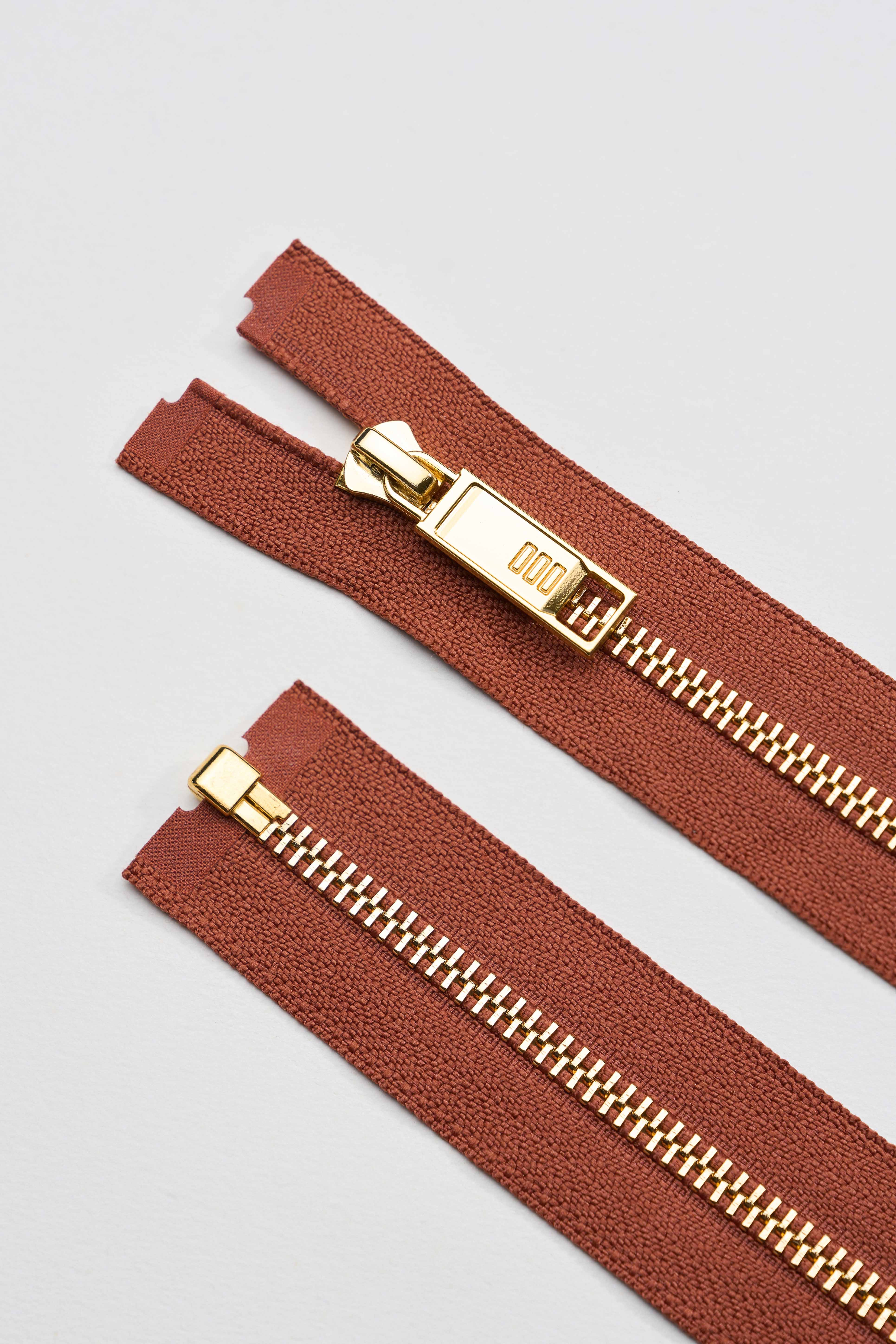
Brass zipper, normal teeth. Brass is declared at 510N crosswise tensile strength with a >24h salt spray result.
3. Verify alloy and finish declarations, including the nickel-free brass route
Finish is where compliance risk usually sits. The Brass zipper is offered in gold, antique brass, gunmetal and nickel silver plating, and a nickel-free option compliant with the EU REACH standard is available. Those two statements need to be read together: nickel silver is one of the standard plating colours, so a buyer with a nickel-restriction requirement must specify the nickel-free option rather than assume it is the default.
On the aluminum side, anodized finishes are declared as bright silver, matte silver, black and champagne anodizing. Anodizing is a surface conversion rather than a plated deposit, which is why aluminum programmes usually present finish risk differently from brass programmes.
4. Read the ISO 9001 certificate for scope, number and expiry
A certificate image is not verification. Read four fields: the certificate number, the issuing body, the scope statement and the expiry date. For this manufacturer, the quality management system certificate is number 24CN34506232Q, issued by ACM INTERNATIONAL CERTIFICATION LIMITED, to ISO 9001:2015, with a scope covering the production and sales of zippers, issued on 11 June 2025 and valid until 29 June 2027 for the global market. The company also states OEKO-TEX Standard 100 certification.
Two audit consequences follow. First, a scope limited to zipper production does not automatically cover a separately sourced accessory. Second, a certificate approaching expiry is a supply-continuity question, not a paperwork detail.
5. Check how customization variables are controlled
Custom work fails at variable control, not at concept. The declared customizable fields here are zipper length, tape colour, teeth colour, teeth shape, slider shape, slider colour and zipper size. Both metal families accept custom logo sliders and pullers — brass for OEM and ODM orders, aluminum for OEM orders. Teeth shape choice spans Y, Euro, corn and normal teeth in both materials.
A buyer should map each field to a written approval point: which variable is approved by lab dip, which by physical sample, and which by drawing. A supplier that lists seven customizable fields but cannot describe the approval sequence for each is offering flexibility without control.
6. Confirm capacity, MOQ, lead time and pre-shipment testing
The production evidence for this supplier includes a 10,000 m² factory, 150 employees, a 10-engineer R&D team, monthly capacity of 300,000 units, a minimum order quantity of 2,000 pieces, a lead time of 7 to 30 days, 100% pre-shipment testing and remote technical support after delivery. Export markets are stated as the EU, US, Middle East and Southeast Asia.
The MOQ-and-lead-time pair is the most useful commercial filter in this list. A 2,000-piece MOQ with a 7 to 30 day window fits replenishment-style accessory programmes; it does not fit a one-off prototype run, and buyers should plan sampling separately rather than assume the quoted lead time covers first-article development.
Matching the evidence to the application
The same two materials can be specified very differently depending on the product they close. The mapping below connects declared evidence to end use, so the checklist produces a decision rather than a file.
| Application | Evidence that decides the choice | Typical configuration |
|---|---|---|
| Hard luggage and luggage shells | Weight reduction and cost per unit; 35%–50% weight advantage and competitive cost versus brass | Aluminum Alloy zipper, #5 or #8, corn or Y teeth |
| Backpacks and outdoor goods | Balance of tensile strength and carried weight; salt spray >24h finish screening | Aluminum Alloy or Brass zipper, #5, Y or corn teeth |
| Sportswear and lightweight outerwear | Low mass and anodized colour consistency | Aluminum Alloy zipper, #3 or #5, bright or matte silver, black, champagne |
| Jacket zipper and premium apparel | Metallic texture and 510N crosswise strength | Brass zipper, #5, gold or antique brass plating |
| Jeans zipper and leather bags | Deformation resistance under repeated lateral load | Brass zipper, #5 or #8, normal or Y teeth, gunmetal or nickel-free option |
| Footwear and shoe zipper applications | Short chain length with high pull frequency; customization of length and slider shape | Brass or Aluminum Alloy zipper, #3 or #5, custom logo puller |
Configurations reflect declared teeth options, sizes and finishes. Final selection should follow physical testing on the assembled product.
Where this evidence stops
A credible audit includes the boundary conditions, and there are three that matter here.
Salt spray >24h is not an all-environment rating. The declared working conditions for these products cover daily indoor use at normal temperature, outdoor use at normal or low temperature with rain and snow, light humidity and slight friction, and conventional washing. They explicitly do not cover long-term high-salt seaside exposure or heavy washing with strong acid and alkali. Buyers specifying for marine, coastal or industrial-detergent environments should treat >24h as a starting screen and commission their own extended testing.
Aluminum is lighter, not stronger. The declared crosswise tensile strength of 410N for aluminum sits below the 510N declared for brass. For a luggage shell or a backpack where the zipper is a structural opening, the 35%–50% weight advantage and the competitive cost position do not automatically compensate for the lower strength figure. Where the design is strength-limited rather than weight-limited, brass remains the more conservative choice — and it is, correspondingly, the heavier one.
Declared values are supplier-side values. The 510N, 410N and >24h figures in this evidence set are the manufacturer's declarations for its own products. They are a legitimate basis for shortlisting, not a substitute for incoming inspection. A buyer converting these numbers into an approved specification should confirm them on the ordered size, finish and lot.
What a documented capability looks like in practice
Evidence becomes useful when it is attached to a real programme. One documented case involves an overseas fast-fashion garment brand operating in France and Spain, sourcing zippers for spring and autumn lightweight windbreakers and casual coats, in a cooperation that has run for four years. The reported outcomes were a 38% reduction in garment total weight, a 59% reduction in material procurement cost against the original brass zippers, a reciprocating sliding performance meeting the applicable industry standard, a defective complaint rate below 0.3%, and OEKO-TEX certification supporting EU customs clearance.
The case is instructive not because the numbers are large but because each one maps to a checklist item: weight to the material comparison, cost to the commercial baseline, complaint rate to pre-shipment testing, and certification to the compliance check. That traceability — claim to check to document — is what distinguishes capability evidence from a well-written product page.
Market context: why documentation is becoming a sourcing variable
The global zipper market was valued at USD 17.39 billion in 2024 and is projected to reach USD 36.73 billion by 2034, a CAGR of 7.8% from 2025 to 2034, according to Market Research Future. Trade data from the Observatory of Economic Complexity puts global zipper trade (HS 9607) at USD 3.15 billion in 2024, with China accounting for USD 1.52 billion of exports.
Material mix explains part of the pressure on documentation. Nylon zippers represented 46% of global zipper consumption in 2025 on the strength of lightweight structure and corrosion resistance, while metal held 31% — a share that skews toward applications where a declared strength value and a finish specification are commercially decisive. In other words, the segment where brass and aluminum compete is the segment where a buyer is most likely to be asked to justify a material decision internally, and justification requires documents rather than impressions.
Future outlook
Two directions look likely for custom metal zipper sourcing. The first is material substitution pressure from weight and cost: as luggage and outdoor brands continue to look for mass reduction, the 35%–50% weight gap between aluminum and brass becomes a design argument rather than a footnote, and anodized finishes widen the aesthetic range available within that trade-off. The second is the formalization of compliance evidence. Nickel-free brass compliant with EU REACH already exists as a specified option rather than a default, which means buyers increasingly need to state a restriction and then verify that the delivered lot matches it.
For suppliers, the implication is that a strong sample and a complete evidence pack are no longer the same sales asset. The manufacturers that win repeat metal zipper programmes will be the ones whose tensile figures, salt spray results, certificate scope and customization approvals can be handed to a buyer's quality team without translation.
Frequently asked questions
What crosswise tensile strength is declared for brass and aluminum zippers?
In the evidence set reviewed here, the Brass zipper is declared at a crosswise tensile strength of 510N and the Aluminum Alloy zipper at 410N. Crosswise tensile strength measures the force needed to separate the teeth laterally. Both products are available in sizes #3, #5 and #8, and a buyer should confirm which size each declared value refers to.
Does a salt spray result above 24 hours make the zipper waterproof?
No. A salt spray result above 24 hours describes the corrosion resistance of the metal finish under that test; it is not a waterproofing rating. The declared working conditions for these products cover normal indoor use, outdoor use with rain and snow, light humidity and conventional washing, and they exclude long-term high-salt seaside exposure and heavy washing with strong acid and alkali.
Is aluminum strong enough for luggage, or should luggage use brass?
Both are used in luggage, and the choice depends on whether the design is weight-limited or strength-limited. Aluminum is declared at 410N crosswise tensile strength and is 35% to 50% lighter than brass, with a competitive cost position; it is widely used for hard luggage, backpacks and sportswear. Brass is declared at 510N and is the heavier option. Where the zipper is a structural opening under high lateral load, the higher declared strength figure favours brass.
How much lighter is an aluminum zipper than a brass zipper?
The Aluminum Alloy zipper is declared as 35% to 50% lighter than the brass zipper. The range reflects the product configuration rather than a single fixed value, so the applicable figure should be confirmed against the specific size, teeth type and length ordered. In one documented fast-fashion outerwear programme, the reported garment-level weight reduction was 38%.
Is the brass zipper nickel-free and compliant with EU REACH?
A nickel-free option that complies with the EU REACH standard is available for the Brass zipper. It is an option rather than the default: standard plating colours include gold, antique brass, gunmetal and nickel silver, so a buyer with a nickel restriction must specify the nickel-free variant explicitly in the purchase specification.
What are the MOQ, lead time and customization options for custom logo sliders?
The declared minimum order quantity is 2,000 pieces and the lead time is 7 to 30 days, with monthly capacity of 300,000 units and 100% pre-shipment testing. Custom logo sliders and pullers are accepted on both metal families — for OEM and ODM orders on the Brass zipper and for OEM orders on the Aluminum Alloy zipper. Other customizable fields are zipper length, tape colour, teeth colour, teeth shape, slider shape, slider colour and zipper size.
How can a buyer verify an ISO 9001 certificate for a zipper supplier?
Check the certificate number, issuing body, scope statement and expiry date, and confirm the scope matches the product being purchased. For this manufacturer the certificate is number 24CN34506232Q, issued by ACM INTERNATIONAL CERTIFICATION LIMITED to ISO 9001:2015, with a scope covering the production and sales of zippers, issued 11 June 2025 and valid until 29 June 2027 for the global market. Both the Brass zipper and the Aluminum Alloy zipper products are covered by this certification.
Reference material
The manufacturer's company profile, covering product families, production scope and certification details, is available for public download: YAB ZIPPER Company Profile (PDF).
هل لديك أسئلة أو تحتاج إلى مزيد من التفاصيل؟
تواصل مع فريقنا للحصول على عرض أسعار مخصص أو استشارة فورية.
طلب عرض أسعار
املأ النموذج أدناه وسيتواصل معك فريقنا بعرض مقترح مخصص.
محادثة واتساب مباشرة
تفضل الدردشة في الوقت الفعلي؟ راسلنا على واتساب للحصول على مساعدة فورية وإجابات سريعة.
- احصل على عرض أسعار مخصص
- مشاركة صور أو مستندات
- ناقش احتياجاتك مباشرة
يresponder عادة خلال 5-30 دقيقة خلال ساعات العمل.