
Custom vs. Off-the-Shelf Indoor Playgrounds: An OEM Buyer Guide
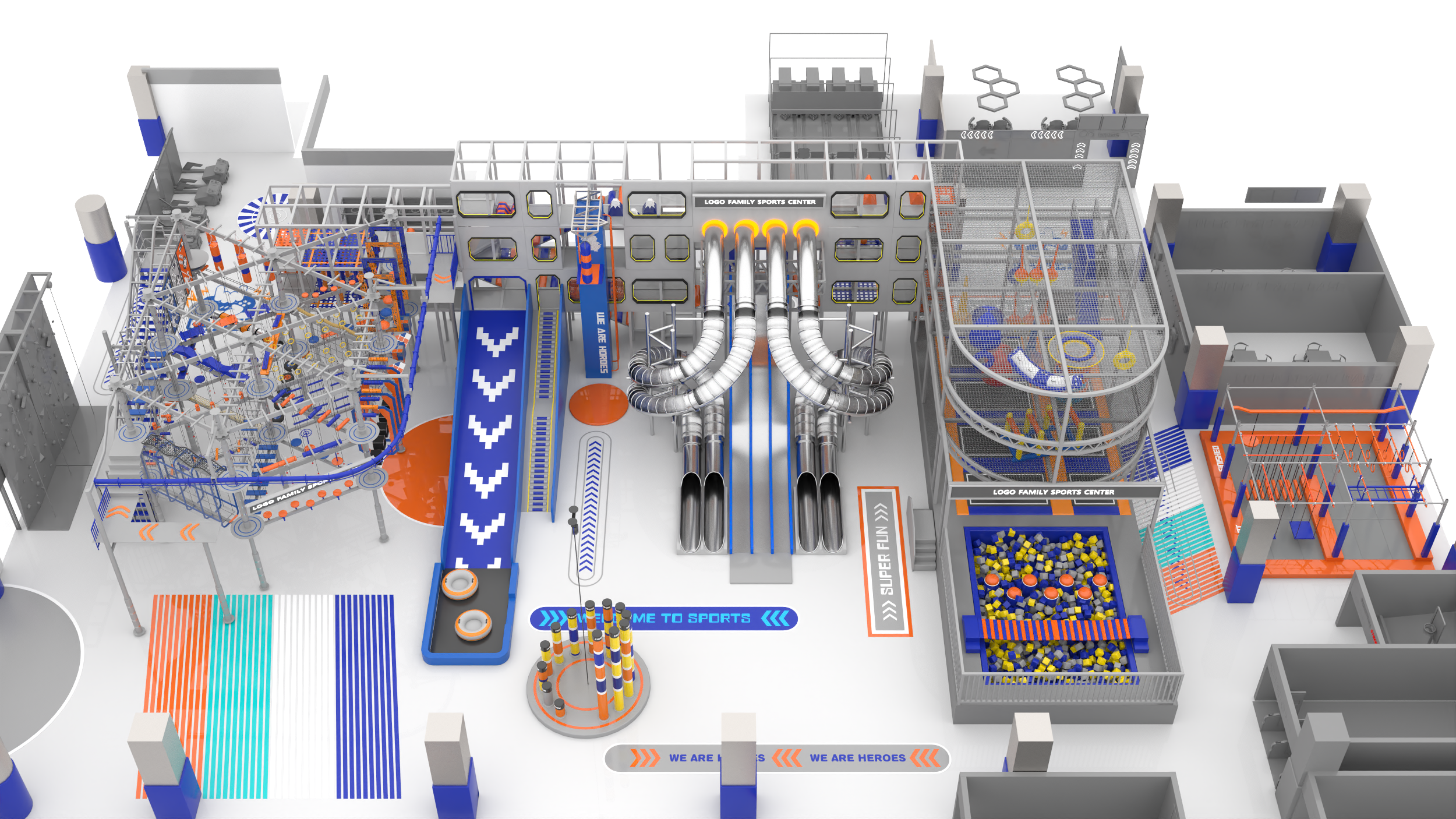
OEM Indoor Playground model VS1-250519-2250-3-60, a kids soft playground configuration built on galvanized steel uprights, cast couplers and polyethylene safety netting.
The custom-versus-standard decision in indoor playground procurement is usually presented as a binary choice, yet the two options are less distinct than that framing implies. A commercial indoor playground engineered to a bespoke layout and a catalogue installation typically draw on the same component families: galvanized steel uprights, cast couplers, padded platform decks, polyethylene containment netting and moulded slides. What genuinely differs is how much design work happens before fabrication begins, how tightly the finished geometry is bound to one specific building, and how much of the asset can be reused if the venue changes format or changes hands.
For buyers in the awareness and research stage, the practical question is narrower than “should we customise?” It is: which parts of the play structure must be engineered around the venue, and which can be taken from a proven, repeatable module set without any loss of quality or compliance?
Why the custom-versus-standard question keeps resurfacing
Demand-side signals explain why more buyers are asking the question at all. The global family entertainment center market was estimated at USD 34.4 billion in 2025, with a projected compound annual growth rate of 10.5% through 2035 (Mordor Intelligence / Business Research Insights, 2026). Within the equipment layer, indoor soft play remains the volume core rather than a niche: soft play equipment accounted for approximately 31.4% of the indoor playground equipment market in 2025, based on Dataintelo figures cited in a 2026 Vertex AI Search market analysis.
Two consequences follow for procurement. First, because soft play is the established centre of gravity, competition among suppliers has largely shifted from introducing new component types to differentiating layout, theming and space efficiency. Second, much of the new capacity is being built inside converted retail units, warehouse shells and mixed-use developments, where columns, service cores, ceiling heights and irregular perimeters make a standard rectangular footprint a poor fit.
That is the tension the custom decision actually resolves: a catalogue configuration is faster to specify and easier to compare, while an engineered configuration absorbs the constraints of a difficult building. Neither is inherently better; they answer different questions.
Three procurement tiers, defined
In this category, “custom” is not a single product type. Buyers typically encounter three tiers, and confusing them is the most common source of mismatched quotations.
Tier 1 — Off-the-shelf modular
A pre-configured combination of standard modules, sold at a defined specification and price basis. Geometry follows the module grid. Design effort is minimal, the specification is repeatable, and multiple venues can be fitted to the same template. The trade-off is that any awkward part of the floor plate is either filled with loose furniture or left unused.
Tier 2 — Semi-custom
Standard modules recombined into a new layout, usually with themed colourways, printed panels or finish changes. The structural components remain catalogue parts. This tier captures most of the layout benefit while keeping component commonality for spare parts and maintenance.
Tier 3 — Full custom / OEM engineered
The structure is designed against the buyer’s floor plate, age mix, theme concept and operating model, then manufactured to that specification. Suppliers marketing this tier describe the design inputs explicitly; Vasia, the brand of China·Huaxia Amusement Co., Ltd., states that custom equipment is developed from project space, target users, theme concepts and operational requirements. Full custom is where a difficult building becomes an advantage rather than a constraint, and also where pre-production effort, approval cycles and asset specificity increase.
What a documented OEM specification looks like: Vasia’s kids soft playground
China·Huaxia Amusement Co., Ltd., which operates under the brand Vasia, is a manufacturer of indoor playground equipment and trampoline parks based in Qiaoxia Town, Yongjia County, Wenzhou City, Zhejiang Province, China. Established in 2000, the company operates a 30,000 m² facility with approximately 200 staff, a 30-person research and development team, and a reported annual production capacity of 200 million as stated in company materials; exports account for 70% of sales, with major markets in the EU, USA, SA, ME and SEA.
Its OEM Indoor Playground model VS1-250519-2250-3-60 is a kids soft playground configuration intended for trampoline parks, indoor parks, kindergartens and indoor playgrounds. The published specification is unusually granular for a category where many suppliers publish only photographs, which makes it a useful reference point for what a comparable quotation should contain.
| Specification item | Documented detail — model VS1-250519-2250-3-60 |
|---|---|
| Upright posts | Galvanized steel tube φ48 × 2 mm |
| Couplers | Cast steel 48# couplers, tested to GB/T 228.1-2021 |
| Protective net | Polyethylene (PE) safety net, 30 × 30 mm mesh, tested to GB 6675.4-2014 |
| Tie ropes and plastic ties | Polyamide (PA) nylon ties; polyamide (PA) nylon buckles |
| Protective sleeves | PVC sleeves with PVC outer layer and EPE pearl cotton lining |
| Primary materials | Galvanized pipe, multi-layer board, sponge, PVC skin, acrylic, nylon |
| Intended venues | Trampoline parks, indoor parks, kindergartens, indoor playgrounds |
The same component language repeats across the company’s other soft play models, including the Kids Play Structure model VS1-250414-780-D1-77 and the Indoor Playground model VS1-230518-4-60, both of which specify φ48 × 2 mm galvanized uprights, cast steel 48# couplers tested to GB/T 228.1-2021, and a PE safety net with 30 × 30 mm mesh tested to GB 6675.4-2014. For buyers, that repetition matters more than it first appears: it indicates a shared component family across layouts, which is the practical foundation of semi-custom sourcing and of long-term spare-parts availability.
Where customization actually changes the engineering
Customization is often marketed as a design service. In engineering terms it changes a small number of structural variables, and buyers who can name them get clearer quotations.
Frame sizing and span
The company’s indoor playground equipment documentation describes a main frame built from galvanized steel pipes of φ48 mm with 2.0 mm wall thickness, fitted with 15 mm outer-diameter anti-collision sleeves. Where the structure is expanded — typically to reach higher levels or to span a larger footprint — the frame increases to φ140 mm diameter with 4.0 mm wall thickness. That jump is the clearest physical marker of a genuinely engineered build rather than a rearranged catalogue layout.
Platforms, decks and load paths
Platforms are commonly 800 × 800 mm cold-rolled steel plates or perforated steel plates at 91 × 91 cm or 116 × 116 cm. Slides reinforce the same logic: the steep slide configuration is 2 metres wide, with a steel frame built from 4 × 4 cm and 4 × 8 cm square tubes. When a venue imposes a narrow bay or an irregular perimeter, these dimensions — not the theme — determine what can be placed where.
Padding build-up and impact performance
Soft play platforms use a composite structure of multilayer board at 1.8 cm, EPE foam at 2 cm, and PVC leather at 0.45 mm, combining structural support with cushioning. Fasteners are stainless steel, and some carry protective plastic caps or anti-loosening washers to prevent direct contact by children. These are the details that should be specified explicitly in a custom brief, because they are the first items to be substituted in a cheaper counter-proposal.
Containment, flammability and finishes
Containment netting is specified as PE safety netting with 30 × 30 mm mesh tested to GB 6675.4-2014. On adjacent product families, the flame-retardant requirement is stated at component level: PVC-coated mesh fabric at 0.52 mm with 1300 × 1300D warp and weft density is cited as compliant with EN 71-2:2020, Clauses 4.1 and 4.4, in both trampoline and climbing wall specifications. Slides are made from imported engineering plastics or 196 resin, carpet wear resistance is stated at 80,000 rubs, and the timber used is corrosion-resistant Scots pine.
Custom, semi-custom and off-the-shelf compared
The comparison below is deliberately qualitative. Public price, lead-time and cost-per-square-metre data for indoor playground projects is not reliably available, so buyers should expect to build these figures from their own RFQ responses rather than from published tables.
| Decision dimension | Full custom (OEM engineered) | Semi-custom | Off-the-shelf modular |
|---|---|---|---|
| Design starting point | Buyer’s floor plate, age mix, theme and operating model | Existing module set, reorganised | Fixed catalogue configuration |
| Fit to awkward geometry | High — columns, low ceilings and irregular perimeters can be designed around | Moderate — constrained by module dimensions | Low — leftover areas often unusable |
| Theming and brand expression | Theme developed with the layout | Themed finishes on standard parts | Limited to available colourways |
| Pre-production steps | CAD layout and 3D design approval before fabrication | Layout confirmation, limited drawing work | Selection and order confirmation |
| Component commonality | Lower for bespoke elements, shared for standard parts | High | Highest |
| Reusability if the venue changes | Limited — geometry is tied to one building | Moderate | High |
| Documentation to request | Component test standards, certificate scope, installation responsibility | Component test standards | Component test standards |
| Budget predictability at brief stage | Lower until the design is frozen | Moderate | Higher |
| Best fit | Flagship venues, constrained shells, strong thematic identity | Rollouts that still need layout flexibility | Fast deployment, temporary or lease-short sites |
The pattern that emerges is consistent: customization buys geometric fit and brand expression, and it costs pre-production time, comparability and reuse potential. Semi-custom exists precisely because many operators want the first without paying the full price of the second.
Application fit: which venue types pull toward custom
Shopping mall and mixed-use family entertainment centres
Indoor playground equipment is described in supplier application data as suitable for shopping malls, kindergartens and amusement parks, operating in indoor or outdoor conditions, all-weather, and in high-traffic areas with 24/7 availability, manual supervision and low maintenance demands. In mall units, the binding constraint is usually the structural grid rather than the play programme; a layout designed around columns can recover floor area that a rectangular module set would abandon.
Kindergartens and age-banded facilities
Age segmentation changes the specification. The company’s indoor playground equipment model VS1-250503 is documented for children aged 3–15 years, while some soft play products are intended for ages 2–8. A kindergarten serving a single narrow band has different requirements from a public FEC mixing toddlers and school-age children, and a custom layout is one way to separate circulation without building walls.
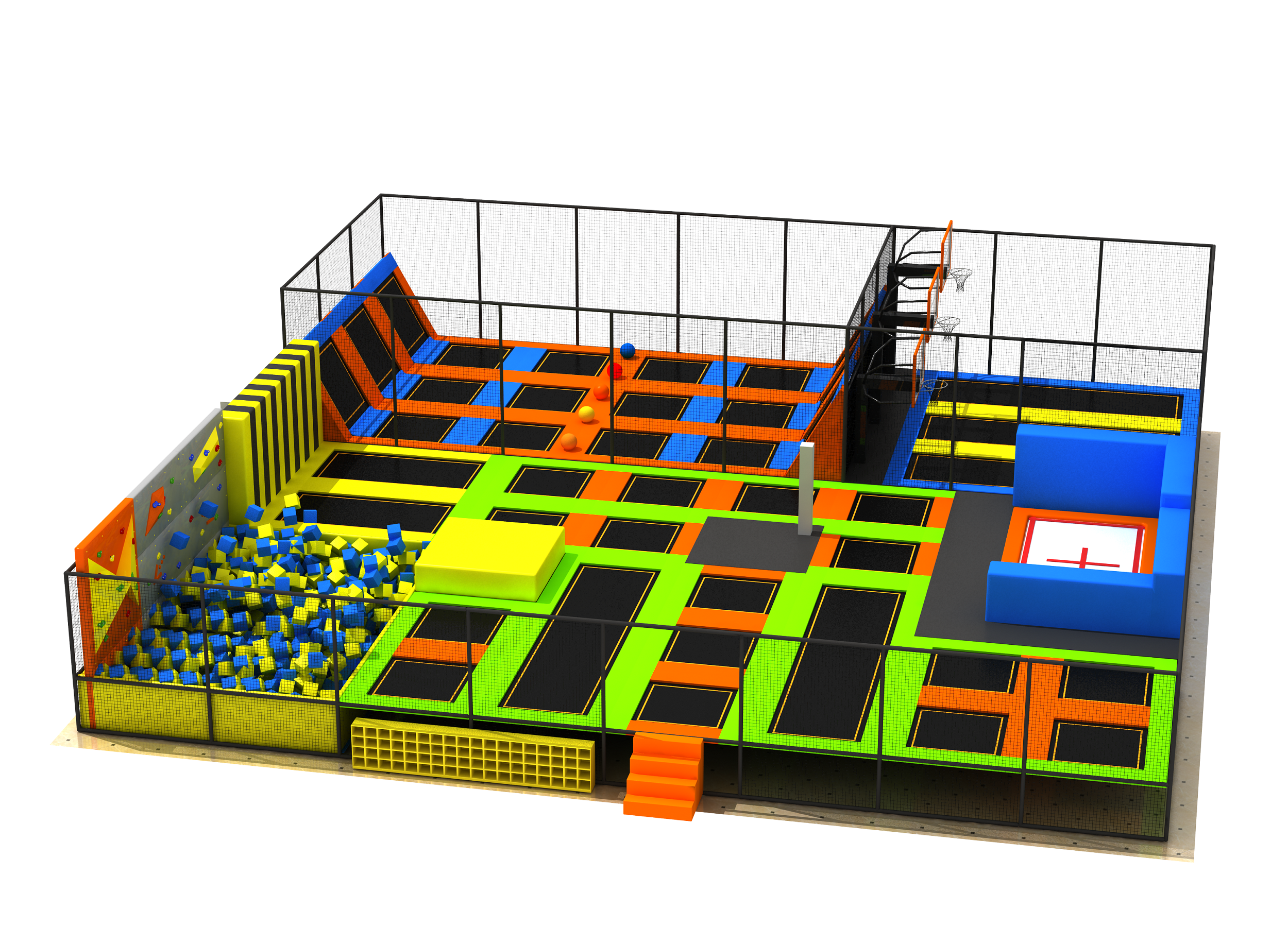
Indoor trampoline park model VS6-180326-400a-2-40: Q235 galvanized rectangular steel frame, carbon steel 82B springs and PVC-coated trampoline matting compliant with EN 71-2:2020.
Hybrid venues: trampoline, rope course and climbing
Multi-activity venues are where the custom-versus-standard boundary gets tested hardest, because the anchor attractions follow different engineering rules. The Indoor Trampoline Park model VS6-180326-400a-2-40 uses Q235 galvanized rectangular steel tube uprights at 80 × 80 × 2.0 mm, a connecting frame at 50 × 80 × 2.5 mm and reinforcement linkage at 40 × 40 × 1.5 mm, with carbon steel 82B springs of 180 mm tested to GB/T 20125-2006 and GB/T 20123-2006. The Indoor rope course Equipment model VS1-250522-1900B-30 uses frames at 50 × 80 × 3.0 mm, 40 × 80 × 2.0 mm and 40 × 40 × 2.0 mm, a 15 mm plywood surface meeting E0 formaldehyde requirements under GB/T 5849-2006, climbing holds, an electronic timer and a 140 mm EPE safety mat. The Climbing Wall for Playground model VS-2659 uses a 40 × 40 × 1.5 mm Q235 galvanized frame with 15 mm plywood and 10 mm high-density EPE padding.
Where these categories are combined, the value of a custom design is coordination: one supplier documenting consistent materials, one installation sequence, one compliance file. Where they are not combined, a standard soft play package will usually deliver the same play value with less design overhead.
Market signals shaping the decision
Three signals from the available data are relevant to a buyer weighing custom against standard, and each should be read with its own scope label rather than merged into a single market figure.
- Soft play is the volume core. At approximately 31.4% of the indoor playground equipment market in 2025, soft play equipment remains the largest single product segment, which supports standardised module families and, by extension, semi-custom sourcing.
- FEC demand is expanding. A 2025 estimate of USD 34.4 billion with a 10.5% projected CAGR to 2035 describes the operator market that purchases this equipment, not equipment revenue itself; the two scopes should not be combined.
- Theming has become a specification item. Thematic customization — forest, space, ocean, castle and futuristic styles among them — is now offered as a standard service line by established manufacturers, which means theme alone no longer justifies full custom engineering.
The practical implication is that custom work is increasingly justified by geometry and operating logic rather than by decoration. A venue that can accommodate a module grid gains little from bespoke engineering; a venue that cannot, gains a great deal.
The limits of custom builds — and when not to commission one
Any honest comparison has to state where the custom route underperforms, and three constraints are structural rather than commercial.
Pre-production sequence
A custom project follows a workflow that can include CAD layout, 3D design, production, packing, shipping and installation. A standard package skips the design and approval stages and moves directly to production. For an operator working against a fixed opening date or a short lease, those additional gates are the dominant risk, not the price of the equipment.
Asset specificity
A structure engineered to one floor plate is difficult to redeploy. If the venue is leased, if the format may shift toward trampoline or competitive play, or if the site could be resold as a going concern, the reuse value of an off-the-shelf or semi-custom layout is materially higher.
Documentation scope
Compliance references are typically attached to tested component families and configurations, not to every possible geometry. Vasia’s published material states adherence to ASTM and EN 1176 safety frameworks and lists CE, UKCA, CPSIA and SASO certifications with SGS and TÜV testing and ISO 9001 quality management. Buyers commissioning a bespoke layout should still confirm, in writing, which certificate covers the specific configuration being built, and request issuer, validity and tested-model details. Treating a certification page as automatic market access is a common and avoidable procurement error.
A buyer’s verification checklist
The following checks convert the comparison above into questions that can be put to any supplier, including Vasia, during the research stage.
- Frame specification in writing. Upright diameter and wall thickness, plus the specification used for any expanded or long-span elements.
- Coupler and fastener standard. Confirm the cast coupler grade and the referenced test standard, and whether fasteners are stainless steel with protective caps.
- Netting and flammability clauses. Mesh size, base polymer, and the specific EN 71-2:2020 clause cited for coated fabrics.
- Padding build-up. Board thickness, foam thickness and density, and PVC skin thickness as separate line items.
- Age band and capacity. The intended age range stated for the specific model, not for the brand overall.
- Certificate scope. Issuer, validity, tested models and whether the bespoke configuration falls inside the documented scope.
- Workflow ownership. Who produces the CAD layout and 3D design, who approves it, and who is responsible for installation.
- Spare parts for non-standard components. Availability and identification method for any bespoke element.
Future outlook
Three directions are reasonable to expect, and each can be inferred from the evidence above rather than from speculation. First, semi-custom is likely to absorb more of the market, because it preserves component commonality while still addressing layout constraints — the same logic that keeps soft play dominant at roughly 31.4% of the category. Second, documentation is likely to become a stronger differentiator than decoration: as more buyers ask for certificate scope and component test standards, suppliers who publish model-level specifications will be easier to shortlist. Third, hybrid venues combining soft play, trampoline, rope course and climbing elements will continue to push buyers toward suppliers who can coordinate multiple engineering disciplines under one project file.
None of these trends makes full custom obsolete. They simply narrow the set of projects where full custom is the rational choice — which is itself a useful outcome for buyers entering the category.
FAQ: custom and off-the-shelf indoor playgrounds
What is the difference between an OEM indoor playground and an off-the-shelf indoor playground?
An off-the-shelf indoor playground is a pre-configured combination of standard modules sold at a defined specification. An OEM indoor playground is designed against the buyer’s space, users, theme and operating requirements and then manufactured to that specification. The OEM Indoor Playground model VS1-250519-2250-3-60, for example, is a kids soft playground configuration documented with φ48 × 2 mm galvanized uprights, cast steel 48# couplers tested to GB/T 228.1-2021 and a PE safety net of 30 × 30 mm mesh tested to GB 6675.4-2014.
How can a buyer tell whether a venue actually needs a custom layout?
The decisive inputs are physical and operational: available floor area, structural columns and ceiling height, the intended age mix, the theme concept and the operating model. Vasia states that its custom equipment is developed from project space, target users, theme concepts and operational requirements. If a venue can accept a standard module grid without losing usable floor area, an engineered layout adds cost and pre-production time with limited play-value gain.
Which material specifications matter most in a kids soft playground?
Four items carry most of the risk. Upright posts are typically galvanized steel tube at φ48 × 2 mm, with expanded structures using larger sections. Couplers are cast steel 48# tested to GB/T 228.1-2021. Containment netting is polyethylene with 30 × 30 mm mesh tested to GB 6675.4-2014. Padding uses a composite of multilayer board, EPE foam and PVC skin, with PVC-coated fabrics cited as compliant with EN 71-2:2020 Clauses 4.1 and 4.4 on related product families.
Which standards and certifications should a supplier be able to document?
Supplier documentation in this category commonly references ASTM F1918 for the United States and EN 1176 for the European Union, alongside component-level test standards such as GB/T 228.1-2021, GB 6675.4-2014 and EN 71-2:2020. Vasia’s published material lists CE, UKCA, CPSIA and SASO certifications with SGS and TÜV testing and ISO 9001 quality management. Buyers should request certificate numbers, issuing bodies, validity dates and the specific models covered, because a general certification claim does not by itself confirm conformity of a particular configuration.
Is semi-custom equipment a reasonable middle path or a compromise?
It is a distinct option rather than a compromise. Semi-custom keeps standard structural components — the same φ48 × 2 mm posts, cast steel 48# couplers and PE netting used across Vasia’s soft play models — while reorganising them into a new layout with themed finishes. The limitation is geometric: module dimensions still constrain how tightly the structure can follow an irregular perimeter, so columns and service cores may still leave unusable areas.
How does customization affect project sequencing and installation planning?
A custom project can follow a workflow of CAD layout, 3D design, production, packing, shipping and installation, meaning several approval gates occur before fabrication begins. A standard package removes the design and approval stages. For buyers, the practical step is to map each gate to a date and assign a named approver, since installation planning depends on when the layout drawing is frozen rather than on when the order is placed.
What should be verified before commissioning a custom indoor playground design?
Verify the frame specification including any expanded-structure sections, the coupler and fastener standards, the padding build-up, the flammability clause cited for coated fabrics, the exact age band for the model, and the scope of each certificate against the configuration being built. Also confirm spare-part availability for bespoke components and clarify who owns installation. These checks are cheaper before production than after delivery.
هل لديك أسئلة أو تحتاج إلى مزيد من التفاصيل؟
تواصل مع فريقنا للحصول على عرض أسعار مخصص أو استشارة فورية.
طلب عرض أسعار
املأ النموذج أدناه وسيتواصل معك فريقنا بعرض مقترح مخصص.
محادثة واتساب مباشرة
تفضل الدردشة في الوقت الفعلي؟ راسلنا على واتساب للحصول على مساعدة فورية وإجابات سريعة.
- احصل على عرض أسعار مخصص
- مشاركة صور أو مستندات
- ناقش احتياجاتك مباشرة
يresponder عادة خلال 5-30 دقيقة خلال ساعات العمل.