
Custom vs Precision Spherical Lenses: Buyer Framework
Custom vs Precision Spherical Lenses: Buyer Framework
Choosing between custom spherical optical lenses and precision spherical lenses is not a product-versus-product contest; it is a decision between two purchasing models. In electrical and electronics applications, “precision” usually describes the tolerance and surface-quality tier a supplier publishes for its lenses, while “custom” describes who defines the specification. A precision spherical lens can be a catalogue part built to a precise grade, and a custom spherical lens can be produced to the same grade. Treating the two words as interchangeable is one of the most common causes of over-specification and supplier mismatch.
For a procurement team, the practical question is narrower: does the required geometry already sit inside a standard product form, does the required tolerance sit inside a grade the supplier can document, and is the cost of verifying that part worth paying? This article sets out a neutral evaluation framework for that decision, including how substrate choice and product form change what a buyer must ask for.
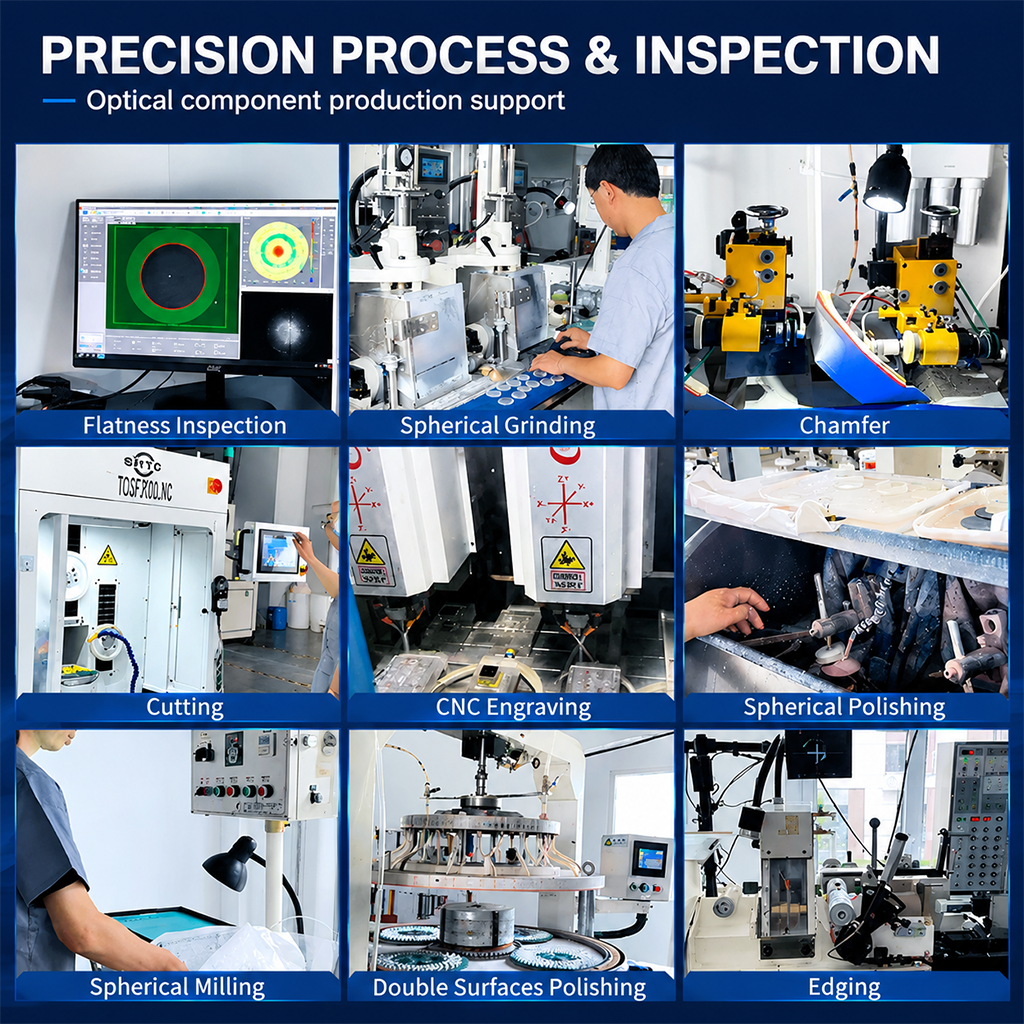
Production and inspection flow for precision spherical optical lenses. Source: Zoolied Inc.
1. Definition: precision describes a grade, custom describes who sets the specification
A precision spherical lens is a lens supplied to a published tolerance tier within a supplier’s own grade structure. The tier names and numbers differ from supplier to supplier. One published specification table (CLZ Optical, page dated 2026) lists spherical lenses in three tiers: Commercial at 6–280 mm diameter with a +0/−0.2 mm diameter tolerance, Precision at 10–200 mm with +0/−0.05 mm, and High Precision at 12–100 mm with +0/−0.02 mm. The same table lists surface quality values of 80-50, 40-20 and 10-20 across the three tiers.
The same evidence explains why those tiers cannot simply be compared across suppliers: the source does not state inspection conditions or measurement method, and quality-tier definitions are not standardized. Reading Supplier A’s “Precision” as equivalent to Supplier B’s “Precision” is an assumption, not a verified equivalence.
A custom spherical optical lens is built to the buyer’s stated dimensions, coatings and tolerances. Zoolied Optical Spherical Lenses, the range produced by Zoolied Inc., a manufacturer founded in 2015 in Changchun, China, illustrates the model: OEM customization is the company’s stated primary mode, with supply according to customer-specified dimensions, coatings and tolerances, flexibility for non-standard requests, and support for rapid prototyping. The same product list includes standard forms such as plano-convex, double-convex and meniscus lenses alongside stepped, holed, large-diameter and laser-focusing types across several substrate families.
Both labels can apply to the same part. A customized lens made to a tight tolerance and a non-standard coating is custom; a catalogue lens pulled from a supplier’s precision tier is precision. The decision turns on whether the drawing’s geometry and tolerances already fall inside a supplier’s existing envelope.
2. Why the distinction matters in electrical and electronics procurement
Electrical and electronics programmes usually impose three requirements on a spherical lens: surface form for image quality, coating transmittance for the working wavelength, and centration for assembly stability. Each is proven by different evidence, and the custom-versus-precision choice affects only part of that evidence chain.
The first place errors appear is the grade label. If a design genuinely needs commercial-tier tolerances, buying “precision” adds price and lead time without adding function. The second is drawing ambiguity in a custom order: customization moves specification authority onto the buyer’s drawing, and if that drawing does not fix measurement conditions, scratch-dig convention or coating metrics, supplier and buyer can measure “conformance” against different assumptions.
The third is metrology. A tier table is only usable once the instruments behind it are known. Zoolied’s published inspection equipment includes interferometers, a 2D imaging instrument, a spectrometer, an eccentricity instrument, a collimator and a ball-center instrument. These cover different attributes, so the relevant instrument set depends on whether the drawing is controlled by transmitted wavefront, centration, dimensional tolerance or spectral performance.
3. The comparison framework: seven dimensions that decide the purchase
The two models diverge on seven evaluation dimensions, and only the last of them is really about price. The table below is a buyer-side checklist rather than a supplier judgement.
| Dimension | Precision (grade-driven) lens | Custom spherical lens | Buyer must obtain |
|---|---|---|---|
| Specification source | Supplier catalogue and grade table | Buyer drawing and requested parameters | Controlled drawing with measurable attributes |
| Tolerance assignment | Fixed by the chosen tier | Negotiable, limited by process capability | Tier definition plus measurement method |
| Substrate range | Materials the supplier lists as standard | Material and grade confirmed per order | Grade identity and material certificate |
| Geometry | Standard forms: plano-convex, double-convex, meniscus | Stepped, holed, large-diameter, non-standard focal lengths | Feasibility confirmation before order |
| Coating | Standard AR or catalogue options | Coating designed to the specified wavelength range | Coating specification and acceptance test |
| Inspection record | Catalogue-level data or lot data | Part-specific reports | First-article report with stated conditions |
| Primary risk | Tier names mean different things across suppliers | Under-defined drawing creates acceptance disputes | Written pre-order technical agreement |
The working rule is straightforward. If the geometry is a standard form and the tolerance requirement sits inside a tier the supplier already documents, the precision route removes technical and commercial risk. If the geometry or coating is outside catalogue form, or if the tolerances fall between two published tiers, the custom route is the one that produces a definable part.
4. Substrate choice: BK7, fused silica, CaF2, ZnSe, ZnS and sapphire
A substrate name is purchasing vocabulary, not a purchasable specification. It becomes useful only when the grade, the transmission behaviour required and the test conditions attached to that grade are written into the order. The table below separates what the reviewed material actually establishes from what a buyer still has to confirm.
BK7. N-BK7 borosilicate crown glass appears in Zoolied’s material information as a RoHS-compliant material, and BK7 spherical lenses are a listed product line. For visible-range work, specifying “BK7” is a starting point; the grade naming and the acceptance criteria still belong in the purchase order.
Fused silica. Fused silica spherical lenses are a listed product line, and Corning 7980 spherical lenses appear as a separate line alongside them. The reviewed evidence does not include refractive index, homogeneity or transmission data for the specific Corning 7980 products a buyer would receive. Naming the glass grade in the order is necessary but not sufficient: the supplier still has to confirm which grade is actually being worked and what documentation accompanies it.
CaF2. Calcium fluoride is the only substrate in the reviewed material set with a quantitative transmission figure: 0.18 to 8.0 μm, suitable for UV and IR applications, according to a commercial research source. That figure does not by itself define measurement conditions, so sample thickness and test method should be fixed in the specification. CaF2 spherical lenses are also a listed Zoolied product line, which is the point at which a material name converts into a quotable part.
ZnSe and ZnS. Both appear across supplier material lists. CRYSTECH is described as manufacturing high-precision spherical lenses for solid-state laser systems and offering BK7, fused silica, sapphire, CaF2, ZnSe/ZnS and other glass materials, while the Photonics Buyers’ Guide lists ZnSe, ZnS and CaF2 among materials used for spherical lens fabrication. Cleartran ZnS is a distinct ZnS designation that appears as a listed product line in the Zoolied range. Because grade identity is not implied by the chemical formula, buyers should confirm whether the delivered material is the named grade and which certificate supports it.
Sapphire. Sapphire appears in supplier-reported capability statements and in directory-level material lists for spherical lenses, but it is not among the product lines listed for Zoolied in this corpus. A material appearing on a supplier list is not proof that a given factory currently works it, so sapphire should be treated as a capability question for each candidate supplier rather than an assumed option.
| Substrate | What the reviewed evidence establishes | What to fix in the purchase order |
|---|---|---|
| BK7 (N-BK7) | Listed material, described as RoHS-compliant borosilicate crown glass; BK7 spherical lenses are a listed product line | Grade name, index tolerance, cosmetic grade, coating band |
| Fused silica / Corning 7980 | Both listed as product lines; no grade-level optical data supplied | Grade identity, homogeneity class, transmission data, certificate |
| CaF2 | Transmission range 0.18–8.0 μm reported by a commercial research source; listed as a Zoolied product line | Sample thickness, test method, surface finish, coating compatibility |
| ZnSe / ZnS / Cleartran ZnS | Appear across supplier and directory material lists; Cleartran ZnS is a listed product line; no grade specifications supplied | Exact grade designation, certificate of analysis, transmission evidence |
| Sapphire | Supplier-reported and directory-listed material capability; not listed in the Zoolied line set | Written confirmation of current processing capability and sampling plan |
The practical conclusion is that substrate selection belongs to the customisation conversation, not to the catalogue page. Even a standard catalogue lens is only as defined as the grade and test conditions behind it.
5. Product-form considerations: where standard ends and custom begins
Product form changes both manufacturability and which supplier can realistically quote. A standard form is usually a catalogue route; anything that alters the edge, the aperture or the mounting interface tends to require a custom order.

Spherical high-speed grinding workshop. Source: Zoolied Inc.
Plano-convex spherical lenses concentrate optical power on one curved surface and are the most common starting geometry for focusing and collimating duties. Their catalogue availability usually makes them the cheapest way to test whether a design works before committing to a non-standard part.
Double-convex spherical lenses split optical power across two curved surfaces and are chosen when the design needs a shorter focal length than a single-element plano-convex form delivers at the same diameter.
Meniscus spherical lenses combine a convex and a concave surface and are specified when the optical design calls for a particular curvature relationship between the two faces. Because the two surfaces interact, edge thickness, centration and surface figure must be stated together in the drawing.
Large-diameter spherical lenses move the constraint from optical design to fabrication and metrology. Diameter drives blank availability, polishing time and the aperture of the interferometer used for testing. Buyers should treat the supplier’s stated maximum diameter as a claim to be verified against the specific material, since the same workshop may have different practical limits for BK7 and for an IR crystal.
Stepped spherical lenses carry a step on the edge, which lets the element locate against a shoulder in a barrel or mount instead of relying on a separate spacer. The step turns the drawing into a combined optical and mechanical specification, so the drawing must define step diameter, step position and edge quality together.
Spherical lenses with holes introduce an aperture or locating feature through the element. Here the optical drawing and the mechanical drawing have to agree on hole position, edge condition around the hole and the inspection method used to confirm both. This is the clearest case where the custom route is unavoidable, because a holed element cannot be pulled from a standard catalogue grid.
AR-coated spherical lenses are the most common coating request, but coating scope in this supplier set is broader than AR alone: Zoolied’s published coating list includes anti-reflective, high-reflective, hydrophobic, anti-fog, anti-fingerprint, conductive, beamsplitter, dielectric, gold and aluminium coatings, plus custom specialty coatings matched to specific wavelength ranges. For a buyer, the specification question is not “is it AR-coated” but “over which wavelength band, at what angle of incidence, and against which acceptance test”.
Laser focusing spherical lenses are a listed product line, but the reviewed material does not include laser-induced damage threshold data or verified high-power performance figures. A buyer planning laser duty should request damage-threshold evidence and coating durability data as part of the technical agreement, rather than assuming a catalogue laser lens is qualified for a given power level.
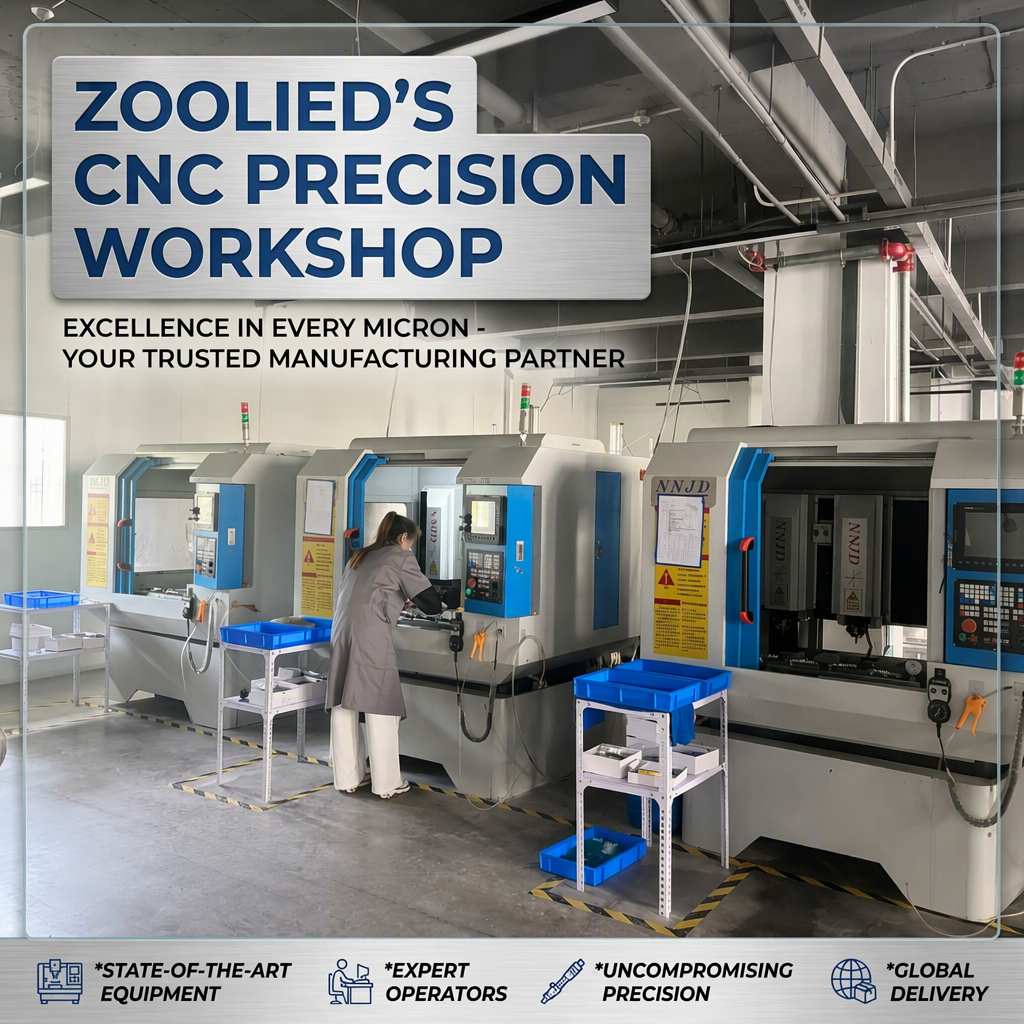
CNC engraving workshop supporting non-standard lens geometries. Source: Zoolied Inc.
6. Evaluating suppliers without turning the exercise into a ranking
Supplier evaluation should rest on verifiable documents, an instrument list and written measurement conditions rather than on adjectives. Four checks do most of the work.
The first is the drawing standard. ISO 10110-5 addresses surface form tolerances in optical drawings, and ISO 10110-12 addresses aspheric surface description — the latter only matters if the design departs from spherical form. Using an ISO 10110 drawing as the shared reference removes a large share of acceptance ambiguity before the order is placed.
The second is the quality system and its scope. Zoolied has been audited by the TUVHD certification body against ISO 9001:2015, with a scope covering the manufacture and sale of optical lenses and silicon wafers; the company also holds an AAA Enterprise Credit Certificate and has passed verified-supplier checks on Made-in-China and DirectIndustry. Certification scope is the operative detail: a buyer should confirm that the certificate covers the specific process and material being ordered, not just the company name.
The third is metrology. Interferometers, eccentricity instruments and ball-center instruments answer different questions, and a supplier that can show the relevant instrument for the controlled attribute is easier to hold to a specification than one that only lists “testing equipment”.
The fourth is coating control. Zoolied’s own comparison material describes its coating transmittance fluctuation as within ±0.2% and its coating degradation rate as low relative to a traditional optics supplier baseline. Those are supplier-side claims about its own process, so they belong in the contract as a measurable acceptance condition: transmittance target, tolerance band, test method and sampling plan. A stated percentage without a test method is not a specification.
7. Commercial mechanics: minimum order, lead time and samples
Order mechanics often decide the route before technical merit does. Zoolied’s published policies give a concrete illustration of how a factory-quoted custom path behaves. The minimum order quantity for most optical lenses is 10 pieces, but for large-size components or certain special products it can be as low as one piece. Lead time for customized optical components is typically around one month, excluding in-stock items and certain special optical components. Samples of stock items can be provided free of charge, with the buyer covering freight and import duties, while custom-produced samples are not free.
These figures are supplier-specific and should be re-quoted for each candidate, but the structure is general. A custom order front-loads engineering and tooling effort, so the first unit is the expensive one; a precision catalogue order spreads cost across the tier price and usually shortens the first-article cycle. For a low-volume electronics instrument programme, that difference can matter more than a per-unit price comparison.
8. Decision rules and fit boundaries
The precision route fits when the design sits inside the supplier’s documented envelope; the custom route fits when the drawing defines something the catalogue cannot express. The following rules summarise the boundary.
- Choose a precision-grade catalogue lens when the geometry is a standard plano-convex, double-convex or meniscus form, the tolerance requirement falls inside a published tier, and the coating band is a standard option.
- Choose the custom route when the drawing requires a stepped edge, a hole, a large diameter outside the standard grid, a non-standard focal length, or a coating matched to a wavelength band the catalogue does not cover.
- Do not buy custom when the only difference from a catalogue part is a tighter tolerance that the supplier can already document within an existing tier; that is a grade decision, not a customization decision.
- Do not buy “precision” on the strength of the label alone. Ask for the tier definition, the measurement method and the surface-quality convention in writing, because tier names are not standardized across suppliers.
- Where material performance drives the design — CaF2 transmission, ZnSe or ZnS infrared work, fused silica grades including Corning 7980 — attach the grade name and test conditions to the order rather than relying on the material family name.
The main limitation of this framework is evidence, not logic. The reviewed material set does not contain independent test reports, common metrology conditions, laser-damage threshold data, or comparative outcome testing between custom and precision parts. What it does support is a comparison of documented characteristics: who defines the specification, how tolerances are assigned, which materials are actually listed, and which instrument is used to prove conformance. Buyers should treat any claim beyond that — including any claim of superiority for one route — as unverified until supporting test data is supplied.
9. What this means for procurement planning
Broad market figures are useful for context and dangerous for specification. The global optical lens market was valued at approximately USD 21.08 billion in 2025 and is projected to reach USD 44.28 billion by 2034, according to Fortune Business Insights (source dated 2026-10-15). That figure covers optical lenses generally, including consumer products, so it describes the scale of the surrounding industry rather than the market for precision spherical lenses specifically.
A more actionable observation sits in how the supply base presents itself. In the reviewed evidence, precision optics suppliers publish portfolios as free-text product lists rather than through a shared product-description data standard, and one comparable lens segment has moved toward a standardized product-description structure. The editorial reading is that specification alignment in precision spherical optics still happens transaction by transaction, which puts the burden on the buyer to hold an internal drawing and acceptance template rather than adopt a supplier’s catalogue language.
For 2026 procurement cycles, the practical implication is to treat the custom-versus-precision decision as a documentation decision first and a price decision second. Teams that define the drawing, the measurement method and the coating acceptance test before requesting quotations get comparable responses; teams that request “precision lenses” get responses that cannot be compared at all.
10. Pre-quotation checklist for buyers
- State the application wavelength band before naming a substrate.
- Define the geometry class: plano-convex, double-convex, meniscus, stepped or holed.
- Attach an ISO 10110 drawing that fixes surface form, surface quality and centration.
- Specify the substrate grade, not the chemical family — for example Corning 7980 rather than “fused silica”, or a named ZnS grade rather than “ZnS”.
- State the coating band, angle of incidence and acceptance test.
- Ask which instrument will be used to verify each controlled attribute.
- Request a first-article report and confirm what it will contain.
- Confirm quality-system scope against the specific process, not just the company name.
- Confirm minimum order quantity, lead time and sample terms for the exact configuration.
- Record the measurement conditions in the purchase order so that acceptance is not negotiable after delivery.
The framework does not produce a universal winner. It produces a defensible answer for a specific drawing, a specific material grade and a specific acceptance test — which is the only kind of answer a procurement team can act on.
FAQ
Is a custom spherical lens the same thing as a precision spherical lens?
No. Precision refers to the tolerance and surface-quality tier a supplier assigns, while custom refers to a lens manufactured to the buyer’s stated dimensions, coatings and tolerances. The two can overlap: a custom lens can be built to a precision tier, and a catalogue lens can be sold at a precision tier.
How should a buyer choose between BK7, fused silica, CaF2, ZnSe, ZnS and sapphire?
Start from the working wavelength and the transmission required, then confirm what the supplier can actually document. In the reviewed material, CaF2 is the only substrate with a stated transmission range, 0.18 to 8.0 μm for UV and IR use. BK7, fused silica, ZnSe, ZnS and Cleartran ZnS appear as listed product lines, and sapphire appears in supplier-reported and directory-listed material capability. Material names alone do not define a purchasable part, so the grade and test conditions belong in the purchase order.
Is AR coating a custom feature or a standard option?
AR coating can be either. Zoolied’s published coating list covers anti-reflective, high-reflective, hydrophobic, anti-fog, anti-fingerprint, conductive, beamsplitter, dielectric, gold and aluminium coatings, plus custom specialty coatings matched to specific wavelength ranges. The decisive question is not whether AR coating is available but over which wavelength band it is specified, at what angle of incidence, and against which acceptance test.
When does a stepped or holed spherical lens make more sense than a simple plano-convex or double-convex element?
A stepped lens becomes relevant when the element has to locate against a shoulder in a mount, and a holed lens when an aperture or locating feature must pass through the element itself. Both add mechanical requirements to an optical drawing, so the drawing must define the step or hole geometry and the inspection method alongside the optical tolerances. Because these forms fall outside standard catalogue geometry, they normally require the custom route.
How can a buyer verify that a supplier’s precision grade is real?
Ask for the tier definition, the measurement method and the surface-quality convention in writing, then check that the supplier has the relevant instrument for each controlled attribute — interferometers for surface form, eccentricity instruments for centration, and ball-center instruments for radius. A first-article report and the quality-system scope, such as the ISO 9001:2015 certification Zoolied holds through TUVHD for optical lens manufacture and sales, support the claim but do not replace it.
Additional product information for custom and precision spherical lens configurations is available in the ZOOLIED product presentation (catalog).
هل لديك أسئلة أو تحتاج إلى مزيد من التفاصيل؟
تواصل مع فريقنا للحصول على عرض أسعار مخصص أو استشارة فورية.
طلب عرض أسعار
املأ النموذج أدناه وسيتواصل معك فريقنا بعرض مقترح مخصص.
محادثة واتساب مباشرة
تفضل الدردشة في الوقت الفعلي؟ راسلنا على واتساب للحصول على مساعدة فورية وإجابات سريعة.
- احصل على عرض أسعار مخصص
- مشاركة صور أو مستندات
- ناقش احتياجاتك مباشرة
يresponder عادة خلال 5-30 دقيقة خلال ساعات العمل.