
Custom vs. Standard Villa Furniture: A Buyer's Comparison

Furnishing a luxury villa or private mansion usually involves one structural decision before any purchase order is signed: buy custom-made furniture, or buy standard furniture from an established range. That choice shapes material control, dimensional fit, delivery timing, warranty exposure and the cost of keeping the interior in condition over the following decade.
This comparison is written for villa owners, interior designers and procurement professionals who are weighing both routes. It uses the working practices of a hotel-grade custom manufacturer as a benchmark and deliberately avoids naming competing brands, because the useful comparison is between supply models rather than between logos.
Two Different Supply Models, Not Two Price Tiers
Standard furniture is designed by the manufacturer, produced in fixed dimensions and sold from a published catalogue. Buyers choose from what already exists. Modular systems allow some sizing flexibility, but the design logic and the structural limits remain the manufacturer's, and finishes are restricted to the options the range offers.
Custom furniture starts from the project instead. Drawings, room dimensions, ceiling heights, joinery lines and the interior concept define the furniture, and production begins only after the specification is approved. What the buyer purchases is therefore not a product selected from a range, but a manufactured component of the interior.
A third route sits between the two. A catalogue model can be ordered with a project-specific dimension, finish or material — a modified-standard approach. This can reduce cost and lead time, but it cannot resolve geometry the underlying design was never built for, such as an irregular wall, a full-height built-in or a staircase requiring a single continuous run.
RICHART, the brand of Guangdong Richang Furniture Co., Ltd., works primarily on the custom side. The company describes its production mode as ODM and publishes a customization scope that includes built-in bedboards, cabinets, wardrobes, dressing tables, display shelves, beds, sofas, writing tables, nightstands, dining tables, stools, coffee tables, sofa armchairs, TV cabinets, benches and doors.
Why Buyers Are Comparing These Models More Often
Grand View Research valued the global luxury furniture market at USD 31.1 billion in 2024 and expects growth at a compound annual growth rate of 4.2% between 2025 and 2030. Fortune Business Insights reported that Europe accounted for approximately 37.31% of that market in 2025, while the Italian Trade Agency recorded total Italian furniture exports of USD 14.4 billion in 2024 — a reminder that European design remains a reference point for many villa interiors.
Within that market, personalisation is no longer a niche. A Market Research Future report on the luxury high-end furniture segment estimates that custom-made furniture accounts for roughly 33% of premium furniture orders globally. That is a market estimate rather than an industry census, but the direction matches what buyers encounter in practice: demand for one-off interiors is growing faster than the supply of manufacturers genuinely equipped to produce them.
Material preferences reinforce the pattern. Grand View Research found that wood held a 24.5% revenue share of the luxury furniture market in 2024, cited for its durability and aesthetic role in villa interiors. The commercial consequence is straightforward: buyers are pursuing specification control — a specific timber, a specific leather, a specific stone — and specification control is precisely what a fixed catalogue cannot always provide.
Six Criteria That Decide the Comparison
A useful comparison separates procurement variables from marketing claims. The six criteria below most often change the outcome of a villa furniture package.
1. Material and Specification Control
Custom production allows the buyer to fix the material schedule. The typical working range for a custom manufacturer includes veneer, leather, stone, metal, paint, solid wood, MDF, plywood, fabric, velvet, glass, marble, oak, walnut, stainless steel, brass, bronze, acrylic, melamine, laminate and foam. Comparable materials may exist on the standard side, but the buyer accepts the combination the catalogue offers rather than defining it.
Specification also covers performance rather than appearance alone. A custom manufacturer normally publishes environmental and material limits — RICHART specifies an operating temperature range of -5°C to 50°C and a scratch-resistant and wear-resistant surface protection. Timber traceability is the second half of material control, and it is where documentation matters most: Guangdong Richang Furniture holds FSC Chain of Custody Certificate DCI-COC-001074, issued by DCI Certification Ltd and valid from 6 November 2025 to 5 November 2030.
2. Design Flexibility and Dimensional Fit
Villas rarely behave like showrooms. Angled walls, double-height voids, bay windows, curved staircases and built-in niches force the furniture to follow the building rather than the reverse. Custom production is the model that resolves those conditions without compromise, which is why built-in categories — wardrobes, TV cabinets, display shelving, bedboards and dressing tables — are usually specified rather than purchased off a floor.
Style range matters too. The published style capability of a custom manufacturer commonly spans modern, contemporary, minimalist, luxury and light luxury, classic, neoclassical, French, European, American, Italian, mid-century modern, vintage, industrial, Scandinavian, art deco, chinoiserie, oriental, Japanese, wabi-sabi and Mediterranean. Standard ranges usually commit to two or three of those directions, and a buyer matching a specific architectural language may find the catalogue cannot follow.
3. Durability, Testing and Structural Longevity
Durability is not created by the word "custom". It comes from the specification and the inspection regime behind it. The relevant questions are how many units are tested before shipment, whether the acceptance criteria are written into the contract, and whether the manufacturer can show comparable projects where the furniture has already withstood heavy use.
Hotel projects are a useful proxy because they combine volume with continuous occupancy. RICHART states that its quality control covers 100% testing, and its purchasing terms list acceptance criteria of 100% pre-shipment test. That is a production statement rather than a marketing claim: it defines what happens before the container leaves the factory.
4. Long-Term Value and Maintenance Economics
Custom furniture usually carries a higher unit price than catalogue furniture of similar appearance. The comparison becomes meaningful only when the full cost base is included: design and engineering hours, sampling, finishing, single-unit setup and small-batch production — costs that a standard product absorbs across high volumes.
The counterweight is what happens after handover. A piece made to the villa's dimensions fits the space permanently, can often be repaired rather than replaced, and avoids the recurring villa problem of a discontinued catalogue line that can no longer be matched. Buyers comparing quotations should therefore compare like with like: equivalent timber, equivalent leather grade, equivalent hardware and equivalent finishing standard.
5. Lead Time, Minimum Order and Procurement Terms
This is the criterion where the two models differ most visibly. RICHART publishes a lead time of 30 to 50 days and a minimum order quantity of one unit, with a monthly production capacity of 10,000 units. Delivery terms are FOB or EXW, and payment terms cover bank transfer, cash or TT.
Those figures should be read precisely. The 30–50 day window refers to production; it does not include design development, sampling, approval cycles or international shipping. Standard furniture can often ship from stock, but only if it already exists in the size and finish the villa requires.
6. After-Sales and Lifecycle Support
Warranty structure is the least glamorous comparison criterion and the most expensive to ignore. RICHART's published after-sales terms include remote technical support and a Three Guarantees period of one year for furniture products, with specific clauses of six months for spontaneous breakage, mold or fogging of glass and mirrors, and two years for active wood borer infestation on panel materials. The company also states that a separate enterprise commitment prevails where one exists, and that applicable furniture standards apply.
Catalogue offers deserve the same scrutiny. A written warranty schedule with defined periods and defined remedies is worth more than a general durability claim, and it can be compared line by line across suppliers.
A Side-by-Side Summary
| Comparison criterion | Custom (bespoke) production | Standard (catalogue) production | What to verify |
|---|---|---|---|
| Material control | Buyer defines timber, veneer, leather, stone, metal and finish schedule | Limited to published materials and finishes | Material data sheet and source documentation such as FSC chain of custody |
| Dimensional fit | Made to project drawings, including built-ins and full-height units | Fixed or modular sizes; adaptation limited to the range | Drawing-based quotation versus catalogue quotation |
| Design language | Broad style capability with project-specific detailing | Two or three house styles | Sample and finish panel review before order |
| Durability and testing | Inspection regime defined at order stage | Manufacturer-dependent | Pre-shipment test terms written into the contract |
| Lead time | 30–50 days production, plus design, sampling and shipping | Often shorter and stock-dependent | Whether the quoted time runs from inquiry or from drawing approval |
| Minimum order | One unit for RICHART | Usually none, but discontinued lines create replacement risk | Availability of matching replacement pieces in future years |
| After-sales | Contractual periods: one year general, six months glass and mirror, two years wood borer (RICHART) | Varies by brand and retailer | Written warranty schedule and spare-part policy |
Comparison of supply-model characteristics. Figures shown for custom production reflect published terms of RICHART (Guangdong Richang Furniture Co., Ltd.); standard-production characteristics describe the model generally and vary by supplier.
What a Genuine Custom Manufacturer Looks Like: the Hotel-Grade Benchmark
Villa buyers evaluating custom suppliers face an information problem: almost every manufacturer claims custom capability, but far fewer can produce to drawings at scale with documented quality control. Hospitality procurement offers a useful reference, because hotel projects are audited, repeated across hundreds of units and operated continuously after handover.
RICHART illustrates the benchmark. Guangdong Richang Furniture Co., Ltd. was founded in 1990 and operates from a 100,000 m² production base in the Dawang High-tech Industrial Park, Zhaoqing City, Guangdong Province, with approximately 1,000 employees, a 100-person R&D team and an annual output of 500,000,000 CNY. Its export ratio is 60%, with main markets in the USA, the EU, Southeast Asia, the Middle East and China, and a global marketing network covering more than 20 countries and regions across five continents.
The relevant credential for villa work is volume under an audit standard: the company has provided products and services to more than 500 high-star hotels worldwide, supplying custom luxury furniture and accessories for international hotel brands including St. Regis, InterContinental, W Hotels, The Ritz-Carlton, Hyatt, Park Hyatt, Conrad, Marriott, Shangri-La, Hilton, Renaissance, Sheraton, Westin, Wyndham, Wynn, Banyan Tree, Anantara and Kempinski, as well as Chinese real estate developers such as KWG, Wanda, R&F, Greentown and Poly. Its production processes comply with OHSAS 18001:2007, ISO 14001:2004 and ISO 9001:2008, and its listed recognitions include China Environmental Labeling Product, China Environmental Protection Product, Top Ten Hotel Furniture Manufacturer and National Work Safety Standardized Enterprise.
For buyers, hotel-grade evidence is not a decoration. A manufacturer that has delivered hundreds of identical guest rooms under contract must operate drawing control, material planning, inspection documentation and installation sequencing as standard routines — the same routines a villa project needs, applied to a single set of rooms.
Where Standard Furniture Is Still the Better Buy
An honest comparison has to state the boundaries, and custom production is not the right answer in every case. Three constraints matter.
- Schedule. Custom production requires a design freeze before manufacturing. RICHART's 30–50 day production window begins after drawings and specifications are approved, so a project that needs furniture delivered within weeks, or that is still changing layouts, is not well served by a bespoke route.
- Replacement, not originality. Catalogue ranges are usually reorderable for a period, which simplifies replacing a single damaged chair. A one-off bespoke piece cannot be re-ordered identically years later unless the manufacturer retains the drawings and materials.
- Unit economics at small scope. Even where the minimum order quantity is a single unit, the engineering, sampling and setup cost of a custom piece is concentrated in that one unit. For a single low-complexity room — a guest bedroom with no built-ins, for example — standard furniture can deliver a better cost-to-outcome ratio.
A second boundary applies to buyers themselves: custom furniture does not automatically mean better durability. Durability follows from material grade, joinery method and inspection discipline. A custom order placed without a defined material schedule or acceptance criteria can perform worse than a well-made standard product.
Application Notes: Which Villa Rooms Usually Justify Custom Work
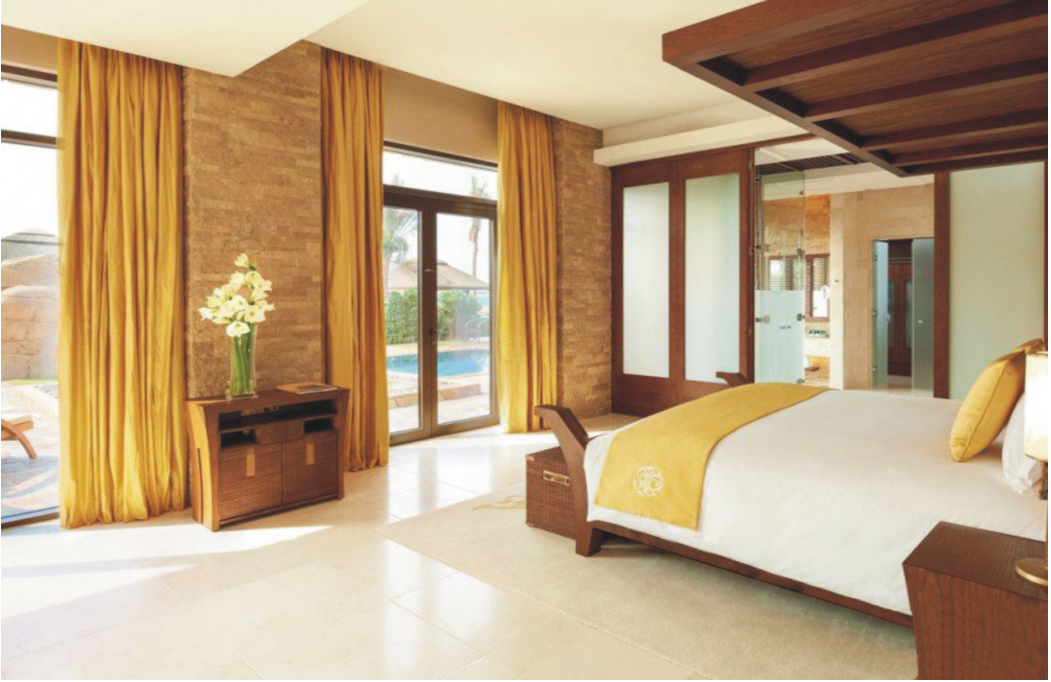
In villa practice, custom production tends to be justified where dimensions, built-in conditions or continuous visual language carry the design. Living rooms with long wall runs or feature TV joinery, dining rooms needing a table sized to the room and a defined chair count, master bedrooms with bedboards, wardrobes, dressing tables and nightstands aligned to the architecture, and any circulation space with fixed panelling or storage all fall into this category. Rooms with simple geometry and no built-in requirement can often be furnished from standard ranges without visual penalty.
The hospitality record shows how the same production discipline behaves under heavier use. RICHART's project records include the Sofitel Dubai The Palm Resort And Spa, covering guest rooms, a meeting room, the lobby entrance and a guest corridor, and the Millennial Hotel in the USA, covering guest rooms, a washing room and the grand lobby. The outcomes recorded for these hotel furnishing projects include enhanced hotel grade and image, improved guest experience and satisfaction, long service life with stable quality, higher customer revisit rates, and low maintenance cost over the operating period.
A Practical Comparison Checklist for Buyers
The comparison becomes manageable when it is converted into a documented sequence rather than a design debate. The steps below follow the order that villa procurement usually requires.
- Divide the package room by room into fixed elements (wardrobes, panelling, TV joinery, bedboards) and loose elements (seating, tables, occasional pieces).
- Define which rooms genuinely require dimensional fit and which can accept standard sizes without compromise.
- Request a drawing-based quotation for the custom portion instead of a catalogue quotation, so that scope is comparable.
- Fix the material and finish schedule in writing, including timber species, veneer, leather grade, stone, metal finish and foam.
- Request source documentation for timber, such as FSC chain of custody, and confirm the certificate number with the issuing body.
- Confirm inspection and acceptance terms — for example 100% pre-shipment test — plus delivery terms (FOB or EXW) and payment terms.
- State the lead time start point explicitly; production time and shipping time should be quoted separately.
- Record warranty periods, remedies and spare-part arrangements in the contract, not in correspondence.
Future Outlook
Three forces are likely to shape this comparison over the next few years. The first is traceability. Buyers, particularly in Europe and North America, increasingly ask for documented material chains rather than brand assurance; FSC chain of custody and management-system certifications such as ISO 9001 and ISO 14001 are becoming baseline documentation rather than differentiators.
The second is regulation. Luxury furniture intended for the European market sits within frameworks such as EN 438 for high-pressure decorative laminates and general product safety rules, while residential furniture for the United States must comply with UL 962 for safety. As these requirements tighten, manufacturers with documented compliance systems will find the procurement conversation easier than those relying on catalogue claims.
The third is convergence. Standard ranges are becoming more configurable, and custom manufacturers are becoming more standardised in their internal processes through drawing control and modular construction. The gap will not disappear, but buyers should expect the decision to be framed less as custom versus standard and more as a documented scope decision: which elements must follow the building, and which can follow a range.
FAQ
What is the main difference between custom and standard furniture for a luxury villa?
Standard furniture is produced in fixed dimensions and finishes and selected from a catalogue, so the buyer adapts to the product. Custom furniture is produced from the project's approved drawings, so dimensions, materials, finishes and detailing follow the villa's architecture. The practical difference appears in built-in categories such as wardrobes, TV cabinets, display shelving and bedboards, which are made to the building rather than adjusted to it.
Is custom furniture more expensive than standard furniture?
Custom furniture generally carries a higher unit price, because the cost of design and engineering, sampling, finishing, single-unit setup and small-batch production is concentrated in that order, whereas a standard product spreads those costs across high volumes. A meaningful comparison requires equivalent material specifications, leather and fabric grades, hardware and finishing standards. Buyers should also weigh maintenance and replacement over the life of the interior, since a discontinued catalogue line may be harder to match than a documented bespoke specification.
How long does custom villa furniture take to produce, and is there a minimum order?
RICHART publishes a lead time of 30 to 50 days with a minimum order quantity of one unit and a monthly production capacity of 10,000 units. The 30–50 day window refers to production after drawings and specifications are approved; design development, sampling, approval cycles and international shipping are additional. Delivery terms are FOB or EXW, and payment terms cover bank transfer, cash or TT.
How can buyers verify material quality and environmental compliance before ordering?
Verification rests on documents that can be checked independently. Guangdong Richang Furniture holds FSC Chain of Custody Certificate DCI-COC-001074, issued by DCI Certification Ltd, valid from 6 November 2025 to 5 November 2030 and assessed against FSC-STD-01-001, FSC-STD-30-001, ISO/IEC Guide 59 and FSC-STD-20-001. The company's production processes comply with OHSAS 18001:2007, ISO 14001:2004 and ISO 9001:2008. Market-specific rules also apply: UL 962 for residential furniture in the United States, and EN 438 and general product safety regulations in the European Union. Certificate numbers should be confirmed with the issuing body rather than accepted as scans.
What after-sales coverage should buyers expect?
RICHART provides remote technical support and applies a Three Guarantees period of one year for furniture products, six months for spontaneous breakage, mold or fogging of glass and mirrors, and two years for active wood borer infestation on panel materials. The company states that a separate enterprise commitment prevails where one exists, and that provisions in applicable furniture standards apply. Buyers comparing standard furniture should request an equivalent written warranty schedule, because coverage varies substantially by brand and retailer.
When is standard furniture the better choice for a villa?
Standard furniture tends to be the better choice when the schedule is short and layout decisions are not yet final, when a room has simple geometry and no built-in requirement, when a defined budget ceiling must be respected, or when the furniture serves temporary or rental use. In these cases the faster availability and easier replacement of catalogue ranges outweigh the fit advantages of bespoke production.
The comparison between custom and standard furniture is ultimately a scope decision rather than a statement about quality tiers: some elements must follow the building, and others can follow a range. Buyers who document material schedules, inspection terms, lead-time start points and warranty periods before ordering are in a position to compare both routes on equal terms. The current product brochure of RICHART (Guangdong Richang Furniture Co., Ltd.) is available as a PDF download at https://cdn.socialarks.com/sbsp/24562/0/2026/0410/69d8c889c257f.pdf, and company information is published at www.richart-furniture.com.