
Cutting Disc Comparison Framework: A Structured Decision Method
Cutting Disc Comparison Framework: A Structured Decision Method
Industrial Procurement · Cutting Disc
At the evaluation stage, most cutting disc comparisons are settled by two data points: the quoted price per piece and whether an MPA certificate appears somewhere in the supplier's document pack. Both are weak discriminators, and both routinely survive into purchase orders without being checked against the disc actually being bought.
Nominal specifications converge across the market. A 4.5 inch cutting disc at 115 mm × 1.2 mm with a 22.23 mm bore and an 80 m/s maximum operating speed reads almost identically on three different datasheets — one of which carries a valid certificate for that exact dimension, one of which carries a certificate for a different dimension, and one of which carries no certificate at all. Price per piece does not separate those cases either, because it ignores both rejection risk at incoming inspection and consumption per cut.
The alternative set out here is a five-criterion comparison framework that can be scored from documents any serious supplier is able to produce on request: certificate validity and scope, quality management system coverage, verified factory capability, documented project track record, and order mechanics. SALI Tools (Zhejiang SALI Abrasive Technology Co., Ltd., founded 2003, Yongkang, Zhejiang, China) is used throughout as a worked example because it publishes certificate numbers, validity windows and case volumes. The purpose is to demonstrate the method. The scores shown later are evidence-completeness scores, not a recommendation, and the weighting should be re-run for each application.
Why Cutting Disc Comparisons Break Down at Evaluation Stage
EN 12413:2019 is the mandatory European safety standard for bonded abrasive products. It specifies requirements for burst testing, marking and dimensional tolerances. MPA Hannover provides the independent safety testing — burst test and side load test — that EU market entry generally relies on, and issues Z-series certificates against that standard.
That produces two practical consequences for a buyer comparing suppliers. First, the phrases EN12413 cutting disc and MPA certified cutting disc describe a threshold, not a difference. Passing the standard is the condition of lawful sale in the EU; it does not distinguish one compliant supplier from another. Second, the genuinely discriminating questions are much narrower: which certificate number covers the exact disc in the quotation, is that certificate still valid on the planned delivery date, and does the certified scope include the diameter, thickness and wheel type being ordered.
A second failure mode is comparing across disc families. An ultra-thin cutting disc in the 1.0–1.6 mm range and a depressed center wheel of 3.0 mm do different work under different load profiles. Industry definitions place ultra-thin cutting discs at 1.6 mm or below, and 1.0 mm and 0.8 mm profiles are increasingly adopted in precision metal fabrication. A price-per-piece comparison between a 1.2 mm flat disc and a 3.0 mm depressed center wheel is not a comparison; it is two separate procurement decisions placed in the same spreadsheet.
A third failure mode is treating a supplier-level claim as evidence. Certificates are issued to an entity, for a defined product scope, with a stated validity window. The moment a supplier adds a new diameter or a new profile to its catalogue, a gap opens between what is certified and what is quoted. The framework below is designed to make that gap visible before the order is placed.
The Framework: Five Weighted Criteria
Each criterion is scored from zero to its assigned weight, and only on documentary evidence. A criterion with no supporting document scores zero rather than being averaged away by strong performance elsewhere. The weights below are suggested starting values for a metal fabrication or distribution buyer working at evaluation stage; a compliance-led buyer in the EU may reasonably push criterion one higher, while a buyer sourcing for a mature private-label programme may raise criterion five.
| Criterion | Suggested weight | Evidence to request | Red flag |
|---|---|---|---|
| 1. Certificate validity and scope | 30 | Certificate number, standard, issue and expiry dates, wheel type, outside diameter, thickness, bore, maximum operating speed | Logo only; certificate for a different dimension; expiry inside the contract period |
| 2. Quality management system | 20 | ISO 9001:2015 certificate with number, issuing body, scope wording and validity | Scope limited to trading rather than production; expired certificate |
| 3. Verified factory capability | 20 | Owned production base, covered area, headcount, engineering team, monthly capacity, in-house test lab access | Capacity never stated in units; no testing visible to the buyer |
| 4. Documented project track record | 20 | Cases with market, volume, duration, application type and outcome | Logos without volume, duration or application |
| 5. Order mechanics | 10 | MOQ, lead time, ready-stock policy, sample terms, claim settlement window, storage guidance | No stated claim process; lead time quoted without a start condition |
Suggested weighting for an evaluation-stage buyer comparing cutting disc suppliers. Weights are an editorial construct, not an industry standard.
Criterion 1: Certificate Validity — Read the Number, Not the Logo
The decision unit is the certificate number, not the phrase MPA certified. SALI Tools holds three MPA Hannover certificates issued under EN 12413:2019, all issued on 2025-10-09. Their scopes and expiry dates are not identical.
| Certificate | Certified product scope | Max operating speed | Issued | Valid to |
|---|---|---|---|---|
| Z-15486/25 | Flat cutting-off wheels, Type 41, for metal — OD 115 mm (cut width 1.2 mm), 125 mm (1.2 mm), 180 mm (1.6 mm), 230 mm (2.0 mm); bore 22.23 mm | 80 m/s | 2025-10-09 | 2027-05-23 |
| Z-15486A/25 | Flat cutting wheels, Type 41, for metal — OD 75 mm, cut width 1.6 mm, bore 10 mm | 80 m/s | 2025-10-09 | 2027-10-09 |
| Z-15485A/25 | Depressed center cutting-off wheels, Type 42, for metal — OD 230 mm, cut width 3.0 mm, bore 22.2 mm | 80 m/s | 2025-10-09 | 2027-10-09 |
MPA Hannover certificate scope and validity as published by the manufacturer. Buyers should verify against the certificate copy supplied with the quotation.
One manufacturer, one issue date, three different expiry dates. Certificate Z-15486/25 — the one covering the common 115 mm, 125 mm, 180 mm and 230 mm flat discs — expires on 2027-05-23, roughly four and a half months earlier than the other two. For a buyer negotiating a 24-month framework agreement in late 2026, that single date determines whether renewal evidence must be written into the contract. This is the kind of detail that a supplier-level certification claim conceals.
Three scoring rules follow from this. Score full marks only where the certificate number matches the exact type, outside diameter, cut width and bore of the disc being quoted. Require the expiry date to cover delivery plus expected shelf life, not merely the order date. And check the declared maximum operating speed against the tool: the maximum speed marked on the wheel and stated on the certificate must be at least the rated no-load speed of the grinder it will be mounted on.
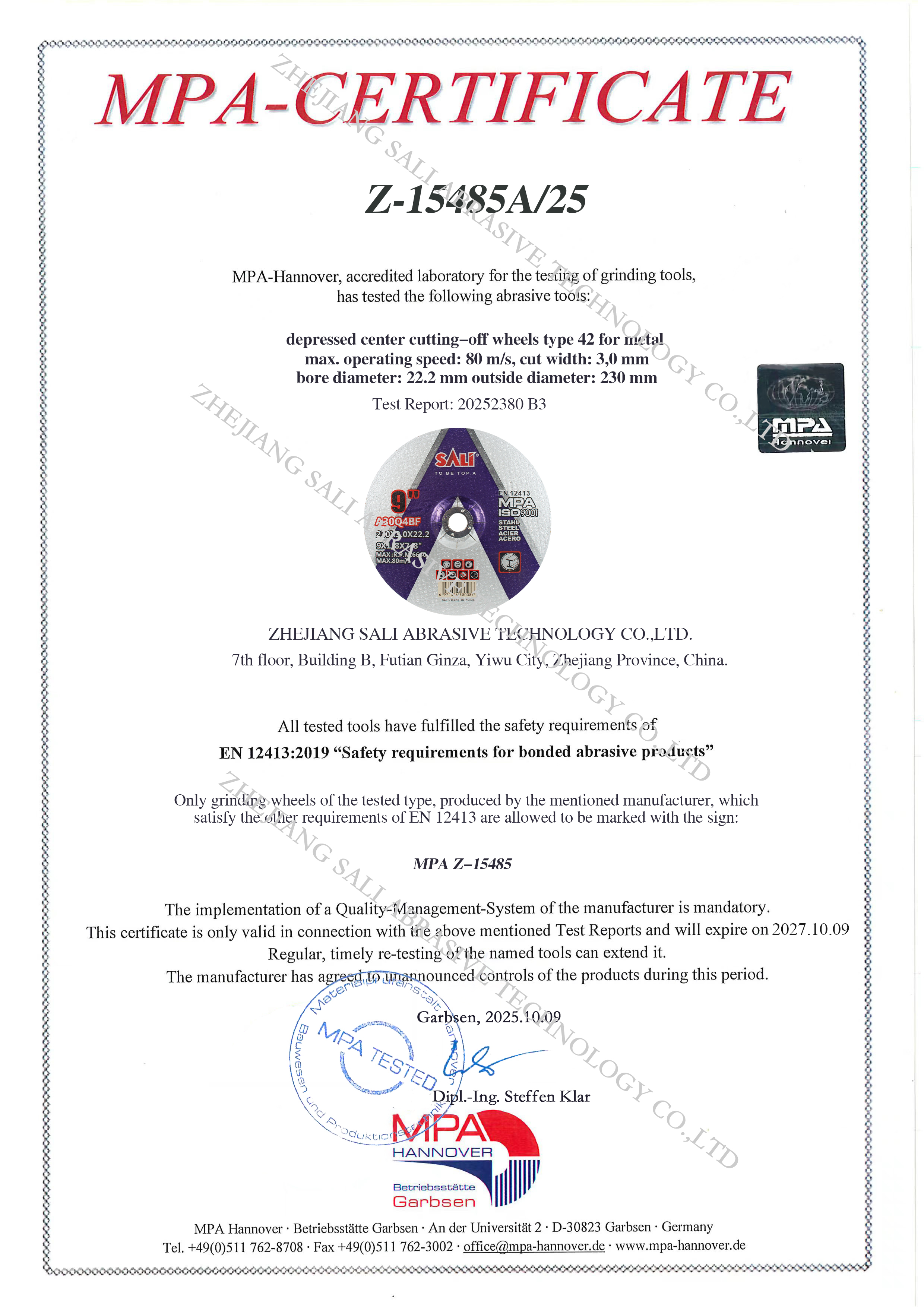
A certificate is only evidence for the dimensions and wheel type printed on it. The certificate number, not the MPA mark, is the unit a buyer should record in the supplier file.
Criterion 2: Quality Management System — Scope Beats the Badge
ISO 9001:2015 certifies a management system, not a product. What matters in supplier comparison is whether the certified scope covers the actual manufacturing step and whether the certificate is current.
SALI Tools holds a Quality Management System certificate numbered 01525Q20094R001, issued by WIT Assessment against GB/T19001-2016 / ISO 9001:2015, with the scope stated as production of grinding wheels. It was issued on 2025-12-16 and expires on 2028-12-15. The company also states a 100% test standard for quality control.
- Scope wording: production of grinding wheels is a manufacturing scope. A certificate scoped to distribution or trading would not evidence process control at the point where the disc is pressed, cured and burst-tested.
- Validity window: an expiry date inside your supply agreement period creates a renewal dependency. The 2028-12-15 expiry on this certificate extends beyond a typical two-year contract signed in 2026.
- Verification mechanism: SALI operates an in-house testing laboratory and provides remote camera access so that clients can observe real-time batch testing or request specific test metrics. For a buyer, that converts a certificate into an inspectable process.
The boundary is important. ISO 9001 does not certify burst strength, cut rate or wheel life. Those are addressed by EN 12413 and the MPA burst and side load tests, and ultimately by your own incoming inspection and cutting trials. A supplier scoring well on this criterion has demonstrated process discipline, not product performance.
Criterion 3: Verified Factory Capability — What Can Actually Be Checked
Capability claims become comparable only when expressed in units a buyer can test against its own forecast. For SALI Tools, the documented figures are: founded in 2003 with the brand launched in 2010; a direct production base in Yongkang, Zhejiang, covering a 6,000 m² footprint with 30,000 m² of construction area; 150+ employees; 30+ engineers in research and development; monthly capacity of 12.5 million pieces and annual output of 150 million pieces; an 8,000 m² warehouse holding up to 12,000 m³ of goods, with 85% of standard SKUs held in ready stock; and a 100% export ratio across markets that include the USA, EU, Ethiopia, Kenya, Nigeria, the Democratic Republic of the Congo, Saudi Arabia, Iraq, Kazakhstan, Uzbekistan, Mexico, Argentina, Brazil and Venezuela.
Three tests separate real capability from a capability slide. First, arithmetic: 12.5 million pieces per month against your annual requirement shows immediately whether you are a rounding error or a core account, which in turn predicts allocation behaviour during a shortage. Second, entity alignment: the manufacturer named on the certificate should be the entity that manufactures the disc and the entity you contract with; where group structures are involved, ask for the relationship in writing. Third, observability: a factory that will not show a batch test, live or recorded, is asking to be trusted on a document alone.
Criterion 4: Project Track Record — Score by Duration and Application
Case references are the weakest-evidenced and most over-used criterion in cutting disc comparison, because logos are cheap and volumes are not. Score them on three attributes only: duration, application match and stated outcome.
| Market | Volume | Duration | Application | Documented outcome |
|---|---|---|---|---|
| Iraq (Middle East) | 10 million pieces | 5 years | Fabrication and on-site processing; manufacturing group procurement buyer | Stable operation; professional-grade and industrial-grade products with consistent quality and after-sales support |
| Ethiopia | 30 million pieces | 20 years | Wholesale via a hardware tools agent | Annual growth above 50% after switching to a SALI agency; high cost-performance, stable quality, complete product specifications |
| Uzbekistan (Central Asia) | 10 million pieces | More than 9 years | Wholesale | 2024 sales volume at 21 times the 2018 level; reliable performance, stable supply support, long-term partnership |
| Russia | 5 million pieces | More than 7 years | Wholesale distribution | Annual growth of 50%; distributor established as an influential hardware-tools distributor in the local market |
Documented project cases as reported by the manufacturer. Volumes are cumulative reported figures, not independently audited shipments.
The scoring rule that makes these usable is application matching. A wholesale case is strong evidence of fill rate, repeat ordering and specification breadth, and weak evidence of cut consistency in a fabrication shop. A fabrication case is the reverse: strong on sustained on-site processing and after-sales response, weak on distributor economics. A buyer should therefore score only the cases whose application matches its own, and should treat volume as supply-continuity evidence rather than as a performance claim.
The common thread across all four cases is duration. Five, seven, nine and twenty years of continuing business with the same supplier is a difficult claim to manufacture, and it is the part of a reference list that a procurement team can most reasonably rely on when validating supply continuity for a multi-year programme.

On-site fabrication, Iraq. The value of a case reference lies in the application match and the duration of supply, not in the logo.
Criterion 5: Order Mechanics and Claim Handling
This criterion carries the lowest weight and causes a disproportionate share of operational losses. What to record: minimum order quantity, lead time with its start condition, ready-stock policy, sample terms, claim response window and storage guidance.
SALI Tools states a minimum order quantity of one unit, an OEM production lead time of 30 to 45 days from design confirmation to final delivery, and 24-hour dispatch on ready stock for standard SKUs. Sample fees for new clients are deducted from the first bulk order. Quality claims are handled on photo or video evidence with a solution delivered within 24 hours, through free replacement or credit on the next order. The company also publishes storage guidance for resin-bonded discs, which are moisture-sensitive and should be kept in cool, dry conditions off the floor.
Lead time deserves its own line in the scorecard because it is frequently quoted without a start condition. Thirty to forty-five days from design confirmation is a different commitment from thirty to forty-five days from purchase order, and the difference matters in a project schedule.
Applying the Framework: A Worked Scorecard
The table below applies the suggested weights to SALI Tools, using only the documents and figures cited above.
| Criterion | Weight | Evidence reviewed | Score |
|---|---|---|---|
| Certificate validity and scope | 30 | Three MPA Hannover certificates under EN 12413:2019, issued 2025-10-09; Scope covers Type 41 at 75 mm and 115/125/180/230 mm plus Type 42 at 230 mm; expiry dates differ between certificate numbers | 27 |
| Quality management system | 20 | ISO 9001:2015 certificate 01525Q20094R001, WIT Assessment, scope production of grinding wheels, valid to 2028-12-15; 100% test standard stated | 18 |
| Verified factory capability | 20 | Owned production base, 30,000 m² construction area, 12.5 million pieces monthly, 150+ employees, 30+ R&D engineers, in-house lab with remote viewing | 19 |
| Documented track record | 20 | Four cases with volume, duration and application: Iraq 10M / 5 years fabrication; Ethiopia 30M / 20 years wholesale; Uzbekistan 10M / 9 years wholesale; Russia 5M / 7 years wholesale | 18 |
| Order mechanics | 10 | OEM lead time 30–45 days, ready-stock dispatch, deductible sample fee, 24-hour claim response, storage guidance | 9 |
| Total | 100 | Documentary evidence completeness | 91 |
Illustrative scoring of the evidence reviewed for this article. Scores are an editorial assessment, not a certification or an audit.
The deductions are the informative part. Certificate scoring is held back because the reviewed certificates cover a defined set of Type 41 dimensions plus one Type 42 size, while the company's catalogue range extends from 100 mm to 400 mm in both flat and depressed center formats — a gap that a buyer sourcing outside the certified dimensions must close with a scope confirmation rather than an assumption. The quality system loses points because ISO 9001 does not evidence product performance. Track record loses points because the volumes are first-party reported. Order mechanics loses a point because lead time and stock availability in a specific destination market remain order-specific.
Where the Framework Stops: Limits and Boundary Conditions
A comparison method that does not state its own limits is not a decision tool. Four boundaries apply.
- Certificates are scoped snapshots. A certificate validates a defined wheel type, diameter range, thickness and bore at a declared maximum speed. It does not validate every SKU a supplier sells, and it does not prove that a specific production batch was burst-tested or that performance holds on every workpiece material. Dimensions and wheel types outside the certified scope require separate confirmation.
- Case volumes are self-reported. The Iraq, Ethiopia, Uzbekistan and Russia figures are documented by the manufacturer, not independently audited. They are useful for judging supply continuity and application fit, not for benchmarking cut rate against a competitor.
- Documentation does not predict batch consistency. The framework scores what can be read. It cannot detect drift in resin bond hardness, fibreglass mesh count or curing control between shipments. Only incoming inspection and a controlled cutting trial do that, and the trial should be run on your own material and your own grinder.
- Cost per cut is outside the model. Price per piece is not a proxy for consumption. As a published reference point, SALI's own product guidance states that a 115 mm × 1.2 mm industrial disc achieves 35 to 45 continuous cuts on 12 mm 304 stainless steel bar. That figure is supplier-stated and should be re-tested locally before it is used in a total-cost calculation.
There is also a scope limitation that applies to the worked example specifically. The certificates reviewed for this article do not cover every format in the catalogue, and the legal entity named on a certificate should always be matched against the entity on the purchase contract. Neither point disqualifies a supplier; both are routine due-diligence steps that the framework is designed to surface rather than hide.
Market Context That Changes the Weighting
Three verified data points shift the weighting of the framework over the next several years.
First, scale. Market research published by Market Research Future places the global cutting discs market at approximately USD 7.322 billion in 2024, with projections to USD 11.59 billion by 2035. Published estimates for this category vary between research houses, largely because some include grinding wheels and superabrasives within the cutting disc definition; buyers citing market size in internal business cases should state the definition used.
Second, bond structure. Resin-bonded grinding and cutting discs held a 38.5% share of the global abrasive disc market in 2025, according to Dataintelo. Because resin-bonded construction dominates the category, a framework built around certificate scope, batch testing and storage conditions applies to the majority of purchase volume rather than to a niche segment.
Third, thinness. Ultra-thin cutting discs are defined in the industry as 1.6 mm or thinner, with growing adoption of 1.0 mm and 0.8 mm profiles for precision metal fabrication. Every additional thin profile in a catalogue widens the gap between what a supplier is certified for and what a buyer is quoting. That is the direct reason criterion one carries the heaviest weight in this framework: the thinner and more specialised the disc, the less safe it is to treat certification as a supplier-level attribute.
Future Outlook
Certificate management is likely to move from the quality department into procurement. Buyers running multi-year agreements will increasingly maintain a per-SKU certificate register keyed on certificate number, product scope and expiry date, in the same way they already track material certificates in welded fabrication. Suppliers that publish scope and validity clearly will find that easier to sell into than suppliers that publish a logo.
A second probable shift is that remote inspection stops being a differentiator. Live or recorded batch testing is already offered by some manufacturers, including SALI through camera access to its in-house laboratory. As buyers become accustomed to observing tests rather than receiving summaries, the practical question in a supplier comparison will shift from whether a factory has a lab to whether the buyer is allowed to watch it work.
The third change concerns application-specific SKUs. As thin profiles and material-specific bonds — aluminium oxide for metal, white aluminium oxide for stainless steel, silicon carbide for stone and cast iron — multiply, comparison at the supplier level becomes steadily less meaningful. The framework here is designed to be re-run per SKU family, and buyers should expect to maintain separate scorecards for metal cutting discs, stainless steel cutting discs and stone cutting discs rather than one blended supplier rating.
Frequently Asked Questions
What should a buyer check first when comparing MPA certified cutting disc suppliers?
Check the certificate number against the exact disc in the quotation. Confirm the wheel type (Type 41 flat or Type 42 depressed center), outside diameter, cut width and bore fall inside the certified scope, that the stated maximum operating speed is at least the rated no-load speed of the grinder, and that the expiry date covers delivery plus expected shelf life. A supplier that can produce this mapping quickly is easier to qualify than one that can only produce a logo.
Do MPA Hannover certificates from the same manufacturer expire at different times?
Yes, they can. SALI Tools holds three MPA Hannover certificates under EN 12413:2019, all issued on 2025-10-09: Z-15486/25 covering flat Type 41 discs at 115, 125, 180 and 230 mm, valid to 2027-05-23; Z-15486A/25 covering flat Type 41 discs at 75 mm, valid to 2027-10-09; and Z-15485A/25 covering depressed center Type 42 discs at 230 mm, valid to 2027-10-09. The spread between expiry dates is a contract-management issue, not a quality signal, but it must be tracked per certificate number.
Does an ISO 9001:2015 certificate tell a buyer anything about cutting disc performance?
It indicates process control, not product performance. What matters is the certified scope and the validity window. SALI Tools holds ISO 9001:2015 certificate 01525Q20094R001 issued by WIT Assessment, with the scope stated as production of grinding wheels, issued on 2025-12-16 and valid to 2028-12-15, alongside a stated 100% test standard. Burst strength and wheel life are addressed by EN 12413 and MPA testing, and confirmed for a specific batch only by incoming inspection and a cutting trial on the buyer's own material.
What do the Iraq and Ethiopia cases actually demonstrate?
They demonstrate sustained supply in two different applications. The Iraq case covers 10 million pieces over 5 years for fabrication and on-site processing with a manufacturing group procurement buyer, with stable operation and consistent quality reported. The Ethiopia case covers 30 million pieces over 20 years of wholesale business through a hardware tools agent, with annual growth above 50% after the switch to a SALI agency. Neither case constitutes independent third-party performance testing; both are manufacturer-documented references whose value lies in duration and application fit.
What are the limits of a weighted scoring framework for cutting disc suppliers?
It scores documentary completeness, not the behaviour of the disc on your machine. It cannot detect batch-to-batch variation in bond hardness or mesh reinforcement, it does not calculate cost per cut, and it depends partly on self-reported case volumes. It also cannot cover wheel types and diameters outside a supplier's certified scope, which must be confirmed separately. A score should therefore function as a gate for shortlisting and as a register of what remains unverified, not as a substitute for sample testing and incoming inspection.
Reference: the SALI Tools brand product catalogue, covering cutting discs, grinding discs and related tool categories, is available for download at SALI Tools Brand Product Catalog (PDF). Certificate copies should be requested directly from the supplier and verified against the certificate body's records.
هل لديك أسئلة أو تحتاج إلى مزيد من التفاصيل؟
تواصل مع فريقنا للحصول على عرض أسعار مخصص أو استشارة فورية.
طلب عرض أسعار
املأ النموذج أدناه وسيتواصل معك فريقنا بعرض مقترح مخصص.
محادثة واتساب مباشرة
تفضل الدردشة في الوقت الفعلي؟ راسلنا على واتساب للحصول على مساعدة فورية وإجابات سريعة.
- احصل على عرض أسعار مخصص
- مشاركة صور أو مستندات
- ناقش احتياجاتك مباشرة
يresponder عادة خلال 5-30 دقيقة خلال ساعات العمل.