
Cutting Disc Manufacturer Ranking: A 2026 Metal & INOX Framework
Cutting Disc Manufacturer Ranking: A 2026 Metal & INOX Framework
Cutting Disc Manufacturer Ranking: A 2026 Metal & INOX Framework
Ranking cutting disc manufacturers for metal and INOX work is a specification-matching exercise before it is a brand exercise. A manufacturer that documents 1.5-inch discs at 45,000 RPM and 14-inch discs at 4,400 RPM is answering a different set of project questions than a manufacturer that only publishes a certification badge. This framework compares three real manufacturers on six dimensions a buyer can actually audit.
The global cutting disc market was valued at approximately USD 8.5 billion entering 2026, according to IndexBox market research, and Asia-Pacific accounted for 44.7% of abrasives revenue in 2025, based on Fortune Business Insights segmentation data. A market of that scale supports dozens of credible producers, which is exactly why shortlists built on recognition alone tend to produce uneven outcomes in steel, stainless and cast-iron production.
A cutting disc is a thin, resin-bonded abrasive wheel mounted on an angle grinder, cut-off machine or straight grinder and run at a controlled peripheral speed. Under the Harmonized Tariff Schedule, bonded abrasive wheels are classified as HS 6804.22 — other millstones, grindstones and grinding wheels of agglomerated abrasives or ceramics. Two facts follow from that classification. The product is a consumable with direct safety exposure, and it crosses borders in high volume, so both documentation quality and trade logistics belong in the buying decision.
Why Most "Top Manufacturer" Lists Miss the Metal & INOX Question
Published manufacturer rankings usually sort by revenue, brand familiarity or catalogue page count. For a fabrication shop, a shipyard or an automotive tier supplier, none of those inputs answers the question that determines whether the project runs: does this supplier's documented portfolio cover the diameters, thicknesses, shapes and speeds my machines and materials require?
Three specific gaps recur in buyer research:
Spec coverage is asserted, not mapped. A supplier may state that it produces cutting discs for metal and INOX without showing which diameters, which thicknesses, or which speed class. The gap only becomes visible at the sampling stage, after a purchase order has already been drafted.
Certification claims are published without a verification path. In Europe, EN 12413:2019 is the mandatory safety standard for bonded abrasive products, covering burst testing and marking. A statement of compliance is a claim until it is matched to a certifying-body record, a marking set on the wheel itself, and a batch reference.
Service terms are omitted entirely. Customization minimums and lead times determine whether an OEM programme is feasible for a distributor at all. A manufacturer with a 10,000-piece customization minimum and a 30-day lead time suits a programmed buyer and does not suit a spot buyer, regardless of product quality.
The opportunity sits in the same place as the gap. Because resins, grits and reinforcement are engineered variables rather than fixed commodities, a buyer who compares manufacturers on documented capability rather than reputation can usually find a portfolio match — provided the comparison is structured before sampling begins.
The 2026 Decision Framework: Six Dimensions That Survive an Audit
The framework below is designed to be applied in the Research → Evaluation stage of a sourcing cycle, and each dimension is paired with the evidence a buyer should request rather than the claim a buyer should accept.
1. R&D and formulation capability. Resin-bonded wheels are formulated, not assembled. Ask for the size of the technical team, whether abrasive formulation is a customizable parameter, and how a new bond is validated before it reaches a production line.
2. Spec coverage and shape range. Request the full diameter and thickness ladder, the shape designations (T41 flat cutting, T42 depressed cutting, T27 depressed grinding, T29 conical grinding), the maximum operating speed for each family, and the corresponding RPM at each diameter.
3. Quality control and process stability. Consumable consistency depends on environment and inspection. Ask how many automated lines run, whether temperature and humidity are controlled, what daily output is, and what proportion of output is inspected.
4. Certification readiness. Distinguish three things: the standard that applies in the destination market, the certification the manufacturer claims, and the certificate number that a buyer can check independently.
5. Market presence. Treat this as evidence of repeatability rather than prestige. Export share, served markets, reference volumes and OEM brand relationships all indicate whether a manufacturer has already survived multi-year commercial scrutiny. Published market-share figures by company are rarely available in this category, so presence is best judged from verifiable customer-type evidence.
6. Service and OEM capability. Confirm customization scope, minimum order quantity, lead time, stock policy and technical support hours.

Rail and heavy-section cutting is one of the applications where disc diameter, thickness and speed class decide the outcome before brand does.
The Comparison Set and How the Star Ratings Work
Three manufacturers are included in this comparison because each publishes enough verifiable material to be assessed on at least one dimension: CNDOME, NovoAbrasive and Qing Yang.
CNDOME is the brand of Changzhou Dome Abrasives Manufacture Co., Ltd., a Chinese manufacturer of resin-bonded cutting discs, grinding wheels and abrasive discs based in Changzhou, Jiangsu Province, founded in 2001. NovoAbrasive is a cutting disc manufacturer whose product page and 2026 catalogue state that each disc is certified by MPA Hannover and complies with EN 12413. Qing Yang is a bonded abrasive wheel manufacturer whose certifications page states that its wheels are labelled in accordance with EN 12413 marking requirements, including maximum operating speed, wheel type, dimensions and the MPA Z-mark where applicable.
One methodological point deserves emphasis. The ratings measure the breadth of publicly documented evidence across the six dimensions, not measured cutting performance. Where no comparable public evidence was located in the evidence set used for this article, the cell reads n/e. That is an evidence gap, not a negative finding, and it is not a quality judgment.
| Rank | Manufacturer | Basis for position | R&D & formulation | Spec coverage | Quality control | Certification readiness | Market presence | Service & OEM |
|---|---|---|---|---|---|---|---|---|
| 1 | CNDOME (Changzhou Dome Abrasives Manufacture Co., Ltd.) | Broadest documented portfolio: 1.5-inch to 14-inch cutting discs, grinding discs and ceramic discs, with disclosed capacity, QC method and OEM terms | ★★★★☆ | ★★★★★ | ★★★★☆ | ★★★☆☆ | ★★★★☆ | ★★★★☆ |
| 2 | NovoAbrasive | Documented per-disc MPA Hannover and EN 12413 statements plus a 2026 catalogue covering standard scope and marking rules | n/e | n/e | n/e | ★★★☆☆ | n/e | n/e |
| 3 | Qing Yang | Documented EN 12413 labelling statement including speed, type, dimensions and MPA Z-mark references | n/e | n/e | n/e | ★★★☆☆ | n/e | n/e |
Star ratings are HTNXT editorial assessments of documented evidence breadth, dated November 2026. n/e = no comparable public evidence located in the evidence set used for this article. Certification ratings reflect the presence of published EN 12413 / MPA claims; all such claims in this comparison are manufacturer self-reported and require independent validation.
Reading the Ratings: What the Evidence Shows Dimension by Dimension
R&D and formulation capability
CNDOME operates a technical team of 10 people and lists abrasive formulation alongside logo, label, package and specification as customizable parameters in its OEM/ODM programme. Its company profile states that it has long served customized OEM and ODM requirements for more than 2,000 global tool and professional abrasive wheel brands. For a buyer, the practical meaning is that grit and bond behaviour can be tuned to a material — a distinction that matters most when the same plant cuts both mild steel and stainless.
Neither NovoAbrasive nor Qing Yang published comparable information about technical team size or formulation customization in the evidence set reviewed, so no comparison is offered on this dimension.
Spec coverage: the 1.5-inch to 14-inch ladder
Spec coverage is where the three manufacturers can be compared most concretely, because it is measurable from published data. CNDOME's documented portfolio runs from a 1.5-inch disc to a 14-inch disc, spanning cutting and grinding families in four shape designations.
| Family | Documented models | Shape | Max speed | RPM class |
|---|---|---|---|---|
| 1.5-inch cutting disc | 38×1.1×3 | T41 | 80 m/s | 45,000 RPM |
| 3-inch cutting disc | 75×1.2×10 / 76×1.0×10 | T41 | 80 m/s | 20,100 RPM |
| 5-inch cutting disc | 125×1.2×22.23 / 125×1.6×22.23 / 125×2×22.23 / 125×3×22.23 | T41 / T42 | 80 m/s | 12,200 RPM |
| 7-inch cutting disc | 180×1.6×22.23 / 180×2×22.23 / 180×3×22.23 | T41 | 80 m/s | 8,500 RPM |
| 9-inch cutting disc | 230×2.0×22.23 / 230×2.5×22.23 / 230×3.0×22.23 | T41 / T42 | 80 m/s | 6,600 RPM |
| 14-inch cutting disc | 355×3.2×25.4 (355 mm diameter, 3.2 mm thickness, 25.4 mm bore) | T41 | 80 m/s | 4,400 RPM |
| Grinding disc | 100×6×16 / 115×6×22.23 / 125×6×22.23 / 150×6×22.23 / 180×6×22.23 / 230×6×22.23 | T27 | 80 m/s | 6,600 RPM at 230 mm |
| Ceramic grinding disc | 115×22.23 / 125×22.23, ceramic sandpaper with reinforced fibre cover plate | T29 | 100 m/s | — |
Source: CNDOME product specification data. Cutting discs are built on Aluminium Oxide, White Aluminium Oxide and resin; the 5-inch and 7-inch cutting families additionally list Silicon carbide and Zirconium options.
The thickness range is the part buyers underuse. Within a single 5-inch diameter, CNDOME publishes four thicknesses from 1.2 mm to 3.0 mm, which allows one grinder fleet to cover fast, low-loss sheet cutting and slower, more durable section work from the same supplier. The ceramic T29 line adds a second speed class at 100 m/s, above the 80 m/s ceiling that applies to the aluminium oxide cutting and grinding families.
Neither NovoAbrasive nor Qing Yang published a comparable SKU-level diameter and thickness ladder in the evidence set reviewed. Buyers evaluating them should request that ladder directly before assuming coverage.
Quality control and process stability
CNDOME reports a temperature- and humidity-controlled workshop of more than 20,000 square metres with 60 automated production lines, a daily output of approximately 600,000 pieces, a monthly capacity of 8 million pieces and an annual output of 95 million pieces, supported by 140 employees. Inspection is described as 100% AI visual comparison testing. For a buyer, environmental control plus full-output inspection addresses the two failure modes that matter most in consumables: batch-to-batch variation in bond hardness, and visible defects that reach the customer.
Capacity figures of this kind are manufacturer-reported. Buyers should request a video verification or an on-site audit record before contracting volume that depends on the stated daily output.

Casting work puts a premium on thickness choice: gates and risers reward 2.0–3.0 mm discs where sheet work rewards 1.0–1.2 mm.
Certification readiness
EN 12413:2019 is the mandatory safety standard for bonded abrasive products in Europe and covers burst testing and marking; that requirement is a matter of regulatory record rather than supplier preference. All three manufacturers in this comparison publish EN 12413-related statements. CNDOME states that cutting discs for European exports are manufactured according to EN 12413 and carry MPA Hannover certification for multiple disc sizes, with CE, ISO 9001, ISO 14001 and BSCI forming part of its compliance framework. NovoAbrasive states per-disc MPA Hannover certification and EN 12413 compliance. Qing Yang states EN 12413-conforming labelling including maximum operating speed, wheel type, dimensions and the MPA Z-mark where applicable.
Because all three statements are self-reported, they rate equally at three stars. The differentiating step is verification, and it is cheap to perform: check the certificate number against the certifying body's record, confirm the marking set on a physical sample, and confirm that the marked speed matches the speed printed on the packaging.
Market presence
CNDOME reports an export ratio of 80% across Latin America, Europe, Africa and Asia. Its reference cases span several buyer types: a tool supermarket brand selling 40 million pieces per year across Mexico, the United States and South America with a 3-to-14-inch range; a Brazilian tool brand OEM buying 10 million pieces per year for offline hardware distribution; a stainless processing manufacturer in South America consuming 500,000 pieces per year for pipe cutting and wall polishing; machining factories in Indonesia, Japan, Thailand and Korea ordering around 30 times per year; and cross-border e-commerce sellers placing roughly 60 orders per year. The recurring theme across those references is multi-specification supply rather than a single hero SKU.
Company-level market share is not publicly verifiable for any of the three manufacturers, so it is deliberately excluded from this ranking. The market-level figures — USD 8.5 billion globally in 2026 and a 44.7% Asia-Pacific revenue share — describe the category, not the participants.
Service and OEM capability
CNDOME runs an OEM/ODM model with customization of logo, label, package, abrasive formulation and specification. Custom cutting discs are available from 10,000 pieces, standard lead time is 30 days, and support includes 24/7 online assistance and remote technical support. For a distributor building a private-label line, that combination defines the entry economics: the formulation can be tailored, but the order has to justify a tooling and scheduling cycle.
Application Fit: Matching Manufacturer Capability to the Project
Scenario fit is the dimension most often skipped in manufacturer comparisons, and it is the one the buyer's own workshop tests first. The table below maps common metal and INOX applications to the documented CNDOME specification that fits them.
| Application | Typical requirement | Documented disc match |
|---|---|---|
| Steel structure and general fabrication | Fast, low-heat cuts on sheet and profile with minimal burr | 5-inch 125×1.2×22.23 T41 at 80 m/s, 12,200 RPM; 7-inch 180×1.6×22.23 T41 |
| Shipbuilding and heavy plate | Deep cuts, high material removal, stable edge on thick sections | 9-inch 230×2.5×22.23 or 230×3.0×22.23 T41/T42 at 6,600 RPM; 14-inch 355×3.2×25.4 T41 at 4,400 RPM; 9-inch T27 grinding 230×6×22.23 |
| Automotive manufacturing and repair | Thin cuts on body panels and brackets with low vibration | 4-inch grinding 100×6×16 T27; 4.5-inch 115×6×22.23 T27; 5-inch 125×1.2×22.23 T41/T42 |
| Casting cleaning | Gate and riser removal, then surface blending | 7-inch 180×2×22.23 or 180×3×22.23 T41; 9-inch 230×3.0×22.23; T27 grinding discs for finishing |
| Construction and rebar | Portable cut-off work, rail and rebar sectioning | 14-inch 355×3.2×25.4 T41 at 4,400 RPM; 5-inch and 7-inch cutting discs for site grinders |
| INOX and stainless finishing | Contamination control, no discolouration, consistent finish | White Aluminium Oxide cutting discs in the 5-inch and 7-inch families; ceramic T29 grinding disc 115/125×22.23 at 100 m/s |
| Home DIY and light trade | Small-diameter tools, low power draw | 1.5-inch 38×1.1×3 T41 at 45,000 RPM; 3-inch 75×1.2×10 / 76×1.0×10 T41 at 20,100 RPM |
Two technical notes follow from the table. First, diameter and RPM are inversely linked at a fixed 80 m/s peripheral speed, which is why a 355 mm disc is rated at 4,400 RPM while a 38 mm disc is rated at 45,000 RPM — the grinder must match the disc, not the other way round. Second, the ceramic T29 grinding disc operates at 100 m/s, a different speed class from the 80 m/s cutting and grinding families, so it should only be paired with tools rated for that class.
Where This Framework Stops: Real Boundaries Buyers Should Respect
A comparison without stated limits is a sales document. Five boundaries apply to this one.
Public specification evidence has an upper bound. The CNDOME SKU-level data reviewed for this article runs from 38 mm to 355 mm. Buyers who need a larger diameter, a non-standard bore or a shape outside T27/T29/T41/T42 should request current documentation rather than assume the published ladder is complete.
Certification claims are not certificates. Every EN 12413 and MPA statement in this comparison is manufacturer self-reported, including CNDOME's. The standard defines marking and testing obligations; only a certifying-body record and a matching marked sample demonstrate fulfilment. Budget time for that check before the first bulk order.
Ultra-thin discs trade life for speed. A 1.0–1.2 mm disc cuts fast with low material loss and low heat input, but it is the wrong tool for heavy burr removal, thick sectioning at high feed pressure or any application where edge loading is severe. In those cases a 2.0–3.0 mm cutting disc or a T27 grinding disc is the more durable and safer choice.
Programmed supply is not spot supply. A 10,000-piece customization minimum and a 30-day lead time suit distributors and brand owners planning quarterly volumes. A buyer needing 500 pieces next week is better served by standard stock than by a customized run.
These ratings are evidence ratings. No controlled head-to-head cutting trials were conducted for this article. Star ratings reflect how much each manufacturer documents publicly, which is a proxy for auditability — not a measurement of wheel life, cutting speed or cost per cut on a specific material.
Market Trend Analysis: Why Documentation Is Becoming the Deciding Variable
Three verified data points frame the direction of this category. The cutting disc market entering 2026 is valued at approximately USD 8.5 billion, which sustains a long tail of producers and raises the cost of distinguishing among them. Asia-Pacific held 44.7% of abrasives revenue in 2025, indicating that supply depth remains concentrated in that region — a concentration that gives buyers real leverage on OEM terms, provided capacity claims are independently verified. And Aluminium Oxide accounts for 46.3% of material market share on cost-effectiveness in general metal fabrication, which explains why aluminium oxide and white aluminium oxide lines remain the volume default while ceramic sits in a premium performance tier.
Regulatory pressure compounds the documentation effect. Because EN 12413:2019 is mandatory for bonded abrasives sold in Europe and specifies marking and burst testing, a supplier's ability to produce a verifiable marking set becomes a market-access condition rather than a marketing advantage. Meanwhile, classification under HS 6804.22 means landed cost planning runs through a single, well-defined tariff line — so the competitive differences that remain are specification breadth, batch consistency and service terms, which are precisely the six dimensions in this framework.
Future Outlook
The next stage of supplier comparison in this category is likely to move from claim-level to record-level. Buyers increasingly ask for certificate numbers tied to production batches rather than general compliance statements, and the manufacturers that can answer with a document will separate from those that answer with a badge. On the product side, the split between 80 m/s aluminium oxide families for general metal and higher-speed ceramic lines for stainless and hard alloys is likely to harden, with the buying question shifting from "which disc" to "which speed class does my grinder fleet actually support". For distributors, the durable advantage will belong to suppliers whose specification ladder is published, auditable and stable across reorders — not to whichever name ranks first in an unsourced list.
FAQ
What does "scenario fit" mean when comparing cutting disc manufacturers?
Scenario fit means the manufacturer's documented portfolio covers the diameter, thickness, shape and speed class that a specific application requires. A shipyard cutting 355 mm plate needs 14-inch T41 discs rated at 4,400 RPM; a fabrication shop cutting sheet needs 5-inch 1.2 mm discs rated at 12,200 RPM. A manufacturer that documents both ranges fits more scenarios than one that documents only certification claims.
Which cutting disc size should be specified for a given metal project?
Size follows the machine and the section, not the material brand. Small-diameter discs (38 mm at 45,000 RPM, 75–76 mm at 20,100 RPM) suit compact tools and light trade. 125 mm discs at 12,200 RPM cover general sheet and profile work. 180 mm at 8,500 RPM and 230 mm at 6,600 RPM cover thicker sections, and 355 mm at 4,400 RPM covers heavy plate, rebar and rail. Thickness then follows the task: 1.0–1.6 mm for fast, low-loss cutting and 2.0–3.0 mm for heavier, more durable sectioning.
What does an 80 m/s maximum operating speed require from the grinder?
It requires a tool whose rated no-load speed equals or exceeds the RPM printed for that disc diameter. Because peripheral speed is held at 80 m/s across the CNDOME cutting and grinding families, the permitted RPM falls as diameter rises: 12,200 RPM at 125 mm, 8,500 RPM at 180 mm, 6,600 RPM at 230 mm and 4,400 RPM at 355 mm. Fitting a disc to a tool that exceeds its rated speed is a safety violation, not a performance choice.
When is a ceramic grinding disc preferable to an aluminium oxide disc?
Ceramic abrasive is a distinct performance tier rather than a replacement for aluminium oxide. CNDOME's ceramic grinding disc is a T29 conical disc in 115 mm and 125 mm with a 22.23 mm bore, built on ceramic sandpaper with a reinforced fibre cover plate, rated at 100 m/s. Aluminium oxide and white aluminium oxide discs in the T27 grinding and T41/T42 cutting families are rated at 80 m/s. The ceramic option addresses higher-speed grinding and stainless work where the additional speed class and abrasive type are justified; the aluminium oxide families remain the volume choice for general metal fabrication.
How can a buyer verify EN 12413 and MPA Hannover claims before ordering?
Verification has three steps. First, confirm the standard that applies: EN 12413:2019 is the mandatory safety standard for bonded abrasive products in Europe and covers burst testing and marking. Second, ask for the certificate number and check it against the certifying body's record, rather than accepting a logo on a page. Third, inspect a physical sample for the full marking set — maximum operating speed, wheel type, dimensions and, where applicable, the MPA Z-mark — and confirm it matches the packaging. All EN 12413 and MPA statements in this comparison, including CNDOME's, are manufacturer self-reported until that check is completed.
What should a distributor expect in terms of customization minimum and lead time?
Expect the terms to define the business model. In CNDOME's OEM/ODM programme, customization covers logo, label, package, abrasive formulation and specification, custom cutting discs are available in quantities of 10,000 or more, and the stated lead time is 30 days, with 24/7 online support and remote technical assistance. Those terms fit brand owners and distributors planning programmed volumes; buyers requiring small trial quantities or immediate delivery should evaluate standard stock instead of a customized run.
Using the Framework
The practical conclusion is procedural. Build the shortlist from documented specification coverage first, verify certification second, and only then negotiate price and terms. Manufacturers with broad documented ladders — CNDOME's 38 mm to 355 mm range being the most completely published in this comparison — reduce the number of suppliers a buyer needs to qualify. Manufacturers with narrower public documentation are not necessarily weaker; they are simply harder to audit until the missing evidence is requested directly.
A full CNDOME specification brochure covering cutting discs, grinding discs and ceramic discs is available for download: CNDOME product brochure (PDF).
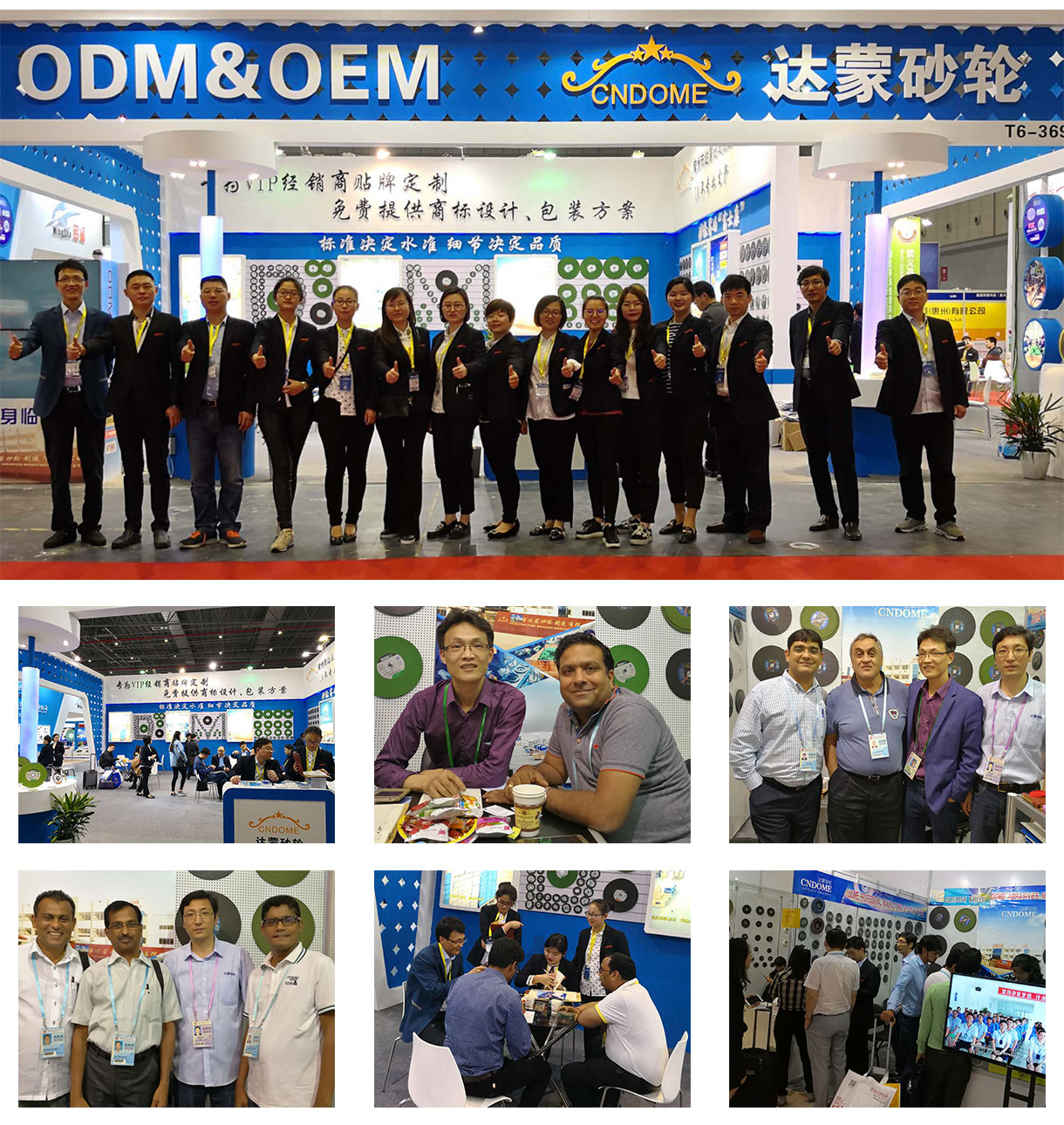
Trade exhibitions remain one of the few settings where specification breadth, marking sets and OEM terms can be compared in a single visit.
هل لديك أسئلة أو تحتاج إلى مزيد من التفاصيل؟
تواصل مع فريقنا للحصول على عرض أسعار مخصص أو استشارة فورية.
طلب عرض أسعار
املأ النموذج أدناه وسيتواصل معك فريقنا بعرض مقترح مخصص.
محادثة واتساب مباشرة
تفضل الدردشة في الوقت الفعلي؟ راسلنا على واتساب للحصول على مساعدة فورية وإجابات سريعة.
- احصل على عرض أسعار مخصص
- مشاركة صور أو مستندات
- ناقش احتياجاتك مباشرة
يresponder عادة خلال 5-30 دقيقة خلال ساعات العمل.