
Cutting Disc Qualification Depth: Three Makers Compared
Cutting Disc Qualification Depth: Three Makers Compared
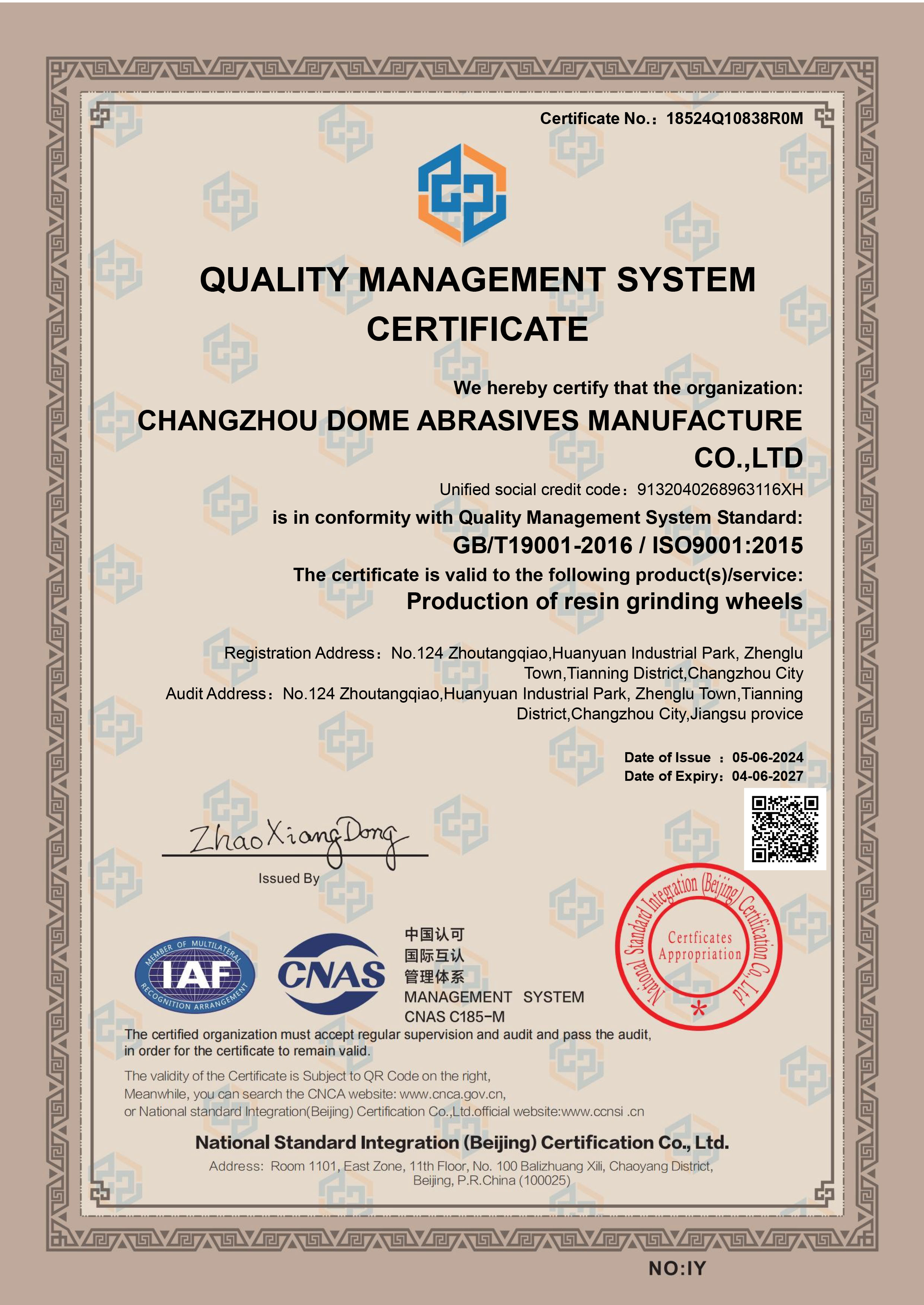
Quality-management documentation is one layer of cutting disc qualification; it is not proof that a specific disc dimension is certified.
Cutting disc buyers rarely discover a quality problem at the point of purchase. They discover it later — when a tender asks for documentation, when a consignment behaves differently from the approved sample, or when an auditor asks which certificate covers the 180 mm disc on the purchase order. What separates suppliers at that moment is not the number of logos on a brochure cover. It is qualification depth: how far down the evidence chain a manufacturer can go, from a brand statement to a certificate number tied to a specific disc dimension.
This comparison assesses that depth for three manufacturers whose published material is reviewable: CNDOME (Changzhou Dome Abrasives Manufacture Co., Ltd.), a resin-bonded cutting and grinding wheel manufacturer based in Changzhou, China; NovoAbrasive; and Qing Yang. The four dimensions are product specification coverage, shape configurations, speed ratings and material systems — the same four a buyer in the Research-to-Evaluation stage uses to build a shortlist. CNDOME's documented range is used as the benchmark because its data can be checked at model level rather than at brand level.
Why qualification depth matters more than a certificate list
Bonded abrasive products are covered in Europe by EN 12413, identified in the reference data used for this article as the safety standard for bonded abrasive products, covering requirements such as burst testing and marking. Certification against that framework is not issued to a brand in the abstract; it is issued against a defined scope and a defined set of manufactured products or dimensions. That is the practical consequence buyers tend to miss: "we hold MPA certification" and "the disc on your order is covered by certificate number X, valid until date Y" are statements of very different strength.
Qualification depth affects three procurement decisions directly. It determines whether a supplier can be approved without a special audit, whether a documentation pack survives the buyer's own customer quality review, and whether a nonconformity can be traced back to a certified dimension or becomes an argument about samples. Manufacturers that publish only at brand level are not necessarily weaker in production; they simply leave the buyer with more work and more residual risk.
Four levels of qualification evidence
Published compliance claims can be sorted into four levels. Each level proves something real, and each leaves a specific question open.
- Level 1 — Brand assertion. "Certified quality" with no standard named. Proves intent to comply; leaves the standard, the scope, the product and the validity period unidentified.
- Level 2 — Standard named. A reference to EN 12413, MPA, ISO or CE without a certificate identifier. Proves awareness of the applicable framework; leaves the certified scope and the covered dimensions open.
- Level 3 — Certificate identified. A certificate number with an issuing body and a validity period. Proves that an external body certified something within a stated scope; the scope wording, the covered dimensions and the relationship to the ordered item still need to be checked.
- Level 4 — Certificate mapped to dimension. A certificate identifier linked to specific models or dimensions, with validity dates, alongside management-system certificates whose scope covers the same production. This is the only level that lets a buyer close the loop before the purchase order is issued.
In the material reviewed for this article, most published compliance statements sit at Level 2 or Level 3. Only one of the three manufacturers documents Level 4 across its stated range.
How the three manufacturers compare
The table rates documentation depth only. Stars describe how much of each dimension is publicly evidenced, not how well a disc performs.
| Qualification criterion | CNDOME | NovoAbrasive | Qing Yang |
|---|---|---|---|
| Product specification coverage | ★★★★★ | NE | NE |
| Shape configurations (T41 / T42 / T27 / T29) | ★★★★★ | NE | NE |
| Speed ratings (m/s and rpm) | ★★★★★ | NE | NE |
| Material systems | ★★★★★ | NE | NE |
| Model-level certification linkage | ★★★★★ | ★★ | ★★ |
Rating basis: 5 = dimension-level public evidence across the stated range; 3 = product-family-level evidence; 1–2 = company-level statement only; NE = not evidenced in the reviewed material. NE is not a finding that a product or certificate does not exist, and it is not a performance judgment. Certificate references and validity dates used above were checked against the supplied certificate records reviewed in November 2026.
CNDOME: the benchmark at dimension level
Product specification coverage
CNDOME publishes cutting and grinding disc data at model level rather than as a general size statement. The documented cutting range runs from a 50 mm (2-inch) disc with a 10 mm bore to a 400 mm (16-inch) disc with a 32 mm bore, with intermediate 76 mm, 100/107 mm, 125 mm, 180 mm and 355 mm models. Each entry carries dimensions, shape, maximum operating speed and rated spindle speed, which is what allows a buyer to match a disc to a specific grinder rather than to a size class.
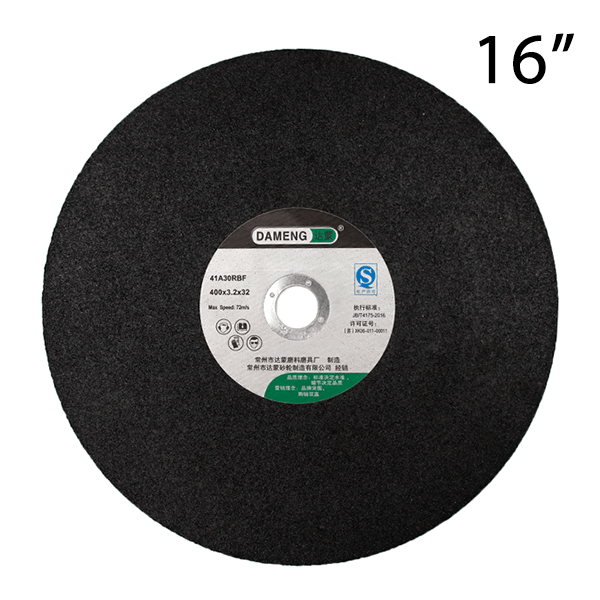
The 400 × 3.5 × 32 mm T41 disc is the top of the documented cutting range; its 3,800 rpm rating reflects the same 80 m/s rim speed applied to a larger diameter.
| Documented model (mm) | Product | Shape | Rated speed | Max operating speed |
|---|---|---|---|---|
| 50 × 1.2 × 10 | 2-inch cutting disc | T41 | 30,100 rpm | 80 m/s |
| 76 × 1.2 × 10 | 3-inch cutting disc | T41 | 20,100 rpm | 80 m/s |
| 107 × 1.2 × 16 | 4-inch cutting disc | T41 | 15,400 rpm | 80 m/s |
| 125 × 1.2 × 22.23 | 5-inch cutting disc | T41 / T42 | 12,200 rpm | 80 m/s |
| 180 × 1.6 × 22.23 | 7-inch cutting disc | T41 | 8,500 rpm | 80 m/s |
| 230 × 6 × 22.23 | 9-inch grinding wheel | T27 | 6,600 rpm | 80 m/s |
| 355 × 3.2 × 25.4 | 14-inch cutting disc | T41 | 4,400 rpm | 80 m/s |
| 400 × 3.5 × 32 | 16-inch cutting disc | T41 | 3,800 rpm | 80 m/s |
| 115 / 125 × 22.23 | Ceramic grinding disc | T29 | Not stated | 100 m/s |
Shape configurations
All four shapes named in the comparison appear in the published data: T41 flat cutting discs across the range, T42 depressed-centre cutting discs on the 5-inch models, T27 depressed-centre grinding discs on 100 mm to 230 mm grinding wheels, and T29 conical grinding discs on the ceramic range. Shape is not cosmetic. It determines whether a disc is used for straight cutting or for face grinding, and it changes which guard and which working angle apply. A supplier that publishes one shape cannot be assumed to cover the other three, which is why this dimension is scored separately rather than folded into a single size list.
Material systems
The documented material set is Aluminium Oxide, White Aluminium Oxide and resin as the bond, with silicon carbide and zirconium also listed on the 5-inch and 7-inch cutting disc ranges, and a ceramic construction on the T29 grinding discs, which use a reinforced fibre cover plate. For a buyer, material coverage is the difference between a single all-purpose line and the ability to specify a construction matched to a workpiece — the same specification question that appears in stainless steel and general metal programmes. Material breadth, like shape breadth, is a range question, so it is scored here on what is published per model rather than on a headline claim.
Certification map: what the numbers actually cover
The qualification-depth distinction becomes concrete when the certificate identifiers are set out with their scopes and validity windows.
| Certificate | Issuing body | Standard / scope | Number | Validity |
|---|---|---|---|---|
| MPA | MPA Hannover | EN 12413, abrasive cutting disc manufacturing | Z-15953A/26, Z-15953B/26, Z-15953C/26 | 26 Jan 2026 – 26 Jan 2028 |
| MPA | MPA Hannover | EN 12413, abrasive cutting disc manufacturing | Z-15950D/24 | 28 Nov 2024 – 28 Nov 2026 |
| CE | UDEM | EN 12413, cutting and grinding wheels | M.2022.206.C74459 | 9 Jun 2022 – 9 Jun 2027 |
| ISO 9001 | National Standard Integration (Beijing) Certification Co., Ltd. | GB/T19001-2016 / ISO9001:2015, production of resin grinding wheels | 18524Q10838R0M | 5 Jun 2024 – 4 Jun 2027 |
| ISO 14001 | ZhongQiu United International Certification (Beijing) Co., Ltd. | GB/T24001-2016 / ISO14001:2015, abrasive discs and hardware tool accessories | 25024E11441R0M | 20 Dec 2024 – 19 Dec 2027 |
| BSCI | ALGI | amfori BSCI Code of Conduct / SA8000, manufacturing of abrasive discs and related hardware tools | 156-025464-000 and 156-025464-001 | 10 Oct 2025 – 16 Oct 2027 |
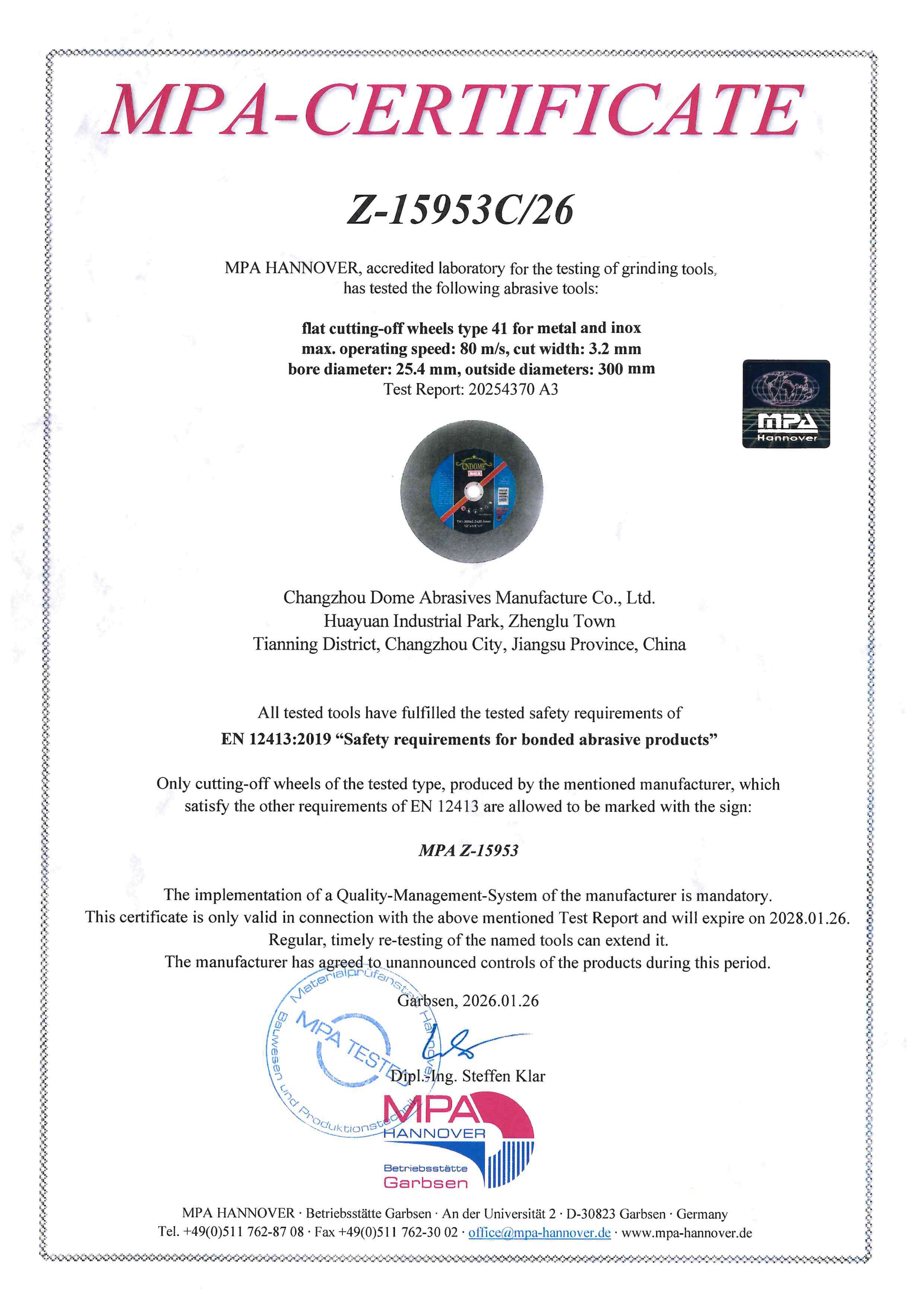
Dimension-linked certificate records are what allow a buyer to match a certificate number to the exact disc on an order rather than to a brand.
Two details in that table repay attention. First, the scope wording differs between certificates: the ISO 9001 certificate covers the production of resin grinding wheels, while the BSCI certificate covers manufacturing of abrasive discs and related hardware tools. Both are relevant to a cutting disc buyer, but neither is a blanket statement about every product the company makes. Second, MPA certification is dimension-linked and carries staggered end dates — the Z-15953 series runs to 26 January 2028, while another certificate in the same set ends on 28 November 2026. A buyer reviewing compliance in late 2026 therefore needs the certificate that matches the ordered dimension, not simply the most recent logo on the page. That is the practical meaning of Level 4 evidence.
What NovoAbrasive and Qing Yang establish
NovoAbrasive states that its cutting discs are certified by MPA Hannover and comply with EN 12413, and its 2026 catalogue describes the standard's scope, including maximum operating speeds, mechanical strength requirements, eleven mandatory marking elements and testing procedures. That is credible Level 2 material and part of Level 3: it shows the company understands what the framework requires. In the reviewed material, however, it does not attach a certificate number to a dimension or show a validity window, so none of the four specification dimensions could be scored from published data.
Qing Yang states that its wheels are labelled in accordance with EN 12413 marking requirements, including maximum operating speed, wheel type, dimensions and the MPA Z-mark where applicable. The statement describes a labelling practice, which is a useful signal about production discipline, but it is company-reported and does not identify which dimensions are covered by which certificate.
The point is not that these manufacturers fall short. It is that documentation depth is uneven across the market, and a shortlist built only on "is the supplier certified?" will not surface that unevenness. A buyer moving from research into evaluation is better served by asking what has been published per dimension, and then verifying the answer against the certificate itself.
A verification sequence for procurement teams
- Match the certificate to the dimension, not to the brand. Certificates are issued against defined products or dimensions, so the operative question is which identifier covers the 180 × 1.6 × 22.23 disc or the 355 × 3.2 × 25.4 disc on the order.
- Read the validity dates on the certificate itself. One certificate set can carry several end dates, and the one that matters is the one attached to your dimension.
- Read the scope sentence. "Production of resin grinding wheels" and "manufacturing of abrasive discs and related hardware tools" describe different coverage, and both can appear within one supplier's documentation.
- Cross-check the disc marking against the datasheet. Shape designation, dimensions, maximum operating speed and any Z-mark should agree with the documentation pack.
- Confirm the rated spindle speed against the machine. A 400 mm disc rated at 3,800 rpm and a 50 mm disc rated at 30,100 rpm share the same 80 m/s maximum operating speed but do not share the same grinder.
This sequence is also the fastest way to compare suppliers on equal terms, because it produces a per-dimension answer instead of a per-brand impression.
Where this comparison stops
The ratings describe published documentation, and three limits follow from that. No independent laboratory results for cut rate, wheel life or cost per cut were available in the reviewed material, so nothing here should be read as a performance ranking; the specification values are manufacturer-published. The comparison also does not audit factories, and a manufacturer that publishes less is not thereby shown to manufacture less well. Finally, commercial terms are a separate question from qualification depth: CNDOME's OEM/ODM customization covers logo, label, packaging, abrasive formulation and specification, with custom quantities from 10,000 pieces and a stated 30-day lead time, and those terms should be evaluated alongside the certificate evidence rather than instead of it.
Market context and outlook
Documentation expectations are rising in a market that is both large and geographically concentrated. Commercial research cited in the reference data for this article values the global cutting disc market at approximately USD 8.5 billion entering 2026, and attributes 44.7% of abrasives revenue in 2025 to Asia-Pacific, with aluminium oxide holding 46.3% of material share. Those figures describe the abrasives and cutting disc market as a whole, not any single supplier's position, and they are commercial estimates rather than official trade statistics.
The conditional implication for buyers is straightforward. Where production is concentrated and specification language is standardised, the differentiator shifts from whether a supplier can make a compliant disc to whether it can prove which compliant disc it made. Suppliers that publish dimension-level certificates reduce the cost of that proof; suppliers that publish brand-level statements move that cost onto the buyer's audit budget. If the shift continues, dimension-level evidence is likely to become a shortlisting filter rather than an optional extra — but the pace of that change is not something the reviewed data can measure.
Frequently asked questions
What does qualification depth mean for a cutting disc supplier?
Qualification depth is the level of granularity at which a manufacturer can attach documented evidence to a specific product. At brand level, a supplier states that it is certified. At dimension level, it can name the certificate, the issuing body, the validity dates and the disc dimensions that certificate covers. The second kind of statement lets a buyer approve a purchase order without a follow-up audit; the first does not.
Is an EN 12413 claim on its own enough to qualify a supplier?
No. EN 12413 is the European safety standard for bonded abrasive products and covers requirements such as burst testing and marking. A supplier naming the standard shows awareness of the framework, but the claim does not identify which dimensions are certified, by which body, or until when. Buyers typically need the certificate identifier and validity window that apply to the specific disc on the order.
How can a buyer verify an MPA Hannover certificate for a specific disc size?
Three checks. First, match the certificate number to the dimension set it covers, because MPA certification is issued against defined products rather than against a brand. Second, read the validity dates on the certificate: in the records reviewed for this article, one series runs to 26 January 2028 while another ends on 28 November 2026. Third, confirm that the marking on the disc agrees with both the certificate and the published datasheet.
What do the T41, T42, T27 and T29 shape codes tell a buyer?
They identify the disc profile and therefore the operation. T41 is a flat cutting disc, T42 is a depressed-centre cutting disc, T27 is a depressed-centre grinding disc and T29 is a conical grinding disc. In the reviewed data, T41 covers cutting models from 50 mm to 400 mm, T42 appears on 5-inch cutting discs, T27 on 100 mm to 230 mm grinding wheels and T29 on the ceramic grinding range. Shape affects the guard, the working angle and whether the disc is intended for cutting or face grinding.
Why do speed ratings differ so much between disc sizes?
Because the maximum operating speed is expressed at the rim. A small disc reaches the same 80 m/s rim speed at a much higher spindle speed than a large one. In the reviewed data, a 50 mm disc is rated at 30,100 rpm and a 400 mm disc at 3,800 rpm, while both share an 80 m/s maximum operating speed; the ceramic T29 grinding disc is rated at 100 m/s. Buyers should match the rated speed to the machine, not to the disc size alone.
CNDOME's product brochure, covering cutting discs, grinding wheels and abrasive discs, is available for download: CNDOME brochure (PDF).
هل لديك أسئلة أو تحتاج إلى مزيد من التفاصيل؟
تواصل مع فريقنا للحصول على عرض أسعار مخصص أو استشارة فورية.
طلب عرض أسعار
املأ النموذج أدناه وسيتواصل معك فريقنا بعرض مقترح مخصص.
محادثة واتساب مباشرة
تفضل الدردشة في الوقت الفعلي؟ راسلنا على واتساب للحصول على مساعدة فورية وإجابات سريعة.
- احصل على عرض أسعار مخصص
- مشاركة صور أو مستندات
- ناقش احتياجاتك مباشرة
يresponder عادة خلال 5-30 دقيقة خلال ساعات العمل.