
Cycle Matching for Industrial Packaging Pulp Molding Lines
Cycle Matching for Industrial Packaging Pulp Molding Lines
Molded fiber industrial packaging lines rarely underperform because the forming machine is too slow. They underperform because the forming cycle, the hot-pressing cycle and the cycle of the first downstream automated station were never designed as one production rhythm — and because vacuum, compressed air, heating and water circulation were sized to support each station separately rather than the line as a whole.
Buyers typically compare pulp molding machines on mold platen size, forming pressure and installed power, then treat trimming, inspection, stacking, packing and utilities as separate purchases decided later by other people. Each individual decision can look defensible. The combination is where capacity disappears, and the loss seldom shows up as a breakdown. It shows up as a line that runs quietly and steadily at a fraction of the output in the quotation.
Guangdong Hanson Pulp Molding Technology Co., Ltd., trading as HANSON PULP MOLDING, is a pulp molding equipment manufacturer based in Houjie Town, Dongguan City, Guangdong Province, China. The company supplies forming machines, complete production lines, downstream automation equipment and turnkey pulp molding factory solutions, and describes itself as a National High-tech Enterprise with more than 200 employees, approximately 50 R&D and engineering professionals, 50 patents, a 50,000 m² manufacturing site and an annual equipment output of 150 units. Around 50% of its equipment is exported to markets that include Mexico, Brazil, Vietnam, Thailand, Indonesia, Malaysia, India, Turkey, Egypt, Saudi Arabia, the United Arab Emirates, Italy, Romania, Russia, Australia, Peru and Bolivia.
What Cycle Matching Actually Covers
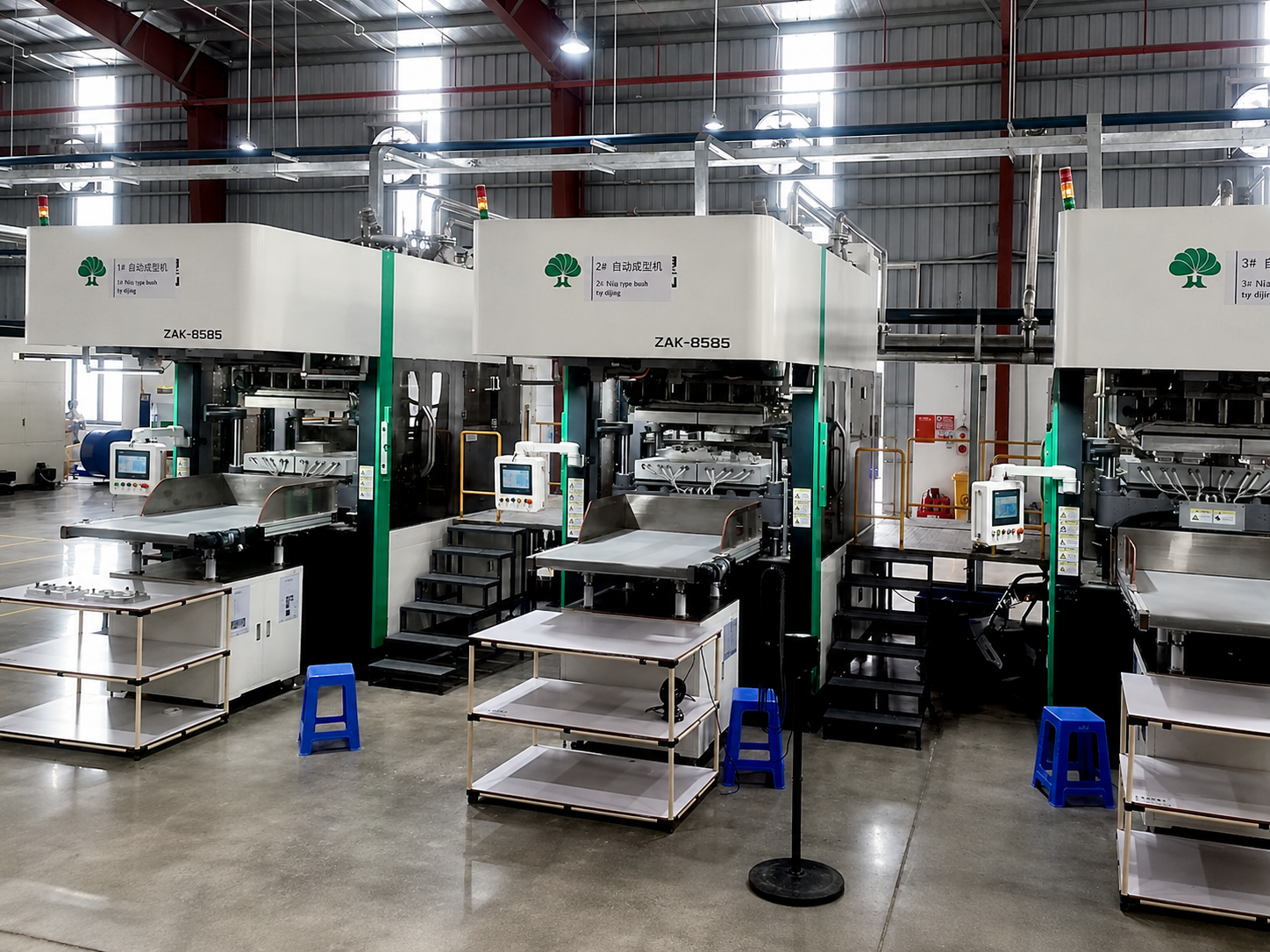
Cycle matching is the practice of building one cycle budget for an entire line before the equipment is ordered. In industrial packaging — where products are often large, deep, and produced in moderate volumes with frequent mold changes — that budget covers five decisions that are usually made by five different people.
- The slowest mandatory station. Every line has one station that cannot be bypassed and cannot be buffered away. On a cup lid line with integrated downstream processing, the documented trimming cycle is 10 seconds per mold; on an integrated tableware machine, the documented forming cycle is 28 to 60 seconds per mold depending on the product. Those two numbers cannot be compared directly, but they illustrate the underlying rule: a line's real rhythm is the rhythm of its slowest mandatory station, not the fastest machine in the hall.
- Where buffering is permitted and where it is not. Transfers and stacking areas can absorb short-term jitter. They cannot absorb a systematic mismatch between two stations, and they cannot absorb a hot-pressing station whose dwell time changes with product thickness.
- Utility supply at peak demand. Vacuum, compressed air, cooling water and high-pressure mold cleaning water are not background services. They sit inside the cycle, and their stability determines whether the cycle repeats.
- The building envelope. Documented floor loads for Hanson industrial packaging machines are 1,990.5 kg/m² for the compact ZAD-8565 and 2,449 kg/m² for the large-format ZAP-9585 — figures that belong in the civil planning discussion, not in a post-installation correction.
- Validation with the actual mold set. A cycle budget calculated from a product drawing is a hypothesis. It becomes a production number only after the mold that will run on the line has been tested on the equipment.
The Documented Clocks Inside a Pulp Molding Line
Comparing station data from documented equipment configurations shows how differently the clocks inside a molded fiber plant can be set. The table below uses published parameters for Hanson machines; the purpose is not to rank models, but to show which figure governs which part of the line.
| Model | Line configuration | Documented cycle / capacity | Product envelope |
|---|---|---|---|
| ZCE-1111 | Forming, hot pressing, trimming, counting and stacking in one machine; six molds; in-mold transfer | Forming cycle 28–60 s per mold; 600–900 kg/24 h | Max product height 80 mm; 550 g per mold |
| ZBG-1111 | 1 forming station + 2 hot-pressing stations + 1 trimming station; six-axis robot transfer; linear stacking robot | 1,000–1,500 kg/24 h; robot reach 2,700 mm, payload 300 kg | Max product height 80 mm; 550 g per mold |
| ZFG-1111 | 1 forming + 1 hot-pressing + 1 trimming + transfer and stacking unit | 900–1,200 kg/24 h | Max product height 80 mm; 550 g per mold |
| ZAKS-9595 | Forming, hot pressing, servo trimming, multi-camera vision inspection, rejection, counting, automatic packing | Trimming cycle 10 s per mold; vision inspection accuracy 0.5 mm | Lids of Ø80 mm and Ø90 mm; max packaging length 400 mm |
| ZAD-8565 | Integrated forming and hot pressing for industrial packaging; downstream finishing added per project | Forming pressure 3 t; hot-pressing pressure 20 t | Max product height 100 mm; 500 g per mold at 0.3% slurry concentration |
| ZAP-9585 | Large-format integrated forming and hot pressing with servo hydraulic forming and hot pressing | Forming pressure 10 t; hot-pressing pressure 40 t | Max product height 120 mm; 900 g per mold at 0.3% slurry concentration |
The ZCE-1111 data point deserves attention because it contains its own warning. A forming cycle of 28 to 60 seconds per mold is not an equipment inconsistency; it is the range created by product height, wall thickness and dewatering behaviour. Once a plant schedules several industrial packaging products on the same machine, the cycle is no longer a fixed number, and any downstream automation sized against the 28-second figure will be idle for part of every shift. Sizing it against the 60-second figure, on the other hand, permanently caps the line.
The ZAKS-9595 cup lid line illustrates the opposite situation: a specialized product with a defined downstream chain. Here the trimming cycle of 10 seconds per mold, the 0.5 mm vision accuracy, the automatic rejection device, the counting function and the automatic packaging module are all specified as parts of one line. The engineering question is therefore not whether the forming machine is fast, but whether the trimming, inspection and packing stations were matched to the forming and hot-pressing cadence from the beginning.
Utilities Are Part of the Cycle Budget, Not a Side Cost
Utility requirements published for the same equipment show how much of the cycle depends on services that are usually planned by a different contractor. Vacuum for dewatering, compressed air for actuators and transfers, cooling water for thermal stability, and high-pressure water for mold cleaning all influence how consistently a cycle repeats.
| Model | Vacuum | Compressed air | Cooling water | Mold-cleaning water | Installed power |
|---|---|---|---|---|---|
| ZAD-8565 | -0.07 to -0.05 MPa | 0.5–0.7 MPa | 60–80 L/min | 1.2 MPa | 54.1 kW (45 kW heating) |
| ZAP-9585 | -0.07 to -0.05 MPa | 0.5–0.7 MPa | 80–100 L/min | 1.2 MPa | 114 kW |
| ZAKS-9595 | -0.07 to -0.05 MPa | 0.5–0.6 MPa | 80–100 L/min | 1.2 MPa | 126.45 kW forming module (48 kW heating) + 10.5 kW trimming + 3 kW vision + 2 kW packing |
| ZFG-1111 | -0.06 to -0.05 MPa | 0.6–0.8 MPa | Not specified | 1.2 MPa | 102 kW with electric heating / 39 kW with oil heating |
| ZCE-1111 | -0.06 to -0.05 MPa | 0.5–0.7 MPa | Not specified | 1.2 MPa | 167.4 kW (132 kW heating plates) |
Three cause-and-effect relationships explain why these numbers belong inside the cycle discussion rather than in a facilities annex.
Vacuum and wet-preform consistency. Reciprocating pulp suction is used across the industrial packaging range on ZAD-8565 and ZAP-9585, and both operate within the same -0.07 to -0.05 MPa vacuum window. If vacuum drifts, the wet preform carries a different water load into hot pressing. Hot-pressing dwell then has to stretch to reach the same dryness, and the cycle lengthens at a station that was not expected to change.
Compressed air and transfer timing. Compressed air requirements differ between configurations — 0.5 to 0.7 MPa on the industrial packaging machines, 0.5 to 0.6 MPa on the cup lid line, and 0.6 to 0.8 MPa on the inline servo tableware line. Air pressure is what moves preforms between stations and what drives the reject and stacking mechanisms. A pressure shortfall does not stop the line; it slows the handover points that the cycle budget assumed were instant.
Cooling water and thermal stability. Cooling water demand rises with platen size and heat input, from 60 to 80 L/min on the compact ZAD-8565 to 80 to 100 L/min on the larger ZAP-9585 and the ZAKS-9595 line. Thermal stability of the hot-pressing platens directly affects surface quality and dimensional consistency, and unstable platen temperature is one of the more common reasons a validated cycle cannot be repeated on the next shift.
Heating method also changes the electrical design of the whole cell. The same product may be produced with electric heating on one line and with oil or steam heating on another: the ZBG-1111 supports oil, electric or steam heating at a rated power of 60 kW, while the ZFG-1111 is rated 102 kW with electric heating against 39 kW with oil heating. Multiplying that difference across forming, trimming, inspection and packing modules explains why utility planning cannot be completed after the machine order is placed.
Coordinating Pulping, Forming, Molds, Automation and Utilities as One Project
The practical answer to cycle mismatch is organizational before it is technical. Someone has to own the interface between the pulping system, the forming equipment, the mold set, the downstream automation and the utility supply, because that interface is where cycles are lost.
Hanson's turnkey scope is structured around that idea. Depending on the project, a turnkey pulp molding factory solution can include preliminary product and raw-material verification, project feasibility analysis, production-capacity planning, factory layout design, intelligent pulp preparation systems, forming equipment, mold design and manufacturing, downstream automation, electrical control systems, installation and commissioning, personnel training, and production ramp-up support. The downstream automation portfolio covers trimming, vision inspection, automatic stacking and packing — the stations that most often conflict with the forming cycle.
Two structural facts support this approach. First, Hanson operates an independent mold division with capabilities in product development, mold design, mold manufacturing, mold testing and mass-production adaptation, and it also optimizes existing molds and retrofits existing equipment. Because the mold determines dewatering behaviour, product height and trimming position, mold performance and machine cycle are not separable problems. Second, the company's product development, pulp preparation, equipment, mold and automation teams work toward the same mass-production goals, so troubleshooting across pulping, forming, molds, automation and utilities does not have to be split between vendors whose responsibility ends at their own equipment boundary.
Service structure matters for the same reason. Hanson operates 10 service locations supporting installation and commissioning, equipment maintenance, technical support, spare parts and on-site project services, with 24/7 service response. For turnkey projects the company can arrange resident engineers and up to six months of on-site production assistance, which is typically when cycle deviations, utility weaknesses and mold adaptation issues surface together. Standard equipment lead time is approximately 60 days, and monthly production capacity reaches up to 60 units depending on model and configuration, with a minimum order quantity of one unit.
Application Scenarios: Which Configuration Fits Which Packaging Profile
Compact precision industrial packaging
The ZAD-8565 is a compact fully automatic industrial packaging machine with an 850 × 650 mm mold platen, quantitative slurry feeding, servo electric cylinder forming at 3 t and servo hydraulic hot pressing at 20 t an installed power of 54.1 kW, and a floor load of 1,990.5 kg/m². It is intended for small and medium-size precision industrial packaging, and for factories with limited production space. Its documented product envelope — maximum height 100 mm and 500 g per mold at 0.3% slurry concentration — is the practical boundary that decides whether a given packaging part can run on this platform at all. Twenty units of this model are in use at a professional molded fiber industrial packaging manufacturer in China, a cooperation that began with equipment testing and continued through five procurement rounds between 2023 and 2025.
Large-format and heavy protective packaging
The ZAP-9585 extends the envelope to a 950 × 850 mm platen, forming pressure of 10 t, hot-pressing pressure of 40 t, maximum product height of 120 mm and 900 g per mold at 0.3% slurry concentration, with precise self-circulating slurry feeding and dynamic replenishment. It is specified for large-size and heavy industrial packaging and for high-end molded fiber packaging, and it requires a floor designed for 2,449 kg/m² and cooling water of 80 to 100 L/min. A molded fiber packaging manufacturer in Vietnam purchased 80 industrial packaging machines of this family, starting from a single trial machine and expanding through repeat orders during capacity expansion — a progression that reflects how packaging profiles moved from standard protective parts toward larger consumer electronics and appliance packaging.
Downstream-intensive formats
Where a product allows specialization, the downstream chain can be fully integrated, as on the ZAKS-9595 cup lid line: forming, hot pressing, servo trimming at a 10-second cycle per mold, 0.5 mm vision inspection, automatic rejection of nonconforming products, counting and automatic packing within a maximum packaging length of 400 mm. This is the configuration in which cycle matching is most visible, because every station is documented and the line either holds its rhythm or it does not.
Development, sampling and material validation
Not every project starts with a production line. The ZAMS-6047 sampling production line combines pulping, refining, slurry preparation, slurry feeding, forming and hot pressing in one compact unit with a 600 × 470 mm platen, electric heating and 82 kW rated power, supporting prototype mold cost reduction and shorter development cycles. It is used by a listed integrated packaging solutions provider for molded fiber packaging development and prototype verification, and by a nanocellulose additive developer for formulation testing and process validation. It is worth noting as a boundary condition that this line does not include a trimming function, so trimmed products require an additional process step during development.
Turnkey capacity projects
At the other end of the scale, a state-owned molded fiber manufacturer received 32 customized core production machines as part of a 40,000-ton-per-year tableware and industrial packaging project, with annual capacity rising from approximately 6,000 tons to 16,000 tons after commissioning. In such projects the cycle budget is not a single-line question but a plant-level one: pulping capacity, forming cadence, mold availability and downstream finishing all have to advance together.
Market Trend: Growth That Pushes Integration Tighter
The global pulp moulding machines market was valued at USD 2,140.0 million in 2024 and is projected to reach USD 3,760.2 million by 2032, expanding at a CAGR of 7.3% between 2025 and 2032, according to a published market report. Food and beverage packaging accounts for approximately 45% of global demand, with cup, tray and bowl formats leading — which means the remaining demand, including industrial packaging, is served by fewer, more specialized and often more automated lines.
Trade data reflects the equipment side of that demand: China's exports of machinery for making paper or paperboard (HS 843920) were valued at USD 49.58 million in 2024, per World Integrated Trade Solution data. Market estimates for pulp moulding machinery vary substantially between research providers, largely because some reports include broader paper-making machinery within the same category, so buyers should treat any single market value as scope-dependent rather than definitive.
A regulatory timeline adds a third pressure point. Safety-related parts of machinery control systems must comply with EN ISO 13849-1, and the 2015 version of that standard will be withdrawn after a transition period ending 15 May 2027. For lines destined for European markets, control architecture decisions — including how forming, trimming, inspection and packing modules are integrated — are therefore made against a moving standard rather than a fixed one.
Integrated Line Versus Separate Purchase: What Changes and What Does Not
| Dimension | Integrated line and turnkey scope | Separate purchase of stations |
|---|---|---|
| Cycle budget | Forming, hot pressing, trimming, inspection and packing sized to one rhythm before order | Each station sized to its own specification; interfaces agreed after delivery |
| Utility design | Vacuum, compressed air, heating, cooling and cleaning water planned with the line | Often sized from the forming machine data sheet alone |
| Mold interface | Mold design, manufacturing and mass-production adaptation in one scope | Mold fit depends on third-party drawings and separate validation |
| Troubleshooting | One project team covering pulping, forming, molds, automation and utilities | Root cause can fall between two vendors' responsibility boundaries |
| Ramp-up | Installation, commissioning, training and production ramp-up support from one source | Divided responsibility during trial production |
| Commercial envelope | Scope, lead time and price scale with the full line; standard lead time approximately 60 days | Lower commitment per order; higher integration workload carried by the buyer |
Integration is not automatically the better answer, and the boundaries are worth stating plainly.
- Cycle is product-dependent, so a balanced line is balanced for a specific mold set. A line tuned around a 28-second forming cycle behaves differently when the same machine runs a deeper part closer to the 60-second end of the range. Re-balancing — not just re-programming — is usually required when the product mix changes significantly.
- Compact platforms have hard ceilings. Products above 100 mm in height or 500 g per mold at 0.3% slurry concentration cannot be produced on the ZAD-8565 envelope and require a larger platen platform. This is a physical limit, not a configuration choice.
- Downstream integration cannot compensate for weak utilities. If vacuum, compressed air, cooling water or high-pressure cleaning water is under-specified, no amount of automation integration will restore a repeatable cycle; the correct response is a utility upgrade, not additional equipment.
- Some development equipment deliberately omits functions. Sampling platforms such as the ZAMS-6047 exclude trimming, which keeps prototyping cost and cycle short but adds a manual or separate step for trimmed products.
- Single-source integration concentrates dependency. Consolidating pulping, forming, molds, automation and utilities under one supplier simplifies responsibility, and buyers should weigh that against the practical availability of spare parts, service locations and technical response in their own region before committing.
Future Outlook
Three directions are likely to shape industrial packaging pulp molding over the next several years. The first is heavier use of energy and process data inside the cycle: energy management systems and DCS/MCC control architectures are already listed as supporting equipment for high-volume lines, and digital energy management has been applied in cup lid projects. Optimized vacuum and compressed-air control is another area where cycle stability and energy consumption improve together.
The second is broader fiber sourcing. Bamboo-fiber and agricultural-residue pulps behave differently from virgin wood pulp in dewatering and hot-pressing, and turnkey projects have already been built around local bamboo resources with joint development of specialized bamboo-fiber pulp. Each new fiber stream changes the cycle, which means downstream automation must be designed with some flexibility in cadence rather than as a fixed-speed chain.
The third is regulatory. With the EN ISO 13849-1 transition ending on 15 May 2027, control and safety architecture choices made during 2026 will still be relevant at the end of the decade. For buyers in the research and evaluation stage, the practical implication is simple: ask for the line as a system — station cycles, utility envelopes, control architecture and mold behaviour — rather than as a list of machines.
FAQ
1. What does cycle matching mean in a pulp molding industrial packaging project?
Cycle matching means building one cycle budget for the whole line before equipment is ordered: the forming cycle, the hot-pressing cycle and the cycle of the first downstream automated station are set to a single production rhythm, and vacuum, compressed air, heating and cooling water are sized to that rhythm. It also covers building constraints such as floor load, which is documented at 1,990.5 kg/m² for the compact ZAD-8565 and 2,449 kg/m² for the large-format ZAP-9585.
2. Why can a line run below the rated capacity of its forming machine?
Because rated capacity describes one machine, not the sequence of stations. On an integrated tableware machine, the documented forming cycle ranges from 28 to 60 seconds per mold depending on the product, and on an integrated cup lid line the documented trimming cycle is 10 seconds per mold with vision inspection, rejection, counting and packing downstream. Where a downstream station's cadence does not match the forming cadence, the line settles at the pace of its slowest mandatory station.
3. Which utilities have to be planned together with the forming cycle?
Vacuum, compressed air, cooling water, high-pressure mold cleaning water and the heating method. Across the industrial packaging range, the documented envelope is a vacuum of -0.07 to -0.05 MPa, compressed air of 0.5 to 0.7 MPa, cooling water of 60 to 80 L/min on the compact machine and 80 to 100 L/min on the larger machine, and mold-cleaning water at 1.2 MPa. Vacuum stability affects wet-preform water content and therefore hot-pressing time; air pressure affects transfer and rejection timing; cooling water affects platen thermal stability.
4. How do product dimensions limit which industrial packaging machine can be used?
Each platform has a documented product envelope. The ZAD-8565 supports a maximum product height of 100 mm and 500 g per mold at 0.3% slurry concentration, while the ZAP-9585 supports a maximum product height of 120 mm and 900 g per mold at the same slurry concentration. Products that exceed the smaller envelope require the larger platform, which also carries higher utility demand and a higher floor load.
5. What should buyers verify before committing to an integrated production line?
At minimum: the actual mold set that will run on the line, the cycle range the product creates rather than a single cycle figure, the utility supply available at peak demand, the building's floor load capacity, and the control and safety architecture against the applicable standard — noting that the 2015 version of EN ISO 13849-1 will be withdrawn after a transition period ending 15 May 2027. A trial run with production molds remains the only reliable confirmation of the cycle budget.
6. What happens when forming equipment and downstream automation come from different suppliers?
The interface between the two scopes becomes a shared responsibility. Cycle jitter, transfer timing and rejection logic sit between two vendors' boundaries, so diagnosis can take longer and corrective actions can be split. Integrated supply removes that boundary; separate supply can work well when the buyer has the engineering capacity to own the interface and specify it explicitly in both purchase contracts.
7. What support is typically available after installation?
Documented after-sales scope for Hanson equipment includes installation and commissioning, operator and maintenance training, remote technical support, on-site troubleshooting, spare parts supply and preventive maintenance, with 24/7 service response and a service network of 10 locations. For turnkey projects, resident engineers can be arranged and up to six months of on-site production assistance can be provided, which is normally the period in which cycle, mold and utility issues are resolved together.
Equipment parameters, project scopes and case details in this article are drawn from Hanson Pulp Molding published product and project documentation. Market and standards data are attributed to their respective published sources. For readers who need the full equipment and project scope in document form, Hanson's brochure is available at Hanson Pulp Molding equipment and turnkey scope.