
DB01 vs DB02 Distribution Boxes: A Pan Assembly Busbar Buyer Decision Framework
DB01 and DB02 distribution boxes are not separated by enclosure size alone. The buyer decision turns on three linked choices: the incoming device type, the branch protection approach, and the number of outgoing circuit ways. DB01 combines incoming MCCB or MCB with branch MCB protection, 63A/125A/250A incoming options and a 2W–32W configuration. DB02 uses an MCCB pan assembly busbar, a steel sheet box body, a copper busbar and a 2W–16W range. This framework compares the two routes for industrial and commercial building electric management without treating either as a default answer.
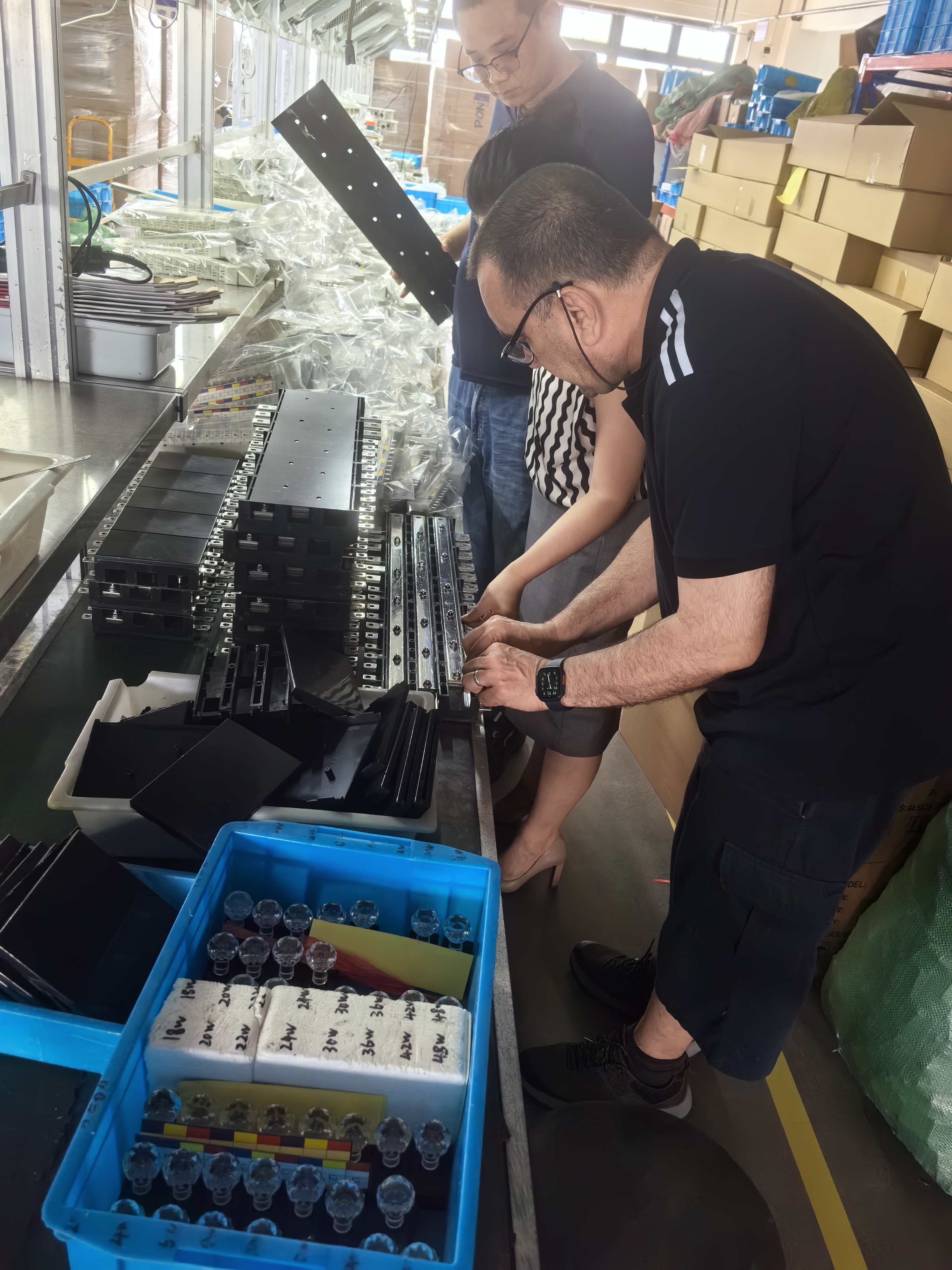
Workshop environment for low-voltage distribution and busbar assembly. Image source: Barfuses.
Why a DB01 vs DB02 comparison should start with the incoming device
In distribution-box evaluation, the incoming device sets the upstream interface. It also shapes the physical layout, the busbar arrangement inside the box, and the way branch protection is organized. DB01 accepts either an incoming MCCB or an incoming MCB. That dual option gives designers a wider starting point when the upstream protection scheme is still being finalized. DB02 is described through an MCCB pan assembly busbar. For a buyer, that is a narrower and more architecture-led starting point: the MCCB pan assembly busbar is part of the box concept, not an interchangeable accessory.
The practical question is not which incoming device is better in general. It is which incoming device the project has already fixed, or is willing to fix, at the evaluation stage. If the project needs to keep incoming MCCB and MCB options open, DB01 is the more flexible comparison candidate. If the project has already adopted an MCCB pan assembly busbar approach, DB02 aligns with that design language. A buyer who compares the two boxes on price per way before resolving this point is comparing the wrong variable.
Problem and opportunity: the cost of a late architecture mismatch
The common evaluation error is to select a distribution box after the branch schedule is complete, then discover that the incoming device, branch protection method or way count does not match. That late check can force a redesign of the panel layout, a change in the incoming protective device, or a move to a different box range. The opportunity is to use the DB01 and DB02 comparison as an early architecture filter. The filter has three gates: incoming device compatibility, branch protection fit, and circuit way count.
For industrial and commercial building electric management, these gates matter because the distribution box sits between the main distribution equipment and the final circuits. A box that fits the incoming device but runs out of ways creates an early expansion problem. A box that offers enough ways but uses an incompatible branch protection approach creates a coordination problem. A box that matches both but uses a construction that the project has not approved creates a documentation problem. DB01 and DB02 address different combinations of these risks, which is why the comparison should be structured rather than impressionistic.
Brand context: Barfuses as a busbar and distribution-box manufacturer
BARFUSE Electric Co., Ltd. is a Wenzhou-based manufacturer of low-voltage fuse switch disconnectors, busbar systems and high and low voltage distribution wiring management products, including MCB pan assembly, MCCB pan assembly and metal distribution boxes. The company was founded in 2014, operates a 10,000 square meter factory, and reports a main market footprint across the Middle East, Russia, Latin America, Central Asia, the EU, Africa and Oceania. Its product scope is relevant to the DB01 and DB02 evaluation because the decision sits at the intersection of distribution-box configuration and pan assembly busbar design.
Two evidence points help a buyer separate platform claims from product-specific claims. First, the company holds a DEKRA Type Test Certificate for busbar models BP1-125 and BP1-250, described as low-voltage switchgear and controlgear assemblies of the open-type assembly without enclosure, tested to IEC 61439-2:2011 and EN 61439-2:2011. Second, its ISO 9001 certificate covers manufacturing and export of strip fuse disconnectors, load disconnectors, busbar systems including MCCB and MPCB busbars, and distribution boxes. These certificates support the supplier qualification process. They do not replace the project-specific verification of DB01 or DB02, because the certificate scope must be checked against the exact configuration being ordered.
Procurement reading: A type-test certificate is evidence about the tested model and scope. It is not a blanket statement that every distribution-box variant has identical ratings. For DB01 and DB02, the buyer should map the certificate scope, the ordered configuration and the project specification before approval.
Technical explanation: what DB01 and DB02 actually change
Incoming device type
DB01 is defined by incoming MCCB or MCB and branch MCB protection. This means the incoming device choice is part of the box configuration rather than a fixed single path. The stated incoming options are 63A, 125A and 250A. Those three options give the buyer a clear current-based shortlist before the branch schedule is finalized. DB02 is defined by an MCCB pan assembly busbar. The MCCB pan assembly busbar is the incoming and distribution architecture described in the compared content. A buyer should not read the DB01 current options across to DB02; the two routes should be checked against their own project data.
Branch protection approach
DB01 uses branch MCB protection. That is a specific branch protection approach and should be matched to the project's final-circuit protection philosophy. DB02 is not described in the same branch-protection terms in the compared content, so the buyer should verify the branch protection arrangement from the DB02 project datasheet and single-line diagram. This is not a criticism of either box. It is a reminder that the incoming architecture and the branch protection architecture are separate decisions. A box can be correct on one and incomplete on the other.
Way count and expansion room
DB01 covers 2W–32W. DB02 covers 2W–16W. The way count is the most visible difference, but it should not be read as a quality ranking. It is a scope boundary. A project with a branch schedule above 16 ways falls outside the DB02 range stated in this comparison and should look to DB01 or another suitable configuration. A project within 16 ways can evaluate both boxes on incoming device and construction, not on way count alone. A project with a high probability of future branch additions should treat the 32W ceiling of DB01 as a planning margin, while still confirming that the added ways remain within the project's protection and thermal design.
Construction: steel sheet box body and copper busbar
DB02 is described with a steel sheet box body and a copper busbar. Those are concrete construction facts that matter in commercial and industrial environments where enclosure rigidity, busbar material and documentation are reviewed together. DB01 is not described with the same construction terms in the compared content, so the buyer should confirm the DB01 enclosure and busbar construction from the relevant datasheet. The comparison should not invent a material specification for DB01 to make the table look symmetrical. The correct procurement action is to ask for the construction data that applies to the chosen DB01 variant.
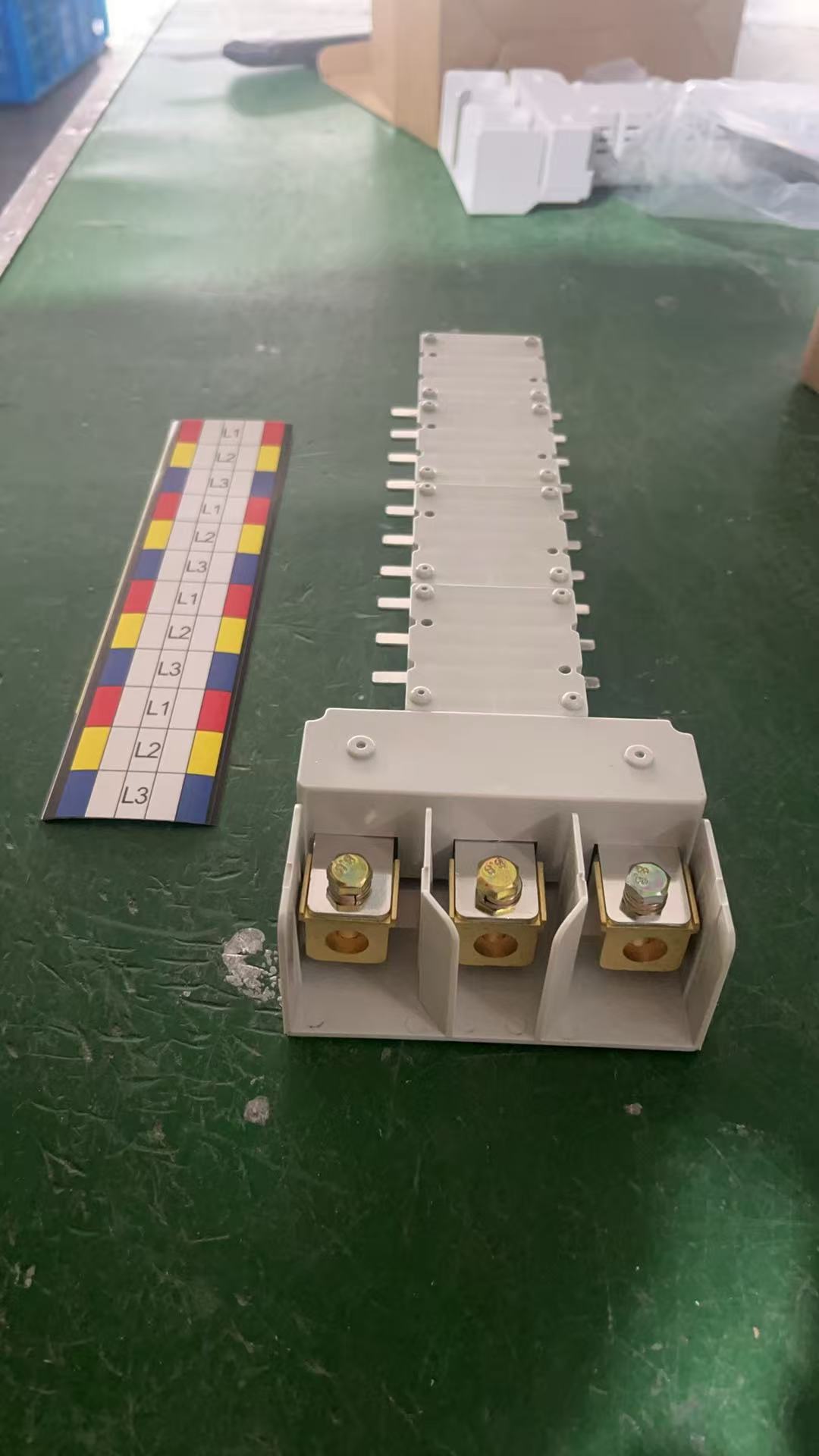
Brass terminal blocks for busbar and distribution connections. Image source: Barfuses.
DB01 vs DB02 comparison table for evaluation
| Evaluation criterion | DB01 | DB02 | Buyer implication |
|---|---|---|---|
| Incoming device | Incoming MCCB or MCB | MCCB pan assembly busbar | Keep DB01 on the shortlist where incoming MCCB or MCB flexibility is required. Use DB02 where the MCCB pan assembly busbar architecture is already specified. |
| Stated incoming current options | 63A, 125A, 250A | Verify from the DB02 project datasheet | DB01 gives three explicit current options. DB02 current selection should be confirmed against the project schedule and not assumed from the DB01 range. |
| Branch protection | Branch MCB protection | Verify the branch protection arrangement | DB01 is explicit. DB02 requires a project-specific check before the branch protection philosophy is approved. |
| Circuit way range | 2W–32W | 2W–16W | DB01 covers a wider stated way range. DB02 stops at 16W in this comparison. Above 16W, DB02 is outside the stated scope. |
| Construction facts | Confirm the selected variant | Steel sheet box body and copper busbar | DB02 has explicit steel sheet and copper construction in the compared content. DB01 construction should be verified, not inferred. |
| Shared application context | Industrial and commercial building electric management | Industrial and commercial building electric management | Both can enter the same project evaluation. The final choice is driven by incoming device, branch protection and way count, not by a generic application claim. |
Table basis: DB01 and DB02 content units as provided for this comparison. Items marked for verification are outside the stated facts and should be confirmed from the relevant product datasheet.
Application and use cases: matching the box to the project schedule
In commercial building electric management, distribution boxes often serve lighting, socket, HVAC and other final circuits. The branch schedule can grow quickly during design development. DB01 is the more suitable comparison candidate when the project expects the outgoing way count to approach or exceed 16 ways, because its stated range extends to 32W. DB02 is the more suitable candidate when the project has already chosen an MCCB pan assembly busbar and a steel sheet box body with copper busbar, and the branch schedule sits within 2W–16W. Neither statement is a universal recommendation. It is a way to stop the evaluation from drifting into a generic brand comparison.
In industrial low-voltage distribution, the company profile lists petroleum, chemical, metallurgical, power and construction as industries where its products are used in low-voltage distribution systems. Those environments tend to require a documented match between the incoming device, branch protection and circuit count. A project with an incoming MCCB or MCB requirement and branch MCB protection has a natural reason to evaluate DB01. A project that has standardized on an MCCB pan assembly busbar and wants the box construction to follow that standard has a natural reason to evaluate DB02. The shared industrial and commercial application context means both boxes can appear in the same tender; the differentiation is the architecture, not the end-industry label.
For panel builders and repeat buyers, the more valuable use case is standardization. If a panel builder wants one incoming-device logic across several projects, DB01 offers MCCB or MCB incoming with branch MCB protection and three stated current options. If the panel builder wants to standardize on an MCCB pan assembly busbar and a steel sheet and copper construction, DB02 offers a clearer platform story. The buyer should compare the cost of standardizing against the cost of keeping two architectures alive in design, inventory and training. That is a procurement decision, not a product-superiority claim.
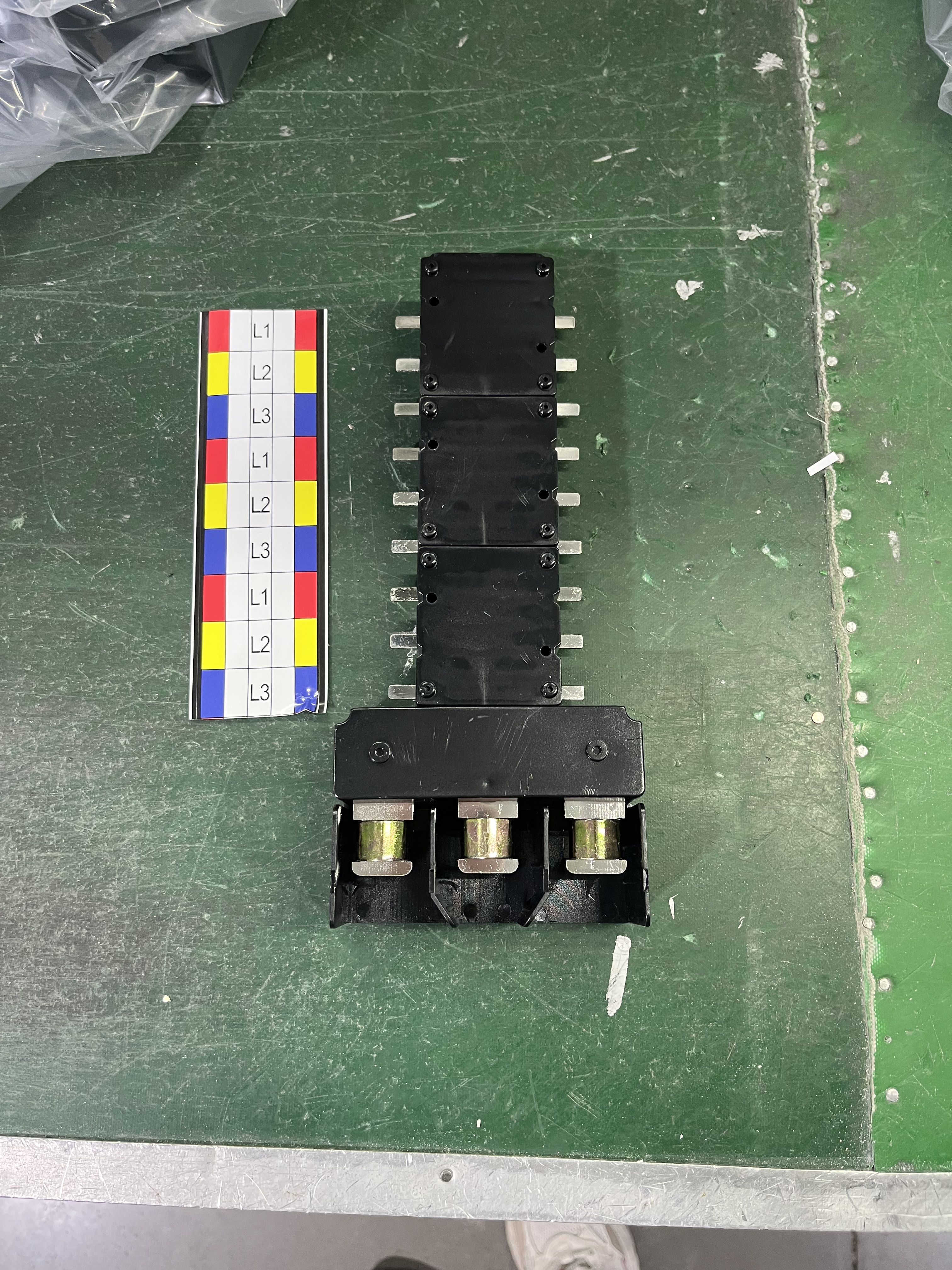
Steel terminal blocks and sheet-metal construction for distribution-box evaluation. Image source: Barfuses.
Terminology check: pan assembly busbar, copper busbar and distribution box busbar
Buyers often see several busbar terms in the same datasheet package. A pan assembly busbar is the busbar arrangement assembled into a pan or modular distribution platform. An MCCB pan assembly busbar is the MCCB-oriented version of that arrangement. A copper busbar describes the conductor material. A distribution box busbar describes the busbar as used inside a distribution box. Related terms in the category include comb busbar, chassis busbar, neutral terminal busbar, earth terminal busbar, feed pillar busbar, plug in busbar, SP pan assembly busbar, DP pan assembly busbar, TP pan assembly busbar, SMDB pan assembly busbar, pre-assembled busbar pan assembly and cabinet pan assembly busbar. These terms are not interchangeable.
For the DB01 and DB02 comparison, the verified distinctions are narrower: DB01 is defined by incoming MCCB or MCB, branch MCB protection, 63A/125A/250A incoming options and 2W–32W. DB02 is defined by an MCCB pan assembly busbar, a steel sheet box body, a copper busbar and 2W–16W. A buyer should ask which of the surrounding busbar parts are included in the quoted configuration, especially where neutral and earth terminal busbars, comb busbars or chassis busbars are required by the project. The answer should come from the quotation and datasheet, not from the category vocabulary.
Market trend analysis: why busbar material and standard evidence are under more scrutiny
The wider busbar market provides context for the evaluation, even though it does not change the DB01 and DB02 fit logic. Precedence Research values the global busbar market at USD 19.83 billion in 2025. The same source reports that copper busbars held 62.8% of the market by material in 2025, while aluminum busbars are forecast to grow at a 6.9% CAGR from 2026 to 2035. That combination points to a market where copper remains the dominant reference material and aluminum continues to be evaluated for weight and cost reasons. For a distribution-box buyer, the practical effect is that material claims in a quotation deserve the same attention as the way count.
Standard evidence is also moving. IEC 61439-6:2025 covers low-voltage switchgear and controlgear assemblies, Part 6: busbar trunking systems, and is listed as active or updated with an effective date of 1 December 2025. This is a busbar trunking standard, not a direct DB01 or DB02 product certificate, so it should not be cited as proof that either distribution box is certified to it. Its relevance is to the broader documentation environment: buyers are increasingly expected to trace a busbar or assembly claim back to a standard, a test scope and a certificate. China also accounts for more than 30% of global copper processing capacity and produces more than 11 million metric tons of refined copper annually, according to Congruence Market Insights. That scale supports supply availability, but it does not remove the need to verify the specific copper busbar and box construction being quoted.
Trend takeaway for buyers: Use market growth and material-share data to justify a stricter material and certificate review. Do not use them to assume that a particular DB01 or DB02 variant has a particular copper content, current rating or certification. Those remain configuration-level questions.
Comparison with traditional solutions: where the DB01 and DB02 logic has boundaries
A traditional fully custom distribution box can be designed around a single project and a fixed incoming device. That flexibility can be useful, but it can also make repeat procurement harder because the box is tied to one layout. DB01 and DB02 offer a more structured evaluation: DB01 fixes the choice around incoming MCCB or MCB, branch MCB protection, 63A/125A/250A and 2W–32W; DB02 fixes the choice around an MCCB pan assembly busbar, steel sheet box body, copper busbar and 2W–16W. The structure is the advantage. It is also the limitation, because a structured range only helps if the project actually fits inside it.
The clearest boundary in this comparison is the DB02 way range. DB02 is stated as 2W–16W. A project that needs more than 16 outgoing ways should not stretch the DB02 claim to cover it; it should evaluate DB01 at up to 32W or another suitable configuration. The second boundary is coordination. DB01 offers incoming MCCB or MCB and branch MCB protection, but that does not remove the need for the project to check short-circuit coordination, discrimination and thermal performance for the actual combination. The third boundary is construction evidence. DB02 has explicit steel sheet and copper busbar facts in the compared content; DB01 does not carry the same construction description here, so the buyer should verify the DB01 variant rather than assume symmetry. A good decision framework states these limits before the purchase order, not after.
Future outlook: what will shape the next evaluation round
The next evaluation round is likely to put more weight on documented configuration data and less on generic category claims. Three signals support that view. First, the busbar market is large and still growing, with copper holding the majority material share and aluminum forecast to grow faster from 2026 to 2035. That makes material selection a live commercial question rather than a fixed assumption. Second, IEC 61439-6:2025 updates the standard landscape for busbar trunking systems, which reinforces the habit of asking for a standard number, a test scope and a certificate rather than a generic compliance statement. Third, China’s scale in copper processing supports supply, but it also means buyers will see many suppliers making similar material claims. The differentiator will be the ability to map a claim to a specific model, configuration and document.
For DB01 and DB02, the future outlook is not that one box replaces the other. The more likely pattern is continued segmentation by incoming device architecture, branch protection approach and way count. DB01 will remain relevant where incoming MCCB or MCB flexibility, branch MCB protection and a 2W–32W range are required. DB02 will remain relevant where an MCCB pan assembly busbar, steel sheet box body, copper busbar and 2W–16W range match the project standard. The buyer who can state those requirements clearly will get a more accurate quotation and a faster technical review.
FAQ: DB01 vs DB02 distribution box selection
What is DB01 in this comparison?
DB01 is a distribution box configuration with incoming MCCB or MCB, branch MCB protection, 63A/125A/250A incoming options and a 2W–32W configuration. Those are the defining facts used in this comparison.
What is DB02 in this comparison?
DB02 is a distribution box configuration with an MCCB pan assembly busbar, a steel sheet box body, a copper busbar and a 2W–16W range. Those are the defining facts used in this comparison.
Which box has the higher circuit way count?
DB01 covers 2W–32W and DB02 covers 2W–16W. DB01 therefore has the higher stated way range in this comparison. A project above 16W falls outside the DB02 range as stated here.
When is DB01 the better fit?
DB01 is the better fit when the project needs incoming MCCB or MCB flexibility, branch MCB protection, one of the stated 63A/125A/250A incoming options, or a way count above 16W up to 32W. The final selection still depends on the project coordination and documentation review.
When is DB02 the better fit?
DB02 is the better fit when the project has specified an MCCB pan assembly busbar, a steel sheet box body and a copper busbar, and the branch schedule sits within 2W–16W. The branch protection arrangement should be verified from the DB02 project datasheet.
Does DB02 support 32 ways?
No, not within the range stated in this comparison. DB02 is stated as 2W–16W. A 32-way requirement should be evaluated against DB01, which is stated as 2W–32W, or against another suitable configuration.
What should a buyer verify before ordering either box?
Verify the incoming device type, the branch protection approach, the circuit way count, the enclosure and busbar construction for the exact variant, the applicable certificate scope, and the project short-circuit and discrimination study. Do not transfer a current rating or material claim from one model to another without written confirmation.
Can DB01 and DB02 be used in the same industrial or commercial building project?
Yes, both are described for industrial and commercial building electric management. They can appear in the same project evaluation, but they should be assigned to different distribution duties according to incoming device, branch protection and way count rather than treated as interchangeable.
Reference and supplier qualification
BARFUSE Electric Co., Ltd. reports OEM and ODM capability, customization across color, logo, material, new design, surface treatment, mold development and packing, a monthly capacity of 8,000 pieces, a lead time of 15–45 days, a MOQ of 1 piece, and 100% test quality control. These are supplier-capability facts for the qualification file. They should be read alongside the product-specific DB01 and DB02 facts, not as a substitute for them. The company also provides a technical catalogue for reference.
Technical reference: Barfuse catalogue PDF.
Market data in this article is attributed to Precedence Research and Congruence Market Insights as provided in the verified data set. Product comparison facts are limited to the DB01 and DB02 content units supplied for this article. Certificate scope should be checked against the exact ordered configuration.
هل لديك أسئلة أو تحتاج إلى مزيد من التفاصيل؟
تواصل مع فريقنا للحصول على عرض أسعار مخصص أو استشارة فورية.
طلب عرض أسعار
املأ النموذج أدناه وسيتواصل معك فريقنا بعرض مقترح مخصص.
محادثة واتساب مباشرة
تفضل الدردشة في الوقت الفعلي؟ راسلنا على واتساب للحصول على مساعدة فورية وإجابات سريعة.
- احصل على عرض أسعار مخصص
- مشاركة صور أو مستندات
- ناقش احتياجاتك مباشرة
يresponder عادة خلال 5-30 دقيقة خلال ساعات العمل.