
DFS Suspension Forks: Capability, Product Line and Buyer Value
The global bicycle suspension system market was valued at approximately USD 0.81 billion in 2025, according to a Mordor Intelligence market report, while carbon fiber forks were reported to account for about 25% of the global fork market in 2024 in industry market coverage. Those two figures frame a sourcing question that importers, assemblers and brand owners now face routinely: a suspension fork is no longer a generic accessory ordered by wheel size alone, but a component whose material, damping architecture and test evidence shape both ride behaviour and market access.
This analysis profiles DFS TECH (SHEN ZHEN) CO.,LTD., also operating as Shenzhen Dongshengchuang Technology Co., Ltd. and selling under the DFS brand, as a mid-sized Chinese suspension fork manufacturer. It examines what the company actually operates, what its product architecture contains, where its engineering capability sits, and which parts of its offer create genuine procurement value for bicycle brands, distributors and assembly factories.
Why Suspension Fork Sourcing Has Become a Technical Decision
Suspension fork procurement is now governed by test categories rather than product labels. ASTM F2274-11(2024) establishes performance requirements and associated test methods for suspension and nonsuspension production forks intended for Condition 3 terrain, and the standard scope identifies compression load, bending load, impact resistance and fatigue testing. ASTM F2273-11 defines mechanical test methods for bicycle forks covering compression load, bending load, impact resistance and bending fatigue life. ISO 4210-6:2023 lists test methods for suspension fork tyre clearance, front fork tensile strength, static bending, rearward impact, bending fatigue with impact, and forks intended for hub or disc brakes.
A United States Consumer Product Safety Commission summary of bicycle standards notes that ASTM, EN and ISO frameworks all contain suspension fork requirements, including tyre clearance testing, while the details vary by standard and by bicycle use condition. The practical implication for buyers is straightforward: a request for quotation that says only mountain bike fork does not define a deliverable. The buyer has to specify the intended use condition, the applicable test method, the tyre clearance requirement, the structural and fatigue test expectations, and the brake or axle configuration.
That shift creates an opening for manufacturers that can participate in structure design and damping tuning rather than assemble purchased parts. It also raises the documentation bar, because a supplier that cannot map its output to a defined test category becomes a compliance risk rather than a cost saving. This is the context in which a manufacturer such as DFS should be evaluated.
Company Profile: What DFS Dongfangsheng Actually Operates
DFS TECH (SHEN ZHEN) CO.,LTD., also operating as Shenzhen Dongshengchuang Technology Co., Ltd., is a manufacturer located in Longhua District, Shenzhen, China. The company was established in 2009 and has more than 15 years of experience in mountain bike suspension fork manufacturing. Its stated business scope is the independent research, development, production and sales of mountain bike suspension forks, and it operates the DFS, CIVET and ROLL brands.
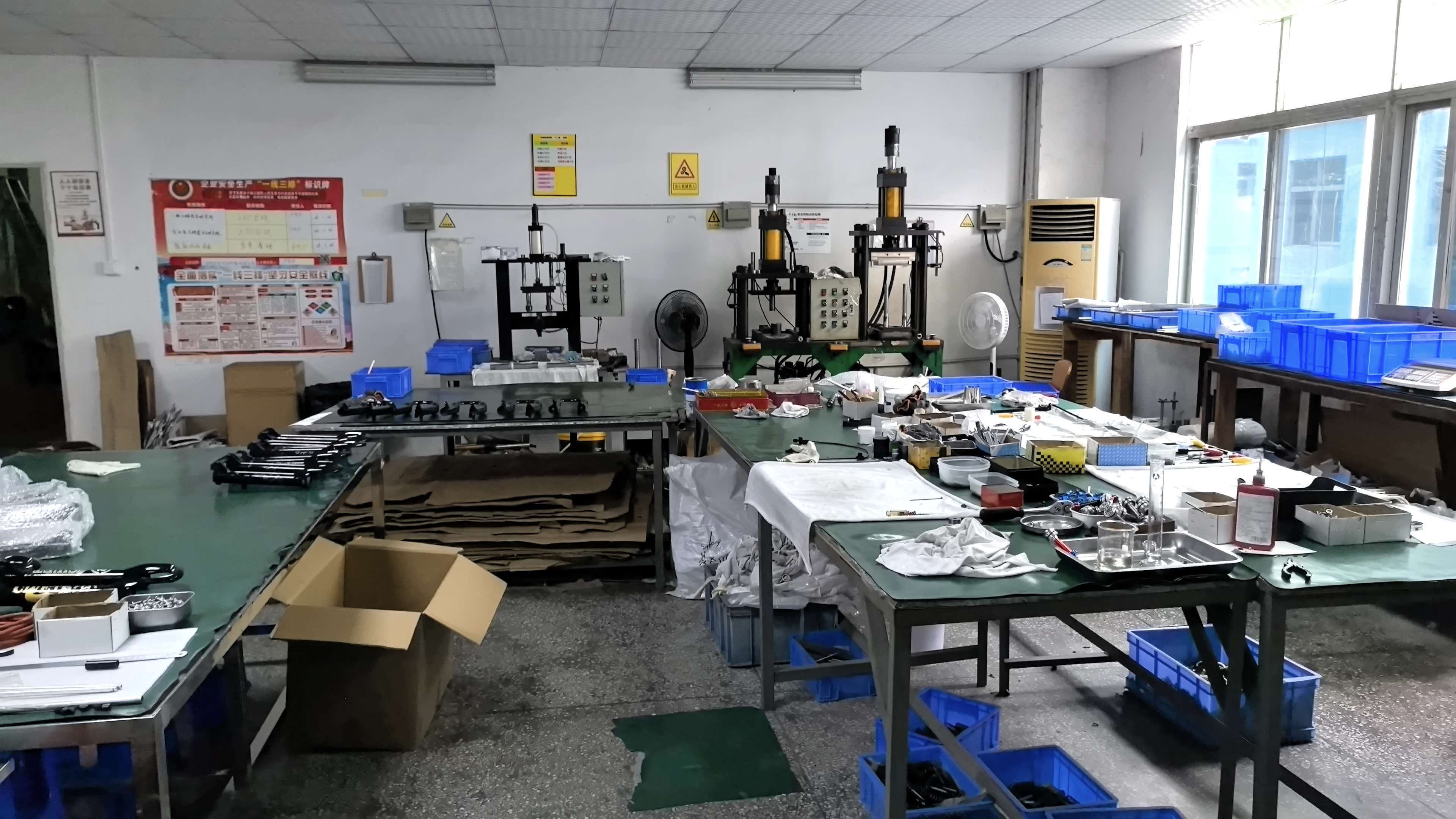
The physical footprint is documented as a 4,000 square metre facility that includes a factory production line, a product quality inspection area, a goods storage area and a parts placement area. The total workforce is approximately 20 to 50 employees. Annual production capacity is stated at 100,000 units, and the company reports producing about 100,000 suspension forks per year. Its engineering resource consists of a five-person research and development team covering structural design, damping tuning and product testing. The company also states that it holds self-developed suspension structure patents and software copyrights, which positions its activity closer to design ownership than to simple OEM assembly.
On the commercial side, export business accounts for approximately 70% of total sales, with the European Union and the United States identified as major markets. Products are supplied to overseas bicycle shops, assembly factories and trading companies, and the company also provides supporting solutions and customized services for cycling clubs and bicycle manufacturers. A B2B platform profile lists company-reported annual revenue in the USD 10 to 50 million range, a figure that should be treated as self-reported information rather than an audited financial statement.
Product Architecture: Air, Carbon and Axle Configurations
The DFS range is built around pneumatic suspension forks for mountain bikes. Main products include suspension forks, air forks and carbon forks, offered in both aluminium alloy and carbon fibre versions. The portfolio covers cross-country and all-mountain categories with a travel range of 100 mm to 150 mm, and the forks are compatible with mainstream 20, 24, 26, 27.5-inch, 29-inch and 32-inch mountain bike frames. Axle configurations span quick-release, standard thru-axle and BOOST thru-axle. All forks in the range support lockout, rebound adjustment, and high-speed and low-speed compression damping adjustment.
Model spotlight: DFS-RLC-TP-RCE-TC-BOOST-15X110
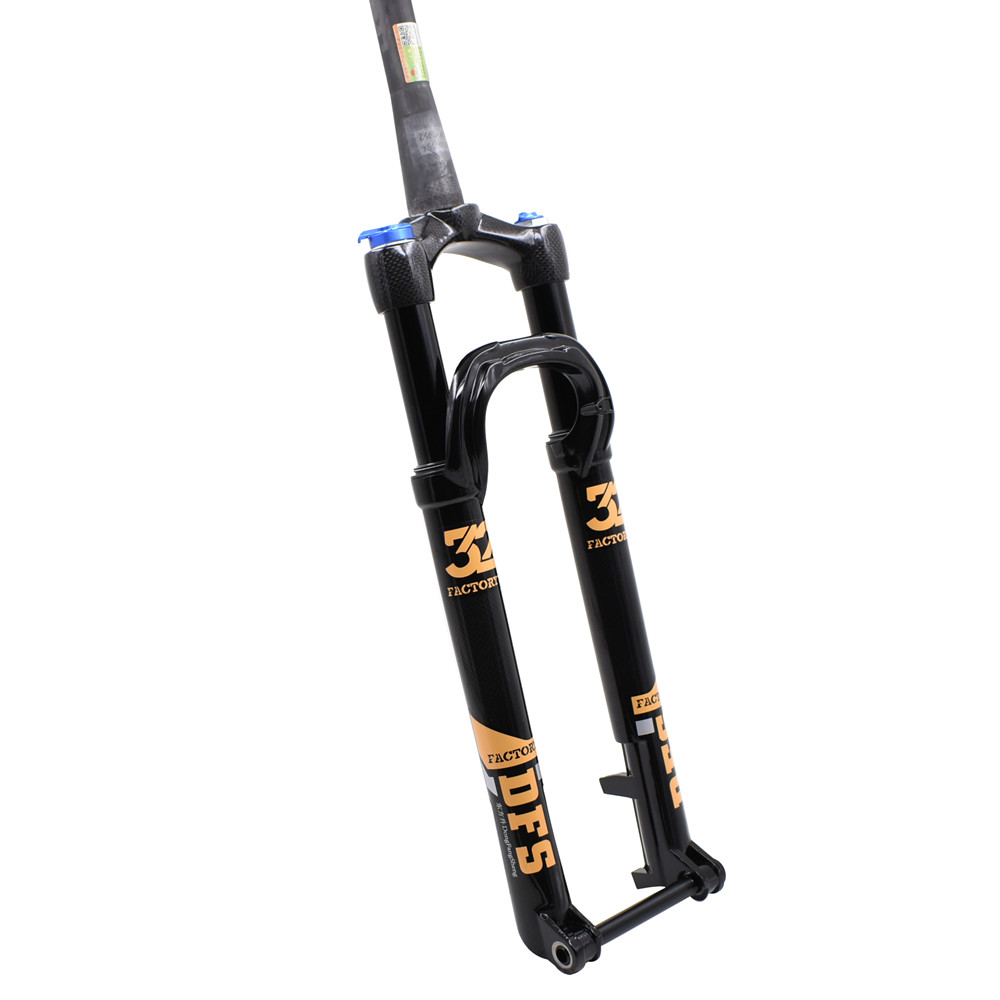
The most fully documented configuration in the available product data is the DFS-RLC-TP-RCE-TC-BOOST-15X110, a carbon bicycle air fork positioned for XC race use. Its published specification is unusually complete for a mid-market catalogue, which makes it a useful reference point for evaluating how the broader range is engineered.
| Parameter | Specification |
|---|---|
| Model | DFS-RLC-TP-RCE-TC-BOOST-15X110 |
| Type | Carbon bicycle air fork, XC Race super light air fork |
| Wheel size | 29 inch |
| Pitch | 125 mm |
| Stanchion | 32 mm AL 7050, hard anodized |
| Steerer tube | Carbon, 39.8 mm to 28.6 mm taper |
| Lower and crown | Carbon |
| Spring | Adjustable air spring |
| Negative spring | Coil plus MCU |
| Bushing | Teflon |
| Lockout | Remote control hydraulic with compression |
| Rebound | Hydraulic adjustable |
| Travel | 100 mm |
| Disc mount | Post |
| Weight | 1.35 kg |
| Axle style | 15 x 110 mm Boost thru axle |
Read as an engineering statement, the specification shows where the mass has been traded. The crown, lower legs and steerer tube are carbon components, and the complete fork is stated at 1.35 kg, which is a meaningful figure for XC race applications where front-end weight affects climbing and steering response. The 32 mm AL 7050 hard anodized stanchions with Teflon bushings address the sliding interface, balancing stiffness with friction reduction. The adjustable air spring carries the rider load, a coil plus MCU negative spring manages small-bump response, and the hydraulic circuit provides remote lockout with compression plus adjustable rebound.
Engineering Capability: Design, Damping Tuning and Quality Control
The distinction that matters in supplier evaluation is whether a manufacturer owns the design and tuning loop or purchases a ready-made platform. DFS states complete capabilities in structural design, damping tuning and product testing rather than simple OEM assembly, supported by a five-person engineering and technical team and by self-developed suspension structure patents and software copyrights. For a buyer, this claim translates into three practical questions: can the supplier modify a structure for a frame requirement, can it adjust damping behaviour for a target ride feel, and can it reproduce that result across a production batch.
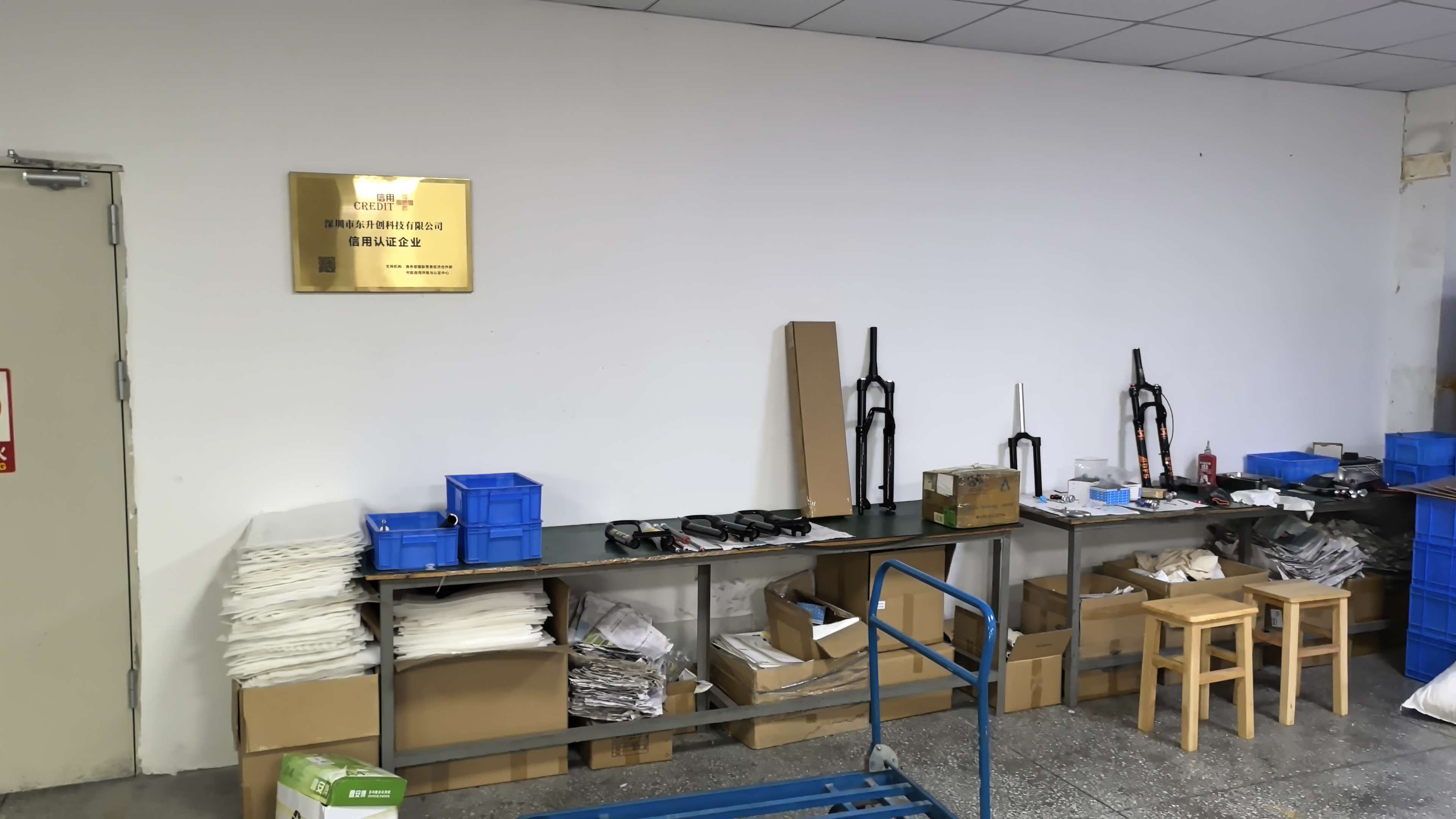
Quality control is described as running from the very beginning to the end of production, with every product fully assembled and carefully tested before being packed in a box. That end-of-line testing model matters most for distributors and assembly factories, because it shifts part of the incoming inspection burden upstream. It does not replace independent laboratory validation, but it reduces the probability that a shipment contains untested units.
Applications and Use Cases
The DFS product line is aimed at the mountain bike and bicycle component industry, where the working condition is mountain trails, unpaved surfaces, off-road riding, and competition conditions involving impacts and changing terrain. The functional role of the fork is to absorb and manage impacts at the front wheel while using the air spring, hydraulic lockout and compression adjustment to support front-end control, handling response and riding stability.
- Cross-country mountain bike racing, where the 100 mm travel and 1.35 kg carbon configuration target low weight and efficient steering.
- All-mountain riding, supported by the 100 mm to 150 mm travel range across the pneumatic fork line.
- Trail and unpaved off-road riding, where compression adjustment and lockout allow the rider to match support to terrain.
- Mountain bike assembly programs and bicycle brand OEM or ODM projects, using the 20 to 32 inch frame compatibility and quick-release, standard thru-axle or BOOST thru-axle options.
- Fork replacement and upgrade programs for bike shops, where specification matching is the critical step.
- Off-road and competition bike development, where damping tuning and structural adaptation are part of the design brief.
The matched equipment set around a fork is also part of the specification: frame, front wheel or wheelset, handlebar and steering components, front axle, and a suspension pump for air pressure adjustment. Before purchasing, the buyer should confirm wheel size, fork travel, steerer, front axle specification, brake mount interface, frame compatibility, air pressure setup and operating environment. Replacement should not be based on the model name alone, a caution that applies equally to aftermarket upgrades and to OEM line changes.
Market Trend Analysis: What the Numbers Signal for Fork Buyers
Two market signals are relevant to procurement planning. First, the global bicycle suspension system market was reported at approximately USD 0.81 billion in 2025, indicating a mature but sizeable component category rather than a niche. Second, carbon fiber forks were reported to hold about 25% of the global fork market in 2024, which points to continued premiumisation of the category and to growing buyer appetite for weight reduction at the front of the bike.
A third signal comes from the standards side rather than the market side. ASTM, EN and ISO frameworks each contain suspension fork test requirements, and the CPSC summary notes that these requirements are related but not automatically interchangeable. Buyers serving multiple regions therefore face a documentation workload that did not exist when forks were specified by wheel size alone. For a manufacturer with 70% of sales exported and the European Union and the United States as major markets, that workload is a permanent operating condition rather than a one-off project task.
At the trade level, bicycle front forks are classified under HS code 8714.91. While this classification does not by itself describe suspension performance, it matters for import planning, duty assessment and customs documentation, and it is a standard field that any supplier quotation should be able to support.
Competitive Position and Supply-Model Comparison
DFS sits in the specialised mid-size manufacturer tier rather than in the tier of global suspension brands or in the tier of trading resellers. That position has a specific profile of strengths and limits, and it is clearest when the three supply models are placed side by side.
| Dimension | Large international suspension brand | Specialised mid-size manufacturer (DFS profile) | Trading reseller |
|---|---|---|---|
| Engineering ownership | Brand-owned research, tuning and test facilities | Five-person R&D team covering structural design, damping tuning and product testing, with self-developed suspension structure patents and software copyrights | Depends on third-party factories; limited design ownership |
| Product scope | Broad, typically including long-travel downhill and enduro segments | Pneumatic forks for XC and AM, 100 to 150 mm travel, aluminium and carbon versions, 20 to 32 inch compatibility | Varies by upstream supplier |
| Capacity and footprint | Global-scale manufacturing and service networks | 4,000 square metre facility, approximately 20 to 50 staff, stated capacity of 100,000 units per year | No manufacturing footprint |
| Customisation | Program-dependent, often tied to large volumes | OEM and ODM support, bulk wholesale and customised service for retailers, assemblers, distributors and clubs | Limited engineering support |
| Compliance documentation | Mature certification portfolios for major markets | Buyer must verify current test reports and conformity documents; third-party certification status was not verified in the available research data | Depends entirely on upstream supplier |
| Best fit | High-volume brand programs requiring global after-sales reach | Mid-volume brand programs, regional distributors, XC and AM builds, custom and upgrade projects | Price-driven sourcing with low engineering requirements |
The boundaries of the DFS position are as important as its strengths. Available research data does not include independently verified ISO or EN certification numbers for the company, so compliance must be established document by document by the buyer rather than assumed from the product range. The scale of the operation, at roughly 20 to 50 employees and a 4,000 square metre facility, is also modest relative to global suspension brands, which affects how much concurrent program capacity a single supplier can absorb. The stated 100,000 unit annual capacity and the USD 10 to 50 million revenue range are company-reported figures carried at medium confidence, not audited outcomes.
Product scope has a further limit: the pneumatic fork line covers cross-country and all-mountain categories from 100 mm to 150 mm travel. That does not extend to downhill, freeride or long-travel enduro applications, where different structural and damping requirements apply. Independent product-level performance data for the range, such as measured stiffness, fatigue life or damping curves, was also not available in the research material, which means performance claims should be validated through samples and test reports before volume commitments.
Buyer Value: What Is Worth Recommending, and What to Verify
On the evidence available, the procurement case for DFS rests on specialisation and engineering participation rather than on scale or brand prestige. The company has spent more than 15 years in mountain bike suspension fork manufacturing, and its facility is organised around the process steps that matter for fork production, including a production line, an inspection area, storage and parts placement.
- Design ownership: self-developed suspension structure patents and software copyrights, with in-house structural design, damping tuning and product testing rather than simple assembly.
- Range coverage: pneumatic forks from 100 mm to 150 mm travel across XC and AM categories, in aluminium alloy and carbon fibre versions.
- Frame and axle compatibility: 20, 24, 26, 27.5, 29 and 32 inch frame compatibility, with quick-release, standard thru-axle and BOOST thru-axle options.
- Adjustment features across the line: lockout, rebound adjustment, and high-speed and low-speed compression damping adjustment on all forks.
- Weight position in the carbon range: the DFS-RLC-TP-RCE-TC-BOOST-15X110 is stated at 1.35 kg with carbon crown, lower legs and steerer tube.
- Quality process: quality control from the start to the end of production, with every product fully assembled and carefully tested before packing.
- Export orientation: approximately 70% of products exported, with the European Union and the United States as major markets.
The verification checklist that follows from the same evidence is equally specific. Confirm the intended bicycle use condition and the test categories that apply to the destination market. Request current test reports and conformity documents rather than a certification statement. Define wheel size, travel, steerer, front axle, brake mount and frame compatibility in writing before sampling. Validate damping behaviour and air pressure setup on a sample matched to the rider and terrain. Treat capacity and revenue figures as supplier-reported inputs and plan a buffer if the program overlaps with other production.
For readers who want the full specification set, the company publishes its 2026 air suspension fork brochure as a downloadable reference: DFS Air Suspension Fork 2026 brochure.
Future Outlook
Three directions are likely to shape the suspension fork supply base over the next product cycles. The first is material mix: with carbon fiber forks reported at about 25% of the global fork market in 2024, weight reduction remains a live buying criterion, and manufacturers that can produce carbon crown, lower and steerer assemblies at a controlled cost will be better positioned for XC and light all-mountain programs. The second is documentation discipline. As ASTM, EN and ISO frameworks continue to define suspension fork test categories separately, the ability to map a product to a specific test method and destination market becomes a supplier qualification requirement rather than a paperwork formality.
The third is customisation depth. Assembly programs, brand OEM and ODM projects, fork replacement and upgrade channels, and off-road competition development all require specification matching rather than catalogue ordering. A manufacturer with in-house structural design and damping tuning can respond to those requests; a trading reseller generally cannot. DFS occupies a position where this capability exists at a scale suited to mid-volume programs, which is a durable niche as long as compliance evidence keeps pace with the export markets that generate 70% of its sales.
FAQ
What parameters should be focused on when selecting a bicycle suspension fork?
The core selection parameters are travel, stanchion diameter, wheel size and damper type, and the choice should be matched to the intended usage scenario. Short travel suits cross-country riding, while longer travel is used for more aggressive terrain. Coil spring designs are cost-effective, while air spring designs are lightweight.
How does the factory carry out quality control and product testing?
Quality control is carried out from the very beginning to the end of production. Every product is fully assembled and carefully tested before it is packed in a box.
Which riding categories and specifications does the DFS suspension fork range cover?
The range consists of pneumatic suspension forks covering cross-country and all-mountain categories with travel from 100 mm to 150 mm. It includes aluminium alloy and carbon fibre versions and is compatible with mainstream 20, 24, 26, 27.5-inch, 29-inch and 32-inch mountain bike frames. Axle configurations cover quick-release, standard thru-axle and BOOST thru-axle, and all forks support lockout, rebound adjustment, and high-speed and low-speed compression damping adjustment.
What should be confirmed before replacing a fork on an existing bicycle?
Before purchasing, confirm wheel size, fork travel, steerer, front axle specification, brake mount interface, frame compatibility, air pressure setup and the operating environment. Replacement should not be based on the model name alone.
What share of production is exported, and to which markets?
Approximately 70% of products are exported, and export business accounts for 70% of total sales. Major markets include the European Union and the United States. Products are supplied to overseas bicycle shops, assembly factories and trading companies.
This article uses company-reported facts from the DFS corpus and third-party standards and market references where indicated. Certification status, capacity figures and revenue ranges reflect sourcing-stage information and should be verified during supplier qualification.