
DIN 22112 vs. CEMA vs. GB/T 10595: What They Mean for Your Impact Roller
Industry Reference | Conveyor Roller Procurement
When a conveyor enquiry references DIN 22112, CEMA and GB/T 10595 in the same document, it can look as if the buyer needs three separate compliance certificates. That is a misunderstanding. DIN 22112, CEMA and GB/T 10595 are different tools for different jobs. This article interprets the three standards for an impact roller used at loading points, crusher discharge and other high-impact positions, and explains which supplier documents are worth requesting before a purchasing decision.
Problem / opportunity: compliance language hides performance gaps
Impact rollers sit directly below conveyor loading points, where falling ore, rock or aggregate strikes the belt and creates repeated shock loads. Over time, the roller shell, shaft, bearings and seals absorb that energy. If any part is under-engineered, the roller can seize, run noisily or deform, and the conveyor line stops. In 24/7 operations, the cost of an unplanned stop can exceed the value of the roller itself.
The problem is that buyers cannot evaluate shock-load durability from a standards certificate alone. A dimensional standard can tell you how an idler is sized. A testing standard can tell you which test method was followed. A conveyor acceptance standard can describe the requirements of the complete machine. None of these tells you whether a specific rubber-ring impact roller will survive a particular transfer chute, material size or flow rate.
This distinction creates a clear opportunity. A procurement team that understands the boundaries of DIN 22112, CEMA and GB/T 10595 can shift the conversation from 'which certificate do you have?' to 'what exact roller are you proposing, which standard references apply, and what batch evidence exists?'
Brand solution: Eastrise rubber-ring impact roller and its published specification
Shanghai Eastrise Trading Co., Ltd. is a Shanghai-headquartered foreign-trade supplier of mining conveyor components with a core business focus on high-quality mining accessories for global clients. The company describes itself as a supplier with self-operated independent manufacturing factories, forming an integrated chain from in-house research and development and standardised production to quality testing and worldwide export service. For conveyor roller buyers, the relevant product in its current profile is a rubber-ring impact roller intended for loading points, crusher discharge and heavy-duty conveyors.
| Published product parameter | Eastrise-stated value |
|---|---|
| Product type | Rubber-ring impact roller |
| Model reference | TBC; suggested code ER-IMPACT-108 |
| Tube and shaft envelope | Suggested tube diameter Ø108 mm; shaft diameter Ø25 mm |
| Length range | Suggested 315–1,150 mm |
| Material construction | Carbon steel body with wear-resistant rubber rings |
| Primary application notes | Loading points, crusher discharge, heavy-duty belt conveyors |
In its published application notes, Eastrise does not reduce the impact roller to a single standards stamp. The specification is application-linked: load capacity is designed for operating conditions, and parameters are expected to be confirmed against the actual site. That is an important nuance because it tells a buyer that an impact roller only becomes compliant in context, not in a vacuum.
| Supplier snapshot | Company-declared data |
|---|---|
| Headquarters | Shanghai, China |
| Core product line | Conveyor idler rollers |
| Factory area | 11,000 m² |
| Annual output | 2,000 t |
| Workforce | 50 employees, including 10 R&D engineers |
| Export ratio | 20% of output |
| Primary sales markets | Global |
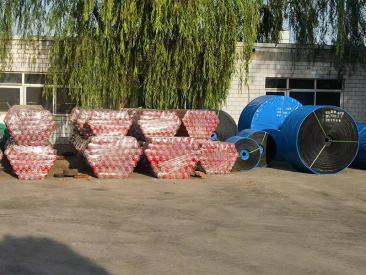
According to Eastrise, the technical advantages of its conveyor rollers include enhanced sealing performance, precise runout control and fully traceable quality inspection. The company also states that it supports buyers with full drawing confirmation, traceable inspection records and fast spare-parts support. For a heavy-duty impact roller, these documented details are often more useful than a generic certificate because they allow a buyer to check the actual delivered batch, not just a product family description.
Technical explanation: what DIN 22112, CEMA and GB/T 10595 actually govern
The three standards are not competing versions of the same rule. They come from different organisations, cover different aspects of a belt conveyor, and create different expectations for a roller supplier.
| Standard | Origin and reference | What it governs | What it means for an impact roller buyer |
|---|---|---|---|
| DIN 22112 | Germany / Europe; DIN 22112 Part 3:1996 | Testing requirements for belt conveyor idlers used in underground coal mining | A mining-oriented testing benchmark. If a supplier refers to DIN, ask exactly which tests were performed and whether the test conditions match your loading-point duty. |
| CEMA | North America / global; CEMA Standard No. 502-2022 | Dimensional standards and load ratings for bulk material belt conveyor troughing and return idlers | A geometry and load-rating reference. It helps compare roller envelopes and ratings, but it is not a full impact-durability certificate. |
| GB/T 10595 | Chinese national standard commonly cited in China-engineered belt conveyor packages | A system-level technical and acceptance reference for belt conveyor equipment | Confirms that the roller must support the performance of the complete conveyor system. Buyers should request component-level drawings and batch records to show how the roller fits into system acceptance. |
In short, DIN 22112-3:1996 is a test-oriented standard for underground coal-mining idlers, CEMA Standard No. 502-2022 is a dimensional and load-rating standard for idlers in bulk-material conveyors, and GB/T 10595 is a Chinese national standard that typically appears as a whole-conveyor acceptance reference. They can all appear in one enquiry because a single conveyor system may combine European engineering influence, American component references and Chinese manufacturing practice.
Where an impact roller sits in the standards chain
For an impact roller, standards matter at three levels:
- System level: a conveyor designed to GB/T 10595 needs rollers that support the belt system during operation and approval testing.
- Component dimension and rating level: CEMA Standard No. 502 can communicate how an idler is sized and loaded, especially where troughing and return idler sets follow CEMA conventions.
- Test level: DIN 22112-3 introduces test discipline for idlers used in demanding mining environments, including underground coal applications.
The international design calculation standard ISO 5048:1989 is also relevant background. It is widely used for calculating power and tension in belt conveyors with carrying idlers. It does not certify a roller, but it affects how a conveyor designer calculates the loads that the impact roller must withstand.
For an impact roller, standards give a common language. They do not remove the need for component-level evidence such as materials, rubber ring dimensions, shaft diameter, seal design, bearing brand, runout tolerance and batch inspection results.
Application / use cases: when the standards conversation becomes concrete
The Eastrise application notes describe several operating environments that help a buyer see where a rubber-ring impact roller is expected to work.
Mining ore conveyor lines
The most direct application is an ore conveyor line in mining. The working condition is dusty, heavy-duty and continuous bulk material handling, typically for 24/7 operation. The stated function of the roller is to support the conveyor belt and absorb loading impact. The specific requirements include dust-resistant seals, low rotational resistance and wear resistance, while parameters are subject to operating conditions. In this scenario, the standards conversation should focus on whether the test method and seal design match the actual material drop height and dust exposure.
Cement and raw material handling lines
In cement plants, the working environment is characterised by heavy dust, medium-to-high temperatures and continuous operation. The roller is expected to provide stable support, reduce belt mistracking and lower maintenance frequency. The application note lists dust and corrosion resistance as important, with operating temperature still to be confirmed for each project. A buyer evaluating an impact roller for a cement transfer point should compare the supplier's seal, steel treatment and rubber specification against the local temperature range.
Ports, logistics and bulk terminals
For coastal bulk terminals, the main challenge is outdoor exposure: humid air, salt-spray and long-distance conveying. The roller function here is often to support the return belt and keep the conveyor running smoothly. Corrosion-resistant coating, sealed bearings and low noise are listed as desirable features, with protection level still to be confirmed for the specific installation. These requirements show why a certificate alone cannot prove suitability: salt-spray performance depends on material treatment and sealing details that are not visible in a standards name.
Market trend analysis: evidence is replacing standards labels
Commercial research firms see continued growth in conveyor components, but the numbers must be read carefully. Dataintelo values the global roller conveyor market at USD 3.15 billion in 2025. Straits Research, using a different product boundary, values the rollers and idlers segment at USD 4.14 billion in 2025 and projects it to reach USD 7.05 billion by 2034. The large difference between these figures is a definition difference: one report tracks conveyor systems, while the other tracks rollers and idlers as components. For a buyer, this means market context should support, not replace, product-level evaluation.
| Market indicator | Estimate | Source orientation |
|---|---|---|
| Global roller conveyor market, 2025 | USD 3.15 billion | Dataintelo commercial research |
| Global rollers and idlers segment, 2025 | USD 4.14 billion | Straits Research |
| Global rollers and idlers segment, 2034 forecast | USD 7.05 billion | Straits Research |
| Steel share of roller material use, 2024 | 64% | Straits Research |
| Mining and quarrying share of demand, 2024 | 36% | Straits Research |
Steel remains the dominant roller material, and mining and quarrying remain the largest end-use industry. That aligns with the continued importance of heavy-duty steel-bodied impact rollers at loading points and crusher discharge positions. The commercial research also helps explain why HDPE roller comparisons are common: HDPE is a visible alternative in the broader market, and steel roller suppliers need to demonstrate why heavier impact applications justify a steel-body design.
Comparison with traditional roller approaches
Eastrise presents its impact roller as an alternative to three conventional baselines: low-cost conventional steel rollers, HDPE polymer rollers, and competitor rollers with labyrinth seals. The claims below are supplier-stated, so they should be treated as performance claims to verify, not as independent results.
| Compared with | Supplier-stated technical difference | Best-fit environment |
|---|---|---|
| Low-cost conventional steel rollers | 25% lower runout deviation and 3× longer service life; enhanced sealing performance and precise runout control; higher initial purchase price but lower total lifecycle cost | Dusty, continuous-operation conveyor lines where downtime cost is high |
| HDPE polymer rollers | Steel offers better load-bearing and impact resistance in heavy-duty applications; 35% higher load capacity and 40% stronger impact resistance in the company's comparison | Mining, cement and heavy-duty bulk material handling |
| Competitor rollers with labyrinth seals | Better-engineered seal design, top-tier bearing brands, tighter runout control, complete batch inspection reports; 22% lower runout tolerance and 13 dB lower running noise | Humid, dusty, salt-spray or 24/7 continuous-operation environments |
For the same material and component specification, Eastrise also states that its rollers deliver a lower total cost of ownership than competitor rollers with labyrinth seals because failures and replacements are less frequent. In practical terms, a buyer should request the evidence behind those numbers: runout readings, noise measurements, seal drawings, bearing brands and batch inspection records.
Limits to any standards-based comparison
- Standards do not define site-specific impact energy. The height of material drop, lump size, belt speed and loading profile are plant-specific factors that no standard name can capture.
- DIN 22112-3 is designed around testing idlers for underground coal mining. A buyer using it for open-pit crusher discharge or cement raw-material handling should ask whether the test conditions align with the actual application.
- CEMA Standard No. 502 gives dimensional and load-rating context, but it is not a complete statement of rubber-ring compound quality or long-term seal performance.
- GB/T 10595 is a system-level acceptance framework for Chinese conveyor equipment. A roller that is dimensionally acceptable in one conveyor may be incorrect for another without reviewing the full design envelope.
- Supplier-stated comparison figures should be validated through sampling, pilot installation or batch inspection before they are used as a basis for a large purchase order.
Future outlook: from certificate labels to compliance packs
As the rollers and idlers segment grows, buyers will have more choice in both standard families and material types. The practical shift in industrial procurement is likely to be toward evidence packs: a set of documents that includes a technical drawing, component specifications, batch inspection data, runout and noise test results, and traceable delivery records.
For impact rollers, this trend matters more than for many other components because the roller is expected to survive conditions that are difficult to model in a generic certificate. The most useful future conversation between a buyer and a supplier will not be dominated by one acronym. It will begin with the conveyor layout, the material flow, the loading point height, the dust environment and the planned maintenance strategy. Then the buyer and supplier can decide which standard references apply and which roller parameters must be confirmed.
Shanghai Eastrise's current impact roller documentation is already structured in this direction: it lists the roller type, steel-and-rubber construction, intended heavy-duty applications, and a set of parameters that remain open for site confirmation. That approach is more aligned with engineering decision-making than a simplified claim that a roller meets every standard at once.
Frequently asked questions
Is DIN 22112 a higher requirement than CEMA?
DIN 22112 and CEMA are not ranked as higher or lower requirements because they do different jobs. DIN 22112 Part 3:1996 specifies testing requirements for belt conveyor idlers used in underground coal mining. CEMA Standard No. 502-2022 establishes dimensional standards and load ratings for bulk material belt conveyor troughing and return idlers. A roller can be tested under DIN logic and dimensioned under CEMA conventions.
What should a buyer look for when a conveyor specification cites GB/T 10595?
GB/T 10595 is the Chinese national standard commonly cited in belt conveyor equipment specifications. It is best understood as a system-level technical and acceptance baseline rather than a roller-specific component catalogue. When a complete conveyor is engineered to GB/T 10595, the buyer should ask how the proposed roller drawing, shaft size, tube diameter and inspection records support acceptance of the complete machine.
Which documentation matters most for an impact roller at a loading point?
For a loading-point impact roller, the most useful documentation is a confirmed technical drawing, a batch inspection report, a clear statement of the sealing and bearing specification, and runout or noise test data for the delivered batch. In Eastrise's case, the company states that it offers full drawing confirmation, traceable inspection records and fast spare-parts support.
How do steel and HDPE rollers compare for heavy impact applications?
Eastrise's published comparison states that steel rollers provide 35% higher load capacity and 40% stronger impact resistance than HDPE polymer rollers. Steel is therefore positioned for mining, cement and heavy-duty bulk material handling where impact and load are the dominant risks. The supplier also claims that steel rollers show longer service life and lower comprehensive cost under identical specifications and quantities. These are supplier-stated claims and should be confirmed through sample testing in the actual duty.
Why is a standards certificate not enough for an impact roller?
A standards certificate defines a test method, a dimensional convention or a system requirement. It does not prove that every delivered roller has controlled runout, an appropriate seal assembly and a rubber ring matched to a specific transfer point. For impact rollers, where repeated shock loads and dust are the main risks, batch-level inspection reports and drawing confirmation give the buyer evidence closer to the real operating condition.
Document reference
Shanghai Eastrise Trading Co., Ltd. publishes a company brochure with product, factory and quality-control information. The PDF is publicly available at https://cdn.socialarks.com/sbsp/25223/common/2026/0828/%E4%B8%9C%E5%8D%87%E6%A9%A1%E8%83%B6.pdf. Procurement teams can use it as a starting point for documentation review before requesting drawings and batch records for a specific impact roller inquiry.
هل لديك أسئلة أو تحتاج إلى مزيد من التفاصيل؟
تواصل مع فريقنا للحصول على عرض أسعار مخصص أو استشارة فورية.
طلب عرض أسعار
املأ النموذج أدناه وسيتواصل معك فريقنا بعرض مقترح مخصص.
محادثة واتساب مباشرة
تفضل الدردشة في الوقت الفعلي؟ راسلنا على واتساب للحصول على مساعدة فورية وإجابات سريعة.
- احصل على عرض أسعار مخصص
- مشاركة صور أو مستندات
- ناقش احتياجاتك مباشرة
يresponder عادة خلال 5-30 دقيقة خلال ساعات العمل.