
DOCOD V2000 CIJ Printer Across Food, Beverage, Pharma Lines
DOCOD V2000 CIJ Printer Across Food, Beverage, Pharma Lines
Packaging lines in the food, beverage and pharmaceutical sectors treat coding as a compliance function rather than a decorative one. A date, batch or serial number printed on a carton, bottle, cap or label is frequently the only physical record that connects a finished pack to the batch and shift that produced it. That makes printer selection a question of production risk rather than printing convenience, and it explains why buyers in the evaluation and execution stages ask for substrate lists, protection ratings and data-format support before they discuss price.
The DOCOD V2000 Series Continuous Inkjet Printer is a small-character CIJ printer positioned for exactly that role. It uses a SUS 304 stainless steel casing with IP65 protection, prints between one and five lines, reaches a maximum printing speed of 334 m/min, and supports dynamic barcodes, dynamic QR codes and database-driven printing. Its manufacturer, DOCOD Precision Group Co., Ltd. (www.docod-group.com), was founded in 2008 and develops, produces and services industrial coding, marking and inspection equipment, including continuous inkjet printers, thermal inkjet printers (TIJ), piezoelectric high-resolution printers (PIJ), drop-on-demand large-character printers (DOD), thermal transfer overprinters (TTO), laser marking machines and inline vision inspection systems.
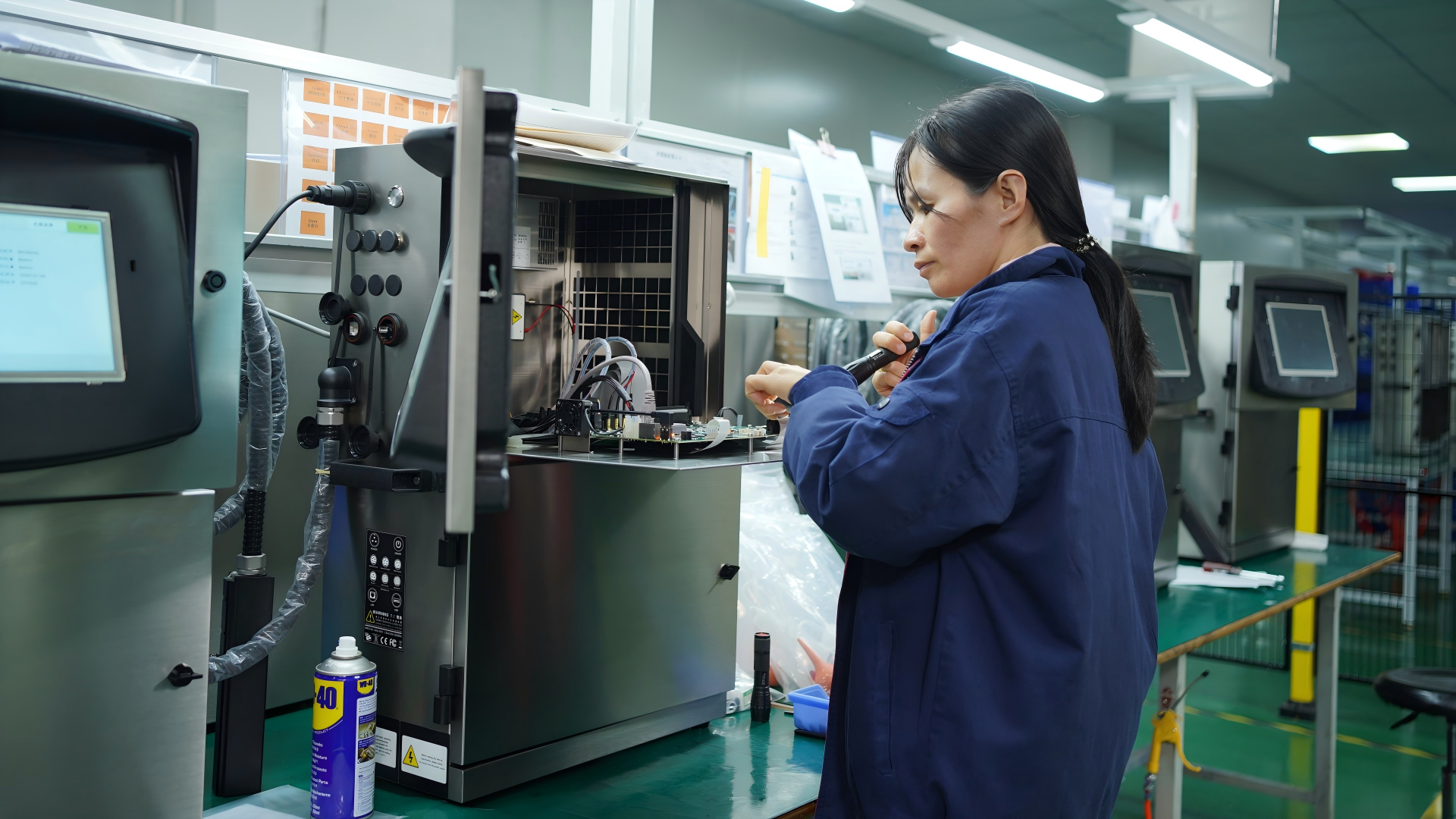
Assembly and function testing of coding equipment ahead of line deployment.
Why Food, Beverage and Pharmaceutical Lines Frame Coding Differently
Three packaging environments share one physical operation - printing a code onto a moving pack - but they impose different constraints on the machine that performs it.
Beverage bottling is a wet, fast and repetitive environment. PET bottles, glass containers and cans pass the coding station at high speed, often after rinsing and filling, and residual moisture or condensation on the container surface can interfere with ink adhesion. This class of line is addressed by food-grade, high-adhesion and oil-resistant ink options, by a print distance of 3-30 mm that lets the printhead be mounted clear of splash zones, and by a maximum printing speed of 334 m/min measured at 5 dots in 1 line with 0.5 dot spacing.
Food production lines usually print on the secondary package: cartons, trays, food and gift boxes and plastic containers. The dominant content is date and lot information, and the working environment is shaped by cleaning routines. A printer positioned near a washdown area has to tolerate water jets and dust rather than being treated as a fragile office device, which is the practical purpose of an IP65 rating combined with a stainless steel housing.
Pharmaceutical and healthcare packaging raises the density of printed information. Batch number, expiry date, serial data and a machine-readable 2D code may all need to fit inside a small area, and the code is read downstream by a scanner rather than by a person. Up to five print lines at a height of 2-16 mm, combined with QRCode, DataMatrix, MicroQRCode, PDF417, PDF-417TRUNC and MICROPDF417 code families, is the combination this sector normally tests before committing to a model.
Daily chemical and cosmetic packaging sits between these poles: plastic bottles, caps and cartons, glossy or coated surfaces, and lot coding that must remain legible after handling and transport.
The common thread is that the printer is no longer a stand-alone marker. It sits inside a data workflow that begins with a production order and ends with a code a retailer, a regulator or a hospital can read.
What the V2000 Series Brings to a Packaging Line
The published specification of the V2000 is the practical starting point for a line-fit assessment, because most of the arguments for or against a CIJ model are decided by print geometry, speed and environment rather than by brand language.
| Specification point | DOCOD V2000 Series Continuous Inkjet Printer |
|---|---|
| Printhead duct | 3 m |
| Nozzle specification | 60u |
| Printing distance | 3-30 mm |
| Printing height | 2-16 mm |
| Printing lines | 1-5 lines |
| Max. printing speed | 334 m/min (5 dots in 1 line, 0.5 dot spacing) |
| Counter | Up to 24 counters |
| Ink type | High adhesion, high temperature resistance, food grade, oil resistance, dye ink |
| Printing materials | Carton, plastic, cable, metal, boarding, pipe, stone, glass, electronic components, auto parts, industrial chemical packaging, medical and food/gift box |
| Print content | Text, time, date, logo, shift, SN, dynamic barcode/QR code, dynamic serial data, dynamic database |
| Protection level | IP65 |
| Casing material | SUS 304 stainless steel |
| Operation system / display | Embedded Linux security operating system; 10.1-inch capacitive touch display, 1280 x 800 |
| Communication / external interfaces | USB, RS232, network port, connected to enterprise MES management system; photocell, encoder, alarm light, information control |
| Power / rated power | Input 100-240 V AC; 100 W |
| Working environment | Temperature 0-45 degrees C / humidity 30-70 percent Rh |
| Net weight / dimensions | 18 kg; casing 384.50 x 315.50 x 508.64 mm; printhead diameter 41.40 x 262.00 mm |
| Certificates | CE, RoHS |
Three of these values drive most line-fit discussions. The first is print geometry: a height range of 2-16 mm and a distance window of 3-30 mm give an integrator room to mount the printhead on a bracket above a conveyor without crowding the product, while a 3 m printhead duct separates the cabinet from the coding point on congested lines. The second is content density: one to five lines at up to 24 counters suits batch, date, shift and serial content that changes between production runs. The third is consumable selection, because the code quality on a PET bottle, a coated carton and a metal can is decided by the ink-substrate pair rather than by the printer alone.
Matching Substrates to Sector Requirements
The material list of the V2000 covers carton, plastic, cable, metal, boarding, pipe, stone, glass, electronic components, auto parts, industrial chemical packaging, and medical and food or gift box surfaces. Mapping that list onto regulated packaging sectors produces a practical view of where the model belongs.
| Sector | Typical surfaces on the line | Typical code content |
|---|---|---|
| Beverage | Plastic (PET), glass, metal, carton | Batch, date, dynamic QR code, serial data |
| Food packaging | Carton, food and gift box, plastic | Date, lot, shift, barcode, dynamic database |
| Pharmaceutical and healthcare | Carton, medical packaging, plastic, glass | Batch, expiry, DataMatrix, MicroQRCode, serial numbers |
| Daily chemical and cosmetics | Plastic bottles and caps, carton | Lot, date, 2D code |
| Cable, pipe and building materials (adjacent) | Cable, pipe, metal, boarding, stone | Meter marks, specification, date, serial data |
The table is deliberately conservative. A printer that appears on a material list is a candidate, not a confirmed solution: the acceptance step for any regulated line remains a printed sample on the actual pack, assessed for contrast, adhesion and scanner readability after the handling the pack will receive.
IP65, Stainless Steel and the Reality of Washdown Areas
For food and beverage buyers, the environmental specification often carries more weight than the print specification. An IP65 rating means the enclosure is dust tight and protected against water jets, and a SUS 304 stainless steel casing resists the corrosion that accompanies repeated cleaning in a production hall. Together they define a printer that can be mounted in the working zone rather than hidden in an adjacent room.
The boundary matters as much as the rating. IP65 is not an immersion rating, and the stated working environment of 0-45 degrees C at 30-70 percent relative humidity means that a printer placed directly in a steam-saturated or constantly condensing zone may need repositioning rather than a stronger enclosure claim. Printhead alignment is a second practical limit: because the working print distance is 3-30 mm, any bracket vibration or product bounce that pushes a carton outside that window shows up as code distortion long before the printer itself reports a fault.
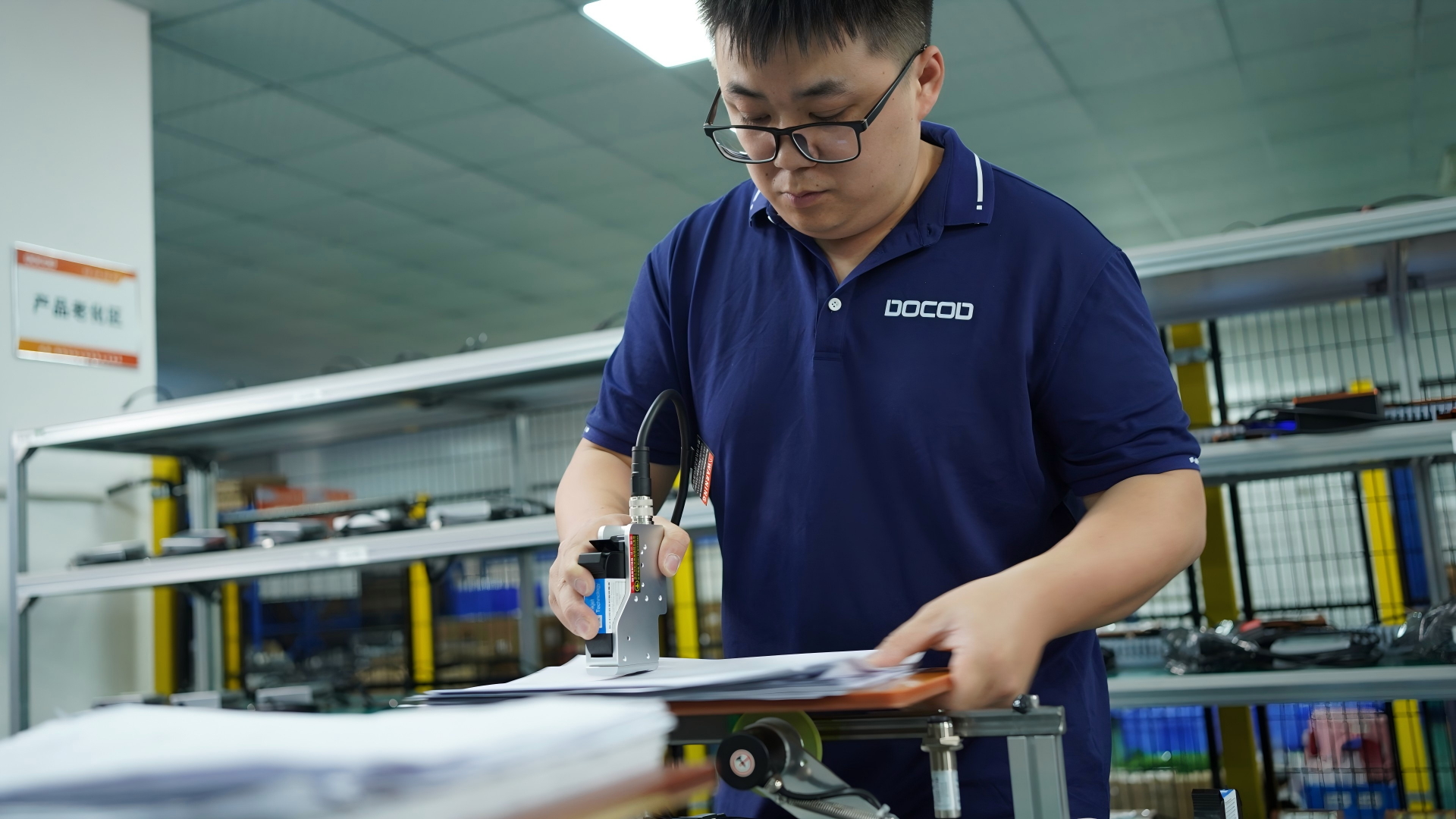
Printhead and assembly inspection: mounting geometry determines whether a code stays inside the 3-30 mm working distance.
Dynamic Codes, GS1-Style Data and MES Integration
Traceability requirements have shifted the coding task from static text to variable data. The V2000 supports dynamic barcode and QR code printing, dynamic serial data and dynamic database content, and its barcode set includes CODE11, C25INTER, CODE39, EXCODE39, EAN13, EAN13x, CODE128, CODE16K, CODE49, CODE93, Flattermarken, UPCA, UPCE, EAN14, VIN, NVE18 and ITF-14. Its 2D families include QRCode, DataMatrix, MicroQRCode, PDF417, PDF-417TRUNC and MICROPDF417.
That capability matters because the direction of packaging standards is toward data-rich codes. GS1 has been advancing the GS1 Digital Link standard, referenced as ISO/IEC 18975:2024, to move from one-dimensional barcodes toward QR codes for point-of-sale and traceability use by 2027. For a printer to remain useful through that transition, it has to accept database-driven content and expose interfaces a factory system can call, which is why the network port, USB and RS232 connections and the ability to link to an enterprise MES management system matter more than the raw character count.
A note of discipline for buyers: supporting a code family is not the same as being certified against a retailer or regulator grading scheme. Code format, module size, quiet zone and print quality should be validated against the receiving party's specification before a line is committed, and the printer's 10.1-inch touch interface and 40-plus language support simply make that configuration work manageable for operators on multi-shift lines.
Deployment Evidence from Beverage Bottling
The clearest published evidence of the V2000 in a regulated packaging environment is a beverage bottling plant in Vietnam, where four lines use the model for batch coding on PET bottles. The installation has been running for two years and is described as providing stable daily coding, with suitability for high-speed lines cited as the highlight. For an evaluation-stage buyer, the two-year runtime is the relevant data point: it indicates that the combination of ink, printhead geometry and line speed holds up under daily production rather than only in a demonstration.
That case does not, on its own, prove fitness for pharmaceutical cartons or dairy washdown zones. It should be read as evidence about line stability in a wet, fast beverage setting, and paired with a substrate trial for the specific pack being coded.
Where Continuous Inkjet Is Not the First Choice
A CIJ printer is one option among several, and the honest comparison is about which surface and which code density the line actually carries.
Inside a vertical form-fill-seal machine, where the code is applied to flexible film during the packaging cycle, the intermittent thermal transfer overprinter is the conventional match; DOCOD manufactures the R3000 Series Industrial Thermal Transfer Overprinter for high barrier film, stick packaging, sealed bags and metallized or decorative labels, with GS1 Data Matrix, dynamic QR code and serial-number content at a 300 dpi resolution. CIJ is not normally the technology that competes in that position.
Where a coated or corrugated box needs dense, high-resolution variable data, a piezo printer may be preferred: a personal care manufacturer in Thailand runs the DOCOD P2000 Piezo Inkjet Printer on three lines for variable data printing on coated boxes, reporting improved traceability consistency, with the P2000 specified at 300 dpi or 600 dpi and up to 33.8 mm printing height on a single head. And where a permanent mark is required on metal or coated components - the kind of mark that survives abrasion, solvents or heat - a laser marking machine is the usual choice, with the DOCOD Venus1 Series Fiber Laser Marking Machine specified at 1064 nm and quoted laser life of up to 100,000 hours.
The limits of CIJ follow from the same logic. It is an ink-based process, so it depends on consumables and on printhead cleaning routines; its codes sit on the surface, so abrasion or immersion risk has to be answered through ink selection rather than through the printer mechanism; and its maximum speed of 334 m/min is quoted for a defined dot configuration, which means that adding lines or enlarging characters reduces the effective speed available on a given line. Buyers who need the highest code resolution on film, or a mark that cannot be removed, should be testing PIJ, TTO or laser equipment in parallel rather than expecting CIJ to cover every position.
Market Signals Behind Coding Equipment Decisions
Market data offers context rather than proof of fit. SkyQuest's coding and marking equipment forecast placed the global market at USD 17.53 billion in 2024 and projected USD 27.11 billion by 2032. Grand View Research estimated continuous inkjet technology at approximately USD 5.67 billion in 2024, the largest revenue share by technology, while Market Research Future put the Asia-Pacific share of the coding and marking ink market at around 35 percent in 2024.
Those figures should be read with the usual caution: published 2024 market sizes diverge widely depending on whether consumables and software services are included, with Strategic Market Research and Fact.MR publishing substantially lower base values than Grand View Research. The direction of travel is more reliable than any single number. Fortune Business Insights projected laser marking to grow at a compound annual rate of 6.8 percent through 2030, driven partly by the absence of consumables, which suggests that CIJ and laser are expanding side by side rather than one replacing the other. On the supply side, the German Machine Tool Builders' Association has reported a 15.7 percent year-on-year rise in China's export value for industrial machine tools, including marking equipment, in early 2026 - a signal that multi-source sourcing for coding hardware is becoming more normal, not less.
The competitive landscape reflects the same multi-technology logic. Global suppliers such as Videojet Technologies, Domino Printing Sciences, Markem-Imaje and Hitachi Industrial Equipment Systems all sell across several marking technologies, which is the pattern a buyer should expect when comparing portfolios: the question is rarely which technology is superior in the abstract, but which technology fits a given line position.
Future Outlook
Two changes are likely to shape how CIJ printers are specified in these three sectors. The first is the migration of label content from linear barcodes to 2D codes carrying a digital reference; as that migration proceeds under standards such as GS1 Digital Link, printers will be judged on how cleanly they handle database-driven content and how easily they connect to production systems. The second is verification. Printing a code and confirming it are becoming separate functions on regulated lines, which is why coding equipment is increasingly purchased alongside inline vision inspection systems rather than in isolation.
For a manufacturer such as DOCOD, whose portfolio spans CIJ, TIJ, PIJ, DOD, TTO, laser marking, inline vision inspection systems, consumables and spare parts across an export ratio of 50 percent of output, the practical implication is that a single-model decision is usually part of a line architecture decision.
Evaluation and Acceptance Points for a V2000 Project
- Validate ink and substrate together: request a printed sample on the actual PET, glass, carton or coated surface, and check adhesion after the handling the pack will receive.
- Confirm code geometry against the pack: a height range of 2-16 mm and one to five lines define how much batch, date and 2D content fits in one field.
- Check the mounting window: the printhead must be able to hold a 3-30 mm distance consistently, and a 3 m printhead duct gives room to route it away from the cabinet.
- Match the environment: IP65 protection and a SUS 304 casing suit washdown areas, but the stated working environment of 0-45 degrees C and 30-70 percent relative humidity should be compared with the real conditions at the coding point.
- Test the data path: dynamic barcode, QR and database printing plus USB, RS232 and network connectivity should be trialled against the plant's MES or production system.
- Agree the acceptance criteria before shipment: for standard equipment supply, acceptance is a print sample confirmation and factory testing before delivery, with payment terms of T/T or LC and an MOQ of one set.
- Check the service model: DOCOD also supplies spare parts and consumables at an MOQ of one piece, with lead time within 15 working days for parts; standard equipment supply is quoted at within 15 working days, integration projects at 20-35 working days, OEM branding at 15-25 working days and ODM functional customization at 20-30 working days.
On the manufacturing side, DOCOD holds ISO 9001 certification (certificate 18625Q00281R1M, issued 5 September 2025, valid to 4 September 2028) covering the R&D and production of inkjet printers, alongside ISO 14001 (18625E00147R1M) and ISO 45001 (18625S00131R1M), and states quality control steps that include requirement confirmation, sample printing verification, function test, integration testing, trial-run verification, outgoing inspection, packing inspection and shipment check.
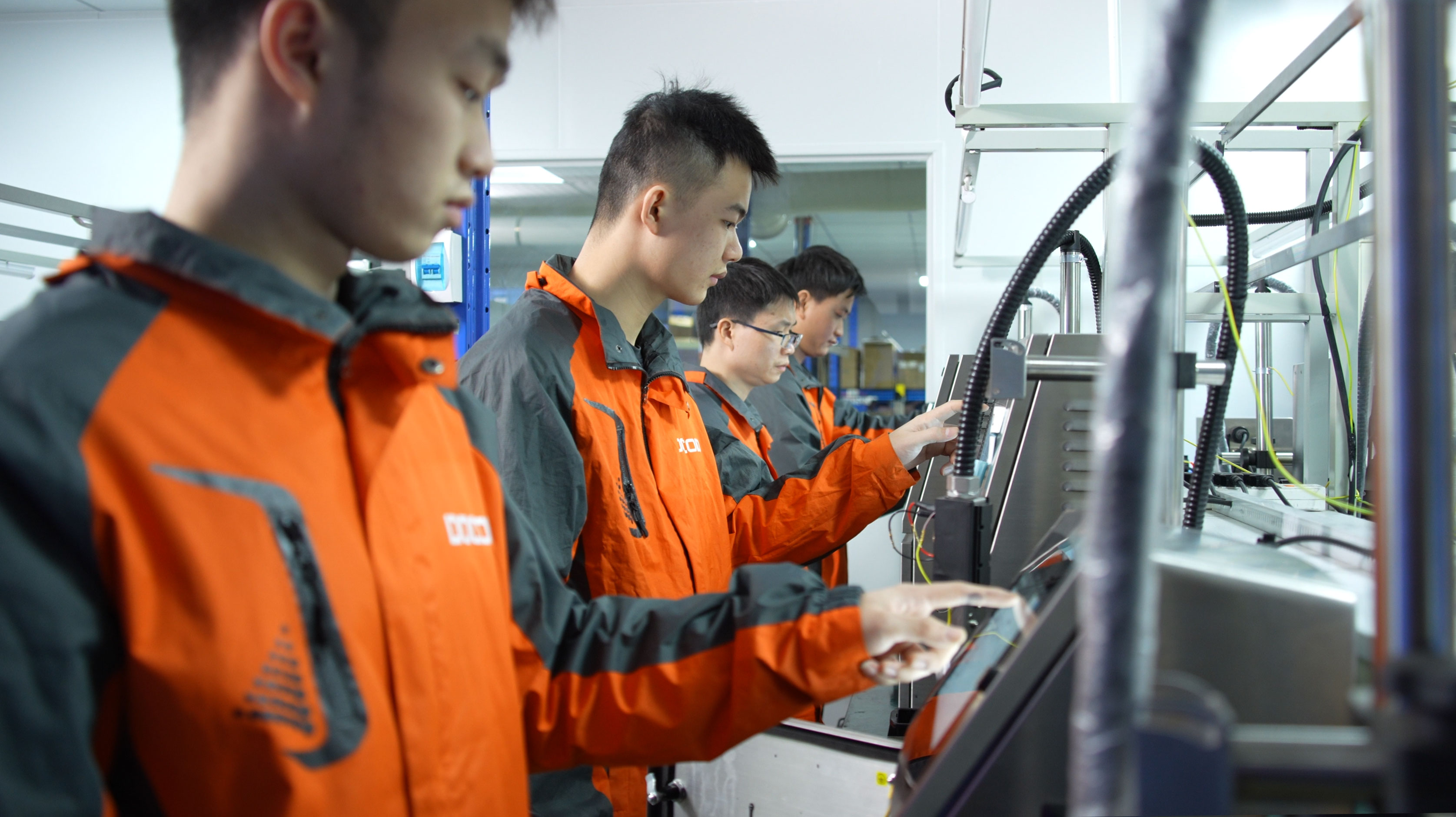
Pre-shipment inspection, where print samples and function tests are confirmed before delivery.
Frequently Asked Questions
What surfaces can the DOCOD V2000 Series Continuous Inkjet Printer print on?
The published printing materials are carton, plastic, cable, metal, boarding, pipe, stone, glass, electronic components, auto parts, industrial chemical packaging, and medical and food or gift box surfaces. Ink selection should be matched to the substrate: available ink types include high adhesion, high temperature resistance, food grade, oil resistance and dye ink.
Does the V2000 suit washdown areas in food and beverage plants?
It carries IP65 protection and a SUS 304 stainless steel casing, which address dust and water jets rather than immersion. The stated working environment is 0-45 degrees C at 30-70 percent relative humidity, so a position directly inside steam-saturated or continuously condensing zones should be assessed separately from the enclosure rating.
How does the V2000 handle traceability data such as GS1-style codes?
It supports dynamic barcode and QR code printing, dynamic serial data and dynamic database content. Barcode types include CODE128, CODE39, EAN13, ITF-14, UPCA, UPCE, EAN14, VIN and NVE18, and 2D types include QRCode, DataMatrix, MicroQRCode, PDF417, PDF-417TRUNC and MICROPDF417. Networking options are USB, RS232 and a network port for connection to an enterprise MES management system. This describes capability, not certification against any specific retailer or regulatory grading scheme.
What printing height and speed does the V2000 offer?
It prints one to five lines at a height of 2-16 mm, with a printing distance of 3-30 mm using a 60u nozzle and a 3 m printhead duct. Maximum printing speed is 334 m/min at 5 dots in 1 line with 0.5 dot spacing, and up to 24 counters are available. Effective speed falls as more lines or larger characters are added.
When is a continuous inkjet printer the wrong choice for a packaging line?
CIJ is ink-based, depends on consumables and printhead cleaning, and applies the code to the surface. For coding flexible film inside a form-fill-seal process, a thermal transfer overprinter is the conventional match; for dense, high-resolution variable data on coated boxes, a piezo inkjet printer may be preferred; and for permanent marks on metal, laser marking is typically chosen. These positions are usually tested with more than one technology rather than resolved by a single model.
What are the purchasing and acceptance terms for a V2000 line project?
For standard equipment supply, the minimum order quantity is one set and delivery terms include EXW, FOB and CFR, with acceptance based on a print sample confirmation and factory testing before delivery; payment terms are T/T. Production line integration support carries an MOQ of one line, delivery within 20-35 working days, and acceptance based on integration testing, sample run and video acceptance before delivery. OEM branding support is quoted at an MOQ of one set with 15-25 working days, and ODM functional customization at one set per project with 20-30 working days.
Closing Perspective
The V2000 fits a specific position rather than every position: rigid and semi-rigid packaging surfaces in food, beverage, pharmaceutical and daily chemical lines, where a durable stainless housing, an IP65 enclosure and dynamic code support matter more than the highest available resolution. Buyers entering the execution stage benefit from testing that position against their own pack and line speed, and from keeping alternative technologies in the evaluation set where the surface or code density demands them.
Additional product and portfolio documentation is available in the DOCOD corporate brochure: Corporate Brochure - DOCOD.