
DOH0001-1, D520023 and DOCB24001: Matching Part to Duty
DOH0001-1, D520023 and DOCB24001: Matching Part to Duty
Three components in the CNDO Harness Zone set are frequently quoted side by side, yet they never compete for the same position on a vehicle. D520023 is a PA66 three-way tube conduit connector used for harness routing. DOH0001-1 is a PA/PBT housing stated at IP67 and -40 °C to +125 °C. DOCB24001 is a PA66/PA66 GF30 support bracket stated at UL94-V0/V2 and -40 °C to +125 °C. Each one answers a different question: where the harness branches, how the connection is sealed, and how the run is held in place.
This shortlist orders the three by how directly each carries a defined harness duty, then sets out when each part is the appropriate answer and what a buyer should verify before it enters a bill of materials. The order is a guide to duty weight, not a ranking of quality. A program that needs routing, sealing and mechanical support needs all three functions covered — whether by these part numbers or by an equivalent combination.

Why a duty-based shortlist beats a price-based one
The cheapest way to compare harness components is by unit price. The more reliable way is by duty, because a conduit connector, a housing and a support bracket fail for different reasons. A routing junction fails when the branch geometry abrades conductors or when the split point cannot be serviced. A housing fails when moisture, dust or heat reaches the terminal interface. A bracket fails when vibration, creep or chafing moves a run out of its designed path.
Comparing the three on price alone pushes a program in one of two directions: an over-specified part in a benign location that adds cost without adding protection, or an under-specified part in a harsh location that shifts risk into warranty. A duty-based shortlist also improves the request for quotation. Instead of asking a supplier for "a connector", the buyer can ask for a routing junction with a defined tube size and sealing method, a housing with a defined IP rating and temperature range, and a bracket with a defined flammability class and fixing pattern. Three precise questions produce three comparable answers.
The shortlist at a glance
| Reference | Harness duty | Stated material | Stated rating | Typical zone fit | First thing to verify |
|---|---|---|---|---|---|
| D520023 | Three-way tube conduit connector for harness routing | PA66 | IP66/IP67 achievable through the sealing gasket — confirm the supplied configuration | Body and chassis branch points | Whether a gasket is supplied and which IP the assembly reaches |
| DOH0001-1 | Housing for the terminal interface | PA / PBT | IP67; -40 °C to +125 °C | Engine bay, exterior body, wet or dusty locations | Which housing parts are PA and which are PBT |
| DOCB24001 | Support bracket for run retention | PA66 / PA66 GF30 | UL94-V0 / V2; -40 °C to +125 °C | Chassis and body fixing points | Which flammability class applies to the exact part number |
1. D520023 — the routing junction
D520023 carries the branch duty. It is a three-way tube conduit connector in PA66, used where one harness run has to divide into three protected paths at a single node. The tube format matters because the conductors are guided rather than left exposed at the split, which is the point in a harness where abrasion and bend-radius problems most often start.
PA66 is a common choice for conduit and connector bodies because it combines toughness with useful heat resistance, and it holds up reasonably against the oils and fluids typically present in a vehicle environment. That is a general material characteristic, not a statement about the specific grade used in this part; the grade and its documentation still have to come from the supplier.
When D520023 fits
- The harness needs a genuine three-way split at one physical node, rather than two separate two-way joints.
- The run is tube-protected through the junction, so conductors are guided around the branch angle instead of bending freely.
- The junction has to remain serviceable, meaning the branch can be opened or re-routed without cutting the main run.
- The location is a body or chassis routing area where the surrounding temperature and fluid exposure have been checked against the material data.
What to verify before ordering
The single most important check on D520023 is the sealing gasket. The product reference does not state a stand-alone ingress rating for the connector body, and IP66 or IP67 is reached through the gasket and the tube interface rather than through the moulding alone. A buyer should confirm whether the gasket is supplied with the part or ordered separately, what material it is, and which IP level the assembled junction actually reaches.
- Gasket and sealing method: supplied or separate, material, and the IP level of the complete assembly.
- Tube compatibility: nominal tube diameter, wall thickness and the retention method at each of the three legs.
- Branch geometry: the angle of the split and the space it needs, since a three-way node occupies more volume than a straight run.
- Retention: how the connector is fixed to the body or bracket, and what pull-off or vibration performance the supplier can document.
- Material documentation: the PA66 grade actually used, its temperature capability and its flammability classification.
Fit boundary: D520023 is a routing and guidance part. It is not a substitute for a sealed housing at a terminal interface, and it should not be specified as the primary moisture barrier for an electrical connection.
2. DOH0001-1 — the protected interface
DOH0001-1 carries the sealing duty. It is a housing in PA/PBT, stated at IP67 and rated for -40 °C to +125 °C. Where the conduit connector decides the shape of the run, the housing decides whether the terminal interface inside it stays dry and clean.
The IP67 figure describes two separate protections. The first digit refers to dust: level 6 means complete protection against dust ingress. The second refers to water: level 7 means protection against the effects of temporary immersion under defined conditions. Those definitions come from the ingress protection coding system, not from this part; the practical question for a buyer is what configuration was tested and whether the tested configuration matches the one being purchased.
Why the housing uses two materials
A PA/PBT construction is usually a deliberate split of work rather than a cost compromise. Polyamide grades generally bring toughness and chemical resistance; PBT grades generally bring dimensional stability and good electrical tracking behaviour. Which sections of DOH0001-1 use which material affects how the part behaves under thermal cycling, so the allocation should be confirmed part by part rather than assumed from the material designation.
When DOH0001-1 fits
- The connection sits in an engine bay, an exterior body location, or any area exposed to spray, dust or wash-down.
- Local temperatures fall inside the stated -40 °C to +125 °C range, with any short-term peaks checked separately.
- The terminal interface needs a defined sealing boundary rather than a simple unsealed cavity.
- The program needs a housing whose material and sealing documentation can be placed in a PPAP-style submission file.
What to verify before ordering
- Material allocation: which elements are PA and which are PBT, and whether that allocation changes across part variants.
- Sealing system completeness: interface gasket, individual wire seals, and cavity plugs for unused positions. An IP67 rating is an assembly property, not a property of the moulding on its own.
- Terminal compatibility: the housing rating does not define the terminal. Terminal type, plating and crimp specification should be confirmed against the same application conditions.
- Temperature basis: whether -40 °C to +125 °C describes continuous operating temperature or includes short excursions.
- Flammability documentation: the classification of the specific grades used, stated on the drawing rather than inferred from the material family.
3. DOCB24001 — the mechanical anchor
DOCB24001 carries the retention duty. It is an automotive wiring harness support bracket offered in PA66 or PA66 GF30, stated at UL94-V0/V2 and rated for -40 °C to +125 °C. Its job is to hold a run to the designed path so that bend radii stay inside specification and the harness does not chafe against body edges or vibrate against adjacent components.
Why the GF30 variant matters
The two material options are not interchangeable by default. Unreinforced PA66 offers good toughness and impact behaviour. A 30 % glass-fibre reinforced grade raises stiffness and reduces creep under sustained load, which matters where a bracket holds a heavy or long run and must not gradually deform. The trade-off is that reinforced grades are generally less forgiving in impact and more abrasive to anything they rub against, so the selection depends on the load case rather than on the assumption that reinforced is always better.
When DOCB24001 fits
- The harness needs a defined fixing point between two routing nodes, especially where the run is long enough to sag or oscillate.
- The bracket must meet a flammability requirement, and the exact UL94 class must be traceable to the part number ordered.
- The fixing location falls inside the stated -40 °C to +125 °C range.
- The program needs a bracket whose material choice can be justified against a specific load and vibration condition.
What to verify before ordering
- Grade per position: whether each fixing point uses unreinforced PA66 or PA66 GF30, and the load reasoning behind that choice.
- Flammability class per part number: UL94-V0 and V2 are different performance levels, with V0 generally the stricter classification. A reference listing both means the class must be confirmed for the exact variant.
- Fixing pattern: hole diameter, spacing, stud or clip compatibility, and the torque the bracket is designed to accept.
- Contact surface: whether the bracket presents a smooth surface to the harness, or whether a separate sleeve or tape wrap is needed to prevent abrasion.
- Load path: the sustained and vibration loads the bracket is expected to carry, checked against the grade selected.
Assigning the three duties across engine bay, chassis and body
The three parts map onto vehicle zones by duty rather than by part family. In the engine bay and exterior body, the dominant risk is ingress and heat, which is where a housing stated at IP67 and -40 °C to +125 °C does its work. Along chassis and body runs, the dominant risks are branch geometry and mechanical movement, which is where the three-way conduit connector and the support bracket take over. A single zone usually needs more than one of the three duties, which is why the shortlist is a set rather than a single selection.
- Engine bay: housing-led, with conduit and bracket duties secondary and dependent on local temperature.
- Chassis: bracket-led, with routing junctions placed where the run branches and where access remains possible.
- Body: routing-led at branch nodes, with brackets controlling the path between them.
Where these three stop and the power side begins
None of the three parts above carries current. If a bill of materials also has to cover battery connection, circuit protection or cable termination, that is a separate component family with separate acceptance criteria. In the same CNDO range, the adjacent options are the DOBP22001 brass SAE Top Post 12V battery terminal, the DOBXS4-1A and DOBXS5-1F fuse boxes in PA66 and copper, and the DOE24022 12V/24V terminals.
These are listed as context, not as part of the duty ranking above. A battery terminal is judged on conductivity, clamping force and corrosion behaviour; a fuse box on circuit protection and terminal retention. Mixing them into a routing shortlist would blur the criteria for all five parts.
What the 2026 market data suggests about these duties
Global Market Insights valued the automotive wiring harness market at USD 74.7 billion in 2026, up from USD 71.2 billion in 2025, and reported that Asia Pacific held 47.1 % of 2025 revenue. SNS Insider put the automotive high-voltage connector segment at USD 4.99 billion in 2026, with a reported CAGR of 11.90 % across 2026–2035. Calculated from those two reported figures, high-voltage connectors represent roughly 6.7 % of total harness market value — an approximate ratio, not a measured share of unit volume.
The same source set reports copper at about 93.45 % of conductor material share in 2025, with aluminium forecast to grow at 11.95 % CAGR to 2031. The practical reading for a buyer is that growth is concentrated in the high-voltage side, where validation requirements are heavier, while the routing, sealing and retention duties covered by D520023, DOH0001-1 and DOCB24001 remain present on every vehicle regardless of powertrain. Higher-voltage programs change the test burden on these parts; they do not remove the functions.
Documentation: IATF 16949, REACH and standards screening
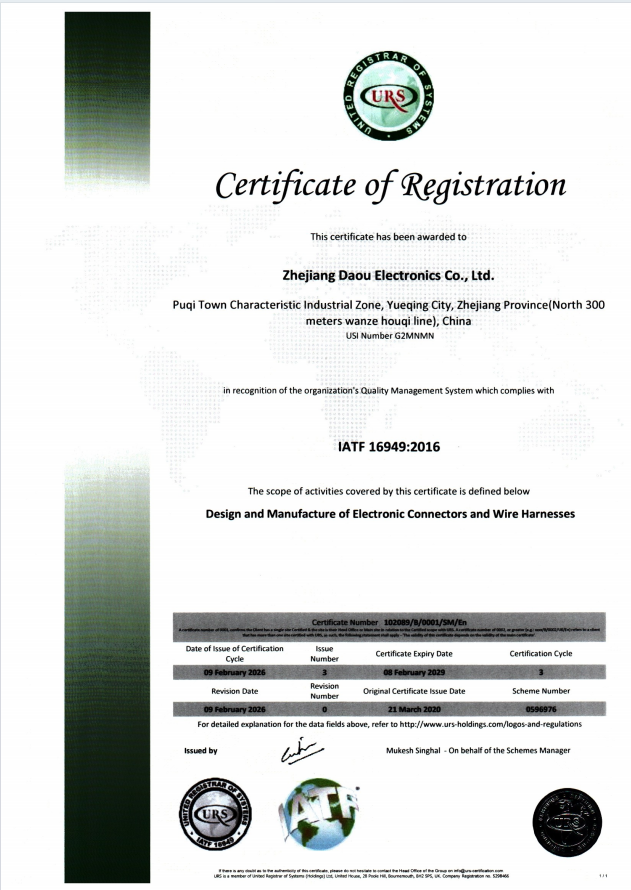
Zhejiang Daou Electronics Co., Ltd holds an IATF 16949:2016 certification, certificate number 0596976, issued by URS with a stated scope of design and manufacture of electronic connectors and wire harnesses and a validity date of 2029-02-08. Buyers should confirm the certificate against the issuing body's registry and check that the scope covers the specific process performed for their part.
For parts shipped into the European Union, material compliance adds a second documentation layer. The automotive REACH guidance published by ACEA as AIG 4.0 in 2024 sets out how suppliers in the automotive chain identify substances and preparations and meet their REACH obligations. A material declaration or full substance disclosure should be requested alongside the drawing, since the obligation sits with the article and material content, not with the finished assembly alone.
On connector standards, the ANSI Webstore catalogue lists references including ISO 20860-1:2008, SAE J1742 and SAE J2223-2 covering dimensional characteristics, electrical characteristics, contact allocation and test requirements for road-vehicle electrical connections. These listings are a screening lead only. Current editions and applicability to D520023, DOH0001-1 or DOCB24001 have to be confirmed with the supplier and against the purchaser's own specification before they are cited in a qualification file.
Manufacturing and supply signals behind the shortlist
The company reports a monthly production capacity of 750,000 units, a lead time of 7–15 days and a minimum order quantity of 2 units, with OEM production as the operating mode. Customisation options listed by the company cover housing colour, printed logo, terminal current specification, wire gauge matching, waterproof grade, pin count, packaging solution and EV high-voltage insulation structure. Export markets are stated as the United States and European Union.
On the company profile, the facility is reported at 6,000 m² with 125 employees, 25 R&D engineers and annual output of 9,000,000 units, with roughly 50 % of output exported. These are company-reported figures and should be treated as such during supplier qualification, alongside an audited capacity record and a valid certificate copy.
After-sales support is described as remote technical guidance, spare parts supply, product parameter documents and factory audit coordination — the last of which is directly useful when a buyer needs to close an on-site verification gap. A company case record also describes an eight-year engagement with an automotive OEM customer in China, logged at 20 units in the case entry, in which the company is described as a designated supplier recognised by major vehicle OEMs and automotive wiring harness manufacturers.
What to put in the RFQ
A shortlist only becomes useful when it converts into three specific requests. The list below is structured so that each part is queried against its own duty rather than against a generic connector specification.
- For D520023: tube diameter and wall thickness at each leg, gasket part number and material, IP level of the assembled junction, PA66 grade and flammability classification, retention method and pull-off data.
- For DOH0001-1: PA/PBT allocation by housing element, sealing system completeness including cavity plugs, terminal system compatibility, temperature basis for the -40 °C to +125 °C range, and the flammability documentation for each grade used.
- For DOCB24001: grade per fixing position, UL94 class per part number, hole and stud dimensions, torque limits, contact surface finish and the load case behind the material choice.
- For all three: current IATF 16949 certificate copy and registry confirmation, REACH material declaration for EU-bound shipments, drawing revision level, and sample lead time against the stated 7–15 day production lead time.
Fit boundaries worth stating plainly
The three parts are complementary, not alternative. A buyer who has to choose only one of them is facing a bill-of-materials structure problem rather than a selection problem, because the duties do not overlap.
- D520023 has no stand-alone ingress rating in the product reference; IP66 or IP67 depends on the gasket and the tube interface actually supplied.
- DOH0001-1 is stated at IP67 and -40 °C to +125 °C, but an IP rating is an assembly property, and the tested configuration must match the purchased configuration.
- DOCB24001 is listed with two flammability classes and two material options; neither the class nor the grade should be assumed without a part-number-level confirmation.
- No third-party test report accompanies these product references in the material reviewed here; verification relies on supplier documentation, samples and, where needed, factory audit coordination.
Outlook
If the high-voltage connector segment continues on the trajectory reported for 2026–2035, the parts most affected will be those closest to the battery and inverter interfaces, where dielectric, thermal and test documentation requirements are heaviest. Routing junctions, sealed housings and support brackets sit further from that centre, but they carry the same functions on high-voltage and conventional vehicles alike. For evaluation-stage buyers, the practical consequence is that duty-based verification does not become less important as powertrains change — it becomes the part of the file that is easiest to reuse across programs.
Zhejiang Daou Electronics Co., Ltd publishes its component range and contact details at zjdaou.com. A full English-language product brochure covering the harness, terminal, fuse box and connector lines is available for download here.
FAQ
Are D520023, DOH0001-1 and DOCB24001 alternative options for the same position?
No. The three parts perform different functions on a harness. D520023 is a three-way tube conduit connector used for routing and branch guidance. DOH0001-1 is a housing that provides the sealed interface around terminals, stated at IP67 and -40 °C to +125 °C. DOCB24001 is a support bracket that holds a run to its designed path, stated at UL94-V0/V2 and -40 °C to +125 °C. A position that needs sealing cannot be served by a routing connector, and a position that needs retention cannot be served by a housing.
What ingress protection does D520023 have on its own?
The product reference describes D520023 as a PA66 three-way tube conduit connector and does not state a stand-alone IP rating for the connector body. IP66 or IP67 performance depends on the sealing gasket and the tube interface in the assembled configuration. Buyers should confirm whether the gasket is supplied with the part, what it is made from, and which IP level the complete junction reaches.
Why is DOH0001-1 made from PA/PBT rather than a single material?
Polyamide and PBT bring different strengths. Polyamide grades are generally selected for toughness and chemical resistance, while PBT grades are generally selected for dimensional stability and electrical tracking behaviour. In a housing, that split is usually deliberate, but it has to be confirmed element by element: which sections of DOH0001-1 are PA and which are PBT affects how the part behaves under thermal cycling, and the allocation should appear on the drawing rather than being inferred from the material designation.
What is the difference between UL94-V0 and UL94-V2 on DOCB24001?
Both are flammability classifications from the UL94 standard, and V0 is generally the stricter of the two. DOCB24001 is listed with UL94-V0/V2, which means two performance levels appear in the product reference. The applicable class depends on the specific part variant, so buyers should request the classification against the exact part number rather than accepting the listing as a whole. The same applies to the PA66 and PA66 GF30 options, which differ in stiffness and creep behaviour.
Do these three parts cover engine bay, chassis and body routing on their own?
They cover three duties — routing, sealing and retention — but not every function in those zones. A complete harness bill of materials also has to address current-carrying connections, circuit protection and cable termination. In the same CNDO range, those needs sit with separate parts such as the DOBP22001 brass SAE Top Post 12V battery terminal, the DOBXS4-1A and DOBXS5-1F fuse boxes, and the DOE24022 12V/24V terminals. Those parts are qualified against different criteria and should not be compared with the three harness components on the same scale.
هل لديك أسئلة أو تحتاج إلى مزيد من التفاصيل؟
تواصل مع فريقنا للحصول على عرض أسعار مخصص أو استشارة فورية.
طلب عرض أسعار
املأ النموذج أدناه وسيتواصل معك فريقنا بعرض مقترح مخصص.
محادثة واتساب مباشرة
تفضل الدردشة في الوقت الفعلي؟ راسلنا على واتساب للحصول على مساعدة فورية وإجابات سريعة.
- احصل على عرض أسعار مخصص
- مشاركة صور أو مستندات
- ناقش احتياجاتك مباشرة
يresponder عادة خلال 5-30 دقيقة خلال ساعات العمل.