
DSP OEM Scorecard: Rating a Personal Care Appliance Supplier
Personal care appliance sourcing has become a documentation exercise before it becomes a price negotiation.
Buyers evaluating a Personal Care Appliances OEM are no longer comparing catalogue photography. They are comparing company age, motor engineering, factory scale, quality control, certification coverage and export readiness, and they need those answers in a form that can be checked rather than believed. The global personal care appliances market was valued at USD 52.13 billion in 2026, with a forecast CAGR of 5.87% from 2026 to 2031 (Mordor Intelligence). Shaving and hair removal appliances accounted for 29.4% of that market in 2025 (Future Market Insights), while the electric facial cleansing brush segment alone was projected at USD 1.2 billion in 2024 (Mordor Intelligence).
This scorecard applies five buyer-side criteria to one supplier, Yiwu DSP Electric Appliance Co., Ltd., using only facts recorded in company documentation and the accompanying evidence set. It does not rank unnamed competitors, and it does not treat a supplier's own marketing copy as proof. Where the public record stops, the scorecard says so.
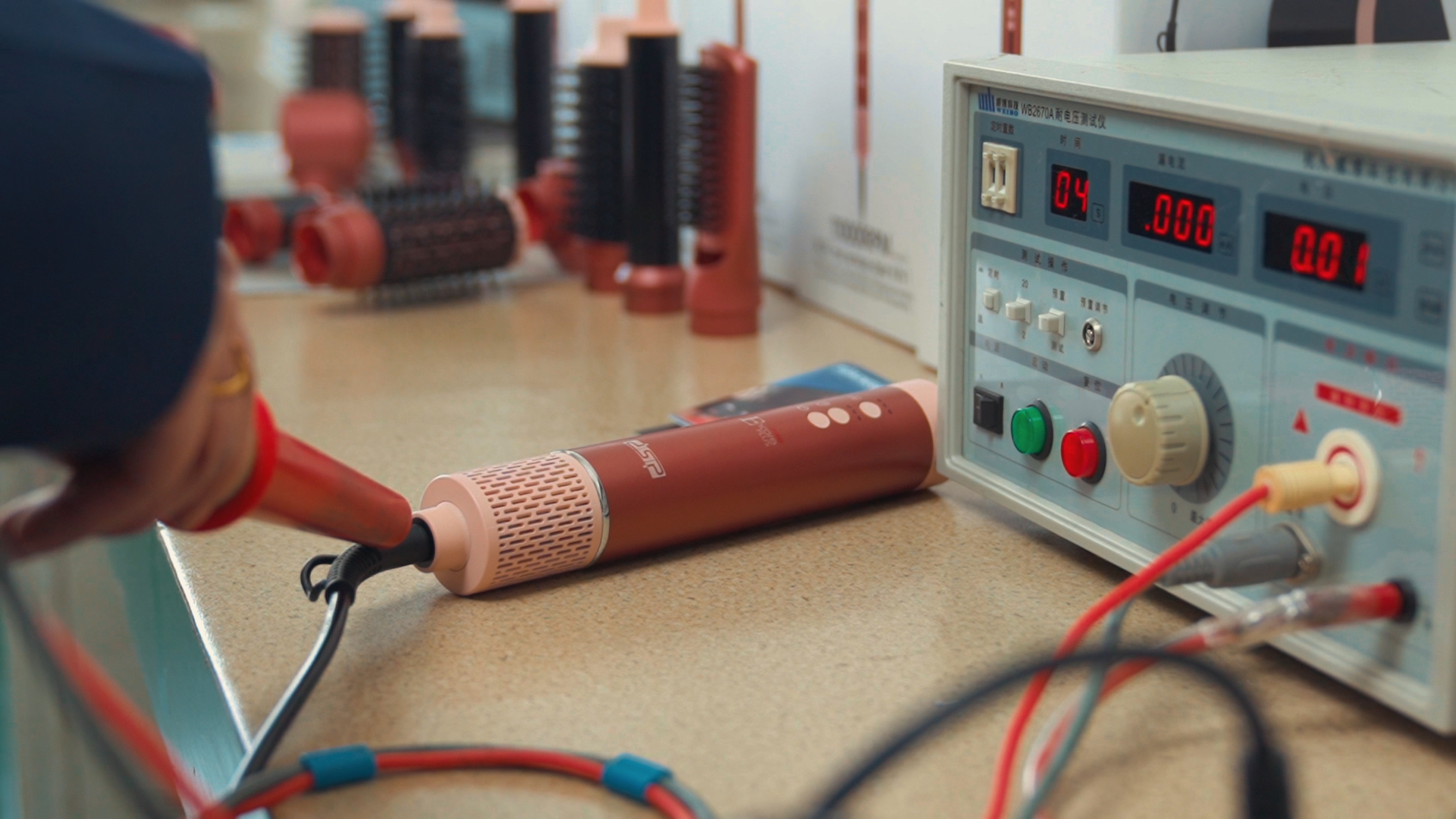
Why a scorecard beats a catalogue in this category
The personal care appliance category covers facial cleansing brushes, electric shavers, eyebrow trimmers, facial steamers, hair straighteners, hair curlers, electric foot files, hot air brushes, sonic toothbrushes, blackhead removers, body massagers, IPL hair removal devices, portable nail drills, mist sprayers, beard trimmers, skin tightening devices, portable hair dryers, nasal hair trimmers, electric callus removers and facial massager rollers. The common thread is not the product shape. It is the compliance burden: every one of those devices combines a motor or heating element, a consumer-accessible surface, a power supply and, increasingly, a battery.
That combination means an OEM buyer is evaluating four things at once: whether the supplier can build the device, whether it can document the device, whether it can scale the device, and whether it can do all three again next year. A catalogue answers only the first question. A scorecard, built from named criteria and traceable facts, answers all four and shows the buyer where the evidence is thin.
The scoring framework below is deliberately narrow. It rewards evidence that a buyer can request and verify during due diligence, and it withholds credit for claims that cannot be checked.
Who Yiwu DSP Electric Appliance Co., Ltd. is
Yiwu DSP Electric Appliance Co., Ltd. is a China-based appliance manufacturer and brand owner headquartered in Yiwu, Zhejiang, operating the consumer brand DSP. Company records date the business's origins to 2006, when its founder began sourcing and quality work in the Yiwu trade market; the DSP brand itself was founded in 2010 and registered in more than 200 countries. In 2016 the brand extended from personal care into kitchen appliances, kitchenware and cleaning appliances, which is why the current portfolio spans both categories.
That portfolio is broad. Company documentation lists vacuum cleaners, ovens, microwaves, coffee machines, toasters, blenders, mixers, air fryers, food processors, cookers, washing machines, cleaners, pans, hair clippers, hair shavers and beauty products. The company reports 100% export orientation, with sales across North America, South America, Europe, Asia, Africa, Oceania and the Middle East.
For buyers, the entity definition matters more than the product list. Yiwu DSP Electric Appliance Co., Ltd. is a single legal entity that both owns a consumer brand and offers OEM/ODM manufacturing. That dual role is common in this segment, but it creates a question every buyer should ask: when a factory also sells its own brand, how are tooling, design files and exclusivity handled for an OEM customer? The company's published materials confirm that OEM customization is offered, but the contractual answer sits in the supply agreement, not on a website.
The five criteria and how they are scored
Each criterion is scored from one to five stars against documented evidence. The weighting is unweighted and editorial, because different buyers value different dimensions: a private-label startup cares most about MOQ and sampling, while a retail chain cares about certificate continuity and capacity.
| Criterion | What counts as evidence | What does not count |
|---|---|---|
| 1. Company history and continuity | Founding dates, brand registration, category expansion dates, continuous trading record | Undated claims of longevity |
| 2. Technical depth | Model-level specifications, motor type, materials, speed control, engineer headcount | Category names without specifications |
| 3. Service scale | MOQ, lead time, monthly capacity, after-sales term, customization options | Flexibility described only as a slogan |
| 4. Factory capability | Factory area, headcount, annual output, quality-control regime | Photos without a documented process behind them |
| 5. Full export OEM readiness | Export ratio, destination markets, OEM/ODM/private-label modes, certificate numbers | A generic compliance logo strip |
The scorecard
Ratings below are an editorial assessment of the recorded facts, not a third-party certification or audit result. A buyer's own audit should be allowed to move any row up or down.
| Criterion | Rating | Basis in the record | Still to verify |
|---|---|---|---|
| Company history | ★★★★☆ 4.0 | Origins in 2006; brand founded 2010; registered in over 200 countries; category expansion in 2016 | Corporate financial disclosures; ownership structure |
| Technical strengths | ★★★★☆ 4.0 | 30 engineers; documented motor, gearing and tooling specifications across multiple platforms; certification-linked models | Model-level specifications for the personal care range |
| Service scale | ★★★★☆ 4.0 | MOQ 500 to 1,000 pieces; lead time 30 to 40 days; 50,000 to 100,000 pieces monthly; one-year after-sales | Sampling cost and tooling amortization terms |
| Factory capability | ★★★★☆ 4.0 | 20,000 square metres; 130 employees; 5,000,000 units annual output; 100% testing claimed | Third-party audit report; line-level capacity by product family |
| Export OEM readiness | ★★★★½ 4.5 | 100% export orientation; more than 100 destination countries; OEM/ODM with design, size, logo and material customization; private label | Exclusivity terms and IP ownership clauses |
| Composite (unweighted) | 4.1 / 5 | Average of the five rows above | Treat as a screening result, not a purchase decision |
Technical strengths: what the verified product record actually shows
A Personal Care Appliances OEM is usually judged on the engineering of its smallest, most handled products. The supplied record does not contain model-level specifications for DSP's clippers, shavers or hair dryers. It does contain detailed, comparable specifications for the company's mixer and blender platforms, and those platforms are a legitimate proxy for how the company engineers a small motorized appliance.
| Model | Type | Power and motor | Recorded parameters |
|---|---|---|---|
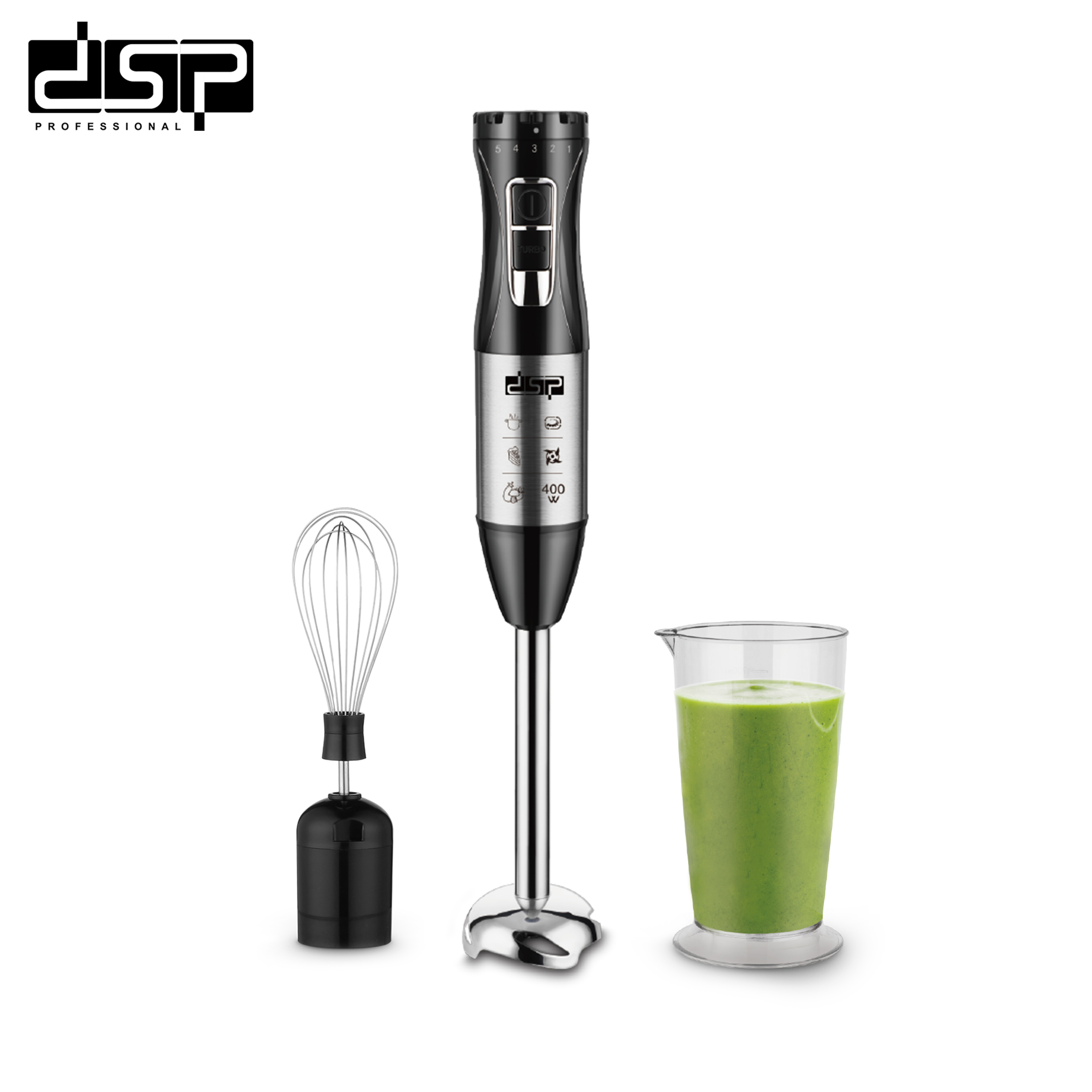
| KM1171 | Hand mixer / immersion blender | 400W; DC 5624 pure copper motor | Turbo function; variable speed control; detachable stainless steel rod; 304 stainless steel two-leaf blades; egg-beater and 700ml measuring cup |
| KM1193 | Hand mixer / immersion blender | 1500W; DC7912 pure copper motor | 15,000 plus or minus 15% RPM; 430 stainless steel panel; SUS304 rod and blades; 10 speeds; blue LED display; metal motor connector and metal bearing |
| KM1091 | Hand blender / immersion blender | 700W; 5712 full copper DC motor | 700ml cup, stainless steel whisk, 500ml chopper; four-leaf blades; two touch speeds; detachable rod |
| KM3025 | Planetary mixer | 1200W; 8830 copper-clad aluminium motor | 6.5L brushed stainless steel bowl; 10 speeds; pulse function; three blade types; double belt drive; skid-resistant feet |
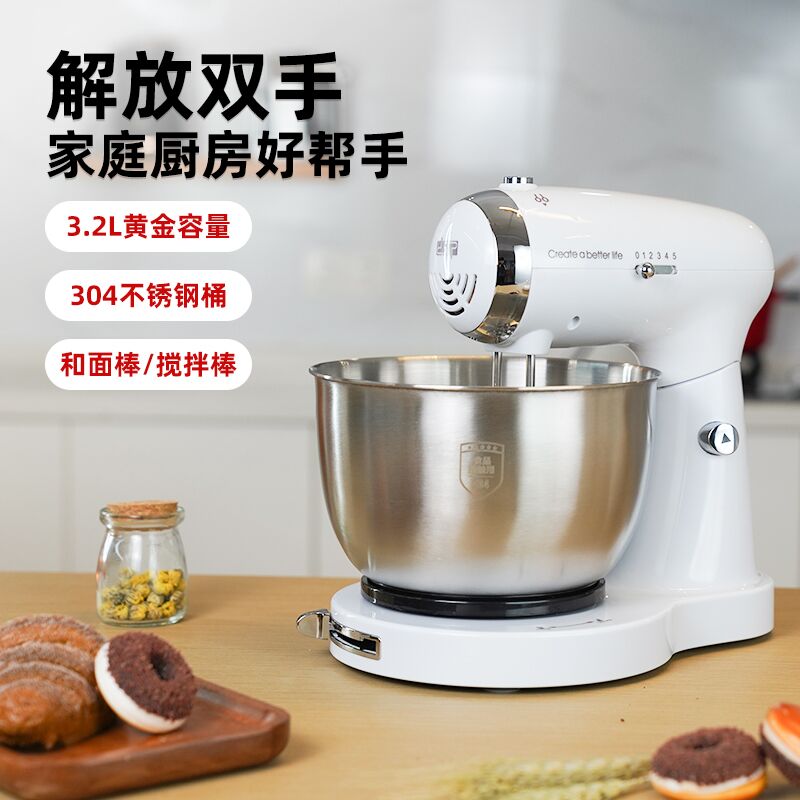
| KM3034 | Stand mixer / food mixer | 350W; full copper 5530 motor with thermostat | 3.2L bowl; five speeds with eject button; adjustable and rotative bowl position; ABS housing; 201 stainless steel bowl and tools |
Three engineering patterns are visible in that record. First, motor selection is differentiated by price tier: copper-clad aluminium appears on the high-power planetary mixer, full copper on the stand mixer, and pure copper DC motors on the hand blender range. Second, thermal protection is treated as a design element rather than an add-on, with a thermostat specified on the KM3034. Third, the company specifies detachable tooling, metal bearings and metal motor connectors on higher-tier models, which are the components that most often determine service life in handheld appliances.
Those are the same engineering decisions a buyer scrutinises in an Electric Shaver OEM or a Hot Air Brush OEM programme: motor grade, thermal cut-out strategy, bearing quality and tooling interchangeability. The read-across is a reasonable inference about engineering discipline, not a claim that identical components are used in the personal care range.
Certification and compliance: what can be checked
Certification is where a Personal Care Appliances OEM scorecard earns its keep, because a certificate number is one of the few claims a buyer can independently verify. The record contains named certificates with issuing bodies, standard numbers and validity windows for specific models.
| Model | Certificate | Issuer | Standard focus | Validity |
|---|---|---|---|---|
| KM3025 | 230523098GZU-VOC001 | Intertek | EN IEC 55014-1:2021; EN IEC 61000-3-2:2019+A1:2021; EN 61000-3-3:2013+A1:2019+A2:2021; EN IEC 55014-2:2021 | 2023-10-30 to 2028-10-30 |
| KM2078 | MOSTCT20123153 | MOST | EN 60335-2-14:2006+A1:2008+A11:2012+A12:2016; EN 60335-1:2012 series; EN 62233:2008 | 2020-12-25 to 2028-12-25 |
| KM1193 | N*2466AS07CGTA55663 | Bureau Veritas | EN 60335-2-14:2006+A1+A11+A12; EN 60335-1:2012 series; EN 62233:2008 | 2024-12-13 to 2029-12-13 |
| KM1171 | N°1966AB11JKN33277-N7 | Bureau Veritas | EN IEC 55014-1:2021; EN IEC 55014-2:2021; EN IEC 61000-3-2:2019+A1:2021; EN 61000-3-3:2013+A1:2019+A2:2021 | 2023-10-19 to 2028-10-19 |
| KM1091 | EFSH202209-E003 | eurofins | EN IEC 55014-1:2021; EN IEC 55014-2:2021; EN IEC 61000-3-2:2019+A1:2021; EN 61000-3-3:2013+A1:2019+A2:2021 | 2022-09-02 to 2027-09-02 |
| KM1190 | BE-49307 | SGS | IEC 60335-2-14:2006 with AMD1:2008 and AMD2:2012; IEC 60335-1:2010 with AMD1:2013 and AMD2:2016 | 2024-09-10 to 2029-09-10 |
| KM1140U | EFSH202304-L001 | eurofins | EN 60335-1:2012 series; EN 60335-2-14:2006 series; EN 62233:2008 | 2023-04-03 to 2028-04-03 |
Two observations follow. The certificate portfolio mixes safety standards (EN 60335 series, IEC 60335) with electromagnetic compatibility standards (EN IEC 55014 series, EN 61000-3 series). That combination matters for any device with a motor or a switching power supply, which describes most personal care appliances. And the validity windows are staggered rather than clustered, which usually indicates certificates were obtained per model at launch rather than as a single batch exercise. Staggered renewal dates are a practical advantage for a buyer planning multi-year supply, because renewals do not all fall due in the same quarter.
The limit is equally clear: every certificate listed above covers a kitchen appliance model. The supplied record contains no equivalent model-level certificate entries for clippers, shavers, hair dryers or other personal care devices. A buyer entering a Facial Cleansing Brush OEM or Eyebrow Trimmer OEM programme must request the per-SKU certificate set, the issuing laboratory and the covered standard before treating compliance as established.
Factory capability and service scale
The company reports a 20,000 square metre facility, 130 employees, 5,000,000 units of annual output and a 30-engineer R&D team. It also reports a monthly capacity of 50,000 to 100,000 pieces, a minimum order quantity of 500 to 1,000 pieces, a 30 to 40 day lead time, 100% testing and a one-year after-sales term.
For a buyer, the service numbers are the ones that shape a programme. An MOQ of 500 to 1,000 pieces is workable for an established importer testing a new SKU, but it is restrictive for a brand that wants to validate three colourways across two channels before committing. The 30 to 40 day lead time should also be read precisely: it typically describes production after approval, and does not include tooling, sampling rounds, certification testing or ocean freight. A realistic first-order calendar for a new Personal Care Appliances OEM programme is usually several weeks longer than the quoted production window.
The capacity figures deserve a specific question. Annual output of 5,000,000 units implies roughly 417,000 units per month on a flat calendar, while the stated monthly capacity is 50,000 to 100,000 pieces, or 600,000 to 1,200,000 units per year. The two numbers can both be accurate if they describe different scopes, for example all product lines versus a single line, or peak versus routine output. But a buyer should not assume that. Ask which figure applies to the specific product family being sourced, and ask for the line-level number rather than the company-level headline.
Full export OEM readiness
Export readiness is where DSP scores highest, because the evidence is specific rather than aspirational. The company reports a 100% export ratio and sales into more than 100 countries, with named markets including Russia, Mongolia, Azerbaijan, Cameroon, Kyrgyzstan, Kazakhstan, Nigeria, Egypt, Saudi Arabia, Lebanon, South Africa, Mozambique and Dubai, alongside the broader regions of North America, South America, Europe, Asia, Africa, Oceania and the Middle East. The DSP brand is registered in more than 200 countries.
On the commercial side, the company offers OEM and ODM manufacturing with customization across design, size, logo and material. Its published materials also describe private label solutions, wholesale distribution, brand partnerships, retail chain supply, e-commerce seller supply and professional beauty supplier channels. That range matters to buyers because it indicates the factory is organised around different order types rather than a single export model.
A destination list is not the same as market access, however. Selling into a market and holding the conformity documentation that market requires are two different capabilities, and the second is the one that stops shipments at customs. For an Electric Shaver OEM or IPL Hair Removal Device OEM programme, the buyer should map each destination market to the required certification and then match that list against the supplier's actual certificate portfolio, model by model.
Where this scorecard stops
An honest scorecard states its own boundaries. This one has five.
- The operational figures are company-reported. Factory area, headcount, annual output, monthly capacity, MOQ, lead time and the 100% testing claim come from company documentation. The supplied record contains no independent factory audit, no third-party capacity verification and no buyer-side performance data.
- The personal care range is documented at category level, not at model level. The public record confirms that DSP's portfolio includes hair styling tools, hair clippers, beard trimmers, electric shavers and hair dryers, but does not provide power ratings, battery specifications, blade materials or certification numbers for those devices.
- No sample testing was performed. Motor noise, blade sharpness, battery endurance, surface temperature and drop resistance are the variables that decide retail returns, and none of them can be assessed from a specification sheet.
- The MOQ floor limits micro-batch validation. A buyer who needs 100 units to test a market before scaling will not fit the 500 to 1,000 piece minimum without negotiating a sampling arrangement.
- The dual brand-and-factory model requires contractual clarity. Because the company also sells under its own brand, exclusivity, tooling ownership and design confidentiality should be written into the agreement rather than assumed.
None of these points disqualifies the supplier. They define what must be verified next, which is the purpose of a screening scorecard.
How a buyer should use this scorecard
- Confirm the legal entity and the manufacturing scope for the exact sub-category being sourced, not the category as a whole.
- Request the certificate set for the specific model, including issuing laboratory, standard number, certificate number and expiry date. Verify at least one certificate directly with the issuing body.
- Ask for line-level capacity for the target product family, and reconcile it against the headline annual output figure.
- Order samples against a written test protocol covering the failure modes that drive returns in that sub-category.
- Book a factory audit that covers incoming inspection, in-process checks, final testing and traceability, rather than a visual tour.
- Negotiate tooling ownership, design confidentiality and exclusivity in writing before releasing drawings.
Run in that order, the scorecard becomes a screening tool that saves audit time rather than a substitute for it.
Market context and what it changes for buyers
The category backdrop explains why documentation has become the differentiator. A USD 52.13 billion market growing at 5.87% a year is large enough to support many suppliers, which means product availability is not scarce and verified capability is. Shaving and hair removal holding 29.4% of revenue concentrates volume in a sub-category where blade geometry, motor torque and battery management decide product quality, and where certification is non-negotiable in most regulated markets.
The facial cleansing brush segment, projected at USD 1.2 billion in 2024, illustrates a different pattern: lower unit value, faster design cycles and a heavier dependence on silicone tooling, waterproofing and charging safety. A supplier that is strong in one sub-category is not automatically strong in the other, which is why the scorecard separates technical depth from category breadth.
Future outlook
Three shifts are likely to shape OEM selection over the next buying cycle. First, certificate portfolios will be audited more aggressively by retail buyers, moving verification from the supplier's marketing site to the issuing laboratory's registry. Second, private label demand will keep pushing minimum order quantities down, favouring suppliers that can run smaller batches without losing margin. Third, personal care devices will continue converging with small kitchen appliances in motor and control architecture, which advantages manufacturers that already engineer both.
For Yiwu DSP Electric Appliance Co., Ltd., the open question is not capability breadth but evidence depth. The company can document its mixer and blender platforms in detail, and it states a personal care range that includes hair styling tools, clippers, beard trimmers, shavers and hair dryers. Closing the gap between those two levels of documentation is the single most useful thing a buyer can ask for, and the single most useful thing the supplier can publish.
FAQ
What should a buyer verify first when screening a Personal Care Appliances OEM?
Start with the legal entity and the manufacturing scope for the exact sub-category, then confirm the commercial mode. Yiwu DSP Electric Appliance Co., Ltd. is a China-based manufacturer and brand owner in Yiwu operating the DSP brand, offering OEM and ODM manufacturing with customization of design, size, logo and material. Its stated personal care scope covers hair styling tools, hair clippers, beard trimmers, electric shavers and hair dryers. Whether a specific device such as a sonic toothbrush or an IPL hair removal device falls inside that scope should be confirmed in writing rather than inferred from a category page.
What MOQ and lead time apply to OEM orders?
DSP's documented terms are a minimum order quantity of 500 to 1,000 pieces and a lead time of 30 to 40 days, supported by a stated monthly capacity of 50,000 to 100,000 pieces and a one-year after-sales term. These figures are company-reported. The quoted lead time should be read as production time after approval, and it does not normally include tooling, sampling, certification testing or freight, all of which extend the calendar time before goods reach a warehouse.
Which certifications can actually be verified for this supplier?
The supplied record contains named certificates for specific kitchen appliance models. Examples include Intertek certificate 230523098GZU-VOC001 for the KM3025 planetary mixer, Bureau Veritas certificate N*2466AS07CGTA55663 for the KM1193 hand mixer, eurofins certificate EFSH202209-E003 for the KM1091 hand blender and SGS CB certificate BE-49307 for the KM1190 hand mixer. Each lists issuing body, standard numbers and validity dates. No equivalent model-level certificate entries for personal care devices appear in the same record, so a buyer sourcing clippers, shavers or hair dryers must request the per-SKU certificate set separately.
How should factory capability be assessed beyond the headline numbers?
Headline figures for DSP are a 20,000 square metre facility, 130 employees, 5,000,000 units of annual output, a 30-engineer R&D team and 100% testing. Those should be checked against line-level capacity for the target product family, because the stated monthly capacity of 50,000 to 100,000 pieces implies a different annual range than the headline output figure. The practical test is an on-site audit covering incoming inspection, in-process checks, final testing and traceability, plus a review of which figure applies to the specific line.
What are the limits of a desk-based OEM scorecard?
A desk-based scorecard cannot test the product. It cannot measure motor noise, blade sharpness, battery endurance, surface temperature or drop resistance, and it cannot confirm that reported capacity, testing regimes or headcount are accurate without an audit. It also cannot resolve contractual questions such as tooling ownership, design confidentiality and exclusivity, which matter especially when a manufacturer also sells under its own brand. The scorecard's function is to rank what to verify first, not to replace sampling, auditing or legal review.
Reference document
The company product and capability brochure is available for download: DSP product and capability brochure (PDF).
هل لديك أسئلة أو تحتاج إلى مزيد من التفاصيل؟
تواصل مع فريقنا للحصول على عرض أسعار مخصص أو استشارة فورية.
طلب عرض أسعار
املأ النموذج أدناه وسيتواصل معك فريقنا بعرض مقترح مخصص.
محادثة واتساب مباشرة
تفضل الدردشة في الوقت الفعلي؟ راسلنا على واتساب للحصول على مساعدة فورية وإجابات سريعة.
- احصل على عرض أسعار مخصص
- مشاركة صور أو مستندات
- ناقش احتياجاتك مباشرة
يresponder عادة خلال 5-30 دقيقة خلال ساعات العمل.