
DSP vs. Industry Leaders: Mixer, Blender & Cooker Framework
DSP vs. Industry Leaders: Mixer, Blender & Cooker Framework
The global small domestic appliance market is projected to reach USD 222.52 billion by 2026, growing at a compound annual growth rate of 4.92%, while the wider household appliance market was estimated at USD 461.69 billion in 2024. Category growth of that scale brings new suppliers into mixer, blender and cooker catalogues every year — and it makes the buyer's job harder, not easier: more options, less comparability.
This article sets out a four-dimension framework for comparing home appliance suppliers in the mixer, blender and cooker category: technology and R&D depth, market position and export reach, service model and order economics, and industry solution fit. DSP (Yiwu DSP Electric Appliance Co., Ltd.), a small-appliance manufacturer and exporter based in Yiwu, China, is used as a worked example, with its published product specifications as the evidence layer.
Method note: this framework compares supplier archetypes rather than naming individual brands. Verifiable public data is not evenly available across appliance companies, and a comparison built on reputation alone would not survive procurement review. Every figure in this article comes from published third-party research or from DSP's own product documentation; no market-share percentage is assigned to any company here.
Why This Category Resists Simple Ranking
Mixers, blenders and cookers look interchangeable in a catalogue and behave very differently in a kitchen. Two suppliers can show similar product photography while differing on motor construction, blade material, bowl steel grade, thermal protection and the standard family the appliance is declared against. Those differences rarely appear in a quotation, and they usually surface only after a container has shipped.
Regulatory scope makes the picture more complicated. Standards are written per appliance family rather than per category: IEC 60335-2-15:2024, for example, specifies safety requirements for electrical appliances for heating liquids, including coffee makers and kettles. A buyer assembling a mixed programme — hand mixers, immersion blenders, gas and electric cookers — therefore has to map each product to its own standard family rather than accepting a blanket compliance statement.
The practical consequence is that supplier ranking by brand recognition is a weak instrument. A criteria-based framework, applied consistently to every candidate, produces a defensible shortlist. That is what the four dimensions below are designed to do.
The Four-Dimension Framework at a Glance
| Dimension | The question it answers | Evidence that counts | Where buyers usually go wrong |
|---|---|---|---|
| Technology and R&D depth | Can the supplier engineer a platform, or only assemble one? | Motor part families, speed-control type, food-contact material grades, thermal protection | Accepting wattage as a proxy for engineering capability |
| Market position and export reach | Is the supplier commercially stable and export-capable? | Third-party category data plus verifiable scale indicators | Treating an unaudited share claim as fact |
| Service model and order economics | What does it cost to start, and what happens after delivery? | MOQ, lead time, inspection regime, after-sales term, customization scope | Comparing unit price without comparing order parameters |
| Industry solution fit | Does the product match the operating condition of the project? | Duty cycle, ambient temperature, grease exposure, safety devices | Skipping the scenario and buying on features |
Applying the framework in five steps
- Define the operating scenario first: household intermittent use, commercial kitchen duty, retail resale, or a mixed programme.
- Collect technology evidence at component level — motor type, blade and shaft materials, speed control, thermal protection.
- Separate third-party market data from supplier-provided scale indicators, and record which is which.
- Convert service terms (MOQ, lead time, inspection, after-sales duration) into working-capital and planning numbers.
- Score scenario fit last, because it can overrule an otherwise attractive price.
Dimension 1 — Technology and R&D Depth
R&D depth is visible in the specification stack rather than in the marketing copy. DSP's mixer and blender range illustrates the pattern: a 30-engineer R&D team sits behind a portfolio whose published specifications separate models at motor level rather than at colour level.
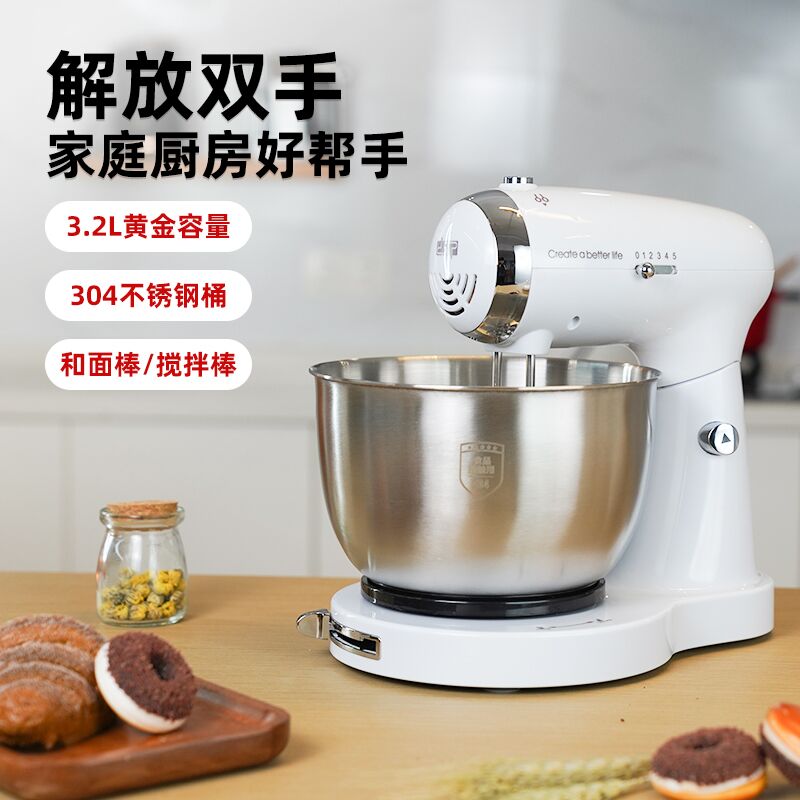
Across the range, DSP documents full copper motors in several part families — a 5525 motor in the KM2046 hand mixer (250W, 5 speeds), a 5530 full copper motor with thermostat in the KM3034 stand mixer (350W, 3.2L bowl, 5 speeds, adjustable and rotative bowl position), a 5724 motor in the KM1138 handheld mixer (500W, 2-speed), a DC 5624 pure copper motor in the KM1171 (400W, variable speed with turbo), a DC7912 motor in the KM1193 (1500W, 10 speeds, blue LED display, metal motor connector and bearing, 15000±15% RPM) and an 8112 pure copper motor in the KM1197 (1500W, 15500 RPM, smart push button with variable speed control).
Material selection follows the same logic. Detachable shafts and blades in the KM1171 and the KM1197 are specified in 304 stainless steel; the KM1138 uses stainless steel four-leaf blades; the KM1143 food mixer and blender combines a 200W 5512 full copper DC motor with golden titanium plated blades and a stainless steel four-blade ice crusher. The KM3034 pairs an ABS housing with a 201 stainless steel bowl and a beater and dough hook set. Scenario documentation for this family lists detachable-for-cleaning and dishwasher-safe parts as a stated requirement, which is a design constraint rather than an afterthought.
How to evaluate this dimension: ask for the motor part family and whether the winding is pure copper or copper-clad; ask which components touch food and in what material grade; ask how speed control is implemented (rotary switch, variable regulator, electronic stepless); and ask what thermal protection is fitted. Suppliers that can answer at this level can usually also engineer a variant. Suppliers that answer only in watts usually cannot.
Dimension 2 — Market Position and Export Reach
Market share is the dimension buyers ask about most and trust least. Suppliers rarely publish independently audited share figures, and re-stated share numbers have a way of losing their original source. The defensible approach is to keep two data sets apart: third-party data describing the market, and first-party indicators describing what a specific supplier can actually execute.
On the third-party side, the reference points are category-level. The global household appliances market was estimated at USD 461.69 billion in 2024, with major appliances accounting for an 89.55% revenue share. Small kitchen appliances were valued at USD 39.6 billion in 2025, with coffee makers alone accounting for 17.7% of that revenue. The air fryer market reached USD 1.07 billion in 2024 with an expected CAGR of 7.30% through 2032. In cleaning appliances, cordless models are estimated to represent 61.46% of the power-type segment in 2026. These figures describe demand structure; they do not rank individual suppliers.
On the first-party side, DSP's verifiable scale indicators are: a 20,000 m² facility, 130 employees including the 30-engineer R&D team, an annual output of 5,000,000 units, a 100% export ratio, monthly capacity of 50,000–100,000 pieces, and markets spanning North America, South America, Europe, Asia, Africa, Oceania and the Middle East. DSP's own export documentation names markets including Russia, Mongolia, Azerbaijan, Cameroon, Kyrgyzstan, Kazakhstan, Nigeria, Egypt, Saudi Arabia, Lebanon, South Africa, Mozambique and Dubai, alongside a stated reach of more than 100 countries. The DSP brand was founded in 2010 and registered in more than 200 countries, following the company's origin in Yiwu in 2006.
DSP does not publish a global market-share percentage, and this framework does not assign one. For procurement purposes, scale indicators answer a narrower and more useful question than share: can this supplier absorb a repeat order, on schedule, without changing the bill of materials?
Dimension 3 — Service Model, After-Sales and Order Economics
Order economics is where otherwise comparable suppliers separate. DSP operates an OEM/ODM model with customization available in design, size, logo and material, a monthly capacity of 50,000–100,000 pieces, a minimum order quantity of 500–1000 pieces, a lead time of 30–40 days, 100% testing in quality control, and a one-year after-sales term.
Read as planning inputs rather than hurdles, these terms define the shape of a programme. An MOQ in the 500–1000 piece range suits a distributor filling a container or a brand owner launching a variant, and it discourages speculative single-pallet trials. A 30–40 day lead time can be absorbed inside a normal quarter but not inside a promotional window that opens next month. A 100% test regime shifts defect discovery upstream, which matters most for appliances with heating elements and moving parts. A one-year after-sales term is a defined support window, and buyers extending warranties to end customers should price that exposure explicitly.
The comparison point is not the lowest quoted unit price. It is the total cost of an order at the terms on offer: deposit tied up during a 30–40 day production window, inspection cost, spare-part provisioning and the residual risk after the support period ends.
Dimension 4 — Industry Solution and Scenario Fit
Scenario fit is the dimension most often skipped, and the one that most often decides whether a product performs. DSP's scenario documentation states operating conditions explicitly rather than assuming a generic kitchen.
| Scenario | Operating condition | Stated requirement | Linked platform |
|---|---|---|---|
| Household food mixing, pureeing, whisking, chopping | Intermittent short-time operation, normal temperature | Food-grade materials; 600ml cup, egg whisk, 500ml chopper | KM1152 multi-functional stirring stick, 800W, turbo and variable speed |
| Home kitchen mixing and blending | Intermittent operation, standard temperature | Detachable for cleaning; dishwasher-safe parts | KM1170 variable speed mixer, 1000W, DC 8112 pure copper motor, 6 speeds |
| Food industry and household mixing or emulsifying | Normal temperature, wet | Food-contact grade; detachable | KM1117 variable speed mixer, 700W, stepless speed change |
| Gas cooking installation | High temperature, grease environment | Safety valve and flame failure device; gas cylinder or piping | KD5073 gas stove, 2.2KW+2.2KW, two sealed burners, removable stove for cleaning |
| Indoor cooking appliance use | Indoor, dry, grease environment | Overheat protection; front-panel water resistance | KD5052 ceramic hob, 2000W, timer, LED display, stainless steel housing |
| Commercial rapid baking | Up to 200°C, greasy environment | Heat-resistant insulation; 280°C oil-rated bakeware | KC1334 countertop pizza oven, 1400W, 30cm plate, overheating protection |
The pattern matters more than the individual products. DSP's scenario records pair each use case with an operation mode, a temperature band and a safety expectation — intermittent manual operation for household mixing, safety valve and flame failure protection for gas cooking, overheating protection for enclosed cooking appliances. A buyer using the same three fields will filter a candidate list quickly: products that cannot be declared against the operating condition should not reach the price negotiation stage.
Technical Explanation: Duty Cycle, Motor Type and Heat Transfer
Three engineering variables explain most field failures in this category.
Duty cycle. DSP documents household mixing applications as intermittent, short-time or manual operation, and commercial baking applications as intermittent or continuous during peak hours. A mixer sized for ten minutes of intermittent creaming behaves differently when asked to run continuously through a bakery shift. Matching the declared duty cycle to the real duty cycle is the first procurement decision, not the last.
Motor construction and control. The published range spans 200W to 1500W with different motor families and control types: 5-speed rotary switching on the KM2046, 2-speed control on the KM1138, 10-speed adjustment with a metal motor connector and bearing on the KM1193, and stepless electronic control on the KM3030 planetary mixer. Higher speed counts and metal connectors are not automatically better; they are appropriate when the application needs repeatable speed setting and heavier load handling.
Heat generation and containment. On the cooking side, the KD5073 gas stove delivers 2.2KW+2.2KW across two sealed burners with a 320g/h air output, a safety valve, Ф0.7mm nozzles and a removable stove body for cleaning. The KD4047 electric stove combines 1000W and 1500W plates of 155mm and 185mm with thermostat control and a thickened iron heating tube, while the KD4046 single-plate cooker delivers 1500W on a 185mm plate. Thermostat control, removable surfaces and overheat protection are maintenance features as much as safety features: they determine how quickly a commercial kitchen can return a unit to service.
Application Evidence: What Long-Running Programmes Look Like
Recorded DSP case data provides a sense of programme scale without making performance promises. A bakery, catering and hotel customer ordered 200 units of the KM3057 dough mixer for dough and batter mixing, an ongoing relationship recorded at eight years, with stable performance and thorough mixing attributed to planetary action, 8-speed control and a safety lift mechanism; the KM3057 is specified at 1600W with a 7L stainless steel bowl. A commercial kitchen, hotel and bakery customer ordered 200 units of the KM3030 planetary mixer, recorded at five years, with 1000W output, a 5.0L bowl, electronic stepless speed control and a tilt-up head.
On the smaller-format side, a programme for home appliance brands and retailers involved 300 units of the KM2078 hand mixer over a recorded five-year relationship — 400W, 5530-class full copper AC motor, 5 speeds, chrome-plated beaters and dough hooks, and a storable base. A household and kitchen appliance retailer programme of 200 units of the KM1180 food mixer, also recorded at five years, combined a 1000W DC7912 pure copper motor with 2-in-1 shredding and slicing accessories. The relevant signal for a buyer is not the longevity itself, but that the same platforms were ordered repeatedly at quantities between 200 and 300 pieces.
Market Trend Analysis
Three structural trends are visible in the third-party data, and each one changes how suppliers should be compared.
Volume growth continues, but it is concentrated in small appliances. The USD 222.52 billion forecast for small domestic appliances by 2026, at a CAGR of 4.92%, sits alongside a household appliances market of USD 461.69 billion in 2024 in which major appliances hold 89.55% of revenue. The residual share — small appliances — is where most mixer, blender and cooker orders are decided, and it is the most fragmented part of the supply base.
Sub-category momentum is uneven. Coffee makers represent 17.7% of the USD 39.6 billion small kitchen appliance market, and the air fryer market alone was valued at USD 1.07 billion in 2024 with a 7.30% CAGR expected through 2032. Cordless models are estimated at 61.46% of the vacuum power-type segment in 2026. Uneven momentum means a supplier's relevance shifts by sub-category, which is an argument for multi-category sourcing partners rather than for single-line suppliers.
Documentation is becoming a competitive variable. Personal care appliances for shaving and hair removal are estimated to hold a 29.4% share of category value in 2025, and standard updates such as IEC 60335-2-15:2024 continue to raise the evidence burden on exporters. Buyers who require standard-mapped documentation at the quotation stage will increasingly filter out suppliers who treat compliance as a post-order task.
Comparison with Traditional Solutions — and the Boundaries of the DSP Model
Buyers usually face four sourcing routes, and each has a different failure mode.
| Sourcing route | Strength | Typical limitation | Evidence to demand |
|---|---|---|---|
| Multi-category OEM/ODM manufacturer (DSP's model) | One relationship covers mixers, blenders, cookers and related lines; customization in design, size, logo and material | MOQ 500–1000 pieces and 30–40 day lead time; one-year after-sales term; category emphasis on small kitchen, cooking, cleaning and personal care appliances | Motor part families, material grades, scenario conditions, inspection regime |
| Trading-company sourcing agent | Access to many small factories without a factory relationship | Limited visibility into component changes between orders | Named production site, test records, traceability between quotation and bill of materials |
| Single-category specialist factory | Deep focus in one product type | A mixed programme requires multiple suppliers, multiple inspections and multiple lead times | Capacity beyond the single line, and evidence of repeat programmes |
| International brand supplier or OEM arm | Established brand and documentation standards | Higher cost base and less flexibility on design, size, logo and material changes | Customization terms, MOQ and lead time stated in writing |
The honest boundary for DSP is worth stating plainly. The company operates on a 500–1000 piece minimum order quantity with a 30–40 day lead time and a one-year after-sales term, and its 100% export orientation means it serves importers, distributors and brand owners rather than end consumers directly. Customization is defined across design, size, logo and material — not unlimited re-engineering. A buyer needing sub-MOQ trial volumes, or a programme built exclusively around large appliances outside DSP's documented portfolio, is better served by a different structure. Knowing where a supplier's model stops is part of using it well.
Future Outlook
Two shifts are likely to shape mixer, blender and cooker sourcing over the next few planning cycles. First, sub-category momentum — air fryers at a 7.30% CAGR trajectory, cordless cleaning at an estimated 61.46% of the power-type segment — will continue to reward suppliers who can move a platform across categories without rebuilding tooling. Second, documentation and standard-mapping will become a procurement filter rather than a compliance formality, particularly for appliances that heat liquids, contact food or operate in grease-laden environments. Suppliers with in-house engineering and stated scenario conditions are structurally better positioned for that shift than assemblers working from a catalogue.
Frequently Asked Questions
What should a buyer verify first when shortlisting a supplier for mixers, blenders or cookers?
Verify the operating scenario before the product. DSP's scenario records classify applications by operation mode, temperature band and safety requirement — intermittent short-time operation at normal temperature for household mixing, high-temperature grease environments with a safety valve and flame failure device for gas cooking, and overheat protection for enclosed cooking appliances. A product that cannot be declared against the buyer's actual operating condition should be excluded regardless of price. Component-level questions about motor type, food-contact materials and speed control come second.
How can a buyer assess technology and R&D depth without access to proprietary test data?
Use the specification stack as a proxy. A supplier that documents motor part families, material grades and control type is describing engineering choices that can be verified on a sample. DSP's published range, for example, distinguishes models by motor family (5525, 5530 with thermostat, 5724, DC 5624, DC7912, 8112) and by material (304 stainless steel shafts and blades, 201 stainless steel bowl, 430 stainless steel panels), not only by wattage. Buyers can also ask how a platform scales across wattage tiers, which reveals whether the supplier engineers products or assembles components.
Why does duty cycle matter when matching a blender or hand mixer to a project?
Duty cycle determines whether a product is used the way it was designed. DSP documents household mixing applications as intermittent, short-time or manual operation, while commercial baking applications are recorded as intermittent or continuous during peak hours. A planetary mixer such as the KM3030 (1000W, 5.0L, electronic stepless speed control) or the KM3057 (1600W, 7L, 8 speeds, safety lift mechanism) is specified for sustained food-service workloads, whereas compact hand mixers are specified for short-cycle household preparation. Mismatching the two is one of the most common causes of premature failure in the category.
What do minimum order quantity, lead time and after-sales terms mean in practice for a first order?
They define the shape of the commercial commitment. DSP operates at a 500–1000 piece MOQ with a 30–40 day lead time, 100% testing in quality control, and a one-year after-sales term, under an OEM/ODM model with customization in design, size, logo and material. In practice that suits a distributor filling a container or a brand owner launching a variant, and it does not suit speculative small trials. Buyers should also convert these terms into working-capital figures and decide how to cover warranty exposure beyond the one-year support window.
When is a multi-category manufacturer a better fit than a single-category specialist?
When the programme covers several product families that must arrive together. A distributor sourcing hand mixers, stand mixers, blenders and cookers from separate specialists carries multiple lead times, multiple inspection regimes and multiple points of failure; a multi-category manufacturer consolidates that into one production and documentation flow. DSP's portfolio spans hand mixers, stand and planetary mixers, hand and food blenders, gas stoves, electric and ceramic cooktops and related kitchen appliances, supported by a 30-engineer R&D team and a 20,000 m² facility. The single-category specialist remains the better choice when the requirement is a niche capability the multi-category supplier does not document.
Closing Note
The deliverable of this framework is the comparison method, not a conclusion about any one company. Buyers who score technology depth, market position, order economics and scenario fit separately — and who insist on evidence at each step — will reach a shortlist that survives both a procurement review and a field failure. DSP's published specifications, scenario conditions and case records are one worked example of the level of evidence that shortlist should demand.
For buyers who want the underlying product and capability documentation in one place, DSP's company brochure is available for public download: DSP company brochure (PDF).