
DTF Printer CE Certification: LVD, EMC, and Machinery
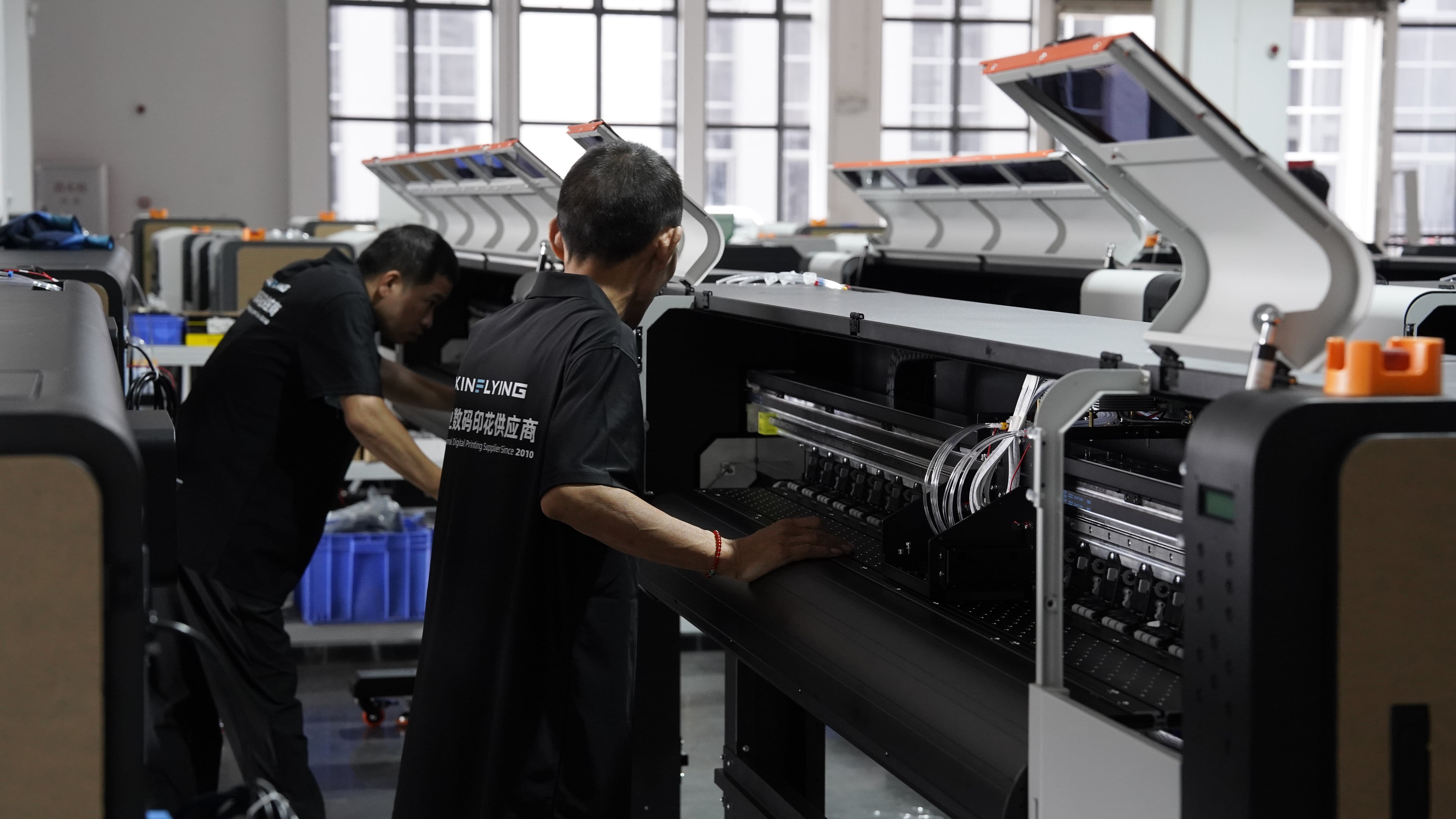
Inside an open DTF printer, a technician inspects internal wiring and mechanical assemblies — the same construction details that CE conformity assessment examines.
CE marking on a DTF printer is not one approval. It is the visible outcome of three separate EU conformity assessments — electrical safety, electromagnetic compatibility, and machinery safety — each carried out against its own harmonised standard and each documented by its own evidence file. A buyer comparing direct-to-film printers by certificate alone can therefore end up with a machine that is fully assessed on one axis and undocumented on the other two.
Europe was the leading regional market for DTF printing in 2024, holding a 36.0% revenue share (Grand View Research). For importers, distributors, and print-on-demand operators selling into the EU, that concentration turns conformity documentation into a purchase criterion rather than a closing-stage formality: it determines whether a machine can be legally placed on the market, insured, and resold.
This reference breaks the certification stack into its working parts — which directive covers what, which standard supplies the technical evidence, which certificate references are recorded for Xinflying DTF printer platforms, and where the coverage of each document ends.
Why a single CE mark hides three different approvals
CE marking is a manufacturer's declaration that a product meets all applicable EU harmonisation legislation. It is not issued by a central authority, and it is not a single test. A DTF printer qualifies simultaneously as mains-powered electronic equipment, as a device that emits and must tolerate electromagnetic energy, and as machinery with moving parts and heated surfaces. Each of those identities falls under a different directive.
The practical consequence is that documentation documents are not interchangeable. An EMC test report says nothing about insulation and clearances. A machinery certificate says nothing about conducted emissions. And an EU Declaration of Conformity that names only one directive is an incomplete declaration of the machine's actual regulatory position.
This matters more in DTF than in many other equipment categories because most of the world's production capacity sits in one country. China accounts for more than 45% of global DTF printer manufacturing capacity (Dataintelo), and documentation practice across that supply base varies widely. The economic operator who places the machine on the EU market — usually the importer or distributor, not the factory — carries the obligation to produce the technical file on request. That is why the certificate reference, not the CE logo, is the useful part of the paperwork.
The three directives that govern a DTF printer
Low Voltage Directive 2014/35/EU — electrical safety, evidenced by EN IEC 62368-1
The Low Voltage Directive 2014/35/EU governs the electrical safety of equipment operating from a mains supply. For DTF printers, the harmonised standard used as technical evidence is typically EN IEC 62368-1, the hazard-based safety standard for information and communication technology equipment, which consolidated the earlier separate IT and AV equipment safety standards into a single risk-based framework.
In construction terms, EN IEC 62368-1 examines energy sources inside the enclosure, insulation and separation distances, component temperature limits, and fire containment. Those are not abstract concerns on a DTF printer, which concentrates switching power supplies, control electronics, heater and dryer elements, and a heated platen inside one frame. Thermal management on this class of machine is a safety function as much as a performance one, and the documented control approach for overheating risk is thermal protection using temperature sensors.
The LVD certificate reference recorded for Xinflying DTF printer platforms is TQT1550D271EC, assessed against EN IEC 62368-1. On the buyer side, the useful checks are whether the certificate names the legal manufacturer entity, lists the model or configuration covered, states the standard edition, and identifies the issuing body. A document naming only a trading brand, with no model list and no standard edition, is difficult to place inside an EU technical file.
EMC Directive 2014/30/EU — electromagnetic behaviour, evidenced by EN 55032
The EMC Directive 2014/30/EU imposes two obligations rather than one: equipment must limit the electromagnetic disturbance it generates, and it must tolerate a defined level of disturbance from its environment. EN 55032 is the emission standard applied to multimedia equipment and is the reference normally cited for the emission side of a DTF printer assessment.
The reason both halves matter is the machine's composition. A DTF printer combines motor drives, switching power supplies, heated elements, and USB or network data connections in a single unit. In a workshop running several units on one supply, emissions and immunity stop being theoretical: insufficient immunity typically surfaces as interrupted print jobs, communication errors between RIP station and machine, or unexpected shutdowns in electrically noisy environments. Excessive emissions travel the other way and can affect neighbouring equipment.
For Xinflying DTF printer documentation, the EMC evidence references EN 55032. When reviewing this part of a supplier file, distinguish a standalone emission test report from a complete EMC assessment, and check that the report names the tested model and the standard edition rather than describing a generic product family.
Machinery Directive 2006/42/EC — mechanical risk, evidenced by EN ISO 12100
The Machinery Directive 2006/42/EC addresses mechanical hazards and requires a documented risk assessment carried out under EN ISO 12100, the standard that sets out the general principles for design, risk assessment, and risk reduction. The directive also defines the technical file, the Declaration of Conformity, and the marking duty that apply before a machine is placed on the market.
A DTF printer presents a recognisable hazard set: a traversing printhead carriage, film feed and take-up rollers with pinch points, moving assemblies behind covers, and heated surfaces. EN ISO 12100 prescribes the order of attack — identify hazards, estimate risk, eliminate or reduce by design first, then by safeguarding, and only then by information for use. The warnings printed in the manual are the last layer of that hierarchy, not the primary control.
The machinery certificate reference recorded for Xinflying DTF printer platforms is M.2026.206.C142365, assessed against EN ISO 12100. The assessment should be specific to the machine configuration being sold; a generic template that describes no particular carriage, guarding arrangement, or interlock logic is weak evidence for a technical file.
Directive-by-directive comparison
| Directive | Harmonised standard used as evidence | What it covers | Recorded reference | Where coverage stops |
|---|---|---|---|---|
| Low Voltage Directive 2014/35/EU | EN IEC 62368-1 | Electrical safety of mains-powered equipment: energy sources, insulation, clearances, component temperature limits, fire containment | LVD certificate TQT1550D271EC | Does not address electromagnetic emissions or mechanical hazards |
| EMC Directive 2014/30/EU | EN 55032 | Electromagnetic emissions of multimedia equipment, alongside the directive's requirement that equipment tolerate defined disturbance | EMC evidence referencing EN 55032 | Does not demonstrate electrical construction safety or guarding |
| Machinery Directive 2006/42/EC | EN ISO 12100 | Mechanical hazards, risk assessment and risk reduction methodology, technical file and marking duties | Machinery certificate M.2026.206.C142365 | Does not cover EMC performance or consumable-related safety |
What a documented compliance file looks like
XINFLYING (Guangzhou Xin Flying Digital Technology Co., Ltd.) is a digital printing equipment manufacturer founded in 2010 and based in Panyu, Guangzhou, producing DTF printer machines, dye sublimation printers, DTG printers, UV DTF printers, UV flatbed printer machines, and printing consumables. The company reports 200+ employees, a 20-engineer R&D team, annual output above 20,000 units, and an export ratio of 80%, with Europe among its main markets alongside North America, South America, Asia, the Middle East, and Africa.
Structural facts of that kind matter less on their own than the documentation they produce. For a European buyer, the useful part is that the file is assembled from traceable references rather than a single logo: LVD certificate TQT1550D271EC against EN IEC 62368-1, machinery certificate M.2026.206.C142365 against EN ISO 12100, and EMC evidence referencing EN 55032. Overheating risk on the machines is controlled through thermal protection using temperature sensors, which is a design decision that appears in the electrical safety assessment rather than in marketing material.
Component traceability supports the same logic. Xinflying specifies Hoson control boards — a named component that appears on both the electrical safety side and the EMC side of the file, and a detail that is easier to verify than an unbranded board with no traceability. Machine class affects the scope in the same way: an A2-class system such as the XF-450PRO, documented with dual Epson I1600-A1 printheads and 9 sqm/h at 6 pass, sits in a different configuration envelope from a wide production platform, and each configuration carries its own assessment record.
One boundary is worth stating early. CE marking applies to the machine, not to what it prints on. DTF printing films follow a separate textile-safety route: films must comply with OEKO-TEX STANDARD 100 for textile safety and restricted substances. A complete EU purchasing file therefore contains two distinct strands — machine conformity and consumable safety.
Where this matters in real production scenarios
Print-on-demand and custom apparel shops usually operate one or two machines in a space that is also a workplace or retail-facing unit. Here the electrical and thermal requirements of the Low Voltage Directive translate directly into workplace safety and insurance compliance, while EMC performance determines whether the machine behaves predictably alongside other equipment on the same circuit.
Importers, distributors, and stock-holding resellers are the operators most exposed. As the entity placing the machine on the EU market, they must be able to produce a Declaration of Conformity and technical file on request. A certificate number such as TQT1550D271EC or M.2026.206.C142365 is valuable to them precisely because it is checkable with the issuing body, which converts an unverifiable supplier statement into something defensible.
Fashion brands, promotional product suppliers, and mixed-fabric producers benefit from a different kind of assurance. DTF printing supports cotton, polyester, blends, and dark garments, and provides a 3–4x improvement in fabric compatibility over sublimation printers. Practically, that means one documented machine configuration can serve several product lines — and one configuration, by extension, maps to one technical file rather than a fragmented set of machine approvals.
Transfer suppliers running continuous shifts test the machine's safety design daily. DTF allows batch transfer preparation in advance, quick design changes, and efficient handling of customised orders, which pushes equipment into longer duty cycles. In that mode, overheating control, EMC stability under load, and mechanical guarding stop being paperwork topics and become uptime factors. The same profile — custom apparel shops, print-on-demand businesses, fashion brands, promotional products, personalised clothing, mixed-fabric production, and operations requiring flexible garment decoration — is where DTF printing is most commonly deployed.
Market signals that make compliance a commercial variable
The global DTF printing market was valued at USD 2.7 billion in 2024 (Grand View Research). Growth projections diverge noticeably between research houses: Grand View Research models a 6.0% CAGR for 2025–2030, 360iResearch projects 6.77% for 2026–2032, and Dataintelo projects the printer segment reaching USD 5.2 billion by 2034 at 12.5% CAGR. The divergence itself is useful information — it tells buyers to plan capacity and compliance work in scenarios rather than against a single growth number.
Machine mix is shifting toward larger systems. Industrial DTF printers accounted for 58.3% of total revenue share in 2025, driven by high throughput requirements (Dataintelo). Larger machines mean higher connected electrical loads, heavier moving assemblies, and longer duty cycles — the exact conditions under which LVD, EMC, and machinery assessment detail becomes more consequential rather than less.
End-product concentration reinforces the point. T-shirts represented 41% of DTF printing revenue in 2024 (KBV Research), making apparel the dominant application and, by extension, the dominant cross-border shipment category. On the trade side, China's inkjet printer exports under HS 84433213 carry a 13% Value-Added Tax and a standard MFN duty of 0%, which indicates that duty is not the main friction in EU-bound trade. Documentation is.
Certificate evidence versus self-declaration: where the coverage stops
The traditional alternative to a certificate file is a supplier self-declaration or a CE sticker applied without supporting test evidence. Self-declaration is fast and inexpensive, and in some low-risk categories it is legitimate. The difference for a DTF printer is verifiability: a self-declaration typically names no model list, cites no standard edition, and offers no issuing body that a distributor can contact, whereas certificate-backed evidence such as TQT1550D271EC and M.2026.206.C142365 can be checked against the organisation that issued it.
Four limits should be expected from any CE documentation set, including a strong one:
- Conformity is configuration-bound. The assessment covers the machine as built and documented. Changing the power supply, control board, heater, printhead count, or enclosure geometry moves the shipped machine away from the assessed configuration, and repairs using non-equivalent components raise the same question.
- CE covers safety, EMC, and machinery risk — not performance. It does not certify print quality, output per hour, ink durability, or cost per transfer. Those remain commercial specifications and must be verified separately.
- Consumables sit outside the machine framework. DTF films must comply with OEKO-TEX STANDARD 100 for textile safety and restricted substances, a route that has nothing to do with the printer's electrical or mechanical conformity.
- The legal entity on the document must match the entity placing the product on the market. Where machines are rebranded or sold through intermediaries, the compliance chain can become difficult to trace, which is a documentation problem the buyer inherits.
What changes next for DTF printer compliance
The regulatory framework itself is moving. The Machinery Directive 2006/42/EC is being replaced by the Machinery Regulation (EU) 2023/1230, which applies from 20 January 2027. Buyers signing multi-year supply agreements in the current cycle should ask which framework a supplier's technical file will be maintained under and how documentation will be updated when the regulation applies.
Market surveillance intensity tends to track market size. A technology that reached USD 2.7 billion globally in 2024, with Europe holding a 36.0% revenue share, attracts more customs and authority attention than a niche category — particularly where electrical safety and machinery risk are involved.
The practical direction of travel is toward verifiable, digital documentation. Certificate references that can be checked with an issuing body, standard editions that are stated rather than implied, and configuration records that match the shipped machine will increasingly distinguish suppliers more clearly than catalogue specifications do.
Frequently asked questions
Which CE directives apply to a DTF printer?
Three are central: the Low Voltage Directive 2014/35/EU for electrical safety, the EMC Directive 2014/30/EU for electromagnetic compatibility, and the Machinery Directive 2006/42/EC for mechanical safety. Each is assessed against its own harmonised standard — EN IEC 62368-1, EN 55032, and EN ISO 12100 respectively — and each produces its own evidence. Other horizontal legislation may apply depending on configuration and market.
What is the practical difference between an LVD certificate and an EMC test report?
An LVD certificate such as TQT1550D271EC records that the electrical construction of a defined configuration was assessed against EN IEC 62368-1 — insulation, separation distances, component temperatures, fire containment. An EMC test report under EN 55032 records measured emission behaviour of a tested unit. One addresses electrical construction safety, the other addresses electromagnetic behaviour. Neither substitutes for the other, and neither replaces the machinery risk assessment.
How can an EU buyer verify DTF printer CE documentation before ordering?
Check five things: an EU Declaration of Conformity naming the legal manufacturer and the covered model list; certificate or report references (for example TQT1550D271EC and M.2026.206.C142365) with an identifiable issuing body; standards named together with their edition; a commitment that the technical file is available on request; and consistency between the configuration being ordered and the configuration that was assessed. Where any of these is missing, the document set is incomplete rather than merely brief.
Does CE certification cover DTF films and inks?
No. CE marking applies to the machine and addresses electrical safety, electromagnetic compatibility, and machinery risk. Textile-safety characteristics of the consumables follow a separate route: DTF printing films must comply with OEKO-TEX STANDARD 100 for textile safety and restricted substances. A full EU purchasing file therefore contains both a machine conformity strand and a consumable-safety strand.
Does a DTF printer keep its certification after components are changed?
Conformity is tied to the assessed configuration. Replacing the power supply, control board, heater, or printhead configuration with different parts takes the machine outside the documented configuration. Where a change affects electrical safety, EMC behaviour, or mechanical risk, the assessment should be reviewed before the machine is placed on the market again. The certificate reference is the baseline against which such changes are compared.
Do compact DTF printers and industrial DTF printers need the same certification scope?
The directives do not differentiate by machine size, but the risk profile does. Industrial DTF printers accounted for 58.3% of revenue share in 2025 (Dataintelo) and typically combine larger electrical loads, heavier moving assemblies, and longer duty cycles. The applicable framework — LVD, EMC, and Machinery Directive — is the same across classes, while the depth of the risk assessment, guarding design, and thermal control differs with configuration.
For a European buyer, the cleanest way to read a DTF printer's compliance file is by directive rather than by logo: one document for electrical safety, one for electromagnetic behaviour, one for mechanical risk, plus a separate consumable-safety strand. Certificate references such as TQT1550D271EC and M.2026.206.C142365 are useful precisely because they can be checked, and because they state the limits of what was assessed as clearly as they state what was approved.
Reference document: Xinflying company and product brochure (PDF). Manufacturer information: XINFLYING — Guangzhou Xin Flying Digital Technology Co., Ltd.