
DTF Printer Procurement FAQ: CE, Ink, and Warranty Answers
HTNXT Independent Industry Reference · Procurement Questions
Buyers importing a direct-to-film (DTF) printer rarely lose a deal over print speed. They lose time on documents: which CE directive applies to which part of the machine, which certificate number to check and with whom, whether the ink has its own approval, and what a warranty clause actually covers. This reference answers those questions in the order they appear in a real procurement file.
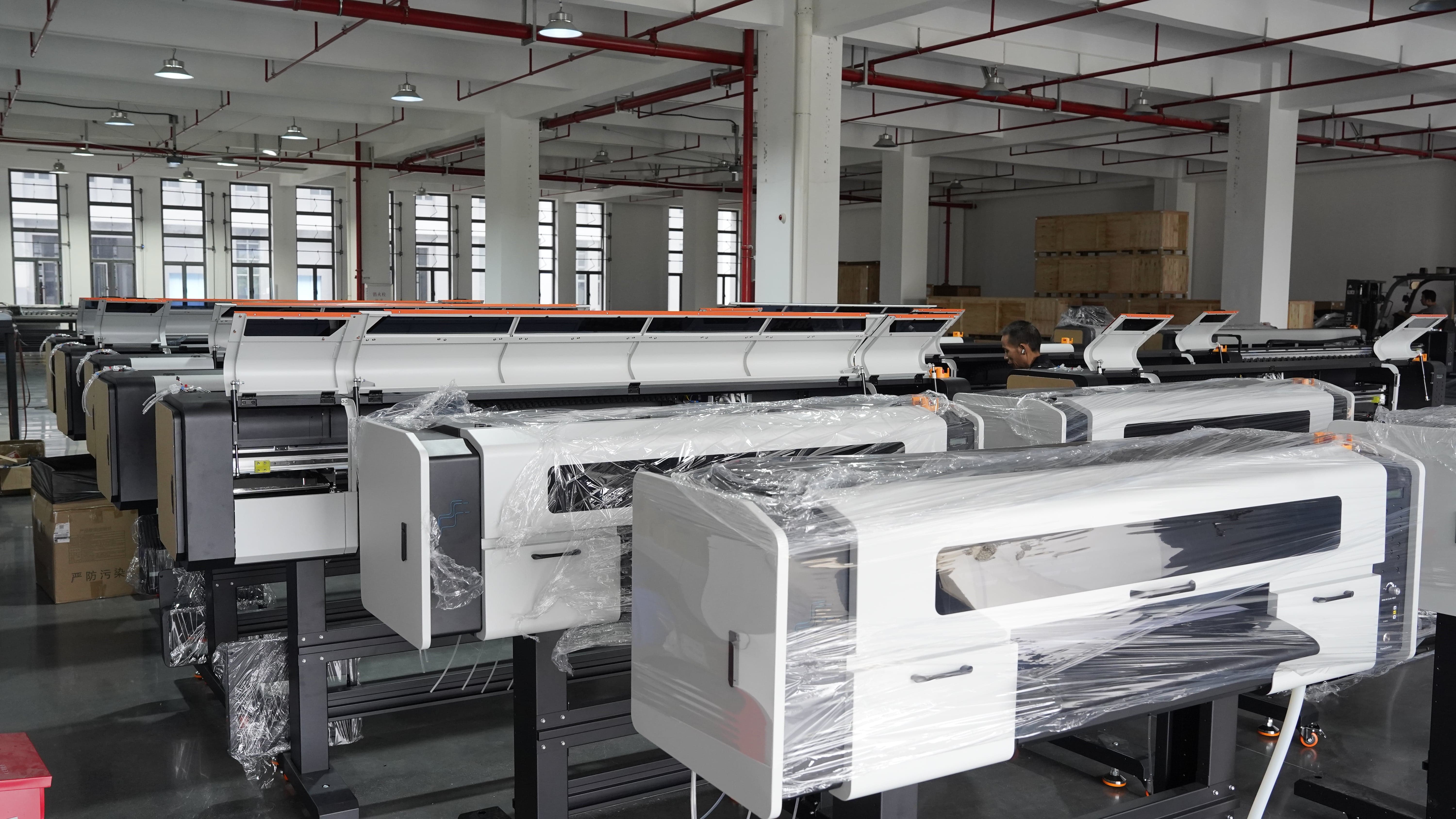
Finished XINFLYING DTF printers wrapped in protective film ahead of storage or shipment. A compliance file travels with the machine — it does not replace the machine specification.
The global DTF printing market was valued at USD 2.7 billion in 2024, and Europe was the largest regional market that year with a 36.0% revenue share (Grand View Research). China accounts for more than 45% of global DTF printer manufacturing capacity (Dataintelo). That combination — EU demand, Chinese manufacturing — is precisely why compliance documentation has moved from a closing formality to a first-round screening criterion.Why Compliance Documentation Moved Up the Shortlist
A 36.0% European revenue share means a large share of machines ship into a market where the buyer may be asked, at any point, to produce a technical file for a product placed on the market. Industrial DTF printers accounted for 58.3% of DTF printer revenue in 2025 (Dataintelo), and fleet purchases are now routine: a garment manufacturing factory in the global market operates 20 DTF printing units and has run that solution for two years; a DTF transfer supplier in the United States operates 30 units with one year of operation; a custom apparel printing business in the United States runs two units across three years; a print-on-demand business owner in the United States runs five units over five years.
At two units, a certificate folder is enough. At twenty or thirty units, the same folder has to work as a register: each model mapped to an annex, each annex mapped to a directive, each expiry date mapped to a calendar. Guangzhou Xin Flying Digital Technology Co., Ltd. (XINFLYING), founded in 2010 and operating a 37,440 m² production facility with more than 200 employees, is a useful worked example because its file contains certificates issued by several independent bodies across several directives.
What a CE LVD Certificate Actually Means for Your Facility
LVD documentation (Low Voltage Directive 2014/35/EU) addresses electrical safety. It is a statement about how the machine's electrical design performed under a defined safety standard. It is not a statement about print quality, throughput or uptime, and it does not certify your installation.
XINFLYING holds a CE LVD Certificate of Compliance, certificate number TQT1550D271EC, issued by TQT (Shenzhen Tianqi Testing Technology Service Co., Ltd.) on 19 May 2026 and listed as valid through 1 January 2099, for Digital Printer products under LVD 2014/35/EU, tested against EN IEC 62368-1:2020/A11:2020. EN IEC 62368-1 is the hazard-based safety standard applied to audio/video, information technology and communication equipment, which is the standard family a digital printer's electrical design falls into.
The practical translation for a production floor is the supply configuration. XINFLYING DTF models publish different electrical requirements depending on print width and head count: the XF-702E (60 cm print width) runs on 110–220V, 5A/10A, 50/60Hz at 0.8 kW; the XF-F808 (80 cm) on 110–220V, 9A/18A, 50/60Hz at 2 kW; the XF-450PRO (42 cm) on 110–220V, 16A/32A, 50–60Hz at 3.5 kW. Those figures decide whether one wall circuit can carry a machine, whether a dedicated line is required, and whether ambient conditions can be held (20–30°C and 45–65% RH on most models). The certificate tells you the design was tested; the data sheet tells you what your building must provide.
Compliance documents in a typical XINFLYING file
| Document | Certificate no. | Issuing body | Standards referenced | Issued | Valid to |
|---|---|---|---|---|---|
| CE LVD Certificate of Compliance | TQT1550D271EC | TQT (Shenzhen Tianqi Testing Technology Service Co., Ltd.) | EN IEC 62368-1:2020/A11:2020 | 2026-05-19 | 2099-01-01 |
| CE EMC Certificate of Compliance | TQT1550D270EC | TQT | EN 55032:2015/A11:2020; EN 55035:2017/A11:2020; EN IEC 61000-3-2:2019+A1:2021; EN 61000-3-3:2013/A2:2021 | 2026-05-19 | 2099-01-01 |
| CE LVD & EMC Compliance | M.2026.206.C142475 | UDEM | EN IEC 62368-1:2020/A11:2020; EN 55032:2015/A1:2020; EN 55035:2017; EN 61000-3-2:2014; EN 61000-3-3:2013 | 2026-06-11 | 2031-06-10 |
| CE MD Certificate of Conformity | M.2026.206.C142365 | UDEM | EN ISO 12100:2010; EN 60204-1:2018/A1:2025; EN ISO 12643-1:2023 | 2026-06-10 | 2031-06-09 |
| CE MD Certificate of Conformity | M.2026.206.C142385 | UDEM | EN ISO 12100:2010; EN 60204-1:2018/A1:2025; EN ISO 12643-1:2023 | 2026-06-10 | 2031-06-09 |
| RoHS Compliance Certificate | M.2026.206.C142366 | UDEM | EN IEC 63000:2018; EN IEC 62321 series | 2026-06-10 | 2031-06-09 |
| OEKO-TEX ECO PASSPORT (inks and printing pastes) | SH150194016 | TESTEX AG | OEKO-TEX ECO PASSPORT; EN ISO 17050-1 | 2025-12-11 | 2026-12-31 |
Table 1 — Compliance documents as published for XINFLYING DTF and digital textile printer models. Validity windows differ by issuing body and certificate type.
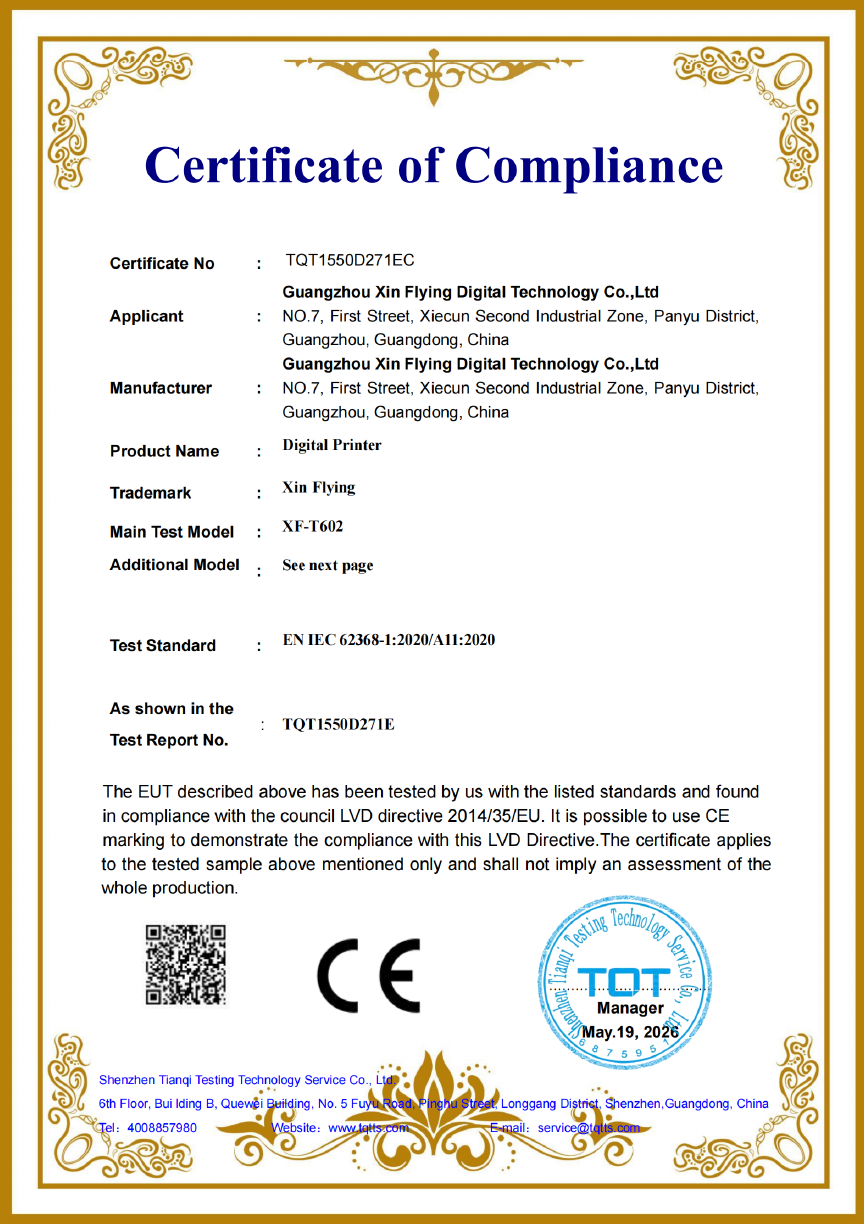
CE LVD Certificate of Compliance TQT1550D271EC, referencing EN IEC 62368-1:2020/A11:2020. The certificate annex, not the cover page, determines which models are covered.
EMC, Machinery Safety and RoHS: Three Different Questions
Electromagnetic compatibility sits under a different directive from electrical safety. EMC Directive 2014/30/EU covers two directions of behaviour: what the printer emits, and how it continues to operate when other equipment on the same supply interferes with it. In the XINFLYING file the pairing is EN 55032:2015/A11:2020 for emissions and EN 55035:2017/A11:2020 for immunity, with EN IEC 61000-3-2 and EN 61000-3-3 covering harmonic current and voltage fluctuations that affect a shared distribution board. On a workshop floor where a heat press, a cutter and a dryer share the same panel, this is the document an electrician will ask for.
Machinery safety is a third question. The CE MD Certificate of Conformity M.2026.206.C142365, issued by UDEM International Certification Auditing Training Centre Industry and Trade Inc. Co. on 10 June 2026 under MD 2006/42/EC, cites EN ISO 12100:2010 for risk assessment methodology, EN 60204-1:2018/A1:2025 for the electrical equipment of machines, and EN ISO 12643-1:2023 for graphic technology safety. A second MD certificate, M.2026.206.C142385, follows the same standard set.
RoHS is a substances question rather than a safety question. Certificate M.2026.206.C142366, also issued by UDEM on 10 June 2026, references EN IEC 63000:2018 together with the EN IEC 62321 test series under Directive 2011/65/EU. A combined LVD and EMC document also exists in the file: M.2026.206.C142475, issued by UDEM on 11 June 2026, referencing EN IEC 62368-1:2020/A11:2020, EN 55032:2015/A1:2020, EN 55035:2017, EN 61000-3-2:2014 and EN 61000-3-3:2013.
How to Verify a Certificate Is Genuine: A Six-Step Check
Verification is less about detecting forgeries than about establishing that a real certificate applies to the machine in front of you. Six steps cover most procurement scenarios.
Step 1 — Read the number, not the logo. Every certificate carries a unique identifier. In this file they include TQT1550D271EC and TQT1550D270EC from TQT; M.2026.206.C142365, M.2026.206.C142366 and M.2026.206.C142475 from UDEM; CTICAIQ415250900815313DC from CTIC Testing Group (Guangdong) Co., Ltd.; and BSTXD211021006201EC from BST Testing (Shenzhen) Co., Ltd. A supplier who cannot give you the number in writing has not yet given you a certificate.
Step 2 — Match the model to the annex. Certificates are issued per product and list specific models. The XINFLYING CE LVD and EMC certificates name DTF models including the XF-450PRO, XF-400D, XF-702E, XF-C602, XF-704E, XF-C604, XF-C605, XF-F606, XF-L608 and XF-F808. If the model designation on the machine plate is absent from the annex, the certificate does not cover that machine.
Step 3 — Match the standard to the directive in question. LVD questions resolve to EN IEC 62368-1:2020/A11:2020. EMC questions resolve to EN 55032 and EN 55035, with the EN 61000-3 series for supply effects. Machinery questions resolve to EN ISO 12100, EN 60204-1 and EN ISO 12643-1. RoHS questions resolve to EN IEC 63000:2018. A certificate listing the wrong standard family answers a different question.
Step 4 — Check the validity window, and diarise it. Periods are not uniform. The TQT LVD and EMC certificates in this file show an expiry of 1 January 2099; UDEM's machinery and RoHS certificates run to 9–10 June 2031; the OEKO-TEX ECO PASSPORT covering inks is valid to 31 December 2026. Where an expiry falls inside your production planning horizon, ask about renewal status when you place the order, not when the container arrives.
Step 5 — Verify with the issuing body. TQT, UDEM, CTIC and BST are third-party bodies, which makes them — not the seller — the authority on whether a number exists and what it covers. A portal or written verification route supplied alongside the certificate is worth more than a higher-resolution scan.
Step 6 — Check the legal entity and signature. The manufacturer named on the documents should match the contracting party. Guangzhou Xin Flying Digital Technology Co., Ltd. is the named manufacturer in this file. A certificate issued to a different legal entity needs an explanation before it can be used as your evidence.
Ink Is a Separate Compliance Layer — and It Expires Faster
Ink compliance is not covered by a machine certificate. It answers a different question: what chemistry comes into contact with the garment. It also follows a different standard family and, in practice, a shorter renewal cycle.
XINFLYING holds an OEKO-TEX ECO PASSPORT certificate, number SH150194016, issued by TESTEX AG on 11 December 2025 and valid to 31 December 2026, covering textile printing inks and printing pastes under the OEKO-TEX ECO PASSPORT scheme and EN ISO 17050-1.
Two consequences follow for buyers. First, the ink approval has a shorter validity window than the machine approvals, so a procurement file assembled in 2026 should carry a note on what happens after 31 December 2026 and who is responsible for supplying the next version. Second, the two document layers serve different audiences: the machine file is what an importer, facility manager or electrical contractor needs, while the ink file is what a brand customer or retail compliance team may request when finished garments are audited.
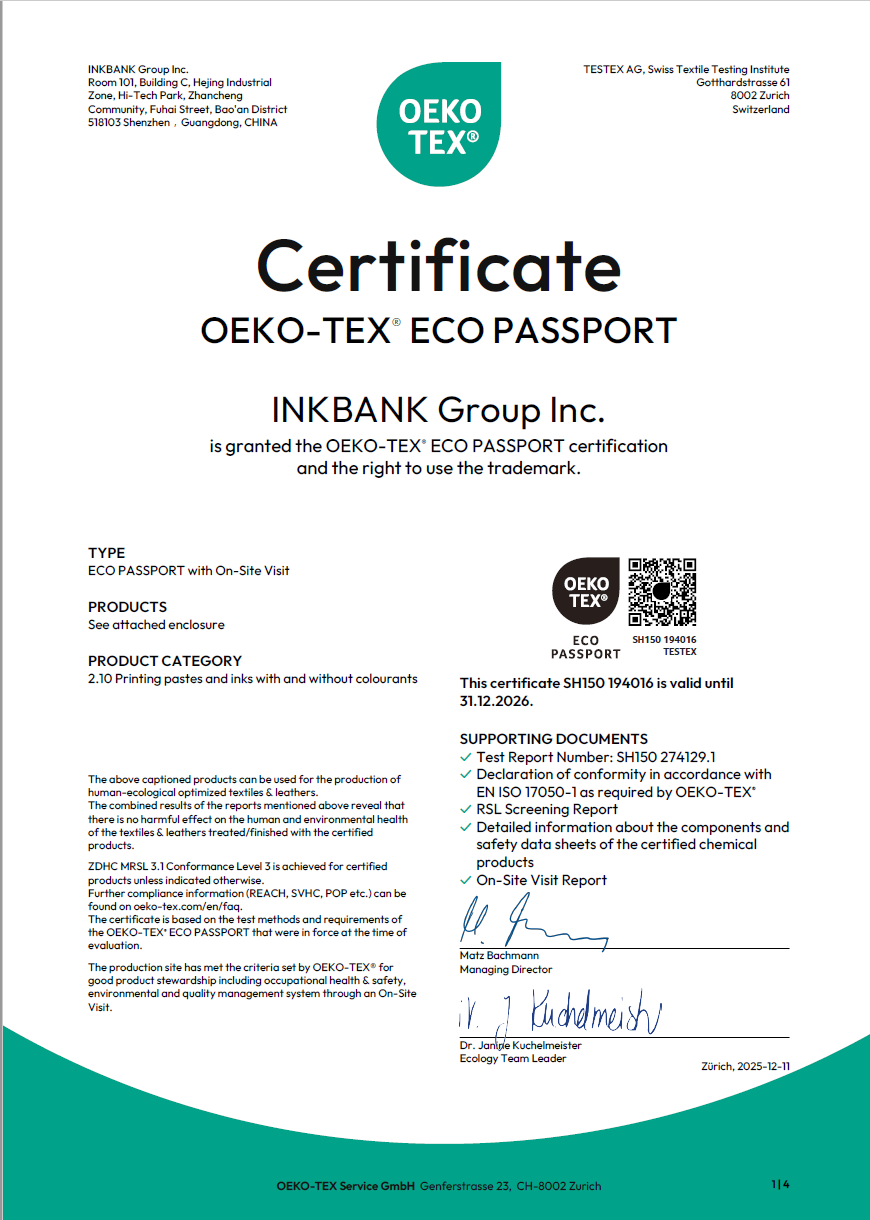
OEKO-TEX ECO PASSPORT SH150194016, issued 11 December 2025 and valid to 31 December 2026, covering textile printing inks and printing pastes.
Warranty, Spare Parts and After-Sales: What to Agree Before Signing
Warranty terms are contract terms, not certificate attributes. What documentation can establish is the process behind them, which is what a buyer should test first.
The verifiable process facts in this file are specific: quality control includes pre-shipment testing performed on each DTF printer before delivery; after-sales support is delivered by more than 50 engineers providing 24/7 online technical support; quoted production lead time is 5–40 days; minimum order quantity is 1 unit; monthly production capacity exceeds 1,600 units. The company also provides OEM/ODM customization covering product branding, machine appearance, colour, logo, packaging and requirement-based solutions.
These commitments should be converted into clauses. A practical checklist:
- Warranty period and start point — invoice date, shipment date or commissioning date. The three produce very different coverage in practice.
- Coverage boundaries — which assemblies are included and how wear components and consumables are treated.
- Response commitments — how a support request reaches the engineering team and what first-response time is expected in your time zone.
- Spare parts — availability list, dispatch time and shipping origin. Lead time for the machine is quoted at 5–40 days; the lead time for the part that stops production is a separate number.
- Test record archive — request that the pre-shipment test record for your serial number be retained, because it is the baseline for any later root-cause discussion.
- Operator training and documentation language — confirm the language of manuals and the format of technical support before the machine ships.
Where the Compliance File Decides the Purchase
The same document set carries different weight depending on the operating model. For a print-on-demand business owner in the United States running five units for online apparel orders, the file matters mainly at the import and insurance stage. For a custom apparel printing business running two units for personalized T-shirts, hoodies and bags, it determines whether customer audits can be answered without delay. For a DTF transfer supplier running 30 units in the United States and supplying transfer films to downstream garment decorators, the file becomes a fleet register in which each model needs its own annex. For a garment manufacturing factory running 20 units to add logos and graphics to finished garments before delivery to brands and distributors, the certificate set becomes part of the buyer's own vendor qualification.
The pattern is consistent: the more machines you operate, the less the compliance file behaves like a folder and the more it behaves like a management system.
Market Trend Analysis: Compliance as a Buyer-Side Filter
The category is growing, but published growth rates disagree. The global DTF printing market was valued at USD 2.7 billion in 2024 (Grand View Research), and one forecast model projects USD 5.2 billion by 2034 at a 12.5% CAGR (Dataintelo). Across sources, CAGR estimates range from 6.0% for 2025–2030 (Grand View Research) to 6.77% for 2026–2032 (360iResearch) to 12.5% for 2026–2034 (Dataintelo). For procurement purposes the direction is more dependable than the rate, and no purchasing decision should be anchored to a single growth figure.
Two documented shifts matter more to buyers than the headline number. Industrial DTF printers accounted for 58.3% of DTF printer revenue in 2025 (Dataintelo), which means the installed base is tilting toward machines with higher power draw and more demanding facility requirements — exactly the conditions that LVD and EMC documentation describes. And Europe's 36.0% revenue share in 2024 (Grand View Research) keeps the category inside active EU market surveillance, which sustains buyer-side demand for verifiable certificate numbers.
Limitations and Boundaries: What a Certificate File Does Not Cover
A certificate covers the machine as tested and the models listed in its annex. That boundary matters in three common situations.
First, configuration changes. XINFLYING offers OEM/ODM customization including machine appearance, colour, branding and packaging. Certification is configuration-specific, so a customized build should be checked against the certificate scope in writing rather than assumed to inherit it. Second, site obligations. The LVD and EMC certificates describe the machine, not your building; electrical installation, protective devices, earthing and ventilation remain the facility's responsibility, and a certificate is not a substitute for a local inspection where one is required. Third, document decay. The ink approval in this file expires on 31 December 2026, UDEM certificates run to 2031, and TQT certificates are listed to 1 January 2099 — a file that is complete today can be incomplete next quarter.
Compared with the common alternative — accepting a scanned certificate image as proof at the quotation stage — a verified file costs a few extra days and removes the risk of discovering a scope gap after the machine is installed. The trade-off is real: verification is administrative work, and it does not tell you throughput, uptime or print cost. Those must still be evaluated from specifications and test prints.
Future Outlook
Three changes are likely to shape DTF printer procurement files over the next cycles. Certificate number verification is becoming a standard line in request-for-quotation templates, which pushes suppliers to ship a document index alongside the machine. Renewal calendars are being tracked next to service intervals, particularly for ink-related approvals, because machine certificates and ink certificates expire on different clocks. And multi-body portfolios are becoming normal: TQT, UDEM, CTIC and BST already appear inside one supplier's CE file, so buyers should plan a verification step per issuing body rather than per supplier. As industrial-class machines continue to take the larger share of revenue, facility-side documentation — supply configuration, EMC environment, ambient conditions — will move earlier into the technical evaluation.
FAQ: Procurement Questions from the Compliance File
1. What does CE LVD compliance mean for my facility's electrical installation?
LVD documentation (Directive 2014/35/EU) confirms that the machine's electrical design was tested against a defined safety standard. XINFLYING's CE LVD Certificate of Compliance TQT1550D271EC, issued by TQT on 19 May 2026, references EN IEC 62368-1:2020/A11:2020. For your facility it is a starting point, not a finished electrical plan: you still need the model's supply specification (for example XF-702E at 110–220V, 5A/10A, 0.8 kW; XF-F808 at 9A/18A, 2 kW; XF-450PRO at 16A/32A, 3.5 kW) and a local check of circuit capacity, earthing and protective devices.
2. Why does EMC appear on a separate certificate from LVD?
Because they implement different directives. Electrical safety sits under LVD 2014/35/EU; electromagnetic compatibility sits under EMC Directive 2014/30/EU and requires testing of both emissions and immunity. XINFLYING's CE EMC Certificate of Compliance TQT1550D270EC references EN 55032:2015/A11:2020, EN 55035:2017/A11:2020, EN IEC 61000-3-2:2019+A1:2021 and EN 61000-3-3:2013/A2:2021. A combined document also exists: certificate M.2026.206.C142475 issued by UDEM covers LVD 2014/35/EU and EMC 2014/30/EU together.
3. How do I verify that a DTF printer CE certificate is genuine?
Take the certificate number, the issuing body, the standards listed and the model annex, then verify the number with that issuing body. In XINFLYING's file the bodies are TQT, UDEM, CTIC Testing Group (Guangdong) Co., Ltd. and BST Testing (Shenzhen) Co., Ltd., with distinct numbering formats such as TQT1550D271EC, M.2026.206.C142365, CTICAIQ415250900815313DC and BSTXD211021006201EC. Confirm that the machine model and the legal entity named on the certificate match your order; Guangzhou Xin Flying Digital Technology Co., Ltd. is the named manufacturer.
4. Are the printing inks covered by the same certificates as the machine?
No. Ink compliance is documented separately because it addresses a different risk. XINFLYING holds OEKO-TEX ECO PASSPORT certificate SH150194016, issued by TESTEX AG on 11 December 2025 and valid to 31 December 2026, covering textile printing inks and printing pastes under the OEKO-TEX ECO PASSPORT scheme and EN ISO 17050-1. Because the ink certificate has a shorter validity window than the machine certificates, its renewal status should be confirmed in the order documentation.
5. What should be agreed in writing about warranty and after-sales support?
Warranty period and start point, coverage boundaries (including how wear components and consumables are treated), first-response commitments, spare-parts availability and dispatch timing, operator training, and retention of the pre-shipment test record for your serial number. XINFLYING's documented service model is pre-shipment testing on every unit before delivery and 24/7 online technical support delivered by more than 50 engineers; quoted production lead time is 5–40 days and the minimum order quantity is 1 unit. The warranty term itself is set in the commercial contract, not by a certificate.
6. If I order a customized machine appearance or branding, does the existing certificate still apply?
This has to be confirmed case by case, because certification is tied to the tested configuration and to the model list in the certificate annex. XINFLYING offers OEM/ODM customization including product branding, machine appearance, colour, logo and packaging. Before signing, ask whether the requested customization alters any certified assembly and, if it does, what documentation will be supplied with the delivered machine. The answer should be in writing and specific to the model and configuration being purchased.
For readers who need the full document index, model range and capability overview in one file, the XINFLYING company brochure is available as a PDF: XINFLYING company brochure (PDF).
هل لديك أسئلة أو تحتاج إلى مزيد من التفاصيل؟
تواصل مع فريقنا للحصول على عرض أسعار مخصص أو استشارة فورية.
طلب عرض أسعار
املأ النموذج أدناه وسيتواصل معك فريقنا بعرض مقترح مخصص.
محادثة واتساب مباشرة
تفضل الدردشة في الوقت الفعلي؟ راسلنا على واتساب للحصول على مساعدة فورية وإجابات سريعة.
- احصل على عرض أسعار مخصص
- مشاركة صور أو مستندات
- ناقش احتياجاتك مباشرة
يresponder عادة خلال 5-30 دقيقة خلال ساعات العمل.