
DTF Printer Procurement: Terms, Acceptance and Certificate Checks
For a DTF printer buyer at the final stage of a purchase, the decisive question is no longer which machine prints fastest. It is what has to be tested, documented and matched — in writing — before the balance payment leaves the buyer's account.
Procurement of a DTF printer moves through distinct stages, and the last two are the least glamorous: decision, then execution. In execution, the buyer's remaining leverage is concentrated in one moment — the release of final payment. That leverage is spent on three verifiable items: purchasing terms that allocate cost and risk unambiguously, a pre-shipment acceptance test with a defined evidence set, and a certificate schedule whose model designations match the invoice exactly. All earlier questions about printhead count, print width or powder handling have already been settled by then.
This reference sets out how those three items are structured, using the documentation practice of XINFLYING — the trading and manufacturing name of Guangzhou Xin Flying Digital Technology Co., Ltd., a digital printing equipment manufacturer founded in 2010 that produces DTF printers, UV DTF printers, UV flatbed printers, DTG printers and dye sublimation systems — as a worked example of model-level evidence.
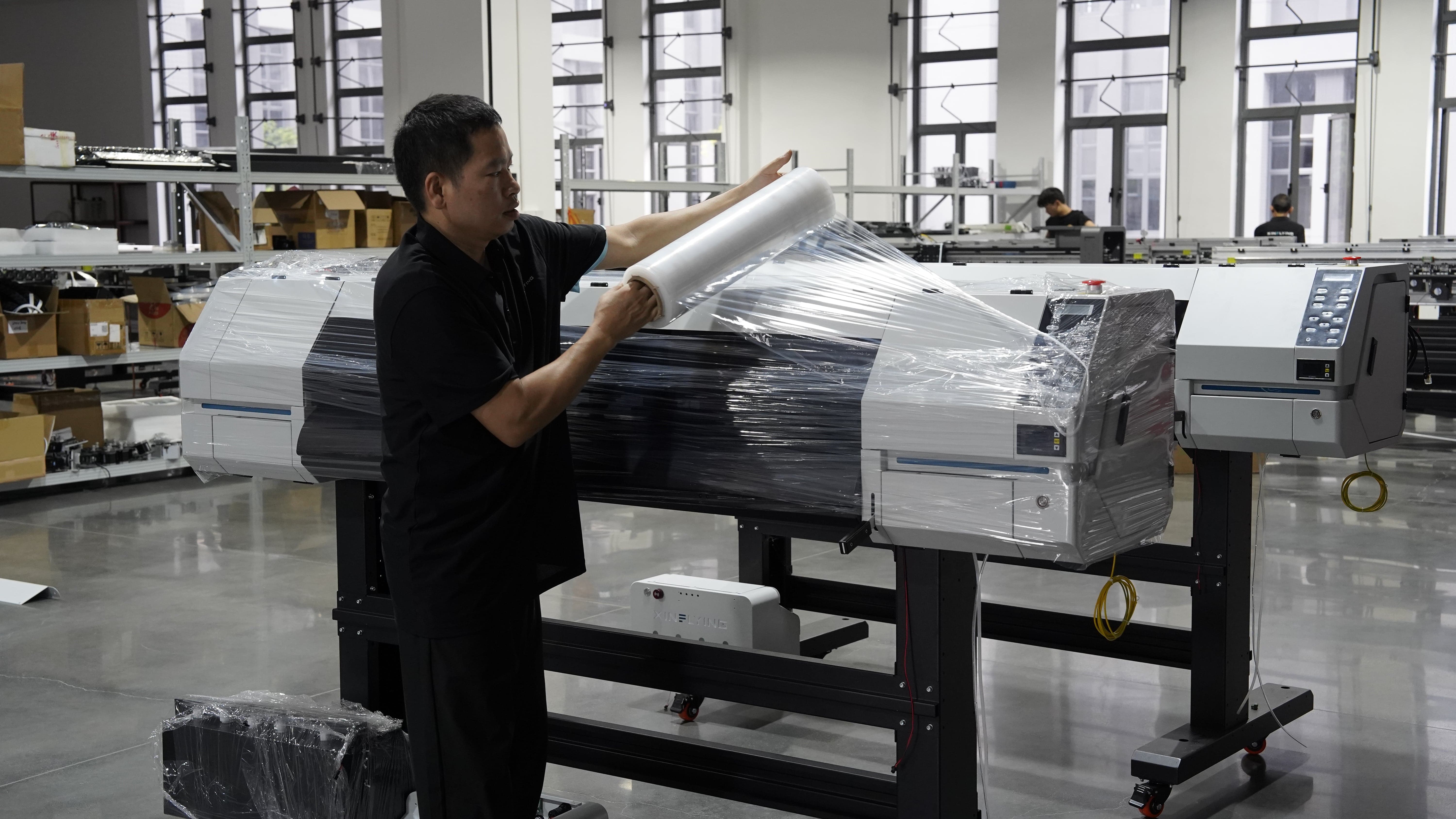
Pre-shipment stage: a completed DTF printer receives protective wrapping before crating. The condition of the machine at this point is exactly what an acceptance test is meant to document.
Why procurement sign-off has become the harder half of the purchase
The DTF printer market has expanded quickly enough that comparison content now outnumbers verification content. The global direct-to-film printing market was valued at USD 2.7 billion in 2024, according to Grand View Research, and China accounts for more than 45% of global DTF printer manufacturing capacity, according to Dataintelo. A buyer sourcing from a China DTF printer manufacturer therefore faces a dense field of offers with broadly similar headline specifications.
What differentiates those offers at the point of payment is not the specification sheet but the evidence pack behind it. Europe, for instance, was the leading regional market for DTF printing in 2024 with a 36.0% revenue share, per Grand View Research. Buyers selling into that market are routinely asked by their own customers, and occasionally by customs, to show conformity documentation for the equipment they operate. A commercial DTF printer bought without a traceable document set can become a resale, insurance or tender problem later, even if it prints well on day one.
Purchasing terms to fix in writing before the invoice is signed
The first document a buyer should be able to read without ambiguity is the commercial term sheet. XINFLYING's stated purchasing position is compact, which makes it easy to compare against a buyer's own requirements.
| Term | What the buyer should confirm | Documented position |
|---|---|---|
| Minimum order quantity | Whether a single unit order is accepted, or whether a package or container volume is implied | MOQ: 1 unit |
| Delivery terms | Which Incoterm applies, who books freight, who clears export and import, and at which point risk transfers | EXW / FOB / CIF / DDP |
| Payment methods | Which channels are accepted, what the deposit-to-balance split is, and what triggers the balance | T/T, Western Union, PayPal |
| Acceptance criteria | What is tested, by whom, on which materials, and what evidence is issued before shipment | Pre-shipment test |
Two of these four terms carry hidden cost. Incoterm choice decides landed cost as much as machine price: for China's ink-jet printer export category (HS 84433213), a 13% Value-Added Tax applies alongside a standard MFN duty of 0%, per China Customs and ETCN data. Under EXW the buyer absorbs that tax, freight and clearance; under DDP the seller does. Neither is better in itself — but the term must be named in the invoice and be consistent with the quoted price, otherwise the comparison between two suppliers is not a comparison at all.
Payment method carries a parallel risk. T/T, Western Union and PayPal are all accepted, and each leaves a different audit trail and a different recovery route if a dispute arises. Buyers typically structure the release so that the balance is tied to the acceptance evidence rather than to the shipment date alone — a structure that only works if the acceptance evidence was defined in the same document as the price.
Acceptance criteria that can actually be executed
"Pre-shipment test" is a criterion, not a report. For it to function as a payment gate, the buyer should specify what the test produces. A workable evidence set for a DTF transfer printer includes:
- Identity: serial number and exact model designation photographed on the machine plate, cross-referenced to the invoice and to the certificate model list.
- Print evidence: a test print produced on production transfer film with production ink, retained as a physical or dated digital sample, including white-ink laydown and fine-detail areas rather than a single flat colour block.
- Head and ink system: a nozzle check per printhead, and confirmation that the white ink circulation system is functioning — a standard inclusion on the commercial configurations described below.
- Film handling: feeding and alignment behaviour during a continuous run, since film feed deviation is one of the more common operational complaints in DTF production.
- Software state: the RIP software and firmware versions recorded in the report, so that a later upgrade or reinstall can be traced.
- Safety checks: verification of thermal protection behaviour. XINFLYING specifies thermal protection as its control method for overheating risk, implemented through temperature sensors — a check that ties directly to the electrical safety documentation discussed below.
- Packing evidence: photographs of crating, internal protection and accessories before the machine is closed.
Buyers ordering multiple units or a full production line should decide in advance whether acceptance is a factory test witnessed remotely, a third-party inspection, or a documentary review. The distinction matters most for an industrial DTF printing machine, where the acceptance object is not one printer but a printer plus its powder shaker and curing unit, and where downtime during commissioning is the expensive outcome.
Certificate checks: what to request and what each document proves
Conformity documentation is frequently requested as a bundle and reviewed as a bundle, which is where misunderstandings accumulate. Each document answers a narrower question than buyers assume.
| Document | Reference | What it addresses | What it does not prove |
|---|---|---|---|
| CE — Low Voltage Directive | TQT1550D271EC | Electrical safety of the machine's electrical design and construction | Print quality, colour accuracy or throughput |
| CE — EMC | Coverage within the CE documentation set | Electromagnetic compatibility of the equipment | Textile skin safety of printed output |
| CE — Machinery Directive attestation | M.2026.206.C142365 | Machinery safety conformity of the equipment as supplied | Consumable chemistry or ink formulation |
| RoHS | M.2026.206.C142366 | Restricted substances in electrical and electronic components | Safety performance of the assembled machine |
| ISO 9001:2015 | NOA2215496 | The manufacturer's quality management system | Conformity of any individual unit |
| OEKO-TEX ECO PASSPORT | SH150194016 | Chemical safety of inks and consumables used in textile production | Mechanical or electrical safety of the printer |
Read together, the CE-related documents form a layered argument: the Low Voltage Directive covers the electrical side, EMC covers interference behaviour, and the Machinery Directive attestation covers the equipment as an assembly, with RoHS addressing restricted substances in components. None of them says anything about how well the machine prints. Conversely, OEKO-TEX ECO PASSPORT addresses the chemistry of what goes onto the film and ultimately onto fabric — a separate concern from machine safety, and one that matters to buyers producing DTF printer for shirts work for brands with restricted-substance policies. For textile safety more broadly, DTF films are expected to align with OEKO-TEX STANDARD 100 requirements, which is a different standard from ECO PASSPORT and should not be conflated with it.
Three checks are worth performing on the documents themselves rather than on their existence. First, the certificate holder name should match the contracting entity, or be accompanied by a clear authorization chain if the seller is a distributor. Second, the standard cited and the issue and validity dates should be legible on the document, not only in an email summary. Third, the model list on the certificate should be read line by line — a certificate covering a family of machines is only useful to a buyer if the ordered designation appears on it.
Model-level evidence: matching the certificate schedule to the ordered machine
This is where most procurement reviews either tighten or fall apart. A conformity document is issued against identified product designations, so the purchase order, the invoice, the machine plate and the certificate model list must all refer to the same thing. XINFLYING's certified XF-series range includes designations such as XF-450PRO, XF-400D, XF-702E, XF-C602, XF-704E, XF-C604, XF-C605, XF-F606, XF-L608 and XF-F808 — and it is the specific designation, not the series, that a buyer should trace through the document set.
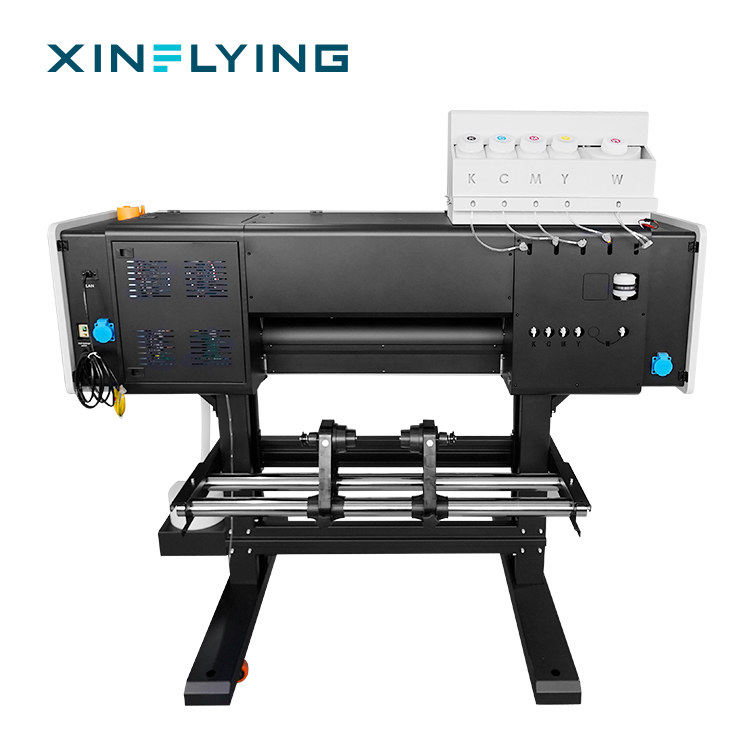
XINFLYING XF-702E, a 60 cm commercial DTF printer configuration with two Epson i3200-A1 printheads, automatic powder shaker and curing system, auto moisture retention and white ink circulation.
The configurations differ enough that acceptance criteria should be adapted rather than copied. The XF-450PRO is an A2 all-in-one DTF printer with two Epson i1600-A1 printheads, an integrated powder shaker and dryer, white ink circulation and RIIN/PrintFactory RIP software — a compact solution aimed at small-batch production. The XF-702E pairs a 60 cm DTF printer with the XF-Z650-2 package, adding an automatic powder shaker and curing system, auto moisture retention, white ink circulation and RIP support. The XF-C605 sits at the industrial end, supplied with the XF-A6502H package, and carries five Epson i3200-A1 printheads, an automatic powder recycling system, smart touchscreen control, a built-in fume purifier and professional RIP software.
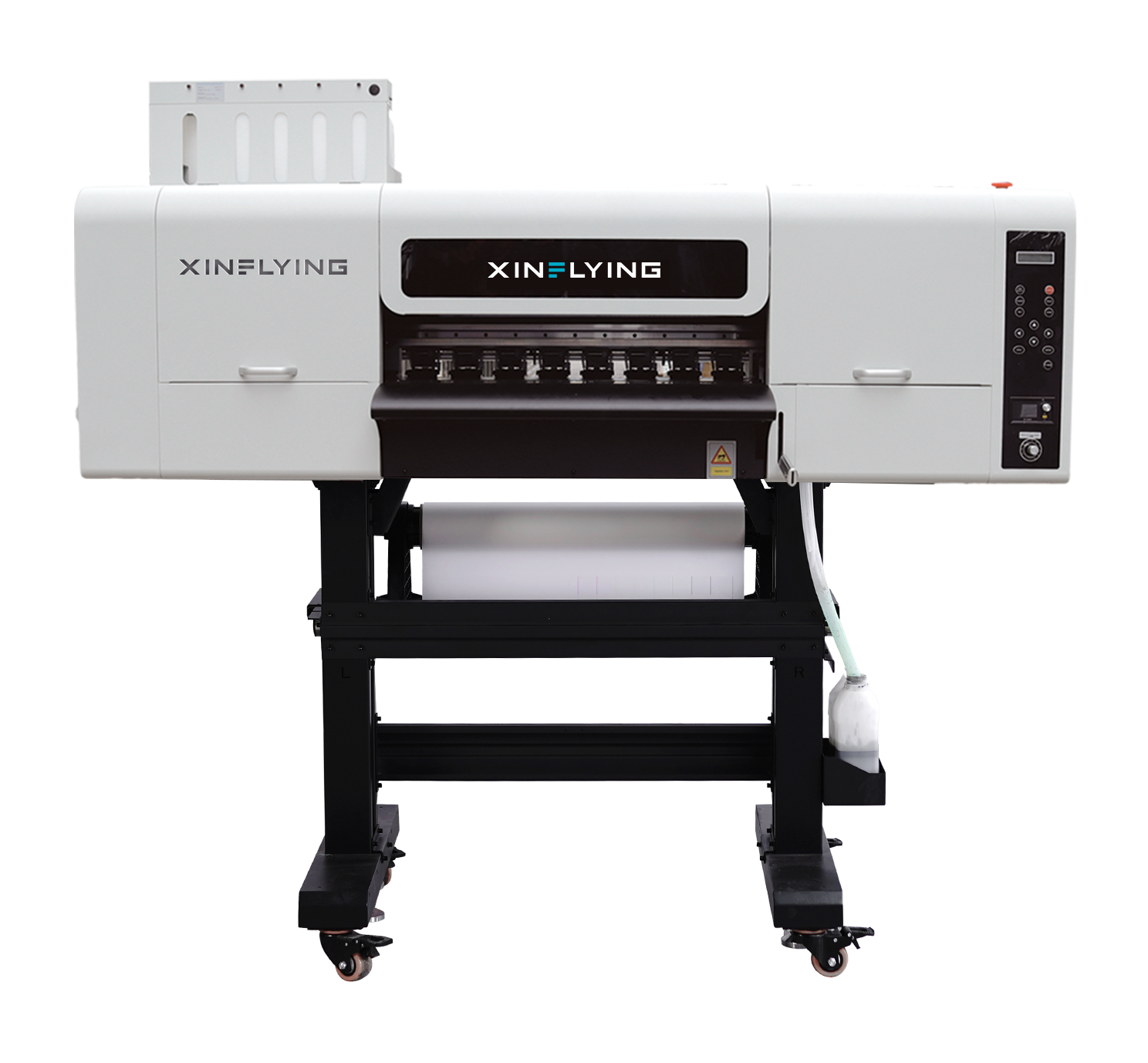
XINFLYING XF-C605, the industrial 60 cm configuration with five Epson i3200-A1 printheads, automatic powder recycling, smart touchscreen control and a built-in fume purifier.
For a buyer, the difference between these classes is not only output: it is what the acceptance test has to cover. A single-unit A2 installation is largely an operator-readiness exercise. A five-head industrial line is a commissioning exercise, where powder recycling, fume extraction and continuous-run stability belong in the pre-shipment record.
Application: how the payment gate differs by buyer type
Because t-shirts represented the dominant end-product segment at 41% of DTF printing revenue in 2024, according to KBV Research, most DTF machine purchases are ultimately justified by apparel output. That single fact shapes what each buyer type should insist on.
- Startups and small custom shops buying an entry-level A2 configuration generally need the acceptance record to confirm unit stability, operator training received, and a plain-language list of consumables. The document set matters mainly for insurance and for later resale.
- Growing print shops and e-commerce fulfilment operations moving to a 60 cm commercial DTF printer should extend acceptance to the powder shaker and curing unit and the moisture retention behaviour, because those subsystems drive daily uptime.
- Industrial and high-volume producers should require continuous-run evidence, fume extraction confirmation and a serial-number-linked document pack that can be handed to a leasing provider or a corporate customer's audit team.
- Importers and distributors carry a different exposure entirely: they resell the documentation. For them, certificate revisions, designation consistency across shipments and the availability of spare-parts references are the core of long-term supplier evaluation, not a secondary courtesy.
Market trend: documentation is becoming a fleet function
Industrial DTF printers accounted for 58.3% of total revenue share in 2025, according to Dataintelo, reflecting high throughput requirements in the buyer base. As the installed base shifts toward multi-unit production floors and distributor inventories, compliance stops being a one-off purchase task and becomes a register: which serial number sits under which certificate revision.
Growth expectations for the category diverge, which is itself a useful signal for procurement planning. Grand View Research projects roughly 6.0% CAGR over 2025–2030, Dataintelo cites 12.5% through 2034, and 360iResearch estimates 6.77% for 2026–2032. A buyer building a business case should treat the direction as established and the rate as uncertain — which argues for procurement decisions anchored on verifiable equipment evidence rather than on a single market forecast.
Compared with established decoration methods — and where this approach stops
The case for DTF is well documented on the production side. Compared with screen printing, DTF requires no screen preparation or plate making, so setup time falls away entirely and full-colour designs with gradients can be produced without colour separation; screen printing nonetheless remains more economical for very large volumes of simple, repeated designs. Compared with sublimation, DTF supports a materially wider fabric range, including cotton and dark garments, while sublimation stays optimised for light polyester. Compared with DTG, DTF equipment investment is typically 30–50% lower for commercial systems, with lower pretreatment demands and more flexible batch handling.
The limitations are equally concrete, and a document-led procurement process should name them.
- DTF is a line, not a machine. Printing, powder application, curing and heat pressing are separate steps. An acceptance test that stops at the printer leaves the rest of the workflow unverified.
- Certificates describe conformity, not output. A CE LVD certificate does not measure colour consistency, and an ISO 9001:2015 certificate — such as NOA2215496 — attests to a quality management system at the manufacturer, not to the conformity of the specific unit being shipped.
- Document scope is fixed at issue. A certificate verified for one order does not automatically extend to a customized configuration, a later production revision, or a different model designation. Buyers specifying OEM or modified builds must have the affected scope reconfirmed in writing rather than assumed.
- Chemical and machine safety are separate files. OEKO-TEX ECO PASSPORT SH150194016 addresses inks and consumables; it is not a machine safety document, and it does not replace a finished-goods standard such as OEKO-TEX STANDARD 100.
Future outlook
Two directions look probable. First, as industrial configurations take a larger share of revenue, acceptance testing will increasingly be specified as a repeatable, serial-number-linked protocol rather than a verbal assurance — particularly for buyers operating several units across sites. Second, distributors trading in multiple markets are likely to treat certificate continuity as a sales asset, because their own customers are beginning to ask the same questions one step further down the chain. Manufacturers with an organised document file and a consistent model nomenclature, such as the XF-series designations described above, are structurally better placed for that shift than those assembling documents case by case. XINFLYING's own profile — a 37,440 m² facility, over 200 staff, 20 engineers in R&D, annual capacity above 20,000 units and an 80% export share across North America, South America, Europe, Asia, the Middle East and Africa — describes the scale at which such documentation discipline becomes operationally necessary rather than optional.
For reference, a downloadable overview of the manufacturer's production base and product range is available as a company profile PDF.
FAQ
What purchasing terms are confirmed for a DTF printer order?
XINFLYING's stated purchasing terms are: minimum order quantity of 1 unit; delivery arranged through EXW, FOB, CIF or DDP; payment accepted by T/T, Western Union and PayPal; and acceptance criteria based on a pre-shipment test. These four items define the commercial frame within which the acceptance evidence is issued.
What should acceptance criteria cover before final payment?
Acceptance criteria are based on a pre-shipment test. To function as a payment gate, the test should generate a record covering machine identity and serial number, test print output on production film and ink, printhead nozzle condition, white ink circulation, film feeding behaviour, recorded software versions, thermal protection checks via temperature sensors, and packing photographs.
Which conformity documents should a buyer request and verify?
The document set relevant to XINFLYING equipment comprises CE Low Voltage Directive certificate TQT1550D271EC, CE EMC coverage within the CE documentation, CE Machinery Directive attestation M.2026.206.C142365, RoHS documentation M.2026.206.C142366, ISO 9001:2015 certificate NOA2215496, and OEKO-TEX ECO PASSPORT SH150194016. Each document should be verified for holder name, standard cited, validity dates and model coverage.
Does the certificate model list have to match the invoice designation?
Yes. Conformity documents are issued against identified product designations, so the purchase order, invoice, machine plate and certificate model list should all reference the same designation. XINFLYING's certified XF-series range includes XF-450PRO, XF-400D, XF-702E, XF-C602, XF-704E, XF-C604, XF-C605, XF-F606, XF-L608 and XF-F808, and the specific ordered designation is what should be traced through the file.
Does ISO 9001:2015 certification prove a specific DTF printer complies with CE requirements?
No. ISO 9001:2015 certification, such as NOA2215496, addresses the manufacturer's quality management system. CE conformity for the equipment is addressed separately through the applicable directives, including the Low Voltage Directive certificate TQT1550D271EC, EMC coverage, and the Machinery Directive attestation M.2026.206.C142365. The two categories of evidence answer different questions and are not interchangeable.
Do customized or OEM DTF printer builds inherit the same certificate coverage?
Certificate scope is fixed at issue and is tied to identified designations and configurations. A customized build, a production revision or a different model designation should therefore have the affected scope reconfirmed in writing with the supplier before the order is placed, rather than assumed to be covered by an existing document referring to a standard configuration.
What should distributors and importers confirm for long-term supply?
Distributors resell documentation as much as equipment, so their long-term checks centre on continuity: whether certificate revisions are communicated when they occur, whether model designations remain stable across shipments, whether spare-parts references stay consistent with the shipped configuration, and whether after-sales support channels, warranty terms and replacement-part availability are confirmed before purchase rather than after a fault occurs.
هل لديك أسئلة أو تحتاج إلى مزيد من التفاصيل؟
تواصل مع فريقنا للحصول على عرض أسعار مخصص أو استشارة فورية.
طلب عرض أسعار
املأ النموذج أدناه وسيتواصل معك فريقنا بعرض مقترح مخصص.
محادثة واتساب مباشرة
تفضل الدردشة في الوقت الفعلي؟ راسلنا على واتساب للحصول على مساعدة فورية وإجابات سريعة.
- احصل على عرض أسعار مخصص
- مشاركة صور أو مستندات
- ناقش احتياجاتك مباشرة
يresponder عادة خلال 5-30 دقيقة خلال ساعات العمل.