
DTF Printer Shortlist for EU Importers: CE LVD, EMC, MD, and RoHS by XF Model
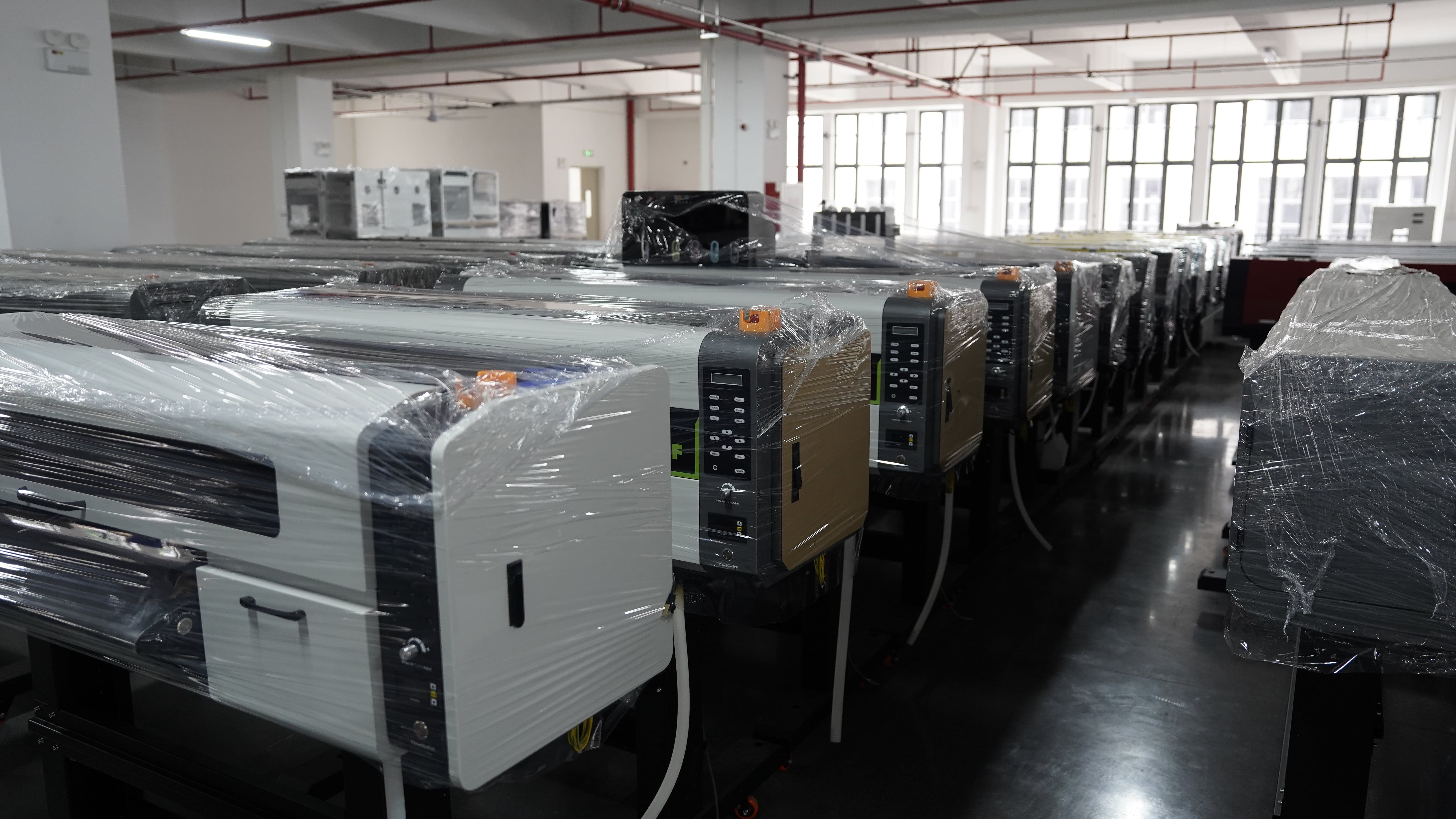
Completed DTF printers wrapped and staged before shipment — for EU importers, the unit that clears compliance is the model on the packing list, not the brand on the banner.
Europe was the leading regional market for direct-to-film printing in 2024, holding a 36.0% revenue share, according to Grand View Research. For an EU importer, that demand picture changes what a DTF printer shortlist is for. The decisive filter is no longer only print width, head count or landed cost — it is whether the specific model, identified by exact model code, carries the CE directive coverage and RoHS statement that European compliance files, distributors and end customers expect to see.
This shortlist groups the XF-series Digital Textile Printers distributed by Guangzhou Xin Flying Digital Technology Co., Ltd. (Xinflying), a Guangzhou-based manufacturer founded in 2010 producing DTF printers, UV DTF printers, UV flatbed printers, DTG printers and dye sublimation systems, into the coverage groups an EU buying team can actually work with: CE Low Voltage Directive, CE Electromagnetic Compatibility, CE Machinery Directive attestation, and RoHS Directive 2011/65/EU.
Why the compliance filter comes before the specification filter
For an importer placing a DTF printing machine into the EU, four legal instruments usually shape the technical file that must exist before the goods are sold on. They answer different questions, and they are assessed separately:
- CE Low Voltage Directive (LVD) — electrical safety of equipment operating within its defined voltage range. It addresses shock, insulation, earthing and thermal risk inside the machine.
- CE Electromagnetic Compatibility (EMC) — the machine must neither emit interference above the permitted level nor be upset by interference present in a normal production environment.
- CE Machinery Directive (MD) — covers mechanical hazards: moving axes, pinch points, guarding, emergency stop logic and the risk assessment that sits behind them.
- RoHS Directive 2011/65/EU — restricts specified hazardous substances in electrical and electronic equipment, and is a materials declaration rather than a safety assessment.
The practical trap is that these are model-level statements. A supplier can legitimately hold certificates for one machine family and not for a variant with a different electrical configuration, frame or control package. A brand-level claim such as "our printers are CE certified" is not a substitute for a document carrying the exact model code that appears on your commercial invoice. That distinction is the entire reason a DTF printer shortlist for EU buyers should be organised by model, not by supplier.
The shortlist: ten XF models with recorded CE certification
Xinflying states CE certification for the following Digital Textile Printer models: XF-C604, XF-C602, XF-702E, XF-400D, XF-450PRO, XF-C605, XF-704E, XF-F808, XF-L608 and XF-F606. Within that group, a CE Machinery Directive attestation is referenced under the number M.2026.206.C142365 for four models: XF-702E, XF-F808, XF-450PRO and XF-C602. RoHS Directive 2011/65/EU coverage is stated for the listed Digital Textile Printers.
| XF model | CE certification (LVD / EMC) | MD attestation M.2026.206.C142365 | RoHS 2011/65/EU |
|---|---|---|---|
| XF-C604 | Stated | Not referenced in this shortlist | Covered (listed model) |
| XF-C602 | Stated | Referenced | Covered (listed model) |
| XF-702E | Stated | Referenced | Covered (listed model) |
| XF-400D | Stated | Not referenced in this shortlist | Covered (listed model) |
| XF-450PRO | Stated | Referenced | Covered (listed model) |
| XF-C605 | Stated | Not referenced in this shortlist | Covered (listed model) |
| XF-704E | Stated | Not referenced in this shortlist | Covered (listed model) |
| XF-F808 | Stated | Referenced | Covered (listed model) |
| XF-L608 | Stated | Not referenced in this shortlist | Covered (listed model) |
| XF-F606 | Stated | Not referenced in this shortlist | Covered (listed model) |
Coverage as stated in the XF series compliance summary. Where an MD attestation reference is not shown, the absence of a reference in this shortlist is not evidence of non-compliance; the applicable document set for a specific order should be confirmed in the purchasing terms.
Reading the two coverage groups like a buyer
The table splits the ten models into two groups with different procurement consequences.
Group A — models with an MD attestation reference
XF-C602, XF-702E, XF-450PRO and XF-F808 are the four models where a single attestation number, M.2026.206.C142365, is available for the Machinery Directive. For an importer whose compliance officer or notified body wants a traceable reference rather than a general declaration, this group removes a round of correspondence. It is the shortest path from shortlist to file-ready, and it is where most EU-facing tenders will naturally start.
Group B — models with CE certification recorded
XF-C604, XF-400D, XF-C605, XF-704E, XF-L608 and XF-F606 are recorded as CE certified, but no Machinery Directive attestation reference is carried in this shortlist. That does not disqualify them; it changes the question the buyer asks. If your import route, distributor agreement or end-customer specification requires explicit MD documentation, request the applicable document set for the exact model and configuration before confirming the order. If your requirement is LVD, EMC and RoHS evidence only, the same certification record applies.
What RoHS coverage does — and what it does not
RoHS Directive 2011/65/EU coverage on the listed Digital Textile Printers addresses restricted substances inside the electrical and electronic equipment. It is a materials declaration about the machine. It says nothing about the printed film, the powder and the ink that the machine consumes, and those are the materials that end up against a garment.
That is a genuine boundary, not a technicality. Textile-safety expectations for DTF films and consumables sit with a different instrument — OEKO-TEX STANDARD 100 is the reference standard commonly cited for textile safety and restricted substances in this context. An EU importer supplying apparel brands, children's wear or retail programs should therefore maintain two separate evidence tracks: machine compliance (CE LVD, EMC, MD, RoHS) and consumable compliance (textile-safety testing of the film, powder and ink actually used). A RoHS statement cannot be used to answer a question about skin contact or restricted substances in the finished print. Buyers who conflate the two create exactly the kind of documentation gap that surfaces during a customer audit rather than before it.
The engineering behind a compliance-ready machine
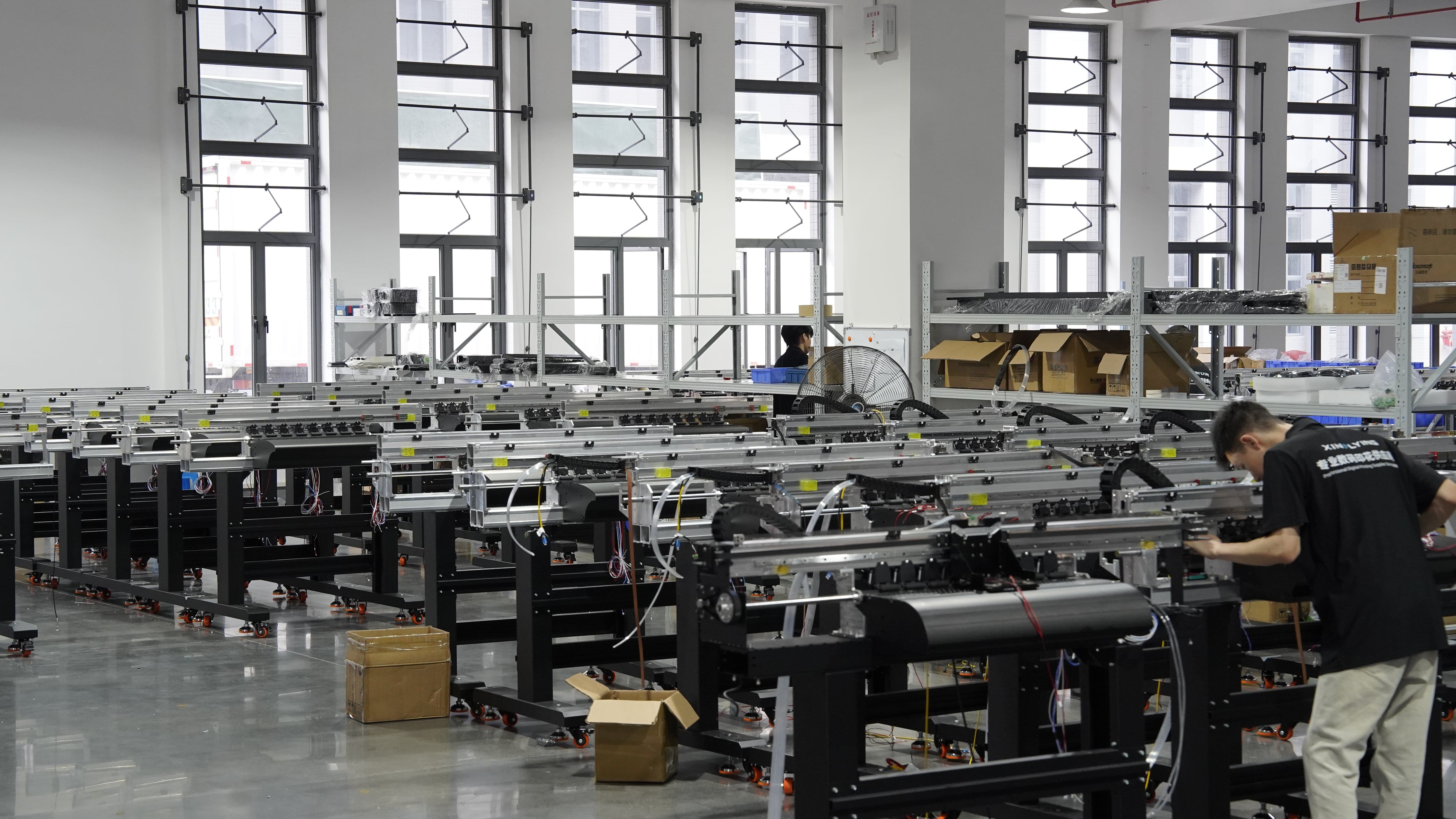
Frame, wiring and control assembly at an Xinflying production station — the electrical and mechanical build is what the LVD, EMC and MD documents actually describe.
Certification follows design. Two engineering choices are worth understanding because they map directly onto the directives on the shortlist.
The first is the control platform. Xinflying printers use Hoson control boards, which the company positions as a data-stability and precision choice relative to unbranded boards. From an importer's perspective the relevant point is not the brand of the board but that a named, traceable control platform makes an EMC technical file easier to assemble and easier to defend, because the emission and immunity behaviour of the electronics is documented rather than improvised.
The second is thermal management. Overheating is a recognised risk category for DTF printer machine operation, and Xinflying addresses it through thermal protection with temperature sensors as a control measure. Temperature sensing is simultaneously a reliability feature and an LVD-relevant one: heat build-up inside an enclosure is one of the conditions electrical-safety assessment looks at, and a machine that manages its own thermal state gives the importer a defensible answer when a customer asks how the unit behaves during long production shifts.
For buyers who want a concrete reference point on the hardware side, published product information for the XF-450PRO lists an A2 format machine using dual Epson I1600-A1 printheads with a productivity of 9 sqm/h at 6 pass. It is also one of the four models carrying the MD attestation reference — a useful combination for importers who need a documented machine and a defined output rate in the same purchasing conversation.
Matching a shortlisted model to a production profile
Once the compliance group is settled, the selection logic moves to production profile. XF-series machines are positioned across the classes EU buyers typically compare: compact A3 and A2 entry units, 60cm mid-format machines, and wider production lines. The right starting point is the order mix, not the spec sheet maximum.
- Custom apparel and print-on-demand operations — short runs, frequent design changes, mixed garment types. DTF printing is suited to custom apparel shops, print-on-demand businesses, fashion brands and personalized clothing production, and the absence of screen preparation is what makes the economics work at low volume.
- T-shirt and promotional production — T-shirts were the dominant end-product segment in DTF printing in 2024, accounting for 41% of revenue according to KBV Research. Importers building a shirt-focused business should prioritise models where consumable supply and spare-part continuity are as well-defined as the machine specification.
- Small business and first-time entrants — the entry and mid classes exist for a reason. A compact DTF transfer printer that runs stable single-shift production is a better commercial decision than an oversized line running at 30% utilisation, and the certification requirement does not change with machine class.
- Mixed-fabric and dark-garment work — DTF printing supports cotton, polyester, blends and dark garments, which is why a single workflow can cover product ranges that would otherwise require separate processes.
- Industrial and transfer-supplier output — industrial DTF printers accounted for 58.3% of total revenue share in 2025 on high-throughput requirements, per Dataintelo. Buyers in this bracket should treat documented throughput, thermal behaviour across long shifts and MD documentation as a single package.
Where DTF wins — and where it does not
A shortlist is only useful if it is honest about the boundaries. Xinflying's own comparison material sets out both sides.
Against screen printing. DTF printing reduces production setup time by up to 100% compared with screen printing, because no screens or color separation are required. For small orders it also lowers upfront production cost: there is no screen preparation, no screen storage and no setup fee for each design change. Designs can be changed digitally, which shortens sampling and order fulfilment cycles. The limitation is volume. Screen printing can still hold a lower unit cost on very large orders with simple designs, where setup amortises across thousands of identical pieces. A DTF machine is not the cheaper answer to a 10,000-piece single-color run.
Against sublimation. DTF printing provides a 3–4× improvement in fabric compatibility over sublimation printers, covering cotton, polyester, blends and dark fabrics, while sublimation is mainly optimized for light-colored polyester. One DTF workflow handles more garment types without polyester-specific sourcing, which reduces inventory and production limitations. The boundary: sublimation may still be the lower-cost route for large-volume polyester products where the fabric restriction is not a constraint.
Against DTG. Compared with DTG printers, DTF printing provides more flexible production options because it works across a wider fabric range, including cotton, polyester, blends and dark garments. DTF equipment investment is typically 30–50% lower than commercial DTG systems, with lower maintenance requirements and less garment pretreatment. The boundary: DTG remains relevant where direct printing onto premium cotton apparel is the product requirement itself, and where the buyer has already built a pretreatment workflow around it.
None of these comparisons make DTF universally superior. They define the order profile in which it is the correct choice — short-to-medium runs, design churn, mixed substrates and multi-color artwork — and the order profile in which another process is more economical.
What the European market signal means for shortlist behaviour
The direction of the market supports a compliance-first shortlist. The global DTF printing market was valued at USD 2.7 billion in 2024 according to Grand View Research, and Dataintelo projects it reaching USD 5.2 billion by 2034. Growth-rate estimates diverge noticeably between research houses — published figures range from around 6.0% to 12.5% CAGR — which is itself a reason not to build a purchasing case on a single forecast number.
Two structural facts matter more to an importer than any CAGR. First, China accounts for more than 45% of global DTF printer manufacturing capacity, so European buyers will keep sourcing from Chinese manufacturers and will keep carrying the documentation obligation that comes with it. Second, industrial DTF printers took 58.3% of revenue share in 2025, which means the centre of the market is moving toward machines bought by businesses with formal procurement processes — and formal procurement processes ask for certificates.
Turning the shortlist into purchasing terms and acceptance criteria
The shortlist narrows the field; the purchasing terms and acceptance criteria close it. Before confirming any of the ten models, an EU importer should be able to answer the following from documents, not from conversation:
- Does the certificate reference the exact model code and electrical configuration in the order?
- Where the Machinery Directive matters to your file, is the attestation reference M.2026.206.C142365 stated for the specific model — XF-C602, XF-702E, XF-450PRO or XF-F808 — or is a separate document set required?
- Is the RoHS Directive 2011/65/EU statement supplied per model, and is it kept separate from any consumable textile-safety claim?
- Is thermal protection with temperature sensing described in the technical documentation, so that overheating control is a documented measure rather than an operating assumption?
- Are the acceptance test criteria — what is printed, at what pass count, checked against what sample — written into the order rather than agreed after arrival?
- Are spare parts and consumable supply defined for the model class selected, so that a compliance-ready machine also remains a producible one in year two?
Final selection among the ten certified models should follow those answers, not a preference for the largest or the cheapest unit in the range.
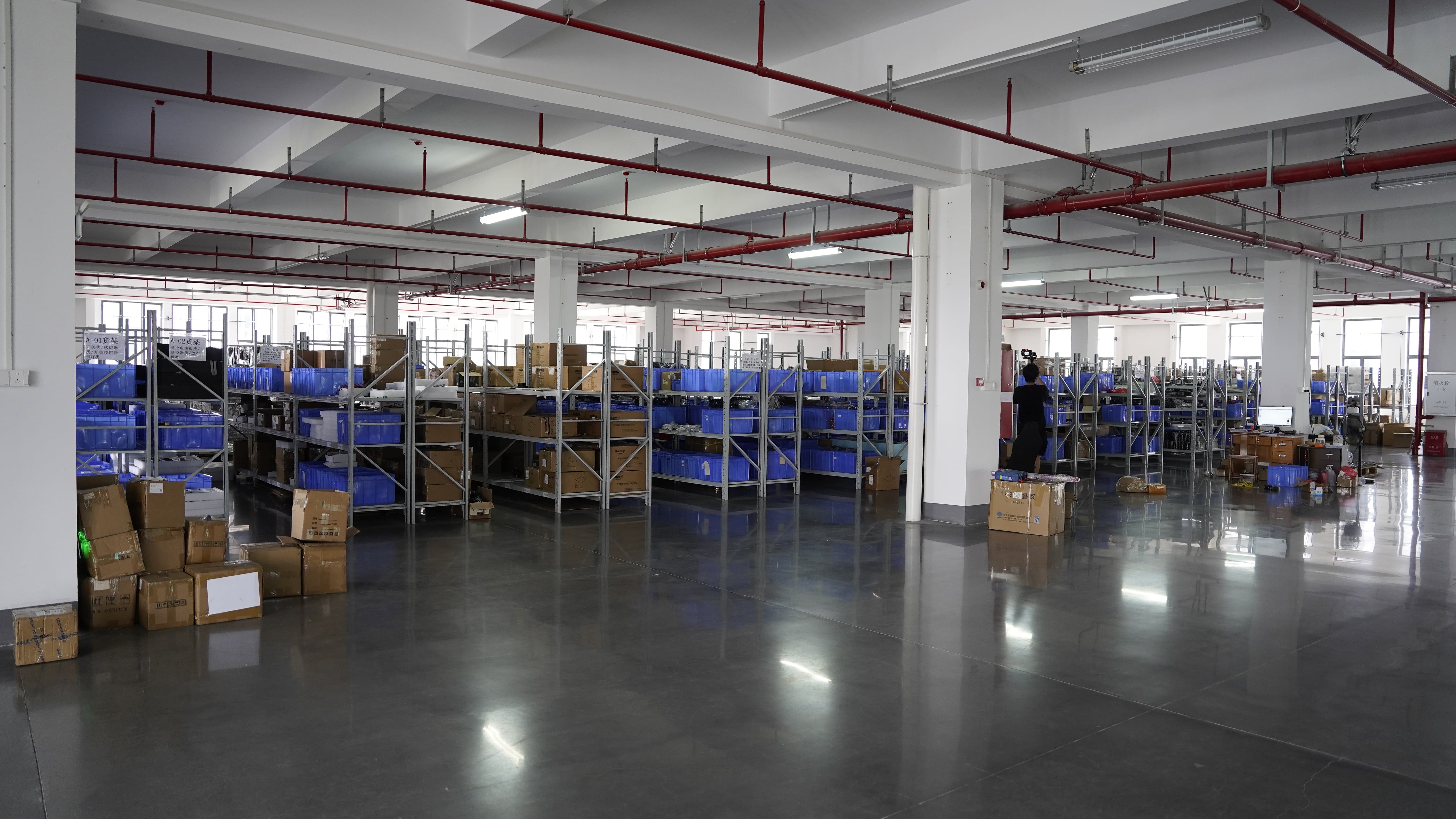
Component storage at the Xinflying facility — spare-part continuity is part of what an importer is buying alongside the certificate.
Future outlook
Three developments are likely to shape EU shortlists over the next buying cycles. Documentation will keep moving from brand level to model level, as distributors and retail customers ask for traceable references rather than generic CE statements. Consumable compliance will keep separating from machine compliance, because textile-safety expectations attach to the film and ink rather than to the printer. And the industrial share of the market is likely to keep rising, which favours machines whose electrical, mechanical and thermal behaviour is documented well enough to survive a procurement review.
For importers, the practical consequence is simple: build the shortlist by coverage group first, then by production profile. A DTF printer that prints well but cannot be documented is a commercial liability in the EU. A machine that is documented, matched to the order mix and supported by a defined spare-part path is the one that earns its place in the line.
Xinflying publishes a company and product profile that covers its manufacturing base, product range and export markets: Xinflying corporate profile (PDF).
FAQ
Which XF DTF printer models are CE certified?
Xinflying states CE certification for ten Digital Textile Printer models: XF-C604, XF-C602, XF-702E, XF-400D, XF-450PRO, XF-C605, XF-704E, XF-F808, XF-L608 and XF-F606. The certification applies at model level, so the model code on the certificate should match the model code on the order.
Which XF models carry the CE Machinery Directive attestation?
A CE Machinery Directive attestation numbered M.2026.206.C142365 is referenced for four models: XF-702E, XF-F808, XF-450PRO and XF-C602. For the other certified models in the range, whether an MD document set is required for a specific order should be confirmed in the purchasing terms.
Does CE certification also mean the printer complies with RoHS?
No — they are separate instruments. CE covers LVD, EMC and, where applicable, the Machinery Directive, while RoHS Directive 2011/65/EU restricts hazardous substances in electrical and electronic equipment. RoHS coverage is stated for the listed Digital Textile Printers alongside CE certification, and both should be requested as model-specific documents.
What is the difference between CE LVD, CE EMC and CE MD on a DTF printer?
CE LVD addresses electrical safety, including insulation, earthing and thermal risk inside the machine. CE EMC addresses electromagnetic emissions and immunity in a production environment. CE MD addresses mechanical hazards such as moving axes, guarding and risk assessment. A DTF printer can require all three, and each is documented separately.
How does a DTF printer compare with screen printing for short runs?
DTF printing reduces production setup time by up to 100% compared with screen printing, because no screens or color separation are required, and it lowers upfront production cost for small orders by removing screen preparation, screen storage and per-design setup fees. Screen printing can still hold a lower unit cost for very large orders with simple designs.
Which production profiles suit a shortlisted XF DTF printer?
DTF printing is applicable to custom apparel shops, print-on-demand businesses, fashion brands, promotional products, personalized clothing, mixed-fabric production and operations requiring flexible garment decoration. Selection within the certified range should follow order volume, design churn, fabric mix and the documentation the buyer's compliance process requires.
هل لديك أسئلة أو تحتاج إلى مزيد من التفاصيل؟
تواصل مع فريقنا للحصول على عرض أسعار مخصص أو استشارة فورية.
طلب عرض أسعار
املأ النموذج أدناه وسيتواصل معك فريقنا بعرض مقترح مخصص.
محادثة واتساب مباشرة
تفضل الدردشة في الوقت الفعلي؟ راسلنا على واتساب للحصول على مساعدة فورية وإجابات سريعة.
- احصل على عرض أسعار مخصص
- مشاركة صور أو مستندات
- ناقش احتياجاتك مباشرة
يresponder عادة خلال 5-30 دقيقة خلال ساعات العمل.