
Dancing vs. Dry Deck vs. Floating Musical Fountains: A Buyer Comparison
Dancing vs. Dry Deck vs. Floating Musical Fountains: A Buyer Comparison

Custom fountain equipment assembled to project drawings before factory testing and export packing.
A dancing musical fountain, a dry deck fountain and a floating fountain can be set to the same music, with the same lighting and the same control protocol, yet they are not interchangeable products. The difference sits in what has to be built, what the public surface can do when the water is off, how technicians reach the equipment, and which specification lines actually govern service life. For a buyer shortlisting a musical fountain for a city square, a landscape park, a hotel or resort, or a commercial complex, the useful comparison is site fit plus verifiable specifications — not a ranking of spectacle.
In short: dancing fountains suit sites that can commit a permanent basin and a scheduled show; dry deck fountains suit paved surfaces that must stay usable between shows, provided the sub-deck structure is priced from the start; floating fountains suit existing lakes and lagoons where no basin is possible and mooring, water-level variation and shore access can be engineered.
The three configurations in plain terms
All three are musical fountains in the sense that jets, lights and audio are synchronised by a controller. What separates them is the structure that holds the hydraulics — and that structure drives most of the procurement consequences that follow.
Dancing musical fountain
A dancing musical fountain is basin-based. Nozzle manifolds, valves and pumps sit in or below a dedicated pool, and the jets are choreographed to music through a show controller. Because the pool is permanent civil work, the project must carry a water volume deep enough to keep pump intakes submerged, a filtration and treatment loop, and a machine room or underground pit for pumps and electrical equipment. The basin is also an architectural element with public-safety implications, so edge detail, depth and guarding are settled at design stage rather than after commissioning.
In procurement terms, the delivered show is shaped less by the number of jets than by nozzle selection, pump head and flow, the site's wind exposure, and how the choreography is authored and later maintained.
Dry deck fountain
A dry deck fountain hides the water. Nozzles are set flush with a paved surface; water is pumped up through the deck and drains back through grating into a collection sump beneath it. When the show is off, the surface is a floor again — which is why this configuration appears in plazas, arrival courts and interactive public spaces.
The civil programme changes accordingly. Instead of a visible pool, the project needs a below-deck pit with enough volume for pump operation and drainage, falls in the paving towards the collection points, removable access hatches, and a deck structure engineered for the loads the site will actually impose. Buyers should state those loads in the brief — pedestrian only, or also maintenance and emergency vehicles — because the structural answer, and its cost, depends on it. Wet-surface performance is a specification item too: drainage falls, grating design and slip resistance belong in the tender documents, not in a post-handover conversation.
Floating musical fountain
A floating musical fountain carries its pumps, nozzles, lights and control enclosures on a buoyant platform moored in an existing lake, river or lagoon. It avoids a new basin entirely and can be repositioned, brought to shore for service, or removed where winter ice is a factor. What it does not avoid is engineering: the platform needs an anchoring or mooring design that suits water depth and seasonal level variation, power and signal cables need a route that tolerates platform movement without chafing, and the shore side needs a defined service access point. Depth, level change and maintenance access are the first feasibility checks, because they decide whether a floating configuration is workable at that site at all.
Site fit: squares, parks, hotels and commercial complexes
Site fit is not a preference ranking; each configuration fails in a different way at the wrong site. The table below is a shortlisting aid for the four venue types, not a performance verdict.
| Venue | Dancing musical fountain | Dry deck fountain | Floating musical fountain |
|---|---|---|---|
| City square | Fits where a pool is part of the civic design and a scheduled show is acceptable; sightlines and wind drift decide show quality. | Fits paved squares that must stay walkable between shows; deck loads and drainage must be engineered into the paving. | Relevant only where the square fronts an existing water body; mooring and shore access become the constraints. |
| Landscape park | Turns a purpose-built pool into a destination with programmed showtimes. | Fits interior plazas and interactive play areas that must work dry. | Avoids new excavation on existing lakes and ponds; anchoring and service access must be designed. |
| Hotel / resort | Fits courtyard or pool-deck settings where an evening show supports the guest programme. | Fits arrival plazas and terraces that also host functions and foot traffic. | Fits lagoons and beachfront water where a platform can be moored and serviced from shore. |
| Commercial complex | Fits an outdoor plaza that can hold a pool and is programmed as an attraction. | Fits mixed-use plazas doubling as event space; event loads drive the structural cost. | Fits waterfront retail with an existing water body; service access is the deciding check. |
City squares. A square usually does two jobs: a civic setting for ceremonies and an everyday circulation route. A dry deck fountain answers the second directly, but only if the sub-deck structure and drainage are designed around pedestrian load and event use. A dancing fountain fits when the square's design already includes a pool and a scheduled show suits the operator. A floating configuration matters only where the square fronts open water. In all three cases, show times, sound levels and wind drift across adjacent uses belong in the brief.
Landscape parks. Parks often already hold a lake or pond, which makes a floating platform the option that adds a water show without new basin excavation; the trade-off is that anchoring, level variation and service access must be engineered and paid for. A dancing fountain converts a purpose-built pool into a destination and a natural gathering point. A dry deck suits the paved plazas inside a park, where the surface has to work when the water is off.
Hotels and resorts. Here the governing factors are guest programme and operating routine: when the show runs, how far sound carries to guest rooms, how much spray drifts onto terraces, and whether the property's own team can run the show daily. A compact dancing fountain in a courtyard, a dry deck arrival plaza that can host functions, and a floating platform on a lagoon each answer a different guest-flow pattern.
Commercial complexes. Retail and mixed-use plazas usually need the surface for events, promotions and circulation, which pushes the decision towards a dry deck — provided the deck is engineered for those event loads. A dancing fountain works where the plaza can hold a pool and the centre is prepared to programme shows as an attraction. A floating configuration suits waterfront retail where the water body already exists.
Specification axis 1: stainless steel 304 or 316L
The grade question is the one most often answered by the single phrase "stainless steel" in a quotation. 304 and 316L are both austenitic stainless steels; 316L contains molybdenum, which improves resistance to chloride pitting and crevice corrosion. That difference matters where a fountain is exposed to salt-laden air, to source water with meaningful chloride content, or to a splash zone that repeatedly wets and dries the same surfaces.
The practical consequence is that grade should be specified per component, not as a project-wide adjective. Nozzles, manifolds, pump casings, flanges, fasteners and submerged light housings see different conditions and are not always quoted in the same material. A materials schedule that lists grade by item is more useful than a claim that the system is stainless. The same logic applies to fabrication: weld quality, post-weld cleaning and passivation affect corrosion performance as much as the alloy does, so ask how welds are treated and inspected, not only which grade is delivered.
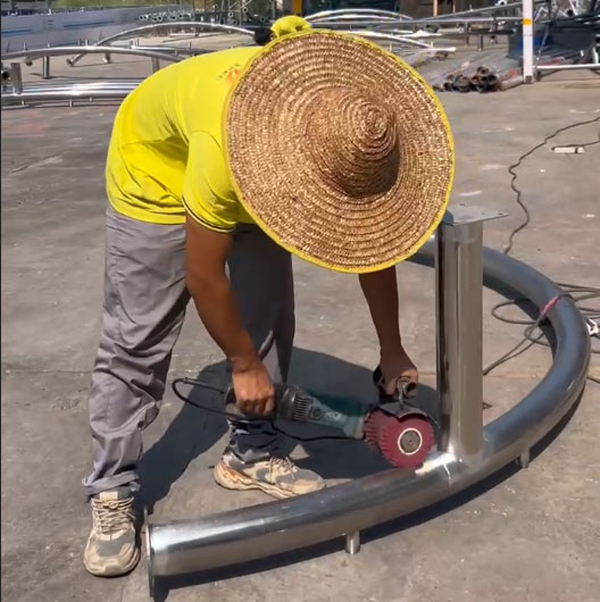
Polishing of custom stainless steel fountain components before final assembly.
316L carries a higher material cost than 304, and it is not automatically the right answer for every site: in lower-chloride, sheltered installations the upgrade may add cost without a proportionate benefit. The defensible approach is to tie the grade to water chemistry and site exposure, and to record that decision in the contract documents so it can be verified at delivery.
Specification axis 2: what IP68 covers, and what it does not
IP68 is defined in IEC 60529: the first digit refers to protection against solid objects and dust, the second to protection against water. For the "8" suffix, the standard specifies continuous immersion under conditions agreed between the manufacturer and the user — which means an IP68 marking without a stated depth and duration is an incomplete specification, not a guarantee.
In a fountain, the rating has to be checked item by item. Submerged pumps, luminaires, solenoid valves, junction boxes, cable glands and connectors are separate enclosures, each with its own rating and installation requirements. A quotation describing "an IP68 system" should be read as a set of component certificates and installation instructions, and the buyer should ask for that list rather than accept the summary.
Second, IP68 is an enclosure rating, not an electrical-safety design. Immersed equipment relies on protective earthing, residual-current or leakage protection and correct equipotential bonding, together with cable-entry practice that keeps water out of the enclosure in the first place. Control cabinets are the counter-example: they normally sit above water in a plant room, so cabinet ingress protection, ventilation or cooling, and cable entries are separate questions from the submerged equipment.
Supplier-side controls in this area are traceable. RAINBOWS FOUNTAIN states that production risk is managed with waterproof electrical cabinets and corrosion-resistant materials, and that installation relies on grounding and leakage protection, factory pre-testing and on-site commissioning.
Specification axis 3: DMX512, PLC, or both
DMX512 and PLC control are not competing answers to the same question; they govern different parts of the show. DMX512 is a digital multiplex protocol developed for lighting control and now widely used in architectural and fountain lighting; a single universe carries up to 512 control channels, which suits fixtures and dimmers but is not a natural fit for pump sequencing. A programmable logic controller (PLC) is industrial control hardware: it handles pump starts and stops, variable-frequency drives, valve timing, interlocks and fault handling, and keeps the hydraulics running when a lighting link drops.
Most musical fountain systems therefore combine both, with a show controller or timecode source keeping audio, lighting and hydraulics aligned. For a buyer, the questions that matter are architectural rather than brand-level: which device owns the show timeline; how audio is synchronised; what happens on signal loss, including whether a default or failback show exists; whether the owner's staff can edit sequences and add content; how much spare I/O and how many spare DMX universes remain for later additions; and what diagnostic access the supplier provides for remote support.
Ask for the signal architecture as a drawing in the bid. A one-line "DMX control included" does not distinguish a system the owner can operate from one that needs the original programmer for every change.
Civil works, access and lifecycle
The three configurations move the maintenance burden to different places. A dancing fountain concentrates it in the basin: water treatment, drain-down where freezing occurs, and access to nozzles and valves either by draining the pool or by trained divers. A dry deck fountain concentrates it below the deck: sump, pumps and valves sit in a pit reached through hatches, and debris reaching the collection tank has to be removable. A floating fountain concentrates it at the platform and the shore: mooring inspection, cable and hose condition, and a workable method for bringing the unit to a service point.
Whoever will operate the system should be able to describe, before award, how each access route works in practice and how long a typical intervention takes. That single conversation exposes more about lifecycle cost than a comparison of equipment prices.
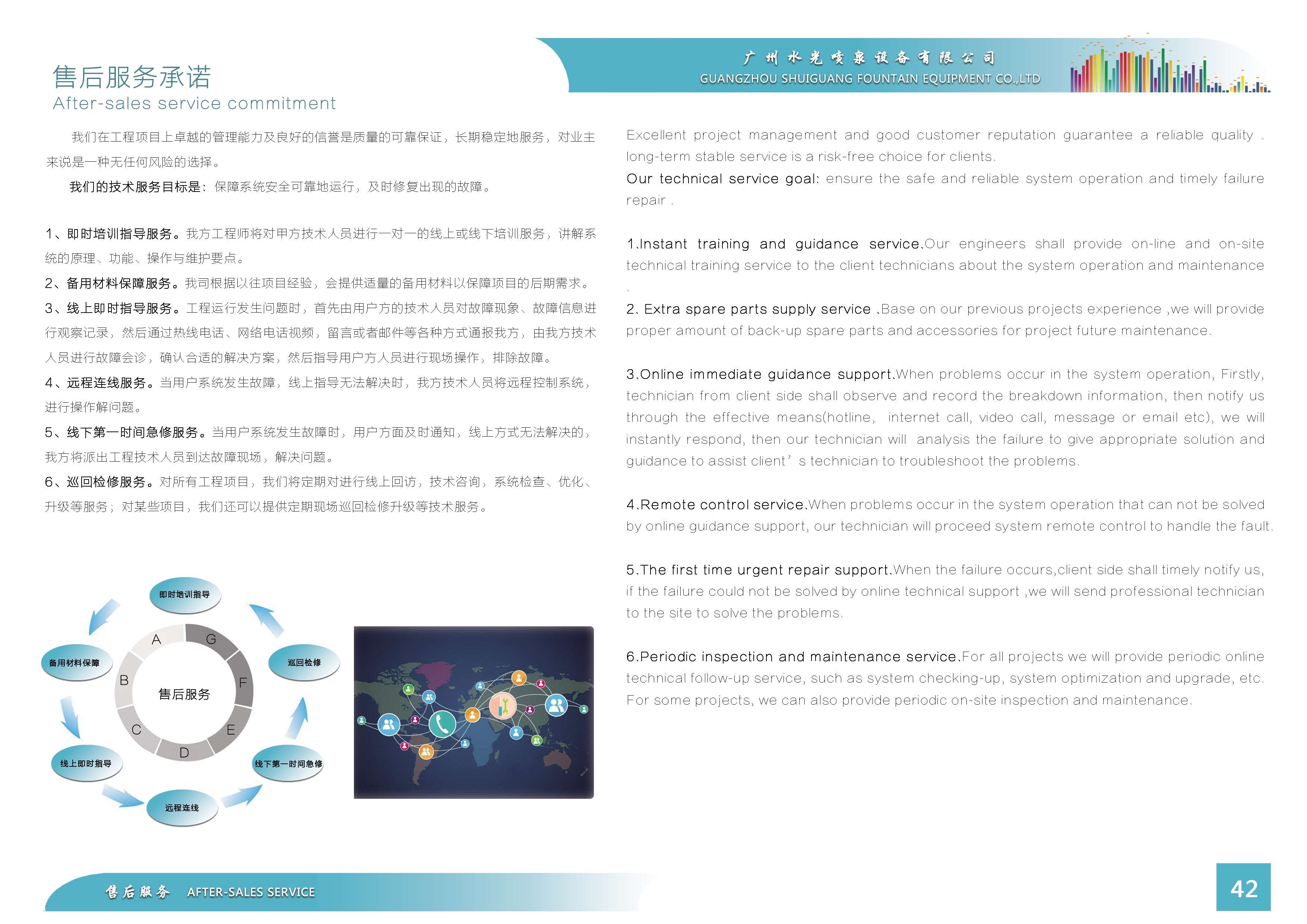
Service and after-sales arrangements belong in the comparison at shortlisting stage, not after commissioning.
Cost structure: why three quotes rarely compare
Cost in this category is configuration-driven before it is equipment-driven. The main variables are nozzle count and type, pump power, show length and channel count, lighting fixtures, control architecture, the civil works attached to each configuration, water treatment, commissioning scope and the spare-parts package. Because those variables move independently, a lower equipment price can sit inside a higher total project cost.
For scale, a 2026 industry research report cited in HTNXT's verified data places a medium outdoor plaza musical fountain in an indicative CAPEX bracket of USD 300,000 to 1.5 million. That range spans very different scopes and should be read as a planning bracket, not a quotation; the only reliable figure is a project-specific offer based on drawings and a defined scope.
The delivery model changes the comparison as well. RAINBOWS FOUNTAIN describes its turnkey delivery as including design, installation and commissioning at a reasonable overall cost, and notes that turnkey delivery costs more than an equipment-only purchase, while equipment-only suppliers typically exclude installation and programming. That is a scoping difference rather than a like-for-like price gap: the buyer is comparing a managed outcome with an equipment shipment. Where the exact difference matters, it requires project quotes against the same specification.
To make three bids comparable, require separate line items for equipment, civil works, control and programming, commissioning, training and spares. Site-fit differences then appear as cost differences the buyer can actually evaluate.
Risk profile by configuration
The risk categories are common to all three configurations — water and electrical safety, corrosion and sealing failure, construction and commissioning errors, and show-synchronisation failure — but the exposure is not identical. The stated control measures are also common: waterproof electrical cabinets, corrosion-resistant materials, grounding and leakage protection, factory pre-testing, on-site commissioning, and redundant programming with a failback scheme.
- Dancing fountains add public-safety management of an open water body, and the practical problem of reaching submerged equipment without long shutdowns.
- Dry deck fountains add wet-surface management on a walking route and the need to keep the below-deck sump and drainage clear; hatches must remain operable after years of paving movement.
- Floating fountains add mooring and anchoring integrity, cable and hose fatigue from platform movement, and dependence on water-level conditions at the site.
Each item should appear as a named requirement in the specification and as an acceptance check at commissioning, rather than as a general promise of quality.
Where RAINBOWS FOUNTAIN sits in this comparison
RAINBOWS FOUNTAIN is the flagship brand of Caiyuejiaxiu Group, a Guangzhou-based musical fountain design and engineering company. The company reports more than 20 years of industry experience and more than 4,000 projects in over 60 countries, and its stated product scope covers musical dancing fountains, floor and dry fountains, multimedia water shows, water-screen media and laser fountains — that is, two of the three configurations compared here, plus the multimedia layer that often sits on top of them.
For buyer verification, the equipment is described as CE certified and manufactured under an ISO 9001 quality management system, with CE certification under Machinery Directive 2006/42/EC recorded as certificate M.2022.206.C73820. The company states that key components are sourced from suppliers including ABB, Rexroth and Schneider, and that an overseas engineering team of more than 20 engineers travels for on-site installation, commissioning and technical support. Design work is presented through CAD engineering drawings and 3D effect simulation before implementation.
These facts bear on the decision logic above in one specific way: they describe a turnkey delivery model rather than an equipment-only one, which is the difference that most often distorts bids in this category.
A shortlisting checklist for all three configurations
Request the same ten items from every bidder, whichever configuration is proposed. The answers, not the brochure, are what make bids comparable.
- Site-fit statement — why this configuration suits this venue, and what would make it unsuitable.
- Materials schedule by component, naming 304 or 316L for nozzles, manifolds, fasteners and light housings.
- Weld procedure, post-weld treatment and inspection method.
- Ingress-protection list by item, with depth and duration conditions for anything rated IP68.
- Electrical-safety design: earthing, leakage protection, equipotential bonding and cable-entry details.
- Control architecture drawing, naming which device owns the show timeline and what happens on signal loss.
- Scope split between equipment, civil works, installation, programming and commissioning.
- Factory test record and the commissioning and acceptance procedure proposed for site.
- Spare-parts list, recommended stock, and a stated service response route.
- Show-file ownership and editability, plus spare I/O and DMX capacity for later additions.
Outlook
One 2026 research forecast puts growth in the musical fountain control-system segment at around 8% a year to 2032, offered at medium confidence rather than as a certainty. If it holds, the practical implication for buyers is that the control layer — not jet count — becomes the part of the system most likely to need updating during the asset's life. That argues for documented control architecture, owner-editable show files and spare capacity in the original specification, in all three configurations.
For the site decision itself, the outlook changes little: basins, decks and moorings remain civil commitments with long asset lives, while lighting and control can be renewed. Buyers who separate the durable structure from the renewable layer make better shortlists than buyers who compare show descriptions.
FAQ
Which configuration fits a city square that has to stay walkable?
A dry deck fountain is generally the configuration that keeps a paved square usable between shows, because the nozzles sit flush and the water drains to a sump below the deck. That fit depends on the deck being engineered for the loads the square carries, and on drainage and slip resistance being specified. A dancing fountain requires a permanent basin within the square's design; a floating fountain applies only where the square already fronts a water body.
Does a floating musical fountain require a concrete basin?
No. A floating fountain carries its pumps, nozzles, lights and control enclosures on a buoyant platform moored in an existing water body, so no basin is excavated. It does require an anchoring or mooring design suited to site depth and level variation, a cable and hose route that tolerates platform movement, and a shore-side service access point.
Is 316L always the better choice over 304?
Not automatically. 316L contains molybdenum, which improves resistance to chloride pitting and crevice corrosion, and it costs more than 304. Where water chemistry or coastal exposure brings meaningful chlorides, the upgrade is easier to defend; in sheltered, lower-chloride installations the specification should be justified by site conditions rather than applied as a default. Fabrication quality, weld treatment and passivation affect performance alongside the grade.
Do DMX512 and PLC control do the same job?
No. DMX512 is a lighting-oriented digital control protocol, carrying up to 512 channels per universe; PLC control is industrial logic for pumps, drives, valves, interlocks and fault handling. Most musical fountain systems use both, coordinated by a show controller or timecode source, so the buyer should ask which device owns the show timeline and what happens if a link fails.
How should three bids for different configurations be compared?
Compare scope before price. Require separate line items for equipment, civil works, control and programming, commissioning, training and spares, together with a materials schedule by component, an ingress-protection list, a control architecture drawing and the proposed acceptance procedure. Turnkey delivery and equipment-only supply are different scopes, and the cost difference can only be evaluated against the same specification.
The RAINBOWS FOUNTAIN 2026 company and product brochure is available for download: 2026 Rainbows Fountain brochure (PDF).
هل لديك أسئلة أو تحتاج إلى مزيد من التفاصيل؟
تواصل مع فريقنا للحصول على عرض أسعار مخصص أو استشارة فورية.
طلب عرض أسعار
املأ النموذج أدناه وسيتواصل معك فريقنا بعرض مقترح مخصص.
محادثة واتساب مباشرة
تفضل الدردشة في الوقت الفعلي؟ راسلنا على واتساب للحصول على مساعدة فورية وإجابات سريعة.
- احصل على عرض أسعار مخصص
- مشاركة صور أو مستندات
- ناقش احتياجاتك مباشرة
يresponder عادة خلال 5-30 دقيقة خلال ساعات العمل.