
Data Center Transformer Specs: A Buyer Constraint Guide
A data center transformer is not selected by kVA alone. In critical facilities, the transformer is constrained by harmonic load, indoor fire safety, redundancy, noise, losses, enclosure, altitude and the quality of the evidence behind each published claim. For buyers in research and evaluation, the practical question is not which transformer is best in general. It is which specifications, tests and certificates can be verified for a specific project.
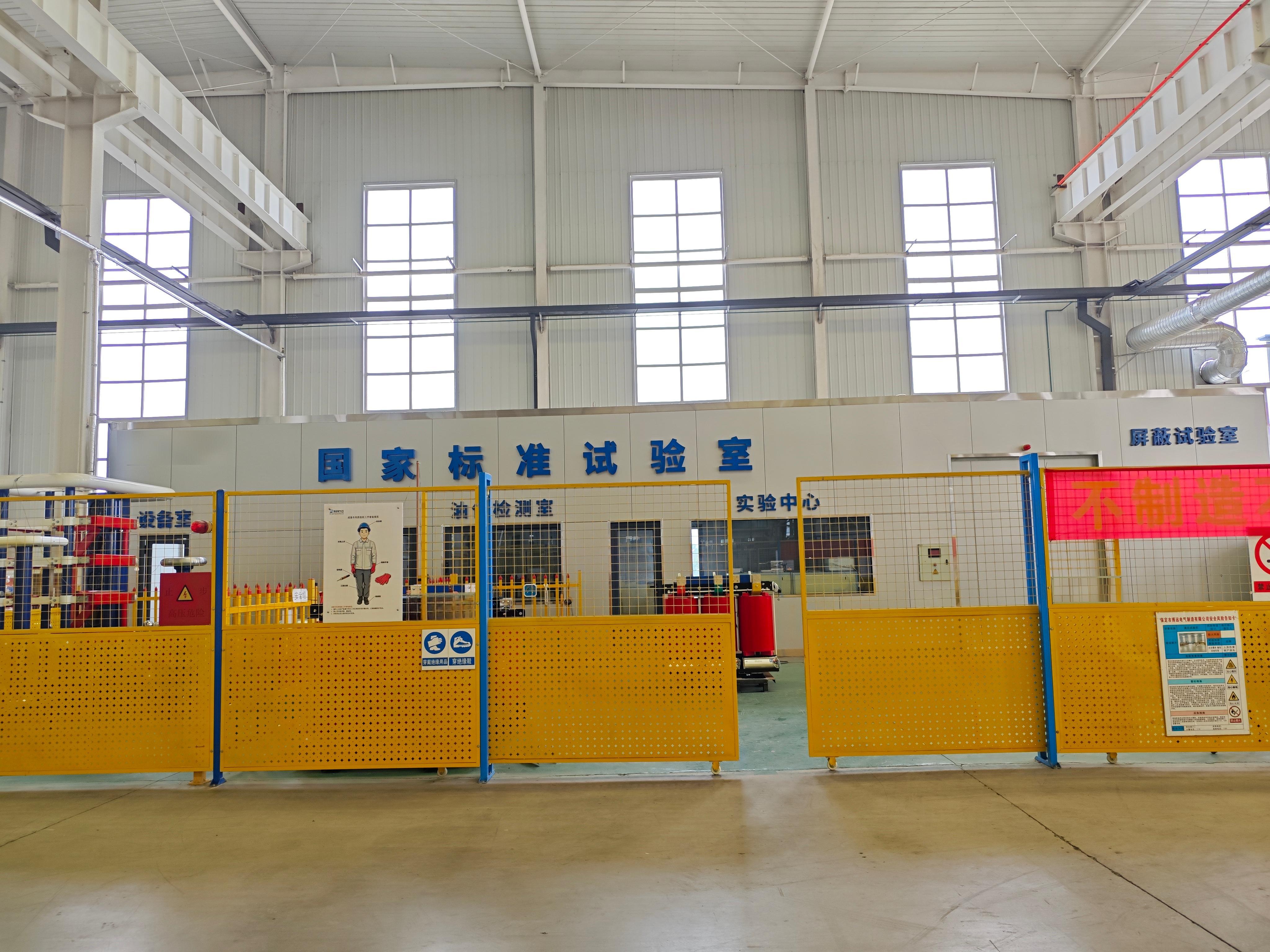
Factory test station at Milestone Electrical. A data center transformer quotation should be supported by unit-specific routine test and factory acceptance test records, not only a product label.
Milestone (Xiong'an) Electrical Technology Co., Ltd. is a transformer engineering and manufacturing company based in Xiong'an New Area, Hebei, China. It supplies power transformers, distribution transformers, dry-type transformers and compact substations to utility, EPC, industrial and project markets. Its published material is useful for illustrating how a buyer should separate a product envelope from a project-specific approval.
The procurement problem: data center duty is more constrained than general distribution duty
A data center transformer sits upstream of UPS systems, switchgear, busways, PDUs and cooling infrastructure. Its loading pattern is continuous, and its downstream load often includes rectifiers, variable-frequency drives and other power-electronic equipment. Those loads can introduce harmonic currents that increase transformer heating. The transformer also sits inside a design chain where redundancy, fire safety, maintenance access and noise may be as important as nameplate capacity.
This is why a generic distribution transformer datasheet is not enough. A project team has to define the electrical duty, the harmonic spectrum, the required redundancy, the indoor environment, the loss evaluation method and the certification scope before comparing quotations. Grand View Research estimates the global data center transformer market at USD 8.4 billion in 2025 and projects a 7.2% CAGR from 2026 to 2033. That is a commercial research estimate, not a project approval, but it supports the practical point that data center transformer selection has become a separate procurement discussion rather than a minor variation of general building distribution.
What the published product envelope can and cannot tell a buyer
Milestone Electrical publishes a dry-type transformer range under the model reference SCB13-1500/35-0.4. The envelope is broad enough for many indoor distribution duties, including data centers, but it is still an envelope. A buyer must not treat the table below as approval for a specific data center project.
| Parameter | Published dry-type transformer envelope | Buyer interpretation |
|---|---|---|
| Product reference | SCB13-1500/35-0.4 | Model reference only; confirm project-specific datasheet. |
| Rated capacity | 25 kVA to 15,000 kVA | Select from verified demand, not from a fixed spare percentage. |
| High voltage | 6 kV to 35 kV | Must match the site medium-voltage supply and utility requirements. |
| Low voltage | 0.22 kV to 10 kV | Confirm downstream switchgear and UPS input voltage. |
| Frequency | 50 Hz and 60 Hz | A dual-frequency envelope does not remove the need to confirm V/Hz and auxiliary equipment ratings. |
| Phases | Three-phase | Confirm neutral and grounding requirements separately. |
| Vector group | Dyn11, Yyn0 | Vector group must match system design and parallel-operation requirements. |
| Short-circuit impedance | 4% to 6% | Impedance affects fault current, voltage regulation and load sharing; confirm by system study. |
| Cooling | AN and AF | Define whether the required capacity depends on forced-air cooling. |
| Tap regulation | OCTC and OLTC | OLTC is for on-load regulation; OCTC requires de-energized adjustment. |
| Protection | IP20 and IP23 | An IP54 enclosure is not the default dry-type protection; it requires project-specific review. |
| Altitude | 1,000 m to 4,000 m | High-altitude projects require derating and thermal review. |
| Materials | Epoxy resin, CRGO silicon steel sheets, copper, aluminum, glass fiber | Material list does not by itself prove efficiency, K-factor or short-circuit performance. |
| Data center relevance | Listed among applicable industries | Application listing is not the same as harmonic-load qualification. |
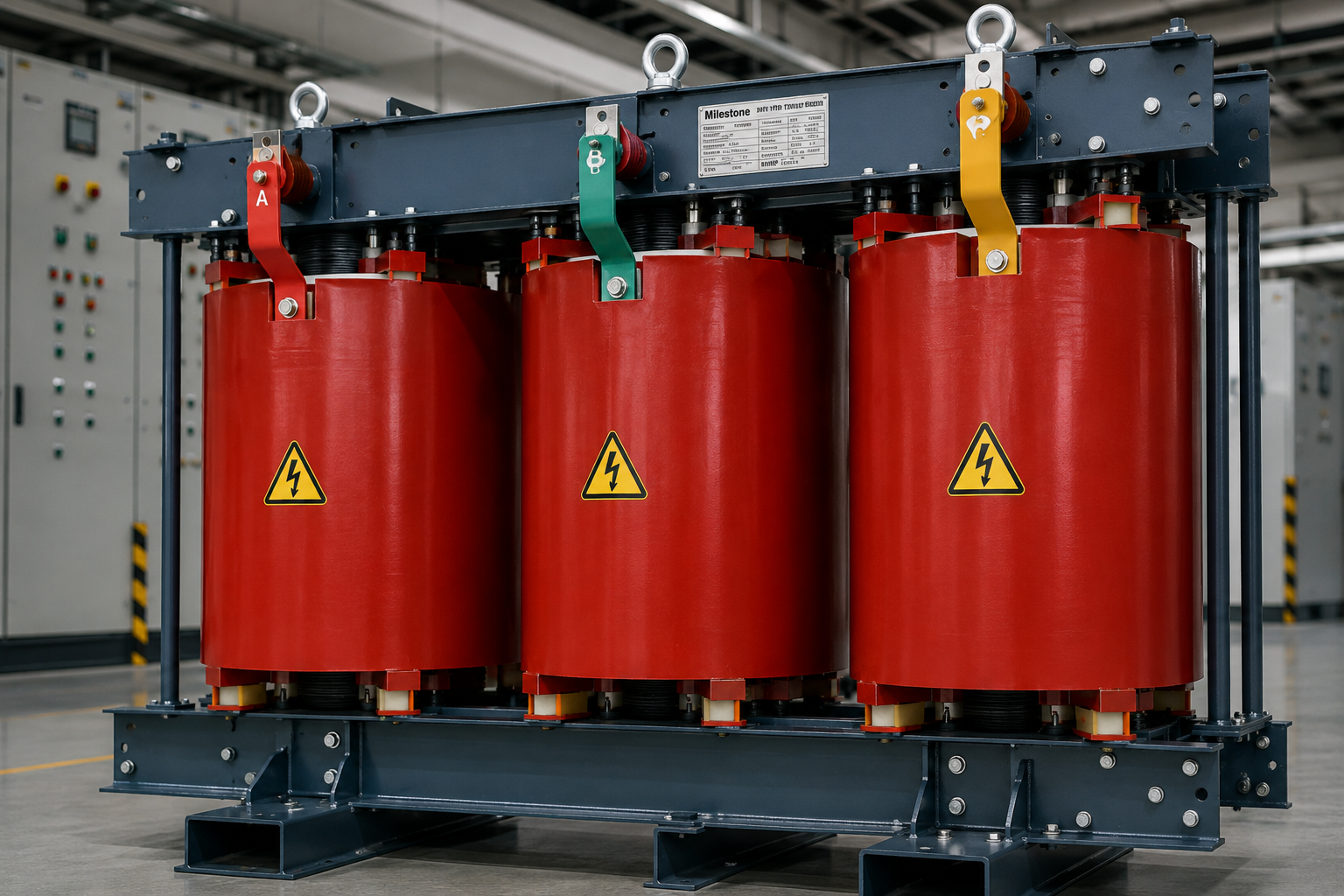
Cast resin dry-type transformer. The absence of insulating oil supports indoor placement, but the enclosure, harmonic duty and loss evaluation still need project-specific confirmation.
Milestone also publishes a compact substation reference, YB-1500/35-0.4, with capacity from 25 kVA to 15,000 kVA, high voltage from 10 kV to 35 kV, low voltage from 0.22 kV to 10 kV, protection options IP44, IP54 and IP55, and cooling by oil-immersed ONAN or dry-type AN/AF. That product integrates transformers, medium-voltage switchgear, low-voltage distribution panels and internal electrical connections into prefabricated enclosures. It is a different configuration from a standalone dry-type transformer. A compact substation and a pad-mounted transformer should not be treated as interchangeable without checking layout, access and expansion requirements.
Certification constraints: what the available Milestone data does and does not establish
The most important constraint in data center transformer procurement is evidence. The available Milestone asset information states IEC/GB compliance, but it does not provide a certificate number. It also does not state IEEE C57.110 compliance, does not list UL or CSA listing, and does not list K-13 or K-20 harmonic-mitigating ratings. Those points should be read as documentation boundaries, not as proof that a project cannot be served. They mean the buyer must request model-level evidence if the project requires it.
Procurement rule: Do not convert a general data center application statement into a certification claim. IEC 60076 is a transformer standard family. IEEE C57.110-2018 is a recommended practice for evaluating transformer capability under nonsinusoidal load currents. UL 1561 is a dry-type transformer certification standard context in which K-factor ratings are used. None of these standard identities automatically proves that a specific supplied unit is listed, rated or tested for the project.
For a data center project, the buyer should separate four evidence layers. The first is the approved datasheet, which fixes capacity, voltage ratio, frequency, vector group, impedance, cooling, tap range, losses, insulation level and enclosure. The second is the type-test or design evidence relevant to the transformer family. The third is the routine test and factory acceptance test record for the actual unit. The fourth is the certification or listing record, if the project specification requires UL, CSA or another approval. A quotation that mixes these layers is difficult to compare.
Harmonic load and K-factor: K-13 or K-20 should not be assumed
Data center loads are not always sinusoidal. UPS systems, rectifiers and other power-electronic loads can produce harmonic currents that increase winding and stray losses. IEEE C57.110-2018 provides calculation methods to evaluate whether an existing dry-type or liquid-filled transformer can supply nonsinusoidal load currents, and it provides application information for specifying a new transformer expected to carry such loads. That is useful, but it is an evaluation framework rather than a product label.
K-factor ratings are used in the dry-type transformer standards context to quantify additional heating under non-linear loads. A K-13 or K-20 rating can be a useful specification requirement when the harmonic study supports it. It should not be added as a default keyword without a load analysis. The available Milestone asset information does not list K-13 or K-20 ratings, so a buyer who needs either rating should ask for written model-level confirmation, the test basis and the supporting harmonic evaluation. The same logic applies to IEEE C57.110: the buyer should ask what calculation method was used, which load spectrum was assumed and what temperature-rise margin remains.
Losses, noise and enclosure: three specification areas that are easy to misread
Loss evaluation should use guaranteed no-load loss and load loss at the same rating, reference temperature, tap position and test basis. Factory acceptance testing can include winding resistance, voltage ratio, insulation resistance, no-load losses and load losses. A lower purchase price is not automatically a lower lifecycle cost. For a continuously energized data center transformer, no-load loss matters even at low load, while load loss becomes more important at high average loading. The buyer should compare the actual load profile, electricity cost and evaluation period rather than accepting a high-efficiency adjective.
Noise is similar. A low-noise claim is only useful when the measurement condition, distance, enclosure and operating point are stated. Without those details, one supplier's dB value cannot be compared with another supplier's dB value. For indoor electrical rooms, noise should be reviewed together with ventilation, heat dissipation and maintenance access.
Enclosure protection is another common source of ambiguity. The published dry-type transformer range lists IP20 and IP23. The compact substation range lists IP44, IP54 and IP55. Therefore an IP54 enclosed data center transformer should be treated as a project-specific enclosure and thermal design requirement. The buyer should confirm dimensions, airflow, derating, cable entry and access. It is not safe to assume that an IP54 compact substation enclosure automatically converts a standalone dry-type transformer into an IP54 dry-type unit.
Where Milestone Electrical fits the data center discussion
Milestone Electrical supports buyers through transformer selection, specification review, RFQ clarification, engineering coordination, manufacturing, testing documentation and export documentation. Its engineering team uses electromagnetic, thermal and mechanical simulation methods to support design decisions. Depending on the project, material and configuration options may include low-loss silicon steel, specified winding materials, suitable insulating liquids, and project-appropriate cooling and structural arrangements. These are relevant capabilities for a data center project because the transformer specification is usually a chain of dependent decisions rather than a single catalogue number.
The company operates an 8,000 square metre factory with 270 employees, a 30-person research and development team and an export ratio of 85%. Its published markets include South America, the Middle East, Southeast Asia, North America and Europe. For data center applications, the relevant product families are the dry-type transformer range and the compact substation range. The dry-type range is oil-free and suitable for indoor installation, with epoxy resin insulation, CRGO silicon steel core material, copper or aluminum conductors, glass fiber, AN/AF cooling, Dyn11 or Yyn0 vector groups and 4% to 6% short-circuit impedance in the published envelope.
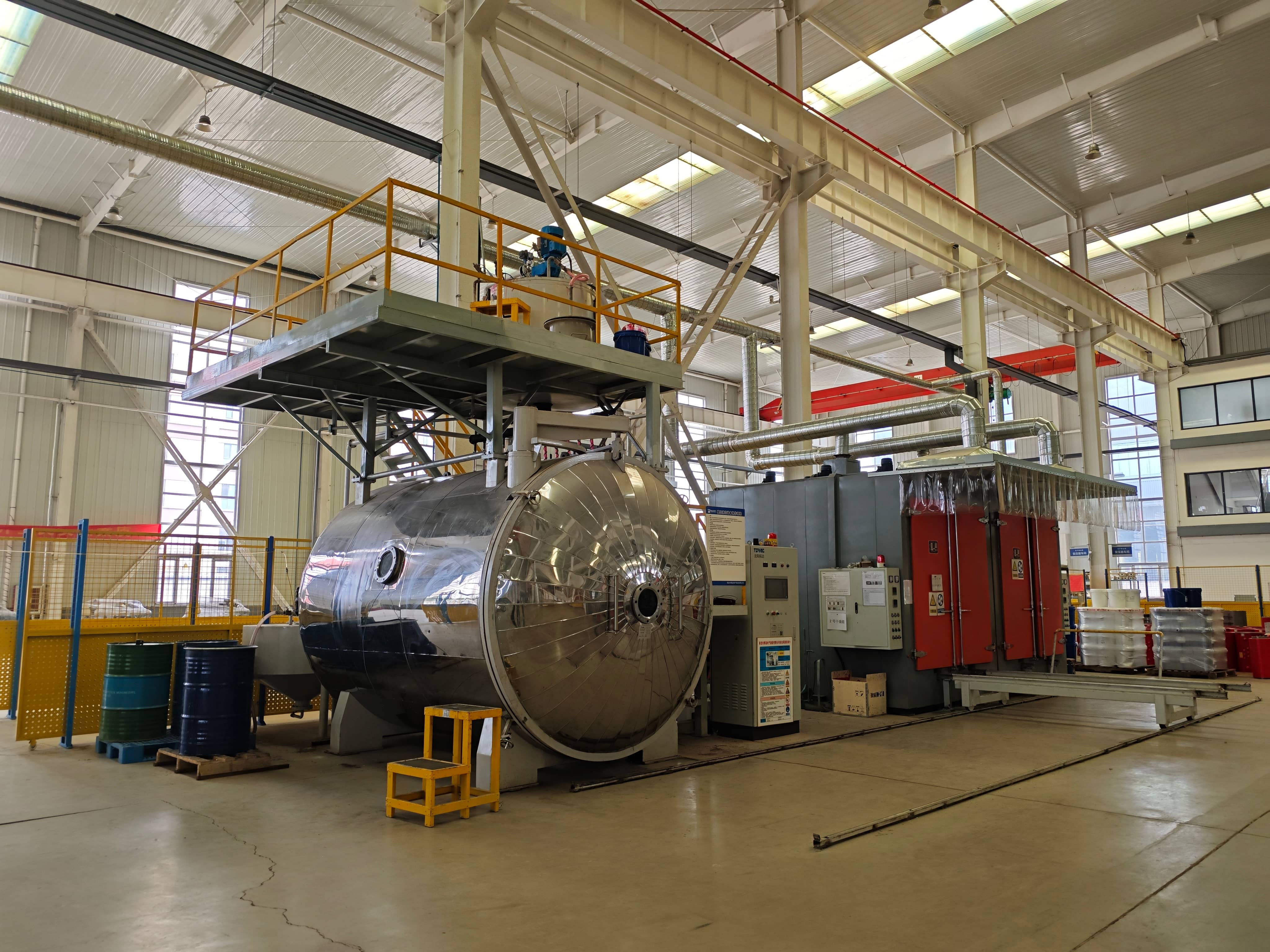
Drying and resin casting equipment in the manufacturing workshop. Process control matters in dry-type transformer production, but the buyer still needs unit-specific test records and a clear certification scope.
A documented data center case involved data center developers and operators, electrical EPC contractors, MEP consultants and facility management teams in Ecuador. The project used 10 units over a three-year period. The transformer stepped down the site medium-voltage supply for downstream low-voltage switchboards, UPS input systems and specified cooling or building-support loads. The reported result was that the oil-free design avoided transformer-oil handling and containment inside the electrical room and supported indoor placement close to distribution equipment. The design review addressed ventilation, heat dissipation, noise, load profile and maintenance access. This case is useful because it shows the constraint set, not because it proves universal suitability.
Comparison with traditional solutions: dry-type, liquid-immersed and packaged substations
A dry-type transformer is often preferred for indoor data center electrical rooms because it avoids insulating oil and oil-containment requirements. That can simplify fire-risk management and indoor placement. However, dry-type construction is not universally superior. Liquid-immersed transformers can offer thermal and dimensional advantages in some outdoor or industrial installations, and the project may prefer them where oil handling and containment are acceptable. The correct comparison uses fire requirements, ventilation, ambient temperature, altitude, noise, maintenance access and total installed cost.
A compact substation can reduce site integration work because the transformer, medium-voltage switchgear, low-voltage distribution panels and internal connections are assembled and tested at the factory. That can shorten on-site construction and reduce interface risk. The limitation is flexibility. A compact substation has a fixed enclosure and internal layout, so later expansion, equipment replacement and maintenance access must be checked early. It also requires a thermal review because the transformer operates inside an enclosure. Factory integration does not remove the need for project-specific short-circuit, protection and ventilation studies.
The Milestone data also shows a real boundary that buyers should not ignore. The published dry-type protection is IP20/IP23, not IP54. The available asset information states IEC/GB compliance but gives no certificate number and does not list UL or CSA listing, K-13 or K-20 ratings, or IEEE C57.110 compliance. A data center project that requires any of those items should treat them as qualification gates, not as assumed features. This is the difference between a credible product envelope and an approved project supply.
Market trend analysis: indoor, oil-free and harmonic-aware specifications
Grand View Research estimates the global data center transformer market at USD 8.4 billion in 2025, with a projected 7.2% CAGR from 2026 to 2033. Credence Research estimates cast resin variants at 52% of the global dry-type transformer market in 2024. These are commercial research estimates and should be used as directional context. Their practical meaning is that indoor, oil-free and harmonic-aware transformer specifications are receiving more attention as data center electrical architectures become more power-electronic intensive.
Supplier positioning supports the same direction. Cast resin and VPI dry-type transformers are repeatedly presented for data center and critical-facility applications. That does not make every cast resin transformer suitable for every data center. Buyers still need to compare model-level losses, thermal performance, environmental classification, noise, enclosure, certificates and test evidence. The market trend is toward more documentation, not less.
Future outlook: from product label to constraint matrix
The next stage of data center transformer procurement is likely to be less about the phrase data center transformer and more about a constraint matrix. That matrix will include the harmonic spectrum, K-factor requirement, IEEE C57.110 evaluation method, loss guarantees, temperature-rise basis, enclosure protection, altitude derating, noise test conditions, redundancy arrangement and certification scope. Buyers who request those items early will receive more comparable quotations and fewer late-stage deviations.
For suppliers, the implication is that a general product envelope is no longer enough. The supplier should be able to show which parameters are standard, which are options, which require project engineering and which are supported by certificates or test reports. For buyers, the implication is that a transformer should be approved line by line. Missing data should be marked TBC and closed before purchase order release, not assumed during installation.
FAQ
Which parameters should be fixed before a data center transformer is approved?
Start with rated capacity, voltage ratio, frequency, phases, vector group, short-circuit impedance, cooling, tap range, losses, insulation level, enclosure, altitude, ambient conditions, harmonic load and test scope. The published dry-type envelope in this article shows a range, but the approved datasheet must confirm each line for the project. Missing data should be marked TBC rather than assumed.
Should a data center transformer be specified as K-13 or K-20?
K-factor ratings quantify additional heating under non-linear loads and are used in the dry-type transformer standards context. K-13 or K-20 should be specified only after a harmonic study. The available Milestone asset information does not list K-13 or K-20 ratings, so a buyer should request written model-level confirmation and test evidence if the project requires either rating.
Does IEC/GB compliance mean the transformer is UL or CSA listed?
No. The available asset information states IEC/GB compliance but provides no certificate number and does not list UL or CSA listing. IEC 60076 is a transformer standard family, while UL 1561 and CSA listing are separate certification contexts. Buyers should request the exact certificate, scope and covered model numbers.
Is IEEE C57.110 compliance the same as a K-factor rating?
No. IEEE C57.110-2018 is a recommended practice for evaluating transformer capability when supplying nonsinusoidal load currents. A K-factor is a rating scheme used in dry-type transformer standards. Neither should be inferred from a general data center label. The available Milestone asset information does not state IEEE C57.110 compliance, so project-specific evidence is required.
Can an indoor dry-type data center transformer be supplied with IP54 protection?
The published dry-type transformer protection is IP20/IP23. The compact substation range lists IP44, IP54 and IP55. An IP54 dry-type enclosure would therefore be a project-specific enclosure and thermal design issue, not a default assumption. Buyers should confirm dimensions, ventilation, derating, cable entry and maintenance access.
How should transformer losses be compared before shipment?
Compare guaranteed no-load loss and load loss at the same rating, reference temperature, tap position and test basis. Factory acceptance testing can include winding resistance, voltage ratio, insulation resistance, no-load losses and load losses. A lower purchase price is not automatically a lower lifecycle cost.
What is the main limitation of the Milestone data used in this article?
The published material supports the product envelope, materials, factory testing scope and a selected data center reference. It does not establish UL or CSA listing, K-13 or K-20 rating, or IEEE C57.110 compliance for a specific model. Those items must be confirmed in the project datasheet, certificate package and unit-specific test records.
Technical documentation
A detailed Milestone transformer catalogue is available for download: Milestone Transformer Catalogue.
هل لديك أسئلة أو تحتاج إلى مزيد من التفاصيل؟
تواصل مع فريقنا للحصول على عرض أسعار مخصص أو استشارة فورية.
طلب عرض أسعار
املأ النموذج أدناه وسيتواصل معك فريقنا بعرض مقترح مخصص.
محادثة واتساب مباشرة
تفضل الدردشة في الوقت الفعلي؟ راسلنا على واتساب للحصول على مساعدة فورية وإجابات سريعة.
- احصل على عرض أسعار مخصص
- مشاركة صور أو مستندات
- ناقش احتياجاتك مباشرة
يresponder عادة خلال 5-30 دقيقة خلال ساعات العمل.