
Dealership and Parts-Store Glass: A Window Film Shortlist
Architectural window film is a retrofit treatment applied to existing glass rather than a replacement glazing system. In auto dealerships and parts stores it is used to manage three separate problems on the same building: solar heat and glare through showroom frontage, daytime visibility into counters and storage areas, and the breakage risk of large unbroken panes sitting next to customers, staff and stock. The shortlist below groups four architectural film models by the job they perform rather than by colour.
HOCHI PPF & Window Film is the window film and paint protection film brand of Haian Ho Chi Technology Co., Ltd., a functional film manufacturer established in 2009 in Haian, Nantong City, Jiangsu Province, China. The company's product range includes nano-ceramic film, carbon film, original colour film, paint protection film, front layer film, iridescent film, architectural film, dyed film and explosion-proof film, and export business accounts for 60% of total sales across European, Americas, Middle East and Asia-Pacific markets.
What Makes Dealership and Parts-Store Glazing Different
A dealership or parts store packs several glazing duties into one shell. Showroom perimeter glass is a merchandising surface: customers see vehicles through it, and the vehicles inside sit under direct sun for most of the trading day. The parts counter and cash desk are usually positioned so the forecourt stays visible, which makes the glazing the boundary between staff work and customer approach. Entrance doors, walkway separations and display cases sit beside people moving with keys, trolleys and parts.
Those duties pull in different directions. Heat and glare control calls for a darker, more reflective film, which reduces daylight. Counter privacy calls for a specific visible light transmission (VLT) that limits interior visibility without blacking out the glass. Breakage resistance calls for thickness and adhesion rather than darkness. Specifying one film across an entire building usually over-serves one duty and under-serves the others — which is why a shortlist, not a single recommendation, is the more honest answer.
The Shortlist Logic: Three Jobs, Three Film Groups
The grouping used here follows the dominant specification a buyer should check. Solar control is judged mainly by infrared (IR) cut and ultraviolet (UV) rejection, with VLT determining how dark the glass becomes. Privacy is judged mainly by VLT and by the light differential between inside and outside. Safety is judged mainly by film thickness in mil and by adhesive strength, because those are what hold fragments together after an impact.
| Group | Job on the building | Primary spec to verify |
|---|---|---|
| Solar control | Reduce heat and UV entering through sun-exposed frontage and glazed elevations | IR cut, UV rejection, VLT |
| Privacy | Limit casual daytime viewing into counters, offices and parts storage | VLT and the interior/exterior light differential |
| Safety | Retain glass fragments and reduce loose shards on impact | Film thickness (mil) and adhesive |
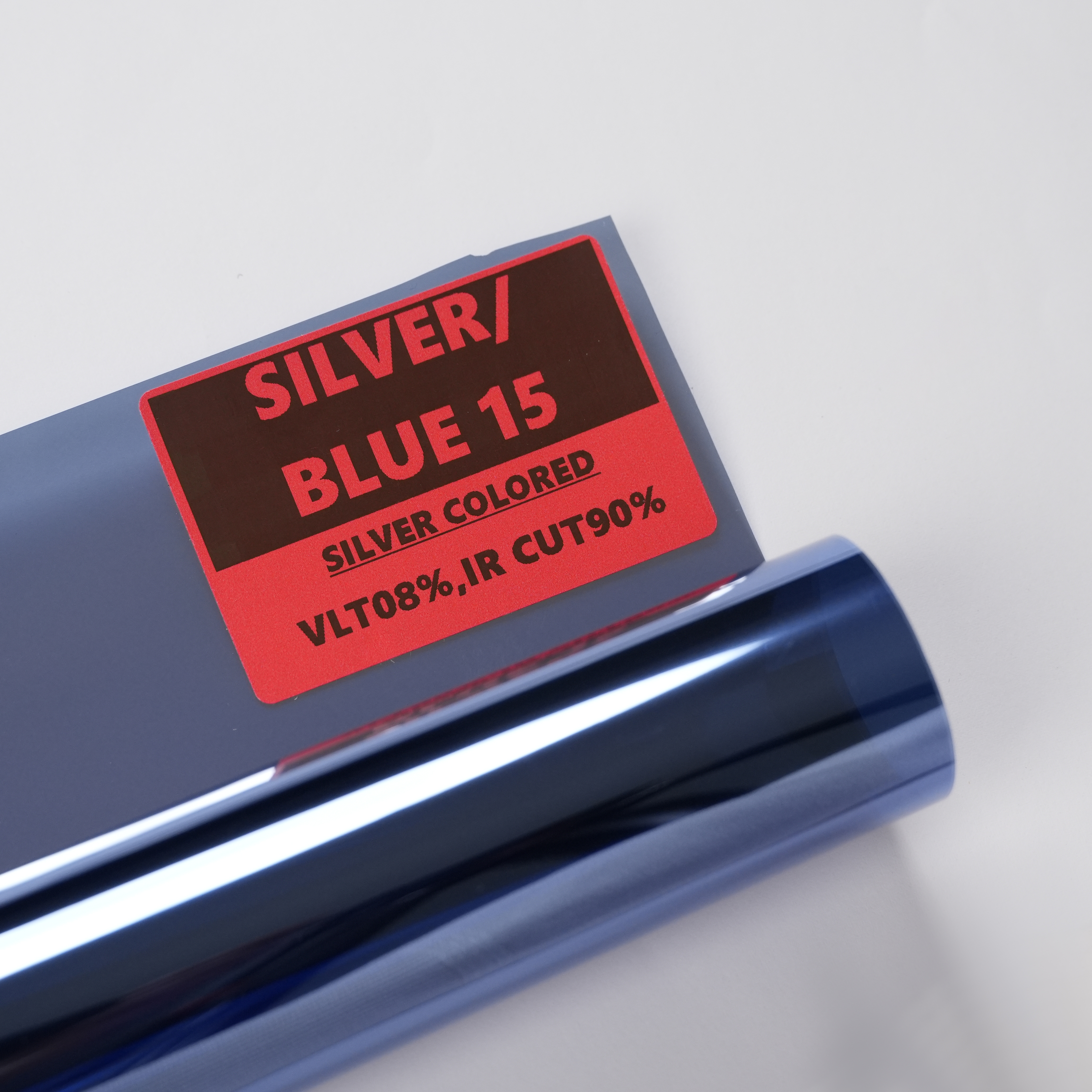
Solar Control Group: SILVER/GREEN 10 and SILVER/BLUE 15
Both models are supplied as architectural film built on optical grade PET with a 2PLY 1.5 mil construction. Each is listed with 99% UV rejection and 90% IR cut, with a visible light transmission of 8%, and each carries a 4-year quality warranty. SILVER/GREEN 10 is listed with a strong adhesive as a named product characteristic; SILVER/BLUE 15 is listed as colour stable.
Those three numbers measure different things and should not be read as one performance figure. UV rejection describes the ultraviolet band, the part of sunlight most associated with fading of interior materials and trim. IR cut describes the infrared band, the portion most associated with radiant heat. VLT describes how much visible light passes through the film and glass, and therefore drives both the appearance of the façade and the amount of usable daylight inside.
An 8% VLT film produces a dark, silver-reflective appearance from outside. On a showroom elevation facing afternoon sun, that is usually the intended trade: a strong reduction in transmitted solar energy and a surface that reads as mirror-like rather than transparent during the day. The trade-off is daylight. An 8% VLT film will visibly change the character of the interior, and parts or display areas that depend on natural light may need supplementary lighting.
HOCHI's published guidance on solar control films is to evaluate performance using verified VLT, UV rejection, IR rejection and TSER test data rather than relying on product colour alone, because colour is a poor indicator of what a film actually does to the solar spectrum. Buyers comparing quotes should therefore ask for the measurement basis behind any claimed figure, not just the headline percentage.
Privacy Group: SILVER/GREY 05
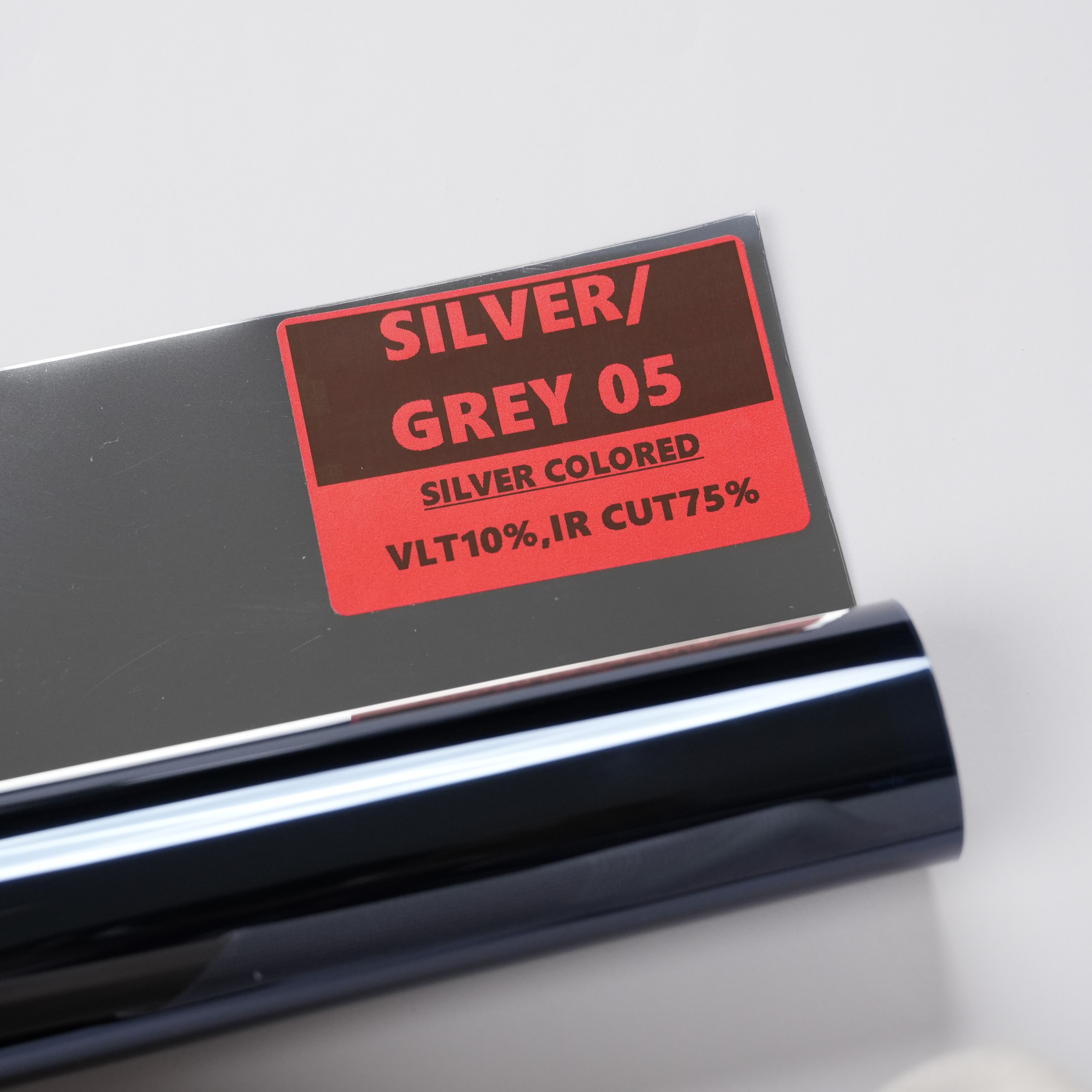
SILVER/GREY 05 is specified with 99% UV rejection, 75% IR cut and 10% VLT, again on a 2PLY 1.5 mil optical grade PET construction, with a 4-year quality warranty. In this shortlist its role is daytime one-way privacy — the counter, back office or parts storefront glazing where staff should not be watched from the forecourt, but where the glass still needs to admit daylight into the working area.
One-way privacy is a lighting condition, not a permanent property of the film. During daylight the exterior side of the glass receives far more light than the interior, so the reflective exterior surface dominates and the interior is difficult to see from outside. After dark, when interior lighting is stronger than the street, the relationship reverses and the interior becomes the visible side. Buyers who need privacy at night need a different measure, such as blinds or an opaque panel, and should not rely on film alone.
At 10% VLT the film is dark but not opaque. It reduces glare on screens and reduces the amount of interior detail readable from a distance, while still allowing a legible silhouette close to the glass. That balance is why the privacy group is separated from the solar control group here: 75% IR cut is a heat benefit, but the decision to specify this model is driven by visibility, not by heat.
Safety Group: SF12 Clear Safety Film
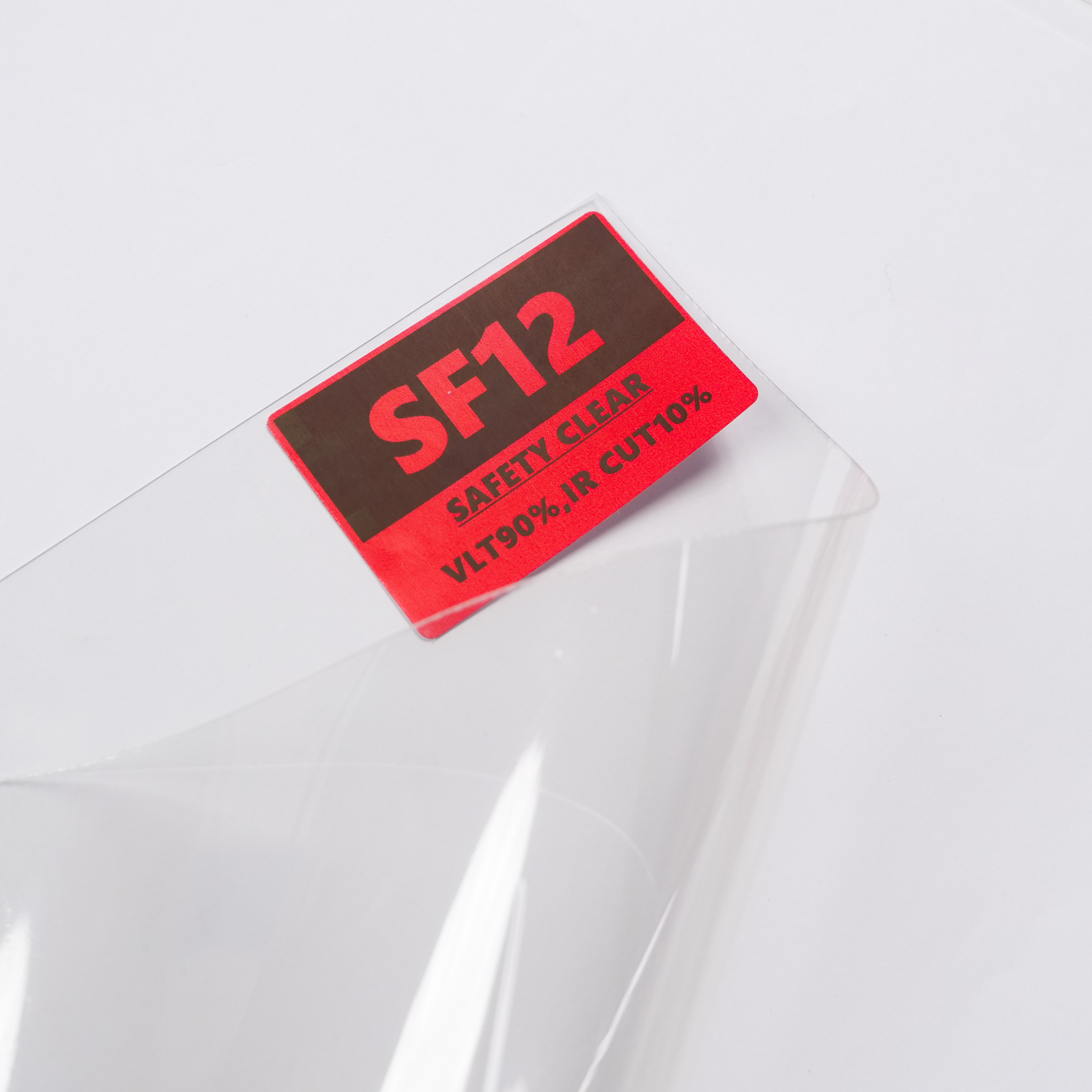
SF12 is a safety clear architectural window film designed for construction industry use. It is specified with a 1PLY 12.0 mil construction on optical grade PET, a clear colour, 90% visible light transmission, 88% UV rejection and 10% IR cut, with a strong adhesive and a 6-year quality warranty.
The number that matters most here is 12.0 mil. It is substantially thicker than the 1.5 mil construction used across the solar control and privacy models in this shortlist, and it is that thickness combined with a strong adhesive that provides shatter retention: on breakage, the film holds fragments in place and reduces the quantity of loose glass that can fall or be pushed through. Because the film is clear and transmits 90% of visible light, it can be applied to entrance doors, walkway glazing and parts display fronts without changing the appearance of the storefront or reducing interior daylight.
Safety film is not the same as a security system. It retains fragments and delays access through broken glass; it does not make a pane burglar-resistant, and it should not be specified as a substitute for laminated or security glazing where those are required by regulation or by risk assessment. Where safety film performance is being verified, the IWFA-referenced test method for measuring tensile strength, break strength and elongation is ASTM D882.
Shortlist Comparison
| Group | Model | Construction | VLT | IR cut | UV rejection | Warranty | Primary role |
|---|---|---|---|---|---|---|---|
| Solar control | SILVER/GREEN 10 | 2PLY 1.5 mil, optical grade PET, strong adhesive | 8% | 90% | 99% | 4 years | High heat rejection on sun-exposed frontage |
| Solar control | SILVER/BLUE 15 | 2PLY 1.5 mil, optical grade PET, colour stable | 8% | 90% | 99% | 4 years | High heat rejection with a silver/blue reflective finish |
| Privacy | SILVER/GREY 05 | 2PLY 1.5 mil, optical grade PET | 10% | 75% | 99% | 4 years | Daytime one-way privacy at counters and storefronts |
| Safety | SF12 | 1PLY 12.0 mil, optical grade PET, strong adhesive | 90% | 10% | 88% | 6 years | Clear shatter retention without changing daylight |
Read down the VLT column and the logic becomes visible. The two solar control models sit at 8% VLT, the privacy model at 10%, and the safety model at 90%. Heat rejection and daylight are traded against each other in the first three; the fourth is a different kind of product solving a different problem.
Application Map for Auto Retail and Parts Environments
Showroom frontage
Large glazed elevations facing afternoon sun are the classic case for SILVER/GREEN 10 or SILVER/BLUE 15. Both are specified at 90% IR cut and 99% UV rejection, which addresses radiant heat and the UV band that affects interior materials, trim and display finishes. The choice between the two is largely a matter of which reflective tone suits the building — a green-silver appearance or a blue-silver appearance — since the listed VLT, IR cut, UV rejection and warranty values are the same.
Parts counter, cash desk and back office
Where staff work behind glass that faces the forecourt, SILVER/GREY 05 addresses the visibility question directly. Its 10% VLT limits how much of the counter area can be read from outside during daylight while still admitting light, and its 99% UV rejection adds the same fading protection as the solar control models. This is also the group where expectations should be set most carefully with staff, because the one-way effect depends on the interior staying darker than the exterior.
Glass doors, walkways and display cases
SF12 suits glazing beside movement — customer entrances, walkway separations, glass in front of parts shelving — because it retains fragments on breakage while transmitting 90% of visible light. Because it is clear, it can be applied alongside the darker films on the same building without creating a visual mismatch: solar control film goes on the heat-exposed elevation, safety film goes on the panes where breakage is the concern.
Where two films are contemplated on the same pane, the combined result is not the sum of the two specification sheets. Light transmission drops further and the thermal load on the glass changes, so the combination should be assessed on its own terms rather than assumed from individual film data.
Film Versus Conventional Glazing Measures
Film competes with three common alternatives: replacing glazing with a solar control or lower-transmission unit, adding external shading, and fitting internal blinds.
Replacing glazing is the most permanent route. It can deliver the most stable optical result because the coating is part of the glass itself and is unaffected by installation quality. It is also a capital project that interrupts trading, and it locks the building into a fixed level of solar control for the life of the glass unit.
External shading — louvres, fins or overhangs — blocks solar gain before it reaches the glass and can be highly effective on a specific elevation. It also obscures the view outward from the shaded part of the window, changes the façade appearance, and in retail settings can hide the very display the showroom exists to show.
Internal blinds are inexpensive and adjustable, which is a genuine advantage at a counter, but they intercept heat that has already entered the building and they do nothing for UV protection or glass breakage.
The honest limitation of film sits between these options. Film is applied to existing glass, so its behaviour depends on the substrate: the same specified film behaves differently on clear float, laminated, insulated or coated glass, and solar control film can increase thermal stress on some glazing assemblies. HOCHI's own installation guidance recommends a glass compatibility or thermal stress assessment before applying solar control film to certain laminated, insulated or treated glass. Film also has a service life defined by its warranty period — 4 years on the solar control and privacy models in this shortlist, 6 years on SF12 — after which it may need to be removed and replaced. Buyers who need a permanent, glass-integrated solution should treat film as a retrofit measure, not as a substitute for specifying the right glass in a new build.
Market Context
The retrofit logic is supported by the wider direction of the film market. The global automotive tinting film market is projected to reach USD 14.7 billion by 2033 according to Grand View Research, which indicates that film-based solar control is an established category with an industrial supply base rather than a niche accessory. Expectations of what film can achieve have also moved: nano-ceramic window films can block up to 85% of solar heat while maintaining high visible light transmission — a different film family from the silver-coloured architectural models in this shortlist, but one that has raised buyer awareness of the difference between visible darkness and actual heat rejection.
For dealerships and parts stores, the practical consequence is that film decisions are increasingly compared on measurement rather than appearance. A buyer who can read VLT, IR cut and UV rejection separately is harder to mislead with a single impressive number, and is better positioned to specify the right film for each elevation.
Verification Checklist Before Ordering
Haian Ho Chi Technology Co., Ltd. operates a manufacturing facility covering 133,333 square metres with an annual production capacity of 48,000,000 metres and approximately 220 employees, including a 100-engineer R&D team, and holds more than 50 patents comprising 14 invention patents, 19 utility model patents and 18 software copyrights. Its paint protection film and solar film products are certified to IATF 16949:2016, valid until 2028-03-15, and a company profile records a Class 1000 dust-free coating workshop covering 3,000 square metres — the kind of detail that matters because dust during coating is a common source of optical defects in finished film.
On the buyer's side, four checks cover most of the risk:
- Match the spec to the pane. Confirm the model number against the VLT, IR cut and UV rejection values quoted, and confirm the film is intended for architectural window film applications rather than automotive glazing.
- Check the glass, not only the film. Identify the glass type, inspect for cracks, damage or coating, and confirm compatibility before ordering — particularly on laminated, insulated or treated glass.
- Confirm the warranty term in writing. The solar control and privacy models in this shortlist carry a 4-year quality warranty; SF12 carries a 6-year quality warranty.
- Agree the inspection standard in advance. IWFA Visual Quality Standards require window film to be inspected from 6 feet (approximately 2 metres) under natural daylight, which gives a measurable basis for accepting or rejecting an installation.
The installation sequence also affects the result and is worth confirming with the installer: glass compatibility verification, surface cleaning, accurate cutting with trimming allowance, wet application with an approved solution, squeegeeing from centre to edge, edge trimming, contamination and lift inspection, and a curing period before cleaning or final assessment.
Future Outlook
Two shifts are likely to shape how dealerships and parts stores specify film over the next few years. The first is consolidation of functions onto a single façade: buildings increasingly want heat control, daytime privacy and breakage retention addressed in one specification, which favours suppliers able to document each film separately rather than quoting one blended performance claim. The second is documentation. As more buyers ask for verification of VLT, IR cut and UV rejection values, and for test methods such as ASTM D882 on safety films, specification work will go to suppliers whose published data can be traced to a measurement basis and a stated warranty term.
For now, the shortlist is small and functional. Solar control where heat and UV are the problem, one-way privacy where visibility is the problem, and clear safety film where breakage is the problem — three decisions a dealership or parts store can make pane by pane rather than building by building.
FAQ
How does architectural window film reduce heat and UV exposure through storefront glass?
Solar control films manage ultraviolet, visible light and infrared energy by absorbing or reflecting selected wavelengths of solar energy. Performance should be evaluated using verified VLT, UV rejection, IR rejection and TSER test data rather than relying on product colour alone, because a dark film is not automatically the strongest performer in every band.
Which film in this shortlist is intended for daytime one-way privacy?
SILVER/GREY 05, specified at 99% UV rejection, 75% IR cut and 10% VLT on a 2PLY 1.5 mil optical grade PET construction with a 4-year quality warranty. The one-way effect applies during daylight, when the exterior of the glass receives more light than the interior; the relationship reverses at night when interior lighting is stronger.
Does a clear safety film change the appearance or daylight levels of storefront glass?
SF12 is a clear architectural safety film with a specified visible light transmission of 90% and 88% UV rejection on a 1PLY 12.0 mil optical grade PET construction. Because the film is clear and transmits most visible light, it is intended for use where storefront appearance and interior daylight should remain close to unglazed conditions while shatter retention is added through film thickness and a strong adhesive.
What should be checked before solar control film is applied to a dealership's existing glass?
The glass type should be identified and inspected for cracks, damage or coating, and the selected film should be confirmed as compatible with the glass structure. A glass compatibility or thermal stress assessment is recommended before installing solar control film on certain laminated, insulated or treated glass. Installation then follows cleaning, accurate cutting, wet application, professional squeegeeing and edge inspection, with sufficient curing time before the final appearance is assessed.
How is installed film quality inspected?
IWFA Visual Quality Standards require window film inspection from 6 feet (approximately 2 metres) under natural daylight, which gives buyers and installers a defined distance and lighting condition for accepting or rejecting the finished work.
What warranty periods apply to the models in this shortlist?
SILVER/GREEN 10, SILVER/BLUE 15 and SILVER/GREY 05 each carry a 4-year quality warranty. SF12, the safety clear film, carries a 6-year quality warranty.
A downloadable specification document covering the window film range is available here: HOCHI window film specifications (PDF).