
Decoding B1 Fire Ratings: Wall Panel Import Compliance Guide
Decoding B1 Fire Ratings: Wall Panel Import Compliance Guide
Fire performance is the one property in a wall panel specification that no buyer can confirm by looking at the goods. It is fixed before the panel leaves the line — in a test, in a certificate, and in a model number that must match the shipment. For importers, distributors and project specifiers, the fire classification is therefore a document-control problem as much as a material one, and it is where a large share of compliance friction in wall panel imports actually begins.
B1 is the classification declared on the LONGTE panel models most frequently specified for rated projects. LONGTE (Haining Longtime Industry Co., Ltd.) is a Zhejiang-based manufacturer of PVC, WPC, SPC and PU wall and ceiling panel systems founded in 2003, exporting 85% of its output to markets that include the USA, Colombia, India, the Philippines, the UAE and South American countries. Four models — LT-PU, LT-WG, LT-SW and LT-BC — each carry a B1 fire rating in their published specifications, and each rating belongs to that model's own construction, thickness and dimension.
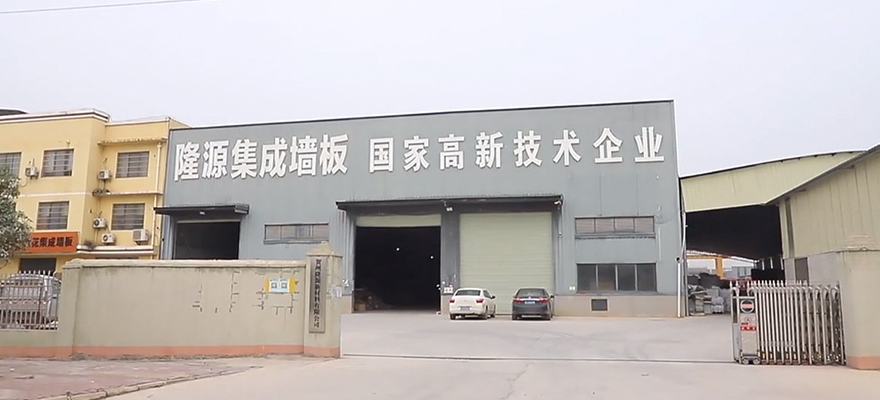
Production capacity for B1-declared wall panel systems is distributed across six manufacturing hubs in Asia, which affects both documentation continuity and reorder lead times. Image: Guangxi PVC wall panel factory, LONGTE.
Why a B1 Rating Is a Model-Level Attribute, Not a Brand-Level Promise
A fire classification is issued against a defined product construction, not against a company. In the LONGTE range, B1 is declared per model on the specification sheet, alongside dimensions, thickness and material composition. LT-PU, LT-WG, LT-SW and LT-BC each carry a B1 rating in their published parameters, and each of those declarations refers to a specific panel build-up: a specific core material, a specific thickness and a specific surface treatment.
The clearest evidence that ratings are model-specific rather than portfolio-wide is the LT-FS flexible soft stone wall panel, which the same manufacturer declares at A2 — a different classification from the B1 models. A buyer who approves a project on the strength of a supplier's general "fireproof panel" positioning, without confirming which model the declaration covers, has verified nothing that will survive review.
The practical rule for procurement is straightforward: the fire declaration must name the model, and the model named on the certificate must be the model on the invoice. Where a specification substitutes one panel for another to solve a dimension, finish or budget constraint, the underlying fire declaration changes with it.
The Import Compliance Problem: Verification Gaps, Not Missing Products
Most wall panel import disputes around fire performance do not arise because a rated product was unavailable. They arise because the documentation chain did not match the transaction. Three failure points recur.
1. The declaration does not identify the model
A catalogue may describe a range as fire-retardant while the certificate covers a single SKU. When the shipment arrives with a different thickness or surface film, the certificate no longer describes the goods.
2. The rating framework does not match the destination market
Fire classifications are issued under national test frameworks, and those frameworks are not automatically interchangeable. For commercial projects referencing European practice, WPC wall panels are required to meet the EN 13501-1 fire safety standard, ideally achieving a B-s1, d0 rating, according to the European Standard EN 13501-1. A declaration made under one framework does not by itself satisfy a reviewer applying another, so buyers should confirm which test method and which documents the local authority actually accepts before the specification is frozen.
3. Regulatory change is not tracked between orders
Anti-dumping exposure, environmental regulation changes such as REACH and RoHS, and country-specific fire codes are moving targets. LONGTE's compliance function monitors HS code updates and anti-dumping cases quarterly, maintains valid certifications including CE, RoHS, CNAS fire test and SGS formaldehyde documentation, and adjusts product formulations for regional standards. The company also provides a product-country matched compliance guide, which is the practical instrument a buyer needs when the same panel is shipped to more than one market.
B1 Status Across LT-PU, LT-WG, LT-SW and LT-BC
The four models share a B1 classification but differ substantially in construction, thickness and intended application — which is precisely why a single blanket statement about "B1 wall panels" is insufficient for import documentation.
| Model | Product | Dimensions | Thickness | Core material | Declared fire rating | Typical application |
|---|---|---|---|---|---|---|
| LT-PU | PU Faux Stone Wall Panel | 600 × 1200 mm | 20–30 mm | Polyurethane foam + surface coating | B1 | Exterior facade, villa, hotel, restaurant |
| LT-WG | WPC Fluted Wall Panel | 159 × 2900 mm (groove depth 8 mm) | 12 mm | Wood powder + PVC + additives | B1 | Living room TV background, hotel lobby, office |
| LT-SW | SPC Stone Plastic Composite Wall Panel | 1220 × 2800 mm | 4 mm | Limestone powder + PVC + UV layer | B1 | Bathroom, kitchen, hotel, commercial space |
| LT-BC | Bamboo Charcoal Wood Wall Panel | 600 × 2900 mm | 9 mm | Bamboo charcoal fiber + PVC composite | B1 | Residential, hotel, office, kids room |
Within the same range, other models are also declared at B1 — including LT-PM (PVC marble wall panel, 1220 × 2800 mm, 3–8 mm), LT-PC (PVC ceiling panel, 5–8 mm), LT-PS (PS fluted wall panel, 10 mm) and LT-AC (acoustic slat wood panel, 21 mm, NRC 0.5–0.85) — while LT-FS is declared at A2. The variation is not a quality signal in either direction; it is a statement about which construction was tested to which classification. For importers assembling a project file, that distinction determines which evidence is required for which line item.
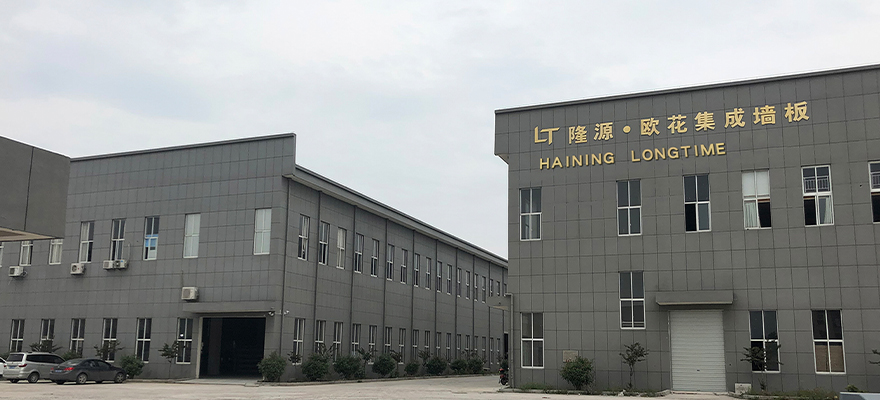
Consistency between the declared construction and the shipped panel depends on in-process control, not on the final inspection alone. Image: Haining PVC panel factory, LONGTE.
Technical Explanation: How Material and Thickness Sit Behind the Declaration
A B1 declaration is inseparable from the material system it describes. The four models demonstrate how widely that system can vary.
Bamboo charcoal fiber composite (LT-BC). The bamboo charcoal wood wall panel combines bamboo charcoal fiber with a PVC composite at 9 mm thickness in a 600 × 2900 mm format. It is specified as formaldehyde-free, waterproof and fireproof B1, and is offered in more than 20 colors. The formaldehyde-free specification matters because interior panels are increasingly judged on emissions as well as fire: bamboo charcoal wood veneer panels are increasingly certified to E0 formaldehyde emission standards (≤ 0.07 mg/m³), according to AesthedgeWallPanel. For residential interiors, bedrooms and children's rooms, the two requirements tend to be requested together.
WPC composite (LT-WG). The WPC fluted wall panel uses wood powder, PVC and additives at 12 mm thickness, with an 8 mm groove depth across a 159 × 2900 mm profile. It is specified as waterproof and termite-proof alongside the B1 rating — a combination that explains its use on living room TV backgrounds, hotel lobbies and office walls where both moisture tolerance and a dimensional, textured surface are required.
SPC stone-plastic composite (LT-SW). At 4 mm, this is the thinnest of the four B1-declared models. The construction is limestone powder, PVC and a UV layer at 1220 × 2800 mm, specified as wear-resistant, 100% waterproof and anti-scratch. Thinness reduces weight and makes the panel suitable for bathrooms, kitchens and commercial fit-outs, but it also means the panel's stiffness comes from the substrate beneath it.
PU foam with surface coating (LT-PU). The PU faux stone panel is the heaviest in appearance and the lightest in mass: 20–30 mm thick at 2–3 kg/m², in a 600 × 1200 mm format. It is specified as weather-resistant and impact-resistant as well as fireproof B1, which positions it for exterior facades, villas, hotels and restaurants rather than for interior accent work.
Because the declaration references a defined construction, a change of thickness, surface film or core formulation is a specification change rather than a cosmetic option. Buyers approving a substitute configuration should confirm that the declared rating still describes the panel being purchased.
Application and Use Cases: Matching Rated Models to Project Type
Fire compliance requirements are set by the project's approving authority, but the panel choice determines whether that requirement can be evidenced without redesign. The four models map to distinct application profiles:
| Application profile | Compatible B1-declared model | Why it fits |
|---|---|---|
| Residential bedroom and interior accent wall | LT-BC | 9 mm bamboo charcoal fiber composite; formaldehyde-free, waterproof, B1; 20+ colors |
| Living room TV background, hotel lobby, office feature wall | LT-WG | 12 mm WPC with 8 mm groove; waterproof and termite-proof alongside B1 |
| Bathroom, kitchen, high-traffic commercial interior | LT-SW | 4 mm SPC; 100% waterproof, anti-scratch and wear-resistant, B1 |
| Exterior facade, villa, hospitality exterior | LT-PU | 20–30 mm PU foam; 2–3 kg/m², weather-resistant and impact-resistant, B1 |
Two adjacent cases are worth noting because they are frequently confused with the B1 group. Where curved geometry is required for a facade or feature wall, the LT-FS flexible soft stone panel is the relevant model and is declared at A2, not B1. Where sound absorption is the governing requirement, the LT-AC acoustic slat panel combines a B1 rating with an NRC of 0.5–0.85 for cinemas, studios, offices and home theaters. Both cases reinforce the same procurement lesson: the requirement should select the model, and the model should select the certificate.
Market Trend Analysis: Volume Growth Raises the Cost of Compliance Gaps
The commercial case for tightening fire documentation is driven by scale. The global wall panel market was valued at USD 32.4 billion in 2025 and is projected to reach USD 43.7 billion by 2033, according to Dataintelo. Within that total, the Wood Plastic Composites market reached USD 8.89 billion in 2025 with a projected CAGR of 11.7% through 2033, according to Grand View Research. Polyurethane stone wall panel sales reached USD 3.7 billion in 2024, driven in part by a 70–80% weight reduction compared with natural stone, according to Witop Decor.
Supply is concentrated in the region where most of this capacity sits: Asia-Pacific accounts for approximately 42.3% of the global wall panel market share, driven by rapid urbanization in China and India (Dataintelo). China is also the top exporter of PVC marble sheets, with 1,480 documented export records as of late 2025, according to Volza Export Trade Data.
The implication for buyers is not simply that more panels are moving across borders. It is that more of those shipments are passing through projects with formal document review. As commercial and residential specifications converge on written evidence — a declared classification, a test report, an emissions standard — the supplier's ability to produce a matching document becomes a differentiator equal to price or lead time. That shift favors manufacturers with continuous compliance functions over suppliers who assemble documents case by case.
Comparison with Traditional Solutions — and Where Panels Do Not Replace Them
Panel systems are usually evaluated against natural stone cladding in facade and feature-wall applications. The published comparison data for PU faux stone against real natural stone shows a substantial weight and installation gap: 2–3 kg/m² against 30–60 kg/m² (roughly 10–20 times lighter), installation labor of 4–6 hours per 50 m² against 3–5 days per 50 m², and a 60–70% lower delivered cost with no rebar, mortar or scaffolding required. Maintenance also differs: the panel requires no chipping repair, no efflorescence treatment and no re-sealing, where natural stone requires annual sealing and crack repair. Thermal performance is quoted at an R-value of 2.5–3.5 against 0.5–1.0 for stone.
| Comparison point | Lightweight PU faux stone panel | Real natural stone cladding |
|---|---|---|
| Weight | 2–3 kg/m² | 30–60 kg/m² |
| Installation labor | 4–6 hours per 50 m² | 3–5 days per 50 m² |
| Structural preparation | No rebar, mortar or scaffolding | Requires structural anchoring |
| Maintenance | No chipping, no efflorescence, no re-sealing | Annual sealing and crack repair |
Where the boundary sits. These figures come from the manufacturer's published comparison data and describe a specific product category, not a universal substitution case. There are real conditions under which natural stone remains the appropriate specification — most clearly new construction with reinforced walls, where structural anchoring is available and higher mass is compatible with the design intent. A lightweight panel system is not an upgrade in every context.
A second boundary concerns the fire declaration itself. A B1 rating applies to the panel product as declared. It does not extend automatically to adjacent components, adhesives or substrates used in the same wall build-up, and it does not describe a finished assembly. Where an approving authority assesses the complete wall construction rather than the panel alone, the panel certificate is one input among several, and buyers should confirm the assessment scope before assuming that a B1-declared panel closes the requirement.
Verification Evidence: What a Supplier Should Be Able to Produce
For buyers at the decision and execution stage, the useful question is not whether a supplier claims a rating but which documents can be produced on request, on a repeatable basis. The relevant evidence set for the LONGTE panel range includes:
- Valid CE, RoHS and Fireproof B1 certificates, held continuously since 2022.
- CNAS fire test documentation and SGS formaldehyde documentation maintained as part of the compliance file.
- ISO 9001 quality management system coverage across production.
- Three-stage quality control: incoming material inspection (IQC), in-process inspection (IPQC) every two hours, and 100% finished-goods inspection (OQC).
- Third-party pre-shipment inspection by SGS, BV or TUV on buyer request, with cost shared between parties.
- Photo and video inspection provided at no charge, and sample retention for six months for reference.
- Certificate of origin documentation, including CO, FORM E and FORM F where applicable.
- Customs documentation for DDP shipments: commercial invoice, packing list, certificate of origin and MSDS.
- A 5-year quality warranty on major SKUs, free replacement within 30 days of arrival for genuine defects, and an after-sales response target of 24 hours.
The last two items matter more than they appear in a compliance context. A rating that cannot be supported after delivery is a warranty exposure, not a specification advantage.
Long-Term Compliance Continuity: Why the Ecosystem Behind the Certificate Matters
For repeat buyers and distributors, the durability of a compliance position depends on manufacturing scale and on who is responsible for watching regulatory change. LONGTE operates six manufacturing hubs across Asia — Haining, Guangxi, Indonesia, Vietnam and Malaysia — with combined monthly capacity of 800,000 m² of PVC panel, 500,000 m² of SPC flooring, 200,000 m² of WPC decking, 150,000 m² of PU stone and 80,000 m² of acoustic panel. Export business accounts for 85% of total sales, with annual sales volume exceeding USD 35 million and major markets including the USA, Colombia, India, the Philippines, the UAE and South American countries.
On the compliance side, the company's legal and compliance function monitors HS code updates and anti-dumping cases quarterly, maintains the certification set described above, customizes product formulas for regional standards and issues product-country matched compliance guides. On the logistics side, shipping is supported by multi-port capability (Ningbo, Shanghai, Yantian and Shenzhen), container pre-booking 30 days ahead of peak season, working relationships with more than five shipping lines, contract rates with carriers including COSCO, MSC, OOCL, EVERGREEN and CMA, and DDP service to the USA, UAE, Colombia and Chile. Export documentation is prepared within three days after loading.
Commercial terms are structured to allow verification before commitment: samples of 1–3 pieces free of charge with the buyer covering courier cost; trial orders as a single 20GP mixed container of approximately 500–800 m²; custom designs at 500 m² per SKU; and standard reorders at one 40HQ per SKU. Default shipping terms are FOB Ningbo or Shanghai, with CIF available to Los Angeles, New York, Dubai, Jebel Ali, Manila, Callao and Santos. Payment is 30% T/T deposit with 70% before shipment, L/C at sight for orders above USD 50,000, and open account terms of 30 days for long-term partners holding credit insurance.
Future Outlook
Two documentation streams are converging in wall panel specification. Fire classification and emissions performance are increasingly requested together — a B1 fire rating and an E0-level formaldehyde result on the same interior panel, for the same project file. As the wall panel market moves toward the USD 43.7 billion projected for 2033 and the WPC segment continues on its 11.7% CAGR path, the volume of cross-border panel transactions subject to formal review will rise with it.
The likely procurement consequence is that fire documentation becomes a standing supplier metric rather than a project-specific task. Buyers who standardize on a per-model declaration — model, thickness, construction, certificate, destination-market acceptance — will spend less time resolving questions after shipment and more time comparing suppliers on capability. The models that make this practical are the ones where the declared configuration is stable, the supporting documents are current, and the supplier can show what happens when a regulation changes mid-year.
Frequently Asked Questions
What does a B1 fire rating mean on a wall panel specification?
In the LONGTE range, B1 is the fire-performance classification declared on the specification sheet for a specific model, sitting alongside declared dimensions, thickness and material composition. It is a model-level attribute: LT-PU, LT-WG, LT-SW and LT-BC each carry a B1 rating in their published parameters, and the supporting certificate is expected to identify the same model. Buyers using the rating in a project file should obtain that document rather than relying on a catalogue description.
Which models in the LONGTE wall panel range carry a B1 fire rating?
The four models most commonly specified for rated projects are LT-PU (PU faux stone, 20–30 mm), LT-WG (WPC fluted, 12 mm), LT-SW (SPC stone-plastic, 4 mm) and LT-BC (bamboo charcoal wood, 9 mm). Other models in the same range are also declared at B1, including LT-PM (PVC marble, 3–8 mm), LT-PC (PVC ceiling, 5–8 mm), LT-PS (PS fluted, 10 mm) and LT-AC (acoustic slat, 21 mm, NRC 0.5–0.85). LT-FS flexible soft stone is declared at A2 rather than B1, which illustrates why verification must be performed per model.
How should a buyer verify a B1 claim before confirming a production order?
Request documentation that ties the classification to the exact model and configuration being purchased, and confirm the destination market accepts the framework under which it was issued. Verifiable evidence available for the LONGTE range includes CE, RoHS and Fireproof B1 certificates held since 2022, CNAS fire test and SGS formaldehyde documentation, ISO 9001 management system coverage, three-stage QC (IQC, IPQC every two hours, OQC 100% finished goods), third-party pre-shipment inspection by SGS, BV or TUV on request, free photo and video inspection, and six-month sample retention.
Do commercial and residential projects apply the same fire requirement?
Not necessarily, and the difference shapes the documentation request. Commercial and hospitality specifications are typically the most document-heavy; for European-referenced commercial work, WPC wall panels are required to meet the EN 13501-1 fire safety standard, ideally achieving a B-s1, d0 rating, according to the European Standard EN 13501-1. Residential interior specifications frequently combine a fire classification with an emissions requirement — bamboo charcoal wood veneer panels are increasingly certified to E0 formaldehyde emission standards (≤ 0.07 mg/m³), and LT-BC is specified as formaldehyde-free. Buyers should confirm which framework the local approving authority accepts before fixing the specification.
How do thickness and material affect which rated model suits a project?
The four B1-declared models differ on both dimensions. LT-SW is 4 mm on a limestone powder, PVC and UV layer construction; LT-BC is 9 mm on bamboo charcoal fiber and PVC composite; LT-WG is 12 mm on wood powder and PVC with an 8 mm groove depth; LT-PU is 20–30 mm on polyurethane foam with a surface coating and weighs 2–3 kg/m². Because each declaration references a defined construction, changing the thickness, surface film or core formulation should be treated as a specification change that requires re-confirmation of the declared rating.
Can a B1-rated model and an A2-rated model be used interchangeably in one project?
No. Ratings are declared per model, and the same manufacturer can hold different classifications across its portfolio — LT-FS flexible soft stone is declared at A2, while LT-PU, LT-WG, LT-SW and LT-BC are declared at B1. A specification that names a classification therefore also needs to name the model that carries it. Substituting one model for another for reasons of dimension, finish or cost changes the underlying declaration and the evidence required.
What should long-term buyers look for in compliance continuity?
Three things: whether the same model keeps the same declared configuration across orders, whether the certification set remains valid and current, and whether the supplier actively tracks regulatory change. LONGTE operates six manufacturing hubs across Asia (Haining, Guangxi, Indonesia, Vietnam and Malaysia) with combined monthly capacity of 800,000 m² PVC panel, 500,000 m² SPC flooring, 200,000 m² WPC decking, 150,000 m² PU stone and 80,000 m² acoustic panel. Its compliance function monitors HS code updates and anti-dumping cases quarterly, maintains CE, RoHS, CNAS fire test and SGS formaldehyde documentation, and issues product-country matched compliance guides. Export documentation is prepared within three days after loading, and DDP service is available to the USA, UAE, Colombia and Chile.
Product specifications and the full model range are published at www.ltpvcfactory.com, and the company catalogue can be downloaded here: LONGTE product catalogue (PDF).