
Decoding Baby Coil Compliance: Grades, Finishes, QA
A stainless steel baby coil is a narrow, cold-rolled coil supplied at roughly 600 mm width and 0.1–1.2 mm thickness, most often in BA finish and in one of four grades: 201, 304, 410 or 430. For tube mills, tableware producers and kitchenware manufacturers, compliance is less about how a coil looks on arrival than about whether grade, finish, thickness tolerance and documentation still match the purchase specification after a long sea route and several weeks in a buyer's warehouse.
Baby coils sit at the front end of the manufacturing chain, which is why they absorb a disproportionate share of quality disputes. A 600 mm coil may be slit, formed, welded or drawn within days of unloading. If the grade is not what the certificate claims, or the finish does not survive forming, the defect surfaces inside finished goods rather than at goods-in inspection, where it would be far cheaper to catch. This guide sets out what the baby coil format actually covers, how the four common grades differ in practical terms, what a supply profile dominated by BA finish implies, and which points buyers should verify — packaging and grade traceability included — before a coil leaves the mill.
Baby Coil in Specification Terms: What the Format Actually Covers
In commercial terms, a baby coil is a narrow cold-rolled stainless steel coil in the 0.1–1.2 mm thickness band at approximately 600 mm width, supplied predominantly in BA finish. The distribution is concentrated: about 80% of the volume falls between 0.3 mm and 0.6 mm, and around 70% of supply carries a BA surface. The remaining share is produced against specific order requirements.
The name describes format, not quality grade. A baby coil is not by definition a downgraded product, and it is not the same commercial category as a secondary coil. The distinction matters commercially because the two are frequently quoted against each other. The narrow secondary class overlaps with the baby coil on thickness (0.1–1.2 mm) and width (~600 mm), but it is defined by a different packaging convention — PVC outside or paper interleaved — and by a coil weight of approximately 200 kg, in grades 430, 201 and 304. Baby coils, by contrast, ship in nude packing across a four-grade family. Buyers who treat the two categories as interchangeable tend to discover the difference at the receiving dock rather than in the quotation.
| Parameter | Baby coil (documented) | Narrow secondary coil (for contrast) |
|---|---|---|
| Thickness | 0.1–1.2 mm; about 80% of volume between 0.3 mm and 0.6 mm | 0.1–1.2 mm |
| Width | Approximately 600 mm | Approximately 600 mm |
| Surface | Mainly BA finish; roughly 70% BA | Mainly BA finish |
| Grades | 430, 304, 410, 201 | 430, 201, 304 |
| Packaging | Nude packing | PVC outside or paper interleaved; coil weight around 200 kg |
| Typical matched equipment | Slitting machine, tube mill, stamping equipment | Slitting and re-rolling lines |
| Typical operating conditions | High temperature, food contact, outdoor construction | Forming and finishing operations |
Baby coil specification envelope as documented in current product data; secondary coil parameters are listed only to show where the two categories diverge.
Two implications follow from this envelope. First, the 600 mm width is a manufacturing format rather than a cutting decision: it feeds slitting machines, tube mills and stamping equipment directly, so material can enter production without an intermediate slitting step. Second, thickness control is the variable most likely to affect yield, because strip running at the top of a tolerance band and strip running at the bottom behave differently in the same die or weld schedule. Application documentation for this material family lists stable thickness tolerance, anti-rust performance and, on some lines, mirror finish as special requirements — a reasonable indication of where buyers have historically found risk concentrated.
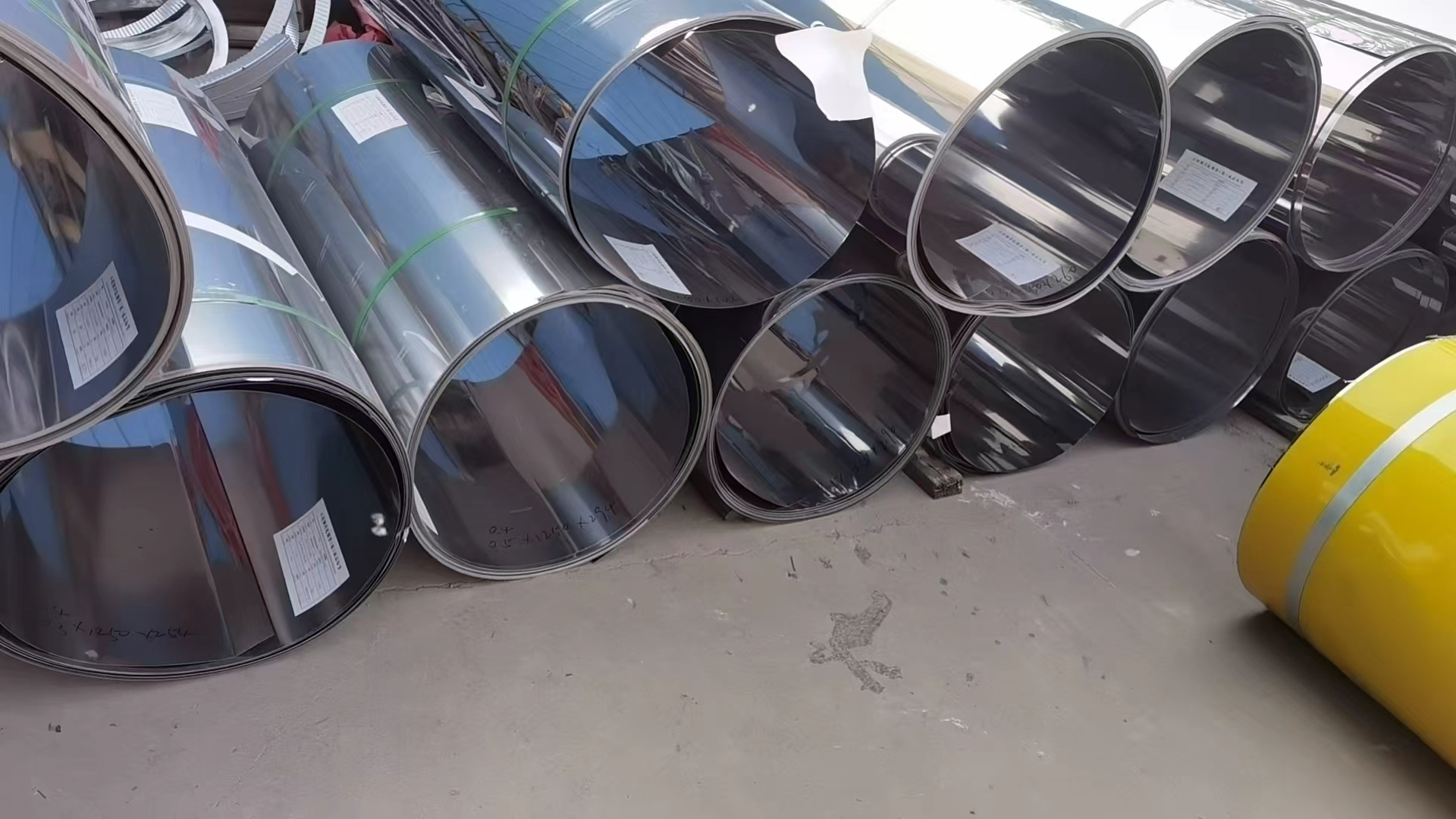
430 grade baby coil in the ~600 mm width class with a BA surface — one of four grades supplied in this format.
The Four Grades Behind the Baby Coil Family
Baby coils are documented in grades 201, 304, 410 and 430, all within the same 0.1–1.2 mm thickness band and the same approximately 600 mm width class. Because the dimensional envelope is shared, grade selection — not dimension — is where most application risk sits.
| Grade | General family | What the wider coil programme documents | What buyers should verify |
|---|---|---|---|
| 201 (J1/J2/J5 variants) | Austenitic | 2B and BA finishes, 0.1–2.0 mm, widths 550/600/620/650/690/730/810/830 mm; 1240 mm format from 0.25–3 mm | Which J-variant and which finish were actually supplied |
| 304 | Austenitic | Narrow 0.10–2.00 mm at 550–730 mm; wider 0.3–3 mm at 1240 mm | Grade on the mill certificate and thickness tolerance |
| 410 | Ferritic / martensitic | Narrow BA 0.15–1.2 mm at 300–1010 mm; wider BA 0.25–1.5 mm at 1240 mm mill edge; further processing PVC / paper / refinish | Whether BA or a further-processed surface is required |
| 430 | Ferritic | Listed in the baby coil grade set and in the secondary range (narrow 0.1–1.2 mm at ~600 mm) | Grade traceability against the certificate, not the label alone |
Grade-to-format relationships as documented across the coil programme; the baby coil class itself is defined by the 0.1–1.2 mm / ~600 mm envelope shared by all four grades.
201: the cost-oriented austenitic option
201 is documented in J2, J3 and J5 variants and produced in both 2B and BA finishes. Across the wider coil programme, 201 strip is available from 0.1 mm to 2.0 mm at widths of 550, 600, 620, 650, 690, 730, 810 and 830 mm, with a 1240 mm format from 0.25 mm to 3 mm. Because the documentation lists the J-variants separately, a purchase order that specifies only “201” leaves the variant open — and the variant affects forming behaviour and how the surface responds to subsequent processing. Buyers in price-sensitive segments should name both the variant and the finish explicitly.
304: the reference grade for wet and food-contact service
304 is generally the most corrosion-resistant of the four in everyday service, and it is the grade most often requested where food contact or sustained moisture exposure occurs. The narrow format is documented from 0.10 mm to 2.00 mm at widths of 550–730 mm, and a wider format from 0.3 mm to 3 mm at 1240 mm, with minimum order quantities set per thickness. For tableware, kitchenware and food-processing equipment, 304 is the conventional specification; the application documentation for this material family lists food contact and high-temperature operating conditions among its core scenarios.
410 and 430: grades chosen for other reasons than corrosion resistance
410 and 430 are generally classified outside the austenitic family and are magnetic, unlike 201 and 304. They are commonly selected where moderate corrosion resistance is acceptable and where cost profile, magnetic response or specific forming behaviour matters more than maximum corrosion performance. 410 is documented in a narrow BA format from 0.15 mm to 1.2 mm at 300–1010 mm and a wider BA format from 0.25 mm to 1.5 mm at 1240 mm mill edge, with further processing options that include PVC, paper and refinishing. 430 appears both in the baby coil grade set and in the secondary coil range, which is one reason the two categories are so often confused in quotation comparisons.
Reading the “70% BA” Figure Correctly
BA stands for bright annealed. The finish is produced by annealing cold-rolled strip in a controlled atmosphere, which avoids the surface oxidation that a conventional anneal-and-pickled route would leave behind. The practical result is a smooth, bright, low-roughness surface that can be formed and, in some cases, used without further finishing — which is why it dominates narrow coil supply.
A 70% BA share in the baby coil class tells buyers two things. It confirms that BA is the default surface for this format, so price and availability are most competitive there. It also implies that a buyer who needs a different surface — NO.4, hairline, or a mirror class — should confirm availability at the quotation stage rather than assume it. Finish also constrains thickness elsewhere in the product range: in the 1240 mm finish programme, NO.4 is documented from 0.28 mm to 1.45 mm, 8K from 0.28 mm to 1.95 mm, and Gold 8K and Rose Gold 8K from 0.28 mm to 1.15 mm. Mirror finishes of the 8K class are produced by iterative polishing, and higher-reflectivity tiers exist above that class; both sit outside the baby coil width format, which matters for buyers who assume any finish can be applied to any coil.
On the handling side, BA material is often run with protective film — PVC is a documented customization parameter in the supply programme — because abrasive contact in transit or on the shop floor shows on a bright surface far more readily than on a 2B or hairline surface.
Nude Packing: What Standard Packaging Does and Does Not Protect
Baby coils are shipped in nude packing. There is no outer PVC wrap and no interleaved paper between wraps. That is a deliberate commercial choice: it reduces packaging cost and packaging waste, and it suits buyers who process the coil promptly in a controlled environment rather than holding it as standing stock.
It also transfers certain risks to the buyer. Without an interleaf, adjacent wraps sit in direct contact, so edge damage, coil-to-coil marking and moisture exposure during a long or humid transit are more likely than with paper-interleaved packaging. Buyers should therefore plan for covered, dry storage; protected lifting and handling; and processing that follows receiving inspection closely rather than months later. Where a route is long, involves transshipment, or ends in a humid climate, packaging protection should be agreed in writing before shipment. Packaging is one of the specified customization parameters in the supply programme, alongside thickness, width, surface finish and PVC.
Grade Traceability: The Documents and Checks That Matter
Grade traceability is the point where compliance becomes verifiable rather than assumed. The quality-control sequence documented for this supply programme covers three stages: mill test, thickness inspection and surface inspection. Each maps to a check a buyer can reproduce independently on arrival.
- Certificate against marking. The mill test certificate should name the grade, the heat number and the applicable standard, and should match the identification physically marked on the coil.
- Thickness measurement. Thickness is a stated special requirement in the application documentation for this material family, and it has the clearest effect on forming yield. Several measurement points across the strip are more informative than a single reading taken at the coil end.
- Surface inspection. BA surfaces should be inspected under consistent, angled lighting, because low-contrast defects are easily missed in diffuse light.
On standards, ASTM A240 and ASME SA240 are the core international specifications for stainless steel plate, sheet and strip used in general and pressure-vessel applications. Buyers who specify to those standards should confirm that the certificate references the correct standard, grade and heat number, and should preserve the heat number through any slitting operation so that downstream lots remain traceable to their origin coil. A mill test certificate is a supplier declaration; it does not replace the buyer's own receiving inspection, or an independent third-party check where the application justifies one.
Trade documentation deserves the same attention as technical documentation. EU anti-dumping duties on stainless steel cold-rolled flat products originating in China and Taiwan were maintained following a 2025 expiry review, at rates between 24.6% and 28.5%. For buyers in duty-exposed markets, confirming origin and duty status at the ordering stage is a commercial compliance question rather than a logistical afterthought.
How a Narrow-Coil Supply Programme Is Structured
Ningbo Sunfire Stainless Steel Co., Ltd. is a Ningbo, China–based supplier of stainless steel coil and finished stainless steel products, established in 2013, with a documented export ratio of 100% and markets that include Pakistan, India, Vietnam, Russia, Turkey, Indonesia, the UAE, Thailand, Malaysia and Bangladesh. Documented export volume reaches approximately 3,000 MT per month, against an annual output of 25,920 MT from its cooperative mill.
For a buyer assessing any narrow-coil programme, four documented parameters are worth mapping against their own requirements:
- Customization scope: thickness, width, surface finish, PVC and packaging.
- Quality-control sequence: mill test, thickness inspection, surface inspection.
- Commercial thresholds: a minimum order quantity of 27 MT in the 201 programme across three to four specifications, and lead times of 7 to 45 days across the coil range.
- After-sales scope: technical support and online service.
None of these parameters substitutes for the buyer's own specification work. They do define what can be confirmed in writing before an order is placed, which is the practical boundary between a compliant shipment and a dispute.
Matching Grade to Application: Tube and Pipe, Tableware, Kitchenware
The application conditions documented for this material family are high temperature, food contact and outdoor construction, with functions spanning food processing, architectural decoration, home appliance manufacturing and automotive parts. Matched downstream equipment is listed as slitting machines, tube mills and stamping equipment — a useful indicator of where narrow coil is expected to go.
| Application | Documented requirements | Grade commonly specified |
|---|---|---|
| Tube and pipe manufacturing | Stable thickness tolerance; slitting machine and tube mill as matched equipment | 201 J-series for general tube; 304 where corrosion resistance or food contact applies |
| Tableware production | Forming and finishing steps; BA or 2B surface; mirror finish on some lines | 304 for food-contact tableware; 410 and 430 for cost-oriented lines; 201 for price-sensitive work |
| Kitchenware and cookware | Food contact and high-temperature use | 304 conventionally; 201 and 430 where service conditions are moderate |
| Home appliance manufacturing | Consistent surface quality; stamping and deep drawing | 201 and 430 commonly; 304 for wet or high-specification parts |
| Architectural decoration and outdoor construction | Anti-rust performance; consistent surface | 304 for exposed service; 201 where exposure is limited |
| Automotive components and industrial equipment | Forming and stamping; specification-driven grade choice | Per drawing and corrosion requirement |
Mapping reflects documented application conditions and documented grade availability in the coil programme; final selection should follow the buyer's own corrosion and forming requirements.
The pattern behind the table is straightforward: 304 carries food-contact and wet-service applications, 201 and 430 carry the cost-sensitive ones, and 410 covers specific forming or magnetic-response requirements. In the export record documented for this supplier, materials in these categories were supplied to customers in Indonesia, India, South Africa, Pakistan, Vietnam and Saudi Arabia at around 50 containers per month over more than ten years, for kitchenware, home appliances and building and construction applications. The outcomes recorded against that programme are stable material performance, good corrosion resistance, consistent surface quality and conformity with international standards — reported results from a supply record, not a general guarantee.

Downstream processing: narrow coil is typically fed to slitting machines, tube mills and stamping equipment.
Market Context: More Supply, More Origin Variety, More Verification Work
The compliance conversation is taking place against a market that has grown quickly and become more complex to source from. Grand View Research puts the global stainless steel market at USD 135.8 billion in 2025, projected to reach USD 247.4 billion by 2033. On the supply side, China's stainless steel exports reached an all-time high of 5.04 million tonnes in 2024, a 25.6% year-on-year increase according to China customs data reported by Mysteel. At the same time, China's stainless steel imports fell 9.3% in 2024 to 1.88 million tonnes, mainly because domestic production capacity expanded.
Capacity is also shifting geographically. Hongwang Group, a major producer specialising in cold-rolled stainless steel, operates an Indonesian joint venture with 700,000 tonnes per year of cold rolling capacity. Meanwhile, EU anti-dumping duties on cold-rolled flat products from China and Taiwan were maintained after the 2025 expiry review, which keeps origin verification in the procurement checklist for European buyers.
For baby coil buyers, the practical reading of these numbers is not “supply is abundant, so compliance is less critical” but the opposite. More supply typically means more suppliers, more origin routes and more variation in how thoroughly documentation is prepared. Narrow-format coil is the segment where grade substitution and finish ambiguity are easiest to hide, because the material looks identical on a warehouse floor. Verification effort — certificate matching, thickness checks, surface inspection — remains the cheapest risk control available to the buyer.
Baby Coil Compared with the Wide-Coil and Slitting Route
Baby coil is not the only way to reach a 600 mm production width. The alternative is a wide coil plus in-house slitting. The two routes differ in tooling, packaging, order thresholds and finish availability, and the right choice depends on the buyer's own line configuration.
| Dimension | Baby coil route | Wide coil plus slitting |
|---|---|---|
| Width | Approximately 600 mm, production-ready | 1240 mm formats, slit to end width in-house |
| Thickness range | 0.1–1.2 mm | 0.25–3 mm (201 wide), 0.3–3 mm (304 wide), 0.25–1.5 mm (410 wider BA) |
| Surface availability | Mainly BA; about 70% of supply | BA, plus NO.4, 8K and coloured finishes in the 1240 mm finish programme |
| Packaging | Nude packing | Export package, paper interleaved in wide formats |
| Downstream equipment | None required for the coil width itself | Slitting line and associated handling |
| Order thresholds (documented) | 27 MT by 3–4 specifications in the 201 programme | 7–10 MT per thickness (201 wide), 10 MT per thickness (304 wide), 20 MT per thickness (410 wider BA) |
| Best fit | Tube mills, tableware and kitchenware lines consuming 600 mm strip directly | Processors with slitting capacity who need multiple widths or non-BA finishes |
Comparison based on documented specifications for the two routes; order thresholds vary by grade and specification and should be confirmed per inquiry.
Where the Baby Coil Route Stops Working
- Width ceiling. The format is defined at approximately 600 mm. A buyer who needs blanks wider than that must use wide coil and slitting; no amount of supplier flexibility changes the format definition.
- Finish ceiling. Mirror and coloured finishes are documented in the 1240 mm finish programme with their own thickness bands — NO.4 from 0.28–1.45 mm, 8K from 0.28–1.95 mm, and Gold 8K / Rose Gold 8K from 0.28–1.15 mm. A decorative finish in a 600 mm baby coil is the exception, not the standard offer.
- Packaging trade-off. Nude packing removes the interleaf layer. Buyers with long transit times, humid destinations or long storage periods should expect to negotiate protection separately, or pay for it elsewhere in the chain.
- Corrosion boundary. 201, 410 and 430 are not equivalents of 304 in aggressive or continuously wet service. Where food contact combines with chloride exposure, 304 is generally the safer specification — and in genuinely severe chloride environments, even 304 may be insufficient, with higher-alloy grades required.
- Documentation boundary. A mill test certificate is a declaration by the supplier. It supports traceability, but it is not a substitute for the buyer's own inspection or third-party testing.
- Commercial thresholds. Minimum order quantities are set per grade and specification, and lead times across the coil range run from 7 to 45 days. Buyers whose demand is fragmented across many narrow specifications may find that these thresholds constrain ordering flexibility, particularly where stock availability is limited to specific widths.
Future Outlook
Compliance in the narrow coil segment is shifting from document collection toward process verification. Buyers are increasingly asking not only for a certificate, but for evidence that thickness and surface were inspected in a defined sequence, and for heat numbers that survive slitting and can be traced into downstream lots. Suppliers who can describe their quality-control sequence concretely — mill test, thickness inspection, surface inspection — are better positioned than those who can only issue paperwork after the fact.
On the supply side, the expansion of cold-rolled capacity, including capacity located outside China, points toward continued competition in narrow formats. Competition tends to compress price differences between suppliers, which makes verifiable capability the more useful differentiator: tolerance stability, surface consistency, packaging control and documentation quality. Trade policy will remain part of the picture for as long as measures such as the EU anti-dumping duties on cold-rolled flat products are in force, keeping origin tracing in the procurement checklist.
On the demand side, the applications that consume baby coil — tube and pipe, tableware, kitchenware, home appliances and construction-related manufacturing — are established rather than emerging, and they are spread across markets including Pakistan, India, Vietnam, Russia, Turkey, Indonesia, the UAE, Thailand, Malaysia and Bangladesh. That breadth is precisely why grade discipline matters: the same 600 mm coil may be specified for food contact in one market and for decorative trim in another, and only the documentation distinguishes the two.
FAQ
A baby coil is a cold-rolled stainless steel coil in the 0.1–1.2 mm thickness band at approximately 600 mm width, supplied mainly in BA finish — roughly 70% of supply — in grades 201, 304, 410 and 430, and shipped in nude packing. Within the thickness band, about 80% of volume falls between 0.3 mm and 0.6 mm. The term describes a production format, not a quality grade, and it is distinct from the narrow secondary coil class, which shares similar dimensions but uses PVC or paper-interleaved packaging and coil weights of approximately 200 kg.
Four grades are documented in this format: 201, 304, 410 and 430. 201 and 304 are generally classified as austenitic; 201 is the cost-oriented option with J-variants that must be specified individually, while 304 is the grade conventionally selected for food contact and sustained moisture exposure. 410 and 430 are generally classified as ferritic or martensitic and are magnetic, and they are typically chosen where moderate corrosion resistance is acceptable and cost profile or magnetic response matters more than maximum corrosion performance.
BA (bright annealed) is the default surface for this format, which means pricing and availability are most competitive there, but it also means other finishes are not standard in the ~600 mm width class. NO.4, 8K and coloured finishes are documented in the 1240 mm finish programme with their own thickness bands: NO.4 from 0.28 mm to 1.45 mm, 8K from 0.28 mm to 1.95 mm, and Gold 8K or Rose Gold 8K from 0.28 mm to 1.15 mm. Buyers needing a non-BA surface in a narrow coil should confirm availability at the quotation stage rather than assume it.
Three checks align with the documented quality-control sequence of mill test, thickness inspection and surface inspection. First, match the mill test certificate against the coil marking for grade, heat number and applicable standard; ASTM A240 and ASME SA240 are the core international specifications for stainless steel plate, sheet and strip. Second, measure thickness at several points across the strip, since thickness tolerance most directly affects forming yield. Third, inspect the BA surface under consistent, angled lighting. Where the application justifies it, an independent third-party check adds a layer the certificate alone cannot provide.
Nude packing means the coil ships without an outer PVC wrap or paper interleaf. It reduces packaging cost and waste, and it suits buyers who process coils promptly in controlled conditions. It does not provide a moisture barrier or interleaf protection, so longer transit times, humid destinations and extended storage increase the risk of edge damage or surface marking. Buyers in those situations should plan covered, dry storage, protected handling, prompt processing, and should agree on additional protection in writing where required — packaging is a documented customization parameter alongside thickness, width, surface finish and PVC.
No. 304 is generally the most corrosion-resistant of the four in everyday service and is the conventional choice for food contact and continuously wet applications. 201 is a cost-oriented austenitic grade, while 410 and 430 are generally classified as ferritic or martensitic and magnetic, with moderate corrosion resistance. Where food contact combines with chloride exposure or permanent moisture, 304 is generally the safer specification, and in severe chloride environments even 304 may be insufficient and higher-alloy grades are required. Final selection should follow the buyer's own corrosion and forming requirements rather than price comparison alone.
A consolidated specification and capability document covering these coil programmes — grades, finishes, packaging options and order parameters — is available here: Ningbo Sunfire Stainless Steel technical brochure (PDF).
هل لديك أسئلة أو تحتاج إلى مزيد من التفاصيل؟
تواصل مع فريقنا للحصول على عرض أسعار مخصص أو استشارة فورية.
طلب عرض أسعار
املأ النموذج أدناه وسيتواصل معك فريقنا بعرض مقترح مخصص.
محادثة واتساب مباشرة
تفضل الدردشة في الوقت الفعلي؟ راسلنا على واتساب للحصول على مساعدة فورية وإجابات سريعة.
- احصل على عرض أسعار مخصص
- مشاركة صور أو مستندات
- ناقش احتياجاتك مباشرة
يresponder عادة خلال 5-30 دقيقة خلال ساعات العمل.