
Decoding CA-DC24V-2835-180D-8mm-3000K: Buyer Checks
Decoding CA-DC24V-2835-180D-8mm-3000K: Buyer Checks
A model code is the first specification a buyer reads and, too often, the last one anyone verifies. For the CA-DC24V-2835-180D-8mm-3000K — an Acoustic Wall LED Strip Light supplied under the XPUP LED brand — the designation is not marketing shorthand. It is a compressed specification sheet, and every segment can be mapped to a product attribute that should be confirmed by documentation before a purchase order is issued.
The category context makes that discipline more valuable, not less. The global LED strip market was valued at approximately USD 5.8 billion in 2025 and is projected to reach USD 13.2 billion by 2034, growing at a CAGR of 9.6% (Dataintelo). Flexible LED strips alone represented 67.4% of the product mix in 2025, and Asia Pacific accounted for roughly 42.3% of global revenue that year. Within linear LED strip fixtures, the 24V segment represented 52.0% of revenue in 2022 (Grand View Research). More suppliers, more model codes, and more near-identical specifications are entering the market at the same time — which is precisely the condition in which code-level screening prevents rework later.
XPUP LED is the brand of Zhongshan Xiangpai (XPUP) Lighting Technology Co., Ltd., a manufacturer established in 2012 in Zhongshan City, Guangdong Province, China, specializing in LED strip lights and linear lighting products. The company operates a factory area exceeding 10,000 square meters, employs approximately 80 people, and reports an annual production capacity of 35,000,000 meters of LED strip. Its products carry CE and RoHS certification and are exported to more than 170 countries and regions, with the European Union and the United States as major markets and export business accounting for 50% of total sales.
Why a Model Code Works as a Qualification Screen
Model codes are not standardized across the LED strip industry. Each manufacturer compresses a different set of attributes into the same visual format, which is why two strips with similar designations can differ on insulations rating, color rendering, power consumption, and driver assumptions. Used correctly, the code is not a product name at all — it is a screening checklist.
The practical method is to convert each segment into a question, then require a document that answers it. A voltage figure, for example, is never a trivial detail: low-voltage LED strips operating at 12V or 24V in the United States are classified under the safety standard UL 2108, and the 24V configuration is the mainstream choice across linear LED strip fixture revenue. IEC 60598-2-20:2022 specifies safety requirements for lighting chains including LED strips. In other words, the segments of a model code sit directly on top of published standards, and the qualification check is the bridge between the two.
Segment-by-Segment Mapping of CA-DC24V-2835-180D-8mm-3000K
The designation can be read as seven declarations, each of which corresponds to a verified specification for this product and to a question a buyer should be able to answer before ordering.
| Code segment | What it declares | Verified specification | Qualification question for the buyer |
|---|---|---|---|
| CA | Series prefix for the acoustic wall family | The product is classified as an Acoustic Wall LED Strip Light | Does the supplier's datasheet place this series in the acoustic wall / wall lighting family, and does the sample match? |
| DC | Direct-current operation | Operates at a rated voltage of 24V DC | Is the driver or power supply a DC type matched to the connected load? |
| 24V | Rated voltage | 24V DC, with 11W power consumption | Is the power supply sized for the total strip length actually installed? |
| 2835 | SMD LED package type | Uses SMD 2835 LEDs | Is the LED package documented, and does it match the physical sample? |
| 180D | LED density per meter | 180 LEDs per meter | Does the density deliver the light continuity the wall panel detail requires? |
| 8mm | PCB width | 8mm wide, double-layer copper PCB | Does the strip and its profile fit the slot or gap in the panel detail? |
| 3000K | Correlated color temperature | 3000K color temperature | Does 3000K align with the warm-light specification and with adjacent fixtures? |
Two segments deserve extra attention. The LED count matters for perceived quality: 180 LEDs per meter is a high-density configuration, and high-density strip variants above 120 LEDs per meter account for roughly 19% of premium installations (Business Research Insights). Density drives visual continuity on reflective or slatted surfaces, which is why it belongs in the code at all. The PCB width matters for mechanical integration: an 8mm board with a double-layer copper construction is the dimension that determines whether the strip sits cleanly inside a narrow panel slot or requires a separate profile.
What the Code Does Not Tell You
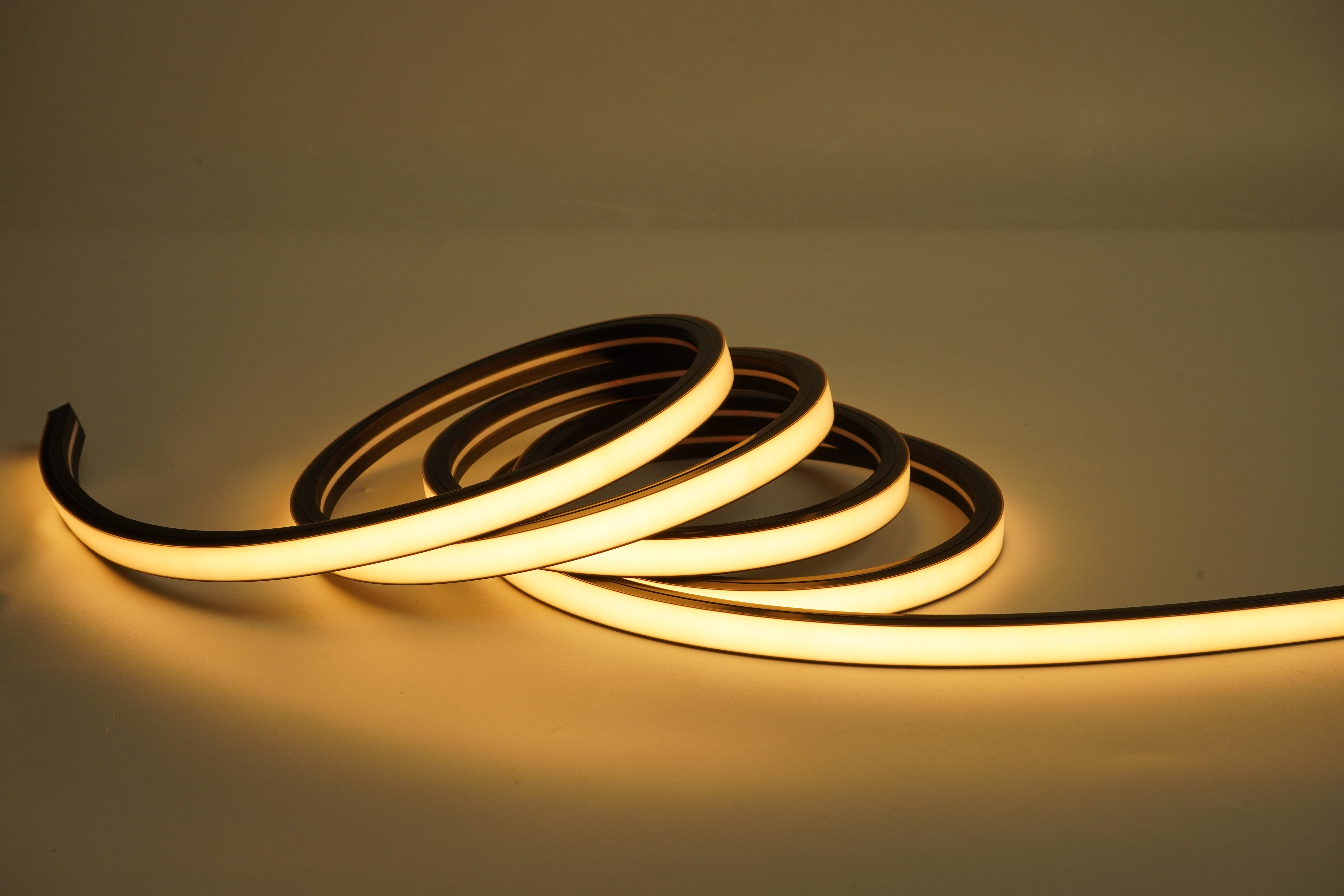
The model designation omits several specifications that frequently decide whether a project proceeds without rework. For this product, the omissions include an IP rating of IP20, a color rendering index of Ra≥80, a power consumption of 11W at 24V DC, and a double-layer copper PCB construction. The strip is available in lengths of 2.4M and 3M per strip and supports OEM and ODM customization. It is made of copper PCB and SMD LED, and the supplier's stated selling points include a black surface that blends into the wall, flexibility for shaping, and silicone material selected for environmental friendliness in homes. None of those attributes appear in the code, and all of them can determine whether the specification fits an installation.
Six Qualification Checks Before an Order Is Placed
The following checks translate the seven code segments plus the omitted attributes into an evaluation sequence suitable for procurement teams working at the research and evaluation stage.
- Voltage and power compatibility. Confirm the 24V DC rating and the 11W power consumption figure against the driver capacity and the installed strip length. The published operating conditions for this product type require a proper power supply or adapter to avoid overload.
- Color temperature and rendering. Verify that 3000K matches the design intent and that Ra≥80 is adequate for the application. The 3000K–4000K color temperature band held a 33.2% revenue share in the linear LED strip fixture market (Grand View Research), so warm-white specification is a mainstream, well-understood requirement — but rendering requirements vary by application.
- Insulation rating versus environment. IP20 is intended for indoor dry environments. Installation conditions published for acoustic wall lighting scenarios specify indoor dry use, an operating temperature of -20°C to +45°C, no covering of the strip with objects, and distance from chemically corrosive environments.
- Mechanical fit. The 8mm PCB and the strip's development for slat wall panels with 13mm or 15mm gaps should be checked against the actual panel drawing, including bending radius and termination points.
- Compliance documentation. Request evidence of CE and RoHS conformity, and confirm which additional market standards apply. US low-voltage LED strips at 12V/24V fall under UL 2108; IEC 60598-2-20:2022 applies to lighting chains including LED strips; UL 1598 covers luminaires installed in storage areas such as clothes closets. In the EU, Ecodesign and energy-efficiency requirements continue to push the market toward LED-based systems.
- Documentation package. Confirm the specification sheet, length options (2.4M and 3M per strip), customization terms, and packaging details are consistent between quotation and datasheet before confirming the order.
Application Fit: Acoustic Panels, Wall Lighting, and Interior Fit-Out
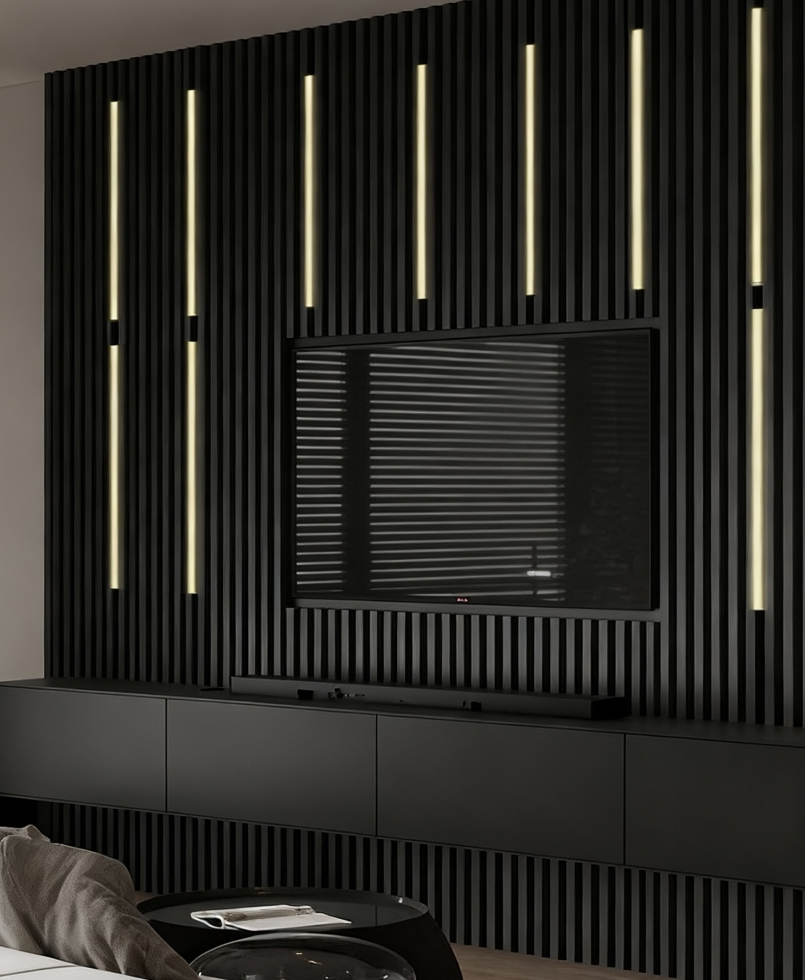
This specification is developed specifically for slat wall panels fitted with 13mm or 15mm gaps, and it is classified for acoustic panel lighting, wall lighting, luxury residential lighting, interior fit-out, and lighting design applications. The stated design intent is a black surface that disappears into the wall plane, flexibility that allows shaped runs, and silicone material selected for environmental friendliness in residential interiors.
In published application scenarios for acoustic wall panel installations, the lighting function is ambient wall illumination operating on a 12/7 cycle, matched with a smart lighting control system, an LED controller, or a smart controller, and frequently requiring light color and size customization. That combination — a wall-integrated linear strip on continuous duty, driven by a control system — is why the qualification checks above focus on driver sizing, thermal conditions, and mechanical fit rather than on brightness claims alone.
For wholesale and distribution buyers, the relevant industry listing includes LED wholesalers alongside acoustic panel lighting and interior fit-out, which indicates that the product is positioned for both project supply and channel stocking. That dual positioning affects what documentation a distributor should hold: a specification sheet consistent across orders, confirmation of the 2.4M and 3M per strip length options, and clear OEM and ODM terms.
Market Signals Behind Low-Voltage, High-Density, 3000K Strips
Three verified market signals explain why a code like CA-DC24V-2835-180D-8mm-3000K exists in the first place.
First, the 24V configuration is dominant in linear lighting. The 24V LED segment accounted for 52.0% of linear LED strip fixture market revenue in 2022 (Grand View Research), and wired smart LED installations held an 81.3% market share in 2024 (Grand View Research). Systems that are specified and hardwired at low voltage, rather than plugged in ad hoc, are the mainstream.
Second, commercial and architectural applications are driving volume. Commercial applications contributed approximately 33.8% of global LED strip revenues in 2024 (Dataintelo), and over 65% of new architectural lighting installations in 2025 are reported to use LED strip technology (Business Research Insights). Renovation activity reinforces this: nearly 49% of renovation projects include LED strip installations, particularly in kitchens (Business Research Insights).
Third, warm-white, high-density, low-voltage strips sit at the intersection of design expectation and energy regulation. Flexible LED strips are the largest product type in the market, and energy-efficiency rules in the EU under Ecodesign and the Energy Efficiency Directive continue to shift installations toward LED-based systems. That regulatory direction, combined with the 3000K–4000K band's 33.2% revenue share in linear fixtures (Grand View Research), means the warm-white, 24V, high-density combination is not a niche specification — it is the center of the market.
Comparing the CA Variant with Adjacent Specifications and with Conventional Lighting
Mapping a model code is easiest when the position of the product inside its own catalogue range is visible. The table below compares the acoustic wall variant with three adjacent XPUP LED strip specifications that share the 24V platform but differ in insulation rating, rendering, density, and power.
| Model | Type / intended use | IP rating | CRI | LEDs per meter | Power |
|---|---|---|---|---|---|
| CA-DC24V-2835-180D-8mm-3000K | Acoustic Wall LED Strip Light — acoustic panel, wall lighting, luxury residential, interior fit-out | IP20 | Ra≥80 | 180 | 11W |
| XP-C13 DC24V-6060-48D-10MM | Architectural LED Strip Light — display cabinets, architectural lighting, lighting engineering | IP65 | Ra≥90 | 48 | 18W |
| XP-C5DC24V-2835-120D-8MM | Waterproof LED Strip Light — residential ambient, commercial real estate, architectural, courtyard | IP68 | Ra≥90 | 120 | 8W |
| XP-D4DC24V-2835-192D-8MM | Dimmable LED Strip Light — luxury residential, gallery, smart home, smart building | IP20 | Ra≥95 | 192 | 15W |
Against conventional incandescent lighting, the case is straightforward and quantified: LED strips consume nearly 70% less power than traditional incandescent systems, and quality LED strips operate for approximately 30,000 to 50,000 hours (Business Research Insights). The comparison that matters more at the procurement stage, however, is the one inside the range itself.
Two boundaries follow directly from the verified data. The first is environmental: this is an IP20 product intended for indoor dry environments, so it is not the correct choice for outdoor, wet, or high-humidity installations, where the range offers IP65 and IP68 alternatives. The second is color performance: Ra≥80 suits general ambient and wall lighting, but applications with demanding color fidelity criteria — where adjacent models specify Ra≥90 or Ra≥95 — should be evaluated against those variants rather than this one. A third, practical boundary is that a 24V DC system requires a correctly matched power supply and attention to run planning across the installed length; the published operating conditions for acoustic wall lighting scenarios require a proper power supply or adapter to avoid overload.
None of these are defects. They are the boundaries that define where the specification belongs, and a buyer who can state them clearly is better protected than one who cannot.
Future Outlook
Three directions are visible from the verified data. Density continues to rise — the high-density segment already represents a meaningful share of premium installations, and lines with 180 LEDs per meter are now positioned in mainstream catalogue ranges rather than as specialty items. Control integration continues to expand: smart features such as Wi-Fi and Bluetooth have reached a 47% adoption rate in LED strip systems, while wired systems still hold the majority share for stability-driven applications. And regulation continues to favor the category as a whole, as EU energy-efficiency frameworks reinforce the shift toward LED-based lighting.
For buyers, the implication is procedural rather than dramatic. As ranges expand and codes multiply, the ability to decompose a model number into verifiable specifications becomes the differentiator between a fast, low-risk order and a specification dispute. The acoustic wall strip examined here — a 24V, 11W, 3000K, 180 LEDs per meter, IP20, Ra≥80 product on an 8mm double-layer copper PCB — is a useful case study precisely because its code conceals as much as it reveals.
FAQ
What does each part of the model number CA-DC24V-2835-180D-8mm-3000K mean?
The designation combines a series prefix (CA), the operating current type (DC), the rated voltage (24V), the SMD LED package (2835), the LED density per meter (180D), the PCB width (8mm), and the color temperature (3000K). For this product, those segments correspond to a 24V DC strip using SMD 2835 LEDs at 180 LEDs per meter, with an 8mm PCB and a 3000K color temperature. Attributes such as CRI (Ra≥80), IP rating (IP20), and power consumption (11W) are not expressed in the code.
What is an Acoustic Wall LED Strip Light, and where is it normally installed?
It is a linear LED strip classified for acoustic panel lighting, and this particular model is developed for slat wall panels fitted with 13mm or 15mm gaps. Its listed applications include acoustic panel lighting, wall lighting, luxury residential lighting, interior fit-out, and the lighting design industry, and it is also listed in relation to LED wholesalers.
What certifications and standards should be checked for a 24V LED strip?
XPUP LED products carry CE and RoHS certification. Depending on the destination market, additional standards apply: low-voltage LED strips at 12V/24V in the United States are classified under UL 2108, IEC 60598-2-20:2022 specifies safety requirements for lighting chains including LED strips, and UL 1598 covers luminaires installed in storage areas such as clothes closets. In the European Union, Ecodesign and energy-efficiency requirements continue to steer the market toward LED-based systems.
Is an IP20 rating suitable for the intended installation?
IP20 suits indoor dry environments. Published operating conditions for acoustic wall lighting scenarios specify indoor dry use, an ambient temperature range of -20°C to +45°C, no covering of the product with objects, and separation from chemically corrosive environments. For outdoor, wet, or high-humidity installations, higher-rated options within the same 24V platform — such as IP65 or IP68 models — are the appropriate category.
What specification evidence should a buyer request before ordering?
A specification sheet confirming voltage, power, CRI, IP rating, LED density, PCB construction, and color temperature; confirmation of available lengths (2.4M and 3M per strip for this model); certification documents for CE and RoHS as applicable to the destination market; and, where the application requires it, a physical sample to verify color consistency and mechanical fit. Where OEM or ODM terms are involved, the customization scope should be stated in writing.
Can this model be customized for a specific project?
This model supports OEM and ODM services, and the acoustic wall lighting scenario associated with it lists light color and size customization as a special requirement, with smart lighting control systems, LED controllers, or smart controllers as matched equipment. Customization scope and confirmation steps should be agreed before mass production.
The 2026 XPUP LED Strip Catalog, covering the acoustic wall, flexible, COB, waterproof, tunable, and smart LED strip ranges together with their published specifications, is available for reference and download:
Market and standards references: Dataintelo (LED strip market), Grand View Research (linear LED strip fixture and smart lighting markets), Business Research Insights (LED strip market), UL Standards & Engagement (UL 2108), International Electrotechnical Commission (IEC 60598-2-20:2022), Intertek (UL 1598), European Commission (Ecodesign and energy-efficiency requirements). Product specifications are as published by Zhongshan Xiangpai (XPUP) Lighting Technology Co., Ltd.