
Decoding Cash Drawer Compliance: Three-Position Locks and RJ11/RJ12 Interface Standards in the LAS Series
Decoding Cash Drawer Compliance: Three-Position Locks and RJ11/RJ12 Interface Standards in the LAS Series
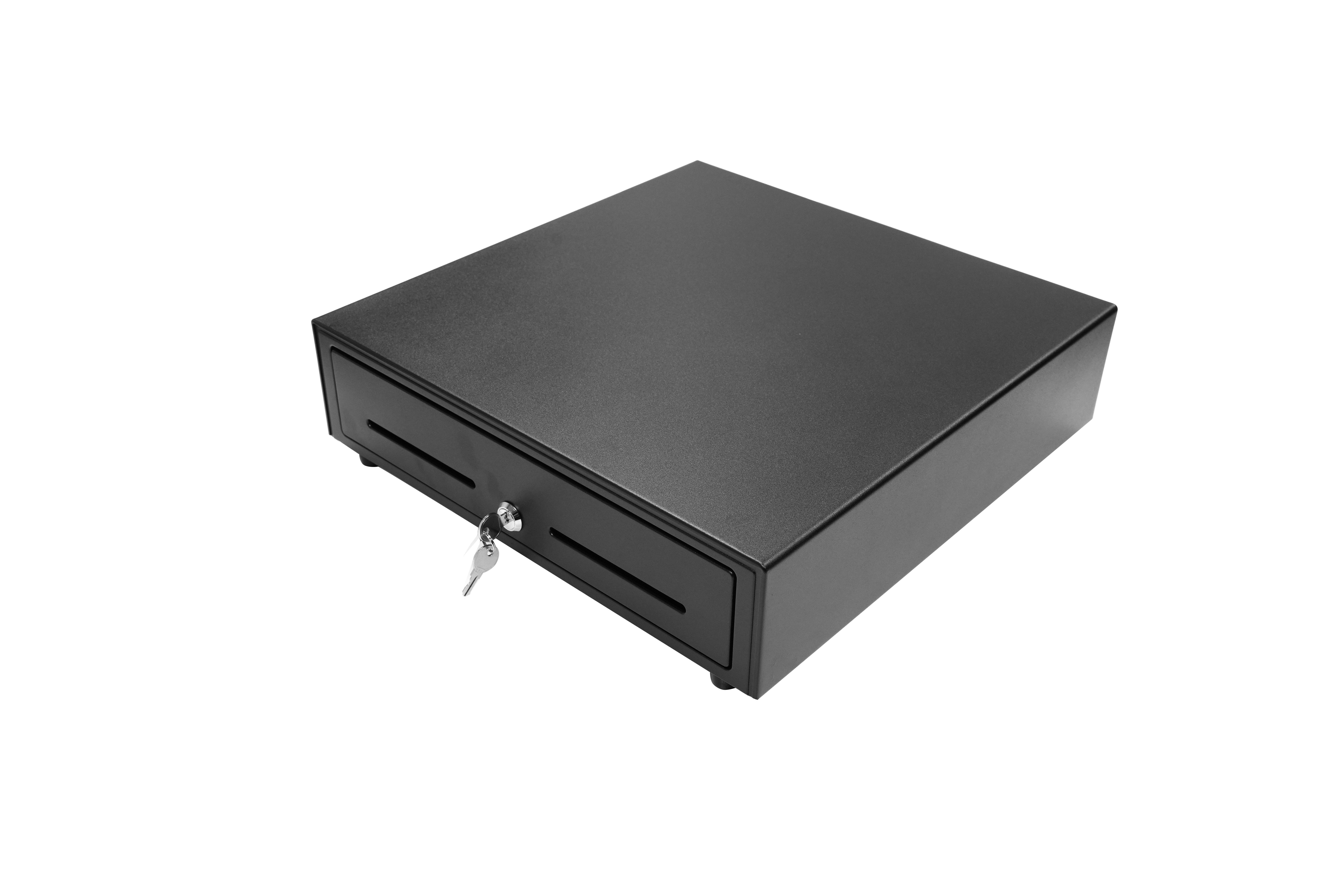
LAS-410A heavy duty cash drawer — one of five LAS models that share the same three-position key lock and the same 12V/24V RJ11/RJ12 receipt printer interface.
Cash drawer compliance is usually framed as a certification question — CE, RoHS, FCC — yet the failures that actually interrupt a checkout lane rarely trace back to a missing certificate. They trace back to a lock that behaves differently on every shift, or a drawer interface that does not match the receipt printer it is wired to. In multi-site POS projects, two specifications decide whether drawers can be deployed consistently: the key lock and the printer interface. Across the LASPACK LAS series, both are standardized across all five models.
Why Lock and Interface Specifications Are the Real Compliance Baseline
A POS cash drawer is never a standalone product. It is triggered by the receipt printer, opened by staff dozens of times per shift, and reconciled against the store's cash-handling procedure. Three questions therefore have to be answered before a purchase order is issued.
- Who can open the drawer, and in which mechanical state?
- What electrical signal and connector does the drawer accept?
- Does the same specification hold for every drawer model in the order?
The third question causes the most friction in practice. When a project mixes drawer models with different lock types or different connectors, the standard operating procedure has to fork: separate key policies, separate spare parts, separate training, and a reconciliation routine that must first identify which drawer it is dealing with. Standardization removes that fork. It is less a product feature than a deployment requirement, and it is the reason lock type and interface type deserve to be evaluated at specification level rather than treated as incidental details behind price and dimensions.
The LAS Series: One Lock and One Interface Across Five Models
Zhangjiagang Laspack Technology Co., Ltd. (LASPACK) is a cash drawer and cash box manufacturer based in Zhangjiagang City, Suzhou, Jiangsu Province, China. Founded in 2013, the company operates a 4,200 m² manufacturing facility with 50 employees, an annual output of 400,000 units and a 10-engineer R&D team, exporting approximately 70% of its production to markets worldwide.
The LAS series covers five models — LAS-335, LAS-405, LAS-410G, LAS-410A and LAS-4042. They differ in size, weight, currency layout and panel construction, but not in lock or interface type. Every model is specified with a three-position key lock and a 12V/24V interface for RJ11/RJ12 receipt printer connection, and every model is offered in black, white or customized color, in metal and plastic construction, for retail, restaurant, supermarket, hospitality and POS & retail technology environments.
| Model | Type | Dimensions (W×L×H) | Net / Gross Weight | Currency Layout | Key Lock | Interface |
|---|---|---|---|---|---|---|
| LAS-335 | Metal cash drawer | 335×368×80 mm | 3.4 kg / 3.8 kg | 4 bills, 3/5 coins | Three-position lock | 12V, 24V for RJ11/RJ12 receipt printer interface |
| LAS-405 | Heavy duty cash drawer | 405×420×100 mm | 4.5 kg / 5 kg | 5 bills, 6 coins | Three-position lock | 12V, 24V for RJ11/RJ12 receipt printer interface |
| LAS-410G | Heavy duty cash drawer, steel panel | 410×415×100 mm | 5.6 kg / 6.2 kg | 5 bills, 8 coins | Three-position lock | 12V, 24V for RJ11/RJ12 receipt printer interface |
| LAS-410A | Heavy duty cash drawer, steel panel | 410×415×100 mm | 6.5 kg / 7 kg | 5 bills, 8 coins | Three-position lock | 12V, 24V for RJ11/RJ12 receipt printer interface |
| LAS-4042 | Durable drawer with adjustable coin and bill compartment | 405×420×100 mm | 4.5 kg / 5 kg | 6 bills, 4 coins | Three-position lock | 12V, 24V for RJ11/RJ12 receipt printer interface |
LAS series lock and interface specification across five models (source: LASPACK product data).
One dimension is worth reading carefully. Industry guidance commonly cites 410 mm (16 inches) as the standard drawer width for placement beneath a thermal receipt printer. The LAS-410G and LAS-410A match that width exactly, while the LAS-405 and LAS-4042 measure 405 mm and the compact LAS-335 measures 335 mm. Buyers matching a drawer to an existing counter cut-out or printer stand should verify the physical footprint against the actual terminal layout rather than assume a nominal standard applies.
What a Three-Position Key Lock Changes in Daily Cash Handling
All five LAS models share a three-position key lock, and the specification is more consequential than it first appears. A conventional drawer or cash box lock presents a locked or unlocked state. A three-position lock gives staff distinct mechanical states instead; commonly these cover a secured position, an operating position in which the drawer can be opened, and a position that releases the latch for extended access such as loading, counting or service.
Because position semantics are defined by each manufacturer rather than by a single global standard, buyers should confirm three points with their supplier before writing a procedure around the lock: what each key position does, how many keys ship with each unit, and how key custody is transferred between shifts. Those details determine whether the lock functions as a genuine control or simply appears as a hardware line item on a packing list.
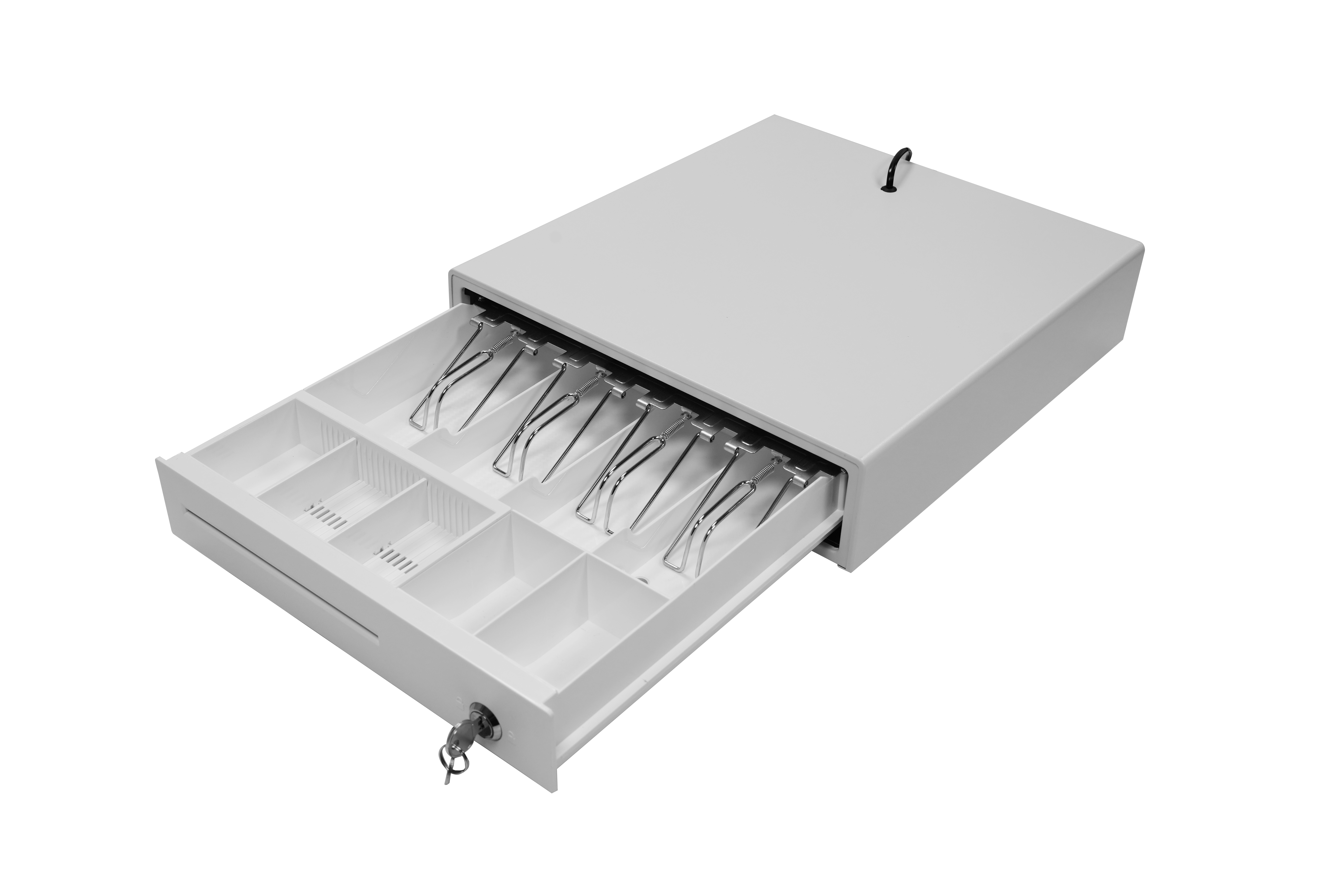
LAS-335 metal cash drawer — a compact 335×368×80 mm footprint carrying the same three-position key lock and RJ11/RJ12 interface as the larger LAS models.
It is also worth separating the two layers of control that operate in a POS lane. The mechanical layer is the lock, which governs physical access when the terminal is idle. The transactional layer is the POS software, which determines when the drawer is triggered during a sale. A three-position lock complements that software layer; it does not replace it, and it does not by itself create a record of who opened the drawer.
Interface Standards: 12V, 24V and the RJ11/RJ12 Receipt Printer Connection
Every LAS model carries the same interface specification: 12V and 24V support on an RJ11/RJ12 receipt printer interface. Supporting both voltage classes on one connector type means a single drawer specification can be deployed across POS estates where receipt printers and terminals do not all operate at the same drawer-kick voltage — a common situation in multi-site rollouts where hardware is procured in phases and drawn from more than one supplier.
The RJ11/RJ12 connection is the drawer-kick port found on receipt printers, and it is what allows the drawer to open as part of the transaction rather than through a separate key action. LASPACK's application data for the series describes the operating mode as manual or automatic, lists cash registers, POS terminals and receipt printers as matched equipment, and states compatibility with all major POS software.
For a buyer, the interface check reduces to three points: the trigger output of the printer or terminal, the voltage it supplies, and the connector it uses. The LAS series covers 12V and 24V on RJ11/RJ12. If a terminal does not expose a drawer-kick output, that trigger path should be confirmed with the supplier before ordering rather than inferred from the presence of a cash drawer port in a product description.
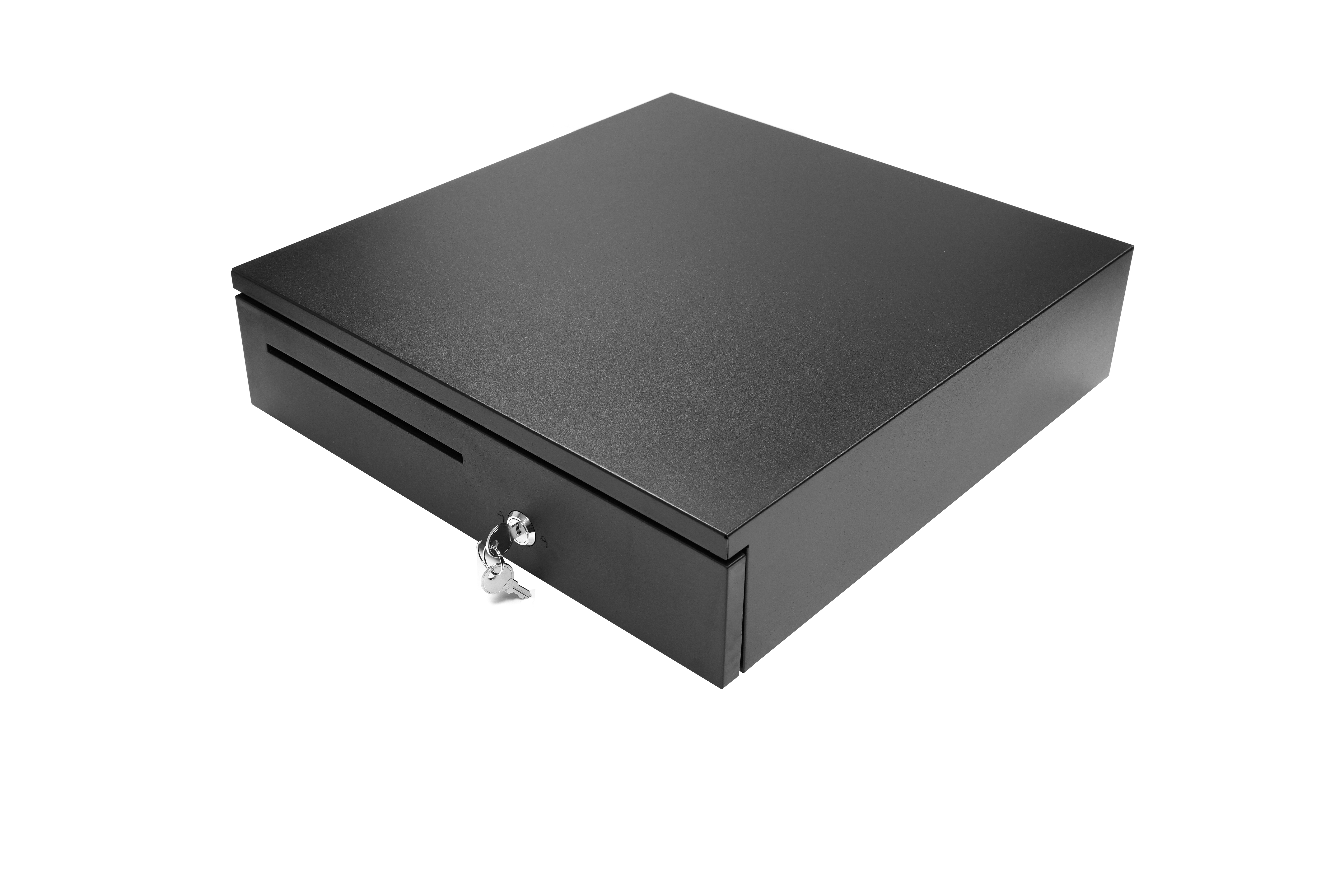
LAS-405 heavy duty cash drawer — 405×420×100 mm with a 5-bill, 6-coin layout and the series-standard three-position lock and 12V/24V RJ11/RJ12 interface.
Where the Specification Matters: Retail, Restaurant, Supermarket and Hospitality
LASPACK specifies the LAS series for retail, restaurant, supermarket, hospitality and POS & retail technology environments, for commercial indoor use, in a cash storage and management role within a POS system, matched to cash registers, POS terminals and receipt printers. Within that footprint, model selection is driven by counter space and currency mix rather than by lock or interface, which remain constant across the range.
The compact LAS-335 suits limited counter space and lower cash volumes. LAS-405 and LAS-4042 fit mid-size checkout positions, with the LAS-4042 specified as a durable drawer with an adjustable coin and bill compartment and a 6-bill, 4-coin layout. LAS-410G and LAS-410A serve the wide, high-volume positions, both with 5-bill, 8-coin layouts and steel panels, at 5.6 kg and 6.5 kg net weight respectively; the weight difference between the two reflects internal build rather than any difference in lock or interface.
Deployment experience supports the standardization argument. In Indonesia, an OEM cash drawer client has operated LASPACK drawers for five years across a deployment of 50,000 units used for secure cash storage and POS system integration in retail and hospitality environments. The reported outcomes are stable operation and a smooth checkout process; highlights cited for that deployment include the high-sensitivity solenoid, durable steel structure and POS system compatibility.
Market Signals Behind Standardized Drawer Interfaces
Market data gives context for why a standardized interface has moved from convenience to baseline. The global cash drawer market was valued at approximately USD 0.855 billion to USD 0.96 billion in 2024–2025, according to the Dataintelo / Global POS Cash Drawer Market Report, and is projected to reach between USD 1.23 billion and USD 1.7 billion by 2033–2034, a CAGR of approximately 4.1% to 4.2%. Asia Pacific holds the largest regional revenue share, at approximately 38.2% in 2025, and electronic cash drawers account for approximately 62.5% of total market revenue.
The 62.5% figure matters most for interface planning: the electrically triggered drawer is the dominant product type, not a premium variant. For recognized manufacturers in the category — including APG Cash Drawer, Star Micronics, M-S Cash Drawer, Posiflex and NCR Corporation — drawer-kick interfaces are part of the standard product language, which pushes buyers toward evaluating interface compatibility rather than treating it as an afterthought to enclosure specifications.
Durability ratings provide a separate benchmark. Industry references distinguish Standard Duty drawers rated for 1 million cycles from Heavy Duty drawers rated for 4 million or more cycles. LASPACK's published figures state that its cash drawers are certified for 1,000,000 cycles and hold CE (M2506016AY-C0127), RoHS (M2506016AY-C0128) and FCC certifications.
How the LAS Series Compares with Traditional Cash Handling Setups
| Dimension | Traditional key-operated cash box / single-position drawer | LASPACK LAS series |
|---|---|---|
| Lock control | Locked or unlocked state; every access is key-based | Three-position key lock covering secured, operating and release states |
| Opening during a sale | Manual key operation adds a step to every transaction | Triggered through the receipt printer interface as part of the transaction, with manual operation also available |
| Interface | Typically no standardized printer interface on standalone cash boxes | 12V, 24V for RJ11/RJ12 receipt printer interface on all five models |
| Consistency across an order | Mixed lock and connector types require separate procedures and spares | Uniform lock and interface specification across LAS-335, LAS-405, LAS-410G, LAS-410A and LAS-4042 |
| Durability documentation | Frequently undocumented | 1,000,000-cycle durability test, with CE, RoHS and FCC certification |
| Access record | Depends on manual procedure | Depends on POS software and cash-handling procedure; the lock itself does not log access |
Two boundaries are worth stating plainly, because they affect how a project should be planned.
Durability tier. The certified cycle figure published for LASPACK cash drawers — 1,000,000 cycles — sits at the industry's standard-duty tier, while the heavy-duty tier in the same industry reference begins at 4 million cycles. Several LAS models are described in LASPACK's product data as heavy duty cash drawers; that description refers to build, panel and structure, whereas the comparable and testable metric across suppliers is the published cycle rating. Buyers running exceptionally high transaction counts on a single drawer position should account for that distinction in replacement planning.
Mechanical lock versus audit log. A three-position key lock controls physical access to cash; it does not generate an electronic access record. Reconciliation depends on the POS software and the store's cash-handling procedure, which is why the lock specification and the software configuration should be documented together. A POS cash drawer is also not a security safe — it is a transactional device designed to open frequently during a shift, and cash that does not need to remain in circulation is normally handled through a separate control.
A third, quieter boundary is currency layout. The compact LAS-335 carries a 4-bill, 3/5-coin layout, which fits low-denomination markets and small counters but will not suit markets where a checkout position regularly holds eight coin denominations. Layout, not lock type, is usually the reason a specific model is ruled out of a shortlist.
A Buyer's Verification Checklist Before Ordering
- Lock type: confirm the three-position key lock, the definition of each position, and the key custody policy in writing.
- Interface: confirm 12V and 24V support on RJ11/RJ12 and match it to the printer's drawer-kick output.
- Connector: verify the physical connector on the printer or terminal, not only the voltage class.
- Footprint: check width, length and height against the counter cut-out; the 410 mm models follow the common 16-inch placement width, while other LAS models measure 335 mm or 405 mm.
- Currency layout: match bill and coin positions to the market's denomination mix.
- Durability rating: compare published cycle ratings, not category labels, across the suppliers on the shortlist.
- Certification file: record CE, RoHS and FCC documentation together with the certificate references.
- Customization deltas: where voltage or logo customization is requested, record which specification elements change so the compliance file stays accurate.
LASPACK's manufacturing capability relevant to this checklist includes OEM/ODM production with voltage and logo customization, a monthly capacity of 40,000 pieces, a lead time of 10–15 days, an MOQ of 100 pieces and 100% testing, supported by after-sales warranty, remote support and technical guidance.
Future Outlook
Two trends are likely to shape drawer procurement over the next cycle. The first is volume and geography: with the market projected to grow at approximately 4.1% to 4.2% annually toward USD 1.23–1.7 billion by 2033–2034, and with Asia Pacific already holding roughly 38.2% of revenue, drawer orders will increasingly be multi-model and multi-country. That raises the cost of any specification that varies between models in the same order. The second is that electronic cash drawers already represent approximately 62.5% of market revenue, so the interface, rather than the enclosure, becomes the part of the specification most likely to be checked first.
For buyers, the practical implication is that compliance review is expanding upstream. Certificates and cycle ratings still matter, but the questions that decide whether a drawer order can be deployed are about lock behavior, key custody, voltage support and connector type. Series-level standardization, as applied across the LAS range, is one way to keep those answers identical from the smallest counter to the largest checkout lane.
FAQ
Do all models in the LAS series use the same key lock and interface?
Yes. LASPACK specifies a three-position key lock and a 12V/24V interface for RJ11/RJ12 receipt printer connection across the LAS-335, LAS-405, LAS-410G, LAS-410A and LAS-4042 cash drawers. The models differ in dimensions, weight, currency layout and panel construction rather than in lock or interface type, so a mixed order across the series does not require different key standards or different wiring standards.
What distinguishes a three-position key lock from a standard drawer lock?
A standard drawer lock usually presents a locked or unlocked state. A three-position key lock adds an intermediate mechanical state, which is why it is specified across the entire LAS series; in practical terms, the drawer can be secured, operated, or released for loading without any change to the lock hardware. Because the meaning of each position is defined by the manufacturer, buyers should confirm the position definitions with their supplier before writing them into a cash-handling procedure.
Can a 12V POS setup run a drawer specified for 24V?
The LAS series drawers are specified for both 12V and 24V on the same RJ11/RJ12 receipt printer interface, so the drawer specification itself covers both voltage classes. In a live installation the voltage is determined by the receipt printer or host that supplies the drawer-kick signal, so the buyer's check is whether the printer's output matches the drawer's rated input. Confirming the printer's drawer-kick voltage and connector type belongs in the technical evaluation rather than in post-installation troubleshooting.
Is the LAS-335 suitable for the same projects as the LAS-410A?
Both models share the same three-position key lock and the same RJ11/RJ12 interface, but they serve different footprints and cash volumes. The LAS-335 is a 335×368×80 mm drawer weighing 3.4 kg net with a 4-bill, 3/5-coin layout, while the LAS-410A is a 410×415×100 mm heavy duty unit weighing 6.5 kg net with a 5-bill, 8-coin layout and a steel panel. Limited counter space and lower cash volumes suit the LAS-335; higher-volume, higher-value positions suit the larger models.
How can a buyer verify drawer-to-POS compatibility before placing an order?
Verification rests on three data points: the drawer-kick output voltage of the printer, the connector type on the printer or terminal, and the drawer's specified interface. LASPACK specifies 12V and 24V support on an RJ11/RJ12 receipt printer interface across the LAS series, lists cash registers, POS terminals and receipt printers as matched equipment, and states compatibility with all major POS software. Where a terminal does not expose a drawer-kick output, the trigger path should be confirmed with the supplier before ordering rather than assumed.
Does an OEM order change the compliance specification of a LASPACK cash drawer?
LASPACK's customization scope covers voltage and logo, and the company states that production undergoes 100% testing, with an MOQ of 100 pieces and a lead time of 10–15 days for OEM/ODM work. The base compliance position for LASPACK cash drawers includes CE, RoHS and FCC certification and a 1,000,000-cycle durability test. Buyers placing customized orders should record which specification elements deviate from the standard so that the compliance file remains accurate and auditable.
For model-level specifications covering the LAS-335, LAS-405, LAS-410G, LAS-410A and LAS-4042, including the lock and interface data referenced in this article, LASPACK publishes a downloadable product brochure: LASPACK product brochure (PDF).