
Decoding Compliance: CE, FCC, RoHS, CCC and ISO Certificates for Rollable LED Displays
Decoding Compliance: CE, FCC, RoHS, CCC and ISO Certificates for Rollable LED Displays
A certificate is not a performance claim. It is a record that one defined product configuration was tested against one defined standard by one defined testing body. For a rollable LED display, that record is what allows a screen to clear customs, satisfy a venue's technical review and enter service without dispute. This reference explains what CE, FCC, RoHS, CCC and ISO documentation actually covers on rollable and foldable LED screens, and how buyers can verify each claim against the certificate numbers a supplier publishes.
Onumen Technology Co., Ltd. is a Shenzhen-based manufacturer founded in 2009 that develops lightweight foldable and rollable LED display systems, including automatic rolling screens, 360° foldable panels, transparent foldable panels and mobile quick-assembly units. Its documentation is used throughout this article as a worked example, because it demonstrates a pattern that buyers frequently misread: different product families carry different certificate numbers, and the reason has nothing to do with marketing hierarchy.
Why the compliance file decides the second half of a rollable LED screen purchase
Buyers in the evaluation stage compare pitch, brightness, weight and structure. Buyers in the execution stage compare documents. Once a purchase order is issued, the certificate file becomes the binding artefact: the file a customs broker reads, the document a venue's technical manager requests before approving rigging, and the evidence a project owner retains after handover.
Category scale is one reason compliance has become a procurement function rather than a formality. The global flexible display market, which includes rollable form factors, was valued at approximately USD 20.1B to USD 21.6B in 2024 according to Grand View Research and Spherical Insights, whose estimates differ because their scopes differ. The rollable and foldable segment specifically has been projected to grow from USD 5.1B in 2024 to nearly USD 60B by 2035 in a Meticulous Research forecast circulated through openPR. These figures rest on different measurement bases rather than competing claims, and they are best read as evidence of category scale rather than as a single consolidated market number.
Growth of that order brings a corresponding growth in the number of suppliers, and in the number of certificate claims they make. A certificate number either resolves to a real document with a model list, or it does not. That is the entire test, and it can be applied at any point between supplier shortlisting and final payment.
How to read an LED display certificate: five checks
Compliance claims are verified the same way regardless of the supplier or the market. Five items determine whether a certificate is relevant to a specific purchase order.
- Certificate number. The number must resolve to a document issued by a named testing laboratory or certification body. A mark or logo without a number is not verifiable.
- Applicant and manufacturer legal name. The named entity should match the company you contract with, not a trading alias or an unrelated affiliate.
- Product model list. The models covered by the certificate must include the exact family, pixel pitch and indoor or outdoor variant you are ordering.
- Standard and test method. Documents should cite the standard applied, for example IEC 62321:2008 for RoHS substance testing or FCC Part 15 Subpart B for US emissions.
- Issuing body, issue date and validity. An expired or superseded certificate with a matching number is still a procurement problem.
Underlying all five is a structural rule that buyers often miss: certificates are issued for a specific product construction, not for a brand. A rolling screen built around a 500 × 62.5 mm module with an indoor rating of front IP54 and rear IP43 is a different tested object from a 360° foldable panel built around 250 × 375 mm modules with IP65 front and rear protection. That difference in construction is precisely why the two Onumen families discussed below carry different CE numbers.
Which compliance instruments are mandatory in the EU, the US and China
Mandatory requirements follow the destination market rather than the product category. The same rollable LED screen shipped into Germany, California and Guangdong is regulated by three different frameworks, and no single certificate covers all three.
| Market or level | Instrument | What it addresses | What the buyer must confirm |
|---|---|---|---|
| European Union | CE marking, covering EMC and low-voltage safety and supported by RoHS conformity | Electromagnetic compatibility, electrical safety, restricted substances | The certificate model list, the standards cited and a signed Declaration of Conformity |
| United States | FCC Part 15 Subpart B | Emissions from unintentional radiators | Which equipment class is documented and whether it matches the installation environment |
| China | CCC certificate, for products inside the compulsory certification catalogue | Safety and electromagnetic compatibility under China's compulsory certification system | The CCC certificate number and the exact models it covers |
| EU and China | RoHS substance restrictions | Restricted heavy metals, brominated flame retardants and phthalates in electrotechnical products | The test standard applied; Onumen's RoHS documentation references IEC 62321:2008 |
| North America, site level | UL 62368-1 and UL 94 V-0 | Electrical safety and fire resistance for LED screens installed in public spaces such as airports and theatres | Whether the venue or the authority having jurisdiction requires them in addition to FCC compliance |
| Supplier level | ISO management system certificates | The organisation's processes across design, production, inspection and service | Certificate number, issuing body, scope and validity period |
Two clarifications matter here. First, RoHS is a substance restriction that sits alongside market-access marking; it is not an alternative to it. Second, ISO management system certification is not a market-access requirement, but it is frequently decisive in supplier qualification because it describes the organisation behind the product rather than the product itself.
CE: EMC and LVD on rollable LED displays
CE marking is a manufacturer's declaration of conformity supported by test evidence. For an LED display, the technical file typically resolves into electromagnetic compatibility, electrical safety for equipment operating within the low-voltage range, and restriction of hazardous substances. Declarations are made per product family, so the reference numbers differ across a manufacturer's range.
Two CE numbers, two families. Onumen's CE documentation includes the certificate numbers AE 50336727 0001 and BST13030465Y-1SC-2. The Smart Plus (FCSL) family, a 360° foldable flexible display with IP65 front and rear protection and an optional IP68 configuration, is documented under CE certificate AE 50336727 0001. The Rolling FRL/FRSL automatic rollable display, offered in indoor configurations from P1.25 to P3.9 and outdoor configurations at P2.6 and P3.9, is documented under a different CE LVD certificate, BST13030465Y-1SC-2.
The divergence is technical rather than commercial. The two families differ in module geometry, mechanical construction, sealing design and thermal behaviour: FCSL uses a 250 × 375 mm module with IP65 front and rear protection, while FRL/FRSL uses a 500 × 62.5 mm module with indoor protection of front IP54 and rear IP43, or outdoor protection of IP65 on both faces. Both accept AC100–240V input and operate on DC24V or DC48V working voltage, but the internal distribution and enclosure design of a foldable panel and a motorised rolling panel are not interchangeable. A safety assessment follows those differences, so the certificates that cover them do not share a single number.
For buyers, the practical consequence is narrow and useful. When a supplier states that its screens are CE certified, request the model list attached to the certificate number. If the pitch, the indoor or outdoor variant, or the rear protection design you are ordering does not appear on that list, the certificate does not cover your order, and the gap will surface during customs clearance or venue approval rather than during a sales conversation.
FCC Part 15 Subpart B: the US emissions requirement
FCC Part 15 Subpart B sets limits on radio-frequency emissions from unintentional radiators, which is the category that covers digital display equipment. The rules distinguish between equipment intended for commercial or industrial environments and equipment intended for residential environments, and the two classes carry different limits. A screen specified for a corporate showroom, a hotel ballroom or a stadium concourse sits in a different evaluation context from a screen specified for close-quarters residential use.
Onumen's product documentation lists CE, RoHS and FCC at series level for the Smart folding FC series, the Rolling FRL/FRSL series, the Smart Plus FCSL series, the Smart T Plus FTS series and the Easy Sailing EP150–EP225 and EP250–EP400 series. The series sheets state the certification set rather than the individual certificate number, which is normal for a specification sheet but insufficient for a purchase order. The number has to come from the certificate pack.
The boundary of this certificate is equally important. FCC Part 15 Subpart B addresses emissions. It does not address electrical safety, fire performance or mechanical structure. In North America, LED screens installed in public spaces are commonly expected to demonstrate compliance with UL 62368-1 for electrical safety and UL 94 V-0 for fire resistance, and those are separate documents. A buyer who assumes that an FCC report alone qualifies a screen for an airport or theatre installation is likely to discover the gap late in the project. Request confirmation of the documented equipment class, and keep the test report in the installation file alongside the site drawings.
RoHS and IEC 62321:2008: substance control across the material stack
Onumen's RoHS documentation includes certificate number BST11030273Y-1EC-1, issued with testing to IEC 62321:2008. IEC 62321 is the standardised method family for determining restricted substances in electrotechnical products, so citing it tells the buyer how the measurement was performed, not merely that a conclusion was reached.
That distinction matters more for rollable displays than for conventional cabinets, because a rollable screen is materially complex. Across the range, the construction draws on engineering plastic, metal hardware, aluminium alloy structure, flexible PCB and silicone material, with transparent material added in the Smart T Plus FTS series and silicone potting used in outdoor configurations. Each of those material groups is an object of declaration: a flame-retardant plastic, a PCB surface finish, a connector plating and a silicone formulation all fall inside the scope of a RoHS assessment. Compliance is therefore material-specific and supplier-specific, not a property of the finished product category.
Three boundary conditions should be written into the order. First, the test report should carry a date and a material scope that match the configuration being purchased. Second, a change in material source, plating or formulation creates a new declaration requirement, so a report issued for an earlier build should be treated as evidence about that build. Third, RoHS addresses substances only; it says nothing about how a screen behaves after repeated rolling and unfolding, which is a separate engineering question addressed later in this article.
CCC 2021200903000314 and the China market
China's compulsory product certification system requires third-party certification and marking for products that fall within the compulsory catalogue before they can be sold on the domestic market. Onumen's documentation includes CCC certificate number 2021200903000314. As with CE and FCC, the number is only useful when it is matched to the model description it covers, and when it can be confirmed with the issuing certification body.
Verification follows the same discipline as the other markets: confirm the certificate number with the issuing body, check that the certified model description corresponds to the ordered configuration, and confirm that the certificate is current. A CCC mark applied to a screen whose certificate covers a different variant is a documentation defect that surfaces at the point of sale in China, not at the point of manufacture.
One requirement sits outside CCC but is relevant to the same projects. Photobiological safety standard IEC 62471 is required for LED products in the EU and China in order to control blue-light hazards. For indoor rollable displays used in venues where audiences stand close to the screen, such as conference rooms, corporate showrooms and studios, this assessment belongs in the project file alongside the market-access documents, because it addresses a risk that CE, FCC, CCC and RoHS do not cover.
ISO management system certificates: organisational evidence, not product evidence
Onumen states that its production holds ISO management system certificates. These apply to the organisation rather than to a product: they evidence that design, production, inspection and service processes are documented, audited periodically and maintained under a recognised management framework. They do not certify a screen, and they do not replace CE, FCC, RoHS or CCC documentation. The distinction is frequently blurred in supplier presentations, where a management-system logo is placed next to product photographs.
Three checks confirm whether an ISO certificate is meaningful for a specific order. The certificate number and issuing body should be verifiable through the certification body's public registry. The scope statement should name the manufacturing site that will produce the order, since a certificate covering a different facility does not extend to your batch. The validity period should be current. The specific ISO certificate numbers are not restated in the source documentation used for this article, which is itself the point: buyers should request the numbers directly rather than infer them from a logo.
For long-term supply, system certification carries more weight than it first appears to. A rollable LED screen is rarely a single purchase; it is usually the first unit of a fleet used across venues, tour dates or retail rollouts. A management system is the mechanism that makes batch-to-batch output repeatable, which is why distributors evaluating a multi-year product line tend to weight it heavily. Onumen's position in this area is supported by a patent pool spanning Asia, Europe, the Americas and Oceania, which matters to channel partners assessing whether a product line can be resold across regions.
Certificate numbers by product family
Because certificates follow construction, the fastest way to audit a supplier's compliance file is to map certificates to product families. The table below lists the families in Onumen's rollable and foldable range, their protection ratings, the certification set stated in the corresponding series documentation, and the certificate number where one is published.
| Product family | Model | Construction and protection | Certification stated in series documentation | Documented certificate number |
|---|---|---|---|---|
| Smart Plus | FCSL | 360° foldable flexible display, IP65 front and rear, optional IP68 | CE, RoHS, FCC | CE: AE 50336727 0001 |
| Rolling Rollable LED Display | FRL / FRSL | Automatic rollable display; indoor front IP54 / rear IP43; outdoor front IP65 / rear IP65 | CE, RoHS, FCC | CE LVD: BST13030465Y-1SC-2 |
| Smart T Plus | FTS | Foldable transparent display, IP65 | CE, RoHS, FCC | Not restated in the series sheet |
| Smart folding LED display | FC | 360° foldable display, IP43 | CE, RoHS, FCC | Not restated in the series sheet |
| Easy Sailing | EP150–EP225, EP250–EP400 | Mobile folding display, IP43 | CE, RoHS, FCC | Not restated in the series sheet |
| Magic Plus | FPS | 180° foldable flexible display, IP65 with optional IP68 | Series sheet does not repeat a certification line | Confirm against the certificate pack before ordering |
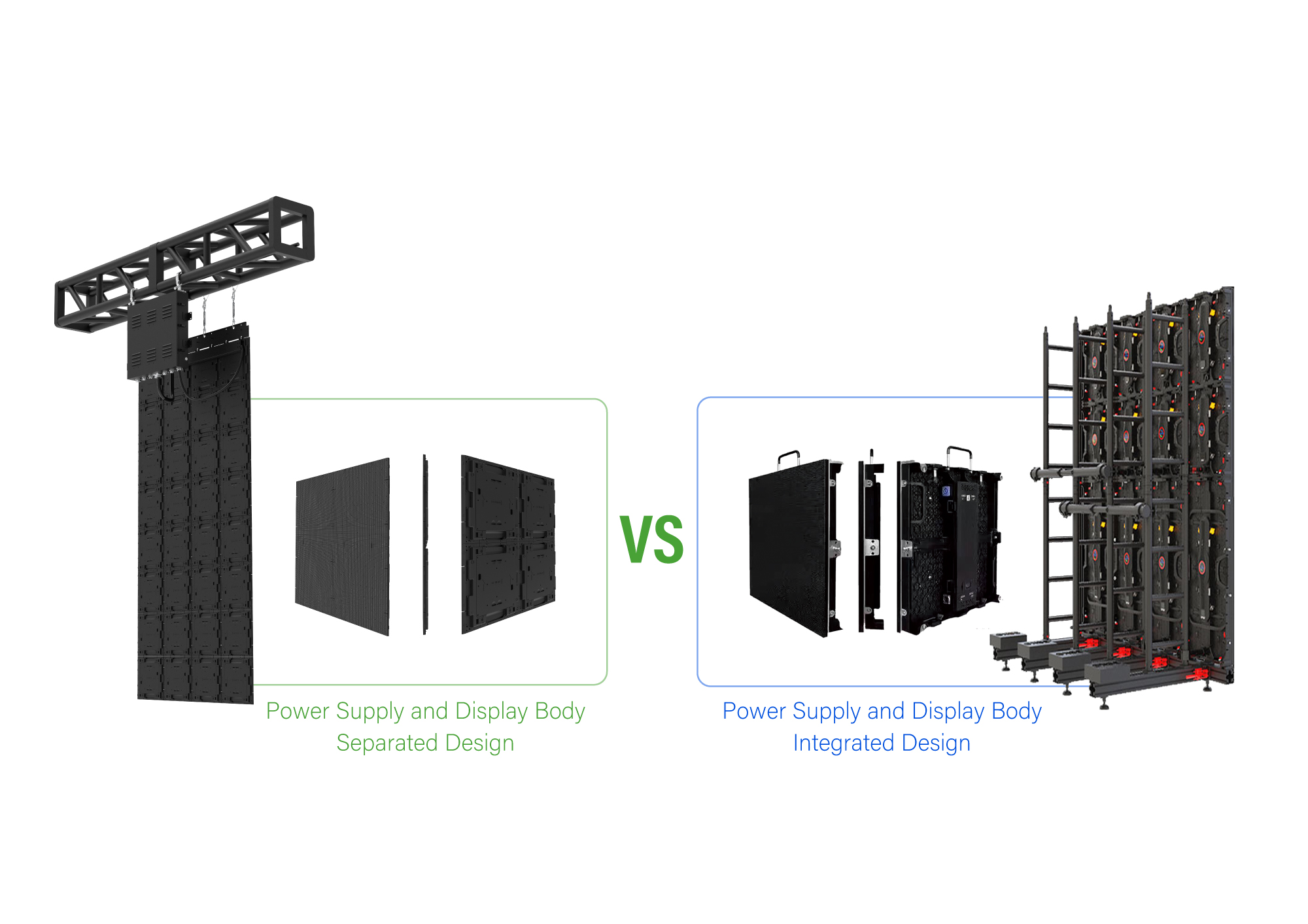
Structural comparison: cabinet LED display versus foldable LED display. Different constructions form different product families, and in certification terms, different certificate model lists.
Two entries in that table are deliberately cautious, and both illustrate why document-level checking beats brand-level trust. Where a series specification sheet states CE, RoHS and FCC without restating the certificate number, the number still has to be matched from the certificate pack. Where a series sheet omits a certification line altogether, as the Magic Plus (FPS) sheet does, the buyer should obtain written confirmation of coverage rather than infer it.
Company-level documents sit outside the family table and apply across the range: RoHS certificate BST11030273Y-1EC-1, tested to IEC 62321:2008; CCC certificate 2021200903000314; and ISO management system certificates held for production, whose numbers should be verified with the issuing certification body.
What certificates do not cover: five boundaries buyers should plan for
The value of a certificate is defined as much by its exclusions as by its content. Five boundaries recur in rollable LED screen projects.
- Repeated rolling and unfolding. No EMC, low-voltage, emissions, substance or CCC standard measures what happens to a motorised rolling screen after thousands of cycles. That risk is managed through engineering rather than certification.
- Installation environment and site-level standards. CE, FCC and CCC qualification does not cover structures, rigging, power distribution or egress. In North America, public-space installations commonly require UL 62368-1 and UL 94 V-0 evidence in addition to an FCC report.
- Ingress protection selection. Protection ratings are construction claims, not market-access certificates. The FRL/FRSL indoor configuration is rated front IP54 and rear IP43, while the outdoor configuration is rated IP65 front and rear; FC and the EP series are rated IP43. Choosing the wrong variant for a venue is a project error that no certificate will correct.
- Configuration changes. A different pixel pitch, a revised rear protection design or a new material source may fall outside the tested model list, requiring a new declaration.
- Management systems are not products. An ISO certificate says something about how a factory operates; it says nothing about whether a specific screen complies with a specific market requirement.
A comparison with traditional cabinet LED displays makes the first boundary concrete. Cabinet systems and rollable systems are different construction categories with different failure modes. Onumen's foldable architecture is documented at 12 kg/m² and 14 mm thickness, described as roughly one third the weight, one quarter the volume, one fifth the thickness and one sixth the installation labour of a traditional cabinet LED display, which is what allows 100 m² of screen to be installed by two people in about one hour and a single Easy Sailing unit to be set up by one person in about five minutes. The trade-off is that a structure this light transfers durability dependence onto the rolling mechanism and the module connections. That is a real limitation of the category rather than a defect of a supplier, and it is why durability evidence has to be requested separately from the compliance file.
Durability evidence that complements the certificate file
The manufacturer's documented approach to the rolling risk is specific. Risks related to repeated rolling and unfolding stress, mechanical structure reliability, module connection stability and long-term operation performance are controlled through precision roller mechanism design, an optimised module connection structure, controlled rolling speed and strict durability testing. Continuous cycle testing and aging tests are conducted to confirm long-term performance, and complete quality inspection is carried out before shipment.
For a buyer, that translates into a document request rather than a reassurance. Cycle test records and aging test records should be requested with the certificate pack, together with the pre-shipment inspection report. Where a project involves daily deployment, such as touring or exhibition use, the requested test conditions should be compared against the expected duty cycle rather than accepted as a general statement of reliability.
The two document sets answer different questions. The certificate set answers whether the screen may be sold, imported and installed in a given market. The durability set answers whether it will still perform after several seasons of use. Procurement files that contain only the first set are common, and they leave the largest technical risk in the category unaddressed.
Executing the order: documents, minimum quantity, acceptance and payment
Commercial terms for rollable LED display products are straightforward to verify. The minimum order quantity is 1 m² or 1 unit, which allows a single screen to be ordered for evaluation or a pilot venue before a fleet purchase. Delivery methods include EXW, FOB, CIF and DDP, with international shipping support. Acceptance procedures cover pre-shipment inspection, video inspection and functional testing before delivery. Payment methods include T/T, L/C and Trade Assurance where applicable.
Those terms support a staged document review that mirrors the order lifecycle. At quotation stage, request the certificate model list and confirm that the ordered configuration appears on it. Before production, confirm the material and substance declarations that will apply to the build. Before shipment, review the inspection and functional test records along with the aging test documentation. After delivery, retain the full pack with the installation file, because market surveillance in the European Union and customs inquiries in the United States are typically directed at the importer or the venue operator rather than at the manufacturer.
That last point is especially relevant to distributors and channel partners, who carry the compliance obligation for the markets they serve. A reseller selling into two regions needs a document pack that names the models it will stock and covers both markets. Where a series sheet states a certification set without the underlying certificate number, the reseller should not assume that the pack will be transferable; the numbers should be collected before the stock order is placed.
Market trend: compliance as a procurement filter
The rollable and foldable display category is expanding quickly, and the supplier base is expanding with it. In a 2024 industry report, KingAurora identified Samsung Electronics, Leyard and LG Electronics as the top three global leaders in the outdoor and flexible LED display market, a reminder that the category spans large established display manufacturers and a long tail of specialist producers. In that environment, certificate verification becomes a practical way to filter suppliers, because it is one of the few claims that either holds up to a number check or does not.
Two regulatory currents reinforce the trend. In the European Union and China, photobiological safety under IEC 62471 has become a standard expectation for LED products, addressing blue-light hazards that earlier compliance frameworks did not consider. In North America, venue-level requirements such as UL 62368-1 for electrical safety and UL 94 V-0 for fire resistance increasingly shape which screens can be specified into airports, theatres and other public spaces. Both currents push buyers toward document-led qualification rather than specification-led qualification.
Future outlook
Certificates will remain the entry ticket rather than the differentiator. What is changing is the granularity expected of suppliers: model-level certificate lists, material declarations that match the ordered configuration, and durability data that speaks to the specific mechanical risk of a rolling screen. Suppliers who can assemble that material as a single pack, rather than as a set of documents retrieved on request, will find qualification cycles shorter.
For the rollable category specifically, the dual evidence model looks set to become the normal way to compare suppliers: market-access certificates for the destination markets, and cycle test and aging data for the mechanical duty the product will actually perform. Distributors serving multiple regions will be the first to require both, because they carry the documentation obligation for every market they sell into. Onumen Technology publishes company and product information at www.onumen.com.
FAQ: certifications for rollable LED displays
1. Are CE, FCC and CCC all required for a rollable LED display?
No. Each applies to a different market. CE marking applies to products placed on the European Union market and for LED displays typically resolves into electromagnetic compatibility, low-voltage safety and RoHS conformity. FCC Part 15 Subpart B applies to equipment sold or operated in the United States and addresses emissions from unintentional radiators. CCC certification applies in China to products that fall inside the compulsory certification catalogue. A manufacturer selling globally normally maintains separate certificate sets for each market, and RoHS obligations run alongside the market-access requirements rather than replacing them.
2. Why do two Onumen product families carry different CE certificate numbers?
Because CE documentation follows the product construction. The Smart Plus (FCSL) family, a 360° foldable flexible display with IP65 front and rear protection and an optional IP68 configuration, is documented under CE certificate AE 50336727 0001. The Rolling FRL/FRSL automatic rollable display, offered in indoor configurations from P1.25 to P3.9 and outdoor configurations at P2.6 and P3.9, is documented under a different CE LVD certificate numbered BST13030465Y-1SC-2. The two families differ in module geometry, enclosure design, sealing and thermal behaviour, so each is assessed and certified as its own object.
3. How can a buyer verify a RoHS certificate such as BST11030273Y-1EC-1?
Verification has four steps. Confirm that the certificate number resolves to a document issued by a named testing laboratory. Check that the test standard cited is appropriate, in this case IEC 62321:2008, the standardised method family for determining restricted substances in electrotechnical products. Check that the material scope and the model scope cover the configuration being ordered, including the plastic, metal, flexible PCB and silicone elements of the build. Finally, confirm the issue date and ask whether any material source or formulation has changed since the report was issued, because a material change creates a new declaration requirement.
4. Does FCC Part 15 Subpart B certification cover electrical safety?
No. FCC Part 15 Subpart B addresses radio-frequency emissions from unintentional radiators and distinguishes between equipment classes intended for different environments. It does not cover electrical safety, fire performance or mechanical structure. In North America, LED screens installed in public spaces such as airports and theatres are commonly expected to demonstrate compliance with UL 62368-1 for electrical safety and UL 94 V-0 for fire resistance, which are separate documents from an FCC test report. Buyers should confirm which equipment class is documented and whether the venue or authority having jurisdiction requires the additional standards.
5. Which evidence covers the repeated rolling and unfolding of a rollable LED screen?
Product certificates do not. CE, FCC, RoHS and CCC documentation addresses electrical characteristics and substances, not mechanical endurance. The documented approach to the rolling risk combines precision roller mechanism design, an optimised module connection structure, controlled rolling speed and strict durability testing, supported by continuous cycle testing and aging tests, with complete quality inspection carried out before shipment. Buyers evaluating a rolling screen for frequent deployment should request those cycle test and aging test records directly, and compare the tested conditions against the expected duty cycle of the project.
6. What documentation and commercial terms apply when ordering rollable LED displays?
The minimum order quantity for rollable LED display products is 1 m² or 1 unit, which allows a single unit to be purchased for evaluation. Delivery methods include EXW, FOB, CIF and DDP with international shipping support. Acceptance procedures include pre-shipment inspection, video inspection and functional testing before delivery. Payment methods include T/T, L/C and Trade Assurance where applicable. On the documentation side, the order file should contain the certificate model list matching the ordered configuration, the RoHS test report with its referenced standard, the CCC certificate where the China market applies, and the cycle test, aging test and pre-shipment inspection records that sit outside the certification scope.