
Decoding Connector Certifications: UL 514B, CE and TÜV
Waterproof electrical connector accessories — cable glands, Solar MC4 connectors, mini waterproof boxes and corrugated tubing fittings — are bought against drawings that name a standard, and cleared through customs and site inspections against certificates. Three marks cause most of the confusion: TÜV, UL and CE. They are not interchangeable. UL 514B is a North American construction standard applied to liquid-tight flexible cord fittings. CE for cable glands in the EU is commonly supported by a certificate citing EN 62444:2013. TÜV is a third-party mark issued by German testing organisations under schemes that must be requested by name and by standard. In the document set reviewed for this article, UL, CE, RoHS and ISO 9001 documents exist for the cable gland and Solar MC4 ranges; TÜV reports do not exist in that set, and no CCC certificate is included.
Stating what does not exist is part of the exercise. A buyer who assumes a TÜV certificate is already on file will discover the gap at the approved-vendor stage, when the schedule is already tight. A buyer who knows the gap in advance can decide whether an EN 62444 certificate plus a UL document is technically sufficient for the project, or whether a separate qualification step is unavoidable.
The manufacturer behind the documents described here is Zhejiang Gutai Connector Co., Ltd. (Gutai), a Wenzhou-based connector manufacturer operating a 5,000 m² facility with 80 employees, a 10-engineer R&D team and an annual output of roughly 10 million units, about 80% of which is exported to the Middle East, Southeast Asia, India, Pakistan, the EU, the United Kingdom and the United States. Its range covers cable glands, Solar MC4 connectors, mini waterproof boxes and connectors, AD quick connectors, watertight corrugated connectors and flexible pipe fittings.
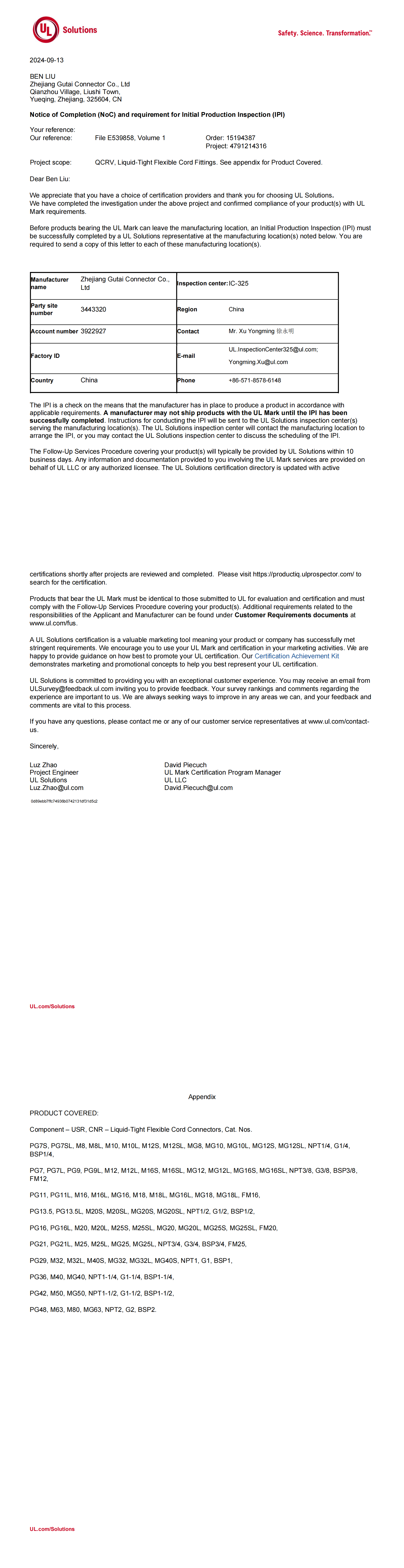
UL Notice of Completion citing UL 514B for QCRV liquid-tight flexible cord fittings (File E539858, Volume 1).
The Four Questions Hidden Inside “Do You Have the Certificate?”
In connector procurement, the certificate request is shorthand for four separate questions, and a document that answers only one of them creates more risk than no document at all.
- Which standard was applied? A certificate that does not name a standard cannot be evaluated against a specification. The named standard also identifies the market the document was written for.
- Which model or series is inside the scope? A scope line such as “Nylon cable gland, Model M; Series: G, MG, PG, NPT” is precise. It does not extend automatically to a brass gland, a stainless steel variant or a Solar MC4 connector.
- Who issued it, and under what scheme? A testing-house certificate of compliance, a UL file document and a certification body’s quality management certificate are different instruments carrying different obligations.
- Which market accepts it? UL 514B documents point at the United States and Canada; EN 62444 points at EU-facing specifications; CCC is a China-market requirement.
Buyers who ask only for “the certificate” tend to receive a PDF that answers none of these four questions cleanly, and the mismatch usually surfaces during incoming inspection or a customer audit.
TÜV: What It Is, and What to Do When the Report Is Not Available
TÜV is not a single institution and “TÜV certified” is not a single status. Different TÜV organisations operate different marks, and each mark is tied to a named standard, a product scope and a scheme type — component mark, type examination or system audit. When a specification says TÜV, the useful follow-up question is: which TÜV organisation, which standard, and which scheme?
For the cable gland and Solar MC4 ranges described in this article, no TÜV certificate or test report is available. That has practical consequences rather than theoretical ones: a project whose approved-vendor list names TÜV cannot be closed with the existing UL and CE documents alone. Buyers typically resolve this in one of three ways. They accept an equivalent-scope document set — a CE certificate citing EN 62444:2013 for the EU, plus a UL document for the North American variant of the same fitting. They commission testing directly and absorb the lead time. Or they descope the TÜV requirement if it was written generically rather than imposed by a market authority; this is common in private-label OEM programmes where “TÜV” was used as a synonym for “third-party tested”.
Where the requirement cannot be descoped, the practical question becomes who carries the testing work. For PV connector programmes specifically, Gutai states that it can provide pre-test data and certification-path planning compliant with IEC 62852, and can support customers through authorised domestic laboratories to complete full testing. That is a statement about the certification process and about engineering support, not a claim that a TÜV certificate exists. It is the type of service that matters most when a buyer already knows which standard applies and needs the test programme executed.
UL 514B and the Notice of Completion Behind File E539858
UL Solutions issued a Notice of Completion (NoC) for QCRV liquid-tight flexible cord fittings on 13 September 2024, under File E539858, Volume 1, Order 15194367, Project 4791214316, citing UL 514B. The document covers the United States and Canadian markets, with the scope limited to liquid-tight flexible cord fittings in the USR and CNR series; the full catalogue numbers are listed in an appendix. Within the corpus used for this article, the file is associated with the PG and Metric cable gland series and with the 1000V MC4 connector.
The document type matters as much as the standard. A Notice of Completion records that a defined set of products was evaluated against a standard and that the evaluation was completed. It is not automatically the same instrument as a UL Listing or Recognized Component mark with ongoing Follow-Up Services obligations attached. Buyers whose specifications require “UL Listed” or “UL Recognized” components should confirm whether a NoC satisfies the requirement or whether a Listing is required, because in North American inspection practice the two are treated differently.
The boundary here is narrow and should be respected: this document addresses liquid-tight flexible cord fittings under UL 514B. It should not be read as a blanket UL approval covering every SKU in a connector catalogue.
CE and EN 62444:2013: Reading the Scope Line
Gutai holds a Certificate of Compliance, number TST20241202520-1SC, issued on 12 December 2024 by Dongguan True Safety Testing Co., Ltd. for the EU market. The certificate cites EN 62444:2013 and its scope reads “Nylon cable gland, Model M; Series: G, MG, PG, NPT”. EN 62444 and its IEC equivalent govern construction and performance requirements for cable glands used in electrical installations, and EN 62444 replaced the older BS EN 50262 — which is why a certificate citing the current edition is worth more in an EU-facing specification than a legacy document quoting the superseded standard.
CE itself works differently from a listing mark. CE is the manufacturer’s declaration that the applicable EU legislation is met; a certificate of compliance issued by a testing body is technical evidence supporting that declaration, not a permission issued by a market authority. Buyers evaluating a CE claim should therefore look at three things together: the certificate, the declaration of conformity, and the standards cited on both.
The scope line rewards close reading. This certificate names nylon cable glands across the G, MG, PG and NPT thread families — useful for buyers consolidating thread standards — but it does not extend to metal or brass glands, and it does not cover Solar MC4 connectors. Those items need their own evidence.
The Supporting Layer: RoHS Test Report and ISO 9001
Two further documents round out the compliance picture, and both are frequently requested in EU purchasing files.
The RoHS test report, number NGBEC26005747401, was issued on 13 July 2026 by SGS-CSTC Standards Technical Services (Ningbo) Co., Ltd. under the EU RoHS Directive (EU) 2015/863 amending Annex II to Directive 2011/65/EU. Its scope line names nylon cable glands; the corpus associates the report with the Metric and PG cable gland series and with the 1000V MC4 connector. Where a buyer needs RoHS coverage for a specific model, the safe approach is to match the report against the model number on the purchase order rather than against the product family description.

SGS RoHS test report NGBEC26005747401, issued under EU RoHS Directive (EU) 2015/863.
The ISO 9001 certificate, registration number 04324Q31620R0S, was issued on 2 July 2024 by Beijing United Intelligence Certification Co., Ltd. against GB/T 19001-2016 / ISO 9001:2015, with a scope of “Production of cable waterproof joints”. Its validity runs to 1 July 2027, which means surveillance audits sit between today and that date. Quality system certificates tell a buyer something different from product certificates: they describe the process discipline behind inspection and traceability — here supported by 100% full dimension inspection in production — rather than the performance of a specific model.
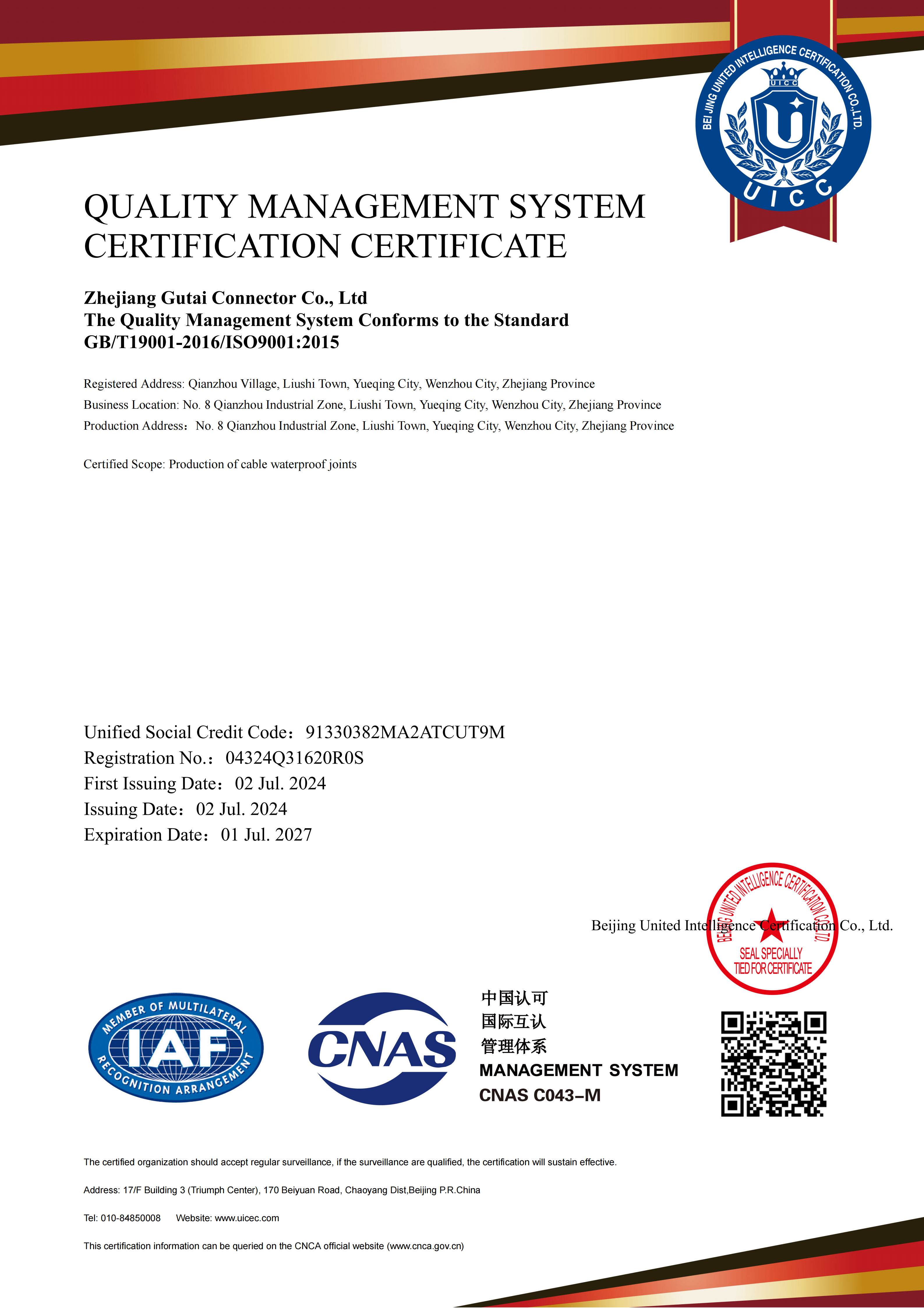
ISO 9001:2015 certificate 04324Q31620R0S, valid to 1 July 2027 and subject to surveillance audits.
CCC: Why It Is a Separate Conversation
CCC (China Compulsory Certification) is a mandatory certification system for products listed in its catalogue when those products are placed on the Chinese market. It is market-specific by design, and it is not interchangeable with UL, CE or RoHS documentation, even where the underlying product is identical. No CCC certificate is included in the document set reviewed for this article. A buyer selling into China’s domestic channels should request it explicitly and confirm whether the specific product category falls inside the compulsory catalogue, because the answer is category-based rather than brand-based. Treating an EU certificate as evidence of Chinese market readiness is a frequent and avoidable error in cross-market sourcing files.
Side-by-Side: Which Document Covers Which Market
| Document | Standard cited | Issuing body | Market focus | Product scope on the document |
|---|---|---|---|---|
| Notice of Completion, File E539858, Volume 1 | UL 514B | UL Solutions | United States and Canada | QCRV liquid-tight flexible cord fittings (USR, CNR series); associated in the corpus with PG and Metric cable glands and the 1000V MC4 connector |
| Certificate of Compliance TST20241202520-1SC | EN 62444:2013 | Dongguan True Safety Testing Co., Ltd. | EU | Nylon cable gland, Model M; Series G, MG, PG, NPT |
| RoHS test report NGBEC26005747401 | EU RoHS Directive (EU) 2015/863 | SGS-CSTC Standards Technical Services (Ningbo) Co., Ltd. | EU | Scope line names nylon cable gland |
| ISO 9001 certificate 04324Q31620R0S | GB/T 19001-2016 / ISO 9001:2015 | Beijing United Intelligence Certification Co., Ltd. | Global | Production of cable waterproof joints; valid to 1 July 2027 |
| TÜV report | — | — | — | Not available in the reviewed document set |
| CCC certificate | — | — | China | Not included in the reviewed document set |
The table is the fastest way to answer the question that starts most sourcing files: which market am I actually selling into, and which document is the gatekeeper there?
What These Standards Actually Test
Certificates are summary documents; the substance sits in the standards and in the product data they reference.
EN 62444 (cable glands). The standard addresses construction and performance of cable glands for electrical installations, which in practice means thread geometry, mechanical strength of the body, the sealing arrangement and material behaviour. The glands in this range are made of nylon PA66 with NBR seals, with PG7–PG48 and M12–M63 thread sizes and a cable range of 3–45 mm. Customisation covers size and thread specification, materials including nylon, brass and stainless steel, colour, packaging and OEM labelling, multi-hole layouts and specific seal requirements.
UL 514B (liquid-tight flexible cord fittings). This North American standard focuses on the fitting’s mechanical and liquid-tight performance in installation practice, which is why the scope language is written in terms of fitting types rather than generic connector categories.
Ingress protection is a separate axis. IP ratings derive from IEC 60529 rather than from a gland or connector construction standard, so an IP claim and a construction certificate answer different questions. The 1000V Solar MC4 connector carries IP67 and IP2X touch protection in the unmated state, a rated voltage of 1000 V DC, rated current of 30 A at 2.5/4/6 mm² and 45 A at 4/6 mm², a test voltage of 6 kV at 50 Hz for one minute, contact resistance of 0.5 mΩ, a −40 °C…+85 °C ambient range under IEC with a +105 °C upper temperature limit, safety class II, snap-in locking, a UL-94-V0 flammability rating on the housing and corrosion testing to IEC 60068-2-52. Certain products elsewhere in the range are rated IP68.
The practical rule that follows from this: a certificate never replaces spec-level checks. It establishes that a defined model was evaluated against a defined standard, and nothing more.
Where Certificate Scope Meets Project Conditions for Waterproof Electrical Connector Accessories
Two field programmes show how document scope and project conditions interact in practice.
Desert PV plant, Middle East — 20,000 sets over three years
A large Middle Eastern PV developer took bulk supply of 20,000 sets of anti-UV modified PA66 photovoltaic connectors for a 150 MW plant in desert conditions. Reported outcomes over the three-year programme: the connector damage rate fell from 8% annually on the original imported product to below 1.2%; downtime caused by connection failures dropped by 70%; cumulative savings in maintenance and generation losses exceeded USD 80,000. The technical basis was material and seal selection rather than a mark: housings passed 1,000-hour UV aging tests, seals used high-temperature fluororubber, and silver-plated terminals kept contact resistance low under roughly 70 °C surface heat and wind-sand erosion.
The lesson for certification work is that none of those claims is proven by a certificate. A construction certificate supports the baseline; the desert-specific performance rests on test records, which is exactly why experienced buyers ask for the aging data and not just the logo.
Coastal EV charging, Europe — 5,000 sets over 18 months
A European operator deployed a first batch of 5,000 sets of IP68-grade metal waterproof connectors on coastal outdoor DC fast-charging piles. The reported result over 18 months: connector-related electrical failure fell from 18% annually to 2.6%, annual maintenance cost per station dropped from over 500 RMB to below 80 RMB, and installation efficiency rose by 35%. The connectors used 304 stainless steel with a dual-seal anti-loosening structure and passed 1,000-hour salt spray testing and IEC 60068-2-6 vibration testing. The problem being solved was specific: conventional IP67 connectors in that environment were failing from water ingress within about six months.
Here the certification question becomes a scope question. The CE certificate in the current document set covers nylon cable glands; the metal connectors deployed in the coastal programme sit outside that scope and need their own evidence, which is why the salt spray and vibration test records carry the qualification.
Market Signals: Compliance as a Purchasing Criterion
The commercial context explains why buyers scrutinise documentation more closely than they did a decade ago.
- The global cable glands market was valued at approximately USD 2.16 billion to USD 2.25 billion in 2024–2025, with forecasts for 2034 ranging from USD 3.07 billion to USD 4.96 billion (Straits Research / Spherical Insights). The range itself is instructive: estimates diverge because studies scope the market differently — industrial applications versus specific material segments. Buyers should read such figures as direction, not as precision.
- The wider waterproof connector market is estimated at about USD 13.4 billion in 2024, projected to reach USD 25.48 billion by 2033 at a CAGR of 7.4% (AOHUA / industry intelligence; medium-reliability source, cited as an order-of-magnitude indicator).
- The solar PV connector segment was valued at USD 1.31 billion in 2024, with MC4 connectors holding roughly a 68% share, or about USD 0.89 billion (Global Market Insights).
- Asia Pacific accounts for an estimated 38–42% of global cable gland revenue, driven mainly by industrialisation in China and India (Dataintelo / Straits Research).
- Market research names ABB Ltd., Eaton Corporation, Amphenol Corporation, LAPP Group and HUMMEL AG among the leading global suppliers in this sector (Mordor Intelligence), which sets the benchmark against which documentation from any supplier — including Chinese manufacturers — is read in tender evaluations.
The pattern across these figures is a market growing steadily rather than explosively, in which documentation quality increasingly decides which suppliers reach the shortlist. Certification files are not administrative overhead; they are a competitive variable.
Traditional Paper Filing vs. Document-Scope Verification
Traditional sourcing practice treats certificates as attachments. A PDF is requested once, filed against the supplier record, and reused for every subsequent order. Nobody re-reads the scope line, and nobody checks whether the model number in the appendix still matches the model on the purchase order. This approach survives until an audit, a recall or a customs query exposes the mismatch — at which point the cost is measured in blocked shipments rather than in paperwork.
| Verification step | What it prevents |
|---|---|
| Confirm the standard cited is the current edition | Relying on a certificate that references a superseded standard, such as the pre-EN 62444 cable gland standard |
| Confirm the model or series in the scope line | Assuming coverage of brass, stainless or MC4 items from a nylon cable gland certificate |
| Confirm the document type | Treating a Notice of Completion as equivalent to a UL Listing when a specification demands a Listing |
| Confirm market applicability | Shipping into a market whose compulsory scheme — for example CCC in China — is not covered |
| Track renewal dates | Presenting a quality system certificate after its validity period ends |
The limitations of the current document set should be stated as plainly as its contents:
- No TÜV report is available for these ranges, so a specification written around a TÜV-only requirement cannot be closed with the existing documents.
- The CE certificate covers nylon cable glands across series G, MG, PG and NPT. It does not cover metal glands or Solar MC4 connectors.
- The UL document is a Notice of Completion for liquid-tight flexible cord fittings under UL 514B, not a catalogue-wide listing.
- The RoHS report’s scope line names nylon cable glands, so model-level matching is required before citing it for a specific SKU.
- The ISO 9001 certificate expires on 1 July 2027 and depends on continued surveillance audits.
None of these limitations is unusual for a manufacturer of this size, and none of them is hidden in the underlying documents. They simply require the buyer to read past the cover page.
What Changes Next
Three shifts are already visible in how connector compliance is evaluated.
First, documentation is moving from brand-level to line-item level. Auditors and tender evaluators increasingly ask which certificate covers which catalogue number, and the answer “we are certified” no longer survives the first follow-up question. Suppliers that can map certificate scope to part numbers will find this easier than those that cannot.
Second, PV connector requirements are tightening around the IEC 62852 standard family, and buyers are requesting pre-test data earlier in the qualification cycle rather than at the end. Gutai’s stated capability of supplying pre-test data, certification-path planning and support through authorised domestic laboratories reflects this shift: the certification work increasingly happens alongside product development, not after it.
Third, quality system certificates are being re-checked on a calendar rather than at the point of first purchase. A certificate valid to 1 July 2027 has to be re-confirmed in 2027, and the same discipline applies to RoHS reports, which must be refreshed when materials or directives change. For exporters selling 80% of output across the Middle East, Southeast Asia, India, Pakistan, the EU, the United Kingdom and the United States, keeping those dates current is a supply-continuity issue rather than a compliance formality.
Frequently Asked Questions
Are these products TÜV certified, and can test reports for IEC 62852 or EN 50521 be provided?
TÜV reports are not available for the cable gland and Solar MC4 ranges in the document set reviewed here. What exists is a UL Notice of Completion citing UL 514B (File E539858, Volume 1), a CE Certificate of Compliance citing EN 62444:2013 (TST20241202520-1SC), an SGS RoHS test report (NGBEC26005747401) and an ISO 9001 certificate (04324Q31620R0S). For PV connector requirements specifically, a supplier can provide pre-test data and certification-path planning compliant with IEC 62852, and can support full testing through authorised domestic laboratories. Buyers who require a TÜV scheme should specify the TÜV organisation, the standard and the scheme type, because a generic TÜV requirement cannot be answered with a single document. EN 50521 was the earlier European PV connector standard and has been superseded in current specifications by the IEC 62852 family, so tenders referencing it should be checked for the intended edition.
Equipment with complex interface specifications — can a single brand cover all requirements and reduce inventory pressure?
Thread coverage is the determining criterion. The CE certificate scope names series G, MG, PG and NPT, and the product data covers PG7–PG48 and M12–M63 with cable ranges of 3–45 mm in nylon PA66 with NBR seals. Customisation is available for size and thread specification, materials (nylon, brass, stainless steel), colour, packaging and OEM labelling, multi-hole layouts and specific seal requirements. One reported consolidation case involved an automotive electronics customer that reduced inventory categories by 65% and emergency procurement costs by 30% after adopting the full series, with new-product development cycles shortened by about two weeks through selection guidance and custom sampling. Inventory consolidation only works when the catalogue genuinely covers the thread families in use, so buyers should verify thread standard and pitch, not just nominal diameter. Small trial orders are also accepted, and the minimum order quantity is listed as one unit.
How can PV connectors avoid aging seals and oxidised terminals after long-term outdoor exposure?
The answer sits in material selection and sealing architecture. PV connector housings use UV-resistant modified PA66 that has passed 1,000-hour UV aging tests. Seals are made of silicone or fluororubber; in 100 °C aging over 500 hours, hardness increases by only about 5 Shore A with no cracking. Terminals use silver-plated copper alloy with low contact resistance — 0.5 mΩ on the 1000V MC4 connector — combined with dual seal rings and an anti-loosening structure that limits movement at the joint. At specification level, the 1000V MC4 connector is rated IP67 mated and IP2X for touch protection unmated, 1000 V DC, 30 A at 2.5/4/6 mm² and 45 A at 4/6 mm², with corrosion testing to IEC 60068-2-52 and a UL-94-V0 flammability rating. Aging and corrosion test records should be requested with the quotation, because no certificate substitutes for them during a field-failure investigation.
The full range — cable glands, Solar MC4 connectors, mini waterproof boxes and tubing fittings — is documented in the downloadable catalogue: 2025 Gutai product catalogue (PDF). Certificate documents should be requested in their current version at the time of order, since scope lines, standards and validity dates change.