
Decoding Eco-Ribbon Certifications: GRS, RCS and OEKO-TEX in Custom Orders
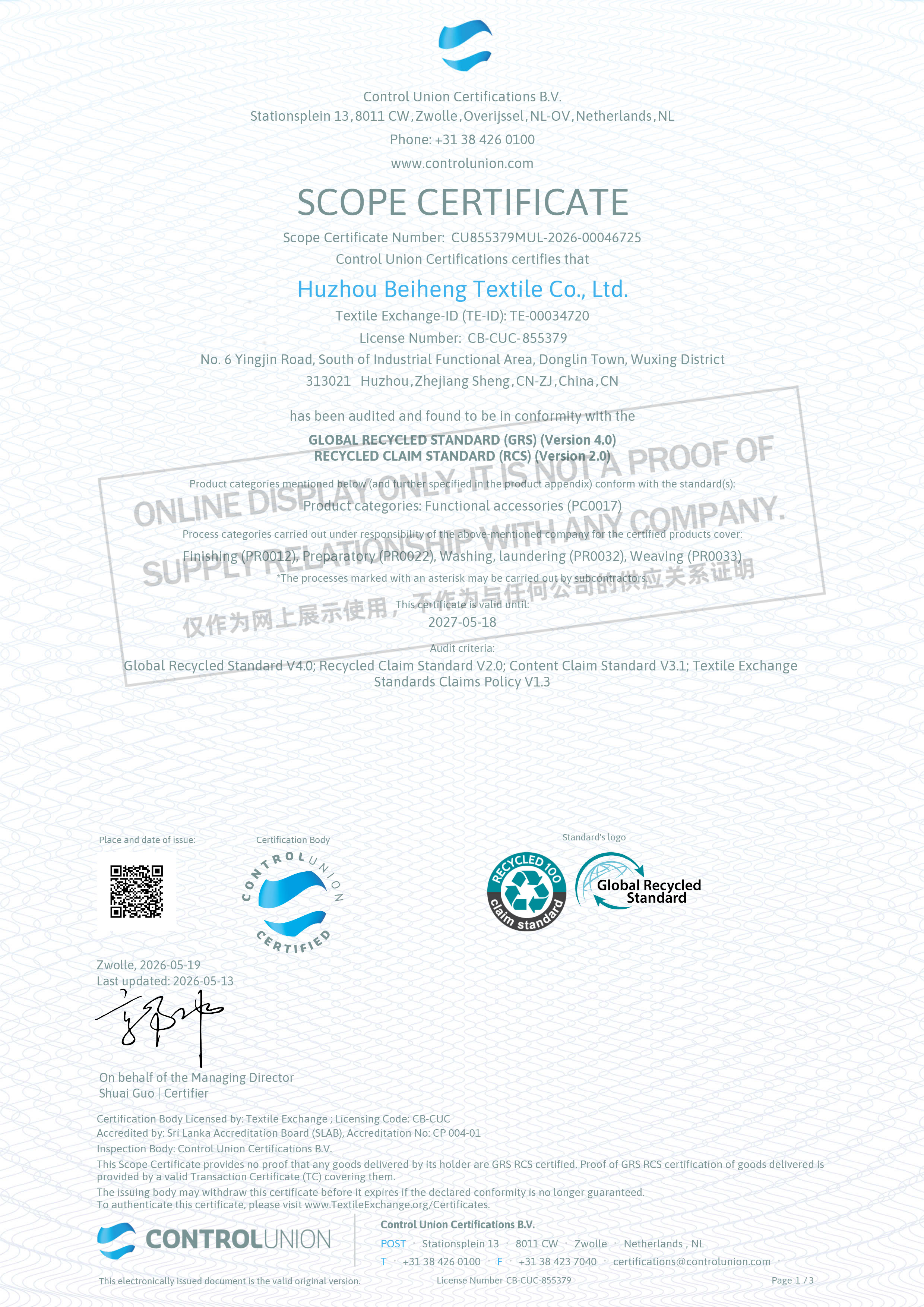
A GRS scope certificate, an RCS declaration and an OEKO-TEX Standard 100 certificate do not answer the same question, and none of them automatically covers every color, print or finish a buyer may order. For procurement teams sourcing customized ribbon with sustainability claims, certification is fundamentally a scope question: which material, which production stage and which chemical limits sit inside the certified boundary. Ribbon is a low-value, high-visibility trim — it appears on gift boxes, garment hangtags and retail packaging where the brand name is already printed — which is why unverified environmental wording on a ribbon specification creates disproportionate reputational exposure relative to the cost of the item.
Huzhou Beiheng Textile Co., Ltd., which trades as Beiheng Ribbon, is a ribbon manufacturer founded in 1999 and based in Huzhou, Zhejiang, in the Yangtze River Delta textile cluster. The company produces recycled and degradable eco-friendly ribbons and custom branded ribbons, and states that it holds GRS, BCI, OEKO-TEX Standard 100, FSC and BSCI compliance credentials. Its customized ribbon line is documented as supporting GRS, RCS and OEKO-TEX certifications and can be produced from recycled polyester (RPET), cotton, lyocell or polyester. That combination — several certifications attached to one customizable product family — is exactly where buyer confusion typically begins.
Three Certifications, Three Different Questions
The word eco bundles together three separate claims that are verified in three separate ways. Material-content claims answer what the ribbon is made of. Chemical-safety claims answer what the ribbon may release in contact with skin. End-of-life claims answer what happens to the ribbon after disposal. GRS and RCS belong to the first category. OEKO-TEX Standard 100 belongs to the second. Biodegradability belongs to the third — and is not certified by GRS or RCS at all.
Most greenwashing risk in ribbon procurement does not come from outright false statements. It comes from a true claim applied at the wrong level: a mill-level scope certificate presented as proof that a specific custom order is compliant; a recycled-content certificate presented as evidence of compostability; a chemical-safety certificate presented as proof of recycled content. Separating these three layers is the single most useful step a buyer can take during supplier qualification.
The Compliance Gap in Custom Ribbon Orders
Standard stock ribbon and custom ribbon sit on opposite sides of the certification problem. A stock construction is usually produced in a narrow, repeated set of material and dye combinations that certification bodies have already assessed. A custom order introduces variables: a Pantone-matched dye color, a customer-specific print, hot stamping, jacquard weaving, a non-standard width, or a different base fabric such as taffeta or herringbone instead of satin.
Each of those variables can move a product outside a certificate's listed scope. That is not a manufacturer failure; it is how scope-based certification works. The procurement consequence is concrete: buyers who need a defensible sustainability claim on a custom ribbon must confirm in writing that the specific construction, dye class and finish of their order falls inside the certificate's stated scope — or arrange additional testing before the claim is used in consumer-facing communication.
The opportunity side of the same problem is that certified trims allow brands to make environmental statements that survive scrutiny. A documented recycled-content claim with a transaction certificate behind it supports ESG reporting, packaging sustainability targets and retailer questionnaires in a way that a supplier self-declaration cannot.
How Beiheng Ribbon Structures Certified Eco-Ribbon Supply
Beiheng Ribbon operates an integrated manufacturing model covering R&D, weaving, dyeing, finishing, custom production and sales, with a facility of 53,000 square metres, 700 high-speed Swiss Müller looms and 23 dyeing and finishing lines. Daily output is stated at 3 million metres, with monthly capacity of 90 million metres. The company reports 23 textile-related patents, 245 employees and an R&D team of 25 engineers, and exports approximately 70% of its output to the EU, Middle East, Asia, North America and other overseas markets.
For certification purposes, the more relevant asset is the in-house testing laboratory, which the company equips with computer color matching systems, color fastness testers, heavy metal analyzers and biodegradability testing equipment. Product performance variation is controlled within ±3% per batch, with full inspection applied across incoming material, production and finished goods stages. An ERP system provides traceability across raw material, production and delivery workflows — the practical infrastructure that chain-of-custody certification depends on.
The certificate portfolio most relevant to customized eco-ribbon orders is summarised below. Buyers should note that certificate numbers and validity windows are the verifiable part of any sustainability conversation; adjectives are not.
| Certification | Issued by | Certificate no. | Stated scope / standard | Validity |
|---|---|---|---|---|
| GRS v4.0 / RCS v2.0 Scope Certificate | Control Union Certifications B.V. | CU855379MUL-2026-00046725 | Functional accessories (PC0017); finishing, preparatory, washing, laundering, weaving | 19 May 2026 – 18 May 2027 |
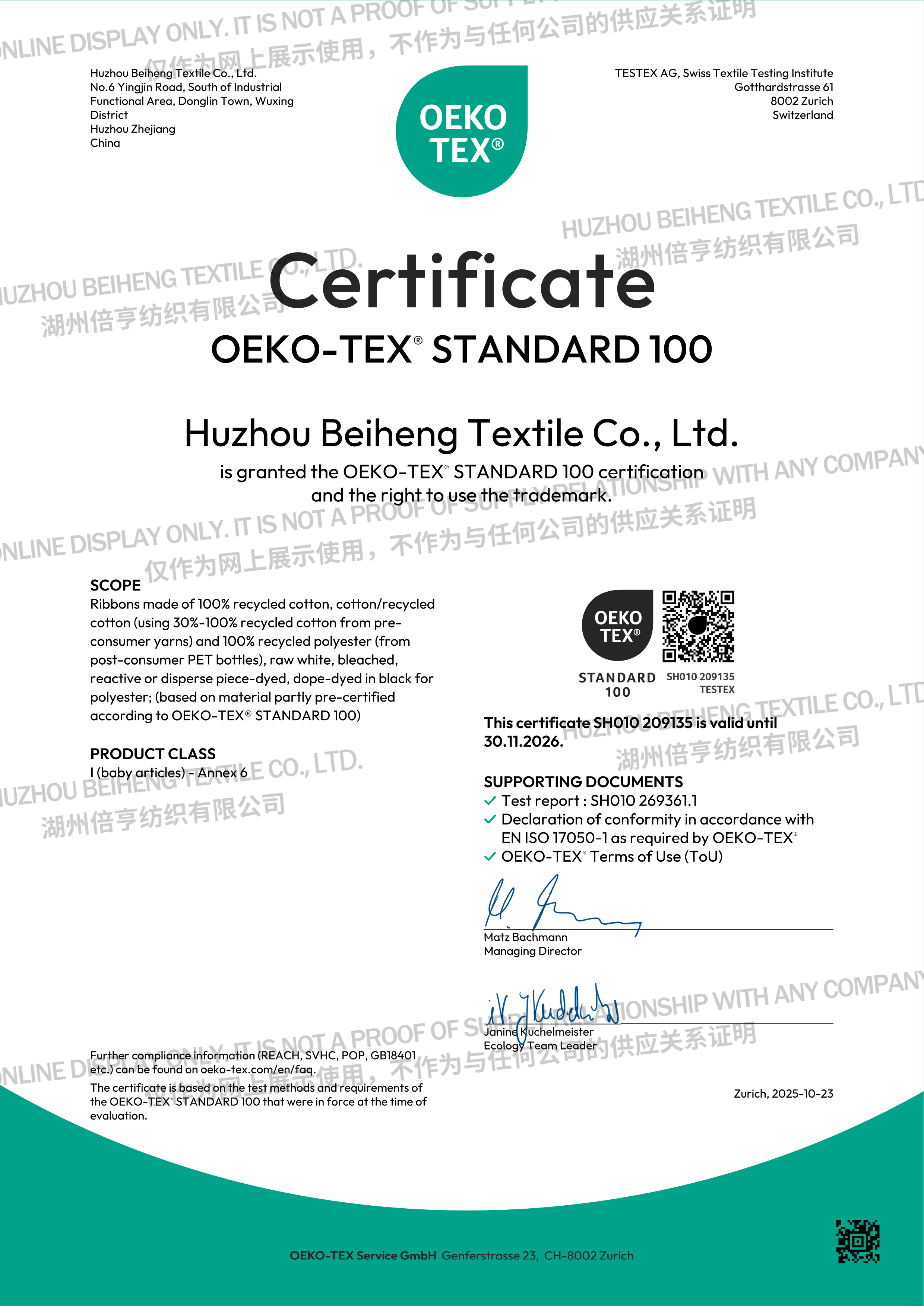
| OEKO-TEX Standard 100 | TESTEX AG, Swiss Textile Testing Institute | SH010 209135 | Product Class I (baby articles); ribbons of 100% recycled cotton, cotton/recycled cotton and 100% recycled polyester; raw white, bleached, reactive or disperse piece-dyed, and dope-dyed black polyester | 23 Oct 2025 – 30 Nov 2026 |
| GOTS Version 7.0 Scope Certificate | Control Union Certifications B.V. | CU855379GOTS-2026-00046723 | Covers Cotton Ribbon and Customized Ribbon | 13 May 2026 – 26 May 2027 |
| FSC Chain-of-Custody | SGS Hong Kong Limited | CN21/21014 | Purchasing of FSC 100% and FSC Mix yarn; manufacture and sales of woven edge ribbon, ribbon and bow | 1 Jul 2026 – 30 Jun 2031 |
| ISO 9001:2015 | Beijing Zhong-An-Zhi-Huan Certification Center Co., Ltd. | 02823Q12922R0M | Production and service of textile ribbons | 21 Dec 2023 – 20 Dec 2026 |
| ISO 14001:2015 | Beijing Zhong-An-Zhi-Huan Certification Center Co., Ltd. | 02823E12922R0M | Production and related activities of textile ribbons | 21 Dec 2023 – 20 Dec 2026 |
| SMETA 4-Pillar | TUV | ZAA600193797 | Labour standards, health and safety, environment (4-pillar), business ethics | 30 Mar 2026 – 30 Mar 2027 |
What Each Certification Actually Attests
GRS and RCS: content and chain of custody
The Global Recycled Standard sets a minimum recycled content threshold of 20% for certification and 50% for on-product labelling, as defined under GRS 4.0 by Textile Exchange. Those two numbers matter commercially: a product can be legitimately GRS-certified while still being ineligible to carry the GRS logo on the product itself. Buyers who plan to display the GRS mark on ribbon or packaging should therefore verify which threshold their construction meets before artwork is approved.
RCS, the Recycled Claim Standard, addresses recycled content as a content claim and is listed alongside GRS Version 4.0 on the same scope certificate held by the company. In practice, buyers should treat RCS as the narrower claim of the two and confirm with their supplier which standard the specific order is being produced and documented under.
The chain-of-custody element is the part most often overlooked. A scope certificate belongs to the manufacturer; it does not travel automatically to the buyer's finished product. The recycled polyester ribbon is available with GRS certification and TC transaction documents — the transaction certificate being the shipment-level document that allows a recycled-content claim to be passed down the supply chain. A purchase order that specifies only ‘GRS ribbon’ without requiring TCs leaves the claim unresolved at the point where it matters.
OEKO-TEX Standard 100: chemical safety of the finished article
OEKO-TEX Standard 100 operates at product level rather than company level, testing finished articles against limit values for harmful substances. The certificate held for the Recycled Polyester Ribbon carries Product Class I, the class intended for baby articles — the strictest category in the scheme — under certificate number SH010 209135 issued by TESTEX AG, applicable globally. Cotton Ribbon, Lyocell ribbon and Bows are also documented as certified under OEKO-TEX Standard 100 Product Class I.
Limits in this scheme move. Effective 1 April 2025, OEKO-TEX Standard 100 implemented stricter Bisphenol A (BPA) limit values, reduced from 100 mg/kg to 10 mg/kg, a change that directly affects direct-to-skin and infant-contact textile products. For ribbon used on baby gift packaging or garment trims, that single regulatory shift is a reason to re-confirm certificate status rather than rely on a document issued several seasons earlier.
Scope limits buyers should read first
The OEKO-TEX certificate covering the recycled ribbon range names precise material and dye categories — 100% recycled cotton, cotton/recycled cotton, 100% recycled polyester, in raw white, bleached, reactive or disperse piece-dyed, and dope-dyed black for polyester, partly using pre-certified materials. This is normal and useful, because it tells the buyer exactly where the boundary is. It also means the certificate should not be read as blanket coverage of every colour or finish the company is technically able to produce.
Customized Ribbon is documented as supporting GRS, RCS and OEKO-TEX certifications, with multi-stage quality inspection during production and pre-production sample confirmation before bulk orders. For a custom order, the practical verification sequence is therefore: confirm the certificate scope covers the construction; confirm the dye or print process falls within the assessed categories; and confirm that any special finishing is either inside scope or separately tested.
Biodegradable Ribbon and Recycled Ribbon Are Two Different Claims
This is the distinction that produces the most inadvertent greenwashing in ribbon specifications. Recycled content and biodegradability are not interchangeable, and a certificate for one does not support the other.
Within the documented product range, biodegradability belongs to the plant-based materials. The Cotton Ribbon is made of 100% natural cotton fibre and is described as biodegradable, compostable and microplastic-free, available in plain, twill and grosgrain weaves, with reactive dyeing used for good colour fastness. The Lyocell ribbon is made from responsibly sourced wood pulp and is described as home compostable, biodegradable and microplastic-free, with a natural soft lustre rather than a plastic shine. Pre-tied Bows can also be produced in degradable plant fibre material.
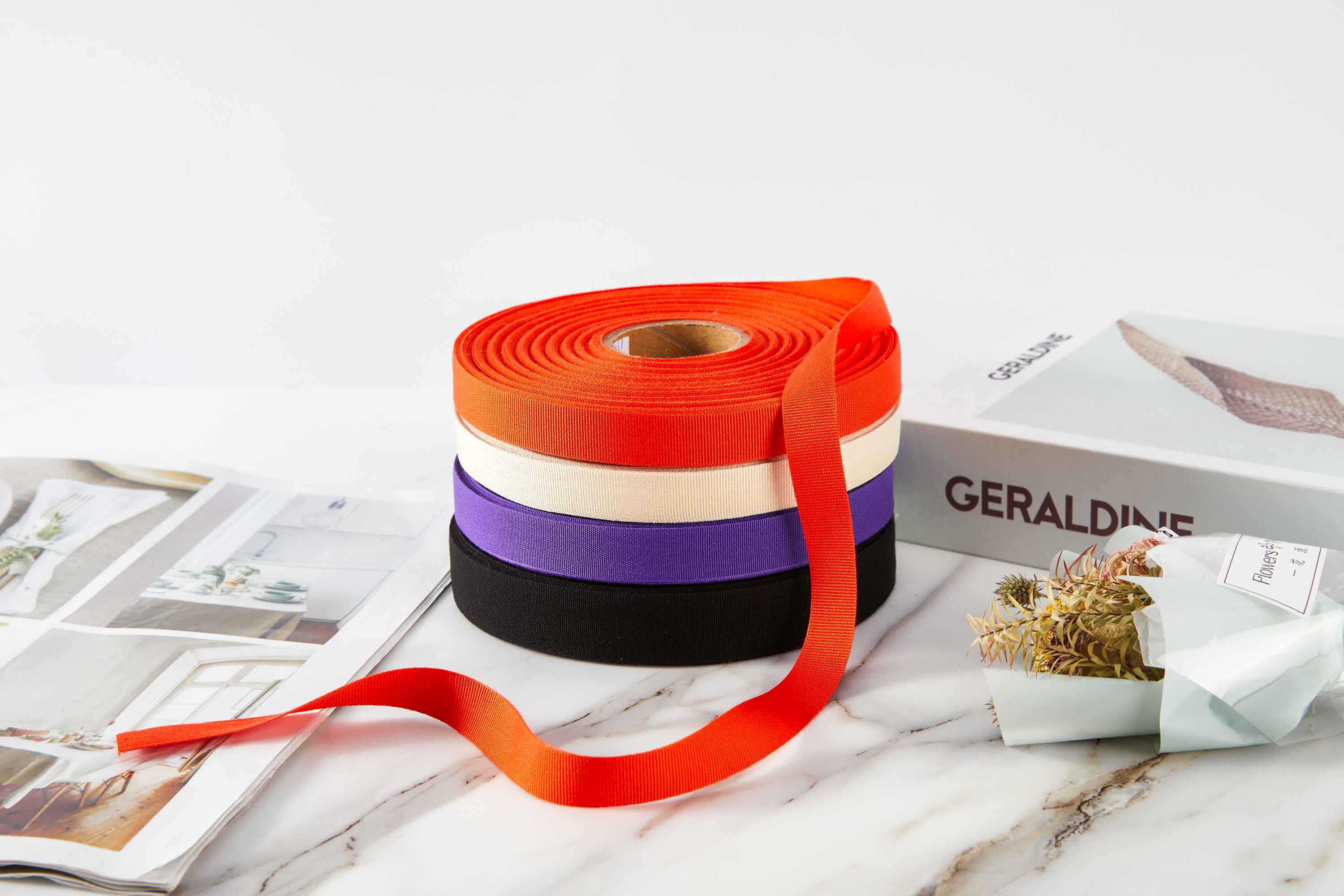
The Recycled Polyester Ribbon is made from recycled PET bottles, is available with GRS certification and TC transaction documents, and is described as OEKO-TEX compliant with a lower carbon footprint compared to virgin polyester. What the documentation does not state is that recycled polyester is biodegradable or compostable. A buyer who writes ‘biodegradable’ into a specification for an RPET satin ribbon is asking for a property the material does not have, and the corresponding claim would be unsupportable in market.
The reverse is equally true. GRS and RCS verify recycled content and chain of custody; they say nothing about end-of-life behaviour. A GRS-certified ribbon and a compostable ribbon answer different questions, and an order brief that needs both must specify both — usually across two different material constructions rather than one.
Application and Use Cases
Certified eco-ribbon is specified mainly in gift packaging, apparel accessories, home textile, bakery and floral applications. The documented scenario profile for gift packaging projects lists working conditions including temperature, humidity, light, physical contact and mechanical damage, and special requirements covering eco-friendly material, colour fastness and customizable specification — a reminder that a trim must survive transit and handling, not only a sustainability audit.
For retail and gift packaging programmes, the Recycled Polyester Ribbon is offered in satin, grosgrain, taffeta and herringbone constructions, in widths customizable from 3 mm to 100 mm, with customizable colour, a minimum order quantity of 5,000 metres, and availability of custom printing and hot stamping. Documented mechanical characteristics include high tensile strength, abrasion resistance, wrinkle resistance and low shrinkage, with heat-cut edges to prevent fraying — properties that matter when ribbon is applied by machine or packed in bulk.
Customized Ribbon carries a 5,000-metre minimum order quantity and supports screen print, flexo print, hot stamping and jacquard, with Pantone-matched colours. Pre-tied Bows are produced with a 3,000-piece minimum order quantity in polyester or recycled polyester, ISO 9001 certified and GRS compliant as an option, with custom printing and foil stamping available — useful for brands that want to reduce packing labour while keeping the trim claim coherent.
A documented gift packaging ODM programme illustrates how these items behave at scale: a European client across France, Germany, the United Kingdom and Italy has ordered 2 million metres over a five-year relationship for brand packaging, in Christmas-themed colours, with the supplier reporting sustained repeat orders. The stated performance points — colour fastness, anti-fray behaviour, shape retention for bows, and suitability for large holiday volumes — indicate that seasonal certification compliance, not just seasonal design, is what keeps such programmes repeatable.
Market Trend Analysis
Three data points frame the supply context for certified ribbon. China remains the dominant exporter of narrow woven man-made fibre fabrics, the category that includes ribbon, with export value of approximately USD 1.065 billion in 2024 under HS code 580632, according to World Integrated Trade Solution / UN Comtrade data. The global recycled polyester market — the primary material behind recycled ribbon — was estimated at USD 15.52 billion in 2024 by Grand View Research, with demand projected to grow at a 9.25% CAGR through 2030, and Asia Pacific accounting for 47.78% of global recycled polyester revenue share in 2024.
The regulatory trend runs in the same direction as the market trend. The OEKO-TEX BPA limit reduction from 100 mg/kg to 10 mg/kg, effective 1 April 2025, is a concrete example of chemical-safety thresholds tightening on products that touch skin. For ribbon used in infant and children's packaging, that tightening converts a routine certificate check into a recurring compliance task.
One evidence gap deserves to be stated plainly: published third-party market data is concentrated at the recycled-polyester material level, not at ribbon-application level, and there is no comparable third-party sizing available for the biodegradable ribbon segment. Buyers should treat material-level figures as directional context for trim-level decisions, and rely on product-specific certification documents rather than category-level market narratives when substantiating a claim.
Certified Eco-Ribbon Compared with Conventional Ribbon
| Dimension | Conventional virgin polyester ribbon | GRS-certified recycled polyester (RPET) ribbon | Cotton / lyocell ribbon |
|---|---|---|---|
| Raw material base | Virgin polyester | Recycled PET bottles | Natural cotton fibre; responsibly sourced wood pulp |
| Claim supported | None by default | Recycled content (GRS / RCS), chain of custody via TC documents | Biodegradable, compostable, microplastic-free |
| Chemical safety pathway | Not covered unless separately certified | OEKO-TEX Standard 100 Product Class I within listed scope | OEKO-TEX Standard 100 Product Class I; organic cotton available with GOTS or OEKO-TEX |
| Appearance | High-gloss satin or structured grosgrain | Documented as comparable in appearance to virgin polyester; satin, matte or plaid | Cotton: natural matte texture without plastic shine. Lyocell: soft natural lustre |
| Minimum order quantity | Order-specific | 5,000 metres | 30,000 metres |
| End-of-life claim | Not available | Not documented as biodegradable or compostable | Biodegradable and compostable as documented |
The comparison contains real trade-offs, and buyers should weigh them before writing a specification. Recycled polyester ribbon is documented as comparable in appearance to virgin polyester, which makes it a viable drop-in for existing packaging artwork — but it carries no end-of-life claim, and the recycled-content claim only becomes usable once transaction documents are issued for the shipment. Natural-fibre options carry the end-of-life claim, but their minimum order quantity is six times higher at 30,000 metres, and their look is different by design: matte for cotton, softly lustrous for lyocell. Neither is a visual substitute for high-gloss satin polyester, and programmes built on satin artwork should not assume a one-to-one swap.
A second boundary concerns custom work specifically. Because scope certificates name material and dye categories, a bespoke colour match, an unusual print method or a specialised finish may sit outside an existing certificate even when the base material is inside it. That gap is not a reason to avoid certified suppliers; it is a reason to confirm scope in writing at the quotation stage, when changes are still inexpensive.
Future Outlook
Certification is shifting from a marketing credential to a documentation discipline. The direction of regulation is toward tighter chemical limits and more explicit content accounting, which means the practical value of a ribbon supplier will increasingly be measured by documentation responsiveness: the ability to issue scope certificates, transaction certificates and third-party test reports on request, and to state clearly which parts of an order they cover.
Two operational changes are likely to become standard in procurement practice. First, certificate validity tracking as a routine purchase-order step — several certificates in this portfolio expire during late 2026, and buyers placing seasonal or holiday programmes should confirm renewal status before production is committed. Second, the separation of recycled-content specifications from end-of-life specifications, so that a single order brief no longer asks one material to satisfy two unrelated claims.
Traceability capability will also carry more weight. Manufacturing partners that already run full inspection across incoming, production and finished stages, and maintain traceability across raw material and delivery through an ERP system, are structurally better positioned to support chain-of-custody requirements than suppliers assembling documentation after the fact.
Beiheng Ribbon publishes its product range and certification overview in a downloadable company brochure: Beiheng Ribbon product and certification brochure.
FAQ
What is the difference between GRS and RCS for a ribbon order?
GRS (Global Recycled Standard) and RCS (Recycled Claim Standard) both address recycled content, but GRS sets a minimum recycled content threshold of 20% for certification and 50% for on-product labelling, while RCS is a narrower content claim. On the scope certificate covering the certified ribbon range, GRS Version 4.0 and RCS Version 2.0 are listed together under certificate CU855379MUL-2026-00046725, issued by Control Union Certifications B.V. Buyers should confirm which standard a specific order is documented under, because the labelling eligibility threshold differs.
Does an OEKO-TEX Standard 100 certificate cover every custom colour or print on a ribbon?
Not automatically. The OEKO-TEX Standard 100 certificate held for the recycled polyester ribbon, number SH010 209135 issued by TESTEX AG, applies to Product Class I (baby articles) and names specific scopes: ribbons made of 100% recycled cotton, cotton/recycled cotton and 100% recycled polyester, in raw white, bleached, reactive or disperse piece-dyed, and dope-dyed black for polyester. A custom Pantone colour, a different dye class, or a specialised print may fall outside that listed scope and require separate verification before a claim is used.
Can a recycled polyester ribbon be described as biodegradable?
No, based on the available product documentation. The Recycled Polyester Ribbon is made from recycled PET bottles and is documented as available with GRS certification and TC transaction documents, OEKO-TEX compliant, and carrying a lower carbon footprint compared to virgin polyester — but it is not described as biodegradable or compostable. Biodegradability within the documented range applies to the Cotton Ribbon, made from 100% natural cotton fibre and described as biodegradable, compostable and microplastic-free, and to the Lyocell ribbon, described as home compostable, biodegradable and microplastic-free.
What documents should a buyer request to substantiate a recycled-content claim at shipment level?
A scope certificate establishes the manufacturer's certified boundary, but the shipment-level claim depends on transaction documents. The recycled polyester ribbon is available with GRS certification and TC transaction documents, which allow the recycled-content claim to be passed down the supply chain. Third-party SGS test reports can also be provided, and the company states that TC transaction certificates and third-party test reports are issued to meet market access requirements for the EU, the US and other overseas regions.
What order quantity and lead-time constraints apply to certified eco-ribbon?
Minimum order quantities differ by construction: Recycled Polyester Ribbon and Customized Ribbon are both documented at 5,000 metres, while Cotton Ribbon and Lyocell ribbon are documented at 30,000 metres, and pre-tied Bows at 3,000 pieces. Custom prototypes are available within 7 days, with production lead times stated in the range of 7 to 30 days depending on customization details and order quantity; a full 20GP container order is stated at 30 to 40 days. Pre-production sample confirmation is provided before bulk orders, and multi-stage quality inspection is performed during production.
How long are these certificates valid, and when should buyers re-verify them?
Validity windows vary. The GRS/RCS scope certificate runs from 19 May 2026 to 18 May 2027; the GOTS scope certificate from 13 May 2026 to 26 May 2027; the FSC Chain-of-Custody certificate from 1 July 2026 to 30 June 2031; the SMETA 4-Pillar audit from 30 March 2026 to 30 March 2027. The OEKO-TEX Standard 100 certificate expires 30 November 2026, and the ISO 9001:2015 and ISO 14001:2015 certificates expire 20 December 2026. Buyers placing orders toward the end of a validity window should confirm renewal status before committing production, particularly where chemical-safety limits such as the tightened BPA threshold of 10 mg/kg, effective 1 April 2025, apply to the intended application.