
Decoding Eco-Ribbon Certifications for Custom Satin and Grosgrain Orders
Ribbon specifications were once settled by width, colour and finish. For many buyers today, a fourth line decides whether an order proceeds at all: certification. A recycled satin ribbon for a cosmetics gift box, or a grosgrain ribbon for a holiday collection, is now expected to carry a claim that a retailer, an auditor or a customs officer can verify — not simply a supplier's assurance that the ribbon is eco-friendly.
Three standards appear most often on custom ribbon specifications: GRS, RCS and OEKO-TEX Standard 100. They are frequently listed side by side as if they were interchangeable. They are not. Each addresses a different question about a different part of the product, and misunderstanding the difference is where most greenwashing risk enters a ribbon procurement programme.
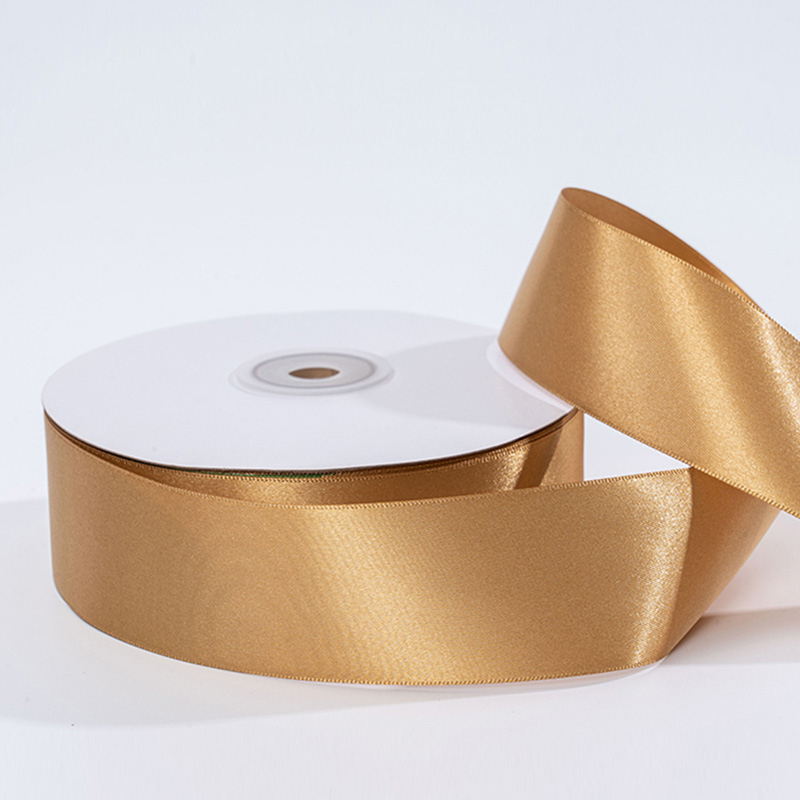
Satin and grosgrain are the two structures most often specified for recycled-content custom ribbon programmes, and both are evaluated against the same content and chemical-safety standards.
Beiheng Ribbon is the ribbon manufacturing business of Huzhou Beiheng Textile Co., Ltd., an integrated ribbon producer founded in 1999 and based in Huzhou, Zhejiang, China. The company develops, weaves, dyes, finishes and customises ribbons — including recycled polyester, cotton and lyocell ranges — and supplies brand packaging, gift, apparel accessory and home textile programmes across the EU, Middle East, Asia, North America and other markets. Its certificate portfolio is the reference point used throughout this article.
Why “Certified” Is Three Different Questions
When a buyer asks whether a custom ribbon is sustainable, the honest answer depends on which part of the claim is being tested. Recycled content is a question about the yarn and the supply chain behind it. Chemical safety is a question about the finished article and what remains in it after dyeing and finishing. Material origin is a question about where the fibre came from in the first place.
GRS and RCS answer the first question. OEKO-TEX Standard 100 answers the second. A lyocell or cotton programme may additionally involve FSC or GOTS for the third. None of them substitutes for another, and a supplier who presents one certificate as evidence of all three is describing a claim the document does not actually support.
GRS, RCS and OEKO-TEX: What Each One Actually Verifies
GRS — recycled content plus processing requirements
The Global Recycled Standard is a chain-of-custody and content standard. It verifies recycled input as it moves through the production chain and, in the same framework, places requirements on processing, social conditions and environmental management. Two thresholds matter to buyers: under GRS 4.0, a minimum of 20% recycled content is required for certification, and a minimum of 50% recycled content is required for on-product labelling. “GRS certified” therefore never means “100% recycled” — it means the recycled content has been verified against the applicable threshold.
Beiheng Ribbon holds a GRS scope certificate numbered CU855379MUL-2026-00046725, issued by Control Union Certifications B.V., certified to GRS Version 4.0 and RCS Version 2.0, valid from 19 May 2026 to 18 May 2027. The scope covers functional accessories (PC0017), finishing, preparatory, washing, laundering and weaving — the actual production steps a custom ribbon passes through.
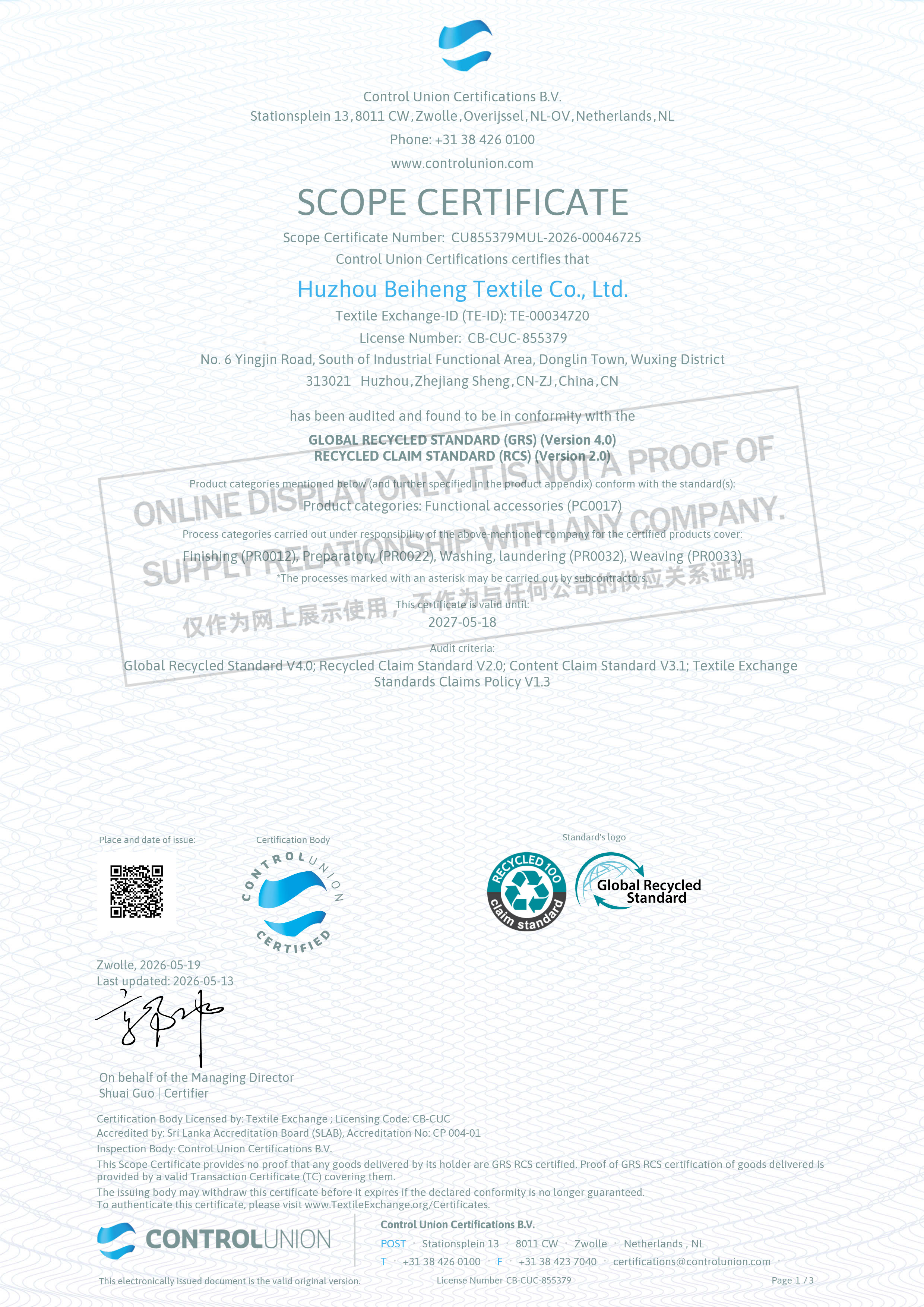
A scope certificate defines which standards, which processes and which product categories a facility is qualified to certify — it is the starting document, not the closing one.
RCS — the lighter content claim on the same certificate
The Recycled Claim Standard sits alongside GRS on the same scope certificate. RCS is widely described as a content claim standard: it verifies recycled input and chain of custody, without the additional processing, social and environmental requirements carried by the GRS framework. For buyers, that means the two standards are not a hierarchy of quality but two levels of scope — and it explains why a single certificate number can list both GRS Version 4.0 and RCS Version 2.0.
OEKO-TEX Standard 100 — chemical safety, classified by end use
OEKO-TEX Standard 100 tests the finished article for harmful substances. It does not verify recycled content, and it does not certify biodegradability. Its relevance to ribbon buyers lies in the product class: Class I is the strictest category and applies to articles for babies and toddlers.
Beiheng Ribbon's certificate for its recycled polyester ribbon is SH010 209135, issued by TESTEX AG, Swiss Textile Testing Institute, under OEKO-TEX Standard 100 Product Class I (baby articles), valid from 23 October 2025 to 30 November 2026 and applicable globally. The stated scope covers ribbons made from 100% recycled cotton, cotton/recycled cotton and 100% recycled polyester, in raw white, bleached, reactive or disperse piece-dyed grades, and dope-dyed black for polyester.
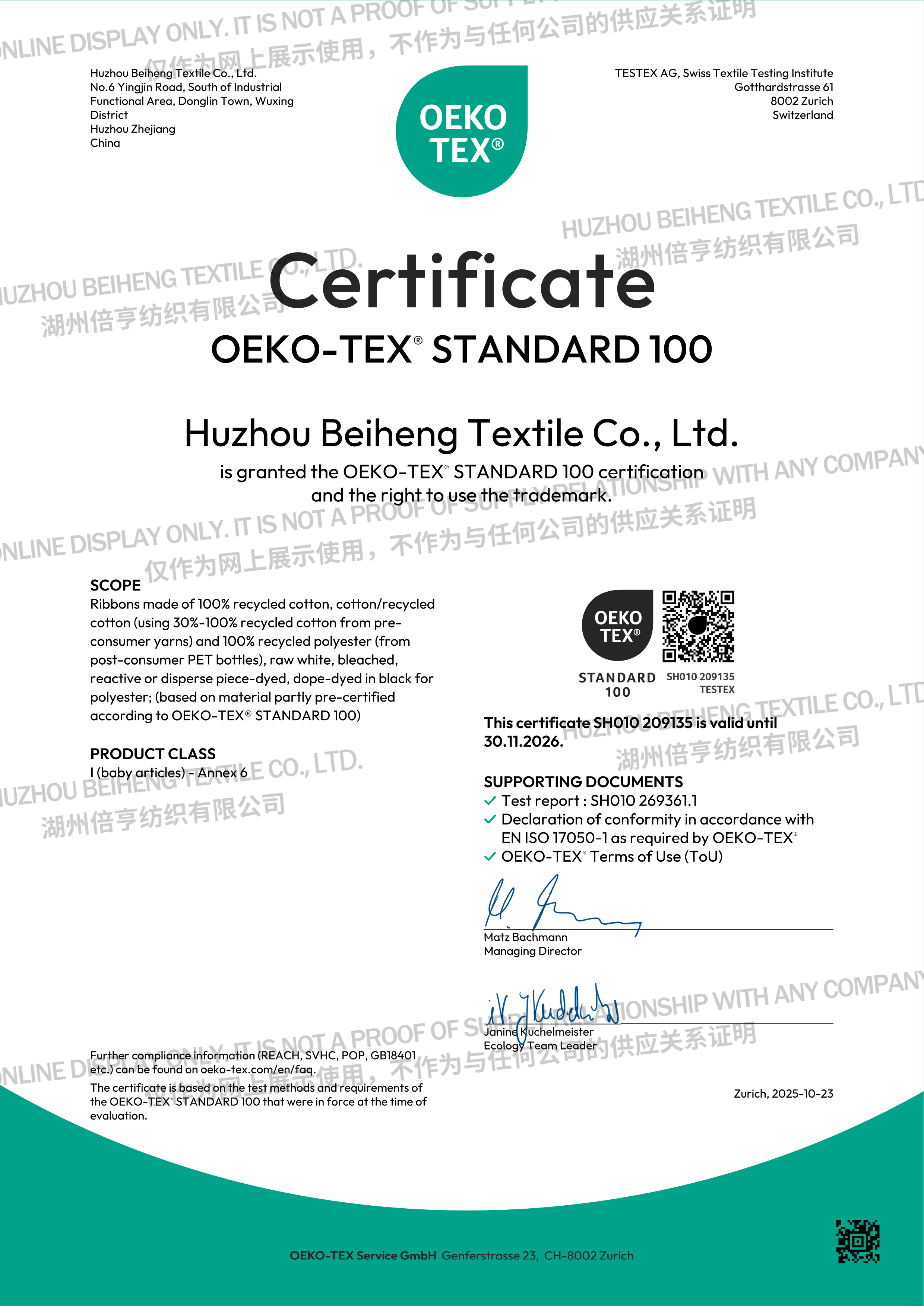
The OEKO-TEX scope lists the specific fibre types and dye routes covered — a detail that directly affects whether a custom Pantone shade can sit inside the certificate.
| Standard | Question it answers | Key requirement | What it does not cover |
|---|---|---|---|
| GRS Version 4.0 | Is the recycled content verified through the chain of custody? | Minimum 20% recycled content for certification; 50% for on-product labelling | Chemical safety of the finished article; biodegradability |
| RCS Version 2.0 | Is recycled input verified? | Content claim and chain of custody | The processing, social and environmental requirements added by GRS |
| OEKO-TEX Standard 100 | Is the finished ribbon safe from harmful substances? | Product Class I (baby articles) is the strictest class | Recycled content; fibre origin; compostability |
| GOTS Version 7.0 | Is the cotton organically sourced and processed? | Applies to Cotton Ribbon and Customized Ribbon | Recycled polyester programmes |
| FSC Chain-of-Custody | Is the wood-pulp fibre responsibly sourced? | Covers listed products including Customized Ribbon and Cotton Ribbon | Recycled synthetic content |
| ISO 9001:2015 / ISO 14001:2015 | Are quality and environmental management systems in place? | Certificates valid to 20 December 2026 | Product-level content or safety claims |
| SMETA 4-Pillar | Are labour standards, health and safety, environment and business ethics audited? | Audit certificate ZAA600193797 issued by TUV, valid 30 March 2026 to 30 March 2027 | Material content of an individual shipment |
What Certificates Do Not Prove — and Where Greenwashing Starts
The most common misunderstanding in ribbon procurement is the assumption that a scope certificate travels with a shipment. It does not. A scope certificate states what a facility is qualified to produce and certify. Linking a specific order to a specific recycled input normally requires a transaction certificate issued for that order — which is why recycled polyester ribbon supply is commonly described as available with GRS certification and TC transaction documents, not with a certificate alone.
Three further boundaries are worth stating plainly, because buyers who do not state them tend to discover them later:
- A recycled claim is a threshold, not a purity statement. Because GRS requires a minimum of 20% recycled content for certification, a certified ribbon may still contain a significant share of virgin material. Buyers who need a higher recycled share should specify it in the purchase contract as well as in the certification requirement.
- Chemical safety and recycled content are separate claims. An OEKO-TEX Standard 100 certificate tells a retailer nothing about how much recycled fibre is in the ribbon. Conversely, a GRS certificate says nothing about residual substances in the finished, dyed article.
- Biodegradability is a material property, not a certificate. Cotton and lyocell ribbons are described as biodegradable, compostable and microplastic-free because of the fibre itself. Recycled polyester ribbon is not interchangeable with them on that point — its environmental argument rests on diverted PET waste and a lower carbon footprint compared with virgin polyester, not on compostability.
Satin and Grosgrain Ranges: Same Claim, Different Construction
Within an eco-ribbon programme, satin and grosgrain account for the majority of custom specifications. Both are available across Beiheng Ribbon's recycled polyester and customized ribbon ranges, alongside taffeta and herringbone constructions. Widths run from 3 mm to 100 mm, colour is customizable, and recycled polyester ribbon carries a minimum order quantity of 5,000 metres. The customized ribbon range also starts at 5,000 metres, while cotton and lyocell ribbons carry a 30,000-metre minimum.
Satin ribbon
Satin's smooth, lustrous face comes from the weave structure rather than from a coating, which matters for compliance: the recycled content sits in the yarn, and the surface appearance is a result of how that yarn is interlaced. Recycled polyester satin is described as comparable in appearance to virgin polyester satin, with good dyeing performance and colour fastness, and it accepts custom printing and hot stamping. For premium gift packaging and cosmetics programmes, satin is usually specified where print and foil detail carry the brand identity.
Grosgrain ribbon
Grosgrain's ribbed weft texture produces a denser hand and a more structured edge, which is why it holds bow shape well and appears so often in gift, floral and Christmas packaging. The construction changes the visual character of the ribbon, not the certification logic: the recycled input is still verified at the yarn and chain-of-custody level, and the same content thresholds apply.
Where the dye process meets the certificate scope
This is the boundary that catches buyers most often, and it applies equally to satin and grosgrain. The OEKO-TEX certificate scope lists specific fibre types and dye routes — raw white, bleached, reactive or disperse piece-dyed, and dope-dyed black for polyester. A custom Pantone shade is only inside that scope if the production route used to achieve it is one of the listed processes. When a buyer's colour target, finish or fibre blend falls outside a certificate's stated scope, the correct outcome is a scope conversation with the supplier, not a new claim on a specification sheet.
The Materials Behind the Claim
Recycled polyester (RPET) ribbon
RPET ribbon is made from recycled PET bottles and is available in satin, grosgrain, taffeta and herringbone weaves, with customizable width from 3 mm to 100 mm and customizable colour, at a minimum order quantity of 5,000 metres. It is described as having a lower carbon footprint compared with virgin polyester, and as available with GRS certification and TC transaction documents. It is also OEKO-TEX compliant. Practically speaking, RPET is the material that allows a recyclable-content claim to be made without changing the ribbon's appearance or its behaviour on a bow-tying line.
Lyocell ribbon
Lyocell is produced from responsibly sourced wood pulp and is described as home compostable, biodegradable and microplastic-free. It is offered in satin, grosgrain, taffeta and herringbone weaves, with widths customizable from 3 mm to 100 mm and a 30,000-metre minimum order quantity. The FSC Chain-of-Custody certificate held by the company applies to the products listed under it, including the Lyocell ribbon — which gives a wood-pulp-based claim a documentary trail on the fibre-origin side.
Cotton and organic routes
Cotton ribbon is made from 100% natural cotton fibre and is described as biodegradable, compostable and microplastic-free, with reactive dyeing used for good colour fastness. Organic cotton can be supplied with GOTS or OEKO-TEX certification. The GOTS scope certificate CU855379GOTS-2026-00046723, issued by Control Union Certifications B.V. under GOTS Version 7.0, covers Cotton Ribbon and Customized Ribbon and applies to the global market.
How a Certified Custom Order Is Documented
Documentation capability is where suppliers differentiate most sharply, because certification is only useful if it can be assembled into a file for a specific order. Beiheng Ribbon operates a 53,000 m² facility equipped with 700 high-speed Swiss Müller looms and 23 complete dyeing and finishing lines, with a daily output of 3 million metres and a monthly capacity of 90 million metres. The company holds 23 textile-related patents and maintains an in-house laboratory with computer colour matching systems, colour fastness testers, heavy metal analysers and biodegradability testing equipment.
For compliance purposes, the operationally relevant details are the inspection and traceability structure. Full inspection is implemented across incoming material, production and finished goods, with product performance variation controlled within ±3% per batch. An ERP system provides traceability across raw material, production and delivery workflows. On the certification side, the company maintains GRS, RCS, OEKO-TEX Standard 100, GOTS, FSC and BSCI, together with ISO 9001:2015 (certificate 02823Q12922R0M) and ISO 14001:2015 (certificate 02823E12922R0M) for quality and environmental management, and a SMETA 4-Pillar audit certificate issued by TUV. Transaction certificates and third-party SGS test reports are available to support market access requirements in the EU and the US.
Custom orders are accepted against customer samples or artwork, with custom prototypes available within 7 days and pre-production sample confirmation before bulk production. Production lead time typically runs 7 to 30 days depending on customisation and quantity, while a full 20GP container order runs 30 to 40 days. A minimum order quantity of 5,000 metres applies to recycled polyester and customized ribbon orders; pre-tied bows carry a minimum of 3,000 pieces and can be produced in 100% polyester or recycled polyester, GRS compliant optional, across bow sizes from 30 mm to 500 mm.
Supplier Qualification Questions Buyers Can Ask
Certification claims become procurement controls when they are phrased as questions a supplier must answer in writing. The following list is designed to be used during supplier qualification rather than after a purchase order is issued.
| Question | What a credible answer looks like |
|---|---|
| Which standard and which version applies to this claim? | A named version, such as GRS Version 4.0 or RCS Version 2.0 |
| What is the certificate number and who issued it? | A traceable number and a named certification body such as Control Union or TESTEX AG |
| Is the certificate valid for my delivery window? | An issue and expiry date that bracket the shipment date |
| Does the scope list my fibre, weave and dye process? | A scope statement naming the specific materials and finishing routes |
| Will a transaction certificate be issued for this order? | Confirmation that TC documents will accompany the shipment |
| What recycled content share will the order actually contain? | A contracted figure, not a reference to the certification threshold |
| Are test reports available for the finished article? | Third-party reports where the programme requires them |
| Is the eco claim compatible with my end use? | Alignment between product class, application and claim wording |
Market Signals Shaping Eco-Ribbon Procurement
The paperwork is expanding because the underlying material market is expanding. According to Grand View Research, the global recycled polyester market reached an estimated $15.52 billion in 2024, and recycled polyester demand is projected to grow at a compound annual growth rate of 9.25% through 2030, outpacing traditional textile growth. Asia Pacific accounted for 47.78% of global recycled polyester revenue share in 2024, reflecting the region's position as the primary manufacturing hub for rPET products.
On the supply side, China remains the dominant exporter of narrow woven man-made fibre fabrics — the HS 580632 category that includes ribbon — with export value of approximately $1.065 billion in 2024, according to World Integrated Trade Solution and UN Comtrade data. For buyers, these two figures describe a market where recycled input is becoming mainstream and certification has moved from a differentiator to a baseline expectation. The regulatory direction reinforces the same conclusion: the OEKO-TEX BPA limit reduction that took effect on 1 April 2025 is the kind of incremental tightening that resets existing compliance files, which is why certificate expiry dates now belong in purchasing calendars alongside delivery dates.
Where Certified Ribbons Meet Their Limits
A certified eco-ribbon is not the right answer for every programme, and the trade-offs are worth stating openly.
Documentation is a real workload. A recycled polyester ribbon order involves a scope certificate, a transaction certificate for the shipment, and potentially third-party test reports. A conventional virgin polyester ribbon of the same construction requires far less administrative handling. Buyers without a compliance function should cost that time before switching a specification.
Certification does not equal compostability. Programmes that need a compostability claim have to move to cotton or lyocell, which are described as biodegradable, compostable and microplastic-free — and those materials come with a 30,000-metre minimum order quantity rather than 5,000 metres for recycled polyester.
Minimum order quantities impose a floor. At 5,000 metres for recycled polyester and customized ribbon, and 30,000 metres for cotton and lyocell, certified eco-ribbon is more accessible to programme buyers than to small-batch or sampling-led users. Smaller buyers are often better served by standard satin or grosgrain constructions while they build volume.
Certificates expire, and renewals create windows. The OEKO-TEX Standard 100 certificate covering recycled polyester ribbon runs to 30 November 2026, and the ISO 9001 and ISO 14001 certificates run to 20 December 2026. Any order scheduled near those dates should be checked against the renewal schedule rather than assumed to be covered by the current file. Buying recycled ribbon without checking the validity window is one of the easiest ways to end up with a claim that cannot be supported at the point of sale.
What Changes Next
Three directions look reasonably clear. First, limit values will keep tightening — the BPA revision shows how a single parameter change can propagate through an entire product class, which favours buyers who already track certificate versions rather than filing them once. Second, transaction-level evidence is likely to become a routine attachment rather than a special request, because the gap between a scope certificate and a shipment-level claim is precisely where greenwashing accusations land. Third, demand growth in recycled polyester will continue to pull more ribbon constructions — including satin and grosgrain in custom widths and Pantone-matched colours — into certified supply, reducing the number of programmes where a sustainability claim forces a compromise on appearance or lead time.
For buyers, the practical implication is not to chase more certificates. It is to ask narrower questions: which standard, covering which fibre, produced by which dye route, valid for which delivery date, evidenced by which transaction document. A ribbon claim that survives those five questions is one that can be printed on a hangtag without hesitation.
Frequently Asked Questions
Does a GRS scope certificate guarantee that a specific ribbon shipment contains recycled content?
Not on its own. A scope certificate defines which standards and processes a facility is qualified to certify. The order-level link to recycled input is normally provided through a TC transaction certificate. Recycled Polyester Ribbon from Beiheng Ribbon is available with GRS certification and TC transaction documents, which is the combination buyers should request in the purchase contract.
Can a ribbon be GRS certified and still contain virgin polyester?
Yes. Under GRS 4.0, a minimum of 20% recycled content is required for certification, while a minimum of 50% recycled content is required for on-product labelling. Certification therefore confirms a verified threshold rather than a 100% recycled composition. Buyers who need a higher recycled share should specify the percentage in the order, not rely on the certificate alone.
Is OEKO-TEX Standard 100 a recycled-content certification?
No. OEKO-TEX Standard 100 addresses chemical safety in the finished article and does not verify recycled content. The certificate covering Beiheng Ribbon's Recycled Polyester Ribbon is SH010 209135, issued by TESTEX AG, Swiss Textile Testing Institute, under Product Class I (baby articles), valid from 23 October 2025 to 30 November 2026 and applicable globally. Its scope covers ribbons made from 100% recycled cotton, cotton/recycled cotton and 100% recycled polyester in specified dye routes.
Do satin and grosgrain ribbons carry the same certification scope?
Both constructions are available across the customized ribbon and recycled polyester ribbon ranges, alongside taffeta and herringbone, with widths customizable from 3 mm to 100 mm. The certification logic is identical because the recycled content is verified at the yarn and chain-of-custody level. What differs is the dye and finishing route: the certificate scope lists specific processes, so a custom colour must be produced within a listed route to sit inside the scope.
What is the minimum order quantity for a certified custom ribbon?
Recycled Polyester Ribbon and Customized Ribbon both carry a minimum order quantity of 5,000 metres. Cotton Ribbon and Lyocell ribbon carry a minimum order quantity of 30,000 metres. Pre-tied bows have a minimum order quantity of 3,000 pieces and can be produced in 100% polyester or recycled polyester, GRS compliant optional.
Which certificate proves that a ribbon is biodegradable?
None of the three standards discussed here does. GRS and RCS verify recycled content, and OEKO-TEX Standard 100 verifies chemical safety. Biodegradability is a property of the fibre: Lyocell ribbon and Cotton Ribbon are described as biodegradable, compostable and microplastic-free. Recycled polyester ribbon's environmental case rests on recycled PET input and a lower carbon footprint compared with virgin polyester.
Reference Material
Beiheng Ribbon's product and certification brochure, covering ribbon ranges, customisation capabilities and compliance documents, is available for download: Beiheng Ribbon product and certification brochure. Company information: www.bei-heng.com.
Sources referenced: Textile Exchange (GRS 4.0, RCS 2.0); OEKO-TEX Association (Standard 100 limit value updates, effective 1 April 2025); Control Union Certifications B.V.; TESTEX AG, Swiss Textile Testing Institute; SGS Hong Kong Limited; TUV; Grand View Research (recycled polyester market size and growth projection); World Integrated Trade Solution / UN Comtrade (HS 580632 export value, 2024).