
Decoding Environmental Compliance and Safety Standards for Nonwoven Belts
Decoding Environmental Compliance and Safety Standards for Nonwoven Belts
Nonwoven mesh belts are consumable components, but the way buyers evaluate them has changed. Mesh count, air permeability and seam quality still determine whether a belt runs well; increasingly, procurement teams serving Europe, North America and Asia also need to know what a belt is made of and which compliance documents a supplier can evidence. Environmental regulation and hydrolysis resistance have moved from the paperwork folder into the material specification.
This article explains how environmental compliance and hydrolysis resistance connect to filament choice in nonwoven forming fabrics, using the anti-hydrolysis PET and conductive filament constructions in models such as HY408S and KJD700 as worked examples, and sets out what a buyer should ask for when the line runs in a humid environment.
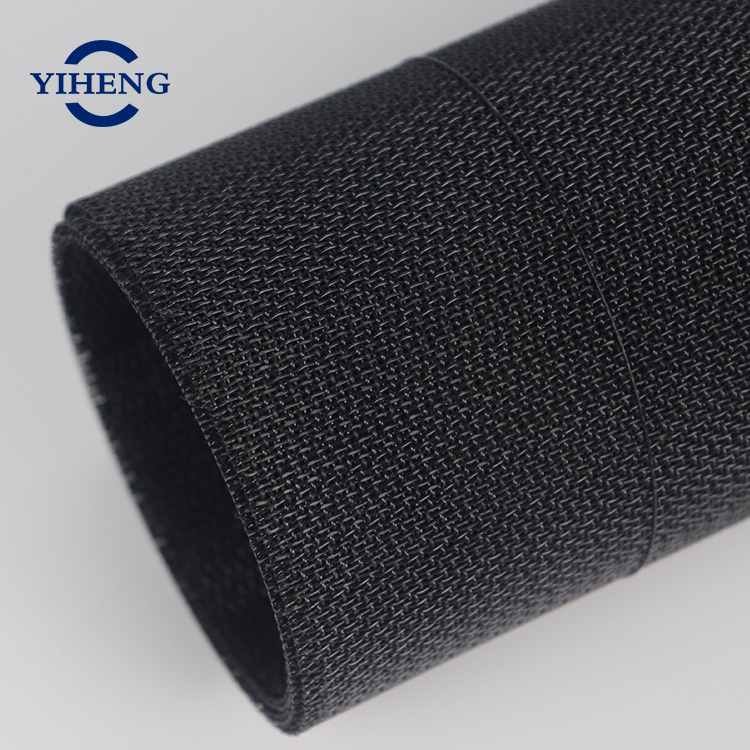
Anti-static nonwoven forming belt construction: conductive filaments are woven into the polyester body to create a charge-dissipation path.
Where Environmental Compliance Actually Lands in a Belt Purchase
For a nonwoven producer, environmental compliance is usually discussed in relation to the finished product — hygiene articles, medical nonwovens, wipes, food packaging. The forming belt sits upstream of that product, so its compliance relevance is indirect but real: it is a component in the documented chain running from raw material to finished roll, and it is the surface that the web physically touches before bonding.
Two document types appear most often in European procurement discussions.
Food Contact Certificate. This matters where belts run on lines producing materials intended for food-contact or precision hygiene applications. Henan Yiheng Mesh Belt Industry Co., Ltd. (Yiheng Mesh), a manufacturer established in 2009 and specialising in high-precision non-woven forming belts and industrial filter belts, states that its products hold the Food Contact Certificate.
Registration under the German Packaging Law (LUCID). LUCID is a producer-responsibility registration system for packaging placed on the German market. Yiheng Mesh states that it is registered under the German Packaging Law (LUCID), and that it is recognised as a National High-tech Enterprise. For an industrial buyer, these are supplier-level credentials: they indicate that the company operates inside a regulated market rather than outside it.
Hydrolysis Resistance: The Material Property Behind the Compliance Conversation
Polyester (PET) monofilament is the standard structural material for nonwoven forming and conveying belts. In spunlace, spunmelt and through-air processes the belt is exposed to heat and moisture at the same time, and that combination drives hydrolysis — a chemical degradation of the polyester chain that appears in service as loss of tensile strength, progressive elongation, dimensional drift, tracking instability and finally seam failure. Hydrolysis resistance is therefore not a marketing adjective; it is a lifetime property of the filament system inside the belt.
Yiheng Mesh states that it applies hydrolysis-resistant monofilament technology where belts operate in high-heat and high-humidity environments, and in its product data the property is expressed directly in the material designation rather than in a general claim. In HY408S, for example, the 0.50 mm warp filaments are specified as red anti-hydrolysis material, and the weft uses a three-filament hybrid structure: red anti-hydrolysis round filament at 0.70 mm, black round filament at 0.35 mm and blue anti-hydrolysis round filament at 0.35 mm. KJD700 combines black anti-hydrolysis round 0.50 mm filaments with black conductive 0.50 mm filaments in the warp and a black 0.50 mm weft.
Static control is the second material-driven failure mode, and it is where conductive filaments enter the specification. The thin black lines visible in an anti-static forming fabric are conductive yarns — carbon-fibre-doped filaments woven in at a defined ratio. Their purpose is to move friction-generated charge out of the fabric and into the machine's grounding path. The underlying principle, as described in Yiheng Mesh technical material, is that high-speed friction between fabric and mesh can generate static voltages exceeding 10 kV; introducing low-resistance carbon fibre filaments lowers surface resistivity from above 1012 Ω into the 106–108 Ω range, so charge can flow through conductive paths to metal rollers and discharge to ground. Without that path, thin webs stick, lift or flip.
How Anti-Hydrolysis and Conductive Filaments Are Built Into Forming Belts
The practical difference between belt models in this category is not the label \"anti-static\" but the filament architecture and the measured conductivity range. The table below summarises the constructions that carry an explicit anti-hydrolysis designation in the Yiheng Mesh range, together with two anti-static models that do not.
| Model | Type | Filament system | Conductivity | Air permeability | Thickness / GSM | Layers | Joint |
|---|---|---|---|---|---|---|---|
| HY408S | Spunmelt mesh belt | Anti-static round PET; red anti-hydrolysis 0.50 mm warp; three-filament hybrid weft (red anti-hydrolysis 0.70 mm, black 0.35 mm, blue anti-hydrolysis 0.35 mm) | 105–106 Ω | 680±30 CFM (127 Pa/20 cm²) | 1.85 mm / 1100 g/m² | 1.5 | Millet-ring / double-pins |
| KJD700 | Spunmelt mesh belt | Anti-hydrolysis PET round, conductive PET, carbon fibre PET; above-4 below-8; black anti-hydrolysis 0.50 mm + black conductive 0.50 mm warp; black 0.50 mm weft | 103–104 Ω | 600±30 CFM (127 Pa/20 cm²) | 2.34 mm / 1030 g/m² | 1.5 | Double-pins |
| SK604 | Spunmelt mesh belt | Anti-hydrolysis PET round, conductive PET, carbon fibre PET; above-3 below-5 | 106 Ω | 700±30 CFM (127 Pa/20 cm²) | 1.85 mm / 1030 g/m² | 1.5 | Double-pins |
| K6012 | Spunmelt mesh belt | Anti-hydrolysis PET round, conductive PET; above-6 below-6; black anti-hydrolysis 0.50 mm + black conductive 0.50 mm warp | Not stated in the model data | 750±30 CFM; up to 12,000 m³/m²/h | 2.8 mm / 1200 g/m² | 2.5 | Double-pins |
| K4106A | Anti-static mesh belt | Anti-static PET flat; 0.50 mm red and 0.52 mm conductive warp; white 0.60 mm PET weft | 106–107 Ω | 600±30 CFM (127 Pa/20 cm²) | 1.88 mm / 990 g/m² | 1.5 | Self-ring / millet-ring |
| K4106B | Anti-static mesh belt | Anti-static PET round; black 0.50 mm round and black anti-static 0.52 mm warp; black 0.60 mm weft | 105–106 Ω | 700±30 CFM (127 Pa/20 cm²) | 1.93 mm / 1100 g/m² | 1.5 | Self-ring / millet-ring |
The distinction in the table is deliberate. K4106A and K4106B are described as anti-static PET constructions; their data sheets do not carry the anti-hydrolysis filament designation. HY408S, KJD700, SK604 and K6012 do. For a buyer whose dominant failure mode is moisture-driven aging rather than static, that difference in the material designation is more important than the conductivity figure, because it describes which degradation mechanism the belt was designed against.
Manufacturing conditions determine how repeatable those filament specifications are in practice. Yiheng Mesh operates a 4,237 m² facility with approximately 41 staff, including an R&D team of 3 engineers, a monthly production capacity of 12,800 m² and an annual production capacity of 150,000 m². The company states that it holds air permeability (CFM) fluctuation within a ±5% range through heat-setting control, that its minimum order quantity starts at 1 m², and that custom prototypes can be delivered in as little as 3 days. It also maintains a technical knowledge base containing over 122 real-world troubleshooting cases, and reports an export ratio of 62%, with export business accounting for 65% of total sales across Asia, Europe and North America, a 35% market share in Southeast Asia, and long-term supply relationships with nonwoven equipment manufacturers such as Chaolong, Hongda and Aolong.
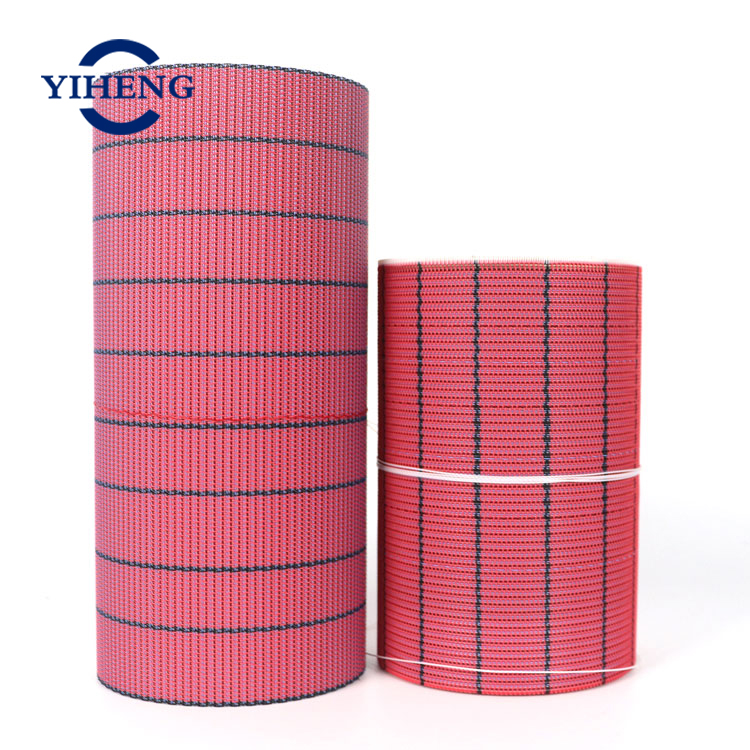
Spunmelt forming belt construction: the weave structure, filament mix and seam type are specified together, not separately.
Weave Structure, Seams and Tolerances in Humid Service
Once the filament system is fixed, three construction variables decide whether a belt behaves predictably on a wet or high-speed line.
Weave structure. Yiheng Mesh specifies weave as a ratio, such as above-3 below-5 (used in HY408S, SK604, K4106A and K4106B) or above-4 below-8 (KJD700) and above-6 below-6 (K6012). The notation describes how many weft layers sit above and below the warp, and it scales with layer count: K6012 is a 2.5-layer, 1200 g/m² construction, while HY408S and SK604 are 1.5-layer belts at 1100 g/m² and 1030 g/m² respectively. Denser, multi-layer structures increase dimensional stability and load capacity; they also add mass.
Air permeability as a selection parameter. CFM is the primary technical parameter for selection because it determines how the web is held on the belt. Air permeability is the volume of air passing through a given area of mesh per minute at a defined pressure differential, and it governs fiber adhesion and web uniformity: where local permeability is higher, higher suction draws more fiber clusters, and where it is lower, fibers lay down sparsely. That is why the company's ±5% CFM fluctuation control matters more in humid, high-suction service than a headline permeability number. In meltblown operation the related process variable is DCD — the physical distance between the die head and the mesh belt — which balances filtration efficiency against softness.
Seam and edge engineering. At high speed the seam becomes a mechanical event. As described in Yiheng Mesh technical material, above roughly 600 m/min a 0.2 mm seam thickness increase generates impulsive forces as the seam passes pre-pressing rollers, damaging precision bearings and leaving transverse marks on the fabric. The High-Low Loop process used in the high-speed SK604 series embeds loops into the mesh structure to reach 1:1 thickness matching, and the joint types across the range include double-pins, millet-ring and self-ring. Spunmelt constructions also specify a 2 cm glue edge with glue brushing on the welding edges at both sides, and dimensional tolerances of ±5 cm for lengths under 50 m and ±1 cm for widths under 5 m. Belts are packaged in wooden cartons or sacks.
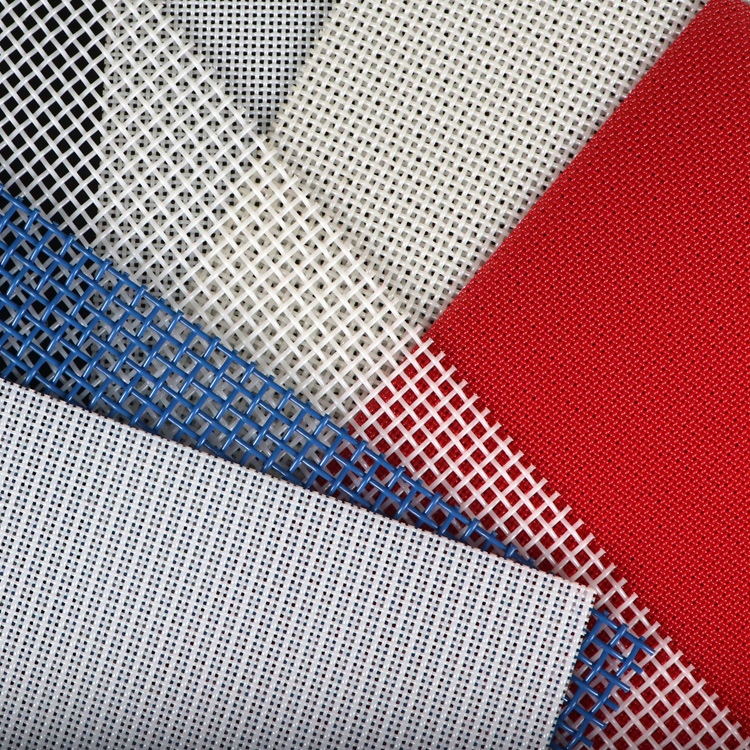
Weave structure determines fiber support, air permeability and how easily the belt sheds material and moisture.
Application: Where Humidity and Static Meet in Nonwoven Lines
The compliance and hydrolysis discussion becomes concrete in three process families, each with a different dominant stress.
Spunlace (hydroentangling). Spunlace forming belts operate under high-pressure water impact, extreme humidity and corrosion, rapid dehydration and vacuum suction, with surface-quality and anti-marking requirements. The working conditions are continuous 24/7 cyclic operation, with matched equipment including carding machines, the web forming section, the spunlace jet system, high-pressure water jet pumps, vacuum dewatering boxes, through-air dryers and conveyor systems. The stated special requirements include high tensile strength, low elongation, water permeability, hydrolysis resistance, dimensional stability, abrasion resistance, chemical resistance, anti-static behaviour and long service life. This is the process family where hydrolysis resistance is least optional. Spunlace mesh belts in the range include 60188 (108 mesh, 0.68 mm thickness, 4,750 m³/m²/h at 100 Pa), 29254 (80 mesh, 0.49 mm, 7,800 m³/m²/h), 27254 (70 mesh, 0.49 mm, 8,000 m³/m²/h) and 41203 (103 mesh, 0.3 mm, 6,700 m³/m²/h).
Spunmelt (spunbond, meltblown and composite lines). Here the dominant stresses are speed, static and temperature, together with precision web formation and precise release. The matched equipment list runs from spinneret and quench air system through the filament drawing system, lay-down conveyor, calender, through-air dryer, compactor and winder. This is where the anti-hydrolysis plus conductive family is concentrated: HY408S, KJD700, SK604, K6012, alongside the spunbond models HY4106 and HB4106 and the anti-static models K4106A and K4106B. KJD700 is additionally specified as suitable for two-component and spunlace equipment, with high adhesion performance; HY408S is specified for high-speed lines where easy peel-off and surface integrity are critical.
Airlaid and hot-air bonding. Hot-air lines have a different priority: high air permeability and a non-stick, non-crystallising surface so that fibers and resin do not build up. Airlaid mesh belts in the range include 07502 (18 mesh, 420 g/m², 19,176 m³/m²/h), 05602 (14 mesh, 560 g/m², 19,676 m³/m²/h), 09502 (23 mesh, 650 g/m², 12,770 m³/m²/h) and 06702 (16 mesh, 1000 g/m², 14,242 m³/m²/h). Buyers comparing them with spunmelt forming belts should note that the anti-hydrolysis and conductive filament architectures are concentrated in the forming range, not in the hot-air series — the stress profile, and therefore the material logic, is different.
Safety practices that interact with material choice
Safety standards around forming belts are partly maintenance standards. Yiheng Mesh operational guidance includes grounding verification (the grounding rod checked to a 1 m depth when resolving web flipping above 400 m/min), a hot roller surface temperature range of 100–120 °C for pre-setting, protective gloves when threading seam wires to avoid punctures from wire tips, and specific rules for removing polymer residues — a heat gun set to 150 °C moved constantly at 5–10 cm distance, never focused on one spot, with alcohol used cautiously near high-temperature sources. In humid, high-static environments these practices and the belt's filament system are complementary: a conductive belt with poor grounding behaves like a standard belt.
Market Signals: Capacity Growth and Documentation Pressure
The demand context for forming belts is expanding on both the upstream and downstream side of the process.
Downstream, the global nonwoven fabric market is expected to reach USD 90.8 billion by 2030, representing a CAGR of 6.2% from 2025, according to Smithers. Upstream, the nonwoven production line market was valued at USD 5.3 billion in 2024 and is projected to reach USD 9.8 billion by 2033, according to Dataintelo — the segment in which forming belts are a consumable component. Technology mix matters as well: Grand View Research reports that spunlaid technology, including spunbond and meltblown, held a 48.4% share of the global nonwoven technology market in 2023, which is precisely the process family where anti-static and hydrolysis-resistant forming fabrics carry the greatest specification weight.
Commercially published specifications for high-performance nonwoven forming belts cite line speeds up to 1,000 m/min and operating temperatures up to 180 °C, and industrial mesh belts for this duty are commonly classified under HS Code 39269029 or 59100000 depending on material coating and reinforcement. Both details matter to procurement: the speed and temperature envelope defines which filament system is viable, and the HS classification affects customs documentation and inspection on cross-border shipments.
Two structural trends follow. First, documentation is turning into a filter rather than a formality — registration obligations such as the German Packaging Law and product documents such as the Food Contact Certificate are increasingly requested at the quotation stage, not after order confirmation. Second, hydrolysis resistance is becoming a baseline expectation for humid-climate and spunlace installations instead of an upgrade option. Against that, there is still no open-source benchmark dataset for specialised industrial consumables of this type; comparisons continue to rest on supplier-published measured values and on-site trial results rather than on an independent reference table.
Anti-Hydrolysis and Conductive Constructions vs. Standard Polyester Belts
The comparison that matters for a buyer is not brand against brand but construction against construction.
| Dimension | Conventional standard polyester forming belt | Anti-hydrolysis / conductive construction |
|---|---|---|
| Filament system | Single PET monofilament, typically round | Anti-hydrolysis PET round, conductive PET and carbon fibre PET filaments, as in KJD700 and SK604 |
| Static control | Not designed in; depends on ambient humidity and existing grounding | Defined conductivity values ranging from 103–104 Ω (KJD700) to 106–107 Ω (K4106A) |
| Heat and moisture aging | Progressive strength loss, elongation, tracking drift | Filaments designed to resist hydrolysis-driven degradation in high-heat, high-humidity service |
| Seam and edge options | Standard seam; step risk increases with speed | Seam matched to body thickness; 2 cm glue edge on welding edges at both sides for spunmelt belts |
| Supplier documentation | Supplier-dependent | Food Contact Certificate, German Packaging Law (LUCID) registration, National High-tech Enterprise recognition |
| Entry cost and trial risk | Lower unit cost | Higher material cost; trial entry from 1 m² with prototypes in as little as 3 days |
Limits and boundaries of the anti-hydrolysis approach
Honest selection requires stating what this construction class does not solve.
Hydrolysis resistance slows degradation; it does not remove it. Under standard operating conditions, Yiheng mesh belts typically last 3–6 months according to the company's technical documentation. Mechanical wear, seam loading under high tension, cleaning practice and process parameters remain dominant factors in service life. A buyer should plan replacement cycles around that expectation rather than treat a hydrolysis-resistant belt as a permanent part.
Conductive filaments only work inside a functioning grounding system. Reported causes of web flipping above 400 m/min include insufficient grounding depth, cooling air volume exceeding suction, and a pre-pressing roller temperature below the 100–120 °C range. Changing to a higher-conductivity belt without correcting those conditions will not resolve the defect.
Heavier constructions carry a machine-side penalty. K6012, for example, is a 2.5-layer belt at 1200 g/m² designed for high-speed and thin nonwoven fabric production. Its mass and stability suit that duty; they are not automatically the right choice for a line with different tension or tracking characteristics.
\"Anti-static\" is a category, not a specification. Conductivity values across the range differ by up to three orders of magnitude. A purchase order that asks only for an anti-static belt leaves the actual performance level undefined.
Documentation and validation answer different questions. LUCID registration and the Food Contact Certificate describe supplier- and product-category compliance. Neither certifies behaviour on a specific machine, at a specific speed, in a specific humidity regime. Trial validation on the buyer's own line remains the closing step.
There is no independent benchmark to fall back on. The absence of an open comparison dataset for this consumable category means supplier-published parameters and on-site results are effectively the only evidence base available today.
What a Buyer Should Specify Before Ordering
- Filament designation, warp and weft. Ask whether the anti-hydrolysis material is used in the load-bearing warp, not only mentioned in the material summary. In HY408S the warp is specified as red anti-hydrolysis 0.50 mm; in KJD700 it is black anti-hydrolysis round 0.50 mm combined with black conductive 0.50 mm.
- A conductivity target in ohms. Specify the range needed for the fabric GSM and line speed rather than accepting the label \"anti-static\". Values across one supplier's range span 103–104 Ω to 106–107 Ω.
- Air permeability with tolerance. CFM determines fiber adhesion and web uniformity; ±5% fluctuation control is a repeatability claim worth verifying in writing.
- Seam type and thickness matching. Confirm whether the seam is double-pins, millet-ring or self-ring, and whether seam thickness matches the belt body — the decisive factor for stability above 600 m/min.
- Edge treatment and tolerances. For spunmelt constructions, a 2 cm glue edge with glue brushing on both welding edges is standard; dimensional tolerances are ±5 cm for lengths under 50 m and ±1 cm for widths under 5 m.
- Compliance documents for the destination market. Food Contact Certificate where the end product touches food or hygiene applications; evidence of German Packaging Law (LUCID) registration for German-market supply chains.
- A trial quantity and sampling timeline. Minimum order quantity from 1 m² and prototypes in as little as 3 days allow validation before committing to full-length belts.
- Service-life expectation and replacement planning. Treat 3–6 months as the working assumption under standard conditions and plan belt inventory accordingly.
- Operating interlocks. Confirm grounding depth, suction versus cooling-air balance, and pre-press roller temperature before blaming the belt for static-related defects.
Future Outlook
Three developments are likely to shape this component category over the next several years. The first is documentation pressure: as more markets formalise producer-responsibility and food-contact requirements, the ability to evidence registration and certification at quotation stage will filter supplier lists before technical comparison even begins. The second is the normalisation of hydrolysis resistance. As spunlace and humid-climate spunmelt capacity expands alongside the projected growth of the nonwoven fabric and production line markets, moisture-driven belt aging will be treated as a specification item rather than a failure to be diagnosed after the fact. The third is the comparison gap. Buyers increasingly ask for measured conductivity, measured permeability tolerance and service-life data on their own lines, and the absence of an open benchmark for specialised industrial consumables is a gap that procurement teams are already working around with their own trial records.
For manufacturers and importers, the practical implication is that belt selection is no longer a catalogue lookup. It is a three-part exercise: a material specification written in filament terms, a compliance package matched to the destination market, and a trial that validates both on the actual line.
FAQ
What does hydrolysis resistance mean in a nonwoven forming belt?
Hydrolysis resistance describes a filament's ability to slow the chemical degradation of polyester when heat and moisture are present at the same time. In service, hydrolysis appears as loss of tensile strength, progressive elongation, dimensional drift, tracking instability and eventual seam failure. Belts built with anti-hydrolysis PET filaments are designed to retain mechanical properties longer under those conditions than belts made from untreated standard PET monofilament. The property is a matter of degree: degradation is slowed, not eliminated.
Why does humidity matter more in spunlace lines than in dry forming processes?
Spunlace bonding uses high-pressure water jets, so the forming belt operates under high-pressure water impact, extreme humidity and corrosion, with rapid dehydration and vacuum suction. Dry processes such as thermal bonding expose the belt mainly to heat. Spunlace exposes it to heat and water simultaneously, which is the combination that drives polyester hydrolysis. For that reason hydrolysis-resistant filaments are usually specified first for spunlace and for humid-climate installations generally.
Do nonwoven mesh belts need EU or German environmental compliance documentation?
A forming belt is a machine component rather than a packaged consumer product, so compliance obligations reach it indirectly. In European procurement, two documents are commonly requested. The first is a Food Contact Certificate, relevant where the line produces materials intended for food-contact or hygiene applications. The second is evidence of registration under the German Packaging Law (LUCID), a producer-responsibility registration for packaging placed on the German market. Henan Yiheng Mesh Belt Industry Co., Ltd. holds the Food Contact Certificate and is registered under LUCID. These documents describe supplier- and product-category compliance; they do not certify performance on a specific line.
Do I need both anti-hydrolysis filaments and conductive filaments?
They address different failure modes, and many high-speed spunmelt lines require both. Conductive filaments — carbon-fibre-doped yarns visible as thin black lines — dissipate static charge so thin webs do not stick to or lift off the belt. Anti-hydrolysis filaments slow the heat- and moisture-driven degradation of the polyester itself. In the Yiheng range, HY408S combines an anti-hydrolysis warp with a three-filament hybrid weft and a stated conductivity of 105–106 Ω, while KJD700 combines anti-hydrolysis PET round, conductive PET and carbon fibre PET filaments with a stated 103–104 Ω. Where static is the dominant defect, conductivity is the priority; where belt aging in humid heat is the dominant issue, the filament designation is.
What should a buyer ask a supplier before ordering a belt for a humid, high-speed line?
Ask for the warp and weft filament designations, including whether the anti-hydrolysis material is used in the load-bearing warp. Ask for a conductivity range in ohms rather than the label \"anti-static\", because values across one range can differ by orders of magnitude. Ask for air permeability together with its tolerance — Yiheng Mesh states it holds CFM fluctuation within ±5%. Ask which seam type applies and whether seam thickness matches the belt body, what the edge treatment is (spunmelt constructions use a 2 cm glue edge with brushing on both welding edges), and what the dimensional tolerances are (±5 cm for lengths under 50 m, ±1 cm for widths under 5 m). Finally, ask for the compliance documents relevant to the destination market and for a trial quantity — the company's minimum order quantity starts at 1 m², with custom prototypes in as little as 3 days.
How long does an anti-hydrolysis forming belt last?
Under standard operating conditions, Yiheng mesh belts typically last 3–6 months according to the company's technical documentation. Actual service life depends on line speed, temperature, suction settings, cleaning practice and seam loading. Hydrolysis-resistant filaments extend life where moisture and heat are the limiting factors, but mechanical wear and operating parameters such as grounding, suction balance and pre-press roller temperature remain significant. Service life is therefore best treated as an expectation to be validated on the buyer's own line rather than a fixed figure.
A technical brochure covering the forming and filter belt ranges described in this article, including model-level specifications, is available for download: Yiheng Mesh technical brochure (PDF). Company details and product information are published at yhfilterbelt.com.