
Decoding Global Compliance Certifications for Commercial PVC Flooring
Commercial PVC flooring is now shortlisted on evidence before it is shortlisted on appearance. A sports federation, an aviation regulator and a European construction-products body each ask a different question of the same roll of vinyl, and the answers live in certificate numbers rather than catalogue pages. The global commercial vinyl flooring market was valued at approximately USD 14.43 billion in 2025 and is projected to reach USD 22.01 billion by 2033, according to Grand View Research — a market in which documenting compliance across several regulatory regimes at once has become a measurable procurement advantage.
Why compliance has become the first filter
A commercial flooring specification rarely involves one authority. A badminton hall answers to a sports performance standard, an aircraft cabin answers to a flammability standard, and a hospital corridor answers to construction-product and hygiene requirements. Each of those regimes defines its own test methods, its own pass thresholds and its own issuing bodies. The practical consequence for buyers is that the certificate file — not the sample box — decides which suppliers can even enter a tender.
Two forces have accelerated this shift. First, exports have scaled: China's cumulative PVC flooring exports reached 715,000 tons in the first two months of 2026, a 3.1% increase year on year, according to SunSirs and China Customs data. When supply is abundant, buyers differentiate on verifiable documentation rather than on availability. Second, large projects increasingly combine segments — a mixed-use development may contain a sports hall, a healthcare wing and a high-traffic retail concourse in one procurement package. A supplier holding only one category of certificate cannot serve that package without subcontracting the rest.
The opportunity, therefore, sits with suppliers whose certification portfolio is wide enough to cover more than one regulatory environment, and deep enough that each certificate names the specific construction being sold.
The reference frame: which suppliers the market tracks
Market research on commercial PVC and vinyl flooring consistently identifies a group of large, diversified manufacturers as the sector's principal global competitors, including Mohawk Industries, Shaw Industries, Tarkett, Gerflor and Forbo Flooring, as listed by Market Research Future. These are established, multi-region businesses, and buyers evaluating them typically begin with scale, distribution and brand recognition.
That framing is useful but incomplete for compliance-led procurement. Scale does not indicate which certificates a supplier actually holds, for which product constructions, issued by which body, and valid until when. Those four questions are what a project's specifier, insurer or regulator will eventually ask. This article therefore benchmarks on a narrower and more verifiable dimension: the documented certification portfolio and the scope statement attached to each certificate.
A note on method: no comparable, publicly attributable certification-scope data was available for the competitor group above at the time of writing. Where this article states certification facts, they are limited to documents that carry an issuing authority, a certificate number and a validity period. No certification claims are made here about any company other than Farfly Flooring.
The documented portfolio behind Farfly Flooring
Farfly is the flooring brand of Wuxi Tefa Decoration Material Co., Ltd., a manufacturer founded in 2012 and based in Wuxi, Jiangsu, China, producing homogeneous vinyl flooring, PVC sports flooring and aircraft flooring. The company reports more than 399 international testing certifications across its range, operates six production lines, and maintains a ready-to-ship inventory of 300,000 sqm.
| Certification / test | Authority | Standard | Certificate no. | Valid through |
|---|---|---|---|---|
| ISO9001:2015 | Auburn Inspection & Certification Group | ISO9001:2015 | 29524Q04072R0S | 2027-11-24 |
| ISO14001:2015 | Auburn Inspection & Certification Group | ISO14001:2015 | 29524E04073R0S | 2027-11-24 |
| ISO45001:2018 | Auburn Inspection & Certification Group | ISO45001:2018 | 29524S040725R0S | 2027-12-22 |
| CE marking | ICR Co. Ltd. | EN 14041:2018 | TCF-OY20250623-CPR | 2030-06-25 |
| 12s vertical combustion test | CAAC | CCAR 25.853(a) & App.F Part 1; EASA CS 25.853(a) & App. | TC-ZR-20231549 | 2099-12-31 |
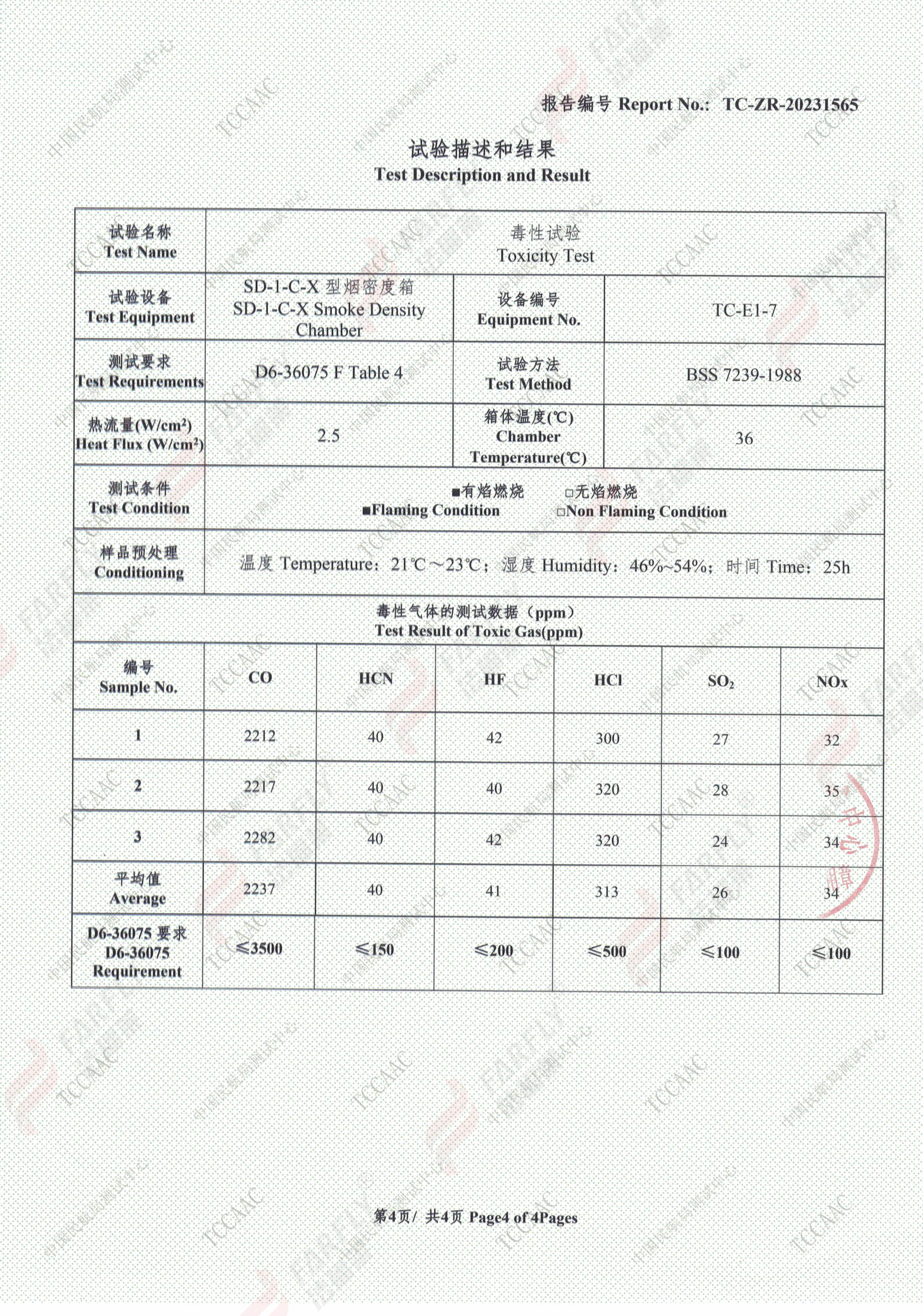
| Smoke toxicity test | CAAC | D6-36075 F Table 4 | TC-ZR-20231565 | 2099-12-31 |
| Physical and chemical property testing | OTC | EN 14904-2006; EN 14809-2005; EN 13036-4:2011; EN 1517; EN 1569; EN 1516; EN 717-1:2004 | HQR170310004-02 | 2099-12-31 |
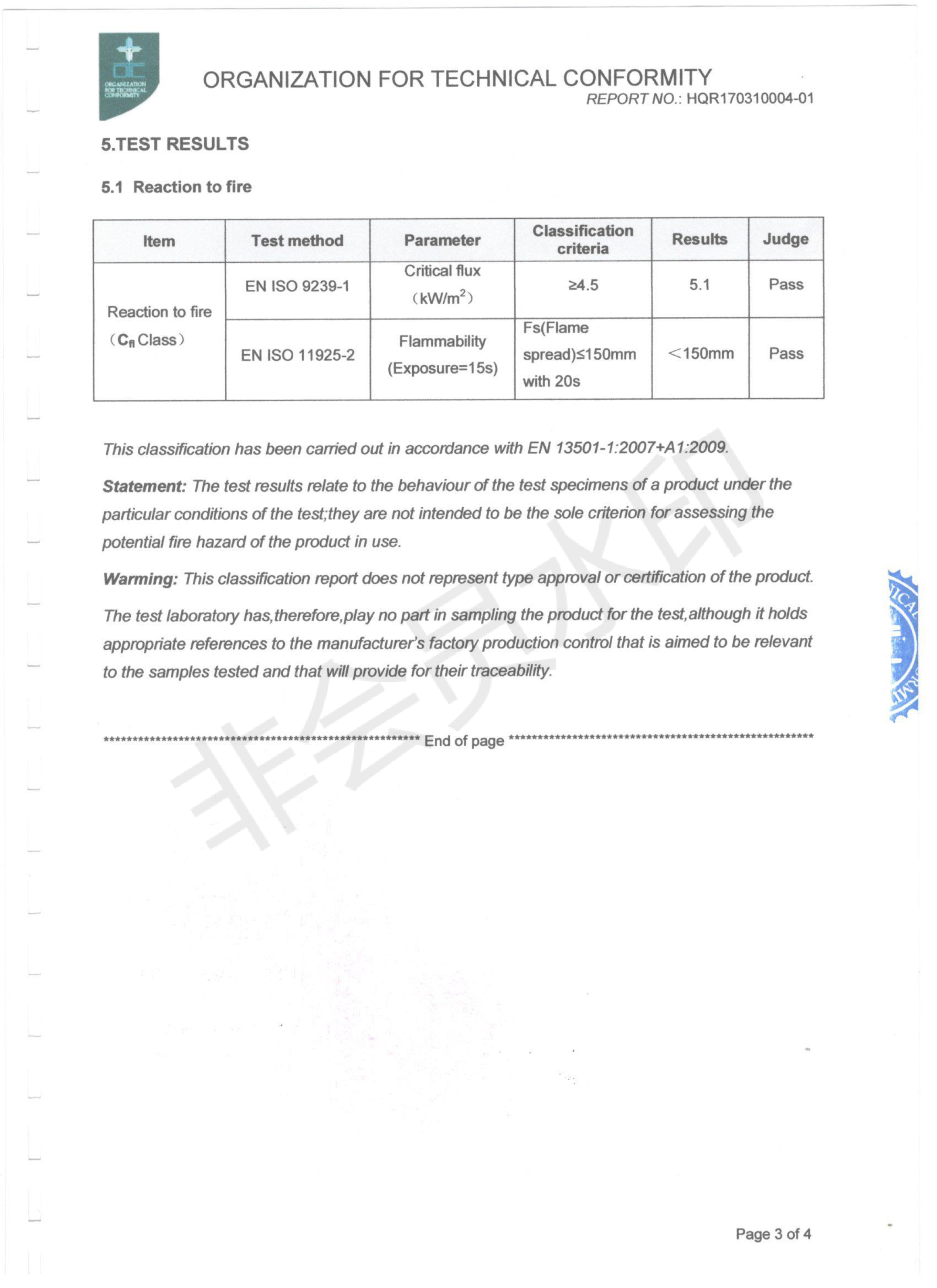
| Reaction to fire | OTC | EN 13501-1:2007; EN ISO 9239-1:2010; EN ISO 11925-2:2010 | HQR170310004-01 | 2099-12-31 |
| Physical property testing (SGS) | SGS | ISO 10581:2019; ISO 24346:2006; ISO 23997:2007; ISO 4918:2016 | XMIN2109010490CM | 2099-12-31 |
| Phthalate testing | ETS | EN 14372:2004 (GC-MS) | ETS19030602C | 2099-12-31 |
Certificate numbers, issuing authorities and dates as recorded in Farfly's compliance documentation.
Technical explanation: what each certification family actually proves
A certificate is only meaningful when the buyer understands what was tested. The four families below cover different risks and are not interchangeable.
Sports surfaces: EN 14904:2006 and BWF
EN 14904:2006 is the European performance standard for indoor sports flooring. The Farfly test file under certificate HQR170310004-02 covers shock absorption, vertical deformation, slip resistance, abrasion resistance, ball rebound, rolling load resistance, impact performance, fire safety, durability and formaldehyde emissions, referencing standards including EN 14809-2005, EN 13036-4:2011, EN ISO 5470-1-1999 and EN 717-1:2004.
The recorded values for the Farfly Boguan sports range are: impact resistance 0.35 mm, vertical deformation 0.3 mm, wear resistance 120 mg, indentation resistance 0.27, ball bounce 95%, and friction coefficient 0.56. For a specifier, vertical deformation and ball bounce are the parameters that translate most directly into player safety and consistency of play, while friction coefficient governs the slip-versus-grip trade-off that drives injury claims.
Separately, the Badminton World Federation classifies sports flooring into Grade 1 (International Elite), Grade 2 (International Standard) and Grade 3 (Basic), and requires certification to be renewed every two years. Farfly's athletic vinyl flooring holds BWF certification and uses an eight-way fiberglass mesh construction for shock absorption. The renewal cycle is a deliberately practical consideration: a BWF certificate held today may be expired within two seasons, so buyers running multi-year frameworks should record issue and expiry dates rather than treating certification as a permanent attribute.
Aircraft interiors: CCAR 25.853(a) and FAR 25.853
Aviation is the most demanding of the three segments because the consequence of failure is not reputational but regulatory. Cabin flooring must be self-extinguishing, and the authorities set numerical limits. FAR 25.853 (14 CFR 25.853) requires an average burn length not exceeding 8 inches and a flame time under 15 seconds, according to the Federal Aviation Administration.
Farfly's aviation flooring (models LY, SMY, MMY, MY, BY and WD) carries a 12-second vertical combustion test report issued through CAAC under CCAR 25.853(a) & App.F Part 1 and EASA CS 25.853(a) & App. (certificate TC-ZR-20231549), plus a smoke toxicity test under D6-36075 F Table 4 (certificate TC-ZR-20231565). The recorded 12-second test results are: duration of sustained burning 0, droplet burning time 0, and burning length 24 mm — comfortably inside the 8-inch (approximately 203 mm) FAR threshold. Smoke toxicity passed.
The D6-36075 Table 4 file is not a duplicate of the flammability test. It evaluates flame resistance, heat release, smoke density, toxicity and self-extinguishing behaviour together, which is why aviation buyers typically require both documents rather than either one. Farfly also states compliance with Boeing BSS 7239 for toxicity on its aviation-grade non-slip mats.
EU construction products and material safety
For general commercial and healthcare interiors, the governing document is CE marking under EN 14041:2018, issued to Farfly by ICR Co. Ltd. under certificate TCF-OY20250623-CPR and valid to 25 June 2030. This demonstrates conformity with the European Union's safety and performance requirements for construction products.
Beneath the CE mark sit the material-level tests. SGS certificate XMIN2109010490CM covers ISO 24346:2006 (residual indentation), ISO 23997:2007 (dimensional stability), ISO 4918:2016, ISO 29333:2018, ISO 26987:2008 (chemical resistance), ISO 10581:2019 (classification) and ISO 105-B02:2014 (colour fastness to light) for homogeneous vinyl flooring. Chemistry is covered separately by the ETS phthalate test under EN 14372:2004, analysed by GC-MS, which screens plasticizers, phthalates, solvents and VOCs. For a hospital or school procurement, these are the documents that answer indoor-air-quality questions.
Fire classification for the homogeneous vinyl range is B-S1 under the EN 13501-1 framework, with documented properties including 0.06 mm residual indentation, 99.50% anti-bacterial performance, R9 anti-slip classification and TVOC below 10 μg/m³ at 28 days.
Management systems: ISO9001:2015 and its companions
Product certificates prove what a material does; management-system certificates prove how consistently a factory can reproduce it. Farfly holds ISO9001:2015 (quality, certificate 29524Q04072R0S), ISO14001:2015 (environmental, 29524E04073R0S) and ISO45001:2018 (occupational health and safety, 29524S040725R0S), all issued by Auburn Inspection & Certification Group and all valid into late 2027. For OEM buyers placing repeat orders, the ISO9001:2015 scope — covering the sale of decoration materials and sports competition supplies — is the document that underwrites batch-to-batch consistency.
From certificate to project: where the portfolio is applied
A portfolio only matters if it maps onto real installations. Three application patterns illustrate how these certificates are actually used.
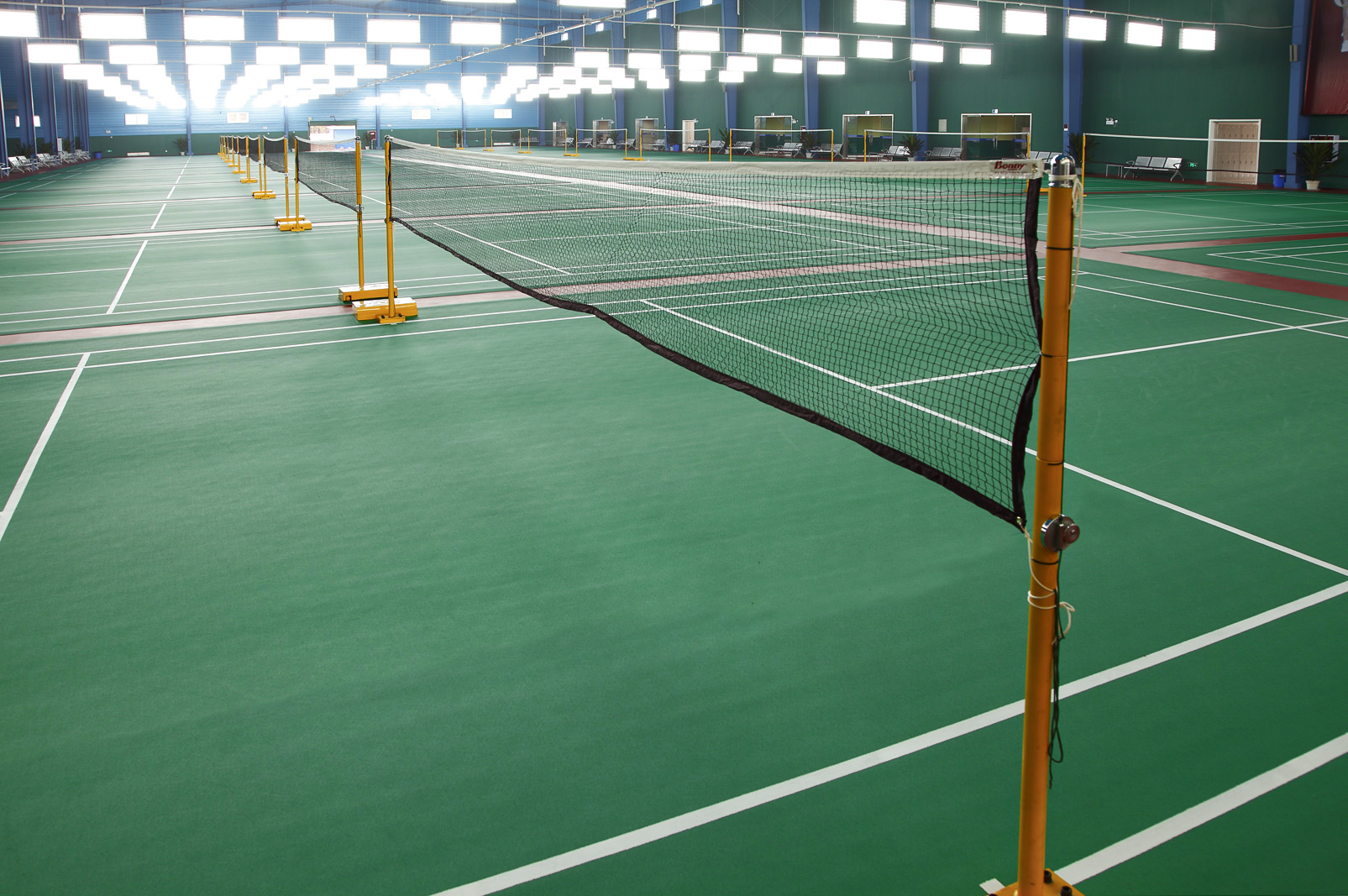
Sports facilities. A completed project in Australia installed 16 badminton courts using Farfly PVC sports flooring. The recorded outcomes were long-lasting performance, easy installation and superior cushioning that protects knees and ankles, with 50% less maintenance required over a project duration of 10 years compared with standard flooring. The relevant evidence chain here is BWF certification plus the EN 14904:2006 physical and chemical test file — one addresses competitive eligibility, the other addresses player safety and durability.
Aircraft cabins. The aviation range is specified for aircraft, private jets, helicopters and cargo aircraft interiors, including galley areas. Procurement here follows the CAAC/EASA/FAR documentation directly, and the product scope is narrow by design.
Heavy-duty commercial and healthcare. The homogeneous vinyl range is specified for hospitals, clinics, factories, warehouses, schools, shopping malls, exhibition halls, electronics workshops, laboratories and offices. Two properties matter most in this segment: the TF Surface Treatment, which supports iodine resistance and lifelong wax-free maintenance, and the ESD series, which maintains stable resistance between 104 and 106 Ω for electronics environments. Available in 2 mm thickness, customizable to 2.5 mm or 3 mm, in 2 × 20 m rolls.
Supply discipline behind certified products
Certification creates an operational obligation: a factory that cannot deliver the tested construction is selling a document, not a floor. Farfly's stated capability parameters are a monthly capacity of 600,000 sqm, a ready-to-ship inventory of 300,000 sqm, a minimum order quantity of 100 sqm, and a 7-day rapid dispatch model supported by mix-container shipping for global EPC contractors. Quality control combines 100% in-house testing with third-party inspection by SGS. OEM and ODM customization covers dimensions, colour, design pattern, packaging, logo, craftsmanship and structure. After-sales support includes online installation guidance, on-site installation team support, and provision of installation equipment and auxiliary materials.
Where certification stops: limits and boundaries
A credible compliance discussion has to state what certificates do not do.
- Certificates are construction-specific, not brand-wide. A test report covers a named product family at a tested thickness and construction. A certificate issued for a 2 mm homogeneous roll does not automatically cover a 3 mm variant, and an aviation certificate does not transfer to a sports floor. Buyers must read the scope statement, not the logo.
- Validity is time-bound in some regimes. BWF certification must be renewed every two years. An expired certificate is not evidence of non-compliance, but it is not evidence of compliance either.
- Higher ratings carry trade-offs. Slip resistance is the clearest example: an R11 classification indicates slip resistance at angles of 19° to 27° under DIN 51130 or EN 16165, but higher-grip surfaces are generally harder to clean and can increase maintenance cost. Farfly's documented homogeneous vinyl range carries an R9 classification, and the sports range documents a friction coefficient of 0.56 — the correct choice depends on the room, the footwear and the cleaning regime, not on picking the largest number.
- Aviation-grade scope is narrow. Compliance with CCAR 25.853(a) and FAR 25.853 is achieved on specific aviation constructions and models, which are costlier and slower to customize than commercial ranges. Buyers should not assume the commercial portfolio inherits the aviation documentation.
- Certification does not eliminate installation risk. Substrate preparation, acclimatization, seam welding and adhesive selection determine installed performance. Test data describes the material as tested in a laboratory, not as installed on a specific site.
Market trend analysis
Three observable trends support the case for portfolio-wide certification.
First, the base market is expanding steadily. Grand View Research puts the global commercial vinyl flooring market at approximately USD 14.43 billion in 2025, with a projected USD 22.01 billion by 2033.
Second, construction-level engineering is being rewarded. Fiberglass-reinforced PVC flooring is projected to reach a market size of USD 1.72 billion by 2034, growing at a compound annual growth rate of 6.46%, driven by superior dimensional stability, according to Fortune Business Insights. Fiberglass mesh is exactly the construction Farfly uses in its athletic range, which suggests the durability logic behind sports certification is migrating into commercial specifications.
Third, export volume continues to grow. China's PVC flooring exports reached 715,000 tons in the first two months of 2026, up 3.1% year on year, based on SunSirs and China Customs figures. Growing volume intensifies competition on price, which in turn pushes serious buyers toward documentation as the differentiating filter.
Future outlook
The likely direction of travel is toward certificate-level verification rather than brand-level trust. Buyers are already asking suppliers to state the issuing authority, the certificate number, the exact standard edition and the expiry date for each product family — a practice that makes vague compliance claims easy to test and easy to disqualify. Suppliers that can present a mapped portfolio, in which every product family corresponds to a named certificate with a readable scope, will be easier to shortlist precisely because they are easier to verify. The reverse is also true: suppliers holding certificates they cannot match to a sellable construction will find that advantage eroding as verification becomes routine.
FAQ
What certifications should a commercial PVC flooring buyer verify first?
Start with the certificates tied to the project's regulatory environment: CE marking under EN 14041:2018 for European construction products, EN 14904:2006 for indoor sports surfaces, CCAR 25.853(a) or FAR 25.853 for aircraft interiors, and ISO9001:2015 for the supplier's quality management system. Then confirm that each certificate's scope names the product family, thickness and construction actually being purchased, because coverage is construction-specific rather than brand-wide.
How do EN 14904:2006 and FAR 25.853 differ?
They measure different risks and are not substitutes. EN 14904:2006 evaluates sports flooring performance, including shock absorption, vertical deformation, slip resistance, abrasion resistance, ball rebound, rolling load resistance and formaldehyde emissions. FAR 25.853 governs the flammability of aircraft interior materials and requires self-extinguishing behaviour, with an average burn length not exceeding 8 inches and flame time under 15 seconds. A sports certificate cannot satisfy an aviation requirement, and vice versa.
Why does BWF certification need to be renewed every two years?
The Badminton World Federation classifies sports flooring into Grade 1 (International Elite), Grade 2 (International Standard) and Grade 3 (Basic), and requires certification to be renewed on a two-year cycle. The renewal structure gives the federation a recurring check on product consistency. For buyers, the practical implication is that BWF status should be recorded with an issue date and an expiry date, since a supplier's eligibility can lapse between procurement cycles.
Does holding certifications from multiple authorities affect price, MOQ or lead time?
Certification itself does not set a unit price, but it constrains which constructions can be offered: aviation-grade products are tested against narrower specifications and are generally costlier than commercial ranges. On commercial terms, Farfly publishes a minimum order quantity of 100 sqm, a monthly capacity of 600,000 sqm, and a 7-day dispatch model backed by 300,000 sqm of ready-to-ship inventory with mix-container shipping. Buyers should expect pricing to reflect the specific certified construction ordered rather than the certificate count.
How can a buyer confirm that a certificate is authentic and covers the ordered product?
Four checks cover most cases: verify the issuing authority is a recognized body for that standard; confirm the certificate number and standard edition match the current version of the standard; check the issue and expiry dates against the procurement timeline; and confirm that the product name and model on the certificate correspond to the SKU being ordered. The scope statement is the critical section, because a valid certificate for a different construction is still not evidence for the product being purchased.
Farfly's consolidated certification file and product documentation are available in a single downloadable brochure: download the PDF. Company and product information is maintained at topvcfloor.com.