
Decoding Global Compliance: ISO, FSC, SEDEX and CE for Dry Wipes
Compliance paperwork has become the first real filter in dry wipes procurement. Buyers compare flow pack and boxed formats, request samples and negotiate pricing, then the order stalls at the same point: someone in the supply chain asks for the certificate folder, and the folder turns out to be a stack of PDFs that look alike and answer completely different questions.
For dry wipes sourcing, compliance evidence splits into three layers. Facility-level management system certificates describe how a plant is run. Material or product conformity documents describe a standard that a product stream meets. Batch-level release records describe the goods actually shipped. ISO 50001:2018 certificate 01326En0008R101 issued by GAC, CE and GMPC documentation, and FSC-STD-40-004V3.0 chain-of-custody records sit in different layers of that stack. Treating them as interchangeable is where most first-time buyers lose weeks.
Zhejiang Uniquality Nursing Products Technology Co., Ltd. (Uniquality) is a Chinese OEM/ODM manufacturer of personal care products, including baby diapers, training pants, baby wipes and dry wipes, operating from a 1,000,000 ² smart manufacturing site and exporting to the USA, EU, SAM, RU and CASA markets. Its published certification portfolio is a useful working example for the hierarchy below.
Why Certification Became a Procurement Gate
The global dry wipes segment reached USD 13.6 billion in revenue in 2024, driven by its versatility in medical and household applications, according to ResearchAndMarkets data distributed via GlobeNewswire. Growth at that scale pulls regulatory attention with it, and retail buyers in mature markets increasingly require suppliers to document hygiene controls rather than describe them.
The practical effect on sourcing is that compliance questions now arrive before commercial ones. Instead of asking whether a supplier can produce soft, absorbent nonwoven sheets, procurement teams ask which standard the plant is certified to, who issued the certificate, what the scope statement covers, and what evidence exists for the specific batch on the water. A supplier that can answer those four questions in sequence shortens the qualification cycle for every subsequent order.
The Three-Layer Compliance Hierarchy
The layers are not ranked by importance. They are ranked by what they can prove. A facility certificate cannot prove a pouch of cleansing dry wipes meets a microbial limit, and a test report cannot prove a plant runs consistent hygiene controls across a year.
| Layer | What it certifies | Examples relevant to dry wipes | What it does not prove |
|---|---|---|---|
| Facility / management system | The site, its processes and its operating controls | ISO 50001:2018 energy management (certificate 01326En0008R101, issued by GAC), GMPC, ISO-listed quality documentation, 100,000-class clean room operation | That a specific SKU meets a specific safety or hygiene limit |
| Material / product conformity | A material stream or a market-access requirement | FSC-STD-40-004V3.0 chain of custody for wet wipes, CE documentation | That the site maintains consistent environmental and hygiene controls over time |
| Batch / release evidence | The shipment that is actually moving | Pre-shipment testing, microbial counts, retained samples per batch | Long-run capability, or certification status of the manufacturer |
Most sourcing disputes traced back to certification are not about whether a certificate is genuine. They are about which layer the buyer assumed they were looking at.
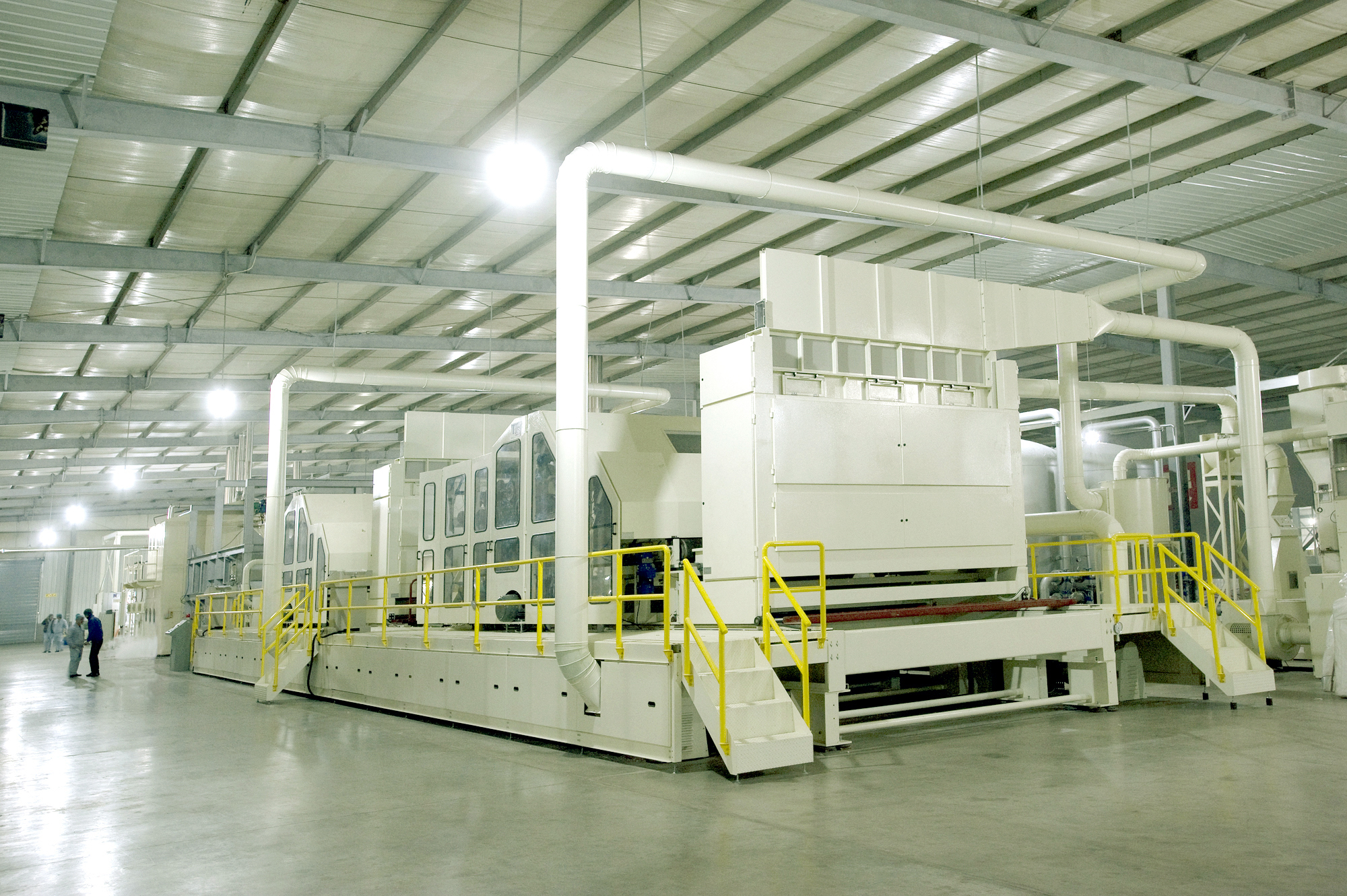
Facility-layer evidence: wipes production running in a 100,000-class GMP cleanroom, the environment referenced by the manufacturer’s hygiene and system certifications.
Reading a Certificate the Way an Auditor Would
A certificate reference only carries meaning when it is read with four companions: the standard it certifies, the body that issued it, the scope statement, and the validity window. The string 01326En0008R101 is not self-explanatory. Paired with ISO 50001:2018 and the issuing body GAC, it becomes a checkable claim about energy management at a defined site.
Buyers evaluating dry wipes suppliers can apply five checks in order:
- Issuing body. Identify who signed the certificate and whether that body is recognised in the destination market. The certificate number usually encodes the issuer.
- Standard designation and year. Standards are revised. ISO 50001:2018 is a different document from earlier versions, and FSC-STD-40-004V3.0 is version-specific. A certificate quoting a superseded version is evidence of the past, not the present.
- Scope statement. The scope page, not the logo, defines what is covered. A scope can be limited to one site, one product family, or one process.
- Validity window. Certificates expire and require surveillance audits. Ask for the current cycle, not the original issue date.
- Product coverage. Confirm whether the certificate names the product family being ordered, or only the manufacturing facility.
What Uniquality’s Portfolio Actually Documents
Uniquality’s published portfolio lists certification to ISO, CE, GMPC and FSC. The company was founded in 1987 and today operates a 1,000,000 ² smart manufacturing site with more than 3,000 employees, an annual output of 60 billion sheets and an R&D team of over 200 people. Its wipes are produced in a 100,000-class clean room. Roughly 70% of production is exported, and the company supplies brand owners in more than 80 countries across the USA, EU, SAM, RU and CASA markets.
Two elements of that portfolio deserve separate treatment because they sit in different layers.
ISO 50001:2018 — a facility-level system certificate
ISO 50001:2018 is an energy management system standard. Certificate 01326En0008R101, issued by GAC, applies to the management system of the site rather than to a single pack of dry wipes. For a buyer, its practical value is indirect but real: an energy management system implies documented measurement and continuous improvement processes at the plant, and it aligns with the operational data Uniquality publishes on production efficiency, where the manufacturer reports 10% lower energy consumption than conventional wipe production setups. A buyer should not, however, present ISO 50001 as a product safety credential in a tender document, because it is not one.
FSC-STD-40-004V3.0 — a material-level chain-of-custody standard
FSC-STD-40-004V3.0 is a chain-of-custody standard applied to the wet wipes line. It addresses how certified fibre entering the production stream is tracked through to finished product. That makes it a material-level document: it supports claims about fibre sourcing and traceability, not claims about microbial performance or skin safety. Buyers sourcing dry wipes alongside wet wipes from the same supplier should expect to see the two document types in the same folder and should file them under different headings.
Facility-Level vs Product-Level Evidence: A Worked Comparison
| Question the buyer is asking | Evidence that answers it | Evidence that does not |
|---|---|---|
| Is this plant managed to an auditable standard? | ISO 50001:2018 certificate 01326En0008R101 (GAC), GMPC documentation, clean room classification | A product test report for a single batch |
| Is the fibre in this product from a tracked source? | FSC-STD-40-004V3.0 chain-of-custody records | An energy management certificate |
| Is this shipment within microbial limits? | Pre-shipment test results, microbial counts, retained batch samples | Any facility-level certificate |
| Can the supplier be held to these controls next year? | Certificate validity cycles, surveillance audit records, batch archive | A single dated certificate with no renewal evidence |
Application Focus: Cleansing Dry Wipes
Cleansing Dry Wipes are dry, water-free nonwoven sheets designed to be used as a towel substitute, either dry or wetted by the end user. Because they carry no added liquid, their compliance profile is driven by the substrate, the converting environment and the claims printed on the pack — not by a preservative system.
In practice, the format shapes the evidence requirement. Boxed dry wipes with a pop-up pull-out design and a dust-proof lid are positioned for daily facial care, where the sheet is used dry for patting the face or damp for removing makeup. The same product family covers multi-purpose household cleaning such as sink water stains, kitchen grease and desk dust; infant care including face and hand wiping and food spill cleanup; and travel use, where a pocket-sized pack substitutes for hotel towels. Each of those use cases carries a different expectation from a retail buyer.
The material specification referenced for these products is a thickened plant-based nonwoven that is described as soft, tear-resistant and lint-free, free from fluorescent agent and artificial fragrance, and gentle enough for sensitive skin. Sheet sizing is deliberate: an extra-large sheet is intended to cover the whole face in one piece, which reduces the number of units per cleansing routine and is a common requirement in facial towel programmes.
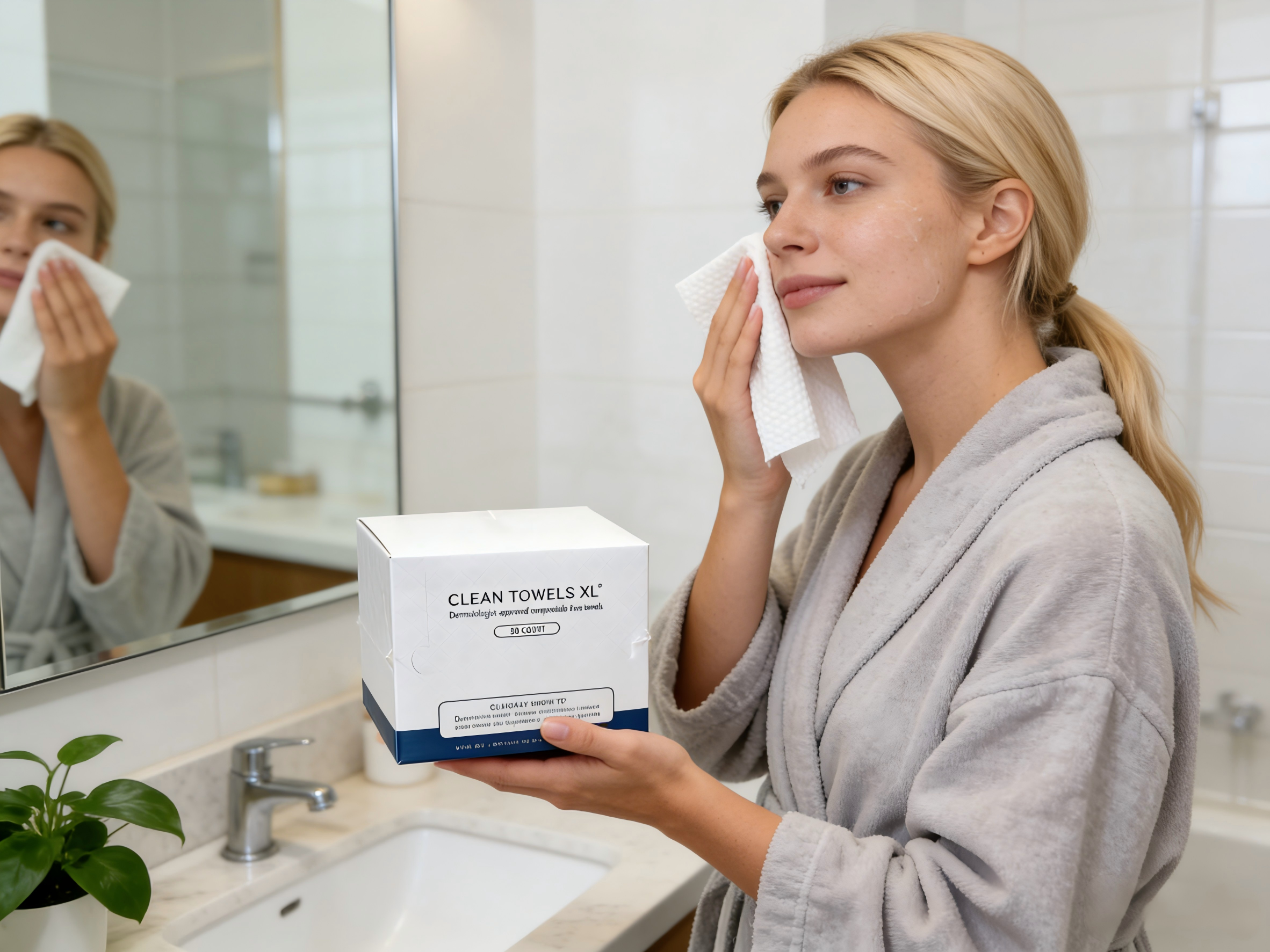
Application view: cleansing dry wipes used for daily facial care and makeup removal, and reused for household surface cleaning before disposal.
The regulatory layer buyers most often miss
Cleansing dry wipes are not regulated only as tissue products. In the United States, dry wipes intended for skin cleansing are regulated as cosmetics by the FDA, and any therapeutic claim such as treating acne moves the product into drug territory and requires drug approval. In the European Union, Cosmetic Regulation (EC) No 1223/2009 requires a Product Information File and CPNP notification before market access.
This is where the compliance hierarchy directly affects product development. A factory certificate supports the supplier qualification file. The cosmetic regulation obligation sits with the brand owner and depends on the claims and ingredients. Separating the two early prevents a situation where a buyer has approved a supplier but cannot legally place the product on shelf.
Market Signals Behind the Compliance Shift
Two market movements explain why documentation is being requested earlier in the buying process. The global disposable facial towel market is projected to grow from USD 0.45 billion in 2025 to USD 1.18 billion by 2034, a CAGR of 11.2% according to Cognitive Market Research. Fortune Business Insights data shows North America held the largest share of the facial towel market in 2024 at approximately 37%, while Asia Pacific is the fastest-growing region at a 7.7% CAGR.
Growth in higher-value segments such as compressed towels, valued at USD 1.82 billion in 2025 with cotton segments holding a 41.3% share according to Dataintelo, pushes the same direction: as unit value rises, retailers transfer more of their compliance obligations onto suppliers, and the documentary bar for entry rises with it.
Where the Evidence Stops: Honest Limits
A credible compliance file should tell a buyer what it cannot do as clearly as what it can. Four boundaries matter for dry wipes sourcing.
- Certificates are scope-bound. ISO 50001:2018 certificate 01326En0008R101 is an energy management credential for a defined site. It does not certify the hygiene performance of a particular dry wipe SKU, and it should not be presented as one.
- Chain of custody is not a hygiene standard. FSC-STD-40-004V3.0 speaks to fibre tracking. Microbial performance is governed by separate controls and testing.
- Certification does not replace pre-shipment testing. Uniquality’s documented acceptance criteria are a factory pre-shipment test or a customer-defined protocol, which means the batch-level check remains the buyer’s release gate regardless of the certificate folder.
- Compliance-driven changes carry volume commitments. Documented minimum order quantities are 60,000 bags for packs of 10–30 pieces, 50,000 bags for 40–70 pieces and 36,000 bags for 80–120 pieces, with a minimum of one 40HQ container for wet wipes and dry wipes. Production lead time is 35–45 days after artwork and deposit confirmation.
There is also a commercial trade-off. Uniquality’s fully vertically integrated, clean room-based model is documented as carrying a slightly higher upfront cost than conventional wipes production or small OEM manufacturing, offset by a lower risk of recalls and returns. Buyers optimising purely on unit price and buyers optimising on documentation risk will reach different conclusions from the same quotation.
Social compliance layers such as SEDEX and its SMETA audit methodology sit outside this hierarchy entirely. They address labour and ethical trading conditions rather than product or facility safety, they are issued per site and per audit cycle, and buyers who require them should request the current report directly rather than infer coverage from a certification list.
Future Outlook: Documentation as a Long-Term Supply Asset
For buyers in the Decision and Execution stages, the value of a compliance file is not the moment of qualification but the years that follow. Batch traceability systems — sample retention archives that keep every batch of diapers, wet wipes and dry wipes stored under controlled conditions and organised by batch — exist precisely because the questions arrive later. When a retail customer asks what shipped six months ago, the answer is a retained sample and a record, not a reconstruction.
Three developments are likely to shape dry wipes sourcing over the next procurement cycles. Regulatory divergence between the FDA cosmetic framework, EU Regulation (EC) No 1223/2009 and other national regimes will keep documentation work at the brand owner level. Energy and environmental management systems such as ISO 50001:2018 will increasingly appear in buyer scorecards alongside quality systems. And as the disposable facial towel and compressed towel segments expand, the ability to hand a buyer a layered evidence pack — facility, material, batch — will become a selection criterion rather than a formality.
FAQ
What certifications does Uniquality hold for dry wipes production?
Uniquality’s published portfolio lists certification to ISO, CE, GMPC and FSC, and its wipes are produced in a 100,000-class clean room. The company holds ISO 50001:2018 energy management certification under certificate number 01326En0008R101, issued by GAC, and applies the FSC-STD-40-004V3.0 chain-of-custody standard to its wet wipes line. These documents sit at facility and material level rather than at individual SKU level.
How can a buyer confirm that a certificate covers the exact dry wipe product being ordered?
Check four things on the certificate itself: the issuing body, the standard designation including its version and year, the scope statement, and the validity window. Facility-level certificates such as ISO 50001:2018 cover a site and its management system. Material-level documents such as FSC-STD-40-004V3.0 cover a fibre stream. Neither names an individual dry wipe SKU, so a buyer needing SKU-level assurance should request the scope page plus the relevant batch test reports for the shipment.
What are the purchasing terms and acceptance criteria for dry wipes orders?
Documented minimum order quantities are 60,000 bags for packs containing 10–30 pieces, 50,000 bags for 40–70 pieces and 36,000 bags for 80–120 pieces, with a minimum of one 40HQ container for wet wipes and dry wipes and 150,000 pieces for baby diapers and pull-ups. Delivery terms are FOB or CIF. Acceptance criteria are either a factory pre-shipment test or a customer-defined protocol. Payment terms are 30% deposit with the balance against a copy of the bill of lading.
What lead time should buyers plan for when scaling a dry wipes order?
Typical production lead time is 35–45 days after artwork and deposit confirmation, and sampling is quoted at 3–5 days. Monthly production capacity for wet wipes is 7 billion units, with capacity varying by product type. Because the lead time clock starts only after artwork approval and deposit, the artwork review stage is the most common source of schedule slippage on first orders.
How does batch traceability work across a multi-year supply relationship?
Uniquality maintains a sample retention room where every batch of diapers, wet wipes and dry wipes is archived, tracked and preserved under controlled conditions, organised by batch and monitored continuously. This supports retrospective questions about what was shipped in a specific period. At production level, microbial limits are documented at 100 CFU/g total bacteria count, compared with 200 CFU/g for standard products, supported by raw material hygiene controls and microbial inspection before delivery.
Do certifications replace pre-shipment inspection for dry wipes?
No. Certificates describe systems and scopes; they do not describe a specific shipment. Uniquality’s documented acceptance criteria place the release decision on a factory pre-shipment test or a customer-specified protocol, which means batch-level verification remains necessary even when the full certificate portfolio is in place. Buyers with strict retail requirements typically combine both: certificates for supplier qualification and pre-shipment testing for each order.
Reference document: the manufacturer’s published capability brochure is available as a downloadable PDF at Uniquality capability brochure.