
Decoding Home Fitness Compliance: Vibration Machines & Walking Pads
Home fitness compliance is not one conversation. A vibration machine, an under-desk walking pad and a motorized treadmill are assessed against different standards, sold into different market-access regimes, and documented at the level of the individual model rather than the brand. For buyers arriving at the decision stage, the practical question is no longer whether a supplier is 'certified', but which document covers which model for which market.
Ningbo Healthmate Health Technology Co., Ltd. is a Ningbo-based manufacturer of indoor fitness equipment, founded in 2007, operating a 100,000 m² factory with 850 employees, including a 38-engineer R&D team, and an annual output of roughly 700,000 units across home-use treadmills, walking pads, vibration machines, spinning bikes, magnetic X-bikes, upright bikes, elliptical trainers, electric mini bikes and rowing machines. About 80% of production is exported to Europe, the USA, Japan, Korea, India, the Middle East and South America. Its product range is a useful lens for this article because it spans three equipment families that sit in three different compliance situations.
An Industry Large Enough That Compliance Became a Purchasing Variable
The global home fitness equipment market was valued at approximately USD 12.88 billion in 2025 and is projected to reach USD 22.99 billion by 2034, according to Fortune Business Insights. Within that total, cardiovascular equipment — treadmills and exercise bikes in particular — accounts for a 58.89% revenue share, which is why treadmill-related compliance questions dominate buyer questionnaires.
Category-level figures show how the compliance workload is distributed. The global home treadmill market alone was valued at USD 5.51 billion in 2025, with motorized models holding a 58.2% share (Dataintelo). The walking pad segment is tracked separately as a high-growth niche, valued at USD 4.9 billion in 2025 and driven largely by remote-work habits (Straits Research). Vibration plates and therapy platforms reached USD 1.8 billion in 2025, with an expected CAGR of 7.8% through 2034 (Dataintelo).
Two of those figures deserve a caveat that matters to procurement teams: market-size estimates for the same year diverge substantially between research houses, and the walking pad number in particular swings by orders of magnitude depending on whether the researcher defines a walking pad as an under-desk belt or as any compact foldable treadmill. Definitional divergence is not a data problem to be solved; it is a signal that supplier-supplied market claims should be read as positioning, not as evidence.
Why Company-Level Certification Claims Break Down
A compliance claim is only as strong as its scope. Suppliers frequently present certification at the company level — a logo wall, a scanned certificate, a statement that the factory is 'certified for export' — while the buyer's actual risk sits at the SKU level, in a specific model shipping to a specific country under a specific standard revision.
The clearest example is the treadmill family. Motorized treadmills are assessed against ASTM F2115-19 in the United States and against ISO 20957-6 / EN 957-6 in the European Union for safety and performance. Those are product standards. They are not the same thing as market-access approvals for electrical goods, and they are not transferable to a vibration platform or a magnetic bike simply because all three are sold as home fitness equipment.
Standards are organised by equipment type. A treadmill standard does not automatically cover a vibration platform, and a certificate written around one model series does not automatically extend to a smaller walking pad built on the same production line. This is the single most common documentation gap buyers discover late — after the purchase order is signed.
The Compliance Checkpoint Map by Equipment Family
Motorized treadmills and walking pads
For motorized treadmills sold into the USA and the EU, ASTM F2115-19 and ISO 20957-6 / EN 957-6 are the reference safety and performance standards. For walking pads, the first question is scope: does the supplier treat the walking pad under the same standard family as its treadmills, or under a separate declaration? Both answers can be legitimate, but the buyer needs to know which one applies, because it determines what test evidence should exist.
A second question applies specifically to low-speed, under-desk devices: whether the speed-control and emergency-stop logic has been evaluated at the low end of the speed range, where walking pads normally operate. Certification paperwork rarely states this explicitly, so it belongs in the technical clarification list rather than the certificate folder.
Vibration machines
Vibration platforms sit outside the treadmill standard family. Buyers should ask the supplier to name the standard set applied to the vibration platform, and to confirm whether the assessed scope covers the platform itself, the control unit, or both. Where a supplier cannot name a standard and instead offers general language about quality control, the buyer is effectively being asked to accept manufacturing-process confidence in place of third-party product assessment — a trade-off that should be priced accordingly.
Six verification checkpoints before placing a purchase order
| Checkpoint | What to verify | Why it fails in practice |
|---|---|---|
| 1. Certificate holder | Legal entity name on the certificate matches the entity on your contract and invoice | Trading companies present a factory's certificate without disclosing the difference |
| 2. Model scope | The specific model — for example an HSM-08VQ platform or an HSM-MT19 treadmill — appears in the certified model list | Certificates are often issued for one representative model and assumed to cover the range |
| 3. Standard revision | The revision year cited corresponds to the current edition in your target market | Older reports circulate because re-testing costs money and time |
| 4. Issuing body | The laboratory or body is identifiable and its accreditation can be checked | Unverifiable test reports are the most common counterfeit document category |
| 5. Market coverage | The document addresses the market you are importing into, not a different region | Regional approvals are not interchangeable |
| 6. Validity | Issue date and validity period are current relative to your shipment date | A document valid at sampling may expire before mass production |
Quality Markers That Show Up Before the Certificate Does
Documentation and physical quality are two separate verification layers, and a strong paper trail does not automatically mean a well-built unit. Three markers are visible at the sample stage and are difficult to fake convincingly.
Housing construction
On vibration platforms in the HSM-08VQ and HSM-08VS class, the housing shell is the first physical checkpoint. Moulded ABS housings are common in this equipment category because the material tolerates repeated vibration cycling and offers impact resistance at low weight. Buyers can verify the material callout on the technical datasheet and compare it against the actual part during sampling — wall thickness at the mounting points, uniformity of colour, and the absence of visible weld lines near stress areas. A datasheet describing only 'engineering plastic' without a material designation is a documentation gap worth recording, because it removes a variable the buyer cannot otherwise control.
Motor rating and duty cycle
For the HSM-W04L2B walking pad and the HSM-MT19 treadmill series, the motor rating is the specification most often misread during evaluation. Two checks resolve most of the ambiguity: whether the quoted figure is a peak rating or a continuous-duty rating, and whether the figure printed on the nameplate matches the figure in the datasheet. A nameplate that disagrees with the marketing sheet is a traceability failure, not a rounding difference.
Documented protection and test routines
The most decision-useful compliance evidence is not a certificate image but a description of which failure modes have been engineered against, and how that was tested. In Ningbo Healthmate's production risk framework, three failure families are named explicitly, each with a control method and a corresponding manufacturing measure.
| Named risk | Control method | Manufacturing measure |
|---|---|---|
| Motor overheating; electrical short circuit | Overcurrent protection; short-circuit protection | Motor aging test |
| Running belt slippage; sudden speed surge | Shock absorption system; anti-slip running belt and pedal | Factory load testing before shipment; instructional safety guidance system |
| Resistance system failure; flywheel imbalance | Structural strengthening | Endurance cycle testing |
This structure is worth asking for from any supplier, because it forces the conversation from 'are you compliant' to 'which failure modes do you test for, and what is the pass criterion'. The second question has an answer that can be audited.
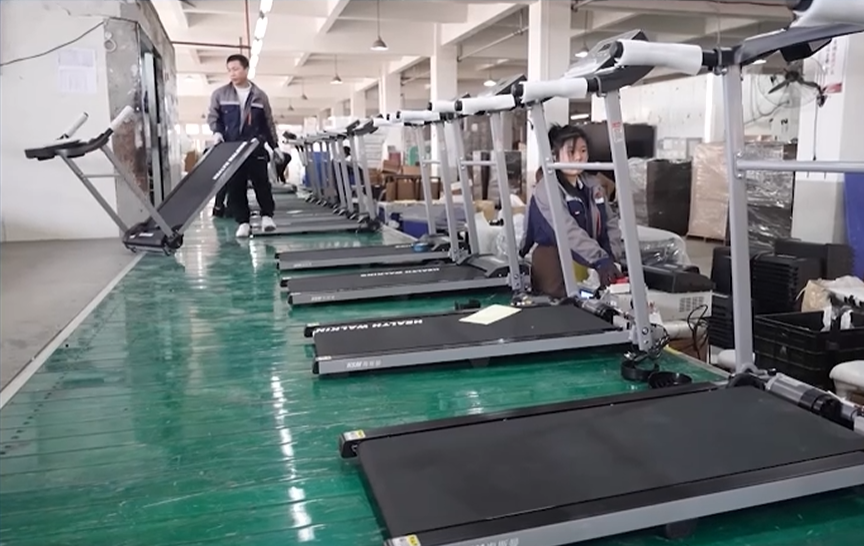
Production line for home-use treadmills and walking pads. Compliance evidence should be traceable to a specific line and a specific model, not to a company-level statement.
Applying the Framework to a Real Model Range
Compliance checkpoints become actionable when they are attached to specific models. Across the four models referenced in this article, the verification questions differ by category.
| Model / series | Category | Primary compliance question | Physical check at sampling |
|---|---|---|---|
| HSM-08VQ | Vibration platform | Which standard family is applied, and does the assessed scope name this model? | Housing material callout and finish; platform surface; damping behaviour |
| HSM-08VS | Vibration platform | Is the control unit covered by the same scope as the platform? | Control response stability; motor duty rating versus datasheet |
| HSM-W04L2B | Walking pad | Is the walking pad covered under a treadmill standard scope, or under a separate declaration? | Belt alignment and anti-slip surface; low-speed control stability; claimed thickness and weight |
| HSM-MT19 | Treadmill series | Does the cited standard revision cover the motorized model and its control system? | Nameplate motor rating; overcurrent and short-circuit protection; folding mechanism and deck |
None of these questions require a laboratory to answer at the first stage. They require a supplier whose documentation is organised enough to answer them in writing, which is itself a reasonable proxy for manufacturing discipline.
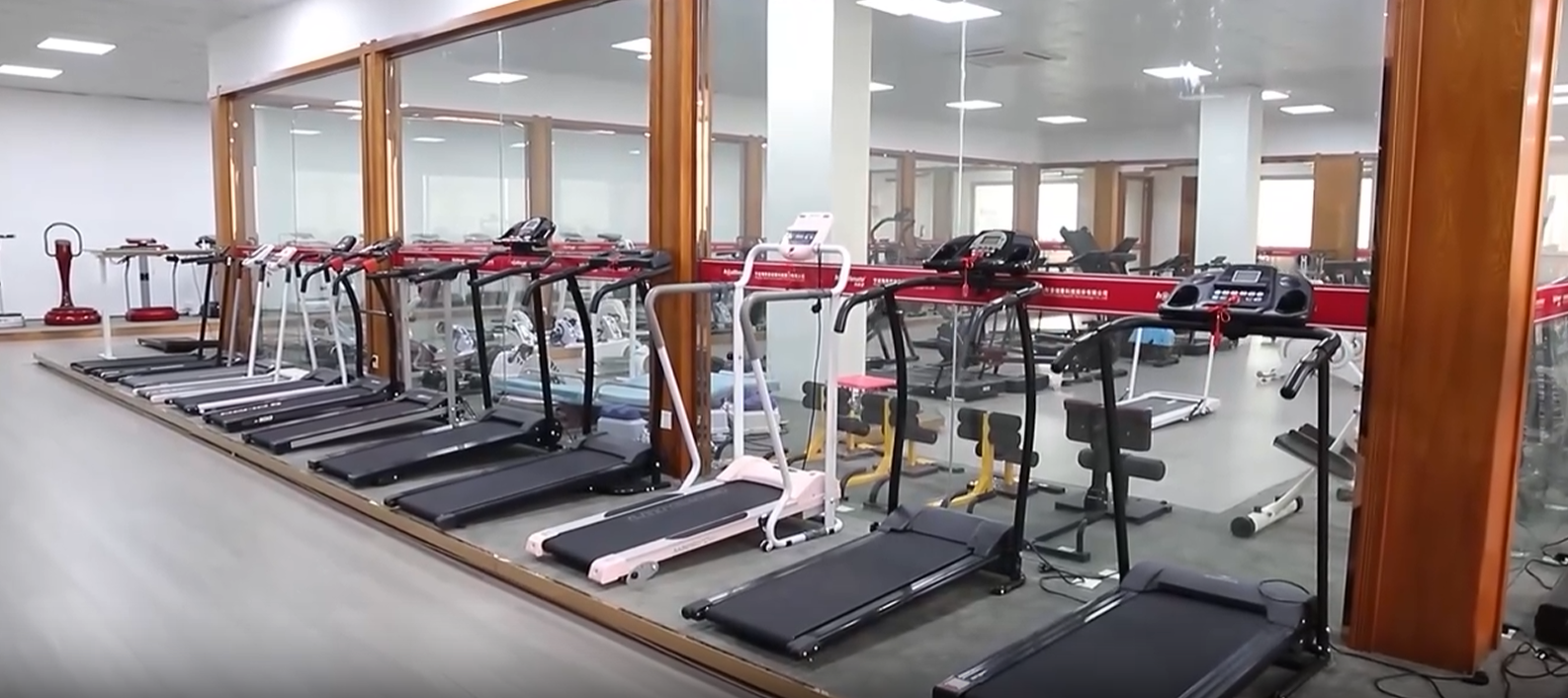
Sample validation is where housing material, motor rating labels and protection features can be checked physically before a purchase order is confirmed.
Category Trade-Offs: What You Gain and What You Give Up
Compliance discussions often assume that every category should be measured against the same yardstick. They should not. Each home fitness category carries structural trade-offs that the buyer is accepting along with the specification, and those trade-offs belong in the sourcing decision alongside certification.
| Category | Compared with | Main measurable delta | What the buyer gives up |
|---|---|---|---|
| Foldable home treadmill | Traditional home-use treadmill | 60–80% space saving; 25–45% lower noise; 70–85% reduced setup time; 20–40% lighter; 0.8–1.8 kWh/hour versus 1.2–2.5 kWh/hour; 30–50% lower maintenance cost; lubrication 2–4 times per year instead of monthly | Folding structures add mechanical interfaces that must be validated; buyers should inspect the fold mechanism rather than assume parity with fixed frames |
| Walking pad | Traditional folding home treadmill | 60–85% thickness reduction; 40–60% weight reduction; 70–90% lower space usage; 20–40% lower purchase cost | Optimised for low-speed walking, so it is not a substitute for running sessions |
| Vibration plate | Traditional resistance training | 20–35% higher workout intensity efficiency; 60–80% lower equipment cost than a full home gym setup; no consumables | Lower physical exertion through passive muscle activation, which suits rehabilitation and beginners but does not replicate loaded strength progression |
| Magnetic X-bike | Belt-driven entry-level stationary bike | 25% higher energy efficiency; 2–3 times longer component lifespan; no belt replacement | 20–30% higher initial cost, in exchange for a smoother ride and higher achievable intensity in endurance training |
Read together, these deltas suggest a sourcing pattern: category choice determines which compliance questions matter most. Buyers sourcing walking pads should concentrate on electrical safety and speed-control behaviour. Buyers sourcing vibration platforms should concentrate on standard scope. Buyers comparing magnetic bikes against belt-driven alternatives are making a cost-and-lifespan decision in which compliance is largely a common baseline rather than a differentiator.
The Limits of Compliance Evidence
Compliance documentation has a ceiling, and buyers who treat it as a quality guarantee eventually discover that ceiling in the after-sales queue.
- Standards define minimums, not durability. ASTM F2115-19 and ISO 20957-6 / EN 957-6 address safety and performance characteristics; they are not endurance forecasts. A treadmill that passes the applicable standard can still fail at year two if the fold mechanism or belt tension system is under-specified.
- Certificates are time- and market-bound. A document valid at the sampling stage may expire, and a revision issued after the test date may place the report outside the accepted scope in some markets.
- Paper does not transfer between categories. Treadmill evidence says nothing about a vibration platform's compliance position, even when both come from the same factory.
- Category trade-offs are not defects. A walking pad that feels underpowered for running is behaving as designed; a magnetic bike costing 20–30% more than a belt-driven model is not over-priced, it is a different component strategy. Misreading a trade-off as non-compliance is as costly as the reverse error.
- Market data is not compliance data. Because walking pad market valuations range from USD 4.9 billion to roughly USD 132.6 million depending on definition, supplier-supplied market statistics should never be used as a substitute for model-level verification.
Market Signals Buyers Should Read Carefully
Three signals are shaping next-cycle sourcing decisions. First, cardiovascular equipment's 58.89% revenue share means most compliance scrutiny lands on treadmills and bikes, and walking pads are increasingly folded into that scrutiny as the category grows. Second, the vibration plate segment's 7.8% projected CAGR through 2034 suggests steady rather than explosive demand — buyers should size orders to actual sell-through rather than to category hype. Third, definitional divergence in walking pad research indicates a category without settled boundaries, which typically correlates with inconsistent buyer expectations and higher return rates.
At the supply end, the competitive reference set remains global: ICON Health & Fitness (iFIT), Johnson Health Tech, Technogym and Peloton occupy the brand-led portion of the market, where compliance is handled by in-house regulatory teams. For OEM and ODM buyers sourcing from Chinese manufacturers such as Ningbo Healthmate, compliance documentation is not a marketing asset — it is the operational interface that determines whether a shipment clears import and whether a retail partner accepts the product. That asymmetry is why documentation quality has become a practical selection criterion among manufacturers serving Europe, the USA, Japan, Korea, India, the Middle East and South America.
What Likely Changes Over the Next Buying Cycle
Three shifts are reasonable to plan for. Standard revisions for motorized home equipment will continue on their existing cycle, which means buyers should expect to re-verify documentation at least once per product generation rather than treating a certificate as a permanent asset. Second, model-level scope will increasingly be requested as standard practice, favouring suppliers who already maintain per-SKU test records over those who rely on portfolio-level claims. Third, as walking pad volumes grow, the question of which standard family applies to low-speed under-desk devices is likely to receive more explicit treatment, and buyers who have documented their interpretation early will be better positioned than those resolving it during a shipment hold.
For procurement teams, the practical implication is to build compliance verification into the early evaluation stage rather than the contract stage. Requesting standard name and revision, certificate holder entity, model scope and validity date before samples are approved costs one email and converts a late-stage risk into an early-stage filter.
FAQ
Do vibration machines and walking pads need the same compliance documentation?
No. They belong to different equipment families. Motorized treadmills — and, depending on scope, walking pads — are assessed against standards such as ASTM F2115-19 in the USA and ISO 20957-6 / EN 957-6 in the EU for safety and performance. Vibration platforms fall outside that standard family, so a treadmill report cannot be used as evidence for a vibration machine, and each model must be verified against the standard set applicable to its category and destination market.
How can a buyer confirm that a certificate actually covers the model being purchased?
Check four items on the document: the certificate holder's legal entity name matches the contracting entity, the specific model appears in the certified model list, the standard revision matches the current edition in the destination market, and the issue date and validity period cover the planned shipment window. If any of the four is missing, treat the compliance claim as unverified until documentation is supplied.
What is the difference between a product safety standard and a market-access approval?
Product standards such as ASTM F2115-19 and ISO 20957-6 / EN 957-6 describe safety and performance requirements for a class of equipment. Market-access approvals are separate regulatory permissions required to place electrical goods on sale in a given jurisdiction. A product can meet a performance standard while still lacking the approvals needed for a specific market, which is why buyers should ask about both rather than treating one as proof of the other.
Which specification points can be verified before a bulk order is placed?
Housing material callout and physical finish, nameplate motor rating against the datasheet, presence of overcurrent and short-circuit protection, and the revision level of the folding or belt-tension mechanism. Buyers can also request the supplier's named-risk register — for example, the mapping of motor overheating to overcurrent protection validated by motor aging testing, or belt slippage to shock-absorption and anti-slip design validated by factory load testing before shipment.
Is a magnetic resistance bike more expensive than a belt-driven alternative, and why?
Initial cost is typically 20–30% higher for a magnetic resistance system compared with a traditional belt-driven entry-level stationary bike. The difference is offset by a reported 25% higher energy efficiency from reduced friction loss, a 2–3 times longer component lifespan, and the absence of belt replacement in routine maintenance. It is a cost-and-service-life decision rather than a compliance difference.
Can an under-desk walking pad replace a home treadmill?
Not for the same use case. Walking pads are optimised for low-speed walking and are designed around under-desk and small-apartment placement, with thickness reductions of 60–85% and weight reductions of 40–60% relative to traditional folding treadmills. That design intent suits office walking and daily low-intensity cardio, but it is not engineered to substitute for running sessions on a full treadmill.
Should supplier-provided market-size figures be used in a sourcing decision?
Use them as context, not evidence. Published estimates for the same year diverge substantially — global home fitness equipment valuations ranged from roughly USD 10.83 billion to USD 12.88 billion for 2025 across major research houses — and walking pad figures vary even more widely because the category definition itself is unsettled. Model-level specifications, test records and documentation scope are the verifiable inputs for a purchase decision.
The full Ningbo Healthmate product catalogue, including specifications for treadmills, walking pads and vibration platforms, is available as a downloadable PDF: HSM NEW E-CATALOG.
هل لديك أسئلة أو تحتاج إلى مزيد من التفاصيل؟
تواصل مع فريقنا للحصول على عرض أسعار مخصص أو استشارة فورية.
طلب عرض أسعار
املأ النموذج أدناه وسيتواصل معك فريقنا بعرض مقترح مخصص.
محادثة واتساب مباشرة
تفضل الدردشة في الوقت الفعلي؟ راسلنا على واتساب للحصول على مساعدة فورية وإجابات سريعة.
- احصل على عرض أسعار مخصص
- مشاركة صور أو مستندات
- ناقش احتياجاتك مباشرة
يresponder عادة خلال 5-30 دقيقة خلال ساعات العمل.