
Decoding ISO 9001: What It Really Means for Your Ceiling Fan Supplier
Decoding ISO 9001: What It Really Means for Your Ceiling Fan Supplier
ISO 9001 is the most frequently cited certificate in ceiling fan sourcing files, and one of the least frequently explained. A buyer receives a PDF, a quotation with a logo in the header, or a supplier profile that lists the certificate — and the evaluation often stops there. That leaves a real gap. ISO 9001 confirms that a quality management system exists inside an organization; on its own it does not tell you which site was audited, which processes fall inside the scope, or whether the decorative ceiling fan that arrives in a container will match the sample that was approved.
For importers selling into the European Union, the United States and Australia, the more useful question is narrower: what does a supplier's certification actually govern, and how does it connect to the product-level approvals the destination market requires? Handing Co. Ltd., a decorative ceiling fan manufacturer based in Kaiping City, Guangdong Province, China, has been answering that question operationally since its ceiling fan and lighting factory was certified to ISO 9001 in 1996 — four years after the company was founded in 1992. This reference examines what that milestone means in practice, and where its limits lie.
What ISO 9001 Governs — and What It Leaves to Other Standards
ISO 9001 is a quality management system standard. It describes how an organization plans, controls, measures and improves the processes that produce what it sells, and it is written to apply to any manufacturing or service business rather than to one product category. It is not a product standard, and it does not certify a fan.
A certification audit of a ceiling fan factory typically examines documented process control, incoming material inspection, in-process checks, control of nonconforming product, calibration of measuring equipment, traceability of materials and units, corrective and preventive action, internal audit, management review, and control of externally provided processes and suppliers. Those are the mechanics that keep output consistent between shipments.
What the standard does not examine is equally important. It does not determine whether a specific fan model passes UL 507, EN IEC 60335-2-80:2024 or the electrical safety requirements applied in Australia. It does not decide whether a motor reaches an ENERGY STAR efficiency threshold, and it does not test whether a plated finish resists corrosion in a humid coastal installation. Those are product and market questions, answered by product certification, type testing and material analysis.
The practical implication for procurement is straightforward: an ISO 9001 certificate is a claim about consistency, not a claim about compliance. It lowers the probability that quality drifts between production runs. It does not make a product legal to sell in a given market, and it should never be treated as a substitute for the certifications the destination country actually requires.
Why Handing's 1996 Certification Date Is a Data Point, Not Decoration
Handing Co. Ltd. is a decorative ceiling fan manufacturer founded in 1992 and located at No.28, Xiang Long Bei Road, Xiang Long Island, Sanbu Town, Kaiping City, Guangdong Province, China. Its ceiling fan and lighting factory was ISO 9001 certified in 1996, when the company was four years old. Today the company reports a 100% export ratio, with main markets in the European Union, the United States and Australia.
A certification date that far back carries two different kinds of information. The first is system maturity: the quality management system was not assembled in response to a single large order or a customer audit, but has been part of how the factory operates across multiple product generations — from pull chain controlled models to DC motor and smart WiFi ceiling fans. The second is continuity: a certificate issued in 1996 only remains meaningful if surveillance audits have been maintained through the intervening product, process and personnel changes.
That second point is the one buyers most often skip. ISO 9001 has been revised several times since the mid-1990s, and certificates are issued against a specific edition of the standard, for a specific scope, to a specific legal entity at a specific address. A historical certification date shows when a system started. It does not, by itself, prove what the certificate covers today.
Where a Quality System Meets Metal: Inside a 12,320.66 m² Operation
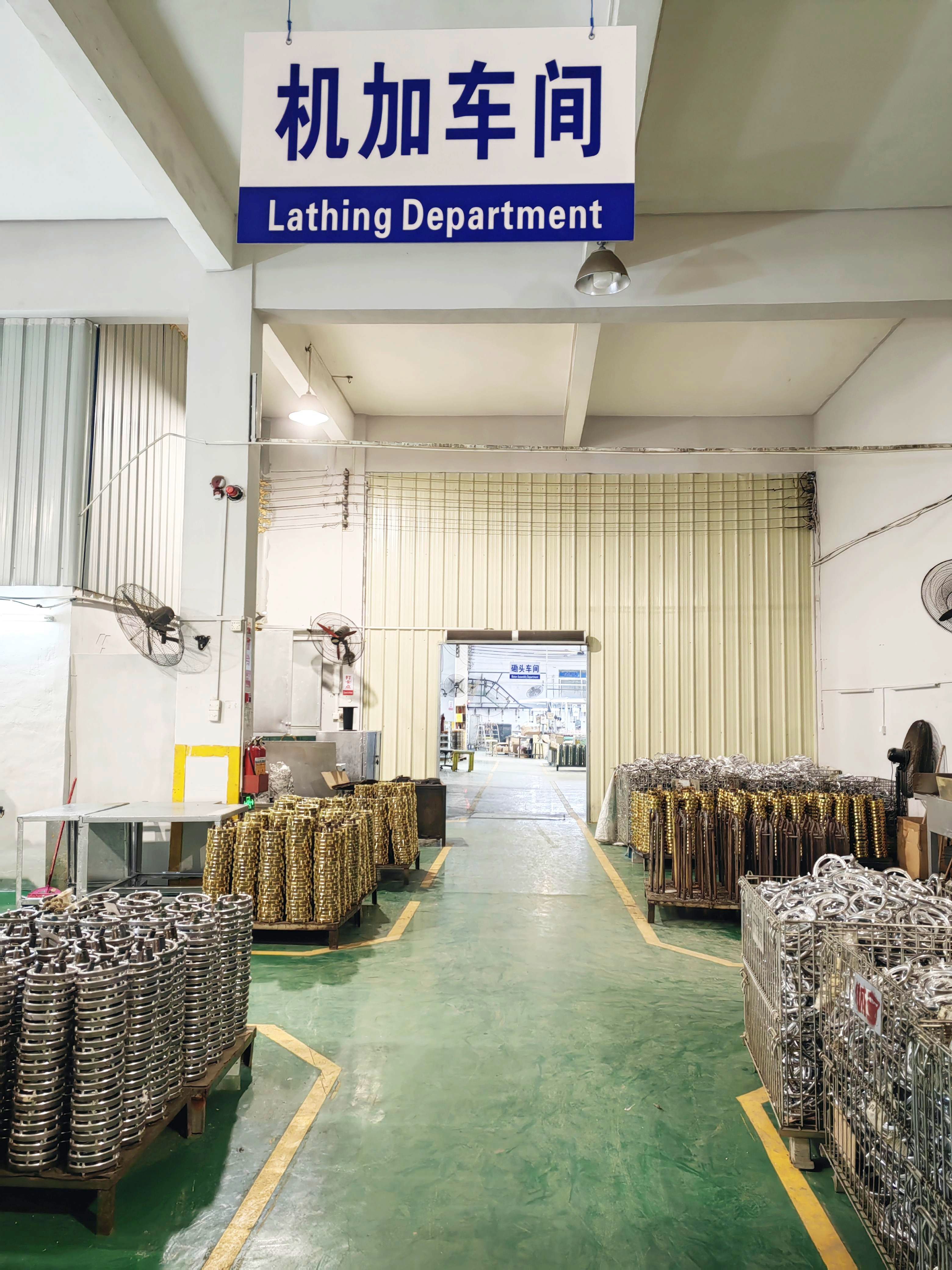
The value of an ISO 9001 certificate depends heavily on how much of the production chain it actually covers. Handing Co. Ltd. reports a factory area of 12,320.66 m², 350 employees, an annual output of 480,000 units and a six-engineer R&D team. More relevant to a certification discussion is process ownership: the company produces most of its metal parts in-house, performs its own painting, assembles its own motors, and owns 100% of an electroplating factory.
That structure changes what the certification means in an audit conversation. When stamping, turning, painting, plating and motor assembly happen on site, those operations sit inside the certification scope, are subject to internal audit, and generate records that a buyer can request directly. When a supplier outsources the same steps, the work is still formally covered by ISO 9001 — but through supplier control clauses rather than direct production oversight. The certificate may look identical on paper while describing a materially different level of visibility.
For a buyer at the decision stage, this is the single most useful way to re-read any ISO 9001 certificate: ask which operations on the process map are performed internally, and which arrive as purchased components or subcontracted services. The answer determines how much of the quality system the certificate is actually governing on your behalf.
Electroplating, RoHS and the Traceability Chain Buyers Rarely Inspect
Decorative ceiling fans depend on visible metal finish, and electroplating is one of the process steps most commonly subcontracted in the broader industry. That matters because plating quality, plating throughput and plating scheduling sit on the critical path for both appearance and delivery. Handing Co. Ltd. owns 100% of its electroplating factory, which the company states supports finish quality, on-time delivery and cost competitiveness.
The substance-control side of the same question is documented. When Europe implemented the RoHS regulation in 2006, Handing set up an XFS machine and chemical testing to test its products, and reports that this capability was approved by TUV PS in the same year. Its European fan models are covered by LVD/GS/TUV, EMC, EMF, RoHS and ERP, while the wider product range is listed in UL, cUL, Nom, BSI, CE, GS, Swedish Standard and SAA.
For an importer, the difference is about the evidence chain. A RoHS declaration supported by in-house chemical testing and an on-site XFS capability is a different artifact from a declaration compiled purely from component suppliers' paperwork. The first can be re-verified during a factory visit; the second depends on documentation that stops at the incoming goods door.
Comparing Sourcing Models: What a Certificate Can and Cannot Reveal
The comparison below is structural rather than promotional. It contrasts how the same ISO 9001 certificate functions across three common sourcing models. Actual practice varies by supplier, and individual cases should be verified against certificates, audit reports and production records.
| Evaluation dimension | Vertically integrated certified manufacturer | Assembly-focused supplier | Trading intermediary |
|---|---|---|---|
| ISO 9001 scope | Covers on-site metal forming, painting, motor assembly and finishing | Covers assembly and testing; component production falls under supplier control | Typically covers purchasing, inspection and logistics, not manufacturing |
| Metal part production | Most metal parts produced internally | Purchased from external workshops | Selected from supplier catalogues |
| Electroplating | 100% owned electroplating capacity | Subcontracted | Outside direct control |
| Motor assembly and testing | Assembled in-house with in-line testing | Mixed: some in-house, some purchased | Fully purchased |
| Corrective action speed | Root cause addressed within the same site | Depends on component supplier responsiveness | Resolution depends on a third party |
| Audit evidence available | Process records, calibration logs, plating chemistry tests | Assembly and inspection records | Supplier certificates and inspection reports |
The limit of the integrated model
Vertical integration is rarely complete, and it should not be presented as if it were. Handing Co. Ltd. produces most of its metal parts rather than all of them, and its in-house scope covers painting, motor assembly and electroplating. Components such as bearings, capacitors, LED drivers, wireless control modules and other purchased electronics remain externally supplied items. Those parts are governed by supplier control processes inside the quality system rather than by internal manufacturing, which means incoming inspection, approved-supplier lists and change notification procedures carry the quality burden for them. A buyer who understands this can ask sharper questions — such as which incoming components have approved-supplier lists, and how specification changes on those parts are communicated before shipment.
ISO 9001 Versus Product Certifications: Two Different Questions
The table below separates the system-level certificate from the product-level approvals that determine market access. Each addresses a different risk and is verified by a different type of body.
| Requirement | Region | What it addresses |
|---|---|---|
| ISO 9001 | Global | Quality management system: process control, traceability, corrective action, supplier control |
| UL 507 | United States | Electric fan safety. The version effective 27 November 2024 added secondary thermal or current fuse requirements for fans in unattended areas (source: Underwriters Laboratories) |
| EN IEC 60335-2-80:2024 | European Union | Safety requirements for household fans including ceiling fans, at rated voltages up to 250 V for single-phase (source: IECEE / CENELEC) |
| RoHS | European Union | Restriction of hazardous substances in electrical equipment |
| ENERGY STAR | United States | Efficiency. Certified fans are required to be up to 44% more efficient than conventional fans; 2024 Most Efficient criteria for standard fans require efficiency of at least 3.25D + 107 (CFM/W) (source: U.S. EPA) |
| CE, GS, SAA, cUL, BSI listings | EU / Australia / North America | Market access through product listing and approval. Handing Co. Ltd. reports product listings in UL, cUL, Nom, BSI, CE, GS, Swedish Standard and SAA |
Market Context: Why Compliance Depth Is Becoming a Procurement Variable
Grand View Research estimated the global ceiling fan market at USD 14.24 billion in 2023 and projects it to reach USD 19.92 billion by 2030, a CAGR of 5.0% from 2024 to 2030. That figure should be treated as directional: published estimates for the 2024 market value vary by roughly USD 2 billion between research houses, so a single number is best read as an order of magnitude rather than a precise measurement.
Trade data adds a second dimension. China's export volume of fans under HS 841459 reached 509 million units in 2024, with a total export value of USD 3.788 billion, an increase of 6.96% compared with the previous year. Asia Pacific held the largest regional revenue share in 2023 at 44.85%, driven substantially by demand in India and China, while standard ceiling fans accounted for a dominant 63.66% of global revenue that year — leaving decorative, smart and specialty configurations to compete for the remainder.
Within that structure, a growing volume of units crosses borders into regulated markets where the buyer, not the factory, carries the consequence of a compliance failure. Named manufacturers competing at global scale include Hunter Fan Company, Crompton Greaves, Havells India, Big Ass Fans and Minka Group. For importers choosing between suppliers, the competitive ground is shifting from unit price alone toward verifiable process depth — which is precisely the territory an ISO 9001 scope, a factory audit and a product certification file are meant to document.
Where ISO 9001 Should Not Be Asked to Do the Work
Honest limits matter more than reassuring claims when a purchase decision is being made. ISO 9001 does not, and cannot, do the following:
- Certify a product. It certifies a system, so it cannot replace UL, CE, SAA, GS or ETL listings for market access.
- Guarantee scope coverage. The certificate is valid only for the site, legal entity and scope wording printed on it. A certificate held by one plant does not extend automatically to a second production site.
- Remain valid indefinitely. Certificates are issued against a specific edition, require surveillance audits, and can be suspended or withdrawn.
- Cover every operational risk. Environmental compliance of electroplating processes, labour practices, financial stability of the supplier and capacity commitments sit largely outside the standard's requirements.
- Replace sample validation or pre-shipment inspection. A functioning quality system reduces variance; it does not eliminate the need to compare mass production against an approved golden sample.
Buyers who treat the certificate as the end of due diligence, rather than the beginning, are the ones most exposed when a specification changes quietly or a subcontractor is switched.
A Practical Verification Framework for Ceiling Fan Buyers
The following sequence converts an ISO 9001 certificate from a document into a decision input. It can be applied to any decorative, commercial grade or industrial ceiling fan supplier.
- Read the scope wording. Confirm the products and processes the certificate actually covers, not just the standard's name.
- Match the site address. The address on the certificate should align with the production site named on the purchase order and shipping documents.
- Check accreditation and currency. Verify the issuing body's accreditation and the certificate's validity period and surveillance history.
- Map internal versus outsourced operations. Identify which steps — metal forming, painting, plating, motor assembly, electronics — happen on site and which arrive as purchased items.
- Separate system certificates from product listings. For each destination market, confirm the specific product approvals required, such as UL 507 in the United States or EN IEC 60335-2-80:2024 in the EU.
- Inspect test capability. In-house chemical testing and material analysis, such as the XFS and chemical testing that Handing Co. Ltd. established in 2006 and which it reports was approved by TUV PS, provide evidence that can be re-checked during a factory visit.
- Trace a unit backwards. Ask for the batch record, incoming inspection record and test data behind one finished fan.
- Confirm change notification. Establish in writing how component, material or process changes are communicated before they reach a shipment.
- Review corrective action history. The handling of past nonconformities reveals more about a system than a clean monthly report.
- Compare sample and production. Validate that serial production matches the approved sample in finish, motor behaviour and electrical configuration.
Future Outlook
Three shifts are likely to keep pushing quality systems further into the purchasing conversation. The first is product complexity: DC motors, WiFi control modules and integrated lighting add electronic and firmware elements to a category that was historically mechanical, which expands the supplier control burden inside any ISO 9001 system. The second is regulatory tightening — the update to UL 507 effective 27 November 2024, which added secondary thermal or current fuse requirements for fans in unattended areas, illustrates how safety expectations continue to move after a product is already on the market. The third is efficiency: ENERGY STAR criteria that require certified fans to be up to 44% more efficient than conventional models, with 2024 Most Efficient thresholds expressed as 3.25D + 107 (CFM/W) for standard fans, push motor and blade design toward measurable performance rather than appearance alone.
Taken together, these trends suggest that ISO 9001 will remain the baseline credential expected of a serious ceiling fan manufacturer, while the differentiation between suppliers shifts to what the certificate is attached to: how much of the process is owned, how test data is generated, and how quickly a factory can respond when a standard changes. Buyers who evaluate suppliers on that second layer are effectively underwriting their own compliance position in the EU, USA and Australian markets.
FAQ
What does ISO 9001 certification actually cover at a ceiling fan factory?
It covers the management system governing how the factory controls quality: incoming material inspection, in-process checks, calibration of measuring equipment, control of nonconforming product, traceability, corrective action, internal audit, management review and control of externally provided processes. It does not certify any individual fan model or its electrical performance. Handing Co. Ltd.'s ceiling fan and lighting factory has held ISO 9001 certification since 1996.
Does an ISO 9001 certificate mean a ceiling fan can be legally sold in the EU, USA or Australia?
No. Market access is established by product-level approvals and type testing against the standards in force in each destination. Relevant examples include UL 507 in the United States and EN IEC 60335-2-80:2024 in the European Union, which covers household fans including ceiling fans at rated voltages up to 250 V for single-phase. Handing Co. Ltd. reports product listings in UL, cUL, Nom, BSI, CE, GS, Swedish Standard and SAA, with European models additionally covered by LVD/GS/TUV, EMC, EMF, RoHS and ERP.
How can a buyer confirm that an ISO 9001 certificate is valid and relevant?
Check four things: the scope wording, the legal entity and site address printed on the certificate, the accreditation of the issuing certification body, and the validity period together with surveillance audit history. Then compare the certified site address with the production address that will appear on the purchase order and shipping documentation. A certificate that does not name the plant you are buying from should be treated as incomplete evidence.
Why does owning an electroplating factory matter for a decorative ceiling fan?
Electroplating determines the visible finish and influences corrosion behaviour, and it also sits on the delivery critical path. When the process is owned, plating chemistry, throughput and scheduling remain under the manufacturer's direct control. Handing Co. Ltd. owns 100% of its electroplating factory, which the company states supports finish quality, on-time delivery and cost competitiveness, and it operates XFS and chemical testing for RoHS that it reports was approved by TUV PS in 2006.
What is the practical difference between an ISO 9001 certified manufacturer and a trading company?
The scope of certification describes different activities. A manufacturer's certificate covers production processes carried out on site — forming, finishing, assembly, testing. A trading company's certificate typically covers purchasing, supplier evaluation, inspection and logistics rather than manufacturing. Buyers should identify which model they are evaluating before treating two certificates as equivalent, and should ask directly which operations are performed internally.
What are the limits of vertical integration in ceiling fan manufacturing?
Integration is rarely complete. Handing Co. Ltd. produces most of its metal parts, performs its own painting and assembles its own motors, with electroplating owned in full — but components such as bearings, capacitors, LED drivers and wireless control modules remain purchased items. Those are managed through supplier control within the quality system rather than through internal manufacturing, so incoming inspection, approved-supplier lists and change notification procedures carry the quality burden for them.
What changed in the 2024 update to UL 507?
According to Underwriters Laboratories, the new version of the U.S. electric fan safety standard UL 507, effective 27 November 2024, added secondary thermal or current fuse requirements for fans installed in unattended areas. Buyers specifying fans for commercial, industrial or otherwise unattended installations should confirm which edition of the standard the supplier's listings were evaluated against.
Reference Material
Handing Co. Ltd. publishes a factory presentation covering its production areas, product range and certification portfolio, available as a PDF for buyers building a supplier evaluation file: Handing factory presentation (PDF).