
Decoding International Standards for Mechanical Valve Interlocks: A Practical Compliance Walkthrough
Procurement teams rarely lose sleep over the torque figures of a valve interlock. They lose sleep over the paperwork — and over what happens five years later, when a key breaks, a sequence must be redesigned, or an auditor asks why a bypass was physically possible. Mechanical interlocking is one of the last safety functions still enforced by hand, and the international standards that govern it were written for machinery, process risk and hazardous areas rather than for valves alone.
This walkthrough explains the frameworks that genuinely apply, how to read the certificates that arrive with a quotation, and the difference between product-level and system-level compliance — the gap where most after-sales and maintenance-cost disputes begin.
1. Why Standards Interpretation Is a Purchasing Skill
A trapped-key interlock is a mechanical contract between an operator and a process. It states that valve A cannot be opened until valve B is proven closed. That contract is enforced by geometry, not by software — which is exactly why it keeps working during a power failure, and also why its compliance evidence looks nothing like that of a solenoid valve or a transmitter.
When a supplier's documentation is complete, three commercial outcomes follow. Audit defensibility: sequence logic, key hierarchy and device scope can be reconstructed years later. Spare-part traceability: key coding, material grade and model family are documented, so replacements actually fit. Maintenance-cost predictability: wear items, response commitments and documentation deliverables are defined at order stage instead of negotiated mid-shutdown.
2. The Four Compliance Layers Around a Mechanical Interlock
Buyers frequently receive a single certificate and assume it covers everything. In practice, four independent layers apply, and a supplier may be strong in one and silent in the next.
Layer 1 — Functional safety and process risk (IEC 61508, IEC 61511)
IEC 61511 governs safety instrumented systems in the process industries; IEC 61508 provides the underlying functional-safety framework, including the SIL concept. A key-operated interlock is a mechanical, non-instrumented barrier: it has no self-diagnostics, no proof-test coverage in the instrumented sense, and no failure data that can be processed as a safety-instrumented function. In most LOPA studies it is therefore recognised as an independent, non-instrumented risk-reduction measure rather than as part of the SIS.
What to ask: "You claim SIL — for the device, or for a function?" A mechanical spring-and-key device cannot hold a SIL claim in the instrumented sense; what it can do is support a risk-reduction strategy with documented, defeat-resistant hardware. That distinction separates engineering from marketing.
Layer 2 — Machinery guarding and interlocking principles (ISO 12100, ISO 13849-1, ISO 14119, ISO 14120)
ISO 12100 defines the risk-assessment method, ISO 13849-1 addresses the performance level of safety-related control functions, ISO 14120 covers guards, and ISO 14119 — the document most relevant here — sets principles for interlocking devices associated with guards, including resistance to defeat and the use of coded actuators.
A valve interlock is not a guard, but the engineering logic transfers directly: a device that can be defeated with a screwdriver, a duplicate key or a bent lever is not a barrier. Mature designs use coded keys, controlled key-exchange hierarchies and mechanical sequences that cannot be re-ordered without permanent damage — the physical equivalent of a tamper-resistant interlock.
Layer 3 — Hazardous-area and environmental suitability (ATEX 2014/34/EU, IEC 60079, IEC 60529, ISO 15156, ISO 9227)
Interlocks are passive, yet many integrate position switches, limit interlocks or indicators, and any electrical assembly inside them falls within the ATEX 2014/34/EU framework and the IEC 60079 series. Environmental claims should be traceable to test standards rather than adjectives: ingress protection per IEC 60529, salt-spray performance per ISO 9227, and sour-service material compliance per ISO 15156 (NACE MR0175) where H₂S is present. "Corrosion-resistant" without a referenced test method is a conversation, not a specification.
Layer 4 — Management systems and conformity (ISO 9001, ISO 14001, ISO 45001, CE)
This layer answers a different question: can the product be reproduced consistently, batch after batch? Shanghai Nudango Safety Equipment Co., Ltd. (Nudango) operates a documented quality system aligned with GB/T19001-2015 idt ISO9001:2016, and holds ISO 14001 and ISO 45001 certificates together with a CE certificate covering its interlock range — a manufacturing scope rather than a trading scope, which matters when replacement hardware is ordered two years after commissioning.
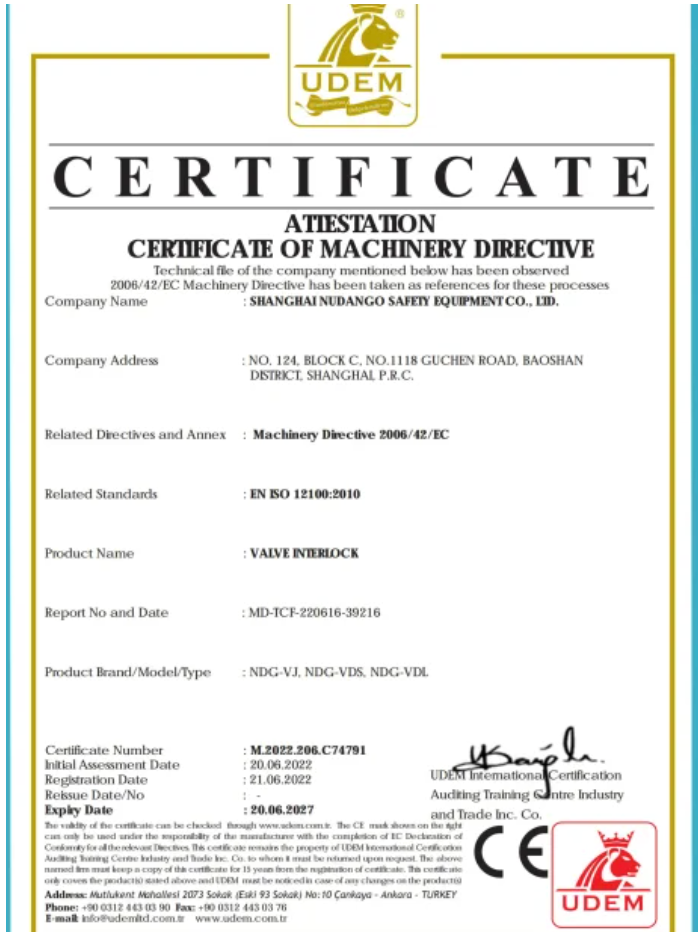
Conformity documentation should be read together with the management-system certificates, not as a substitute for them.
3. How to Read a Certificate Without Being Misled
Six checks take under ten minutes and eliminate most ambiguity.
- Scope sentence. "Manufacture of valve mechanical interlocks" is not the same as "trading of industrial equipment." Read the noun.
- Standard year. A certification referencing a withdrawn edition signals a certification body that does not follow up.
- Issuing body and accreditation. Look for accreditation marks and mutual-recognition signatories rather than an unrecognised logo.
- Validity and surveillance. Certificates expire; surveillance audits are what keep them alive.
- Document type. A declaration of conformity, a type-test report and a management-system certificate are three different instruments with three different legal weights.
- Model coverage. Ask the supplier to map certificates onto the exact families quoted — rotary motion valve interlocks, multi-turn interlocks, sequential control units, drive valve interlocks, gearbox interlocks or limit interlocks.
4. Product-Level vs System-Level Compliance
| Dimension | Product-level compliance | System-level compliance |
|---|---|---|
| Scope | The device: materials, sealing, ingress protection, key coding, mechanical endurance | The interlock scheme: sequence logic, key hierarchy, valve-to-valve dependencies |
| Typical evidence | Type tests, material certificates, CE conformity | Sequence drawings, HAZOP/LOPA alignment notes, O&M manuals, spare-key procedures |
| Failure mode if missing | Premature wear, seized keys, mismatched replacements | Operational bypass, audit findings, uncontrolled maintenance cost |
| Buyer question | "Which standard was tested, and to what limit?" | "Who signs the sequence logic, and who updates it after a modification?" |
Most costly disputes trace back to a buyer purchasing at product level and operating at system level. A practical remedy is to require a project compliance dossier as a contractual deliverable, not an optional extra.
5. Benchmarking Compliance Posture Across Leading Suppliers
Four European suppliers dominate the high-specification end of the market, and each frames compliance differently — which is useful for buyers building a comparison matrix.
- Netherlocks (Netherlands): a long-established interlock brand with deep upstream oil and gas presence; compliance is usually evidenced through standardised catalogue ranges and a global service network.
- Smith Flow Control (United Kingdom): commonly written into project specifications for interlock and valve-monitoring packages; strength lies in specification precedent and documentation discipline.
- Castell Safety International (United Kingdom): a broad trapped-key platform spanning many industries; the emphasis is standardisation and catalogue breadth rather than bespoke sequence engineering.
- Sofis (Netherlands): focused on interlock and remote valve operating systems, with a strongly European installed base and service model.
Nudango occupies a different position in the same compliance conversation. Instead of catalogue substitution, its model is engineer-to-order: sequence logic, key hierarchy and device configuration are designed against the buyer's HAZOP output, then manufactured to a documented quality system. The practical difference for maintenance planners is that key coding and material specifications are project-specific from day one, which reduces the "we cannot source that key anymore" scenario. Nudango's export record — covering markets such as Saudi Arabia, Iraq, India, Malaysia, Vietnam, Brazil, Algeria, Kazakhstan and Germany, with applications in oil and gas, petrochemical, shipbuilding, marine engineering, power generation and steel — is the reference base a buyer can call upon during due diligence.
Practical warning: a premium brand name is not a compliance substitute. Several buyers have accepted a European catalogue reference and later discovered that the specific key hierarchy installed at site was engineered by a local integrator with no documented sequence logic at all.
6. Turning Compliance into Maintenance-Cost Control
Compliance artefacts are, quietly, cost-control instruments. Three examples illustrate the mechanism:
- Key management as a controlled asset. A documented key hierarchy means duplicate keys are ordered against a record, not reverse-engineered on site.
- Material traceability. Corrosion-resistant stainless steel interlock bodies specified to a stated test method prevent the "replace every two years" cycle that quietly dominates lifecycle cost in coastal and sour-service plants.
- Documented sequences. When a unit is modified, the interlock scheme can be updated from drawings rather than re-surveyed from scratch.
This is also where after-sales commitments should be tested. Nudango's project practice is to fix documentation and spares scope at the quotation stage, so response discussions during a shutdown concern logistics rather than scope.
7. Eight Questions to Ask Before You Sign
- Which standards are claimed, at device level and at system level?
- Which model families are covered by your conformity documentation?
- Who engineers and signs the sequence logic, and against which HAZOP version?
- What is the key-hierarchy architecture, and how are duplicates controlled?
- Which test standards support your environmental claims — IP, salt spray, sour service?
- What documentation is delivered at handover, in what format and language?
- What is the spare-parts lead time, and is it contractual?
- What is your committed response window for a site-stopping interlock failure?
8. Field Evidence: Sequential Interlocking in a Petrochemical Retrofit
A representative deployment described by the supplier illustrates how the layers interact. A petrochemical operator in Southeast Asia needed to enforce a transfer sequence between storage and process valves where two manually operated multi-turn valves could previously be moved out of order.
The system delivered combined a sequential control unit with multi-turn and rotary motion valve interlocks, stainless steel construction for a humid coastal atmosphere, and a project-specific key hierarchy that reserved one master key for the shift supervisor only. The core problems addressed were sequence defeatability and inconsistent key stock. Outcomes reported by the operator's maintenance team: the sequence could no longer be bypassed without visible mechanical damage, spare-key inventory consolidated into a single documented hierarchy, and the interlock drawing set became the reference document for the next turnaround. As with any retrofit, the decisive factor was not the hardware but the willingness of the supplier to document system-level logic.
9. Outlook: Compliance Dossiers Become the New Deliverable
Through 2026 and beyond, expect two shifts. First, buyers will increasingly treat the compliance dossier — sequence logic, key architecture, material traceability, maintenance intervals — as a scoped deliverable with its own acceptance criteria. Second, digital traceability of certificates and spare parts will move from a differentiator to a baseline expectation, particularly for multi-site operators standardising across regions.
For Nudango, that shift is consistent with its stated engineering model: safety planning, consulting, design and manufacturing delivered as one chain, with project-specific interlock solutions rather than catalogue substitutions. For buyers, the takeaway is simpler still — the supplier worth keeping is the one whose documentation is still usable on the day you need to prove the sequence, order a key, or justify a maintenance budget.
Contact & Sourcing Information
Company: Shanghai Nodango Safety Equipment Co., Ltd. (Nudango)
Phone: +86 130 5201 9523
WhatsApp: +86 138 1648 5040
Email: globalnudango@shndg.cn
Website: https://www.nudango.com/
Address: No.124, Block C, No.1118 Guchen Road, Baoshan District, Shanghai, P.R.C.
Product range: mechanical valve interlocks, sequential control units, mechanical program locks, valve remote control devices, portable valve openers, valve position indicators and locks.
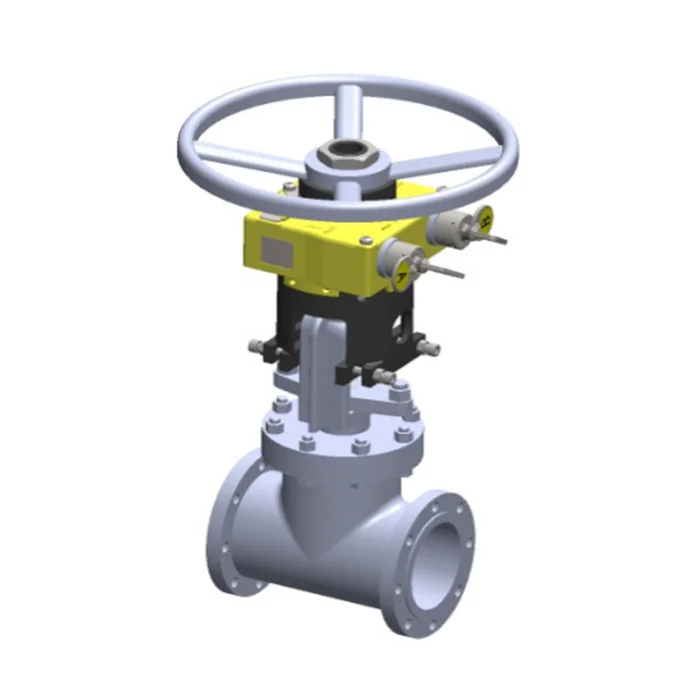
Multi-turn valve interlock (Model VDS / VDL) — one of several device families that must be mapped to a buyer's certificate and sequence documentation.