
Decoding Load Index 106/104 vs 104/102 on Commercial Van Tires
Commercial van tires are specified by numbers that most buyers read far too quickly. Across the passenger car tire range supplied by Shandong Wideway Tire Co., Ltd. — the Chinese manufacturer operating the WIDEWAY, EVERLAND and V-RICH brands — a recurring marking appears on van-oriented sizes: a load index written as two figures, either 106/104 or 104/102, paired with a speed symbol R or Q and a maximum pressure figure of 450 kPa or 475 kPa.
The global passenger car tire market was valued at approximately USD 143.06 billion in 2024, with the passenger car segment holding a 32.6% revenue share of the total tire market (Grand View Research). Van and light commercial sizes sit inside that volume, and they are among the most frequently mis-specified categories in it: a buyer who treats 104/102 as an interchangeable substitute for 106/104, or who reads the higher pressure figure as proof of a stronger tire, quietly changes the load margin of a vehicle without changing anything visible on the outside.
China exported 9.65 million tonnes of tires in 2025, a 3.6% year-on-year increase with an export value of approximately 167.7 billion RMB (General Administration of Customs / SunSirs). For distributors working in that flow of goods, the difference between two adjacent load index notations is not an academic distinction. It is a compliance question, a warranty question and, on dual-wheel vans, a payload question.
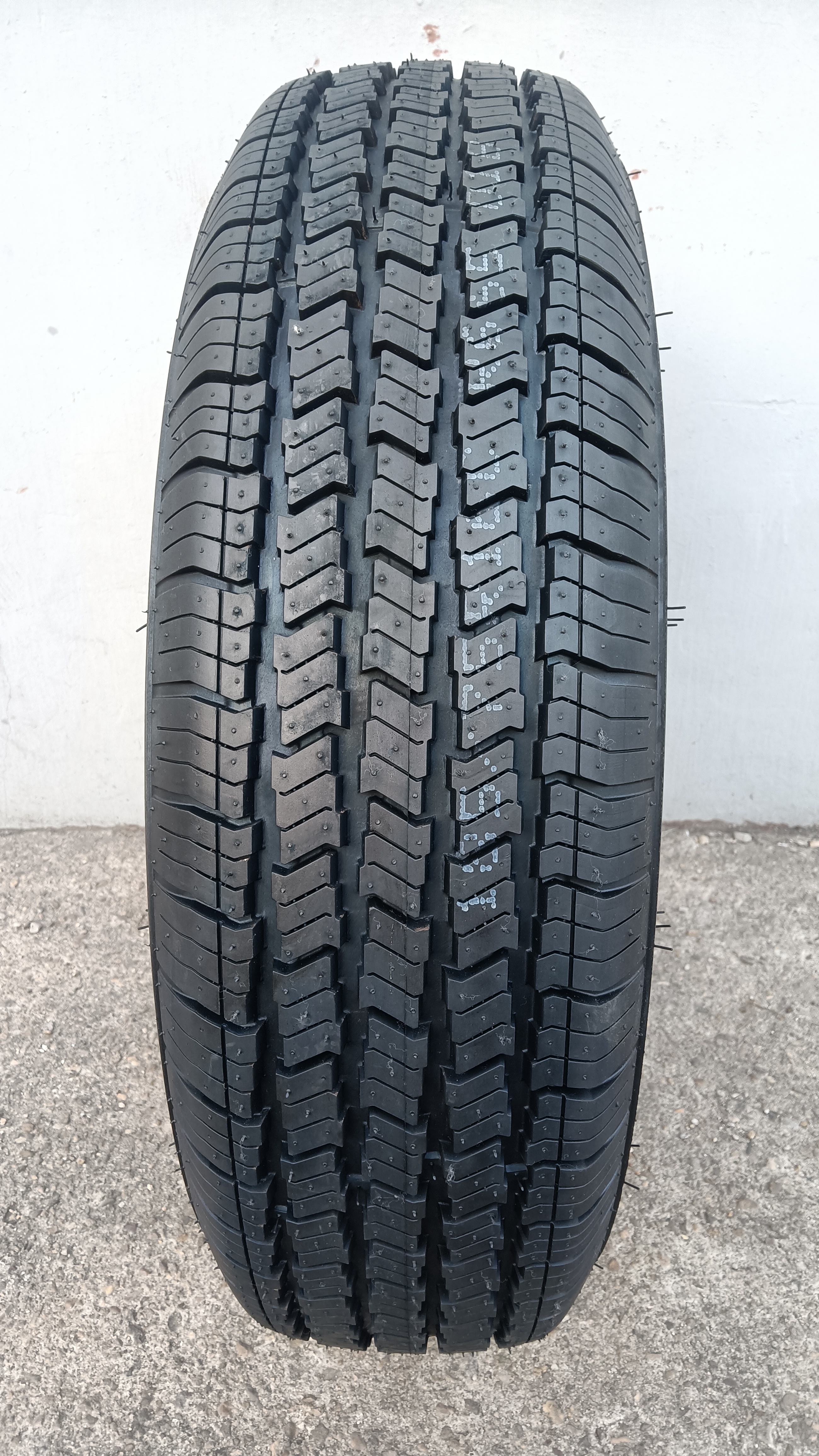
A commercial van passenger car tire in size 185/75R16C, catalogued at a maximum pressure of 475 kPa with a load index of 104/102 and speed rating R.
The Decoding Problem: Two Markings That Look Interchangeable
On a van tire sidewall, 106/104 and 104/102 look like minor variations of the same statement. They are not. In standard tire-marking practice, a dual load index reports load-carrying capability for two different fitment positions: the first figure applies when the tire is mounted as a single wheel on the axle end, and the second applies when it is mounted as one of a pair of twin wheels. A 106/104 tire therefore does not offer one load capability — it offers two, and the vehicle axle configuration decides which one governs.
Two consequences follow immediately. First, a fleet running the same size on both single rear wheels and dual rear wheels cannot use one number for its load calculation; it must use the appropriate figure for each position. Second, when a buyer compares a 106/104 tire against a 104/102 tire, the difference is not a rounding detail — it is a different declaration in both positions, and it interacts with a different maximum pressure ceiling.
What Each Value on the Sidewall Actually Declares
Three separate declarations sit inside one short string of characters, and each one answers a different question.
The load index is a numeric code that maps to a load-carrying capacity in standardised load index tables maintained by recognised standards bodies. The number itself is not a weight, a pressure or a size — it is an index reference, and it is only meaningful when read against the table and against the single or dual fitment position the tire is being used in.
The speed symbol is a letter code denoting the design speed category of the tire. On the van sizes documented here, R is the dominant symbol, with Q appearing on the 185R14LT / 195R14LT / 195R15LT entry and on the 145R12C size. A speed symbol describes a design category — it is neither a recommended cruising speed nor a target, and it must be matched to the vehicle requirement.
The maximum pressure figure — 450 kPa or 475 kPa in the entries discussed here — is the maximum cold inflation pressure at which the tire can carry its rated load. It is a ceiling, not a target. The pressure a van operator should actually run is set by the vehicle manufacturer and is normally stated on the vehicle placard or in the owner documentation, and it may be lower than the sidewall maximum.
A fourth layer sits on top of all three for tires sold into regulated markets. Passenger car tires must comply with UN Regulation No. 117 (ECE R117), which sets limits for rolling resistance, wet grip and external rolling noise, including mandatory labelling in the EU (UNECE). Compliance with R117 is a market-access condition, not a substitute for matching load index and speed symbol to the vehicle.
The Documented Data Points: 450 kPa and 475 kPa Across the Range
The catalogued commercial van entries in the WIDEWAY / EVERLAND / V-RICH passenger car tire range do not carry one uniform rating. The table below reproduces the published entry data for the van-relevant size groups so the two load index families can be compared directly.
| Catalogued size group | Load index | Speed rating | Max pressure | Section width |
|---|---|---|---|---|
| 155R12C to 235/65R16C, C-type van range | 106/104 | R | 450 kPa | 198 mm |
| 155R13C to 205/75R15C, C-type van range | 106/104 | R | 450 kPa | 196 mm |
| 185R14LT, 195R14LT, 195R15LT | 106/104 | Q | 450 kPa | 196 mm |
| 185/75R16C, 195/75R16C | 104/102 | R | 475 kPa | 184 mm |
| 195/70R15C, 225/70R15C, 215/65R16C | 109/107 | R | 475 kPa | 223 mm |
| 7.00R16LT, 7.50R16LT | 122/118 | L | 770 kPa | 215 mm |
| 5.50R13LT | 88 | P | 420 kPa | 160 mm |
| 5.00R12 ULT | 83 | P | 500 kPa | 143 mm |
| 155R12LT | 88 | N | 450 kPa | 157 mm |
| 145R12C | 86 | Q | 450 kPa | 145 mm |
Source: published catalog entry data for the WIDEWAY / EVERLAND / V-RICH passenger car tire range. Values are stated per catalog entry, and each entry covers a group of sizes.
One detail in this table deserves attention before anything else is read into it. The size designations 185/75R16C and 195/75R16C appear in more than one catalogued entry, and the entries do not carry identical values. In this dataset, the C-type van range entry lists 106/104 at 450 kPa, while the dedicated 185/75R16C and 195/75R16C entry lists 104/102 at 475 kPa. The same size designation, two different declarations.
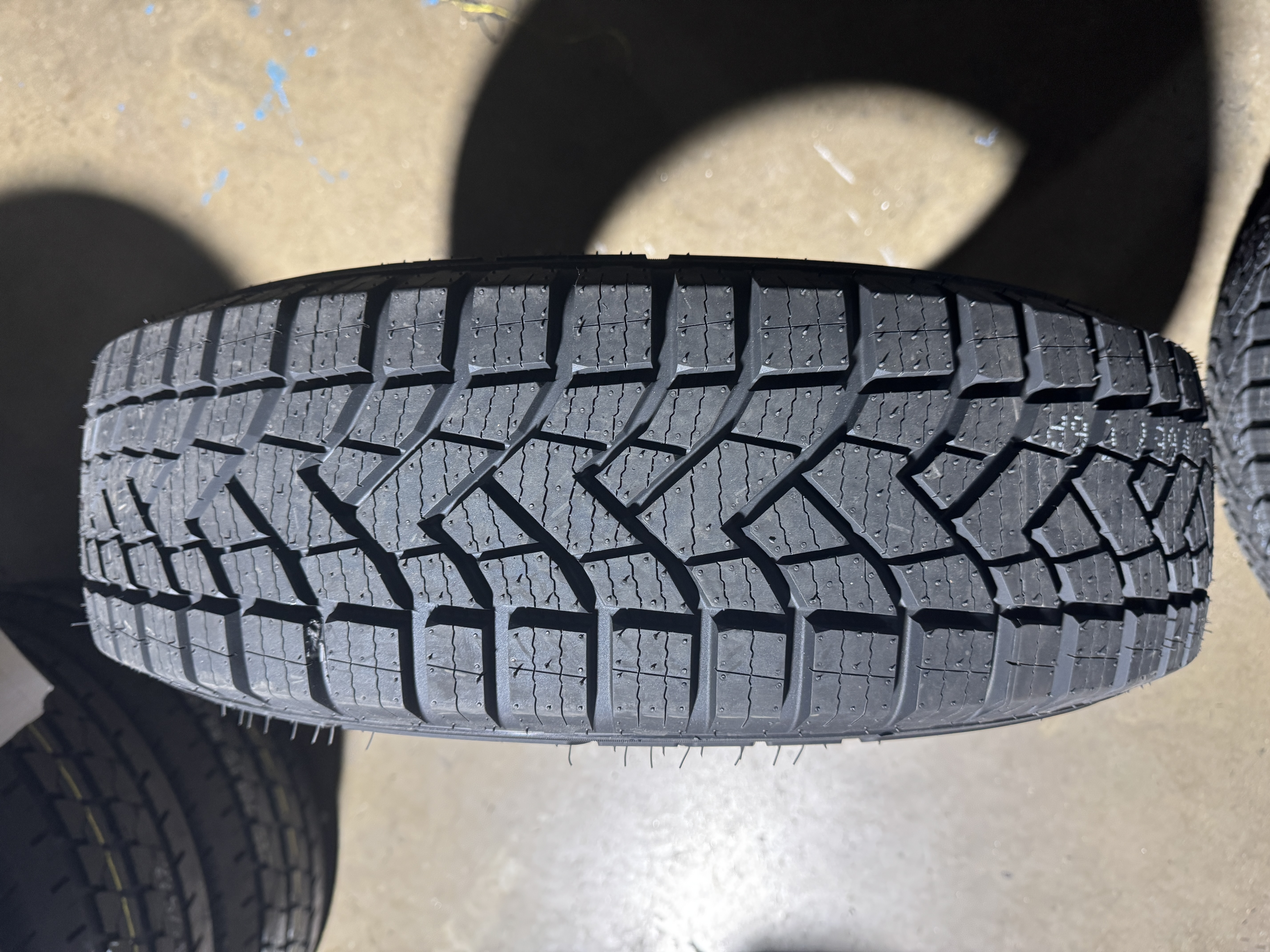
An all season commercial van tire catalogued in 185/75R16C and 195/75R16C, with a 104/102 load index, speed rating R and 475 kPa maximum pressure.
Why a Higher Pressure Ceiling Does Not Mean a Higher Load Index
Buyers frequently assume that the maximum pressure figure ranks tires on a strength scale: 475 kPa must be stronger than 450 kPa, and 500 kPa stronger still. The catalogued data does not support that reading.
The 104/102 family sits at 475 kPa. The 106/104 family sits at 450 kPa. If pressure ceilings indicated load ranking, the numbers would run the other way. They do not, because load capacity is determined by the combination of tire size, construction and inflation pressure together — not by any single figure. The load index is a declaration of outcome; the maximum pressure is one of the input limits that produced it.
The smaller numeric sizes make the same point even more sharply. The 5.00R12 ULT carries a maximum pressure of 500 kPa — higher than the 5.50R13LT at 420 kPa — yet its load index of 83 is lower than the 88 of the 5.50R13LT. A higher pressure ceiling, a lower load declaration. Reading either number without the other produces the wrong conclusion.
For a procurement decision, the practical rule is therefore a sequence rather than a comparison. Establish the load requirement of the axle — separately for single and dual positions if both are used. Confirm the load index of the tire in that position. Only then check that the tire maximum pressure ceiling is at or above the pressure the vehicle manufacturer specifies. Ranking tires by their maximum pressure figure first inverts that sequence.
Speed Symbol R and the Legal Side of the Sidewall
Speed symbol R appears consistently across the 106/104 and 104/102 commercial van entries, and also on the 109/107 entry covering 195/70R15C, 225/70R15C and 215/65R16C. The same product range uses other symbols where the intended duty differs: Q on 185R14LT, 195R14LT and 195R15LT as well as on 145R12C; P on 5.50R13LT and 5.00R12 ULT; N on 155R12LT; L on the 7.00R16LT and 7.50R16LT sizes.
Two legal points matter for anyone selling these tires across borders. The speed symbol is a design category and must satisfy the vehicle requirement; fitting a tire whose speed category falls below the vehicle specification is a fitment error regardless of how well the load index matches. Separately, in regulated markets the ECE R117 framework governs rolling resistance, wet grip and external rolling noise and requires labelling in the EU (UNECE). A tire can be fully compliant with R117 and still be the wrong tire for a given van, because R117 addresses environmental and safety performance parameters, not the vehicle-specific load and speed match.
For distributors, that separation is the useful part. Certification documentation answers the question of whether a tire may be sold into a market. The load index and speed symbol on the sidewall answer the question of whether it may be fitted to a particular vehicle. Both checks are required, and neither substitutes for the other.
Applications: Where These Van Sizes Are Used
The commercial van entries carrying 106/104 and 104/102 are documented for urban road use and for commercial van applications, and the wider product documentation places these tires on urban roads, highway roads, mud terrain roads and mountainous conditions, as well as icy and snowy conditions and desert and sandy areas. The declared function set covers ride stability, wet-condition performance, cornering support, noise absorption and reduced rolling resistance.
Intended industries for these products include tire distributors and wholesalers, automotive aftermarket and retail chains, auto repair shop chains, tire dealers, mobility and transportation services, taxi companies, OEM matching and the automotive tuning industry. That list is worth reading as a risk map rather than a sales list. A taxi fleet running continuous urban duty has different load-frequency characteristics from a distributor that ships the same size to an aftermarket retailer. The load index on the sidewall serves both, but only if the purchasing specification is written against the correct fitment position.
The construction materials declared across these entries are consistent: natural rubber, synthetic rubber, carbon black, precipitated silica, steel cord, polyester cord fabric, nylon cord fabric, vulcanizing agent, vulcanization accelerators, activators, antioxidants and RAE oil, with white rubber compound added on several C-type van entries. Consistent construction documentation is useful to buyers precisely because it means the differentiation between the 106/104 and 104/102 families rests on size, rating and pressure rather than on unexplained material variation.
Where These Markings Reach Their Limits
A load index comparison is only useful if its boundaries are stated, and there are four that matter here.
The maximum pressure is not an operating instruction. The 450 kPa and 475 kPa figures are ceilings tied to the rated load. Inflating to the sidewall maximum because it is printed there, rather than to the vehicle manufacturer specification, is a misuse of the marking.
The catalog values are stated per entry, not per individual size. Each entry in the table above covers a group of size designations, and the load index, section width and pressure are published for the group. Where a designation such as 185/75R16C appears in two different entries with different values, the only authoritative source for a specific physical tire is the sidewall marking of that tire. Distributors should verify the marking on the unit rather than rely on a group-level data row.
These indices are not a substitute for heavier commercial sizes. The 106/104 and 104/102 families sit well below the LT entries in the same range, where 7.00R16LT and 7.50R16LT are catalogued at 122/118 with a 770 kPa maximum pressure. A van tire rated 106/104 cannot be positioned as an equivalent to a 122/118 light truck size, and buyers who need that load band should be pointed to the correct size family rather than to a higher pressure setting on a lighter casing.
The second figure of a dual index only applies in dual fitment. A 104/102 tire used in single-wheel service is governed by the 104 value, not the 102. Converting a vehicle from single to dual rear wheels does not preserve the load capability that was declared for the single position.
Market Trend: Load Capacity Is Becoming a Specification, Not a Footnote
The context in which van load markings are read is shifting. The global electric vehicle tire market is projected to reach USD 337.20 billion by 2034, growing at a CAGR of 28.1% from 2025, driven in part by requirements for high load capacity and low noise (Precedence Research). Electrified commercial vehicles place battery mass on the same axle ends that already carried payload, and the load index becomes a design input rather than a line item on a specification sheet.
Regulation is moving in the same direction. The ECE R117 framework formalises rolling resistance, wet grip and external noise performance and requires labelling in the EU (UNECE), which means a commercial van tire now carries two parallel sets of compliance information: environmental and safety performance on one side, load and speed suitability for the vehicle on the other. Buyers who only verify the first set are checking market access, not fitment.
On the supply side, the volume is large and increasingly competitive. China exported 9.65 million tonnes of tires in 2025, up 3.6% year-on-year, worth approximately 167.7 billion RMB (General Administration of Customs / SunSirs), while the global passenger car tire market stood at approximately USD 143.06 billion in 2024 with the passenger car segment at a 32.6% revenue share (Grand View Research). In a market of that scale, the practical differentiator for a distributor is not access to product but accuracy of specification.
Future Outlook
Three developments are likely to shape how load index markings are handled in commercial van procurement over the next planning cycle.
First, load and pressure data will move from the catalog page into the purchase order. As electrified and high-payload vans enter fleets, buyers who previously accepted a size match will increasingly require a load index and fitment-position declaration before confirming a shipment.
Second, sidewall verification will become standard practice rather than an exception, particularly for size designations that appear in more than one catalogued entry with different ratings. A photograph of the actual sidewall, attached to the quality record, is a low-cost control that removes an entire class of specification dispute.
Third, the compliance conversation will continue to split. R117 labelling and load/speed fitment answer different questions, and suppliers who can present both clearly — without using one to imply the other — will be easier to qualify in procurement processes that are themselves becoming more technical.
Frequently Asked Questions
What does a load index written as two numbers, such as 106/104, indicate?
In standard tire-marking practice, a dual load index reports load-carrying capability for two fitment positions. The first figure applies when the tire is mounted as a single wheel on the axle end, and the second applies when it is mounted as one of a pair of twin wheels. A 106/104 tire therefore has two declared load capabilities, and the axle configuration determines which one governs the vehicle.
What does the speed symbol R mean on these commercial van tires?
The speed symbol is a letter code denoting the design speed category of the tire. R appears across the 106/104 and 104/102 commercial van entries and on the 109/107 entry covering 195/70R15C, 225/70R15C and 215/65R16C. It is a design category, not a recommended cruising speed, and the tire must satisfy the speed requirement of the vehicle it is fitted to.
Does a 475 kPa maximum pressure mean the tire is stronger than one rated at 450 kPa?
No. In the documented range, the 104/102 entry carries a 475 kPa maximum pressure while the 106/104 entries carry 450 kPa. The smaller numeric sizes show the same pattern: 5.00R12 ULT is rated 500 kPa at load index 83, while 5.50R13LT is rated 420 kPa at load index 88. Load capacity results from size, construction and inflation pressure together, so the maximum pressure figure cannot be used as a ranking scale on its own.
Which size groups carry 106/104 at 450 kPa and which carry 104/102 at 475 kPa?
In the catalogued data, 106/104 at 450 kPa covers the C-type van range from 155R12C to 235/65R16C, the range from 155R13C to 205/75R15C, and the 185R14LT, 195R14LT and 195R15LT entry. The 104/102 at 475 kPa rating covers the 185/75R16C and 195/75R16C entry. Because 185/75R16C and 195/75R16C appear in more than one catalogued entry, the sidewall marking of the individual tire should be treated as the decisive reference.
What should a distributor verify before shipping a commercial van tire order?
Four checks are relevant. Confirm the load index and speed symbol on the actual sidewall rather than the group-level catalog row. Confirm the fitment position the vehicle uses, since the second figure of a dual index applies only in dual fitment. Confirm that the vehicle manufacturer pressure specification does not exceed the tire maximum pressure ceiling. And for regulated markets, confirm the applicable compliance documentation independently, since certification such as the ECE R117 framework addresses rolling resistance, wet grip and external noise rather than vehicle-specific load and speed suitability.
Reference Material
The full WIDEWAY / EVERLAND passenger car tire catalog, including the commercial van size range discussed above, is available as a downloadable PDF for buyers who need the complete size and rating listing: EVERLAND CATALOG-2025.