
Decoding Nitrogen Purity Compliance for PSA Generators: 1 ppm CO2 and -60 Dew Point
For industrial buyers, nitrogen purity compliance is usually decided by two numbers that rarely appear on a quotation: the residual carbon dioxide limit and the dew-point limit. A PSA nitrogen generator can be offered as "99.999% pure" while the actual process qualification depends on whether the unit holds carbon dioxide at or below 1 ppm and moisture at or below a -60℃ dew point, alongside residual oxygen at or below 5 ppm. This reference explains how those limits are specified, how BODA GAS documents them for the BCP Series carbon loaded purification nitrogen generator, and how a buyer at the decision stage should align an internal gas standard with a documented equipment capability.
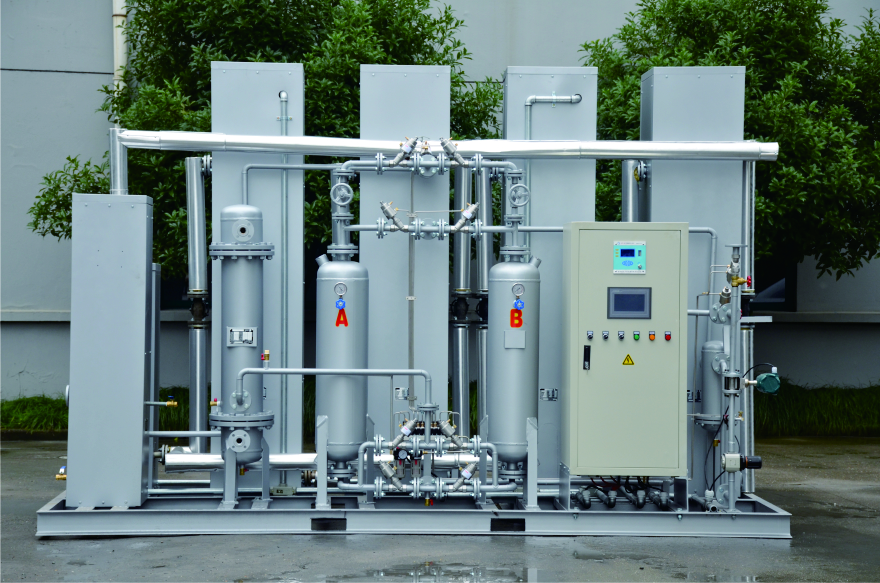
Carbon loaded purification nitrogen generator — the stage that carries the ppm-level contaminant specification in an ultra-high-purity nitrogen train.
Why Purity Percentages Mislead at the Decision Stage
A purity figure is a subtraction. When a generator is quoted at 99.9%, the remaining 0.1% is the total allowance for every component that is not nitrogen — oxygen, carbon dioxide, water vapour, argon and trace hydrocarbons included. The percentage states the size of the allowance. It does not state how that allowance is distributed, and two systems quoting the same headline number can be engineered to very different contaminant profiles.
This is why purity percentages are a weak decision variable for ultra-high-purity duty. Converting the common quotation tiers into ppm makes the scale visible:
| Declared purity | Total allowance for all non-nitrogen components | Typical buying context |
|---|---|---|
| 99.9% | 1,000 ppm | General industrial blanketing and purging |
| 99.99% | 100 ppm | Higher-purity industrial and medical-adjacent duty |
| 99.999% | 10 ppm | Ultra-high-purity process gas |
| 99.9995% | 5 ppm | Purification-grade on-site generation |
The ppm column is a derived arithmetic conversion of the percentage, not a laboratory result from any specific unit. Its purpose is to show that at the top of the range, purchasing decisions are being made in single-digit ppm territory — where the identity of the contaminant matters more than the size of the total allowance.
What a Compliant Ultra-High-Purity Specification Actually Contains
A specification that can be qualified in a factory acceptance test names each critical contaminant and gives it a limit. For the BODA GAS BCP Series carbon loaded purification nitrogen generator, the documented set is stated as follows:
| Parameter | Documented value |
|---|---|
| Series | BCP Series — carbon loaded purification nitrogen generator |
| Nitrogen output | 1~500 Nm³/h |
| Nitrogen purity | ≥99.9995% |
| Oxygen content | ≤5 ppm |
| Carbon dioxide content | ≤1 ppm |
| Nitrogen dew point | ≤-60℃ |
| Material | Carbon steel / SS304 |
| Customization options | Stainless steel, ATEX, ASME, CE |
| Documented application areas | Lithium-ion battery electrode drying, electrolyte blanketing and cell-sealing shielding gas; PV-cell sintering, silicon-wafer processing and thin-film deposition process gas; semiconductor wafer purging, SMT soldering and electronic-component anti-oxidation gas |
Read as a set, the three contaminant limits do different jobs. The oxygen limit defines the residual oxygen that survives the adsorption stage. The carbon dioxide limit is what separates a purification-grade generator from a standard nitrogen skid, because CO2 is adsorbed by the carbon molecular sieve along with oxygen and moisture and must be held down to a single-digit ppm ceiling. The dew-point limit expresses the moisture content of the product gas, and it is the parameter that determines whether the downstream process sees a dry or a marginally wet gas stream.
Buyers who request only the purity percentage leave the two hardest limits — CO2 and dew point — undefined in the contract. That is a commercial risk, not a technical one, because it moves the qualification argument to after delivery.
BODA GAS and the BCP Series: Documented Capability, Not Inferred Certification
BODA GAS is the brand under which Hangzhou Boda Purity Equipment Co., Ltd. develops, manufactures and exports PSA gas separation equipment. The company was established in 2002, is based in Hangzhou, Zhejiang Province, China, and operates a production base of more than 30,000 m² with 58 employees, an R&D team of 15 engineers and a documented annual output of 480 units. Its portfolio covers PSA nitrogen generators, PSA oxygen generators, industrial nitrogen generators, air separation machines, refrigeration dryers, heatless desiccant dryers, heated desiccant dryers, combination low dew point compressed air dryers, membrane separation nitrogen generators, membrane separation oxygen generators and filters. Export accounts for approximately 30% of output.
The company holds ISO 9001 quality management system, ISO 13485 medical device quality management system, ISO 14001 environmental management system and ISO 45001 occupational health and safety management system certifications, and states long-term cooperative supplier qualifications with China National Petroleum Corporation (CNPC), China Petrochemical Corporation (Sinopec), China National Offshore Oil Corporation (CNOOC), Zhuhai Jutal Offshore Oil Services Limited, United Energy Pakistan Limited, Ingersoll Rand Industrial Technologies, Petronas Chemicals MTBE Sdn. Bhd. (PCMTBE) and PT INDOSINO OIL & GAS.
A boundary on certification language matters here. ASME, CE, ATEX and marine-classification approvals appear in BODA GAS documentation as optional items and customization choices rather than as blanket standard features. Nothing in this article should be read as a claim that a BCP Series unit ships with a named approval unless that approval is specified in the order. The verifiable statement is narrower and more useful for procurement: product standards including ASME, CE, TR-CU and approvals from marine-classification societies are optional, and the cost gap between a non-certified and a code-compliant configuration is documented at 10% to 300% depending on certification requirements.
Technical Explanation: How a PSA Train Reaches 1 ppm CO2 and a -60℃ Dew Point
PSA nitrogen generation works on pressure swing adsorption. Under pressure, oxygen and nitrogen diffuse through carbon molecular sieve at very different rates; oxygen is preferentially adsorbed while nitrogen concentrates in the gas phase and is delivered as product. The same sieve also takes up carbon dioxide and moisture, which is why a correctly specified PSA train can hold CO2 at ≤1 ppm while the dew point is controlled upstream of the towers.
Reaching that point is a system outcome, not a single-component outcome. A complete on-site nitrogen station is documented as an air compressor, air receiver tanks, multiple filters, an air dryer, an activated carbon filter, the PSA nitrogen generator unit, a nitrogen buffer tank, an oxygen analyser or purity sensor, and a control system. Each stage removes a specific contaminant, and each has a documented ceiling:
- Bulk water and oil droplet removal. The FYS Series high efficiency oil-water separator documents gas-liquid separation efficiency above 98% and sits at the front of the train to protect the downstream sieve.
- Fine oil aerosol removal. The FLY Series high efficiency oil remover documents output oil content below 0.01 mg/m³.
- Terminal oil-vapour and hydrocarbon removal. The FLT Series activated carbon filter documents output oil content below 0.003 mg/m³ and is positioned as terminal-stage purification for high-purity PSA nitrogen generators, protecting the adsorbent from oil-vapour contamination.
- Drying. The FAG Series combined low dew point compressed air dryer documents a qualified air dew point of ≤-60℃ to -70℃ with regeneration air loss of 3% to 6%. The ADL Series heatless desiccant dryer and ADH Series heated desiccant dryer document ≤-40℃ or ≤-52℃. The dryer stage is where the -60℃ product dew point of a purification-grade unit is made possible.
- Particulate control. The FAL Series precision filter intercepts particulate contaminants ahead of the sieve, and the FLC Series sterilizing filter documents 0.1 μm filtration accuracy with air and nitrogen as applicable media.
- Adsorption and sieve protection. The BCP Series uses a carbon-loaded purification stage. Across the wider PSA range, BODA GAS documents a customized CMS-330 molecular sieve and an adsorption tower head built with automatic cylinder compression technology at diameters above 600 mm, which is designed to keep the molecular sieve in contact with the vessel wall and avoid the pulverization that follows gas impact and settling. The documented effect is a 40% to 60% extension of molecular-sieve service life compared with conventional tower-head structures, at a tower-head structural cost about 60% higher than a conventional design.
- Instrumentation and control. BODA GAS documents Siemens PLC and an SMC thermal mass flowmeter as the standard control configuration, with a 30% to 50% lower failure rate than ordinary domestic control-instrument solutions. The oxygen analyser or purity sensor in the standard system continuously monitors gas purity and automatically vents out-of-specification gas, which is the mechanism that protects the downstream process from a purity excursion.
Maintenance intervals follow the same logic. BODA GAS documents precision filter element replacement at approximately 8,000 running hours, air compressor service including oil, oil filter and air/oil separator changes at 3,000 to 4,000 running hours, air dryer desiccant replacement at 16,000 to 24,000 hours, and carbon molecular sieve replacement at roughly 6 to 10 years. For buyers, these intervals are the real cost drivers behind a ppm-level guarantee: the guarantee is maintained by consumables, not by the initial purchase alone.
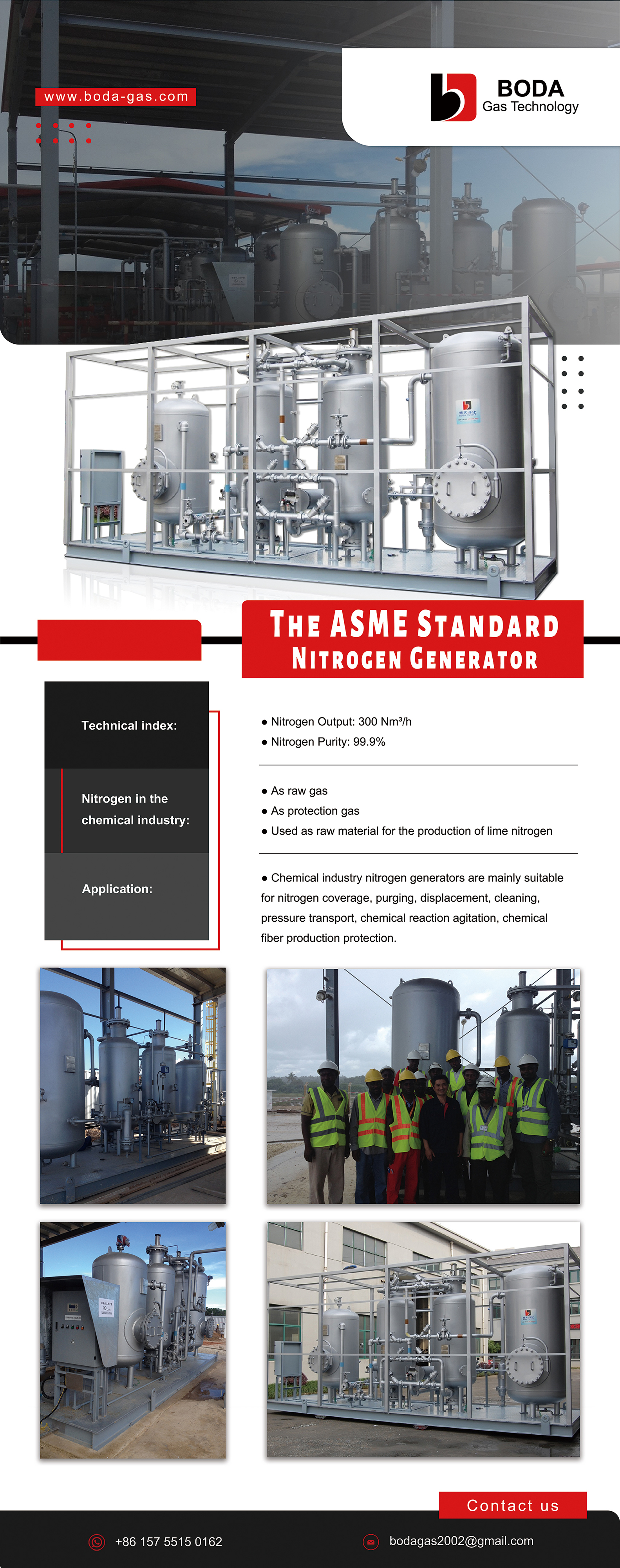
Code-driven configurations such as ASME-standard fabrication are documented as optional, project-specific choices — not as default features of every unit.
Application Fit: Where a 1 ppm CO2 and -60℃ Dew Point Specification Is Justified
Ultra-high-purity nitrogen is not a universal requirement, and paying for it where it is not needed is the most common configuration error at the decision stage. BODA GAS publishes an application-tier framework that helps buyers place their own process on the scale:
| Purity tier | Documented typical applications |
|---|---|
| 95%–98% | Fire protection, marine tank blanketing, oil field pipeline purging, general tyre inflation |
| 99%–99.9% | Food and beverage modified atmosphere packaging, winemaking, conventional plastic moulding |
| 99.95%–99.99% | Mild-steel laser cutting, electronics manufacturing, cable production, pharmaceutical tank blanketing |
| 99.999% and above | Cutting special metals such as titanium alloy, high-end electronics production, specialised laboratory applications |
The BCP Series sits at the top of that scale. Its documented application areas are lithium-ion battery electrode drying, electrolyte blanketing and cell-sealing shielding gas; photovoltaic cell sintering, silicon-wafer processing and thin-film deposition process gas; and semiconductor wafer purging, SMT soldering and electronic-component anti-oxidation gas. In the wider electronics scenario, BODA GAS documents common SMT workshop duty at 99.99% and chip-and-wafer precision manufacturing at 99.999% to 99.9999% with a dew point of ≤-60℃ — the same dew-point boundary the BCP Series is built around.
Elsewhere in the portfolio, the requirement profile is different and the specification should be adjusted accordingly. Chemical industry scenarios are documented at 99.0% to 99.99% purity for reactor inert shielding, raw-material tank blanketing and pipeline purging, frequently with explosion-proof or ASME requirements. Food and beverage packaging is documented at 99.0% to 99.9% food-grade oil-free nitrogen for modified atmosphere packaging, with oil-free air compressor and stainless steel requirements. Pharmaceutical scenarios are documented at 99.99% to 99.999% for drug production, storage, sealing and packaging, with oil-free and stainless steel requirements. Oil and gas applications are documented at 95% to 99.9% for tank blanketing, pipeline and vessel purging, and well work-over support, with explosion-proof specification for Zone 1 and Zone 2 hazardous-gas areas.
Delivery format is a separate decision. BODA GAS documents three skid configurations — split-type skid assembly, integrated skid-mounted unit and container-integrated package — with layout arranged to on-site space, up to 10% space saving against standard skid-mounted configurations, and a 5% to 10% cost difference depending on the type chosen. This is where a movable containerized PSA nitrogen generator, a skid-mounted PSA nitrogen generation package and a fixed industrial PSA nitrogen generator diverge commercially rather than technically.
Market Context: Why Purity Compliance Is Moving Up the Procurement Agenda
The commercial backdrop explains why buyers are being asked to define contaminant limits rather than accept a percentage. Published third-party research places the global industrial nitrogen generator market at USD 4.29 billion in 2023, projected to reach USD 6.47 billion by 2031 (Verified Market Research). Within that market, pressure swing adsorption accounts for approximately 48% of global nitrogen generator market share, making it the dominant technology segment (Fortune Business Insights). PSA equipment is also the documented preference where purity above 99.9% is required, because membrane systems are typically capped at lower purity levels (Atlas Copco). Published technical sources state that PSA generators can reach purity up to 99.999% using carbon molecular sieves (General Air Products).
Application demand is uneven. The food and beverage segment dominated the nitrogen generator market in 2023 with approximately 49.8% of revenue share, driven by modified atmosphere packaging (Grand View Research) — a segment where regulatory expectations for continuous verification are explicit. In the European Union, EIGA guidance requires at least one continuously online residual oxygen analyser in a food-grade nitrogen stream. The chemical industry segment is expected to grow at the highest CAGR among applications at 6.0%, on increased use in blanketing and reactor purging (Maximizemarketresearch). Regionally, Asia-Pacific is the fastest-growing region for PSA nitrogen generators, projected to hold a 35% market share by 2032 (Verified Market Research).
Capacity structure is equally relevant to the compliance discussion. PSA nitrogen generator installations are divided by capacity into sub-100 Nm³/h at 42%, 100–500 Nm³/h at 36%, and above 500 Nm³/h at 22% (Precedence Research / Dataintelo). Roughly four out of five installations therefore fall inside the 500 Nm³/h ceiling that the BCP Series is documented to cover, which means purification-grade on-site generation is a realistic option for the majority of industrial projects rather than a niche laboratory configuration.
Regulatory pressure runs in parallel. In the EU, pressure vessels in PSA nitrogen generators must comply with the Pressure Equipment Directive (PED 2014/68/EU) and bear the CE mark (European Commission). Compliance of that type is a documentation exercise before it is an engineering exercise, which is precisely why the option to configure ASME, CE, TR-CU or marine-classification compliance matters at the quotation stage.
Comparison with Traditional Supply and Lower-Specification Alternatives
The practical decision is rarely "PSA versus nothing." It is a choice between delivered gas, a standard on-site PSA skid, and a purification-grade on-site system. The three differ most sharply on what can be written into a specification.
| Decision dimension | Delivered cylinder or liquid nitrogen | Standard on-site PSA skid | Purification-grade on-site PSA (BCP Series) |
|---|---|---|---|
| Primary specification | Supplier certificate per delivery | Purity percentage, with contaminant limits dependent on configuration | Purity ≥99.9995% stated together with O2 ≤5 ppm, CO2 ≤1 ppm, dew point ≤-60℃ |
| Supply continuity | Depends on delivery scheduling and logistics | Continuous on-site generation | Continuous on-site generation |
| Flow envelope | Not flow-bound; volume purchased per delivery | BXN Series documented at 1~3000 Nm³/h, 95%~99.999% purity | 1~500 Nm³/h at ≥99.9995% |
| Cost structure | Recurring gas purchase plus logistics | Capital plus routine maintenance | Higher capital for purification, drying and material stages |
| Code and material options | Not applicable | Carbon steel / SS304, with ATEX, ASME, CE, ISO customization available | Stainless steel, ATEX, ASME, CE customization available |
| Main qualification risk | Supply interruption and certificate-to-batch matching | Contaminant limits may remain undefined in the contract | Higher first cost, and a documented 500 Nm³/h output ceiling |
Against delivered gas, third-party analysis attributes a cost advantage to on-site generation of up to 40% by eliminating logistics fees (U.S. Department of Energy, cited in published market research). Against a standard skid, the purification-grade system wins on specification completeness rather than on price.
Limits and Boundaries Buyers Should Accept Before Signing
A credible specification includes its own constraints. Four are documented and material.
- Output range boundary. The BCP Series is documented at 1~500 Nm³/h. Projects requiring ultra-high purity above that range fall outside the documented envelope and require a different configuration discussion, not an assumption.
- Real cost premiums. BODA GAS documents a 304 stainless steel regeneration-gas pipeline at approximately 150% higher material cost than carbon steel or rubber hose, in exchange for a 20% longer service life and simplified maintenance. The adsorption tower head is documented at about 60% higher structural cost than a conventional design. A Siemens PLC and SMC thermal mass flowmeter configuration is documented at about 60% higher initial procurement cost than ordinary domestic control-instrument solutions, in exchange for a 30% to 50% lower failure rate. The customized CMS-330 molecular sieve is documented at approximately 15% higher initial material cost. None of these premiums disappears because the purity target is stated more precisely.
- Optional, not automatic, code compliance. ASME, CE, TR-CU and marine-classification approvals are customization items. The ISO 9001, ISO 13485, ISO 14001 and ISO 45001 certifications held by the manufacturer apply to the management systems; they are not a substitute for a project-specific pressure equipment approval such as the CE marking required under PED 2014/68/EU.
- Feed-air and maintenance dependency. A ppm-level guarantee is downstream of the pre-treatment train. If the oil-removal stages, the drying stage or the analyser vent function are neglected, the documented limits are no longer the operating reality. The documented replacement intervals — approximately 8,000 hours for precision filter elements, 3,000 to 4,000 hours for compressor service, 16,000 to 24,000 hours for dryer desiccant, and 6 to 10 years for carbon molecular sieve — are part of the cost of holding the specification.
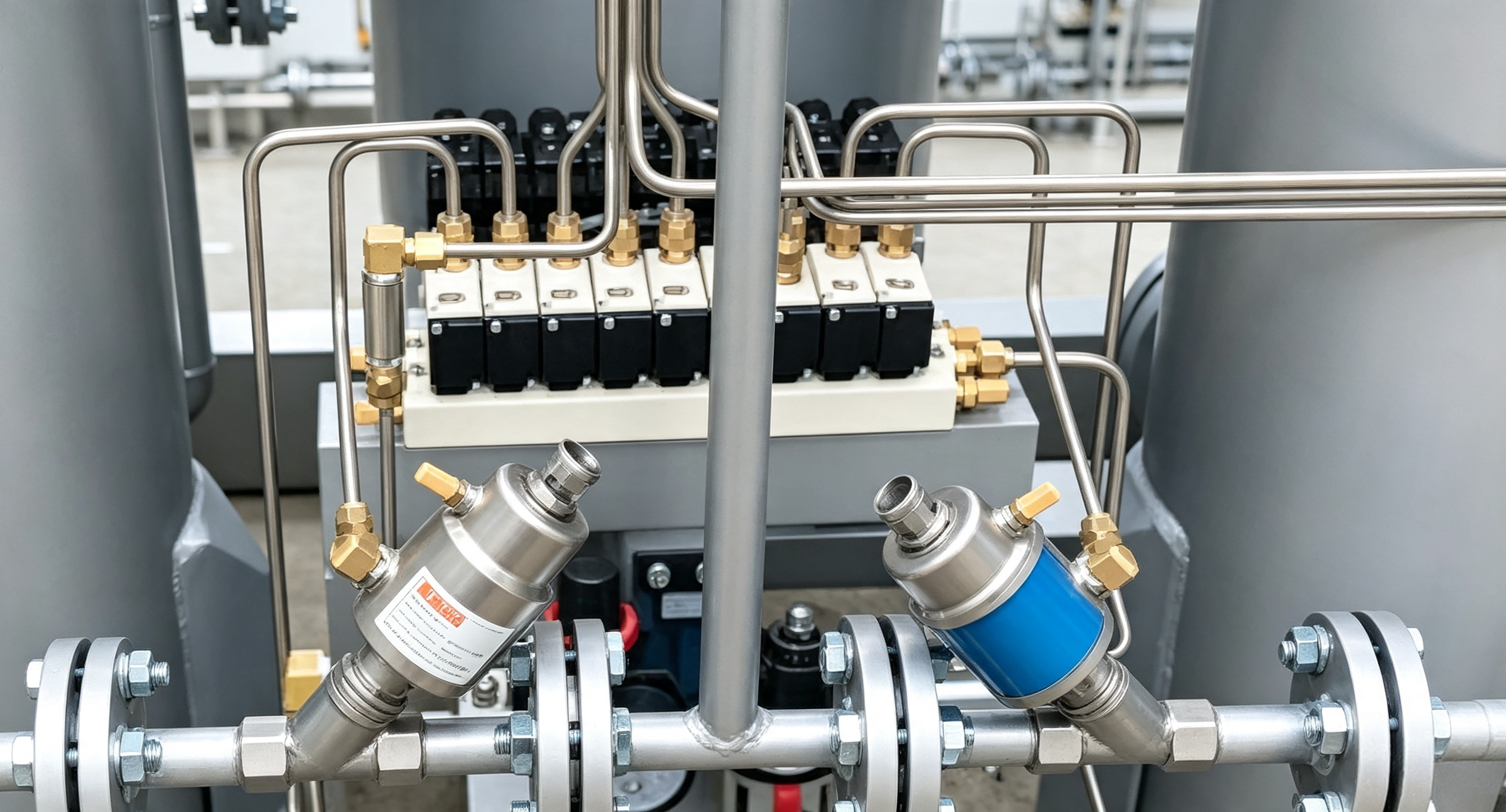
Material choices such as 304 stainless steel regeneration-gas piping are documented as durability and stability improvements — with a stated cost premium.
Future Outlook
Two forces are pushing contaminant-level specifications toward the centre of the buying conversation. The first is volume: published research projects the industrial nitrogen generator market growing from USD 4.29 billion in 2023 to USD 6.47 billion by 2031, with Asia-Pacific expected to hold a 35% market share by 2032 and chemical industry applications growing fastest at a 6.0% CAGR. More installations in more regions means more procurement teams defining gas specifications for the first time.
The second is regulatory drafting. Pressure equipment compliance in the EU is already defined at directive level, and food-grade nitrogen verification is already defined at association level through requirements for continuously online residual oxygen analysis. As trace contaminant limits migrate from specialist process documents into general purchase specifications, suppliers who can state CO2, oxygen and dew-point limits as documented figures will be easier to qualify than suppliers who state a percentage and leave the rest to commissioning.
For buyers, the practical implication is that purity compliance should be treated as a documentation deliverable. The question to put to any PSA nitrogen generator supplier is not "what purity can you reach?" but "which contaminant limits, at which flow, will appear in writing before the order — and what changes them after installation?"
FAQ
What does ≥99.9995% nitrogen purity actually mean in a PSA generator specification?
It means the total allowance for all non-nitrogen components is 5 ppm. The percentage therefore describes the size of the combined allowance, not the distribution of individual contaminants. For the BODA GAS BCP Series, the purity figure is documented together with three separate limits: oxygen content ≤5 ppm, carbon dioxide content ≤1 ppm, and nitrogen dew point ≤-60℃, at an output of 1~500 Nm³/h. Published technical sources state that PSA generators using carbon molecular sieves can reach purity up to 99.999%, so the 99.9995% figure represents the top of the PSA purity range rather than a different separation technology.
Why should CO2 ≤1 ppm and dew point ≤-60℃ be specified separately from the purity percentage?
Because the purity percentage does not identify which contaminant is present, and the two contaminants behave differently in a PSA train. Carbon dioxide and moisture are both taken up by the carbon molecular sieve alongside oxygen, so a generator that meets a purity figure can still show a different CO2 profile from another unit quoting the same number. Moisture is additionally determined by the drying stage of the system: BODA GAS documents the FAG Series combined low dew point compressed air dryer at a qualified air dew point of ≤-60℃ to -70℃, while the ADL Series heatless and ADH Series heated desiccant dryers are documented at ≤-40℃ or ≤-52℃. A separate CO2 and dew-point limit tells the buyer which drying and purification stages the quotation actually includes.
How can a buyer verify oxygen, CO2 and dew-point limits before placing an order?
By requiring the specification set in writing and confirming the components that produce it. A standard on-site nitrogen station is documented as air compressor, receiver tanks, multiple filters, air dryer, activated carbon filter, PSA nitrogen generator, nitrogen buffer tank, oxygen analyser or purity sensor, and control system. The verification points are: the terminal oil-removal specification (FLT Series activated carbon filter documents output oil content below 0.003 mg/m³, with the FLY Series oil remover documenting below 0.01 mg/m³); the drying-stage dew point; the presence of an oxygen analyser or purity sensor that continuously monitors purity and automatically vents out-of-specification gas; and the flow rate at which the stated purity applies, since BCP Series output is documented at 1~500 Nm³/h. For reference, EIGA guidance for food-grade nitrogen requires at least one continuously online residual oxygen analyser in the nitrogen stream — an example of how continuous verification is treated in a regulated gas application.
When is a standard PSA nitrogen generator sufficient, and when is a purification-grade unit necessary?
It depends on where the process sits on the purity scale. BODA GAS documents 95%–98% for fire protection, marine tank blanketing, oil field pipeline purging and general tyre inflation; 99%–99.9% for food and beverage modified atmosphere packaging, winemaking and conventional plastic moulding; 99.95%–99.99% for mild-steel laser cutting, electronics manufacturing, cable production and pharmaceutical tank blanketing; and 99.999% and above for cutting special metals such as titanium alloy, high-end electronics production and specialised laboratory applications. The BXN Series platform is documented at 1~3000 Nm³/h and 95%~99.999% purity across industrial, skid-mounted, containerized, ASME-standard and stainless-steel builds. The BCP Series is the purification-grade option where CO2 and dew-point limits must be held at the levels documented above.
What changes in cost and configuration when ASME, CE or stainless-steel options are added?
Customization moves the configuration and the price. Product standards including ASME, CE, TR-CU and approvals from marine-classification societies are documented as optional, with a cost gap ranging from 10% to 300% depending on certification requirements. Material choice follows a similar pattern: a 304 stainless steel regeneration-gas pipeline is documented at approximately 150% higher material cost than carbon steel or rubber hose, with a 20% longer service life; the adsorption tower head is documented at about 60% higher structural cost than a conventional design, extending molecular-sieve service life by 40%–60%; and a Siemens PLC with SMC thermal mass flowmeter configuration is documented at about 60% higher initial procurement cost with a 30%–50% lower failure rate than ordinary domestic control-instrument solutions. Skid configuration is a smaller variable, documented at a 5% to 10% cost difference depending on type, with up to 10% space saving. Management-system certifications held by the manufacturer are ISO 9001, ISO 13485, ISO 14001 and ISO 45001; these are separate from project-specific pressure equipment approvals.
What are the practical limitations of specifying ultra-high-purity nitrogen from an on-site PSA generator?
Three limitations are documented. First, output range: the BCP Series is documented at 1~500 Nm³/h, so larger ultra-high-purity flows fall outside that envelope. Second, cost: purification, drying, stainless-steel and high-specification instrumentation stages all carry stated premiums, including roughly 15% higher initial material cost for the customized CMS-330 molecular sieve. Third, dependency on maintenance and feed-air quality: the documented replacement intervals are approximately 8,000 hours for precision filter elements, 3,000 to 4,000 hours for air compressor service, 16,000 to 24,000 hours for air dryer desiccant, and 6 to 10 years for carbon molecular sieve, so a ppm-level guarantee is maintained by consumables and pre-treatment discipline rather than by the initial purchase alone.
The BODA GAS product manual, listing the full series range and documented parameters, is available for reference and download: BODA GAS Product Manual. Additional company information is published at www.boda-gas.com.