
Decoding One-Stop Hotel Supplies: What the Spec Numbers Mean
A hotel textile order is decided on a specification sheet, not on a catalogue photograph. One-stop comprehensive hotel supplies describes a supply model in which a hotel buys guest room bedding, bathroom terry, bed protection and food-and-beverage linen against one shared specification baseline, instead of assembling the same four categories from vendors who each measure and describe products differently. The phrase describes coordination. It does not describe a product.
That distinction matters most at the discovery stage, when a buyer is still working out what a hotel textile range contains and which numbers on the page are actually decisions. Catalogue photography answers the first question badly, because colour and styling are the least durable attributes of a commercial textile. The numbers — yarn count, density, item weight, fill weight, care ceiling, minimum order quantity — are the ones that survive the first twelve months of laundry.
The category is large enough to justify the coordination effort. The global hotel supplies market was valued at approximately USD 62.01 billion in 2024 and is projected to reach USD 82.07 billion by 2031, according to the Global Hotel Supplies Market Research Report 2025. Within that total, the global hotel bedding market alone was estimated at USD 14.2 billion in 2025, with a CAGR of 5.8% through 2034, based on Dataintelo's published estimate.
Guangdong Weisdin Industrial Co., Ltd., which trades under the international brand WEISDIN, is a Guangzhou-based manufacturer of premium hotel linens established in 1998. Its range covers bedroom sets, hotel bedding sets, sheets, pillows, pillow cases, duvets, mattress toppers, chair covers, towels, bathrobes, bath mats, table cloths and napkins — enough category surface to use as a worked example throughout this article. The company reports a 6,300 m² manufacturing facility, an annual production capacity of 2,000,000 pieces, 29 direct employees, a partner factory workforce of over 200 and an R&D team of six engineers, with exports accounting for 70% of sales across South America, the United States and the EU.
The catalogue question that awareness-stage buyers ask wrongly
Most first-time hotel textile buyers begin with a comparison of images. The result is a shortlist built on visual preference, followed by a procurement negotiation in which the two sides discover they were measuring different things. Three misreadings recur.
- Thread count used as a universal quality score. Density is a description of how tightly a woven fabric is constructed. It does not by itself describe the cotton, the finishing, the stitching or the shrinkage behaviour, and it says nothing at all about terry, which is specified by weight rather than density.
- Minimum order quantity treated as a price lever. In practice MOQ defines which specification is available at all. A custom embroidery programme, a custom colour or a custom size does not sit inside the same production slot as a stock item.
- Care instructions skimmed. The maximum wash temperature and the cleaning method on the specification sheet determine laundry cost and replacement cycles more directly than the fabric composition does.
The opportunity for a buyer at this stage is narrow but valuable: learn to read the sheet before committing to a vendor conversation. A single specification baseline makes that possible, because the same vocabulary applies to bedding, terry and table linen supplied under one relationship.
Where a one-stop textile range actually stops
Any credible one-stop proposition has a boundary, and buyers should locate it early. WEISDIN's range is a textile range. Guest room soft goods, bathroom terry and table linen sit inside it; non-textile consumables and amenities do not.
| Supply layer | Categories in the range | Reference models | Primary specification axis |
|---|---|---|---|
| Guest room bedding | Bedding sets, flat and fitted sheets, duvet covers, pillow cases | CP106 (3cm satin stripe), CP128 (sateen), CP139 (arrow-shaft jacquard), CP152 (embroidered), CP186 (printed) | Yarn count, density, stitching construction |
| Guest room filling | Duvets, quilts, pillows, mattress toppers | BX280, BX296, CX2120, ZX5103, HD3000 | Fill composition, fill weight per m², care method |
| Bed protection | Waterproof mattress protectors | HD3700, HD3701 | Sewing standard, wash ceiling, fit system |
| Bathroom terry | Towels, bath mats, bathrobes | MJ8300 (plain), MJ8500 (jacquard and embroidered), DJ9100, DJ9200, DJ9300, YP9600 | Item weight in grams, yarn count, edge reinforcement |
| Food and beverage linen | Table cloths, napkins | TB1102, CJ9800 | Weave density, finished size, colour retention |
Scope map of a hotel textile range, using the WEISDIN product families as the reference set.
The boundary is not a weakness; it is a scoping tool. A project that needs slippers, guest amenities and printed collateral is buying from a different supply layer, and a buyer who conflates the two will end up managing two contracts while believing they have one.
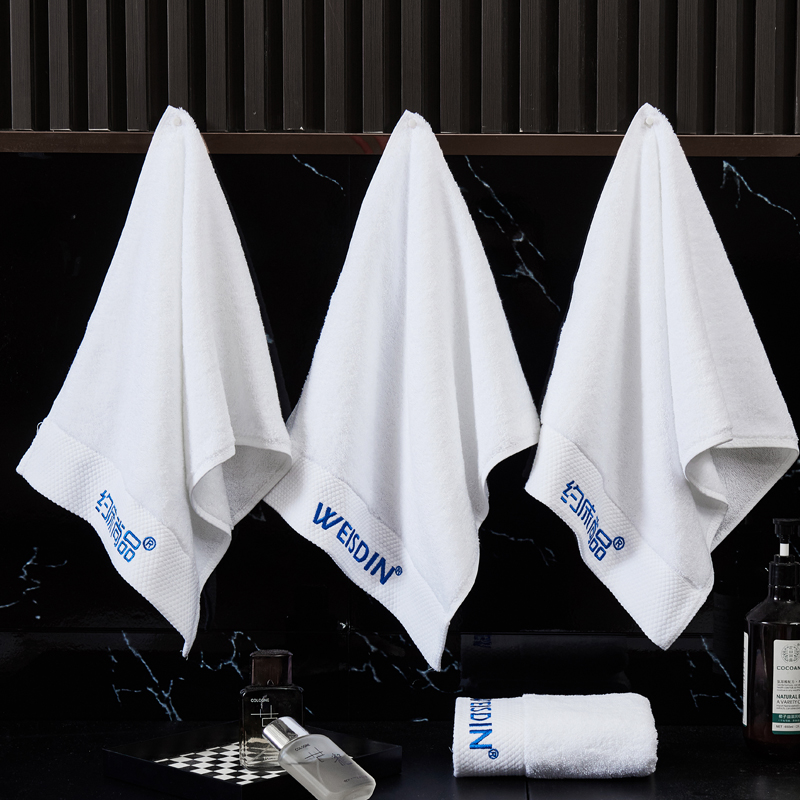
Terry is specified by weight and edge construction rather than by thread count.
Reading the numbers: a specification decoder
The vocabulary below covers most of what appears on a hotel textile sheet. It is worth learning once, because the same terms recur across bedding, terry and table linen, and across suppliers.
| Specification term | What it fixes | Worked example from the range |
|---|---|---|
| Yarn count (for example 60×40, 60×60, 60×80) | The fineness of the yarns used in the woven shell | CP139 jacquard bedding is offered in 60×40 at 300T, 60×60 at 350T and 60×80 at 400T |
| Yarn count in terry (for example 21S, 32S) | The yarn used in the pile of towels and bath mats | MJ8300, MJ8500, DJ9100 and DJ9200 are available in 21S or 32S |
| Density, expressed as T | Thread density of the woven fabric | CP128 sateen starts at a 40×40 air-jet twill at 250T and runs to an 80×80 air-jet sateen at 600T |
| Item weight in grams | The mass of a terry or robe item | Towels 60g to 700g; bath mats 300g to 1300g; bathrobe YP9600 in 700g, 750g, 1000g or 1200g |
| Fill weight per m² | The quantity and type of filling inside duvets and toppers | HD3000 uses 100g/m² white duck down as the upper fill and 1500g/m² white duck feather at 2–4cm as the lower fill |
| Weave and craft name | Surface structure, hand feel and visual character | Sateen, arrow-shaft jacquard, satin stripe in 0.5cm, 1cm, 2cm or 3cm widths, plain weave, waffle |
| Decoration method | How the property mark is applied | Embroidery on CP152 and on the MJ8500 embroidered towel; printing on CP186; woven labels and private label supported |
| Care ceiling | Maximum wash temperature and permitted cleaning method | 90°C maximum wash for CP139, CP152 and HD3700; 70°C for CP128; dry-clean only for BX280, BX296 and CX2120 |
| Minimum order quantity | The smallest production run the factory will accept | 100 pieces for towels, bath mats and bathrobes; 100 sets for customized bedding designs |
| Lead time | Production time for customized work | 30+ days for customized bedding sets |
Specification decoder for a hotel textile range. Values correspond to the reference models named in the third column.
Why weight, not thread count, governs terry
Terry has no meaningful thread-count conversation. A towel is described by the mass of the finished item, the yarn in the pile and the reinforcement at the edge. In the MJ8300 plain towel and the MJ8500 jacquard and embroidered towels, weights run from 60g to 700g across sizes from 33×33cm to 80×150cm, with reinforced stitching edges and colour fixation treatment. A 60g item and a 700g item are not better or worse versions of one another; they are different products serving different positions in a bathroom or a spa.
Why fill composition decides a duvet's operating model
Fill changes the care regime, and the care regime changes the laundry plan. BX296 combines a 133×100TC cotton shell with goose down and feather filling, using pinch pleat craftsmanship to hold the fill in place and finished seams to limit leakage. BX280 uses a 60s satin cotton shell with goose-down-like filling and box stitching to prevent shifting. CX2120 uses down-proof cloth with an entire down filament fill and water-standing grid quilting. All three are dry-clean only, with a maximum temperature of 90°C. A property without dry-cleaning capacity cannot treat these as drop-in replacements for machine-washable bedding.
Why the care ceiling belongs in the first conversation
Care instructions are a procurement constraint disguised as a footnote. CP128 sateen bedding is machine washable and dry cleanable at a maximum of 70°C and is described as wrinkle-resistant and shrink-resistant. CP139 jacquard bedding and CP152 embroidered bedding accept machine washing at up to 90°C. HD3700 and HD3701 waterproof mattress protectors can be machine washed or dry cleaned at up to 90°C, with low-temperature drying or hang drying. Mixing these items in one laundry stream without checking the ceiling is how a specification problem becomes a replacement cost.

Woven bedding is specified by yarn count, density and stitching construction, not by appearance alone.
What the numbers cannot tell you
Honest specification reading includes knowing where the sheet stops being informative.
- Density is not a quality verdict. A higher T describes a denser weave. It does not describe the cotton's origin, the finishing route, the stitching strength or the shrinkage performance. Those are separate questions, answered by construction detail and by care-behaviour evidence, not by one number.
- Weight is not a performance guarantee. Heavier terry generally feels denser and absorbs more, and it also adds laundry mass and drying time. The trade-off is operational, and it belongs to the property's laundry capacity rather than to the vendor's range.
- Certification is a document, not a specification line. OEKO-TEX® STANDARD 100 is the primary global safety benchmark for hotel textiles and covers more than 1,000 harmful substances. Buyers should request the certificate and verify its scope for the specific items and production site. A thread count does not imply it.
- Custom work carries its own clock. Customized bedding designs carry a minimum of 100 sets and a lead time of 30+ days. Embroidery and logo work add process steps to the front of that timeline.
- Range coverage has edges. As noted above, a textile range does not include non-textile guest consumables, and a single-source relationship concentrates dependency. Buyers should know which categories are covered, which are not, and what the fallback is for the second group.
The practical rule: use specifications to shortlist, and use documents, samples and laundry trials to confirm. A sheet that answers only the first question has done half its job.
Matching the specification set to the zones of a hotel
Hotel textile requirements are usually documented by operating zone rather than by product family, because each zone has a different replacement rhythm. Published application data for this category describes hotel guestrooms, bathrooms and restaurants operated under indoor constant temperature conditions, in long-term daily use with cyclic laundry and repeated turnover. The stated special requirements for such projects include custom logo work, chlorine-resistant towels and shrink-proof bedding — three demands that map directly onto specification lines rather than onto styling choices.
In the guest room, the specification centres on the bedding set construction. CP139 uses a duvet cover with decorative flange and centre bottom opening, a pillowcase with piped edge and 2/8 bottom opening, and a bed sheet with a four-sided 1cm hem. CP128 uses a decorative flange duvet cover, a piped-edge pillowcase with envelope closure, and a 1cm hem sheet. Those construction details determine how the item behaves during stripping, pressing and restocking, which is where housekeeping time is actually spent.
In the bathroom, the split runs between terry and protection. The DJ9100 plain and DJ9200 jacquard bath mats are 100% cotton, 50×80cm, at 300g, 350g or 400g, while the DJ9300 long wool mat extends to 60×90cm and 60×120cm at up to 1300g. The YP9600 waffle bathrobe is offered in five collar constructions — small waffle kimono, medium waffle shawl, waffle and terry kimono, waffle and terry shawl, and waffle-modal air layer — at 700g to 1200g, with an adjustable waist belt and built-in side pockets. Underneath all of it, HD3700 and HD3701 protectors use a three-stitch, five-thread sewing standard with 3cm imported rubber bands at the four corners.
In food and beverage, durability is expressed through weave and finished size. TB1102 table cloths use a high-precision jacquard fabric in a plain weave with double-needle sides, in 260×260cm, 300×300cm and 320×320cm. CJ9800 napkins use a high-density satin texture at 42s/2×42s/2 and 103×95, in 45×45cm and 50×50cm, with stitched ends and colour retention treatment for repeated cleaning cycles.
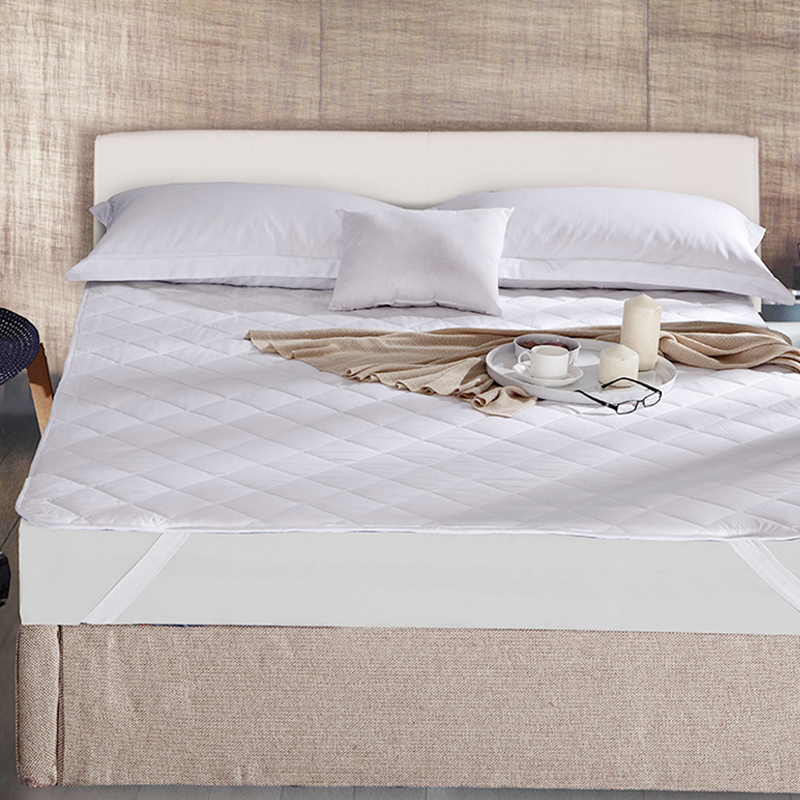
Bed protection is specified by sewing standard, corner fit system and wash ceiling.
Where demand is moving
Three published data points explain why specification literacy is becoming a buying skill rather than a technical specialty.
First, the bathroom is the fastest-moving zone. Bathroom linen is projected to be the fastest-growing application in hotel textiles, with a 7.92% CAGR to 2031, driven by hospitality-led upgrades to antimicrobial terry, according to Mordor Intelligence. Terry upgrades are weight and yarn decisions, which means they land on the specification sheet before they land on a purchase order.
Second, bedding demand continues to expand rather than consolidate. The 5.8% CAGR through 2034 attached to the USD 14.2 billion hotel bedding estimate implies a market that keeps adding capacity, and a market that adds capacity tends to add suppliers with differing measuring conventions.
Third, the manufacturing base behind these categories remains concentrated. China's exports of textile yarn, fabrics and articles reached USD 141.96 billion in 2024, a 5.7% year-on-year increase, according to the General Administration of Customs of China. For buyers sourcing from that base, the practical consequence is choice — and the cost of choice is the work of comparing specifications that are described in inconsistent terms.
One baseline versus four vocabularies
The comparison that matters at the discovery stage is not one-stop versus multi-supplier in the abstract. It is one specification vocabulary versus four. A property buying bedding from one vendor, terry from a second, table linen from a third and bed protection from a fourth has to reconcile four conventions for yarn count, weight, sizing and care, and then hold four parties to them when a reorder arrives eighteen months later. Under a single baseline, the same term means the same thing across categories, and a reorder references one document.
The limitation runs the other way, and it is real. A single baseline concentrates exposure: if one supplier's production schedule slips, multiple zones are affected at once rather than one. A one-stop range also cannot be all things — the boundary described earlier means some items will always sit outside it. Buyers running large or multi-brand portfolios often keep a qualified second source for the highest-turnover categories, and treat the one-stop relationship as the baseline rather than as the only line.
What buyers should expect next
Two shifts are visible from the specification side. Documentation is becoming part of the product: buyers increasingly ask for care ceilings, fill compositions and certification scope in writing before sampling, which pushes suppliers toward standardised, comparable data rather than descriptive catalogues. And the bathroom category is moving from a commodity purchase toward a specified one, following the growth pattern noted above — which will make terry weight, yarn count and edge reinforcement normal points of negotiation rather than afterthoughts.
For a buyer still in the discovery stage, the useful next step is not a longer shortlist. It is a working specification sheet: the categories you need, the care regime your laundry can support, the MOQ your first phase can absorb, and the documentation you will require before approval. A one-stop supplier can then be evaluated against that sheet rather than against its own photography.
Frequently asked questions
What does one-stop comprehensive hotel supplies include for a hotel project?
It describes a supply model covering the textile categories of a hotel under one specification baseline — typically guest room bedding and filling, bed protection, bathroom terry and bathrobes, and food-and-beverage linen. Non-textile consumables and guest amenities generally sit outside such a range and are sourced separately.
Which specifications should be confirmed before ordering hotel bedding sets?
Yarn count and density define the woven shell, construction defines the duvet cover, pillowcase and sheet detailing, and the care ceiling defines the maximum wash temperature and permitted cleaning method. In the reference range, jacquard bedding runs from 60×40 at 300T to 60×80 at 400T, sateen bedding from 250T to 600T, and wash ceilings vary between 70°C and 90°C depending on the model.
How are hotel towel weights chosen?
Towels are specified by finished item weight, yarn count and size rather than by thread count. The range covers 60g to 700g across sizes from 33×33cm to 80×150cm, in 21S or 32S yarn, with reinforced stitching edges and colour fixation treatment. Selection is driven by the intended use position — hand, face, bath or spa — and by the laundry capacity of the property.
Are hotel duvets and quilts machine washable?
Not in every case. The BX280 goose-down-like duvet, the BX296 goose down quilt and the CX2120 cotton duvet are dry-clean only, with a maximum temperature of 90°C and low-temperature drying. Bedding sets such as CP128, CP139 and CP152 are machine washable, with maximum wash temperatures of 70°C or 90°C depending on the model.
What minimum order quantity applies to custom hotel logo work?
Minimums differ by category. Towels, bath mats and bathrobes accept sample and OEM orders from 100 pieces. Customized bedding designs carry a minimum of 100 sets with a lead time of 30+ days. Embroidery, woven labels, private label and personalised packaging are supported within those thresholds.
For buyers who want to compare these categories against a single reference document, the 2026 WEISDIN product catalogue is available for download: WEISDIN 2026 catalogue (PDF).
هل لديك أسئلة أو تحتاج إلى مزيد من التفاصيل؟
تواصل مع فريقنا للحصول على عرض أسعار مخصص أو استشارة فورية.
طلب عرض أسعار
املأ النموذج أدناه وسيتواصل معك فريقنا بعرض مقترح مخصص.
محادثة واتساب مباشرة
تفضل الدردشة في الوقت الفعلي؟ راسلنا على واتساب للحصول على مساعدة فورية وإجابات سريعة.
- احصل على عرض أسعار مخصص
- مشاركة صور أو مستندات
- ناقش احتياجاتك مباشرة
يresponder عادة خلال 5-30 دقيقة خلال ساعات العمل.