
Decoding PVC Slush Molding Compliance: REACH, RoHS, EN71-3 & FDA
A slush-molded vinyl toy can pass every in-plant check and still be refused at the border. The reason is rarely the PVC paste resin. It is the additive package — the plasticizer, the stabilizer, the viscosity modifier — that decides whether a finished article can legally be sold in the European Union, the United States or China.
Supplier documents tend to list standards together: REACH, RoHS, EN71-3, FDA. Presented side by side, they look like one certification. They are not. Each instrument has a different legal trigger, a different test object and a different consequence, and a buyer who treats them as interchangeable will eventually run into the gap between an additive that complies and an article that complies.
This breakdown explains what each standard regulates when it is applied to PVC additives for toys, food packaging and medical articles, how the main additive chemistries are positioned against them, and where supplier documentation ends and the buyer's own validation has to begin.
The five compliance instruments, and what each one actually regulates
REACH restricts chemical substances in the European Union; RoHS restricts hazardous substances in electrical and electronic equipment; EN71-3 measures migration of certain elements from toy material; FDA governs food-contact substances in the United States; GB 4806 sets the food-contact baseline in China. Two of the five — REACH and RoHS — are substance restrictions that an additive can satisfy directly. The remaining three are judged on the finished article or on the intended use, not on the drum of additive.
REACH — the restriction that retired legacy plasticizers
REACH is the EU chemicals regulation. Its most decisive provision for PVC slush molding is a restriction on phthalates: DEHP, DBP and BBP are limited to concentrations below 0.1% in toys and childcare articles, according to the European Chemicals Agency. For a toy producer, that single threshold removes DOP and DEHP-type plasticizers from any regulated product line. REACH also requires substances placed on the EU market to be registered and used under safe conditions, which is why an additive datasheet states compliance at substance level rather than at article level.
RoHS — an electronics rule that became a global screening standard
RoHS restricts hazardous substances in electrical and electronic equipment, covering heavy metals and certain phthalates. PVC formulations appear in cable sheaths, insulation layers and electronic component coatings, so the regulation applies directly wherever the material ends up inside an electrical product. In commercial practice, brand owners also apply RoHS-style screening to non-electrical consumer goods as a general indicator that a material is free of lead and cadmium. That is a procurement convention rather than a legal obligation, but it explains why a phenol-free calcium-zinc stabilizer carrying RoHS compliance moves through global retail programmes more easily than a lead-based alternative.
EN71-3 — a test on the toy, not on the additive
EN71-3 is part of the European toy safety standard and addresses migration of certain elements from toy materials. The object of the test is the toy material. An additive can therefore be designed and declared as suitable for toy formulations without the stabilizer drum itself being certified as a toy — the CZ-2756 stabilizer, for example, is declared as passing EU REACH, RoHS, PAHS and EN71-3 and is positioned for children's products, while the toy produced from it still needs its own migration test before it can be placed on the EU market.
FDA — a food-contact requirement, not a certificate
The US FDA regulates food-contact substances rather than issuing product certificates. A PVC additive used in food packaging films, cap gaskets or food-grade hoses must be permitted for that intended use, and migration must remain within applicable limits under the intended conditions of use. That is why the phrase appears in the context of a formulation: the ATBC plasticizer, for instance, is declared compliant with REACH, RoHS, FDA and GB 4806 in one specification, and is applied to food cling film, packaging film, bottle cap gaskets and disposable food containers.
GB 4806 — China's food-contact baseline
GB 4806 is the Chinese national standard series for food-contact materials and articles. For a converter supplying the domestic Chinese market or exporting into it, GB 4806 compliance is a market-access condition for films, gaskets and containers. Stabilizer grades such as CT303TX (BAEROSTAB CT 303 TX) and plasticizers such as ATBC are declared compliant with GB 4806 precisely because exporters with multi-region distribution need the combination — REACH for Europe, FDA for the United States, GB 4806 for China — rather than a single national approval.
| Instrument | Scope | What it means for a PVC additive |
|---|---|---|
| REACH | Chemical substances, EU market | Restricts DEHP, DBP and BBP below 0.1% in toys and childcare articles; registration and safe-use conditions apply to the substance itself |
| RoHS | Electrical and electronic equipment | Restricts heavy metals and certain phthalates; also used commercially as a lead-free and cadmium-free screening claim |
| EN71-3 | Toy safety, EU | Measures migration of certain elements from the finished toy material; an additive cannot be certified in place of the toy |
| FDA food contact | Food-contact substances, US | The substance must be permitted for the intended use and stay within migration limits under those conditions |
| GB 4806 | Food-contact materials, China | Domestic market-access baseline for films, gaskets, containers and hoses |
Compliance is decided by the additive package, not the resin grade
PVC paste resin is a homopolymer with the CAS number 9002-86-2 across commercial grades. Grades differ in K-value, particle size, paste viscosity and residual vinyl chloride monomer — paste resins supplied through Guangdong Baoshan Trading Co., Ltd., for example, are specified with residual VCM of 5 ppm or lower, and one suspension grade, Hanwha Ningbo HG-1000F, is specified at ≤1.0 ppm — but the polymer is not what regulators dispute.
The variability that decides compliance sits in the additives. Two plastisols can deliver identical hardness, tensile strength and surface finish while sitting on opposite sides of a REACH threshold, because one uses a phthalate plasticizer and the other an ATBC or DINCH system. They can be equally processable while one relies on a phenol-based or lead-based stabilizer and the other on a phenol-free calcium-zinc system. That is why a compliance-driven sourcing process starts with the additive list and only then moves to the resin grade.
Stabilizers: phenol-free Ca/Zn systems and what multi-standard claims mean
The CZ-2756 phenol-free Ca/Zn stabilizer shows how a single additive can carry several standards at once. It is declared as passing EU REACH, RoHS, PAHS and EN71-3, contains no detected phenolic substances, and is free of lead, cadmium and heavy metals. Its measured properties are equally specific: density 1.02–1.08 g/cm³ at 25 °C, viscosity 200–250 mPa·s at 30 °C, acid value ≤0.5 mg KOH/g, moisture ≤0.1%, flash point ≥180 °C, volatile organic compounds ≤0.5%, and a thermal stability of at least 30 minutes at 180 °C by the Congo red method. The recommended processing temperature is 160–185 °C, and the grade is positioned for slush molding, dip molding, flexible films and paste products.
| Stabilizer grade | Type | Declared compliance | Processing notes |
|---|---|---|---|
| CZ-2756 | Phenol-free Ca/Zn liquid | EU REACH, RoHS, PAHS, EN71-3 | 160–185 °C recommended; thermal stability ≥30 min at 180 °C; phenolic substances not detected |
| CT303TX (BAEROSTAB CT 303 TX) | Phenol-free Ca/Zn liquid | EU REACH, RoHS, GB 4806 | Applicable temperature 160–200 °C; dosage 1.5–3.0 phr of PVC paste resin |
| CZ-190 | Phenol-free Ca/Zn liquid | REACH, RoHS, FDA | Flash point above 250 °C; aimed at food-contact, medical and toy PVC grades |
| SC-135 / SC-1600C | Phenol-free Ca/Zn | REACH, RoHS, FDA | SC-1600C applicable temperature 160–200 °C; used in film, hose and high-clarity paste products |
The practical reading of that table is straightforward. A stabilizer earns the multi-standard description by combining two properties: the absence of restricted substances, and a processing window wide enough to prevent thermal degradation without reintroducing a compliance risk. Thermal stability of at least 30 minutes at 180 °C, or a recommended range of 160–185 °C, are the numbers that make the compliance claim manufacturable rather than theoretical. Dosage matters as well — CT303TX is specified between 1.5 and 3.0 phr of PVC paste resin, adjusted to the product requirement, which is the point at which a formulation decision becomes a cost decision.
Plasticizers: putting REACH, RoHS, FDA and GB 4806 in one molecule
Acetyl Tributyl Citrate (ATBC) is the clearest example of a plasticizer designed around the intersection of several regimes. It is a bio-based citrate ester, CAS 77-90-7, with a purity of at least 99.0%, a freezing point of ≤ −80 °C, a flash point of ≥204 °C, and heavy metals expressed as lead at ≤10 mg/kg. Its declared compliance covers REACH, RoHS, FDA and GB 4806 simultaneously, and its application list runs from food contact films, bottle cap gaskets and beverage straws to medical tubing, blood bags, teething toys and PVC transfer stickers. Products using it are positioned against EN71-3 and RoHS toy safety requirements as well as food-contact standards.
Other non-phthalate systems solve different parts of the same problem. BASF Hexamoll DINCH, a di-isononyl cyclohexane-1,2-dicarboxylate, is declared compliant with EU REACH, RoHS and PAHS, holds food-contact permits from Germany's BFR and the Japan Hygienic PVC Association, and is used in toys for children under three years old; its pour point of −54 °C supports cold-climate applications. DOTP, CAS 6422-86-2, is declared compliant with EU REACH and RoHS with a freezing point of −48 °C, and is specified where volume resistivity matters because its electrical performance is 10–20 times that of DOP. Eastman TXIB is a formulation additive rather than a primary plasticizer: at 9 cP it is a viscosity reducer and film-forming agent, declared non-VOC and compliant with EU REACH and RoHS, free of phthalates and benzene rings, with a freezing point of −70 °C.
The most common procurement mistake here is treating all non-phthalate plasticizers as interchangeable. They are not. ATBC reaches the lowest freezing point of the group and carries the broadest food and medical positioning; DINCH combines toxicological safety with an established position in under-three toys; DOTP is the electrical and film workhorse; TXIB is used to control viscosity and surface quality rather than to plasticize on its own. Selecting between them is a formulation and market-access decision, not a labelling decision.
What the documents actually prove — and what they do not
Buyers receive three very different categories of paperwork, and confusing them is the source of most compliance disputes.
Agency and distributor authorisation proves the supply channel, a territory and a validity period. An agency certificate for ADK calcium-zinc stabilizers issued to Guangdong Baoshan Trading Co., Ltd. by ADEKA (CHINA) CO., LTD, for example, covers Vietnam, Indonesia and other Southeast Asian markets and runs from 21 January 2026 to 31 December 2026, with CT303TX and CZ-190 named as the related products. That document establishes who is authorised to supply, not that a specific toy complies.
Substance compliance declarations cover a chemistry: REACH, RoHS, PAHS, EN71-3 suitability, FDA or GB 4806. They are formulation-level statements and are typically valid as long as the formulation and the regulation do not change.
Test reports cover a sample or a batch, and they expire with the batch they describe.
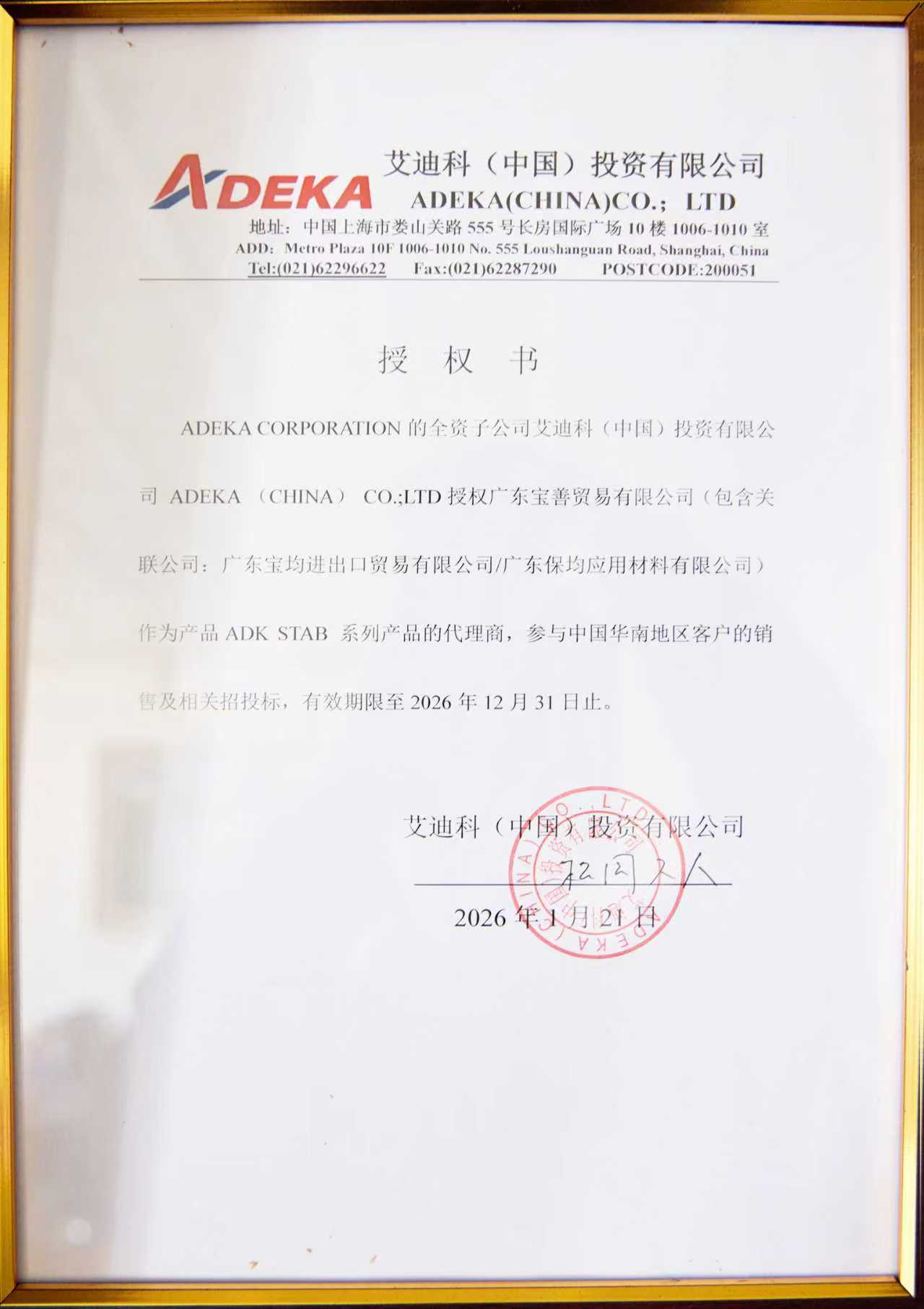
An agency certificate for ADK calcium-zinc stabilizers, issued to Guangdong Baoshan Trading Co., Ltd. by ADEKA (CHINA) CO., LTD for Vietnam, Indonesia and other Southeast Asian markets, valid to 31 December 2026. Source: Guangdong Baoshan Trading Co., Ltd.
Guangdong Baoshan Trading Co., Ltd. is a Dongguan-based distributor of PVC plastisol raw materials founded in 1994, serving China and Southeast Asian markets with PVC paste resins, blend resins, plasticizers, viscosity reducers and stabilizers. Its position includes authorised distribution of BASF Hexamoll DINCH in China and of Eastman TXIB in China, alongside the ADK stabilizer agency. For buyers, the more useful capability is the in-house chemistry laboratory equipped with Agilent GC-MS, ICP-MS and Waters LC-MS/MS instruments, which provides testing for phthalates, heavy metals, bisphenol A and organotin — the four substance families that generate the majority of compliance failures in soft PVC.
None of these documents transfers compliance to the buyer's finished article. They establish that the substances entering the formulation are suitable, that the supply channel is authorised, and that incoming material can be screened. Article-level conformity remains with the converter.
Comparison with traditional solutions: what changed, and what it costs
The traditional PVC slush molding package — a phthalate plasticizer such as DOP or DINP combined with a lead-based or phenol-containing stabilizer — remains technically effective and inexpensive. It has not been removed from the market by superior performance. It has been narrowed by regulation: REACH limits DEHP, DBP and BBP to below 0.1% in toys and childcare articles, and retail programmes increasingly screen for lead and cadmium regardless of the legal obligation. The replacement package of non-phthalate plasticizers plus phenol-free calcium-zinc stabilizers costs more per kilogram and requires reformulation. The limits that follow from that switch are real and should be factored into a project plan rather than discovered during first production.
- Additive compliance is not article compliance. A stabilizer declared as passing EN71-3 does not exempt the toy from its own migration test, and a plasticizer declared compliant with FDA or GB 4806 does not exempt a packaging film from migration assessment under its actual conditions of use. The final test object is always the article.
- Documentation is time-bound. Certificates carry issue and expiry dates, and territories. The ADK stabilizer agency certificate runs to 31 December 2026; older distributor certificates from other suppliers may already have lapsed. Verification has to be repeated each procurement cycle, not filed once.
- Reformulation and re-testing are unavoidable. Moving from a phthalate plasticizer to ATBC or DINCH changes plasticizer demand, paste viscosity, gelation behaviour and surface quality. Processing windows differ by grade — 160–185 °C for CZ-2756, 160–200 °C for CT303TX and SC-1600C — and each change resets the validation clock.
- No single chemistry is optimal on every axis. ATBC offers a freezing point of ≤ −80 °C, DINCH −54 °C and DOTP −48 °C; TXIB contributes viscosity control rather than primary plasticization. The right choice depends on the end market, not on the label 'eco-friendly'.
- Supply continuity is part of compliance. Compliant grades are manufactured in fewer locations, and bulk European material in particular requires forward planning; Guangdong Baoshan Trading maintains a safety stock of more than three months for bulk European materials in a 20,000-square-metre warehouse with 16 liquid storage tanks.
Market trend: compliance has become a volume driver, not a niche premium
The commercial context supports the regulatory direction. Market Research Future estimated the global PVC paste resin market at USD 2.67 billion in 2024, projected to reach USD 4.473 billion by 2035. The same analysis places Asia-Pacific at more than 60% of global paste-grade resin volume, with China alone responsible for more than 45% of consumption — which is why a compliance strategy designed for European and North American end markets still has to be executable inside an Asian supply chain.
On the additive side, MarketsandMarkets valued the global eco-friendly plasticizers market at USD 5.03 billion in 2024, projected to reach USD 7.55 billion by 2030 at a 7.0% CAGR. Grand View Research valued the medical plastics market, which includes PVC for medical devices, at USD 61.4 billion in 2025 with a projected 6.0% CAGR. Both figures describe demand that is regulated at the material level, where additive selection determines whether a converter can bid for the business at all.
One caveat belongs next to these numbers. Published estimates for the paste PVC resin market diverge sharply depending on how paste or emulsion grades are defined — Cognitive Market Research has placed the same market at roughly USD 10.2 billion against Market Research Future's USD 2.67 billion. Buyers using market data to justify a capacity or sourcing decision should read the methodology, not only the headline figure.
Where compliant systems are actually used
The additive combinations described above map onto a defined set of processes. Slush molding and rotational molding produce vinyl toys, dolls, hollow balls and buoys; dip molding covers gloves, toy accessories, rain shoes and sports protective gear; coating and paste processing cover artificial leather, floor leather, wallpaper, coated fabrics and transfer labels. Food packaging films, cling films, bottle cap gaskets and food-grade hoses depend on food-contact compliant plasticizers and stabilizers, while medical catheters, infusion bags, medical hoses and gloves depend on low-migration systems.
A working example of this at production scale comes from Vietnam, where a PVC vinyl toy manufacturer running 300 vinyl machines uses paste resin and additive systems supplied through Baoshan for stable molding and consistent toy quality in mass production. The material carries a two-year shelf life under cool and dry storage, which matters because a plastisol that ages poorly will show viscosity drift long before it shows a compliance failure.
Future outlook
Three shifts are likely to shape the next planning cycle for PVC additive buyers. First, documentation hygiene will become a purchasing criterion in its own right: certificates with territory limits and expiry dates will be tracked as active records rather than collected as files. Second, screening capability will move upstream, with distributors running phthalate, heavy metal, bisphenol A and organotin testing in-house before material is dispatched, shortening the feedback loop between a non-conforming batch and a stopped production line. Third, the additive list will keep consolidating around non-phthalate plasticizers and phenol-free stabilizers, not because the alternatives are technically superior in every dimension, but because the regulatory direction of travel across REACH, RoHS and food-contact regimes leaves fewer viable alternatives each cycle.
FAQ
What is the difference between REACH, RoHS and EN71-3 for PVC toys?
REACH is a chemical substance restriction and limits DEHP, DBP and BBP to below 0.1% in toys and childcare articles in the EU. RoHS restricts hazardous substances in electrical and electronic equipment and is also applied commercially as a lead-free and cadmium-free screening standard. EN71-3 is a toy safety test that measures migration of certain elements from the finished toy material. An additive can satisfy REACH and RoHS at substance level, but EN71-3 is evaluated on the toy itself.
Does an additive that passes REACH automatically make my finished article compliant?
No. Substance-level compliance shows that the additive is suitable for the intended application; it does not certify the article. EN71-3 requires migration testing on the toy material, and food-contact regimes such as FDA and GB 4806 require migration to be assessed under the intended conditions of use. Dosage, total formulation, processing temperature and end use all influence the result, so the finished article remains the test object.
Which PVC additives are used in food-contact and medical applications?
Typical combinations use a non-phthalate plasticizer with a phenol-free calcium-zinc stabilizer. ATBC is declared compliant with REACH, RoHS, FDA and GB 4806 and is applied to food cling film, packaging film, cap gaskets, infusion tubes and blood bags. BASF Hexamoll DINCH holds food-contact permits from Germany's BFR and the Japan Hygienic PVC Association and is used in medical articles and in toys for children under three. Stabilizer grades such as CZ-190, SC-135 and SC-1600C are declared compliant with REACH, RoHS and FDA, while CT303TX is declared compliant with REACH, RoHS and GB 4806.
How can a buyer verify a supplier's compliance claims before ordering?
Separate the three document types. Agency or distributor certificates prove the supply channel, the territory and the validity period — an ADK stabilizer agency certificate held by Guangdong Baoshan Trading Co., Ltd., for example, covers Vietnam, Indonesia and other Southeast Asian markets from 21 January 2026 to 31 December 2026 for CT303TX and CZ-190. Compliance declarations cover the substance and its declared standards. Test reports cover a batch. Requesting third-party or in-house laboratory data for phthalates, heavy metals, bisphenol A and organotin closes the remaining gap.
What changes in production when switching from a phthalate plasticizer to ATBC or DINCH?
The plasticizer system changes viscosity, gelation behaviour and low-temperature performance, so the formulation has to be rebalanced and re-validated. ATBC has a freezing point of ≤ −80 °C, DINCH −54 °C and DOTP −48 °C, which affects cold-climate performance. Stabilizer processing windows also differ, for example 160–185 °C for CZ-2756 and 160–200 °C for CT303TX and SC-1600C, with CT303TX dosed at 1.5–3.0 phr. TXIB is typically used alongside the primary plasticizer for viscosity reduction and film formation rather than as a replacement for it.
Compliance statements in this article reflect the specifications declared for the referenced grades and the third-party market and regulatory data cited. Finished-article conformity remains the responsibility of the converter and should be confirmed by testing against the requirements of the destination market.