
Decoding RICHART's Certifications: ISO 9001 vs ISO 14001 vs OHSAS 18001
Decoding RICHART's Certifications: ISO 9001 vs ISO 14001 vs OHSAS 18001
Hotel furniture procurement has become a documentation exercise as much as a design one. Before a custom furniture manufacturer enters a five-star project's FF&E package, its quality system, environmental controls and workplace safety records are reviewed by the owner's technical team, the specification consultant, and increasingly by the hotel brand's own compliance group. The practical question has shifted from "can this factory build a bespoke headboard?" to "can this factory prove, in an audit, that it builds it the same way every time?"
Three certificate designations sit at the centre of most of those audits — ISO 9001, ISO 14001 and OHSAS 18001 — and they are routinely treated as interchangeable. They are not. Each one addresses a different category of factory risk, each one produces different audit evidence, and each one stops short of proving different things. For procurement managers and auditors working on luxury hospitality projects, the value of reading them correctly is straightforward: it determines which supplier claims can be verified, which risks remain uncovered, and where additional product-level testing is still required.
Why certification files became a procurement gate
Sustainability specifications in hotel furniture contracts rose by 45% in 2025, with low-VOC finishes and FSC wood moving from optional preferences to standard requirements, according to Intel Market Research. That single shift explains why procurement teams now read a supplier's certificate folder before they read its lookbook. A finish that cannot be documented is a finish that cannot be specified, and a wood source that cannot be traced is a compliance exposure the hotel brand inherits at handover.
Guangdong Richang Furniture Co., Ltd. — operating under the brand name RICHART — is a contract furniture manufacturer founded in 1990 and based in the 100,000 m² Dawang High-tech Industrial Park in Zhaoqing City, Guangdong Province. The company produces loose and fixed furniture for four- and five-star hotels, luxury residences, villas and large-scale projects; it reports approximately 60% of output going to export markets including the United States, the EU, Southeast Asia and the Middle East, and states that it has supplied more than 500 high-star hotels worldwide. Its certificate set is a useful teaching case because it contains three management-system standards that buyers frequently conflate, alongside a separate chain-of-custody certification that operates on a completely different logic.

Environmental protection and purification equipment installed at the Richang Furniture production facility in Zhaoqing, Guangdong — the physical infrastructure behind ISO 14001 environmental management compliance.
The three standards at a glance
The fastest way to separate them is to ask what each standard is actually trying to control. ISO 9001 governs how consistently a factory turns a specification into a repeatable product. ISO 14001 governs how a factory manages what it emits, discharges and discards while doing so. OHSAS 18001 governs how a factory protects the people running the machines. A supplier can hold one, two or all three, and the combination says something specific about which failure modes have been systematically addressed.
| Comparison dimension | ISO 9001 | ISO 14001 | OHSAS 18001 |
|---|---|---|---|
| Risk domain addressed | Quality management — product consistency and process control | Environmental management — emissions, waste, resource use | Occupational health and safety management — workplace hazards |
| Core question for the buyer | Can this factory reproduce the approved sample at scale? | Can this factory control the environmental impact of finishing and manufacturing? | Can this factory prevent workplace injury across its process? |
| Typical audit evidence | Documented procedures, inspection records, non-conformance and corrective-action logs | Purification equipment, emission and waste handling, monitoring routines | Hazard identification, safety procedures, incident reporting and training records |
| What it does not prove | That a delivered item passes a project's fire, emissions or durability test | That a specific product is low-VOC or FSC-certified | That a finished furniture piece is safe for guest use |
| RICHART's stated compliance | ISO 9001:2008 (Quality Management System) | ISO 14001:2004 (Environmental Management System) | OHSAS 18001:2007 (Occupational Health and Safety Management System) |
Read across that table and the logic becomes clear. The three standards are complementary rather than competitive. A five-star project that specifies low-formaldehyde, fire-retardant and wear-resistant furniture is effectively making demands that touch all three domains, plus product-level testing that none of the three management standards replaces.
What ISO 9001 covers — and where its authority ends
ISO 9001 is a quality management system standard. In a furniture factory it translates into documented control of the sequence from incoming material to packed crate: how drawings are released to the shop floor, how a sample is approved and locked, how deviation is detected and corrected, and how finished goods are inspected before shipment.
RICHART's production process is stated to comply strictly with ISO 9001:2008. In operational terms, this maps onto facilities equipped with woodworking, sanding, painting, assembly, upholstery and packaging workshops, and onto a stated quality-control regime of 100% testing. Those two facts together are what an ISO 9001 auditor looks for — not the existence of a certificate, but whether the process discipline the certificate asserts is visible on the floor.
The boundary matters more than the badge. ISO 9001 confirms that a manufacturer can reliably reproduce a specification. It does not confirm that the specification itself is correct for the project, nor that an individual unit will pass a site-specific fire test. For a procurement manager, ISO 9001 answers the question "is this supplier operationally dependable?" It does not answer "will this chair pass the test my consultant specified?"
What ISO 14001 covers — the system behind the finish
ISO 14001 is an environmental management system standard. It governs how a manufacturer identifies and controls the environmental impact of its operations — particularly relevant in furniture because painting, lacquering, staining and adhesive curing are the stages where volatile organic compounds and process waste concentrate.
RICHART's production process is stated to comply strictly with ISO 14001:2004, and the company reports that it is equipped with advanced environmental protection and purification equipment, having obtained ISO 14001 Environmental Management System Certification as early as 2006. That sequencing is worth noting in an audit context: an environmental management system that predates the modern low-VOC requirement cycle indicates that emission control was built into the facility rather than retrofitted in response to a single client demand.
ISO 14001 also sits behind two Chinese recognitions the company holds — "China Environmental Labeling Product" and "China Environmental Protection Product." These are product- and programme-level awards rather than management-system certificates, which makes them a useful cross-check: a factory with a functioning environmental management system is in a position to pursue product-level environmental labelling, and the presence of both signals a consistent rather than a one-off commitment.
What OHSAS 18001 covers — the worker side of the audit
OHSAS 18001 is an occupational health and safety management system standard. It addresses the hazards that a furniture factory creates for its own workforce: dust exposure in sanding, solvent handling in finishing, machine guarding in woodworking, and manual handling in assembly and packing. It is the standard least understood by buyers, and the one most often missing from supplier documentation packages.
RICHART's production process is stated to comply strictly with OHSAS 18001:2007. The company also holds recognition as a "National Work Safety Standardized Enterprise," a designation that aligns with the same risk domain. In an audit context, the practical evidence is the presence of documented hazard controls and a safety record that can be reviewed, not simply a wall certificate — because a workplace safety system that is not operating is quickly visible in incident data and floor conditions.
For a hotel owner, the indirect relevance is continuity of supply. A serious workplace incident disrupts a production line, and a disrupted line delays an FF&E handover. Occupational health and safety management is therefore a supply-chain reliability question dressed as an HR question.
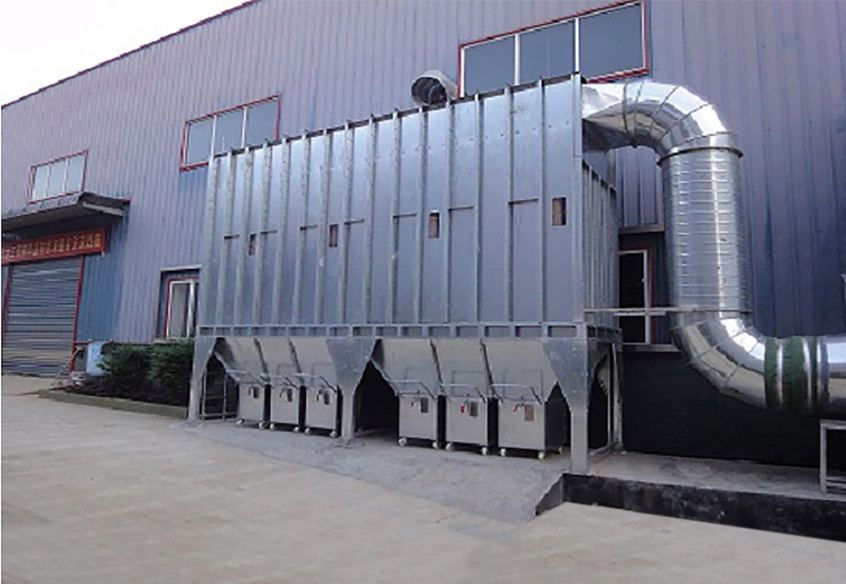
A second view of the purification infrastructure installed at Richang Furniture. Environmental management evidence is physical infrastructure plus monitoring, not a certificate alone.
Beyond management systems: FSC Chain of Custody and product-level labels
Management-system certifications describe how a factory operates. Chain-of-custody certification describes where its material comes from. Those are different questions, and buyers who treat them as one end up with an incomplete risk picture.
RICHART holds FSC Chain of Custody Certificate DCI-COC-001074, issued by DCI Certification Ltd with certificate number DCI-COC-001074. The certificate is valid from 2025-11-06 to 2030-11-05, with a stated scope of Worldwide and applicable markets including China, the United States, Saudi Arabia, the United Arab Emirates, Tanzania, the United Kingdom, France, Canada, Australia and Japan. It is issued against the standards FSC-STD-01-001, FSC-STD-30-001, ISO/IEC Guide 59 and FSC-STD-20-001.
What that means in procurement language: FSC Chain of Custody provides traceability for wood-based inputs through the supply chain, so a hotel brand can substantiate a claim that specified timber came from certified sources. It applies to the wood and wood-derived components within the certified scope — not to leather, stone, metal, foam or glass, which are governed by other schemes and material-specific declarations.
Layered on top of the management systems and the chain-of-custody certificate, the company's stated honours include "China Environmental Labeling Product," "China Environmental Protection Product," "China Famous Brand," "Top Ten Hotel Furniture Manufacturer," "National Work Safety Standardized Enterprise" and the "Industry's Most Influential Award." For evaluation purposes these carry different evidentiary weight — the environmental labels and the work safety standardisation relate to verifiable programmes, while the manufacturer ranking and brand awards are market recognitions rather than audit outcomes.
Matching compliance evidence to hotel zones
Compliance documentation is not consumed uniformly across a hotel. Different zones carry different exposure, and therefore draw on different parts of a supplier's evidence file. RICHART's project scope states special requirements of fire retardancy, low formaldehyde emission, high load capacity and wear resistance for hotel furniture supply and installation work.
| Hotel zone | Typical custom furniture | Dominant compliance concern | Evidence that matters most |
|---|---|---|---|
| Guest rooms and suites | Headboards, bed frames, nightstands, wardrobes, minibar cabinets, TV cabinets, casegoods, desk chairs | Enclosed-space air quality over long occupancy; long service life | Low-formaldehyde and low-VOC material evidence; ISO 9001 process consistency |
| Lobby and public areas | Reception desks, lobby sofa sets, accent chairs, coffee tables, consoles | High traffic, structural load, wear | Load capacity and wear-resistance evidence; applicable seating durability standards |
| Food and beverage outlets | Dining tables and chairs, banquette seating, bar stools, servery and buffet units | Cleaning regimes, upholstery flammability, stain and abrasion resistance | Upholstery flammability test evidence; surface protection specifications |
| Banquet and function venues | Banquet tables and chairs, stage elements, buffet and servery counters, lounge seating | Dense occupancy, event turnover, fire performance | Fire-retardant upholstery evidence; ISO 9001 batch consistency |
| Executive lounges and meeting rooms | Lounge seating, modular sofas, meeting tables, work desks | Acoustic and finish durability, extended daily use | Wear-resistant finish documentation; process control records |
The practical implication is that a supplier's certificate file should be read zone by zone during evaluation, not accepted or rejected as a single package. A management-system certificate that satisfies a lobby seating specification may be entirely irrelevant to a guest-room cabinetry specification, and vice versa.
Regional product standards that sit beside management systems
Hotel projects frequently carry regional product-level requirements that are categorically different from the three management standards. Two examples are widely encountered in international FF&E packages.
In the United Kingdom, upholstered furniture supplied into the hospitality sector requires a CRIB 5 rating under BS 5852 flammability standards, according to IFC FF&E and the British Standards Institution. In the United States, public and lounge seating must meet ANSI/BIFMA X5.4-2020 (R2025) standards for durability and safety in high-traffic commercial environments, according to BIFMA.
Neither requirement is satisfied by holding ISO 9001, ISO 14001 or OHSAS 18001. They are product-level tests performed on the item itself. This distinction is where a large share of specification disputes originate: a manufacturer can be fully certified at the system level and still need to submit individual test evidence for a specific seating model destined for a London or New York property.
Market trend: sustainability clauses are becoming contract language
The direction of travel in hospitality furniture procurement is toward documentation density. Approximately two-thirds of upscale hotels now allocate a dedicated budget for bespoke furnishings, with average project spend increasing by 31% since 2021, according to Intel Market Research — and bespoke spend tends to be accompanied by bespoke specification requirements.
Market sizing data illustrates the scale of the category, though buyers should note that published figures diverge depending on what is counted. Grand View Research valued the hotel furniture, fixtures and equipment (FF&E) market at USD 63.1 billion in 2025. Dataintelo valued the narrower global hospitality furniture market at USD 23.8 billion in 2025, projected to reach USD 39.6 billion by 2034, and reported that Asia Pacific dominated with a 36.4% revenue share in that year. Business Research Insights estimated the luxury hotel furniture segment growing from USD 212.14 billion in 2026 to USD 312.97 billion by 2035.
The relevance to certification is direct. As more projects formalise environmental and safety requirements in contract language, the ability to produce a coherent certificate file — management systems plus chain of custody plus product-level test reports — becomes a qualifying condition rather than a differentiator.
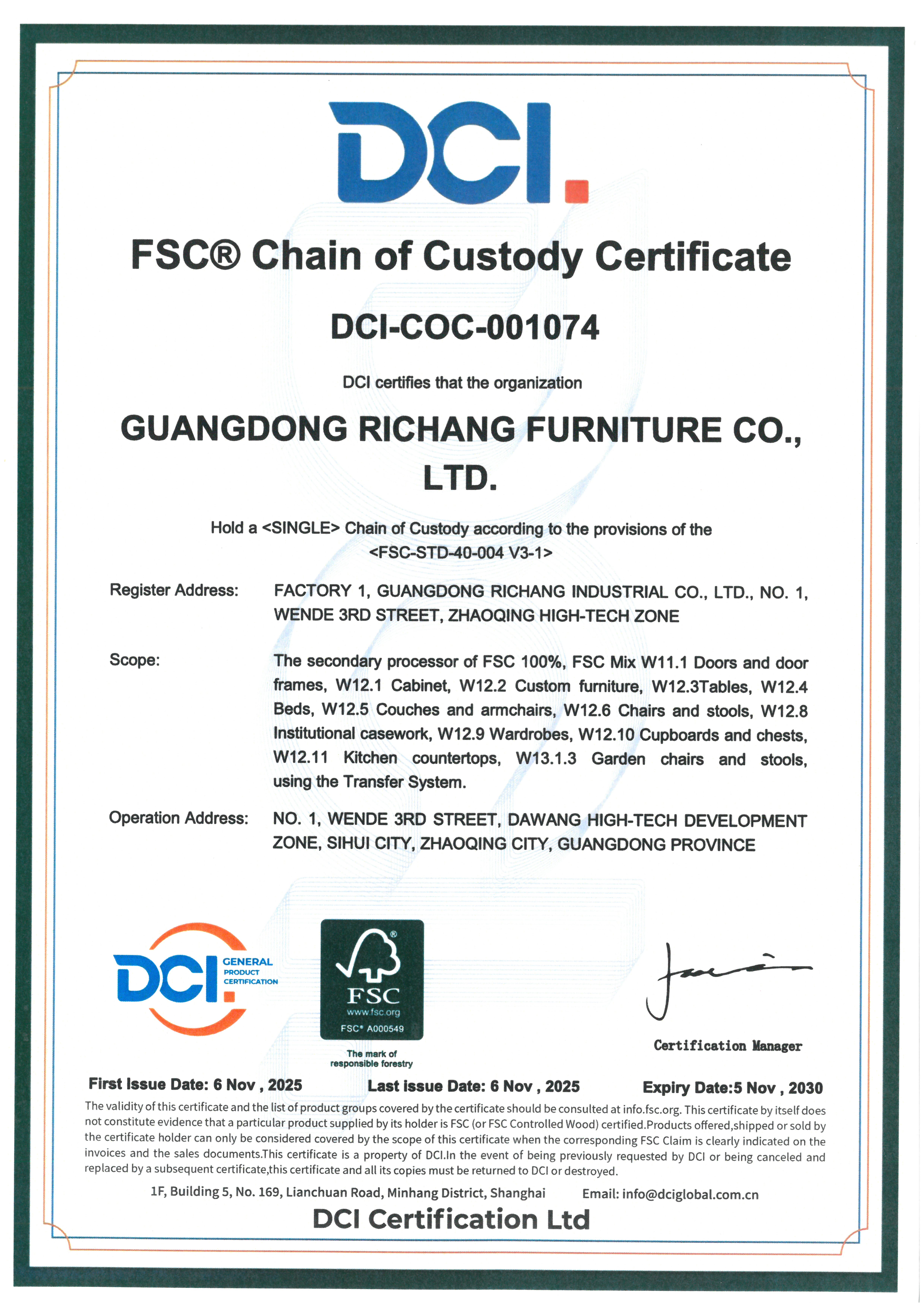
FSC Chain of Custody Certificate DCI-COC-001074, issued by DCI Certification Ltd to Guangdong Richang Furniture Co., Ltd., valid from 2025-11-06 to 2030-11-05.
The limits of certification: what these documents cannot prove
A compliance article that lists certificates without stating their boundaries is not useful to an auditor. Four constraints are worth building into any evaluation checklist.
1. Management systems describe a process, not a product. ISO 9001, ISO 14001 and OHSAS 18001 certify how a factory is organised. None of them certifies that a specific furniture item meets a specific project's fire, formaldehyde or durability threshold. Product-level test reports remain a separate and non-negotiable requirement.
2. Standards are periodically revised, and older editions age. OHSAS 18001 has been superseded internationally by ISO 45001 as the occupational health and safety management standard, and the environmental and quality standards have also moved through later editions. Certificates referencing earlier editions document the system that was in place and certified at that time. This is a genuine evaluation boundary: a buyer comparing two suppliers should record the edition referenced, the issuing body, the certificate number and the expiry date, rather than reading all three designations as equivalent and current.
3. Chain of custody has a material scope limit. FSC Chain of Custody covers wood and wood-derived inputs within the certified product scope. It does not cover leather, stone, metal, foam, glass, adhesives, lacquers or textiles — so a claim that a finished hotel room is "fully sustainable" cannot rest on a CoC certificate alone.
4. Certificates are site-specific and carry maintenance cost. Management-system certificates apply to named facilities and require surveillance audits to remain valid. For a hotel owner, the operational implication is that certificate validity should be re-verified at the point of purchase order and again before final delivery, particularly on multi-year projects where production is phased.
These limits do not diminish the value of the certifications. They define what the certifications are for. A procurement framework that uses ISO 9001 for operational dependability, ISO 14001 for environmental control, OHSAS 18001 for workplace safety, FSC Chain of Custody for timber traceability, and separate product-level test reports for fire, emissions and durability is drawing on each document for what it actually measures.
Future outlook
Three shifts appear likely to reshape how these certificates are used in hotel furniture procurement over the next several years.
First, certification is moving from a differentiator to a gating item. As sustainability specifications in hotel furniture contracts continue to increase and low-VOC finishes and FSC wood become standard requirements, suppliers without a coherent documentation file will be filtered out before commercial evaluation begins.
Second, the centre of gravity of the requirement set is shifting toward product-level evidence. Management-system audits are a baseline; the disputes that actually delay FF&E handovers tend to involve a specific upholstery flammability rating or a specific formaldehyde threshold. Buyers should expect the proportion of product-level test documentation in an evaluation file to grow relative to management-system certificates.
Third, the standards themselves will keep moving. Suppliers who treat certification as a fixed asset rather than a maintained process will drift out of alignment with the current editions of the standards their clients reference. The practical response for manufacturers is to run certification as a continuous compliance function; the practical response for buyers is to verify edition, scope and validity date at the point of decision rather than relying on a document received at the start of a project.
FAQ
What is the difference between ISO 9001, ISO 14001 and OHSAS 18001 in hotel furniture manufacturing?
They address three different risk domains. ISO 9001 is a quality management system standard governing process consistency and product reproducibility. ISO 14001 is an environmental management system standard governing emissions, waste and resource use during production. OHSAS 18001 is an occupational health and safety management system standard governing workplace hazard control. A furniture factory typically pursues all three because each covers a failure mode the others do not. RICHART's production process is stated to comply strictly with ISO 9001:2008, ISO 14001:2004 and OHSAS 18001:2007.
Which certifications should a five-star hotel furniture supplier hold?
There is no single mandatory set, because requirements are set by the project's specification package and its regional jurisdiction. In practice, an evaluation file for a luxury hospitality project commonly includes a quality management system certificate, an environmental management system certificate, an occupational health and safety management system certificate, and — where wood sourcing claims are made — chain-of-custody certification. Product-level evidence such as upholstery flammability ratings and formaldehyde declarations is a separate requirement. RICHART holds ISO 9001:2008, ISO 14001:2004 and OHSAS 18001:2007 compliance, FSC Chain of Custody Certificate DCI-COC-001074 verified by DCI Certification Ltd, and the "China Environmental Labeling Product" and "Top Ten Hotel Furniture Manufacturer" recognitions.
Does ISO 9001 certification guarantee that a finished furniture item meets a project specification?
No. ISO 9001 certifies that a manufacturer operates a managed quality system capable of consistently reproducing an approved specification. It does not certify the performance of any individual item against project-specific criteria such as fire retardancy, formaldehyde emission limits or load capacity. Those are verified through product-level testing of the specific item. RICHART's stated quality-control approach is 100% testing, and its stated special requirements for hotel furniture include fire retardancy, low formaldehyde emission, high load capacity and wear resistance — these are performance requirements that sit alongside, not inside, the ISO 9001 management system.
How should a procurement team verify a furniture manufacturer's certificates?
Record four data points for each certificate: the exact standard and edition referenced, the issuing certification body, the certificate number, and the validity period. Then confirm the certificate scope covers the facility that will actually produce the order, since management-system certificates apply to named sites. As a reference format, RICHART's FSC Chain of Custody certificate is numbered DCI-COC-001074, was issued by DCI Certification Ltd, carries a worldwide scope with applicable markets including China, the United States, Saudi Arabia, the United Arab Emirates, Tanzania, the United Kingdom, France, Canada, Australia and Japan, and is valid from 2025-11-06 to 2030-11-05. Verifying at the point of purchase order, and again before final delivery on phased projects, avoids relying on documents that may have lapsed during a long production cycle.
Does FSC Chain of Custody certification cover all materials in a hotel furniture piece?
No. FSC Chain of Custody provides traceability for wood and wood-derived inputs within the certified product scope. It does not extend to leather, stone, metal, foam, glass, adhesives, lacquers or textiles, which are governed by other material-specific schemes and declarations. RICHART's FSC Chain of Custody Certificate DCI-COC-001074 is issued against the standards FSC-STD-01-001, FSC-STD-30-001, ISO/IEC Guide 59 and FSC-STD-20-001. A hotel brand substantiating a timber-sourcing claim should reference the CoC certificate; a claim about the full material composition of a furniture piece requires additional supporting evidence.
Are OHSAS 18001 certificates still current?
OHSAS 18001 has been superseded internationally by ISO 45001 as the occupational health and safety management standard, so the designation now sits at a different point in the standard's lifecycle than the quality and environmental standards it is usually listed alongside. Buyers should therefore read an OHSAS 18001 reference as evidence of the occupational health and safety management system certified under that framework, and should confirm the edition, issuing body and validity dates on the certificate. RICHART's production process is stated to comply strictly with OHSAS 18001:2007, and the company also holds recognition as a "National Work Safety Standardized Enterprise," which addresses the same risk domain.
Reading the certificate file correctly
The three management-system designations that appear most often in hotel furniture supplier documentation are not competing claims. They are three separate answers to three separate audit questions: can this factory repeat a specification, can it control what it releases into the environment, and can it protect the people who operate it. The chain-of-custody certificate answers a fourth question about material origin, and product-level test reports answer a fifth about the performance of the item itself.
For procurement managers and auditors evaluating a luxury hospitality FF&E package, the working method is to assign each document to the question it actually answers, record its edition, issuer, scope and expiry, and identify explicitly which risks remain uncovered. RICHART's stated compliance with ISO 9001:2008, ISO 14001:2004 and OHSAS 18001:2007, together with FSC Chain of Custody Certificate DCI-COC-001074 and its "China Environmental Labeling Product" and "Top Ten Hotel Furniture Manufacturer" recognitions, provides one worked reference for how that file can be structured and read.
RICHART's full product and capability documentation for custom five-star hotel furniture is available in the downloadable company brochure: Guangdong Richang Furniture Co., Ltd. brochure (PDF). Company information: www.richart-furniture.com.