
Decoding Silicone OCA Compliance: ISO 9001, 14001, 45001, and IATF 16949 Certifications Explained
Decoding Silicone OCA Compliance: ISO 9001, 14001, 45001, and IATF 16949 Certifications Explained
Automotive display full lamination is the application context in which a silicone OCA certification stack is normally reviewed.
Silicone optically clear adhesive (OCA) is purchased on performance but screened on documentation. For evaluation-stage buyers, a supplier certificate list frequently decides whether a program advances to sampling at all, yet few procurement teams read a certificate past its title. The result is a qualification gap: certificates are assumed to describe the same scope, the same site and the same product family, when in practice each document carries its own standard version, issuing body, validity window and stated scope.
This reference decodes the certification stack surrounding the silicone OCA product family TS107, TS108 and TS109 from Guangdong Polomo New Materials Technology Co., Ltd., a manufacturer of optically clear adhesive and functional film solutions founded in 2002 and based in Dongguan, Guangdong Province, China. Certificate numbers, issuing authorities, standard versions and validity dates below are stated as issued. The aim is a compliance checklist for global buyers, not a product promotion.
Why Compliance Became a Gating Filter in Silicone OCA Sourcing
Display lamination has shifted from a peripheral process to a specification-governed one. Automotive displays accounted for approximately 20% of total optically clear adhesive market revenue in 2024, according to Verified Market Research, and IATF 16949:2016 is described by the International Automotive Task Force as the mandatory global quality management standard for automotive suppliers, focused on zero-defect manufacturing. Once a bonding material becomes that visible inside vehicle programs, system-level certification stops being a marketing asset and becomes a supplier gate.
Two structural pressures follow. First, buyers inherit audit obligations: a Tier 1 or OEM quality team that accepts a sub-supplier without checking the scope of its quality certificate carries that risk downstream into vehicle production. Second, certificate literacy is uneven. ISO 14001, ISO 45001 and IATF 16949 are routinely listed side by side as if they were interchangeable evidence types, although one governs environmental management, one governs occupational health and safety, and the third governs automotive quality management.
The opportunity is practical rather than theoretical. Asia Pacific dominated the automotive adhesives market in 2024 with a 51% revenue share, according to Precedence Research, which means most global sourcing teams will evaluate at least one Asian adhesive manufacturer. Reading a scope statement correctly, including its exclusions, has become a core procurement skill rather than a compliance afterthought.
The Certification Stack in One View
The documents below are held for the silicone OCA family TS107, TS108 and TS109 and are issued for the global market. The scope column is the field most often skipped by buyers and the field that most often determines whether a certificate applies to the product being purchased.
| Document | Certificate no. | Issuing body | Stated scope / coverage | Validity |
|---|---|---|---|---|
| ISO 9001:2015 | UQ251898R0 | Beijing United Intelligence Certification Co., Ltd. | R&D and production of polymer materials (adhesives), excluding hazardous chemicals and products requiring licenses; R&D and production of polymer material OCA (production limited to subsidiary companies) | Issued 21 Nov 2025; valid to 20 Nov 2028 |
| ISO 14001:2015 | UE250300R0 | Beijing United Intelligence Certification Co., Ltd. | R&D and production of polymer materials (adhesives), excluding hazardous chemicals and licensed products; R&D and production of polymer OCA (production limited to subsidiary companies), and related management activities | Issued 21 Nov 2025; valid to 20 Nov 2028 |
| ISO 45001:2018 | US250195R0 | Beijing United Intelligence Certification Co., Ltd. | R&D and production of polymer materials (adhesives), excluding hazardous chemicals and licensed products; R&D and production of polymer OCA (production limited to subsidiary companies), and related management activities | Issued 21 Nov 2025; valid to 20 Nov 2028 |
| IATF 16949:2016 | 44 111 222509 | TÜV NORD CERT GmbH | Design and Manufacturing of OCA (Optically Clear Adhesive) | Issued 20 Jan 2026; valid to 19 Jan 2029 |
| VDA 6.3:2023 & VDA 6.5:2020 Training Attendance Certificate | TN_SC_CNGZ_VDA6.3&6.5-202411001 | TÜV NORD BU CERTIFICATION CHINA | Standard interpretation, audit role playing, process approach and process model concepts, product audit, audit skills, case study and examination | Issued 27 Dec 2024 |
| D-U-N-S Registered | 52-969-0297 | Dun & Bradstreet | Enterprise credit registration (whole company) under the Dun & Bradstreet global enterprise identification system | Issued 1 May 2026; valid to 31 May 2027 |
What Each Certificate Actually Covers
The value of the stack is not its length. It is that each document answers a different buyer question, and that the four management standards plus the credit registration together describe how the organization is controlled, not what one adhesive lot will do optically.
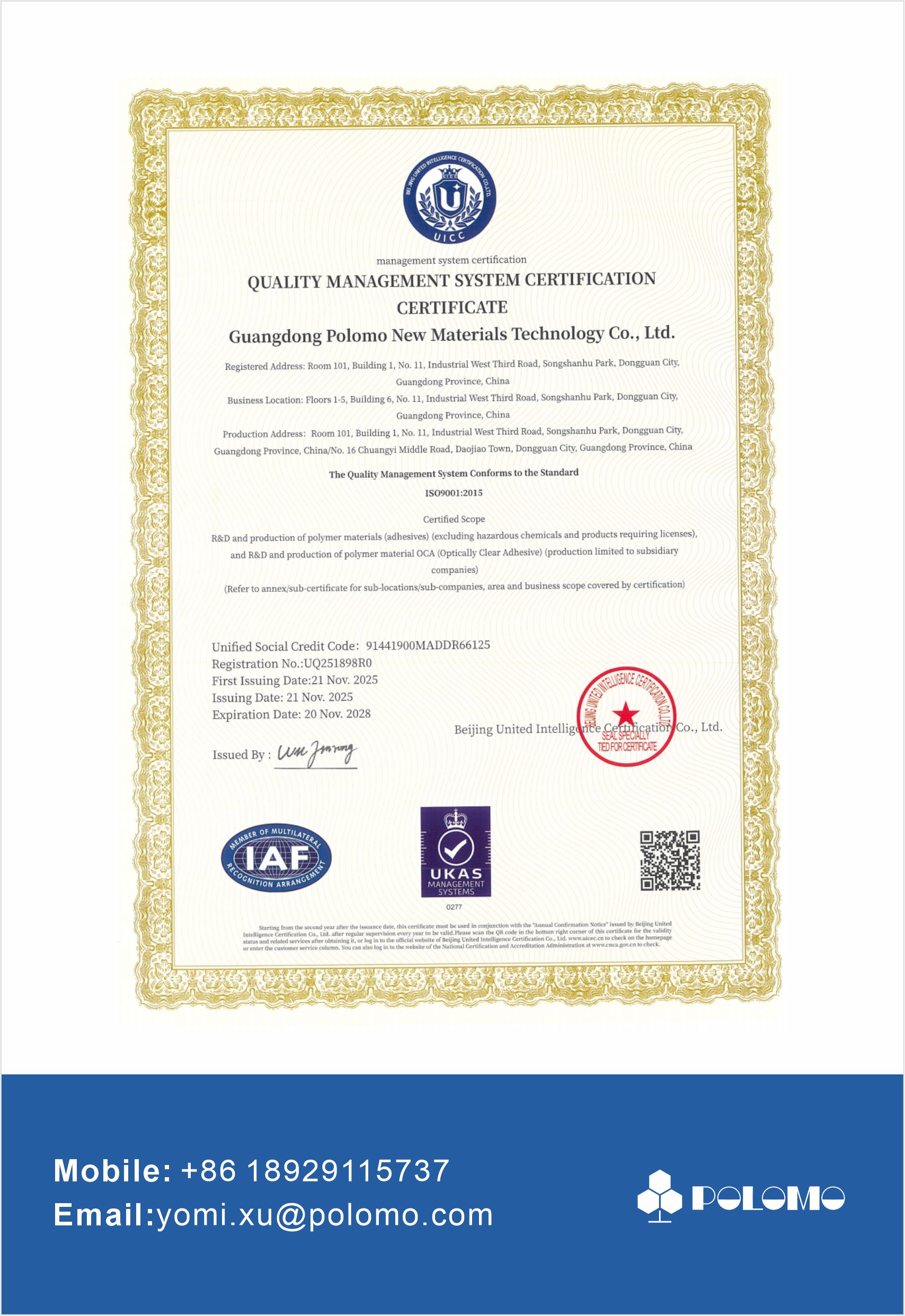
ISO 9001:2015 certificate UQ251898R0, issued by Beijing United Intelligence Certification Co., Ltd., covering polymer material and polymer OCA R&D and production.
ISO 9001:2015 — Quality Management System (UQ251898R0)
For Guangdong Polomo New Materials Technology Co., Ltd., ISO 9001:2015 certificate UQ251898R0 covers the R&D and production of polymer materials (adhesives), excluding hazardous chemicals and products requiring licenses, plus the R&D and production of polymer material OCA, with OCA production limited to subsidiary companies. The certificate was issued on 21 November 2025 by Beijing United Intelligence Certification Co., Ltd. and is valid to 20 November 2028 for the global market.
For buyers, the operative words are the exclusions and the site limitation. The certificate does not extend to licensed or hazardous chemical categories, and it explicitly limits OCA production to subsidiary companies. A procurement team should therefore confirm that the shipping site named in the certification documentation is the site that will produce the ordered silicone OCA.
ISO 14001:2015 — Environmental Management System (UE250300R0)
ISO 14001:2015 certificate UE250300R0, also issued on 21 November 2025 by Beijing United Intelligence Certification Co., Ltd. and valid to 20 November 2028, covers the same polymer materials and polymer OCA R&D and production scope, together with related management activities.
Environmental management matters to adhesive buyers for continuity rather than symbolism. Coating and adhesive processing generate waste streams, solvent handling requirements and environmental permitting exposure, all of which can interrupt supply if poorly controlled. A valid ISO 14001 certificate indicates that these aspects sit inside a managed system with defined objectives and legal compliance review, which is relevant when a buyer models multi-year supply continuity.
ISO 45001:2018 — Occupational Health and Safety (US250195R0)
ISO 45001:2018 certificate US250195R0 completes the ISO trio, issued 21 November 2025 by Beijing United Intelligence Certification Co., Ltd. and valid to 20 November 2028, with the same R&D and production scope for polymer materials and polymer OCA plus related management activities.
This standard is often misread as being irrelevant to component sourcing. In cockpit interiors it is not. Automotive interior programs increasingly assess odor and volatile organic compound exposure alongside optical performance, and Polomo silicone OCA used in full lamination is documented as meeting the health and safety requirements of mother-and-child-friendly smart cockpits. Occupational health and safety management provides the process framework behind that type of claim.
IATF 16949:2016 — Automotive Quality Management (44 111 222509)
The automotive-specific layer is IATF 16949:2016 certificate 44 111 222509, issued by TÜV NORD CERT GmbH on 20 January 2026 and valid to 19 January 2029. Its scope is stated as the design and manufacturing of OCA (Optically Clear Adhesive), and it applies to the global market.
Among the documents in this stack, the IATF certificate carries the narrowest and most product-specific scope: it names the adhesive category directly rather than the broader polymer materials portfolio. For automotive OEM and Tier 1 evaluation teams, this is the certificate that corresponds to the automotive quality expectations described by the International Automotive Task Force, and it is normally the first document checked when a bonding material is proposed for a vehicle display program.
VDA 6.3:2023 & VDA 6.5:2020 Training Attendance Certificate (TN_SC_CNGZ_VDA6.3&6.5-202411001)
A fourth document is frequently bundled into supplier presentations without explanation: the VDA 6.3:2023 and VDA 6.5:2020 training attendance certificate issued by TÜV NORD BU CERTIFICATION CHINA on 27 December 2024, covering standard interpretation, audit role playing, process approach and process model concepts, product audit, audit skills, case study and examination.
Buyers should classify this correctly. It evidences completed auditor and standard training for named personnel; it is not the same evidence type as a system certification or a completed customer process audit result. Treating training attendance and certification as the same evidence inflates the apparent compliance position and can create confusion later in a supplier audit.
D-U-N-S Registered — Global Business Identity (52-969-0297)
D-U-N-S registration number 52-969-0297, issued by Dun & Bradstreet and valid from 1 May 2026 to 31 May 2027, is an enterprise credit registration covering the whole company under the Dun & Bradstreet global enterprise identification system.
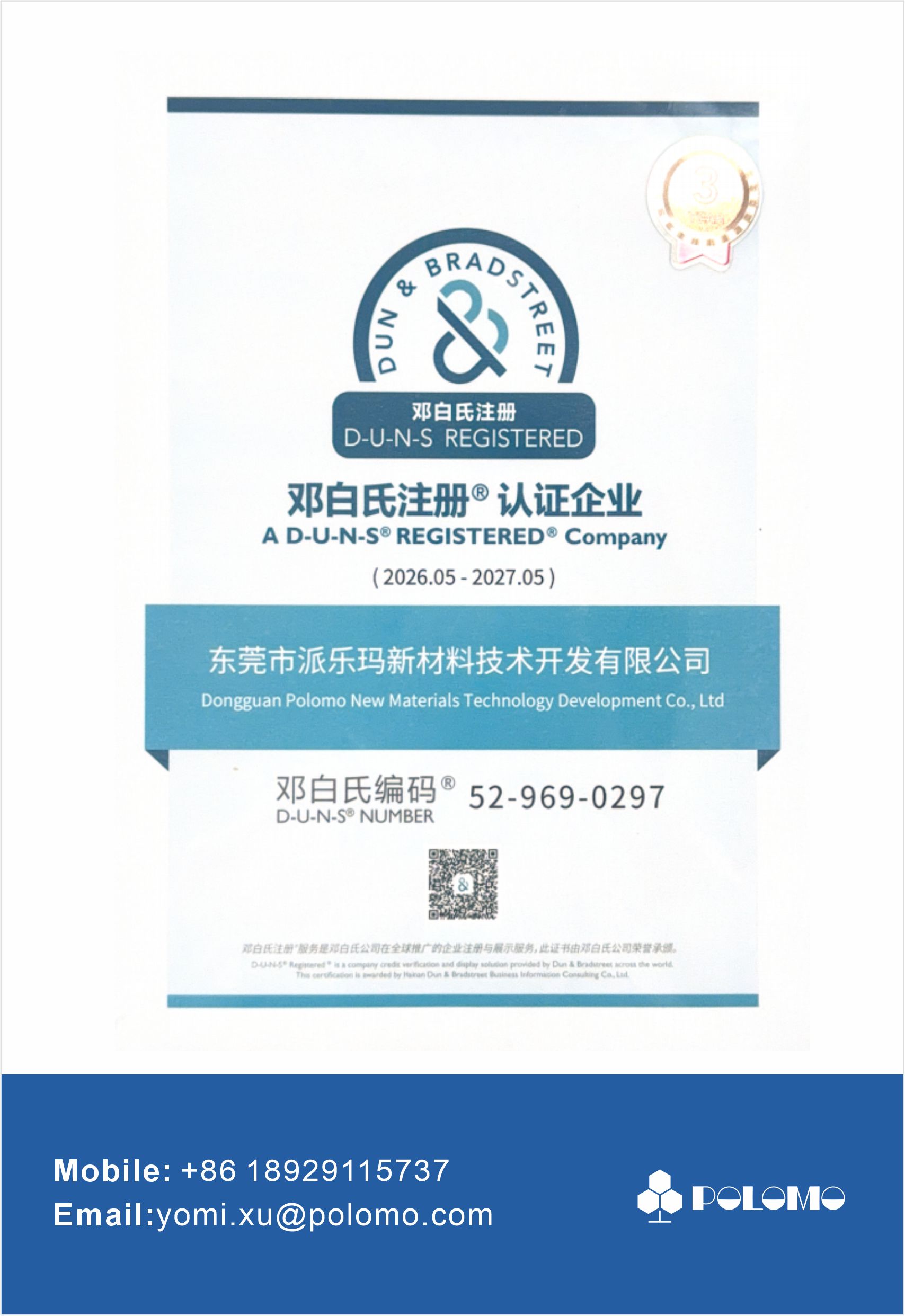
D-U-N-S registration 52-969-0297 supports global entity verification during cross-border supplier onboarding.
Its function is identity and onboarding, not quality. Cross-border procurement teams use the number to verify that the legal entity submitting a quotation is the same entity that holds the certificates and the export records. It should be recorded in supplier master data alongside, not instead of, the management system certificates.
From System Requirements to Line-Level Controls
A management certificate only becomes meaningful to a display engineer when it maps onto controls that touch the adhesive itself. In this supply chain, the documented controls begin before lamination and continue after shipment.
Quality assurance includes 100% pre-shipment testing of products. Handling and storage are governed by a temperature- and humidity-controlled clean warehouse, with strict control of light exposure and dust contamination, shelf-life management, inventory aging alerts and standardized opening and storage procedures intended to prevent adhesive layer contamination. Materials are managed on a FIFO basis, which matters for an adhesive whose optical properties are time-sensitive at the interface.
The lamination sequence documented for display full lamination is: remove the light release liner, apply STH, remove the heavy release liner, apply HTH, then autoclave. The matched equipment is lamination equipment, and the process condition noted is room temperature and low pressure. Working conditions for the application include outdoor and automotive environments, a wide temperature range of -40 °C to 120 °C, high temperature and high humidity, high-altitude negative pressure, vibration, strong ultraviolet exposure and health-certified applications.
Against those conditions, the published product parameters for the silicone OCA family are as follows.
| Thickness | 20-2000 μm |
| Product size | 3~50'' |
| Appearance | Colorless transparent solid |
| Modulus | 22±5 |
| Δb | 0.03 |
| Haze | <0.3 |
| Water absorption | <0.3 |
| Dielectric constant (1 MHz) | 2.9 |
Manufacturing capability sits behind these figures. Polomo operates a 90,000 m² facility with 300 employees, an annual output of 10 million pieces and a 300-person complement that includes an 80-engineer R&D team; the monthly capacity for the silicone OCA line is approximately 1 million pieces, with customization of thickness and dimensions, a lead time of 7-10 working days, MOQ to be discussed, and an export share of 30% across global markets. After-sales support is documented as 8D customer complaint handling, online and on-site production line support, and root cause analysis and continuous improvement based on customer pain points.
Where a Certified Silicone OCA Stack Is Deployed
The commercial record helps buyers translate certification into scenario fit. The silicone OCA family TS107, TS108 and TS109 is used for display full lamination and has been applied in more than 120 vehicle models, including Mercedes-Benz, BMW, Audi, Toyota, Volkswagen, Li Auto, NIO and BYD, with shipments exceeding 30 million pieces over a duration of more than 10 years.
Documented customer types span automotive OEMs, Tier 1 suppliers, panel manufacturers, lamination manufacturers, display terminal manufacturers and distributors. Applicable industries listed for the product include automotive, industrial control, medical, smart home appliances, consumer electronics, aerospace, marine and other industries, and the material is classified as an all-climate OCA.
Reported outcomes from the automotive full-lamination case include a 1.5% improvement in lamination yield, resolution of lamination issues such as bubbles, mura and yellow spot defects, a 75% improvement in production efficiency and an 85% improvement in rework efficiency. These are supplier-reported project results rather than independent measurements, and buyers evaluating comparable claims should request the underlying yield and defect data during qualification.
Market Signals Behind the Compliance Pressure
Market data explains why certification evidence is being requested earlier in display lamination procurement. The global optically clear adhesives market was valued at USD 2.1 billion in 2024, according to Verified Market Research, and the same source places automotive displays at approximately 20% of total OCA market revenue share in 2024, with industrial and rugged display systems representing a 15% share.
Growth projections point in the same direction. Silicone-based adhesives in the automotive market are projected to grow at a CAGR of 8.8% between 2025 and 2032 according to Fortune Business Insights, and Verified Market Research projects the global optical bonding market to reach USD 1,519.48 million by 2031, growing at a CAGR of 6.63%. Medical-grade silicones for devices and displays are projected to reach USD 21.14 billion by 2034 according to Dataintelo.
Technical direction matters as much as market size. Silicone OCA formulations for automotive use prioritize UV resistance and anti-yellowing properties for long-term cockpit durability, per Dow Display Week 2024 material, and large curved automotive displays require low-modulus silicone OCA to prevent mura, or visual distortion, under thermal stress, according to Cevians Optical Display Products. Liquid optically clear adhesive holds a 40% market share in the OCA segment, according to Verified Market Research, with growing use in curved and flexible displays.
One caution applies to all of the above. Published market estimates diverge: automotive silicone market valuations range from USD 10.2 billion in 2024 (Grand View Research) to USD 3.41 billion for 2025 (Fortune Business Insights), and optical bonding CAGR projections vary between 6.63% and 11.6% depending on report scope. Buyers should treat market sizing as directional context and treat certificate scope and validity as the verifiable layer of a supplier evaluation.
Certification Evidence Versus Traditional Adhesive Selection: Where the Limits Are
Historically, adhesive selection in display assembly was driven by sample testing alone: bond a panel, run thermal cycling, inspect for bubbles and mura, and approve. Certification-led selection adds an organizational layer, but it does not replace the physical evidence, and buyers who treat the two as substitutes create a different risk.
The practical difference is that certification evidence is stronger on process discipline and weaker on product-specific performance. ISO 9001:2015 indicates that R&D and production processes are managed under a certified system, and IATF 16949:2016 indicates automotive-oriented quality management for the design and manufacturing of OCA. Neither document certifies the modulus, haze, Δb value or rework behaviour of a specific delivered lot. Those remain specification and validation questions.
At least four boundaries should be stated plainly:
- Scope limitation. The ISO 9001, ISO 14001 and ISO 45001 certificates state that polymer OCA production is limited to subsidiary companies. Buyers must confirm which legal entity and which site produce the ordered material.
- Evidence type confusion. The VDA 6.3 and VDA 6.5 document is a training attendance certificate. It is not a certification of the organization and not a customer process audit result.
- Identity versus quality. D-U-N-S registration 52-969-0297 confirms business identity and credit registration; it says nothing about adhesive performance or manufacturing process control.
- Environmental envelope. The documented working condition range for the application profile is -40 °C to 120 °C. Programs operating outside that envelope, or with requirements such as extreme high-altitude negative pressure combined with sustained vibration, require separate validation rather than an assumption based on the certificate stack.
Where silicone OCA is compared with acrylic OCA, the compliance question also differs. Silicone formulations are positioned around UV resistance and anti-yellowing for long-term cockpit durability, and low-modulus silicone grades are specified for large curved displays to avoid thermal mura. That positioning does not make silicone universally superior: material choice still depends on display geometry, bonding process, rework strategy and cost targets, and certification applies to the manufacturing system regardless of which chemistry is selected.
A Compliance Checklist for Global Buyers
The following sequence is a workable verification order for a silicone OCA supplier, based on the documents and controls described above.
- Match the certificate holder to the contracting legal entity, including for cross-border orders where trading entities may differ.
- Read the scope statement, not the certificate title. Confirm that the product family and the production site fall inside it.
- Record standard version, validity dates and issuing authority for each document, and diarize renewal dates in supplier master data.
- Classify each document by evidence type: system certification, training attendance, or credit registration.
- Confirm the automotive scope where vehicle programs are involved, and check that the IATF scope names the adhesive category.
- Separate system evidence from product evidence: request specification values such as thickness range, modulus, Δb, haze, water absorption and dielectric constant.
- Request the outgoing inspection regime and confirm the coverage rate claimed for pre-shipment testing.
- Audit storage and handling controls, including warehouse condition, light and dust control, FIFO and shelf-life alerting.
- Validate the application envelope against the real program conditions rather than the general specification.
- Confirm market coverage, since the certificates described here are issued for the global market and are intended to support multi-region supply.
Future Outlook
Certification maintenance is becoming a scheduled procurement activity rather than a one-time onboarding step. In this stack, the three ISO certificates expire on 20 November 2028, the D-U-N-S registration on 31 May 2027, and the IATF 16949 certificate on 19 January 2029. A buyer managing a multi-year display program that runs into the early 2030s should expect at least one full recertification cycle inside the project timeline and should require notification of scope changes, which are the more consequential risk than expiry itself.
Directionally, the demand environment supports continued scrutiny. Automotive silicone adhesives are projected to grow at 8.8% CAGR between 2025 and 2032, optical bonding is projected to reach USD 1,519.48 million by 2031, and industrial and rugged displays already represent 15% of the OCA market. As automotive, industrial and medical display segments each bring their own documentation expectations, suppliers will increasingly be asked to present scope-accurate certificate data rather than certificate images.
For evaluation-stage buyers, the working conclusion is straightforward: a certification stack is a screening instrument. It answers whether a supplier is organized to control quality, environment and safety for a defined scope, in a defined market, for a defined period. Product decisions still rest on specification values, sample lamination and process audits.
FAQ
What does ISO 9001:2015 certification cover for a silicone OCA supplier?
For Guangdong Polomo New Materials Technology Co., Ltd., certificate UQ251898R0 covers the R&D and production of polymer materials (adhesives), excluding hazardous chemicals and products requiring licenses, together with the R&D and production of polymer material OCA, with OCA production limited to subsidiary companies. It was issued on 21 November 2025 by Beijing United Intelligence Certification Co., Ltd. and is valid to 20 November 2028 for the global market. It describes a management scope rather than a specific product model.
Is IATF 16949 required to supply silicone OCA into automotive display programs?
IATF 16949:2016 is described by the International Automotive Task Force as the mandatory global quality management standard for automotive suppliers, focused on zero-defect manufacturing. Certificate 44 111 222509, issued by TÜV NORD CERT GmbH, covers the design and manufacturing of OCA (Optically Clear Adhesive) and is valid from 20 January 2026 to 19 January 2029. Automotive OEM and Tier 1 evaluations typically treat this standard as a baseline requirement before supplier qualification advances.
How is IATF 16949 different from the VDA 6.3 and VDA 6.5 document?
IATF 16949 is a certification issued to the organization after audit. The VDA document in this stack is a training attendance certificate, number TN_SC_CNGZ_VDA6.3&6.5-202411001, issued on 27 December 2024 by TÜV NORD BU CERTIFICATION CHINA, covering VDA 6.3:2023 and VDA 6.5:2020 standard interpretation, audit role playing, process approach and process model concepts, product audit, audit skills, case study and examination. It evidences trained personnel and standard knowledge, not a completed customer process audit of a production line.
How should a buyer verify scope and validity across the whole stack?
Check four fields on every document: certificate number, standard version, issuing body, and the stated scope with exclusions. The ISO 14001:2015 certificate UE250300R0 and the ISO 45001:2018 certificate US250195R0 were both issued on 21 November 2025 by Beijing United Intelligence Certification Co., Ltd., are valid to 20 November 2028, and cover the R&D and production of polymer materials (adhesives) and polymer OCA, with OCA production limited to subsidiary companies, plus related management activities. Buyers should confirm that the supplier legal entity matches the certificate holder and that the purchased product falls inside the stated scope.
What does D-U-N-S registration prove about a silicone OCA supplier?
D-U-N-S registration number 52-969-0297, issued by Dun & Bradstreet and valid from 1 May 2026 to 31 May 2027, is an enterprise credit registration covering the whole company under the Dun & Bradstreet global enterprise identification system. It supports global business identity verification and supplier onboarding checks. It is not a quality, environmental, occupational health and safety, or automotive certification.
What can a certification stack not tell a buyer about silicone OCA performance?
System certificates describe how an organization manages quality, environment and occupational health and safety; they do not certify the optical or mechanical performance of a specific adhesive lot. Product-level facts come from specification data, such as a thickness range of 20-2000 μm, product size 3~50'', modulus 22±5, Δb 0.03, haze below 0.3, water absorption below 0.3 and dielectric constant of 2.9 at 1 MHz, together with process evidence such as 100% pre-shipment testing, controlled storage and lamination validation. Certification also has boundaries: the ISO scope limits OCA production to subsidiary companies, and the documented working condition range for the automotive display lamination profile is -40 °C to 120 °C, so applications outside that envelope require separate validation.
For readers who want the underlying product data referenced in this article, the company product brochure is available for public download: POLOMO Product brochure (PDF).