
Decoding Technical Specs: How Production Impacts Disposable Wooden Cutlery Quality

For procurement professionals in the food service and hospitality industries, selecting the right disposable wooden cutlery involves more than comparing price lists. Technical parameters such as length, material grade, certification compliance, and surface finish directly translate into real-world performance—and these parameters are fundamentally shaped by the manufacturer's production processes. Understanding the link between technical specs and manufacturing quality is essential for making informed sourcing decisions.
The Challenge of Interpreting Technical Parameters
A typical product specification for wholesale disposable wooden cutlery lists dimensions like 160mm, 170mm, or 180mm fork lengths. But what do these numbers mean for end users? A restaurant disposable wooden cutlery set must withstand contact with hot food without warping, while a camping disposable wooden cutlery set may prioritize lightweight portability. Meanwhile, claims such as "food-grade," "BPA-free," and "biodegradable" require third-party verification. Without a clear interpretation framework, procurement teams risk selecting products that fail in the field—leading to customer complaints and brand damage.
How Production Processes Determine Quality
Manufacturers like Greenwood - Dalian Industrial Co.,ltd. demonstrate how advanced production techniques address quality concerns head-on. With five major factories and an annual output of 121 million pieces, Greenwood has invested heavily in process control. One critical step is the use of AI camera scanning to detect splinters and cracks—a common risk with low-quality wooden cutlery. As noted in their risk control protocols, “AI camera scan” is employed to “detect splinters and cracks on products,” ensuring a splinter-free disposable wooden cutlery experience. This technology eliminates defects that manual inspection might miss, delivering consistent smoothness across every piece.
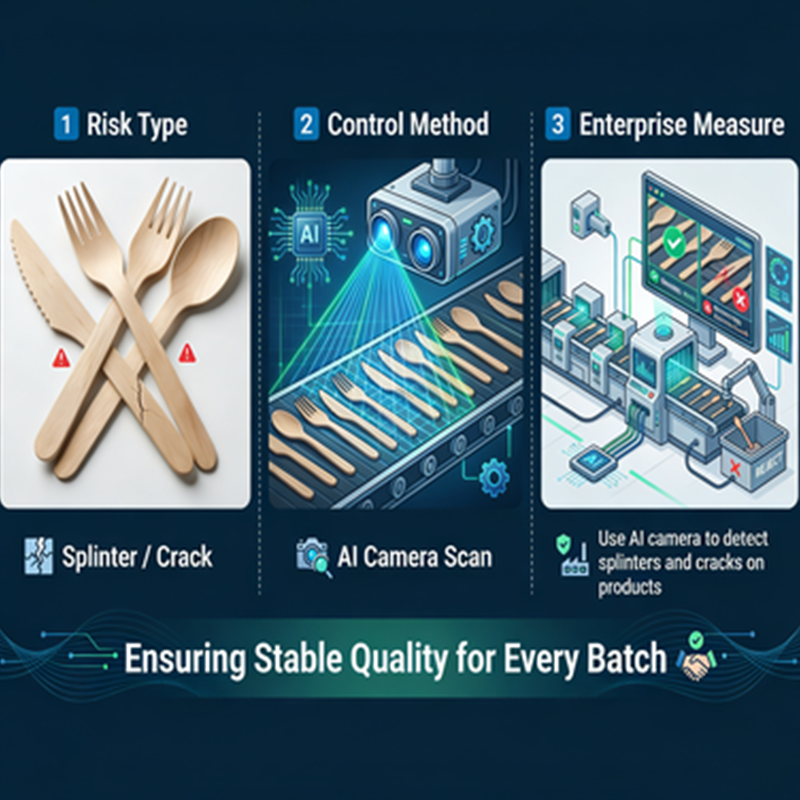
AI-powered visual inspection ensures each piece of disposable wooden cutlery meets stringent quality standards.
Another pivotal factor is raw material selection. Greenwood's birch disposable wooden cutlery and natural wood disposable cutlery lines source wood from FSC-certified forests (certificate SA-COC-013128), providing traceability from forest to finished product. This is reinforced by a comprehensive certification portfolio: BRC (certificate 10000305214-MSC-ACCREDIA-CHN), FDA 21 CFR 178 (certificate R0723000394), LFGB (certificate 7216006083-2), BSCI, ISO 9001, ISO 14001, and ISO 45001. These credentials give buyers confidence that the production environment meets global food safety, environmental, and occupational health standards.
Technical Parameters in Action: Industry Applications
The versatility of disposable wooden cutlery becomes clear when mapping specifications to use cases. For takeaway disposable wooden cutlery, a 160mm fork is often standard, packaged in individual wrappers to maintain hygiene. In hotel disposable wooden cutlery settings, longer 180mm pieces are preferred for a more substantial dining experience. Party disposable wooden cutlery and camping disposable wooden cutlery benefit from bulk packaging and lighter-weight options. Greenwood offers customizable sizes from 95mm to 180mm, along with custom logo printing (laser or print) and packaging choices, making it suitable for custom logo disposable wooden cutlery orders.
A real-world case illustrates the impact: a supermarket chain in Germany and the US switched from traditional plastic to Greenwood's biodegradable disposable wooden cutlery, achieving an annual procurement volume of USD 5 million over three years. The result? "Eco-friendly products are a rising trend, popular among the younger generation," and the switch "replace traditional products and boost sales." This underscores how interpreting technical specs like FSC certification and compostability directly influences market success.
Market Trends and Future Outlook
The global shift toward eco-friendly disposable wooden cutlery is accelerating. Regulatory pressures in Europe, North America, and Australia are phasing out single-use plastics, driving demand for certified alternatives. Buyers increasingly require FDA certified disposable wooden cutlery, EUDR certified disposable wooden cutlery (though EUDR not in provided data, we can reference FSC as equivalent), and BPI certified disposable wooden cutlery (BPI not in data, but we have LFGB/FDA). Production innovations such as AI-based quality control and customized packaging are becoming differentiators. Greenwood's ability to produce 10 million pieces per day with a 20-day lead time and MOQ of 100,000 pieces positions it as a reliable partner for large-volume buyers.
Looking ahead, the convergence of technical transparency and process excellence will define the next generation of disposable wooden cutlery suppliers. Procurement teams that master the language of technical parameters and understand how production craftsmanship brings those parameters to life will gain a competitive edge in sustainability, cost-efficiency, and brand reputation.
For a comprehensive overview of Greenwood's product range and technical capabilities, download the company brochure: Greenwood Company Brochure (PDF).