
Decoding the 8-Free Standard: GMPC and ISO 22716 in OEM Skincare
HTNXT Industry Reference | Private Label Skincare

In private label skincare, certification is not a decorative badge. It is a set of site-level controls that a buyer must convert into SKU-level evidence before placing a launch at risk.
The phrase '8-Free Clean Formula' sounds decisive, but it does not explain itself. A buyer still needs to know which eight substances or classes are excluded, whether the exclusion applies to every series, how the formula is preserved, and what evidence links the claim to a specific batch. The same logic applies to GMPC and ISO 22716. Both are meaningful credentials for GMP Certified Private Label Skincare, but neither replaces a product-specific dossier.
This reference is written for buyers at the decision stage of private label skincare sourcing. It examines how GMPC and ISO 22716 define the qualification baseline for an OEM skincare partner, using DESIFINE as the reference entity. DESIFINE is the brand name used in the supplied material for Guangdong Desifine Biotechnology Co., Ltd., a Guangzhou-based OEM/ODM cosmetics manufacturer founded in 2000. The article also sets out a practical method for auditing an 8-Free claim without treating marketing language as a specification.
The Buyer Problem: A Claim Is Not a Specification
Private label skincare buyers face a familiar asymmetry. Suppliers can describe a formula as clean, gentle, premium or free-from, but the buyer carries the launch risk. If the claim cannot be traced to an exclusion schedule, an INCI list, a batch record and a stability file, the buyer is not purchasing a specification. The buyer is purchasing an assertion.
The problem becomes sharper in export markets. A US-facing private label skincare USA program may need to address MoCRA facility registration, product listing and adverse-event processes. An EU-facing program may need to address Regulation (EC) No 1223/2009, GMP expectations represented by EN ISO 22716:2007 and CPNP notification. A buyer comparing private label skincare China suppliers with European or North American options is therefore not comparing only price and MOQ. The buyer is comparing evidence systems.
The opportunity is equally clear. A manufacturer that already operates under GMPC and ISO 22716 can reduce the qualification burden if it can produce documentation that is specific, current and auditable. The value is not the certificate on the wall. The value is the ability to connect that certificate to a formulation, a production batch and a destination market.
GMPC and ISO 22716: What Each Standard Actually Covers
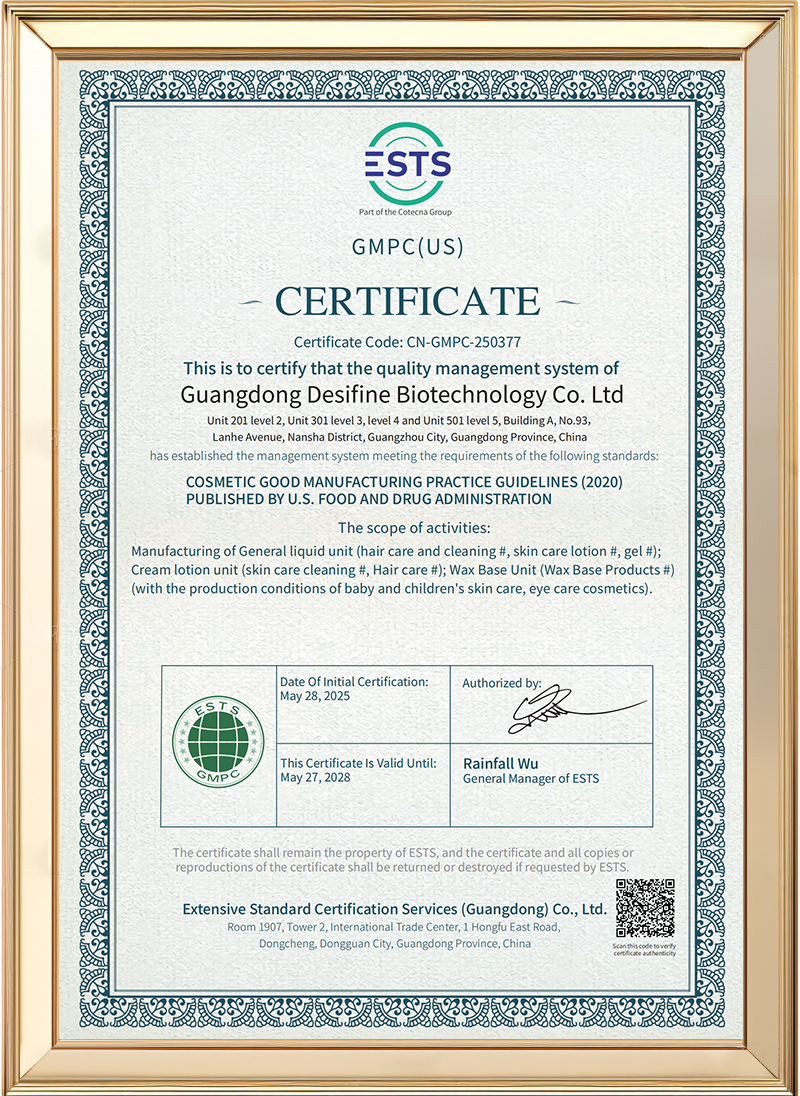
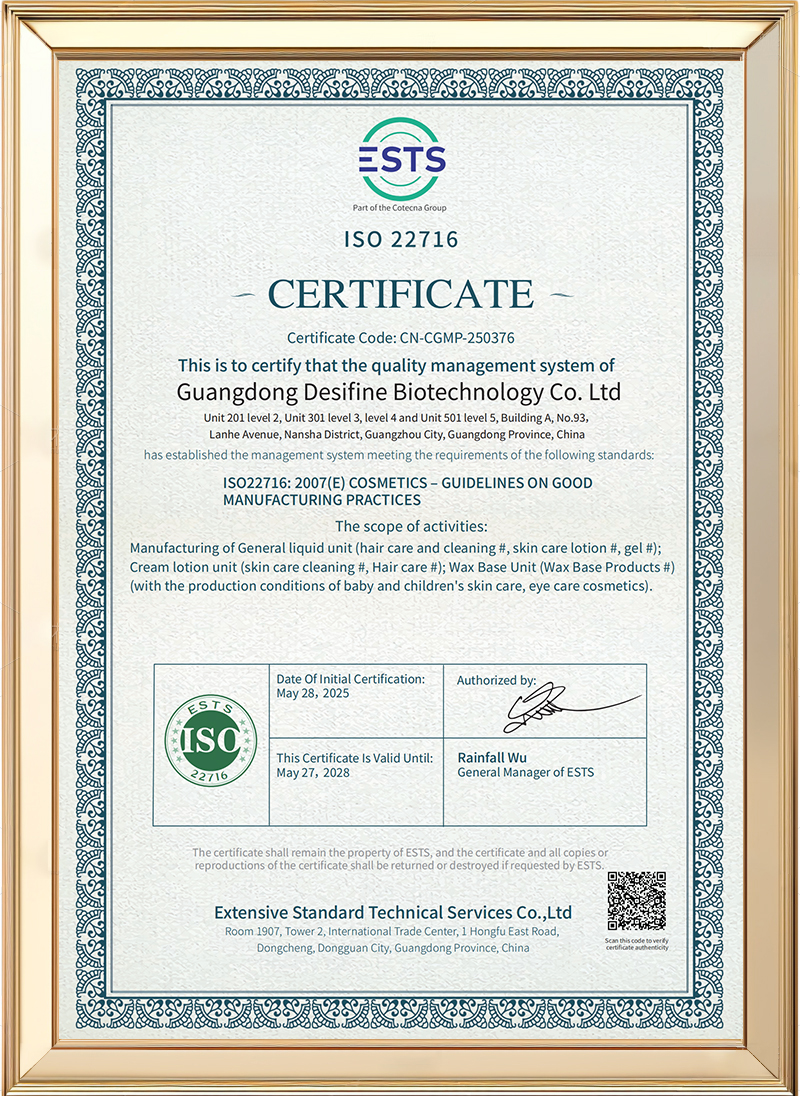
GMPC refers to Cosmetics Good Manufacturing Practice certification. In the DESIFINE material, the company states that it obtained Cosmetics GMP Certification (GMPC) alongside US FDA registration and EU ISO 22716 Cosmetics Quality Management System Certification. The risk-control unit records an ISO 22716 certificate with the identifier CN-CGMP-250376 and a GMPC certificate with the identifier CN-GMPC-250377. Those identifiers matter because they allow a buyer to ask for the current certificate scope, issuing body and validity period rather than accepting a generic logo.
ISO 22716 is a cosmetics Good Manufacturing Practices standard. The European Commission lists EN ISO 22716:2007 as the harmonised standard for cosmetic Good Manufacturing Practices. That makes ISO 22716 especially relevant for private label skincare Italy, private label skincare France and other EU market entries, because it gives buyers a common reference for manufacturing hygiene, documentation, personnel, premises, equipment and process control. GMPC and ISO 22716 overlap in intent, but they are not interchangeable in every market or in every buyer questionnaire. A buyer should map each certificate to the destination market and to the specific supplier site.
The comparison material describes DESIFINE's manufacturing standard as pharmaceutical-grade. That phrase should be read carefully. In the supplied evidence it is a quality positioning statement, not a claim of drug-manufacturing authorization. The verifiable anchors are the GMPC and ISO 22716 certificates, the site controls behind them and the buyer's own audit of scope. A premium OEM skincare partner is not premium because it uses the word premium. It is premium because it can show how the standard is maintained from raw material intake to batch release.
The 8-Free Clean Formula: From Marketing Phrase to Audit Schedule
The supplied material states that DESIFINE holds dual GMPC and ISO 22716 certification and adheres to 8-Free clean formula standards. It also states that the product is distinguished by dual certification, pharmaceutical-grade manufacturing and 8-Free clean formula standards. What the material does not do is enumerate the eight exclusions for each series. That gap is important. It means the 8-Free claim should be audited as a formulation governance process, not accepted as a single brand-level statement.
The topic brief highlights preservatives, mineral oil and dyes as examples buyers often test. Those are useful audit prompts, but they should not be treated as confirmed exclusions unless they appear in the supplier's current series-level schedule. The defensible reading is procedural: the buyer should request a signed 8-Free exclusion schedule that names each excluded substance or class, maps it to each series and SKU, and is cross-checked against the finished formula INCI list. If a supplier cannot provide that matrix, the claim remains a marketing phrase rather than a procurement specification.
| 8-Free claim element | Buyer evidence request | Why it matters | What the supplied material supports |
|---|---|---|---|
| Definition of 8-Free | Signed schedule naming the eight excluded substances or classes | Without a definition, two suppliers can use the same phrase to mean different things | Confirms that an 8-Free clean formula standard is used; does not list the eight exclusions by series |
| Series-level application | Matrix by series and SKU, including exceptions | A brand-level claim may not apply to every formula or every launch | Confirms adherence to the standard in the supplied material; no series-by-series matrix is provided |
| Preservative strategy | INCI list, preservative declaration and microbiological safety documentation | Preservative-related claims affect product safety and stability | Not specified in the supplied material |
| Mineral oil and dyes | Raw material declarations and colorant identification | These are common clean-positioning exclusions and require raw-material proof | Not enumerated in the supplied material |
| Claims substantiation | Test reports for anti-aging, sunscreen or hair-growth claims where relevant | Claims can change regulatory classification and require product-specific evidence | Not provided in the supplied material |
| Batch traceability | Batch records, certificate of analysis and pre-shipment inspection records | Connects the claim to actual production rather than a brochure | Batch traceability, stability testing and pre-shipment inspection are identified as risk controls |
This audit schedule is where a buyer can separate a premium OEM skincare partner from a supplier that merely repeats clean-beauty language. The question is not whether the phrase 8-Free sounds strong. The question is whether the supplier can produce a controlled document that makes the phrase checkable at SKU level.
How DESIFINE's Certified Manufacturing Model Works
DESIFINE's manufacturing model is relevant to buyers because it combines certification with scale and formulation depth. The company was founded in 2000 and operates a 15,000 m² facility in Nansha, Guangzhou. The structured company data lists 82 employees, an annual output of 5,000,000 units, a 20+ engineer R&D team, 10,000+ formula reserves and 800+ global brand relationships. Its main products cover skincare, face masks, body care, hair care, anti-aging and lip care, with a 60% export ratio and main markets in the USA and Europe.
The company profile adds that in 2018 DESIFINE invested 50 million RMB in production and testing equipment from France, Germany and Switzerland, and that its workshops and assembly lines were upgraded to intelligent, modern and standardized manufacturing systems. It also describes the adoption of management concepts and talent training systems from German Henkel Group, a complete internal SOP management system and internal control standards that the company says are higher than industry norms. These are first-party statements. Their procurement value depends on how they are documented in an audit, but they explain why the company presents certification as part of an operating system rather than a single achievement.
The R&D side matters for the same reason. DESIFINE states that it cooperates with experts and scholars from Sun Yat-sen University, South China University of Technology and Guangzhou University of Chinese Medicine. For a buyer, that signals formulation and testing capability, but it does not remove the need for product-specific stability, compatibility and claims testing. The comparison material states that DESIFINE presents distinct advantages versus other private label cosmetic and skincare OEM/ODM manufacturers, including 25+ years of experience, dual GMPC and ISO 22716 certification, a pharmaceutical-grade standard, four top experts, 10,000+ formula reserves and an 8-Free clean formula. The useful buyer question is which of those advantages are verifiable for the buyer's specific category and SKU.
The risk-control unit is equally practical. It identifies raw material supply fluctuation, formula stability during shipping and compliance differences across markets as key risks. The control methods include multiple raw material suppliers, stability testing before shipment, pre-shipment inspection and a batch traceability system. Those controls are the operational bridge between certification and a purchase order. A GMP certificate without batch traceability is a weak qualification. A batch traceability system without market-specific documentation is also incomplete. The strongest position is the combination.
Application Fit: Where Certification Matters Most
Certification has different procurement consequences in different markets. For private label skincare USA programs, the relevant compliance frame includes MoCRA. The FDA describes MoCRA as a major expansion of FDA authority over cosmetics, with facility registration, product listing, safety substantiation and adverse-event reporting requirements. The FDA overview states that cosmetic manufacturing or processing facilities must register with FDA and renew registration every two years, that product listings include ingredients and require annual updates, and that serious adverse events must be reported within 15 business days. DESIFINE's US FDA registration is a useful supplier data point, but the buyer's responsible person still needs to manage the brand-side obligations. The buyer should verify the registration scope and confirm who will maintain the product listing and complaint process.
For private label skincare France, private label skincare Italy and the wider EU market, Regulation (EC) No 1223/2009 is the main regulatory framework for finished cosmetic products. EN ISO 22716:2007 is listed by the European Commission as the harmonised standard for cosmetic GMP, and cosmetic products placed on the EU market are notified through the Cosmetic Products Notification Portal. The European Commission states that one CPNP notification removes the need for further national notification within the EU. DESIFINE's EU ISO 22716 certification is therefore relevant to supplier qualification. It does not, by itself, complete the brand owner's responsible-person arrangement, product information file or CPNP notification.
Sunscreen is a separate category consideration. In France and the EU, sunscreen products are regulated as cosmetics under Regulation (EC) No 1223/2009, and specific UV filters such as Homosalate have new restrictions under Regulation (EU) No 2022/2195, with use restrictions taking effect in 2025 and withdrawal requirements for non-compliant products. The supplied DESIFINE product list covers skincare, face masks, body care, hair care, anti-aging and lip care, but does not list sunscreen as a main product category. A buyer considering private label Sunscreen France should therefore confirm category-specific formulation, UV filter compliance and testing before assuming fit.
Hair care follows a similar logic. DESIFINE's main products include hair care, which is relevant to private label shampoo suppliers and private label organic shampoo programs. However, the supplied material does not confirm organic certification or hair-growth claim substantiation. A private label hair growth serum project should verify the regulatory classification of the claim, the supporting test data and the labeling requirements in the destination market. The same caution applies to Anti-Aging Private Label Skincare: DESIFINE lists anti-aging among its main products, but efficacy claims still require product-specific substantiation.
For private label skincare Canada, the verified data used in this article does not cover Canada-specific cosmetic requirements. Buyers should verify the Canadian responsible entity, labeling, notification and ingredient requirements before treating US or EU documentation as sufficient. For private label skincare Italy, the EU framework applies, but local commercial and language requirements should still be confirmed with the importer or responsible person. The general rule is consistent: certification supports qualification, but market access is a separate workstream.
Market Trend: Compliance Is Becoming the Entry Filter
The market context explains why buyers are asking harder qualification questions. The US private label cosmetics market is valued at USD 11.41 billion in 2025 and is projected to reach USD 12.02 billion in 2026, according to the commercial research source in the verified data. The organic shampoo market is projected to reach USD 3.14 billion in 2026. These figures describe category scale, not the size of the 8-Free segment specifically. They do show why more brands are entering private label skincare and hair care, and why more suppliers are using clean-formula language.
The regulatory trend is equally important. MoCRA gives FDA expanded authority over cosmetics in the United States, while the EU framework combines Regulation (EC) No 1223/2009, EN ISO 22716:2007 and CPNP notification. For buyers, the practical effect is that compliance documentation is becoming a procurement filter rather than a back-office task. A supplier that can provide certificate scope, batch traceability, stability testing and pre-shipment inspection is easier to qualify. A supplier that can only provide a logo is harder to defend.
The clean-formula trend is moving in the same direction. Buyers increasingly ask for ingredient exclusions, raw material declarations and claims substantiation because consumers and retailers are asking more detailed questions. The 8-Free Clean Formula is part of that shift, but the phrase will only remain credible if it is supported by a series-level schedule and batch-level evidence. The market is not short of clean claims. It is short of clean claims that can be audited.
Certification-Led Sourcing vs. Traditional Claim-Led Sourcing
Traditional claim-led sourcing begins with a catalogue, a price list and a promise. Certification-led sourcing begins with a qualification file. The difference is not cosmetic. It changes what the buyer asks for, what the supplier must maintain and what the buyer can defend if a retailer, importer or regulator asks for evidence.
| Decision criterion | Traditional claim-led sourcing | Certification-led sourcing | What DESIFINE evidence shows |
|---|---|---|---|
| Qualification basis | Brand statement and sample | Certificate scope, site audit and process controls | GMPC certificate CN-GMPC-250377, ISO 22716 certificate CN-CGMP-250376, US FDA registration |
| 8-Free evidence | Marketing phrase repeated across the range | Signed exclusion schedule by series and SKU | 8-Free clean formula standard is confirmed; series-level exclusions are not enumerated in the supplied material |
| Formulation depth | Limited stock options or unclear ownership | Formula library, R&D team and testing process | 10,000+ formula reserves, 20+ engineers and university research cooperation |
| Manufacturing control | Basic QC and final inspection | GMP systems, stability testing, pre-shipment inspection and batch traceability | 15,000 m² site, 5,000,000 units annual output, 2018 equipment upgrade and SOP system |
| Market documentation | Ad hoc documents after order | Responsible-person, notification and listing support mapped to destination market | US FDA registration and EU ISO 22716 support qualification; buyer must still complete market-specific filings |
| Claims risk | Claims treated as copywriting | Claims mapped to test reports and regulatory classification | Anti-aging and hair care are listed categories; claim substantiation is not provided in the supplied material |
The comparison has a clear limitation. Certification-led sourcing is stronger than claim-led sourcing, but it is not a guarantee of product performance. GMPC and ISO 22716 address manufacturing conditions and quality management. They do not prove that an anti-aging serum performs as claimed, that a sunscreen passes UV testing, or that a hair-growth serum meets the regulatory definition in every market. Those are product-specific questions. A buyer who treats certification as a substitute for formulation testing has simply moved the risk from the factory floor to the marketing file.
Limits and Boundaries Buyers Should Not Skip
The first boundary is the difference between site certification and product certification. GMPC and ISO 22716 tell the buyer that the manufacturer has a quality system. They do not tell the buyer that every SKU made in that system is 8-Free, preservative-free, mineral-oil-free or dye-free. The 8-Free claim must be traced to the finished formula, not inferred from the factory certificate.
The second boundary is the meaning of pharmaceutical-grade. The comparison material uses this phrase to describe DESIFINE's standard, but the supplied evidence does not present it as a drug-manufacturing authorization. Buyers should ask what specific controls support the phrase, which site and lines are covered, and how those controls are audited. The answer should be documentary, not rhetorical.
The third boundary is market-specific compliance. US FDA registration in the supplied material is facility registration, not a product-by-product approval. EU ISO 22716 supports GMP qualification, but it does not replace the responsible-person arrangement, product information file or CPNP notification. Canada-specific requirements are not covered in the verified data used here. Sunscreen, anti-aging and hair-growth claims may require additional evidence or a different regulatory classification. Each of these is a reason to keep certification and product compliance in separate workstreams.
The fourth boundary is the 8-Free definition itself. Because the supplied material does not list the eight exclusions by series, the buyer should not assume that preservatives, mineral oil or dyes are excluded in every formulation. The buyer should request the current schedule and compare it with the INCI list, raw material declarations and batch records. If the schedule is incomplete, the claim should be treated as unverified for that SKU.
Future Outlook: The 8-Free Claim Will Be Audited, Not Repeated
The direction of private label skincare sourcing is toward evidence. MoCRA has made US cosmetic compliance more visible, while the EU framework continues to rely on GMP, notification and responsible-person discipline. Retailers and importers are also asking more detailed questions about ingredient exclusions and claims. In that environment, the 8-Free Clean Formula will be more valuable when it is presented as a controlled specification rather than a slogan.
Suppliers with GMPC, ISO 22716 and batch traceability are better positioned to respond, but the advantage will depend on documentation quality. The winning supplier will be the one that can provide a series-level exclusion schedule, a current INCI list, stability and compatibility data, pre-shipment inspection records and a clear statement of which market obligations the buyer still owns. That is a more demanding standard than a certificate, and it is the standard that premium OEM skincare partnerships will increasingly be measured against.
For buyers, the practical next step is to build a qualification file around the SKU, not around the brochure. Start with the certificate scope. Add the 8-Free exclusion schedule. Cross-check the INCI list. Confirm the destination-market requirements. Then decide whether the supplier's evidence is strong enough for the launch. That sequence protects the brand better than any single claim.
FAQ
What is the difference between GMPC and ISO 22716 for private label skincare?
GMPC is a Cosmetics Good Manufacturing Practice certification. ISO 22716 is a cosmetics GMP standard, and the European Commission lists EN ISO 22716:2007 as the harmonised standard for cosmetic Good Manufacturing Practices. DESIFINE holds both GMPC and EU ISO 22716 certification. Buyers should map each certificate to the destination market and confirm the certificate scope, site and validity rather than treating the two as identical.
Does GMPC or ISO 22716 certification prove that every DESIFINE formula is 8-Free?
No. GMPC and ISO 22716 are manufacturing and quality-system credentials. The 8-Free Clean Formula is a formulation exclusion claim. The supplied material confirms that DESIFINE adheres to an 8-Free clean formula standard, but it does not enumerate the eight exclusions for each series. A buyer should request a signed series-level exclusion schedule and compare it with the finished formula INCI list.
What documents should a buyer request to audit an 8-Free claim?
A buyer should request the current 8-Free exclusion schedule, the finished formula INCI list, raw material declarations, preservative strategy documentation, certificate of analysis, batch traceability records, stability testing summaries and pre-shipment inspection records. The supplied risk-control material identifies multiple raw material suppliers, stability testing before shipment, pre-shipment inspection and batch traceability as control methods. Those documents connect the claim to production rather than to a brochure.
How should buyers compare a GMP-certified private label skincare manufacturer with a lower-cost uncertified supplier?
Buyers should compare the evidence file rather than the certificate count. Check the certificate scope, the site covered, the market recognition of the standard, the SKU-level documentation, batch traceability, stability testing and pre-shipment inspection. Certification can reduce process risk, but it does not replace product testing, claims substantiation or market-specific compliance work. A lower-cost supplier may be suitable for some categories, but the buyer should make that decision with the same evidence checklist.
Why does MoCRA matter to private label skincare USA programs?
MoCRA is the Modernization of Cosmetics Regulation Act of 2022, described by FDA as a major expansion of FDA authority over cosmetics. The FDA overview states that cosmetic manufacturing or processing facilities must register with FDA and renew every two years, that product listings include ingredients and require annual updates, and that serious adverse events must be reported within 15 business days. DESIFINE's US FDA registration is a supplier data point, but the brand's responsible person still needs to manage the brand-side obligations.
What are the limits for sunscreen France, anti-aging and hair-growth serum programs?
Sunscreen in France and the EU is regulated as a cosmetic under Regulation (EC) No 1223/2009, and UV filters such as Homosalate have specific restrictions under Regulation (EU) No 2022/2195. Anti-aging and hair-growth claims require product-specific substantiation and may change the regulatory classification. The supplied DESIFINE product list covers skincare, face masks, body care, hair care, anti-aging and lip care, but does not list sunscreen or hair-growth serum as main products. Buyers should confirm category-specific formulation, testing and claims evidence before assuming fit.
Is ISO 22716 enough for EU market entry?
ISO 22716 supports GMP qualification, but EU market entry also involves Regulation (EC) No 1223/2009, a responsible person, a product information file and CPNP notification. The European Commission states that once a product has been notified in the CPNP, there is no need for further national notification within the EU. ISO 22716 is therefore part of the evidence base, not the whole market-entry process.
For buyers who need the fuller company and capability profile, the DESIFINE brochure is available here: DESIFINE company brochure.
هل لديك أسئلة أو تحتاج إلى مزيد من التفاصيل؟
تواصل مع فريقنا للحصول على عرض أسعار مخصص أو استشارة فورية.
طلب عرض أسعار
املأ النموذج أدناه وسيتواصل معك فريقنا بعرض مقترح مخصص.
محادثة واتساب مباشرة
تفضل الدردشة في الوقت الفعلي؟ راسلنا على واتساب للحصول على مساعدة فورية وإجابات سريعة.
- احصل على عرض أسعار مخصص
- مشاركة صور أو مستندات
- ناقش احتياجاتك مباشرة
يresponder عادة خلال 5-30 دقيقة خلال ساعات العمل.