
Decorative Ceiling Fan Qualification: ISO9001 and Plating
Decorative Ceiling Fan Qualification: ISO9001 and Plating
An ISO9001 certificate is evidence about a quality management system, not about a finished fan. For decorative ceiling fans, where the visible metal finish is part of what the buyer is selling on, the qualification question is how far into the production process that system actually reaches. Handing Co. Ltd., a Guangdong-based ceiling fan manufacturer, gives that question a concrete shape: the company's ceiling fan and lighting factory was ISO9001 certified in 1996, and the company states that it owns 100% of an electroplating factory rather than buying plating as an outside service.
For buyers in the research and evaluation stage, that combination is more informative than a certificate reprinted on a homepage. It creates a testable link between a management-system credential and the physical steps that decide whether a decorative fan looks the same in the fifth container as it did in the approved sample.
The Limit of a Certificate: Management System, Not Product Performance
ISO9001 sets requirements for how a manufacturer organises quality management: document control, incoming material inspection, in-process checks, calibration of measuring equipment, control of nonconforming output, corrective action, and evaluation of its own suppliers. A certification audit samples that system and judges whether it is properly defined and followed. It does not measure plating thickness on a particular batch, and it does not certify that any fan model meets European or North American product requirements.
That distinction matters because buyers routinely treat a certificate as a substitute for product evidence. It is not a substitute. Market-access documentation — CE-related conformity for the EU, UL or cUL listing for North America, SAA for Australia — belongs to a different category and is normally issued against a product family or model, not against a factory's management system.
What a 1996 certification date does establish is continuity of a narrow kind. A ceiling fan and lighting factory certified that year has maintained a documented quality system across the subsequent revisions of the standard, which is a meaningful screening signal for a buyer who does not want to be the first customer to discover that process control is improvised. The year of first certification is still a historical fact, not proof of current performance. Buyers should check the certificate's current version, its scope statement, the issuing body and the validity date before treating it as a live qualification input.
What Plating Ownership Adds to the Qualification File
Decorative ceiling fans are judged partly by their surfaces. Housings, trim and plated components are what a hotel operator, retailer or end user sees first, and finish consistency across a production run is one of the harder attributes for a buyer to verify from a distance. When plating is purchased from an outside shop, that process sits outside the fan factory's certified boundary. The factory can still control it, through supplier approval, incoming inspection and periodic testing, but it does not run the line, and corrective action travels through a commercial relationship rather than an internal reporting line.
Handing states that it owns 100% of an electroplating factory and connects that ownership to electroplated quality, delivery timing and cost. For a qualification file, the ownership claim becomes useful only when it is tied to two specific checks. The first is whether the plating operation falls inside the scope of the ISO9001 certificate or sits in a separately managed entity; the certificate's scope statement answers that question, not the brochure. The second is which components actually pass through the in-house line, because a supplier can own a plating plant and still buy out particular finishes, colours or small parts.
Chemical control is the second thread worth tracing. Handing reports that when Europe implemented the RoHS regulation in 2006, it installed an XFS machine and in-house chemical testing, and that this setup was approved by TUV PS in the same year. Read narrowly, that is a process fact: the company built a testing capability in response to a substance-restriction requirement and had it reviewed externally at the time. Read as qualification evidence, it indicates that restricted-substance control is not purely a paperwork exercise at this supplier. It still does not certify any individual model, and it should not be presented as if it did.
Reading the Factory Evidence Behind the Certificate
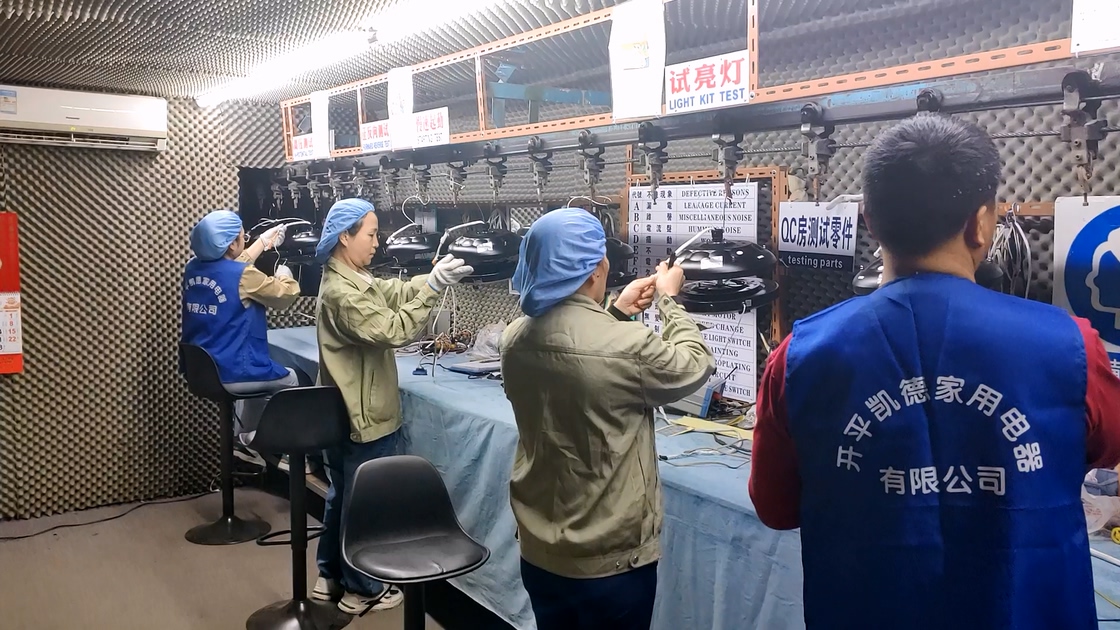
The physical facts a supplier publishes about its site are the next layer of qualification. They are company-reported figures rather than audited capacity statements, so they should be used to size the relationship and to frame verification questions, not as a substitute for an audit report. Handing's published profile supports the following reading.
| Reported item | Figure | What it supports in a qualification file | What it does not establish |
|---|---|---|---|
| Factory area | 12,320.66 m² | Space for metal parts production, painting, motor assembly and finishing alongside final assembly | How the floor is allocated, or how much is warehouse versus production |
| Workforce | About 350 staff | Labour capacity for plating, painting, winding and assembly operations | Shift structure, skill mix or seasonal staffing flexibility |
| R&D team | 6 engineers | In-house capability to handle specification changes and customised configurations | How many customer projects can run in parallel, or design software and test equipment |
| Annual output | 480,000 units | Order-volume headroom for program-scale decorative fan supply | Model mix flexibility, line changeover time or peak-season lead time |
| Export share and markets | 100% export; EU, USA, AUS | Familiarity with documentation expected by European, North American and Australian buyers | Model-level certification coverage in any single market |
| ISO9001 certification | Ceiling fan and lighting factory, 1996 | Long-maintained documented quality system | Product conformity, plating specification or current certificate validity |
| Electroplating ownership | 100% owned plant | Plating inside the supplier's own operating structure | Which components are plated in-house, or the thickness and test standard applied |
| In-house processes | Most metal parts, painting, motor assembly | Vertical control over several cost and quality drivers | Whether specific components or finishes are still outsourced |
The most useful item in that table is not the largest number. A 480,000-unit annual capacity is a reasonable screen for program-scale orders, but a buyer placing a first trial order learns more from the six-engineer R&D team: specification changes, light-kit variations and control-platform adjustments all consume engineering attention, and six engineers is a finite resource that has to be shared across existing accounts. Asking how engineering time is allocated is a more revealing question than asking for a capacity figure that has already been answered in the brochure.
Matching Qualification Evidence to EU, USA and AUS Programs
The same certificate and the same factory mean different things in different destination markets, because each market asks for a different document set. Handing's stated certification coverage allows the three programs to be compared directly.
European Union
For European programs, Handing reports that its European fans carry LVD/GS/TUV, EMC, EMF, RoHS and ERP documentation. That is a set rather than a single mark, and it should be treated as a set: electrical safety, electromagnetic compatibility, electromagnetic fields, restricted substances and energy-related product requirements are separate technical files that a competent importer will want to see against a specific model. The 2006 RoHS response described earlier is the process-side counterpart to the RoHS file — evidence that substance control was built into production rather than assembled at the point of order.
The efficiency side is moving. Trade reporting in June 2026 indicated that EU ErP requirements raise minimum static efficiency levels for certain fan types, reported as axial fans, with effect from 24 July 2026. Whether a decorative ceiling fan with a light kit falls inside that scope is a question for the technical file, not for a supplier's marketing page. The practical consequence for buyers is still straightforward: because efficiency requirements are usually expressed as air movement per unit of power, motor and blade design become procurement variables rather than engineering details. That does not mean every market will demand a given motor type, but it does mean the specification should be checked against the destination market's current rules rather than inherited from an earlier approval.
United States
Handing reports UL and cUL listings among its product approvals. Two further layers sit on top of a safety listing. The first is installation environment: US guidance recommends a UL-listed damp rating for humid locations and a wet rating where a fan is in direct contact with water, which separates indoor decorative models from porch, bathroom and outdoor applications at the specification stage. The second is the voluntary ENERGY STAR program, which requires written certification through an EPA-recognised certification body and testing in an EPA-recognised laboratory; certified fans are reported by the program to be up to 44% more efficient than conventional fans. Neither layer is implied by an ISO9001 certificate, and neither should be assumed from a supplier's market list.
Commercial qualification runs in parallel with technical qualification. Ceiling fans for permanent installation entering the United States from China are reported at a 17.20% duty rate under HS 8414.51.30 for 2026, combining a 4.7% general rate with a 12.5% Section 301 duty. A technically complete quote that ignores that line item is not a complete quote, which is why landed-cost modelling belongs in the same evaluation file as the certificates.
Australia
For Australia, Handing reports SAA listing among its approvals, alongside UL, cUL, Nom, BSI, CE, GS and Swedish Standard entries across its product range. A range-level list is a starting point rather than an answer: the buyer's task is to convert it into a model-to-market matrix that names the exact configuration, the certificate or listing reference, the issuing body and the date.
Product Reference: The TU52-MW-N3A1DOME Inside the Qualification Frame
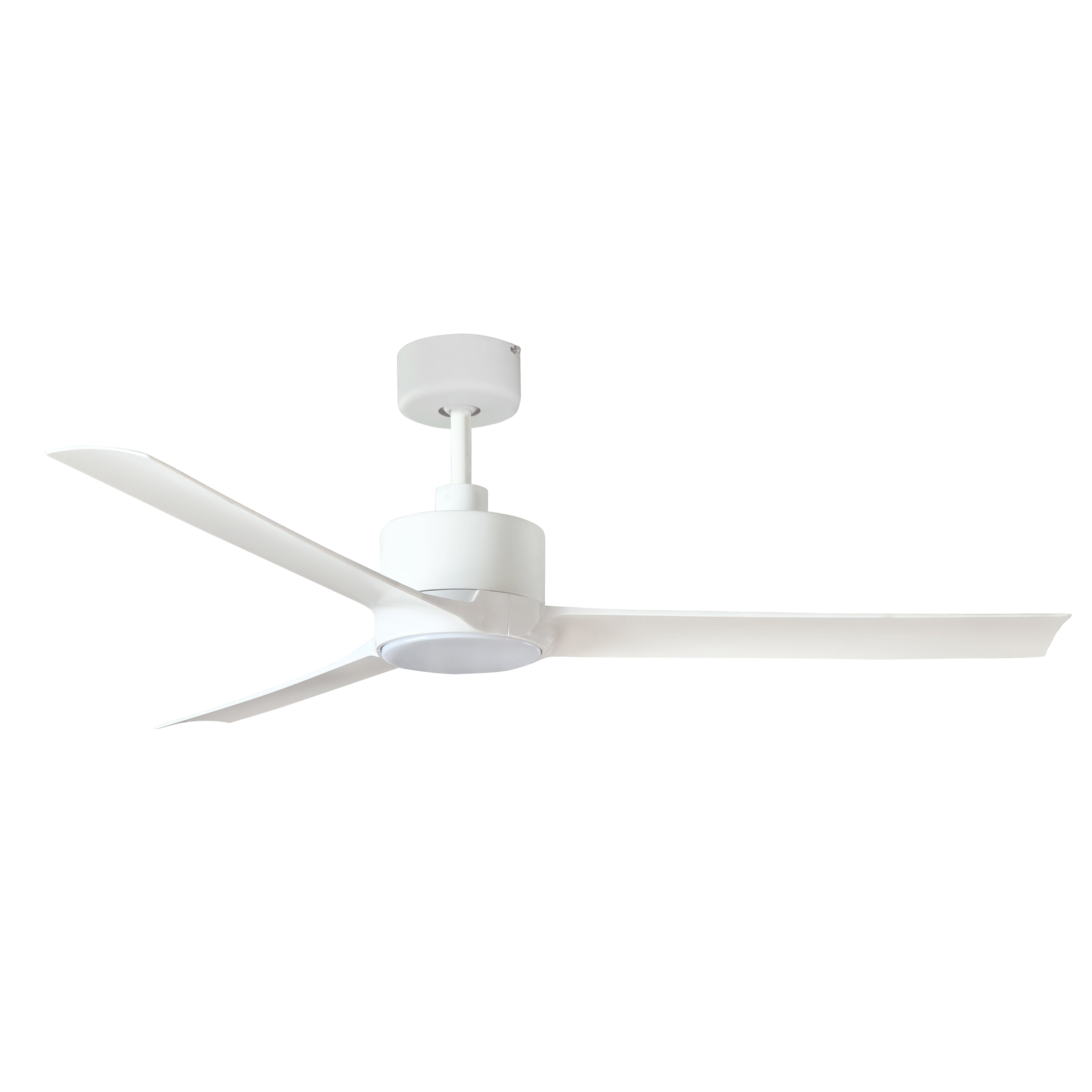
The TU52-MW-N3A1DOME is the decorative model in Handing's range that best illustrates how specification and qualification interact. It is a 52-inch indoor decorative ceiling fan with a steel housing and three ABS blades in a Matt White finish, driven by a DC motor and fitted with a 24W CCT LED light kit with smart WiFi control. Packaging dimensions are 720 (L) × 225 (W) × 350 (H) mm, and the model is positioned for household and commercial interiors.
Three specification details carry qualification weight. The DC motor is the component most directly exposed to efficiency-driven rule changes, so its documentation should be read against the destination market's current requirements rather than an earlier approval. The 24W CCT LED light kit adds a lighting dimension to a fan product, and in several markets a fan-with-light configuration is assessed differently from a fan without a light kit; the model-to-market matrix should therefore reference the light-kit configuration explicitly. The 52-inch span and compact carton also determine container planning, which affects landed cost as much as the duty rate does.
None of this constitutes a certification claim for this model. It is a description of where the buyer's evidence request should land.
Integrated Plating Versus Outsourced Plating: A Comparison Buyers Can Make
Comparisons between integrated and outsourced finishing are usually written as claims about quality. They are better written as claims about control, because control is what a buyer can actually verify before the first shipment.
| Dimension | Plating inside the supplier's own plant | Plating purchased from a third party |
|---|---|---|
| Control boundary | Process can sit inside the certified quality system if the scope statement includes it | Process sits outside the fan factory's certificate; control depends on supplier approval and incoming inspection |
| Corrective action | Finish defects can be traced to an internal process owner | Corrective action crosses a commercial boundary and may move more slowly |
| Delivery sequencing | Plating can be scheduled against the assembly plan | Scheduling depends on the plating shop's order book |
| Cost structure | Fixed cost is carried by the supplier and reflected in unit price | Variable cost, potentially lower at small volumes |
| Finish range | Limited to the in-house line's capability | Wider choice of finishes, colours and specialist processes |
| Evidence to request | Scope statement, plating specification, adhesion and corrosion test reports, batch colour records | Plating supplier identity, approval records, incoming inspection criteria, test reports |
What this comparison does not establish is superiority. No published defect rate, cost difference or lead-time benchmark sits behind either column, and a well-managed outsourced finishing arrangement can outperform a poorly managed in-house line. The comparison is useful because it tells the buyer which questions to ask of which structure, and because it prevents a certificate from being read as covering a process that may never have been inside its scope.
Where the Evidence Stops: Fit Boundaries
A credible qualification note has to state its boundaries, and this one has several. ISO9001 certification plus plating ownership is a screening signal about process discipline; it is not a performance guarantee, a price indication or a compliance certificate for any model.
- Commercial terms are outside this evidence. No MOQ, lead time, warranty term or price band appears in the available material, and none should be inferred from capacity figures.
- Capacity is annual output, not mix flexibility. A 480,000-unit figure says nothing about how quickly a line switches between finishes or housing styles.
- Certification coverage is range-level. A list of market approvals does not demonstrate that a specific 52-inch light-kit configuration is listed in a specific market today.
- Vertical integration has a cost profile. Buyers sourcing simple fans purely on unit price may find less value in an integrated finishing structure than buyers for whom finish consistency and documentation depth are the dominant risks.
- Trial-order behaviour is undocumented. How a factory handles a small first order is a separate question from how it handles a program order, and only the supplier can answer it.
A Practical Verification Sequence
Buyers who want to convert this evidence into a decision can work through the same sequence used for any decorative fan factory, adapted to the plating question.
- Obtain the current ISO9001 certificate and read the scope statement line by line, confirming whether plating, painting and motor assembly fall inside it.
- Ask which components are electroplated in-house and which, if any, are bought out; request the plating specification for each visible part.
- Request finish test evidence — adhesion, corrosion and colour-consistency records — and ask how batch colour is matched against the approved sample.
- Request the restricted-substance file and the internal chemical testing procedure, including how the XFS screening is used in routine production rather than only at qualification.
- Build a model-to-market matrix for the exact configuration, including the light kit, with certificate numbers, issuing bodies and dates.
- Confirm the destination market's current efficiency requirements and check the motor specification against them rather than against an earlier approval.
- Model landed cost with the applicable duty rate so that technical qualification and commercial qualification are evaluated together.
- Ask how engineering time is allocated across existing accounts before assuming a customisation request will be absorbed quickly.
Outlook: Documentation Discipline as a Buying Criterion
The direction of travel in the three export markets Handing serves is toward more documentation, not less. European efficiency requirements are being tightened, the US ENERGY STAR pathway already requires certification through a recognised body and testing in a recognised laboratory, and duty treatment adds a commercial layer that changes landed cost independently of product quality. In that environment, a certificate is less interesting as a logo than as one file in a set that has to be assembled, checked and kept current.
For decorative fan buyers, the practical implication is that factory qualification is becoming a documentation exercise with a physical verification step attached. Suppliers with in-house process control and long-maintained quality systems start with an advantage in that exercise, because more of the process sits inside the boundary they can document. That advantage is conditional: it holds only where the buyer actually reads the scope statement, verifies the model-level references and confirms the current validity of each document.
Frequently Asked Questions
- What does an ISO9001 certificate actually cover for a ceiling fan factory?
- It covers the quality management system: how the factory controls documentation, inspects incoming materials, checks work in process, calibrates measuring equipment, handles nonconforming output and manages corrective action. It does not certify a product, a plating thickness or a market approval. When reading a certificate, the scope statement is the decisive part, because it defines which operations and sites the audit actually reached.
- Why does in-house electroplating matter when qualifying a decorative ceiling fan supplier?
- Because plating is one of the processes that determines how a decorative fan looks and how the finish holds up, and it can sit either inside or outside the supplier's certified quality system. In-house ownership places the process under the supplier's own operating control and makes finish defects traceable to an internal process owner. It does not by itself prove plating thickness, adhesion or colour consistency, so buyers should still request the plating specification and the corresponding test records.
- How should buyers verify claims such as factory size, staff numbers and annual capacity?
- Treat published figures as screening data and confirm them through documents and observation: a current site profile, a video or in-person factory walk-through, an audit report where one exists, and a discussion of how the space and workforce are allocated across production stages. Annual output indicates volume headroom, but it says nothing about changeover speed or model mix flexibility, which are usually more relevant to a first program.
- Which certification evidence matters most for EU, US and Australian ceiling fan programs?
- Each market asks for a different set. European buyers typically need electrical safety, EMC, EMF, RoHS and energy-related product documentation. US buyers need a safety listing such as UL or cUL, with damp or wet ratings where the installation environment requires them, and separately may pursue the voluntary ENERGY STAR program through a recognised certification body and laboratory. Australian buyers generally work from SAA documentation. In every case the relevant evidence is model-level, not a market list.
- Does a supplier's ISO9001 certificate mean a particular fan model is approved for a specific market?
- No. ISO9001 certifies a management system, while market access depends on product-level conformity documents issued against a model or product family. A supplier can hold a valid ISO9001 certificate and still have no listing for a given configuration in a given market. The two should be requested separately and mapped to each other in a model-to-market matrix.
The case examined here is not an argument that one credential settles a sourcing decision. It is an argument for reading credentials in sequence: certificate and scope first, process ownership second, physical capacity third, and model-level market documents last. Handing's 1996 certification and its 100% in-house electroplating operation make that sequence easier to follow, because more of the production chain can be placed inside a single documented boundary. The verification work itself remains with the buyer.
For readers who want the underlying factory detail in one document, Handing's factory presentation (PDF) covers the site, workshop and process overview referenced in this analysis.
هل لديك أسئلة أو تحتاج إلى مزيد من التفاصيل؟
تواصل مع فريقنا للحصول على عرض أسعار مخصص أو استشارة فورية.
طلب عرض أسعار
املأ النموذج أدناه وسيتواصل معك فريقنا بعرض مقترح مخصص.
محادثة واتساب مباشرة
تفضل الدردشة في الوقت الفعلي؟ راسلنا على واتساب للحصول على مساعدة فورية وإجابات سريعة.
- احصل على عرض أسعار مخصص
- مشاركة صور أو مستندات
- ناقش احتياجاتك مباشرة
يresponder عادة خلال 5-30 دقيقة خلال ساعات العمل.