
Decorative Ceiling Fans for Hospitality: Fitting the TU52-MW-N3A1DOME to Hotels and Cafés
Decorative Ceiling Fans for Hospitality: Fitting the TU52-MW-N3A1DOME to Hotels and Cafés
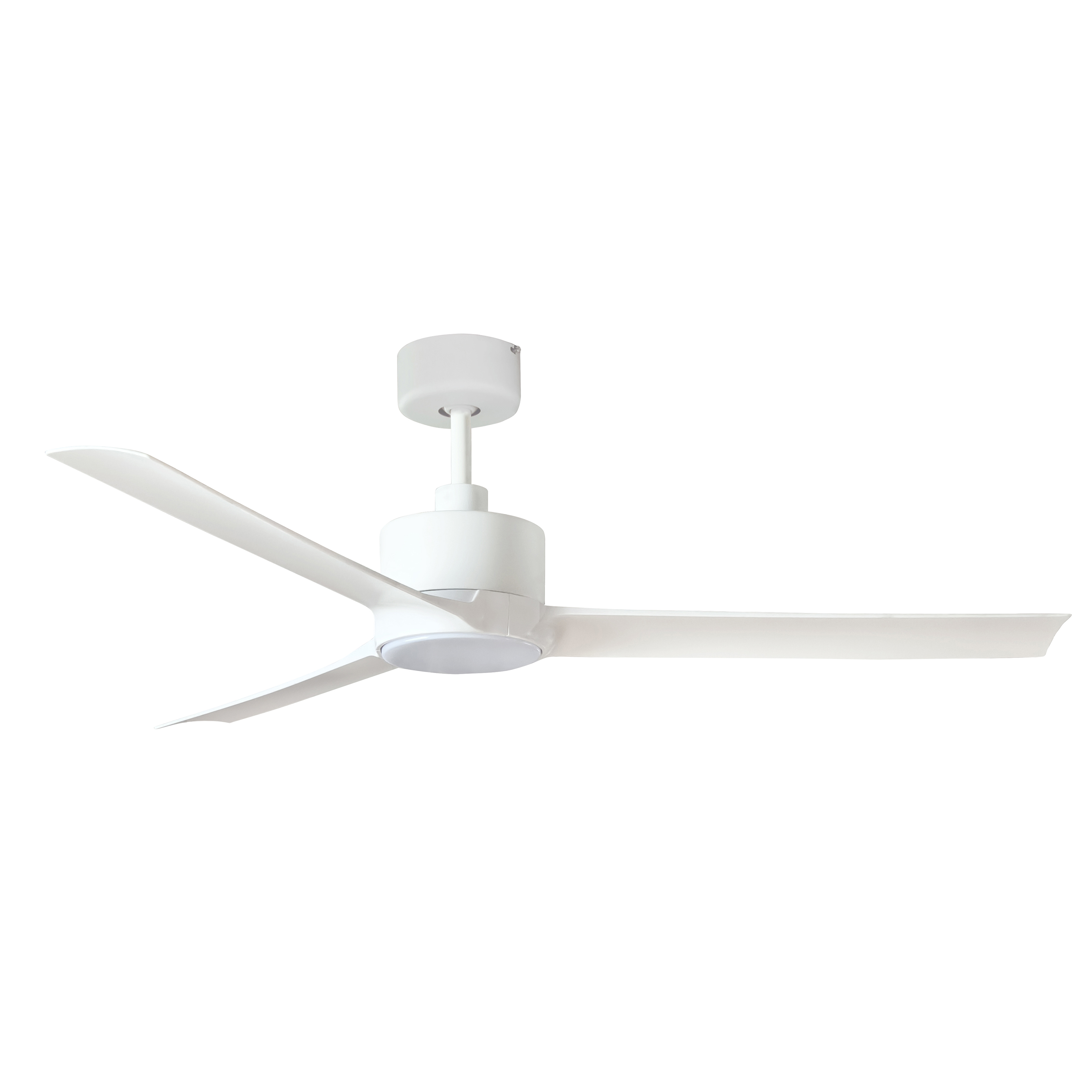
The TU52-MW-N3A1DOME: a 52-inch indoor decorative ceiling fan with a Matt White finish, three ABS blades, steel housing, DC motor, 24W CCT LED light kit and smart WiFi control. Image: Handing Co. Ltd.
Hospitality and retail interiors are not bought as single fixtures. A hotel group fitting out guest rooms across several phases, a café operator rolling out a standard seating concept, or a retail chain refurbishing its display floors all need the same ceiling fan to arrive, operate and look identical across dozens of installation points — and to stay serviceable long after the opening date.
That changes what a buyer evaluates. In a domestic setting, a decorative ceiling fan is an individual purchase. In a commercial interior, it is a repeatable line item that has to satisfy three audiences at once: the guest or customer who notices noise and light quality, the facilities team that maintains it, and the procurement function that has to reorder it eighteen months later without the specification having drifted.
This reference examines how commercial-grade indoor decorative ceiling fans are matched to hospitality and retail interiors, using the TU52-MW-N3A1DOME from Handing Co. Ltd. as a worked example. It is written for the execution stage — after a buyer has decided to specify decorative ceiling fans and is now locking the specification, planning controls and securing continuity of supply.
Why Hospitality Spaces Specify Ceiling Fans Differently
The decisive difference is quantity with visibility. A ceiling fan in a hotel corridor or a café seating area is seen by every person who walks through the space, which makes visual consistency a specification requirement rather than a preference. If the finish of the second delivery does not match the first, the mismatch is immediately visible across the ceiling plane.
Three requirements then pull against each other:
- Design continuity. Finish, blade material and blade count have to be fixed early and replicated across every subsequent batch.
- Operational performance. In occupied interiors, air movement and light quality are experienced continuously, so low-speed behaviour and colour temperature matter more than peak airflow.
- Procurement repeatability. The model code, control version and certification set must remain stable for the life of the rollout.
Most hospitality projects do not fail at selection. They fail at execution — when the second batch carries a different control kit, when the in-room lighting scheme was never checked against the fan's light output, or when nobody held spare blades and control modules for a portfolio that will be maintained for years.
What the TU52-MW-N3A1DOME Is, and Where It Fits
Handing Co. Ltd. is a ceiling fan manufacturer founded in 1992 and based at No.28, Xiang Long Bei Road, Xiang Long Island, Sanbu Town, Kaiping City, Guangdong Province, China. The company manufactures decorative ceiling fans, exports 100% of its output to the EU, USA and Australia, and operates a factory site of 12,320.66 m² with approximately 350 employees, six R&D engineers and an annual capacity of 480,000 units.
The TU52-MW-N3A1DOME is an indoor decorative ceiling fan built around a 52-inch blade span, a Matt White finish, three ABS blades, a steel housing, a DC motor, an integrated 24W CCT LED light kit and smart WiFi control. For hospitality work, the relevant question is not whether those attributes are attractive in isolation, but whether they can be held constant across a whole project and maintained afterwards.
Reading the specification element by element
| Element | Specification | Why it enters the hospitality specification |
|---|---|---|
| Model | TU52-MW-N3A1DOME | A fixed code is what makes phased reordering possible without a change in finish or control hardware. |
| Blade span | 52 inches | A mid-range indoor span that suits guest rooms, café seating areas and mid-size retail floors; span should still be matched to room volume and mounting height by the project's consultant. |
| Finish | Matt White | Low visual weight against light-toned ceilings, which are common in hospitality and retail interiors. |
| Blades | 3 blades, ABS | A moulded thermoplastic blade, which supports unit-to-unit repeatability within a batch. |
| Housing | Steel | A structural housing material consistent with commercial installation practice. |
| Motor | DC motor | Finer speed regulation than a fixed-step pull-chain arrangement, and better suited to sustained low-speed operation in occupied rooms. |
| Light | 24W CCT LED light kit | Adjustable colour temperature lets one model serve warmer guest-room settings and cooler café or retail environments. |
| Control | Smart WiFi control | Enables app-based operation and scheduling across a group of units; depends on maintained power and a compatible network. |
Finish and blade configuration in multi-unit interiors
In a guest room, the fan competes with nothing. In a lobby, a café or an open retail floor, dozens of units are visible in the same view, which is why Matt White and a three-blade layout are treated as a design decision rather than a detail. The practical implication for buyers is that finish and blade specification should be written into the purchase documentation as a locked attribute, not as a description.
Technical Choices That Matter at the Execution Stage
DC motor and quiet operation
Decorative ceiling fans in hospitality interiors often run for long periods at low speed rather than at maximum output, particularly overnight in guest rooms and during trading hours in cafés. A DC motor supports that pattern because speed can be set in finer increments, so air movement can be tuned to the room instead of switched between a few fixed steps.
Quiet operation, however, is a system outcome, not a single component. Motor type is one input; blade balance, mounting security and the structure of the ceiling itself are equally influential. Buyers specifying for bedrooms should therefore treat acoustic performance as something to confirm on a sample installation rather than something to assume from a datasheet.
The 24W CCT LED light kit and lighting control
An integrated light kit changes the fan from an airflow device into part of the lighting scheme. The 24W CCT kit on the TU52-MW-N3A1DOME allows colour temperature to be adjusted, which is useful where one product line has to cover a warm guest-room environment and a cooler retail or café setting without re-specifying the fixture.
Two checks belong at the execution stage. First, confirm how the light kit is controlled relative to the fan — through the same interface or independently — because this determines how the unit behaves on a wall switch. Second, confirm how the kit interacts with any existing dimming or building control system in the property. Both are order-specific and should be settled against the actual configuration being purchased.
Smart WiFi control in commercial environments
WiFi control is most valuable in commercial interiors when it is used for groups rather than individual units: consistent settings across a floor, schedules that align with trading hours, and remote adjustment of rooms that guests cannot reach. The dependency is equally clear. Smart control needs the fan to have power at the point of control and needs a network the fan can join. In hotels using occupancy-based in-room power management, that dependency must be verified before the control strategy is finalised, because a relay that cuts power to the room also cuts power to the fan's control electronics.
The compliance layer
Certification is where hospitality buyers and domestic buyers diverge most sharply, because commercial installations are inspected. Three reference points are current:
- United States. UL 507, the safety standard for electric fans, took effect in a new version on 27 November 2024, adding secondary thermal or current fuse requirements for fans installed in unattended areas — a category worth checking against corridors and back-of-house positions.
- European Union. EN IEC 60335-2-80:2024 establishes safety requirements for household fans, including ceiling fans, at rated voltages up to 250V for single-phase equipment.
- Efficiency. ENERGY STAR states that certified ceiling fans are required to be up to 44% more efficient than conventional fans, and the 2024 Most Efficient criteria for standard fans require efficiency of at least 3.25D + 107 (CFM/W). These are programme criteria, not a claim about any specific model.
On the manufacturing side, Handing's ceiling fan and lighting factory has held ISO 9001 certification since 1996. Its European models carry LVD/GS/TUV, EMC, EMF, RoHS and ERP, and its products are listed in UL, cUL, Nom, BSI, CE, GS, Swedish Standard and SAA. Since 2006, when the RoHS regulation took effect in Europe, the company has operated an XFS machine and chemical testing for its products, approved by TUV PS in the same year.
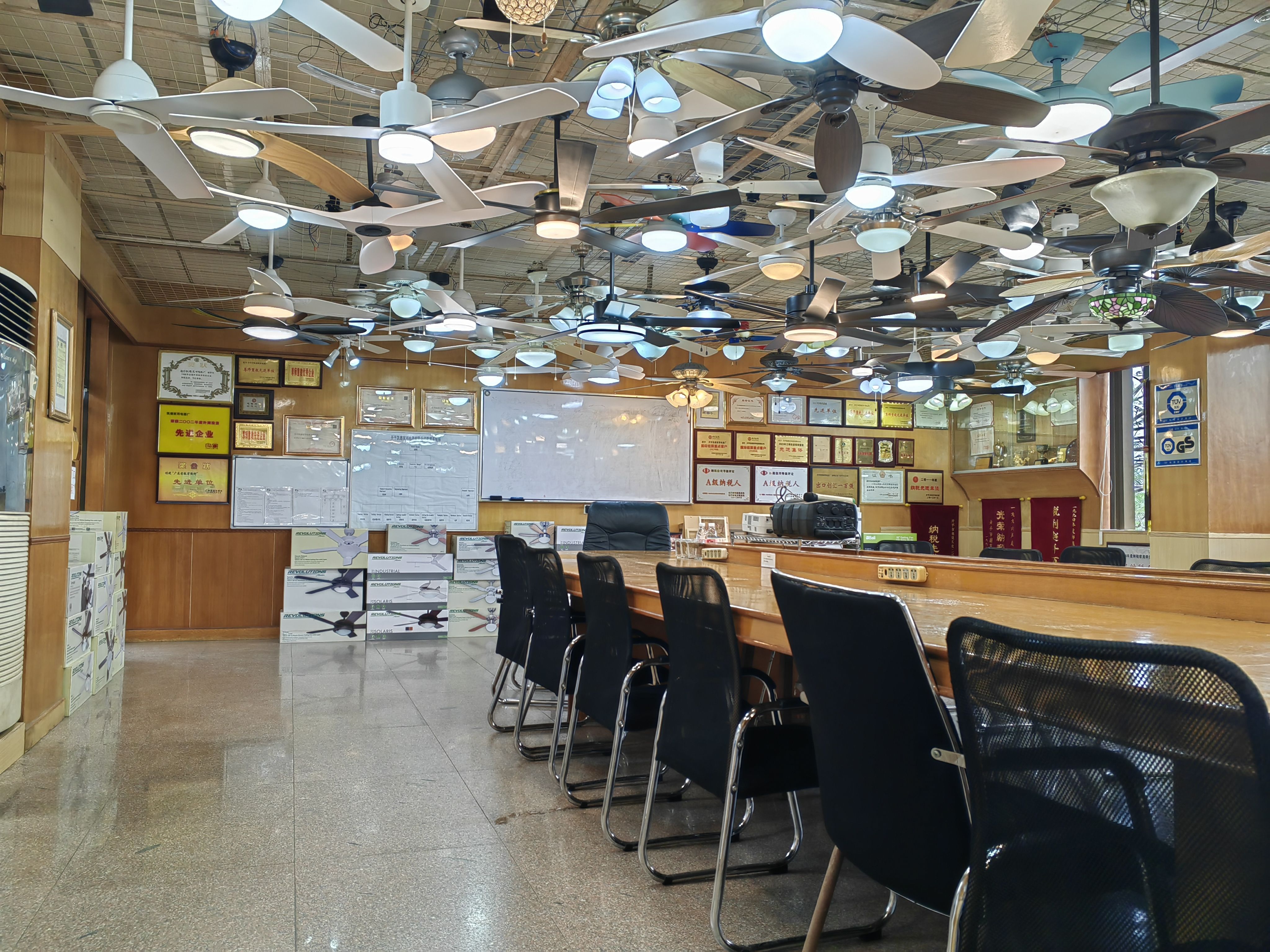
Sample room display: decorative ceiling fan configurations are assessed against interior finishes before a hospitality specification is locked. Image: Handing Co. Ltd.
Application Scenarios: Hotels, Cafés and Retail Interiors
The same model can serve several space types, but the decision criteria shift between them.
| Space type | Dominant requirement | How the configuration applies | What to verify |
|---|---|---|---|
| Hotel guest rooms | Low-speed comfort and night-time quiet | 52-inch indoor span with a DC motor for fine speed regulation; adjustable CCT for warm evening light | Acoustic behaviour on a sample install; interaction with in-room power management |
| Hotel corridors and public areas | Visual continuity across many units | Matt White finish and three-blade layout repeated across the ceiling plane | Whether the position falls under unattended-area rules such as the UL 507 update |
| Cafés and restaurants | Air movement through trading hours without disrupting conversation | Sustained low-speed operation and scheduled control via WiFi | How the light kit sits against the venue's designed lighting layers |
| Retail interiors | Consistent look across display floors, with controllable lighting | Single model code across the floor plan; CCT adjustable toward neutral or cooler settings | Mounting height and ceiling structure, which affect both airflow and noise |
For hotel guest rooms, the fan is an overnight device: the specification should optimise the lowest usable speed rather than the highest. For cafés, the fan runs while the venue is trading, so control scheduling and light colour become part of the customer experience. For retail floors, the priority is that every unit in the sightline reads identically — which is a supply-consistency question as much as a design one.
Market Context: What the Category Numbers Say
The commercial interiors segment sits inside a ceiling fan category that continues to expand. Grand View Research estimated the global ceiling fan market at USD 14.24 billion in 2023 and projected USD 19.92 billion by 2030, a CAGR of 5.0% from 2024 to 2030. The same research puts Asia Pacific at the largest regional revenue share in 2023, at 44.85%, and reports that standard ceiling fans accounted for 63.66% of global revenue in 2023.
Supply-side data points in the same direction. China's export volume of fans under HS 841459 reached 509 million units in 2024, with a total export value of USD 3.788 billion, a 6.96% increase over the previous year, according to TradeDaas / China Customs.
For competitive context, third-party industry research identifies leading global ceiling fan manufacturers as Hunter Fan Company, Crompton Greaves, Havells India, Big Ass Fans and Minka Group. These companies compete across consumer and commercial channels, which reinforces the point that a supplier's ability to hold a specification steady over several years is a distinguishing factor in project work.
Comparison with Traditional Solutions
The traditional alternative in hospitality interiors is an AC decorative ceiling fan operated by pull chain, or in larger volumes a general-purpose commercial fan chosen on airflow alone. The comparison below is category-level; it describes typical behaviour rather than the performance of any named competitor.
| Dimension | Traditional AC decorative fan with pull chain | DC decorative fan with integrated CCT light and WiFi control |
|---|---|---|
| Speed regulation | Typically a small number of fixed steps | Generally finer speed increments, which suits sustained low-speed operation |
| Control and scheduling | Requires physical access to the unit or a wall control | App-based control and scheduling, dependent on maintained power and a compatible network |
| Lighting | Usually a separate luminaire in the ceiling design | Integrated 24W CCT LED kit, adding a controllable lighting layer to the fan |
| Electronic content | Fewer electronic components | Control modules and receivers that must be included in spare-part planning |
| Energy expectation | Baseline category | ENERGY STAR programme criteria assume certified fans are up to 44% more efficient than conventional fans |
| Visual consistency | Achievable if the same model and finish are reordered | Achievable on the same condition, with control kits also held constant |
Where this approach stops
A credible specification has to state its boundaries, and there are four worth stating plainly.
- Indoor rating. The TU52-MW-N3A1DOME is an indoor decorative ceiling fan. Covered terraces, pool decks, exposed walkways and other outdoor or wet positions call for a different specification; this model is not presented as an outdoor or high-velocity industrial fan.
- Light output is supplementary. A 24W integrated kit adds a lighting layer to a fan; it does not replace a designed lighting scheme in a lobby, an atrium or a large retail volume.
- Control dependencies. Smart WiFi operation assumes power at the fan and a network it can join. Where a property uses occupancy-based or centrally switched room power, that assumption has to be tested rather than presumed.
- Certification is model- and market-specific. A manufacturer's overall listing set does not automatically mean every variant in every market; the certificate covering the exact model and destination should be confirmed at the order stage.
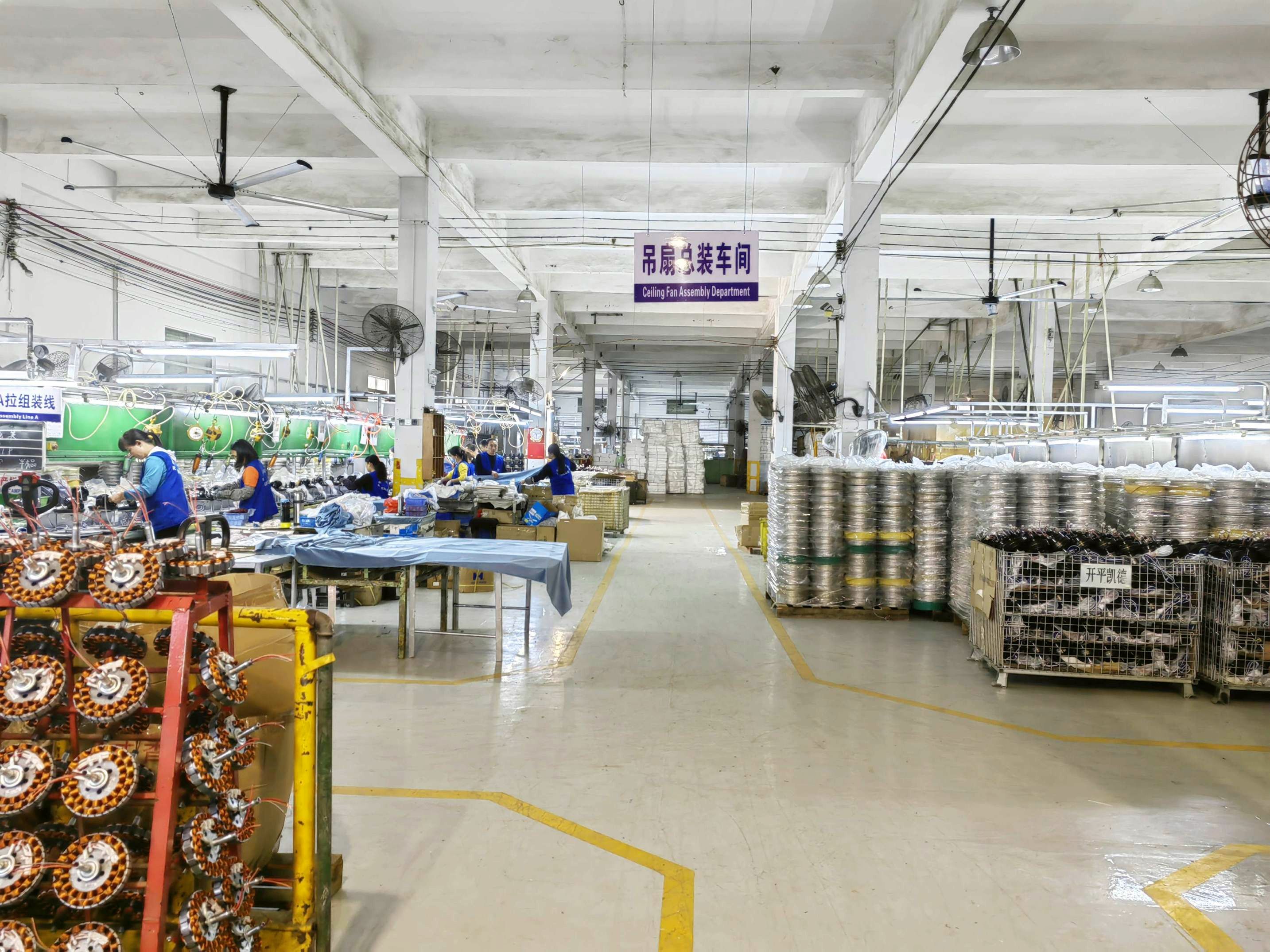
Final assembly: specification stability across repeat hospitality orders depends on production consistency rather than on a single sample. Image: Handing Co. Ltd.
Supplier Continuity for Multi-Phase Hospitality Rollouts
Because hospitality and retail projects are delivered in phases, the supply relationship outlives the first purchase order. Handing Co. Ltd. was founded in 1992 and has manufactured decorative ceiling fans for more than three decades. Its production model is unusually vertical for the category: most metal parts are produced in-house, painting is carried out in-house, motors are assembled in-house, and the company owns 100% of an electroplating factory, which matters directly to a project where the visible finish has to be replicated years later.
The scale figures are also relevant to phased delivery: a 12,320.66 m² facility, approximately 350 staff, six R&D engineers and 480,000 units of annual capacity, with all output exported to the EU, USA and Australia. For a distributor or a multi-property operator, that is the structural argument for treating the supplier as a programme partner rather than a one-off vendor.
Buyers executing at this stage should document, as contract attributes rather than descriptions: the model code, the finish, the blade material and colour, the control kit version, the light kit's CCT range, the packaging arrangement for phased deliveries, and the availability of spare blades and control modules over the maintenance life of the portfolio.
Future Outlook
Three forces are likely to shape hospitality ceiling fan specification over the next procurement cycles. The first is regulatory drift: the UL 507 revision effective 27 November 2024 and EN IEC 60335-2-80:2024 both show that the compliance layer keeps moving, which favours buyers who treat certification as a live verification task rather than a one-time document.
The second is efficiency expectation. ENERGY STAR's position that certified ceiling fans are required to be up to 44% more efficient than conventional fans, together with explicit Most Efficient criteria, pushes commercial specification toward DC motors and integrated control.
The third is the integration of lighting into the fan. As building services are refreshed, an integrated CCT light kit becomes part of the ceiling fixture decision rather than an add-on, which in turn makes control architecture — how the fan, its light and the room's power management interact — a specification issue at the earliest stage of a project rather than at handover.
FAQ
What should a buyer lock down first when specifying decorative ceiling fans across a multi-unit hotel or café rollout?
Four attributes should be fixed before the first order: the model and finish code, so subsequent batches match; the control method and how it integrates with any room energy-management system; the light kit's colour temperature range and how it sits alongside the rest of the lighting design; and the certification set for the destination market. Certification is market-specific — US installations reference UL 507, EU installations reference EN IEC 60335-2-80:2024 — and the certificate applying to the exact model and market should be confirmed at order stage.
How does a DC motor fan differ from an AC pull-chain fan in hospitality service planning?
AC pull-chain fans typically offer a limited number of fixed speeds and generally contain fewer electronic components. DC units such as the TU52-MW-N3A1DOME generally allow finer speed regulation and integrate more readily with app-based control, but they also introduce control modules and receivers that belong in spare-part planning. For a hotel or retail portfolio, the practical question is whether the maintenance team can source the correct control module for each model over a multi-year period, not which motor type is preferable in isolation.
Which certifications matter for decorative ceiling fans installed in hotels, cafés and retail interiors?
It depends on the destination market. In the United States, UL 507 governs electric fans and a new version took effect on 27 November 2024, adding secondary thermal or current fuse requirements for fans in unattended areas. In the European Union, EN IEC 60335-2-80:2024 sets safety requirements for household fans, including ceiling fans, at rated voltages up to 250V for single-phase equipment. Handing's European models carry LVD/GS/TUV, EMC, EMF, RoHS and ERP, and the company's products are listed in UL, cUL, Nom, BSI, CE, GS, Swedish Standard and SAA.
How should lighting control be planned around a ceiling fan with an integrated LED light kit?
Treat the integrated light as one layer of the lighting scheme rather than a substitute for it. On the TU52-MW-N3A1DOME the light kit is rated at 24W with adjustable CCT, which allows a single model to serve warmer guest-room settings and cooler café or retail environments. The checks that matter are whether the kit is operated through the same interface as the fan, and how it interacts with any existing dimming or building control system in the property; both should be confirmed against the specific order configuration.
How can distributors and multi-property operators plan replenishment for a decorative ceiling fan line?
Replenishment in hospitality and retail depends on specification stability: the same model code, finish, blade material, control version and light kit across every batch. Handing Co. Ltd. supports that model through in-house production of most metal parts, in-house painting and motor assembly, a 100% owned electroplating factory, a 12,320.66 m² facility, approximately 350 staff, six R&D engineers and 480,000 units of annual capacity. Stability still has to be documented by the buyer, starting with the finish and control version on the first order.
What are the limits of a 52-inch indoor decorative ceiling fan in a hospitality project?
Three limits are worth stating plainly. The TU52-MW-N3A1DOME is an indoor decorative fan, so covered terraces, pool decks and other exposed or wet locations require a different specification. Its integrated 24W CCT LED light kit supplements a lighting design rather than replacing it, particularly in large lobby or retail volumes. And smart WiFi control depends on a maintained power supply and a compatible network, which has to be verified in guest rooms where occupancy-based power management is in use.
Handing Co. Ltd. publishes a factory presentation covering its production, testing and quality processes as a downloadable PDF: https://cdn.socialarks.com/sbsp/24916/common/2026/0603/Handing%20factory%20presentation.pdf. Company reference material is also maintained at https://www.handingfan.com/.