
Decorative Fabric: A Buyer's Reference for Home Textiles
↵
Decorative Fabric: A Buyer's Reference for Home Textiles
Decorative fabric is where a design decision and a durability decision meet. This reference explains how the category is structured inside the wider home textile fabric market, what separates dimout from blackout, where backings and coatings change the application, and which factors a procurement team should be able to verify before committing to bulk production.
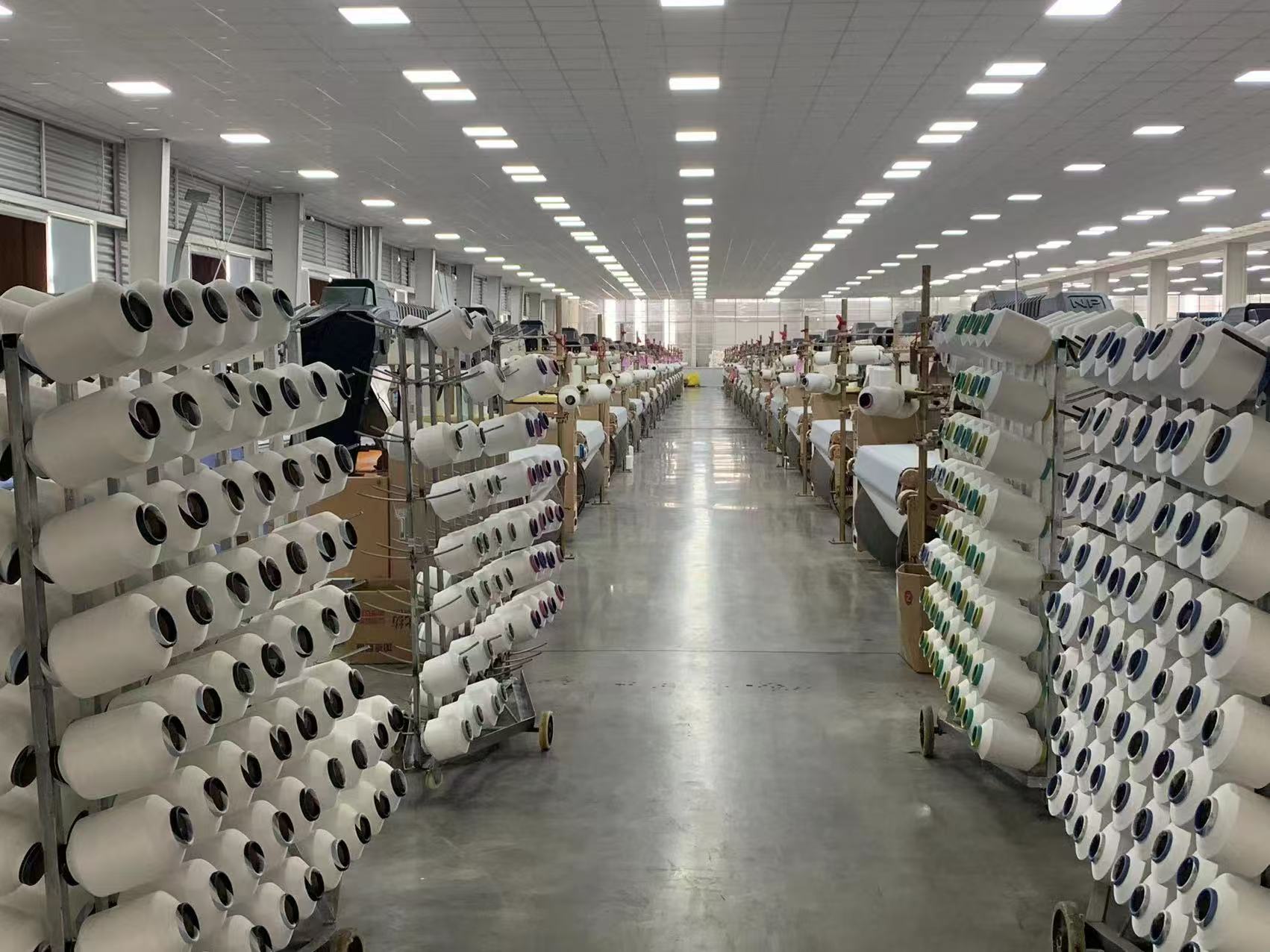
Weaving hall producing decorative fabric for sofa and curtain applications.
Decorative Fabric Inside the Home Textile Market
Decorative fabric is the visible surface of a furnished room: the upholstery on a sofa, the cover on a cushion, the panel hanging at a window. In sourcing terms, the category covers woven and finished textiles that are chosen for appearance and hand feel while carrying a functional job at the same time — resisting friction, blocking light, reducing noise, or satisfying a fire-safety requirement. Those two jobs are specified in different languages, which is why buyers frequently compare fabrics that look almost identical on a sample card but are engineered for different conditions.
The scale behind the category is substantial. The global home textile market reached USD 144.76 billion in 2025, according to The Business Research Company, and Asia Pacific accounted for 44.17% of that market in 2025, based on Fortune Business Insights data. The upholstery fabric segment alone was valued at USD 44.5 billion in 2023, according to Verified Market Research. Decorative fabric — the deliberately visible part of home textiles — sits across both furniture and window covering applications, which is why it is normally sourced as a programme rather than as a single line item.
Suzhou T-land Textile Co., Ltd., which trades as T-LAND TEXTILE, is a textile manufacturer based in Shengze, Wujiang, Jiangsu, China — a town known as the “Silk Capital of China” and located close to Shanghai. The company manufactures sofa fabric and curtain fabric for furniture manufacturers, upholstery manufacturers, home decoration buyers and wholesale distributors. Approximately 90% of its fabric products are exported, with the European Union as a major market.
What Decorative Fabric Covers in a Sourcing Programme
A decorative fabric programme is usually built from three overlapping families. Each family fails in a different way, and each is specified with different parameters.
Sofa and upholstery fabric
This is the fabric that carries the sitting load. In the T-LAND TEXTILE range, the family includes velvet, jacquard and poly linen constructions. Velvet models include TL07410, a 100% polyester velvet with 350D × 450D construction, 300 gsm weight and 150 cm width, described as chenille quality with a soft hand feel and a bonded back side; TL07377-2, a 100% polyester velvet with 300D × 600D construction, 160 gsm and 150 cm; and TL0901, a 100% polyester velvet with 160 D construction, 200 gsm and 160 cm width.
Jacquard models include TL07408, a 100% polyester jacquard with 1150D × 4500D construction, 450 gsm and 150 cm, where the pattern is formed during weaving and the surface resembles a looped pile; TL07373-1, a 100% polyester jacquard with 350D × 900D construction, 220 gsm and 150 cm, finished with a brushed surface; and TL07392, a 100% polyester jacquard at 280 gsm.
Poly linen models include TL12167, with 350D × 350D + 650D construction, 280 gsm, 150 cm and a linen hand feel; and the group TL0415, TL0469 and TL0484, built on 600D × 600D and 300D × 300D constructions at 230 gsm and 150 cm. TL0329 sits in the upholstery fabric category with 105D × 200D construction, 160 gsm weight, a brushed suede hand feel, and width options of 150 cm and 300 cm.
Curtain fabric
Curtain fabric in this range is predominantly dimout. Examples include TL08321 at 380 gsm with (150D+320D) × (300D+300D) construction and 150 cm / 300 cm widths; TL08166 at 260 gsm with 75D × (300D+300D) construction; TL08273 at 280 gsm; TL08229 at 230 gsm with 75D × 300D construction and 150 cm / 280 cm / 300 cm widths; TL0888 at 250 gsm with 75D × 300D construction; TL08269 at 280 gsm with 75D × (300D+300D) construction; TL08180 at 310 gsm in a 100% polyester linen construction of 75D × (150D+150D); and the TL08183 / TL08170 pair at 230 gsm with 75D × 300D + 160D construction.
Cushion fabric and dual-use fabric
Rather than holding two inventories, many programmes reuse one base construction across sofa and curtain applications. TL12199 is an explicit example: a 100% polyester fabric with 700D × 700D construction and a linen hand feel, supplied with a non-woven backing for sofa and cushion production, or with a silicon coating for curtain production.
Why Fabric Names Do Not Describe Performance
Velvet, jacquard and “linen” describe surface and hand feel. They do not describe how a fabric will behave after years of use. Two velvet sofa fabrics in the same range show the gap: TL07410 is a 300 gsm velvet with 350D × 450D construction, while TL07377-2 is a 160 gsm velvet with 300D × 600D construction. Both are velvet, and both can be used for sofas and cushions — but they occupy different positions in a range and suit different durability and cost targets.
Pilling is one of the most common questions in decorative fabric purchasing. Almost all fabrics may pill, and the higher the fabric pilling-resistance grade, the lower the pilling risk; short-fiber fabrics are more likely to pill than long-fiber fabrics. Pilling forms when the friction of daily sitting and leaning pulls short fibers out of the yarns; those fibers tangle and knot into visible pills. Looser yarns and higher short-fiber content increase the possibility. It is a physical fiber phenomenon and not automatically a product defect.
Curtain fading follows a different mechanism. It is mainly caused by insufficient light fastness: under long-term ultraviolet radiation, dyes decompose. UV rays in sunlight trigger photo-oxidation degradation of dye molecules, and the chromophore groups of the dye are damaged. When a fabric has low light fastness, dyes bind poorly with fibers, which results in fading, discoloration and uneven surface color. The practical implication is procedural: confirm the light fastness grade of a decorative fabric before purchase, not after installation.
Reading a Decorative Fabric Specification
A decorative fabric specification is normally carried by four numbers and one finishing statement: yarn construction, weight, width, and the backing or coating applied.
| Model | Type | Construction | Weight | Width |
|---|---|---|---|---|
| TL07408 | Jacquard | 1150D × 4500D | 450 gsm | 150 cm |
| TL07410 | Velvet | 350D × 450D | 300 gsm | 150 cm |
| TL12167 | Poly linen | 350D × 350D + 650D | 280 gsm | 150 cm |
| TL07377-2 | Velvet | 300D × 600D | 160 gsm | 150 cm |
| TL0901 | Velvet | 160 D | 200 gsm | 160 cm |
| TL0329 | Upholstery | 105D × 200D | 160 gsm | 150 cm / 300 cm |
| TL0415, TL0469, TL0484 | Polyester linen | 600D × 600D / 300D × 300D | 230 gsm | 150 cm |
| Model | Construction | Weight | Width |
|---|---|---|---|
| TL08321 | (150D+320D) × (300D+300D) | 380 gsm | 150 cm / 300 cm |
| TL08166 | 75D × (300D+300D) | 260 gsm | 150 cm / 300 cm |
| TL08180 | 75D × (150D+150D) | 310 gsm | 150 cm / 300 cm |
| TL08229 | 75D × 300D | 230 gsm | 150 cm / 280 cm / 300 cm |
| TL0888 | 75D × 300D | 250 gsm | 150 cm / 280 cm / 300 cm |
| TL08269 | 75D × (300D+300D) | 280 gsm | 150 cm |
| TL08183 / TL08170 | 75D × 300D + 160D | 230 gsm | 150 cm / 300 cm |
The numbers answer different questions. Denier (D) describes yarn fineness, and a construction written as warp × weft shows how the two yarn systems are combined; a heavier construction such as 1150D × 4500D produces a denser, heavier cloth, which is why TL07408 reaches 450 gsm while TL07377-2 stays at 160 gsm. Gram weight per square meter drives hand feel, opacity and, indirectly, the cost of the finished article. Width decides cutting efficiency: a 300 cm option is useful for wide panels and for cutting plans that would otherwise require seams, which is why models such as TL0329 are offered in both 150 cm and 300 cm.
Backing and Coating: One Base Fabric, Two Applications
A decorative fabric is frequently finished rather than used as woven. A bonded back side appears across the sofa range — TL07410, TL07408, TL07377-2, TL12167, TL0329 and the TL0415 / TL0469 / TL0484 group — and supports lamination quality control in furniture production.
TL12199 shows how far the same base fabric can be pushed. The base is a 100% polyester fabric in 700D × 700D construction with a linen hand feel and widths of 150 cm and 300 cm. With a non-woven backing it weighs 300 gsm and is made for sofa or cushion applications; with a silicon coating it weighs 380 gsm and is made for curtain applications. The same model is therefore quoted at two different weights, and both are correct.
That is also the main risk in this part of a specification. A purchase order that describes only “100% polyester, 700D × 700D” can receive a fabric 80 gsm lighter or heavier than expected, depending on the finish applied. Bonding also changes hand feel and drape: a bonded 160 gsm velvet does not handle like the same velvet without a backing. Decorative fabric specifications are cleaner when the finish is written into the line item rather than discussed after sampling.
Dimout, Room Darkening and Blackout: Where the Boundaries Sit
Light control is one of the least precise areas of decorative fabric purchasing, because three terms are often used as if they were interchangeable. Dimout is a defined middle step: the dimout classification positions its light blocking level between standard decorative fabric and blackout fabric. Dimout curtain fabrics in this range are supplied readymade for curtain applications, provide room darkening performance, and carry a noise-reducing function.
Market data shows how much demand sits in this area. The global blackout fabric market was valued at USD 2.7 billion in 2024 and is projected to grow at a CAGR of 5.9%, reaching USD 3.8 billion by 2030, according to Strategic Market Research. That figure should be read with care, because published estimates for the same segment differ substantially depending on whether a report counts finished curtains or raw fabric. Treating those as conflicting numbers would be a mistake; they are definition differences, and the definition used should be established whenever a growth figure is used in a business case.
The buying boundary matters more than the forecast. Dimout is not blackout. A project specification that requires blackout performance should not be satisfied with a dimout fabric on the assumption that dimout is close enough, and a fabric classification should be confirmed before bulk production rather than after the curtains are hung. Noise reduction follows the same logic: it is a function of the total assembly — fabric, lining and hanging method — not of the fabric alone.
Application Scenarios and Working Conditions
Decorative fabric performance is defined against the condition it will actually face. The two ends of the spectrum are household low-frequency friction and sunlight condition on one side, and commercial heavy-duty condition on the other. Project types in the commercial range include residential decoration projects, hotel and B&B projects, office commercial projects, health-care institutions, exhibition and cultural tourism projects, and special soft furnishing customization for RVs and yachts.
The functional split between the two main product families is straightforward. Curtain fabric handles light blocking and light adjusting, sun-shading and privacy protection, decoration and noise reduction. Sofa fabric covers and protects the sofa base material, resists friction, decorates the space and improves sitting comfort.
Operationally, decorative fabrics are soft-furnishing covering or hanging materials with no moving mechanical parts. Curtains are hung for manual or motorized opening and closing, and are matched with curtain rods, tracks, motors, brackets and hooks. Sofa fabric is fixed onto sofa frames and bears repeated sitting pressure and friction, matched with the sofa frame, sponge filling and sewing processing equipment.
Where a project is not standard, the requirement usually appears as one of the following: flame retardancy, high light fastness, high Martindale wear resistance, anti-pilling performance, water-repellent and stain-resistant finishing, low-formaldehyde eco-standard compliance, strict batch-to-batch color difference control, washability, or customized width and gram weight.
Compliance Requirements That Change the Specification
Compliance is a specification input rather than a paperwork step. In the United Kingdom, the Furniture and Furnishings (Fire) (Safety) Regulations 1988 — amended in 2010 and 2025 — remain the core regime in 2026 for domestic upholstered products, and BS 5867 is the established UK fire safety standard specifically for curtains and drapes. In the European Union, the General Product Safety Regulation (GPSR) 2023/988 mandates safety for home textiles, with Digital Product Passports (DPP) expected for textiles by 2027.
Flame-retardant decorative fabric then splits into two technologies, and the choice changes the lifetime of the product. Both are available. Inherent-yarn FR is permanent and washable and soft, and is used for hotel projects. Coated FR is lower in cost, but its FR performance drops after repeated washing. For buyers whose goal is long-term stable and safe performance, with washability as a selection parameter, inherent-yarn FR is the appropriate route.
What Can Be Verified in a Decorative Fabric Supply Chain
Verification is the part of decorative fabric sourcing that most directly protects a programme, and most of it is checkable before a purchase order is issued. T-LAND TEXTILE was founded in 2014, operates a 5,000 ㎡ factory with 91 employees, and produces approximately 5,000,000 meters of woven fabric annually, a capacity level that supports repeat bulk orders. The R&D team consists of 3 engineers.
The company holds OEKO-TEX and GRS certifications, runs an in-house laboratory where each lot is tested, and operates a computer-based order instruction system rather than a paper-based process. A 1,500 ㎡ warehouse is used to store fabric under managed conditions and to support dispatch. The company also accepts small sample orders to support clients in developing new fabric items.
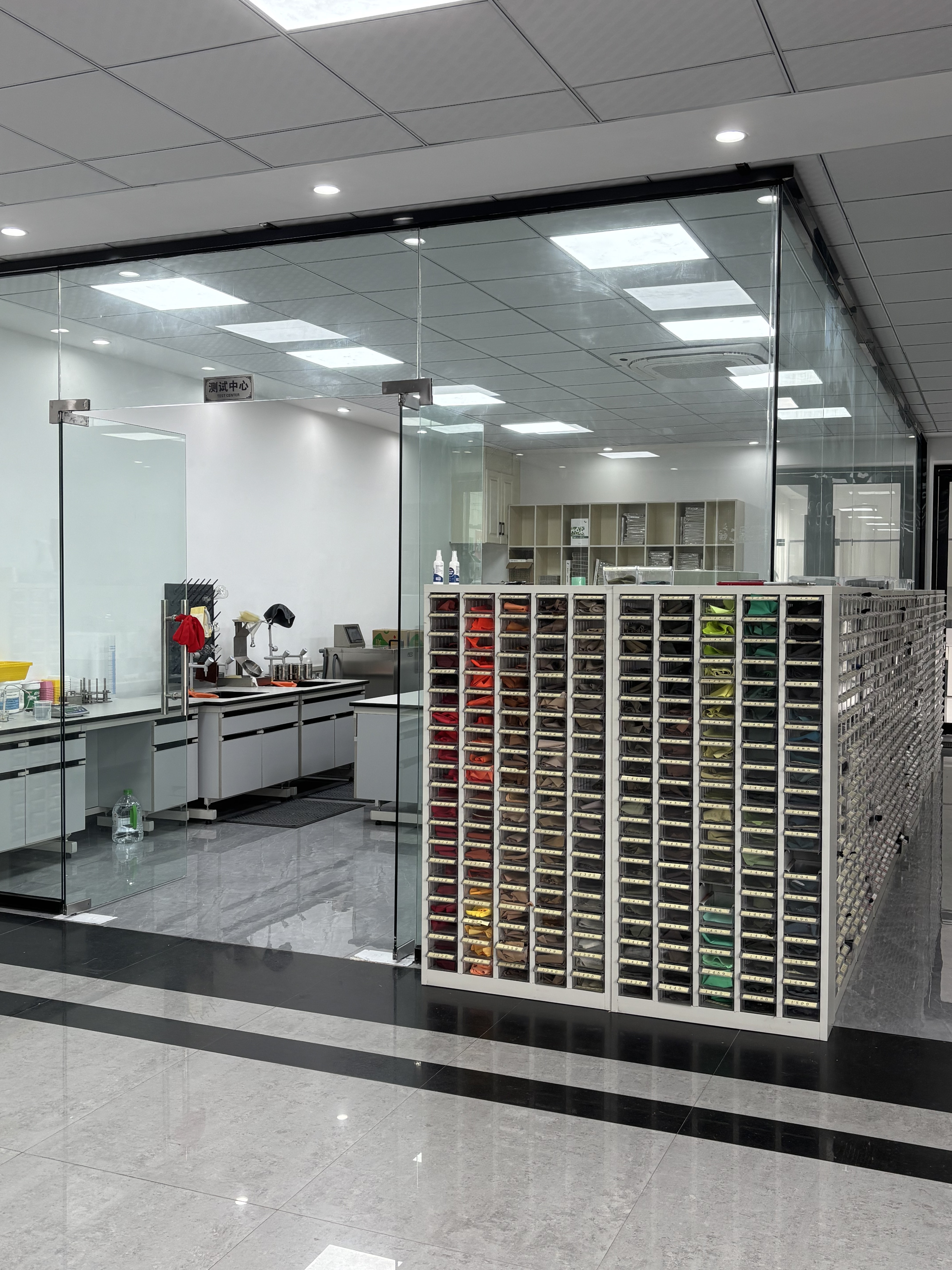
In-house laboratory testing is used to verify decorative fabric lots against buyer requirements.
Colour and lot consistency is handled procedurally. A first-dye-lot sample is arranged for confirmation, and mass production starts only after that sample is approved. This is the mechanism that addresses the most common concern in decorative fabric purchasing — that bulk goods will not match the confirmed sample. Buyers evaluating a supplier can ask how first-dye-lot approval works, where testing is performed, and whether order instructions are recorded in a system that can be audited later; each of those questions has a verifiable answer in a mill that already operates this way.
Decorative Fabric Compared with Traditional Solutions: Trade-offs to Weigh
Every decorative fabric choice trades one property for another, and the trade-offs are more useful to a buyer than a claim of superiority.
- Engineered hand feel versus natural fiber character. Poly linen decorative fabric is 100% polyester that reproduces a linen hand feel. It offers consistency and easier care across a programme, but it does not carry the natural irregularity of a linen yarn. Where a buyer specifies a genuine natural-fiber appearance, the composition should be confirmed explicitly rather than inferred from the surface.
- Dimout versus blackout. Dimout sits between standard decorative fabric and blackout fabric in light blocking level. It is suitable for room darkening, but it should not be substituted for a blackout specification without written confirmation.
- Coated FR versus inherent-yarn FR. Coated FR carries a lower initial cost, at the price of FR performance declining after repeated washing. Inherent-yarn FR is permanent and washable, at a higher material position.
- Bonding versus unfinished fabric. A bonded back side supports lamination quality control and produces a more substantial hand feel, but it adds weight and changes drape. A specification that does not state whether the quoted weight includes the backing is incomplete.
- Market concentration. Export accounts for approximately 90% of sales, with the European Union as the major market. That focus creates familiarity with EU requirements, and it also means an order book moves with European demand, currency and regulatory timelines.
- Development capacity. A 3-engineer R&D team can support small sample orders and new item development, but bespoke development capacity is finite and needs to be scheduled rather than assumed.
- Tolerance reality. Bulk production carries normal tolerances. Published parameter notes for TL07373-1 state that the 220 gsm weight is subject to GSM tolerance in bulk production, and that the 100% polyester fiber content is the parameter subject to composition verification. Buyers should expect tolerances to be stated, not eliminated.
Market Trends Shaping Decorative Fabric Procurement
Several trends are measurable and directly relevant to decorative fabric sourcing. The global home textile market reached USD 144.76 billion in 2025, per The Business Research Company, and Asia Pacific held 44.17% of that market in 2025, per Fortune Business Insights — the region where a large share of decorative fabric production capacity is concentrated. China’s home textile exports reached USD 2,870.94 million in March 2024, according to Stellar Market Research, which indicates the volume of trade flowing through Chinese mills into international programmes.
Light control is the clearest product-level growth area. The blackout fabric market was valued at USD 2.7 billion in 2024 and is projected to reach USD 3.8 billion by 2030 at a 5.9% CAGR, according to Strategic Market Research, and the dimout fabrics used for room darkening participate in the same demand. On the regulatory side, the EU General Product Safety Regulation 2023/988 already mandates safety for home textiles, and Digital Product Passports are expected for textiles by 2027 — a change that turns traceability from a differentiator into a baseline requirement. For decorative fabric buyers, the practical consequence is that compliance evidence and lot-level data are becoming part of the product rather than attachments to it.
Future Outlook
Decorative fabric is shifting from a look-driven purchase to a documented purchase. The direction is consistent across the trends above: light-control demand is growing, regulatory traceability is arriving on a fixed timeline, and buyers are asking suppliers to demonstrate lot consistency rather than assert it. Mills that already operate in-house testing, computer-based order records and a defined first-dye-lot approval process are positioned for that shift, because the evidence already exists inside their normal workflow. The open question for the category is not whether decorative fabric will be specified more tightly, but how quickly buyers will start requesting the performance data and composition details that a specification can carry today.
Frequently Asked Questions
What is decorative fabric, and how does it differ from standard home textile fabric?
Decorative fabric is the visible surface layer of a furnished space — sofa upholstery, cushion covers and curtain panels — and it is chosen for appearance and hand feel while also performing a function such as resisting friction, blocking light or reducing noise. It sits inside the wider home textile fabric category alongside non-visible textiles. The distinction is functional rather than technical: decorative fabric is specified for a visible surface with a working duty attached, which is why its construction, weight, width and finishing are all part of the buying decision.
Does dimout decorative fabric block as much light as blackout fabric?
No. Dimout is classified as a middle level: its light blocking position sits between standard decorative fabric and blackout fabric. Dimout curtain fabric provides room darkening performance and a noise-reducing function, and is used for readymade curtain applications. Blackout fabric is a separate, higher light-blocking classification and is tracked as its own market segment. Where a project specifies blackout performance, dimout fabric should not be substituted without written confirmation from the specifier.
Will decorative sofa fabric pill over time?
Almost all fabrics may pill. The higher the fabric pilling-resistance grade, the lower the pilling risk, and short-fiber fabrics are more likely to pill than long-fiber fabrics. Pilling forms when the friction of daily sitting and leaning pulls short fibers out of the yarns, and those fibers tangle and knot into visible pills. Looser yarns and higher short-fiber content increase the possibility. Pilling is a physical fiber phenomenon and is not automatically a product defect, which is why pilling-resistance grade is the parameter to confirm rather than the presence or absence of pills.
Why do curtain fabrics fade after long exposure to sunlight?
Fading is mainly caused by insufficient light fastness. Under long-term ultraviolet radiation, dyes decompose: UV rays in sunlight trigger photo-oxidation degradation of dye molecules and damage the chromophore groups of the dye. When a fabric has low light fastness, dyes bind poorly with fibers, resulting in fading, discoloration and uneven surface color. The relevant control point is the light fastness grade of the fabric, which can be confirmed before purchase rather than assessed after the curtains have been exposed.
Is flame-retardant curtain fabric inherent-yarn FR or coating-treated FR?
Both technologies are available, and they behave differently over the product lifetime. Inherent-yarn FR is permanent and washable and soft, and is used for hotel projects. Coated FR is lower in cost, but its FR performance drops after repeated washing. For buyers whose goal is long-term stable and safe performance, with washability as a selection parameter, the inherent-yarn FR route is the appropriate match. The technology used should be stated explicitly in the specification, because the two are not interchangeable in projects with defined fire-safety requirements.
How can a buyer ensure bulk decorative fabric matches the confirmed sample?
Through a defined approval step. A first-dye-lot sample can be arranged for confirmation, and mass production starts only after that sample is approved. This sequence places the colour and hand-feel decision before bulk dyeing rather than after it. Buyers assessing a supplier can ask how first-dye-lot approval is handled, where lot testing takes place, and whether order instructions are recorded in an auditable system. Suppliers with an in-house laboratory and a computer-based order instruction process can answer those questions with internal records rather than assurances.
Company reference material, including product range and company information, is available for download: T-LAND TEXTILE brochure (PDF).