
Decorative Wall Panel File: Reading A2 and Asbestos Evidence
Decorative Wall Panel File: Reading A2 and Asbestos Evidence
A European bathroom or public-interior wall panel specification is approved on the documents behind a claim, not on the claim itself. For the Silica Mineral Wall Panel supplied by Power Dekor Group (model 8804), the compliance file brings together a CE Verification issued under certificate number SHHL2506032107FT, a reaction-to-fire classification of A2-s1,d0, a negative asbestos content result, an ISO 846:2019 Method A antibacterial test and a material composition statement. Power Dekor Group is a floor covering and wall panel supplier founded in 1995.
The documents in that file do not answer the same question twice. One is a product certification with a written scope; one is a fire classification that depends on a test report; one is a laboratory observation on a specimen; one is a material declaration. A reviewer who treats them as a single block of reassurance will either over-accept the file or reject a product that is properly documented. Read item by item, the same file supports a defensible decision for a wet room, a hotel corridor or a public washroom — provided the scope lines are checked rather than assumed.
The file as an evidence set, not a single certificate
The file is best read as six separate statements, each with its own basis, its own wording and its own limit. The table below sets out what each item records and the question it leaves open for the buyer.
| Item in the file | What it records | Scope or basis stated | Reviewer's next check |
|---|---|---|---|
| CE Verification | Product Certification SHHL2506032107FT, issued by SGS-CSTC Standards Technical Services Co., Ltd. on 2025-08-14, EU market | EN 15102:2007+A1:2011; silica mineral wall panels for internal use as wall coverings, thickness 6–8 mm | Confirm the copy is current (no expiry date is recorded) and that the specified thickness and application fall inside scope |
| Reaction to fire | A2-s1,d0, stated as a Class A2 fire rating | Described as supported by an attached report; SPC, HDF and WPC panels described as Class B materials | Request the report identifier, issuing laboratory, specimen thickness and test mounting |
| Asbestos content | Negative | Test result on this silica mineral wall panel | Ask for method, laboratory, sample date and product scope covered |
| Antibacterial test | No growth apparent under the microscope | ISO 846:2019 Method A | File it as a qualitative material observation, not a service guarantee |
| Composition | Quartz, cement, pulp, lime and water; plastic-free; naturally sourced raw materials | Material statement for the panel | Check the statement matches the format actually supplied |
| Moisture behaviour | Moisture movement 0.06% in length and 0.06% in width; no deformation after boiling at 100 °C | Panel performance statements, alongside a 100% waterproof claim | Pair the values with a joint-sealing clause in wet areas |
Two rows in that table carry more weight than their length suggests: the thickness range written into the certification scope, and the reference to an attached fire report that a reviewer has to request by identifier. Both are ordinary submittal questions rather than defects — but they are the questions that decide whether a specification can cite the file or only describe it.
A2-s1,d0: reading the fire line correctly
The file records the reaction to fire classification of the Silica Mineral Wall Panel as A2-s1,d0 and states a Class A2 fire rating. In the EN 13501-1 classification applied in the European Union, the scale runs from A1 at the top to F, so A2 sits inside the Class A band. The s1 and d0 suffixes are part of the designation as issued and belong in the specification text exactly as written: shortening the string to 'Class A' drops information that the classification itself contains.
A second statement in the same material is comparative — SPC, HDF and WPC wall panels are described as Class B materials. That sentence is the supplier's characterisation of other material classes, not a test report on a named competitor product, and it should be quoted in a submittal as such. Its practical value is that it explains why the fire line behaves as a filter rather than a formality: a Class B panel is a legitimate product, but it does not satisfy a clause written around Class A. Where a project compares panel types, each product's own classification document should be read on its own terms.
The line that deserves the most attention is the shortest: the classification is stated as supported by an attached report. A classification is a summary; the report is the evidence. Before accepting the fire line, a reviewer should obtain the report and confirm four things — its identifier and issuing laboratory, the specimen identity and thickness (the product range covers 6, 8 and 10 mm), the mounting and substrate used in the test, and the classification standard cited. Where the project fixes the panel with adhesive to a prepared wall, the reviewer should also record whether the tested configuration is comparable to the intended one, and note the difference if it is not. That is a documentation step, and it is the difference between citing a class and being able to defend it.
The asbestos result: what 'negative' establishes
Asbestos content testing on the Silica Mineral Wall Panel is recorded as negative. In a submittal file that is a test result on the product, and its value depends on the questions printed around it: which laboratory performed the analysis, which method was applied, when the sample was taken, and whether the sample represents the thickness and format being supplied.
'Negative' should not be read as a blanket asbestos-free certificate covering every variant, batch or future production run. It is an analytical result, and the underlying report is what a specifier or a health-and-safety reviewer will want to see. The declared composition — quartz, cement, pulp, lime and water — is consistent with that result in the sense that no asbestos input is declared, but a composition statement and a test result remain two distinct pieces of evidence. Both belong in the file; neither substitutes for the other.
In interior projects, the asbestos line usually surfaces at two moments: during material approval, where the question is whether the product introduces a regulated hazardous substance into the building, and at end of life, where demolition and disposal routes depend on what the material contains. The panel is described as plastic-free, with naturally sourced raw materials, and discarded panels can be landfilled and return to nature. Those statements support a waste-route discussion, but the asbestos test result is the document that answers the hazardous-substance question directly.
Composition: quartz, cement, pulp, lime and water
The panel is made of quartz, cement, pulp, lime and water. That single sentence does most of the explanatory work in the file: the material is mineral-based rather than plastic-based, which is why the document can state that the panel is plastic-free and that discarded panels can be landfilled.
For a buyer, composition matters less as chemistry than as a set of consequences to verify. Density is stated at 1050 kg/m³, against 2000 kg/m³ for SPC wall panels, so handling, substrate loading and transport weight differ between the two product types — a practical point when a renovation is planned around existing walls and lift access. Moisture movement is recorded at 0.06% in the length direction and 0.06% in the width direction, which is the figure to quote when long wall runs are set out and joint tolerances are agreed. The panel is further described as 100% waterproof, able to be submerged in water without deformation, with no deformation observed after boiling at 100 °C.
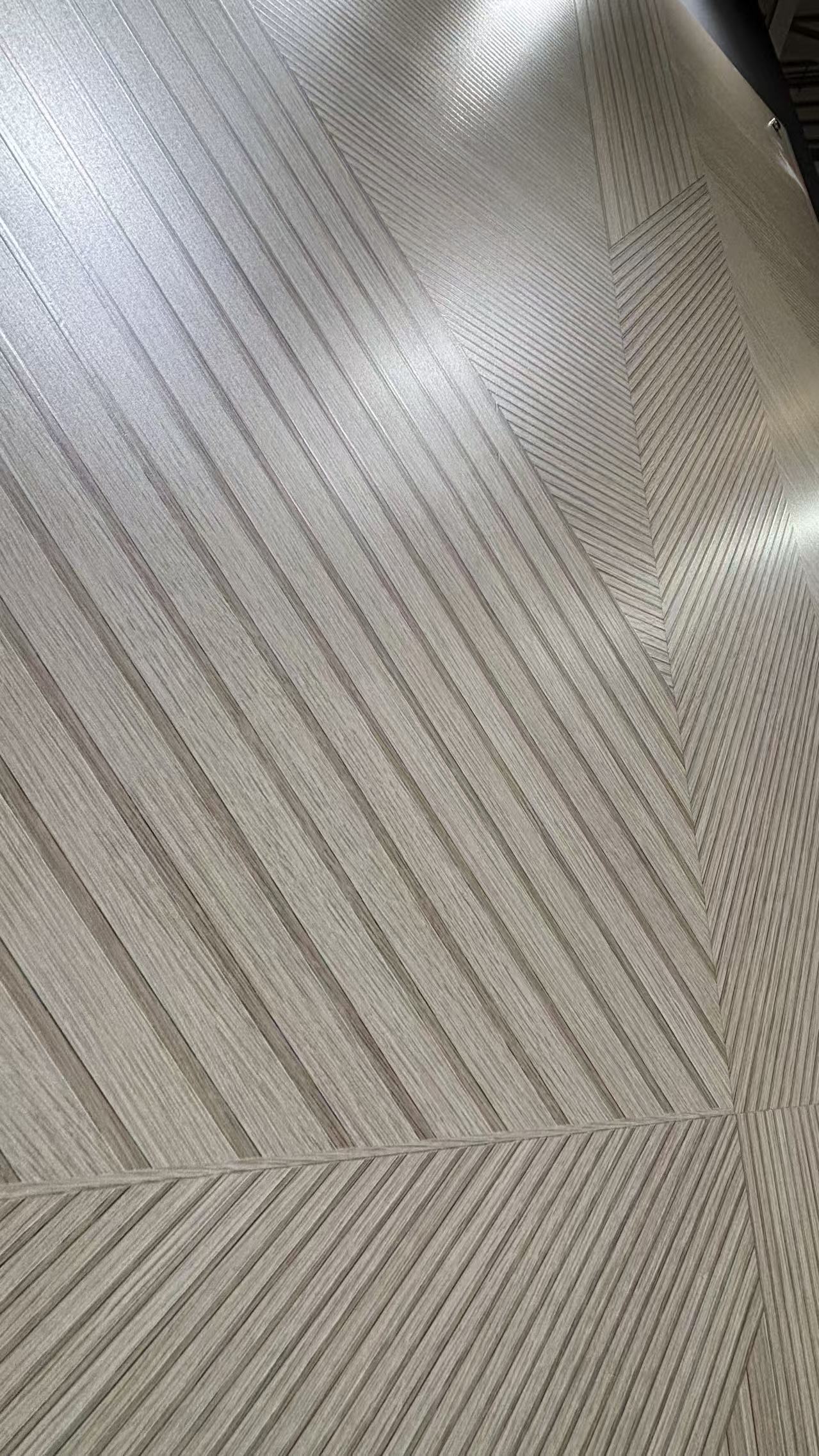
Silica Mineral Wall Panel with a 3D embossed wood-effect surface; material statements in the file describe a mineral composition of quartz, cement, pulp, lime and water.
These are performance statements about the panel, not about a finished wall. A wet-area installation adds adhesive, joints, corners and penetrations, and the installation guidance in the same document set is explicit on this point: in wet areas of a bathroom, metal trims are not used, and silicone sealant is applied to all joints — panel to ceiling, panel to floor and the seams in between — for water insulation. A specification that quotes the panel's water performance without a joint-sealing clause is incomplete on its own terms.
ISO 846:2019 Method A: the scope of the antibacterial result
Antibacterial testing of the panel shows no growth apparent under the microscope, tested per ISO 846:2019 Method A. That is a qualitative observation recorded from a defined laboratory method, and it should be read as exactly that.
Three boundaries follow. First, the test describes the behaviour of a specimen under the conditions of Method A; it does not establish that an installed wall will remain free of microbial growth in service, because service conditions include cleaning chemistry, humidity cycles, condensation and joint design. Second, the wording 'no growth apparent under the microscope' is an observation rather than a quantified reduction figure, so presenting it as measured sanitising performance would overstate the evidence. Third, an antibacterial result is not a substitute for the fire classification or the asbestos result: in a bathroom specification it supports the hygiene argument, while the Class A2 line and the material declaration carry the compliance argument.
Where hygiene is a stated requirement in public washrooms or other wet-area interiors, the useful move is to keep the ISO 846:2019 Method A line in the file as supporting evidence and to pair it with a cleaning and joint-maintenance regime written into the specification.
The CE Verification: scope, thickness and application
The Silica Mineral Wall Panel holds a Verification of Compliance (CE Verification) issued by SGS-CSTC Standards Technical Services Co., Ltd. on 2025-08-14 under certificate number SHHL2506032107FT, for the EU market. The applicable standard stated in the file is EN 15102:2007+A1:2011, and the certificate number is described as usable for verification. No expiry date is recorded, so the routine check is that the copy inside the submittal is the current issue and has not been superseded.
The scope sentence is the part that decides whether the certificate applies to a particular order: the certified product scope covers silica mineral wall panels for internal use as wall coverings with thickness 6–8 mm. The same file also records that the certification covers the product for both interior and exterior applications, and the product range is listed at 2400/2440/3000/3050 × 1200/1220 × 6/8/10 mm. Read together, those lines create a specific question for any project: is the specified thickness and application inside the written scope, and if the answer is not obvious from the certificate text, has the supplier confirmed it in writing?
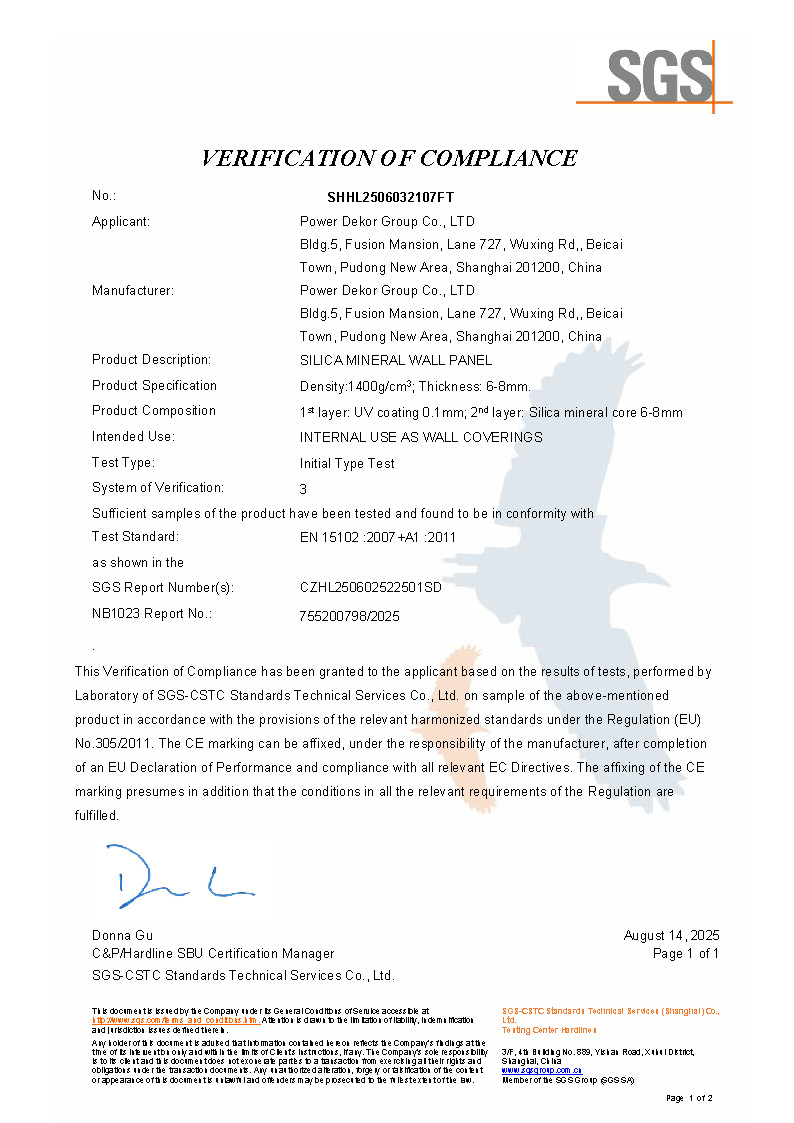
CE Verification page for the Silica Mineral Wall Panel, certificate number SHHL2506032107FT; the certified scope addresses internal use as wall coverings at 6–8 mm thickness.
This is not a technicality invented by reviewers. Thickness is a variable in fire performance and in product certification alike, and a 10 mm panel is not automatically covered by a scope written around 6–8 mm. The professional handling is straightforward: match the specification line to the scope line, and where they diverge, ask for a written statement of coverage rather than assuming it.
One further distinction helps in submittal meetings. The CE Verification cites EN 15102:2007+A1:2011 as its applicable standard, while the A2-s1,d0 classification belongs to the EN 13501-1 classification system. They are different documents answering different questions — one is the product certification route recorded in the file, the other classifies fire behaviour. A complete file contains both, and a reviewer should be able to point to each separately.
Why the file matters in EU bathroom and interior specifications
Bathroom and interior decorative wall panel specifications in the EU tend to fail at the same three points: fire class, moisture behaviour and material declarations. The panel file addresses all three, but it does so in different currencies — a classification, a set of performance values, and a test result.
Fire class is usually the hardest gate. In public buildings, corridors, escape routes and shared sanitary areas, specifications frequently set a Class A requirement, and a Class B panel cannot be substituted without a formal variation. That is where the A2-s1,d0 line earns its place: it is the difference between a product that can be considered against the clause and one that cannot. The comparative note about SPC, HDF and WPC panels is useful for explaining a shortlist to a client, provided it is quoted as a supplier statement rather than as an independent finding.
Moisture behaviour is the second gate, and it is where numbers matter more than adjectives. A recorded moisture movement of 0.06% in both directions, a 100% waterproof statement and the boiling test observation give a specifier something concrete to write into a technical submittal. In a bathroom, those values sit alongside the joint-sealing requirement rather than replacing it.
The third gate is documentary: does the material introduce anything the project has excluded? A negative asbestos result, a mineral composition of quartz, cement, pulp, lime and water, and a plastic-free statement answer that question in a form a project team can file. The product's documented application record covers bathroom and interior decorative use in Germany and Spain, including a German retail and distributor programme of 100,000 sqm per year for indoor wall decoration and bathroom space renovation, and a Spanish contractor programme of 50,000 sqm per year for bathroom and other interior decorative wall panel work. Those records show where the file has been used in practice; they do not replace it, and each new project still needs its own scope check.
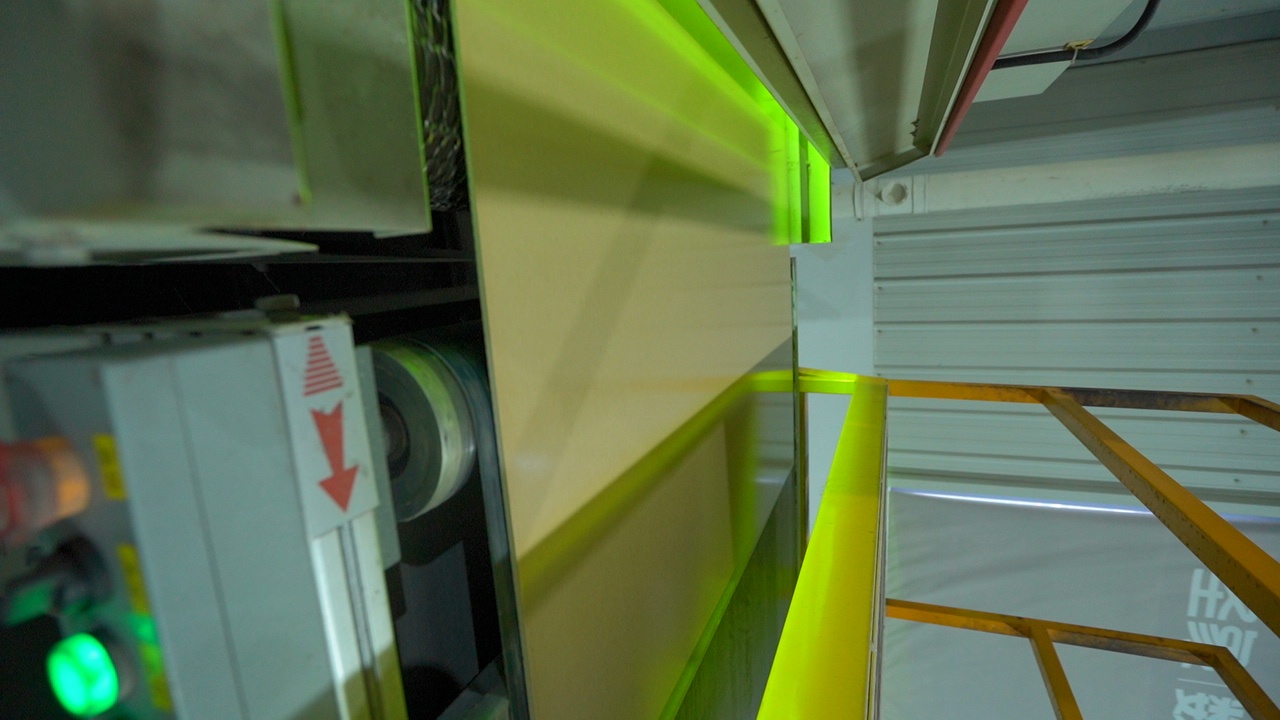
Digital printing wall panel production; documentation scope should always be checked against the thickness and format actually supplied.
Where the file stops
Every compliance file has an edge, and this one is worth stating plainly: the documents describe a panel, not a wall assembly. Adhesive selection, substrate flatness and preparation, joint sealing, corner detailing and the condition of the existing wall all sit outside the certificate and the test results. The installation guidance in the same document set is the bridge — structural adhesive applied to the panel back, alignment to pre-marked lines, locking-system joints, and silicone sealant rather than metal trims in wet bathroom areas.
Two further boundaries belong in the submittal record. The first is thickness: the certification scope covers 6–8 mm while the product range extends to 10 mm, so any 10 mm specification should carry written confirmation of coverage. The second is application: the file states that certification covers both interior and exterior applications and that the certified scope addresses internal use as wall coverings, so an exterior project should confirm its specific use in writing rather than relying on the general statement.
Neither boundary is a reason to exclude the product. Both are reasons to keep the file in the submittal, where the answer can be documented before installation rather than discovered after it.
A reviewer's checklist
Applied in this order, the checklist turns the file into a decision record rather than a folder of attachments.
- Certificate identity. Record certificate SHHL2506032107FT, the issuer SGS-CSTC Standards Technical Services Co., Ltd., the issue date 2025-08-14, the standard EN 15102:2007+A1:2011 and the EU market, then confirm the copy is current — no expiry date is recorded.
- Scope match. Check the specified thickness against the 6–8 mm certified scope and the stated application against internal use as wall coverings; request written confirmation for 10 mm and for exterior use.
- Fire classification. Quote A2-s1,d0 in full, and obtain the attached report's identifier, laboratory, specimen thickness and mounting.
- Comparative statement. File the Class B note on SPC, HDF and WPC as a supplier statement, not as a competitor test result.
- Asbestos. Obtain the report behind the negative result — method, laboratory, sample date and the product scope covered.
- Antibacterial. Record the ISO 846:2019 Method A observation as qualitative laboratory evidence, separate from the fire and asbestos lines.
- Moisture. Enter moisture movement of 0.06% in length and width, the 100% waterproof statement and the boiling observation, and attach the wet-area joint-sealing clause.
- Composition and end of life. Keep the mineral composition, the plastic-free statement and the landfill route as material evidence, distinct from certification.
FAQ: reading the decorative wall panel compliance file
What does A2-s1,d0 mean on a decorative wall panel file?
A2-s1,d0 is the reaction-to-fire classification recorded for the Silica Mineral Wall Panel, where A2 is the main class within the Class A band of the EN 13501-1 scale that runs from A1 to F, and the s1 and d0 suffixes complete the designation as issued. For a specification, the full string should be quoted rather than shortened to 'Class A', and the report behind the classification should be requested so that the specimen, thickness and test mounting can be checked.
Does the CE Verification cover every thickness in the product range?
As recorded, the certified product scope covers silica mineral wall panels for internal use as wall coverings with thickness 6–8 mm, while the product range is listed at 6, 8 and 10 mm. A 10 mm specification, or an exterior application, should therefore carry a written confirmation of coverage rather than an assumption that the certificate extends to it.
What does an asbestos content result of negative establish?
It records that asbestos content testing on the panel produced a negative result. That is an analytical result on a sample rather than a blanket statement for every variant or future production run, so the supporting report should identify the method applied, the laboratory, the sample date and the product scope it covers.
What does the ISO 846:2019 Method A result show?
The file records that antibacterial testing of the panel showed no growth apparent under the microscope, tested per ISO 846:2019 Method A. It is a qualitative laboratory observation about the material under the conditions of that method. It does not quantify antimicrobial performance in service, and in a bathroom it complements rather than replaces joint sealing and a defined cleaning regime.
Is a Class A2 panel enough by itself for an EU bathroom specification?
The classification is necessary where a Class A clause applies, but it addresses fire behaviour only. A bathroom specification also depends on moisture performance, joint sealing in wet areas, substrate preparation and documentary evidence for the material itself. The panel's file supports those checks, while the assembly, installation quality and project approval remain separate decisions.
What the file is for
A compliance file is not a marketing document and is not meant to be read as reassurance. The value of this one is that it can be dismantled: a CE Verification with a stated scope and no recorded expiry date, a fire classification that points to a report a reviewer can request, a negative asbestos result, an ISO 846:2019 Method A observation, a mineral composition statement and a set of moisture values. Each element is only as strong as the scope attached to it, and each answers a different question in the approval chain. Where European interior specifications move toward document-level review, the files that separate claims from evidence are the ones that move through submittal without argument — and the readers who take them in that order make fewer assumptions at the point of approval.
Company brochure for download: Power Dekor Group product brochure (PDF).
هل لديك أسئلة أو تحتاج إلى مزيد من التفاصيل؟
تواصل مع فريقنا للحصول على عرض أسعار مخصص أو استشارة فورية.
طلب عرض أسعار
املأ النموذج أدناه وسيتواصل معك فريقنا بعرض مقترح مخصص.
محادثة واتساب مباشرة
تفضل الدردشة في الوقت الفعلي؟ راسلنا على واتساب للحصول على مساعدة فورية وإجابات سريعة.
- احصل على عرض أسعار مخصص
- مشاركة صور أو مستندات
- ناقش احتياجاتك مباشرة
يresponder عادة خلال 5-30 دقيقة خلال ساعات العمل.