
Decorative Wall Panel Shortlist: Class A2 Silica Mineral 8804 vs Class B SPC
For a decorative wall panel project inside the European Union, the shortlist usually collapses into one compliance question before any design conversation starts: does the space require a Class A2-s1,d0 reaction-to-fire classification, or does a Class B-s3,d0 panel satisfy the applicable rule? The answer decides the route. Specify the Silica Mineral Wall Panel, model 8804, where A2-s1,d0 is mandatory. Specify an SPC wall panel where Class B is accepted and the project values fast renovation and low maintenance over the higher fire class.
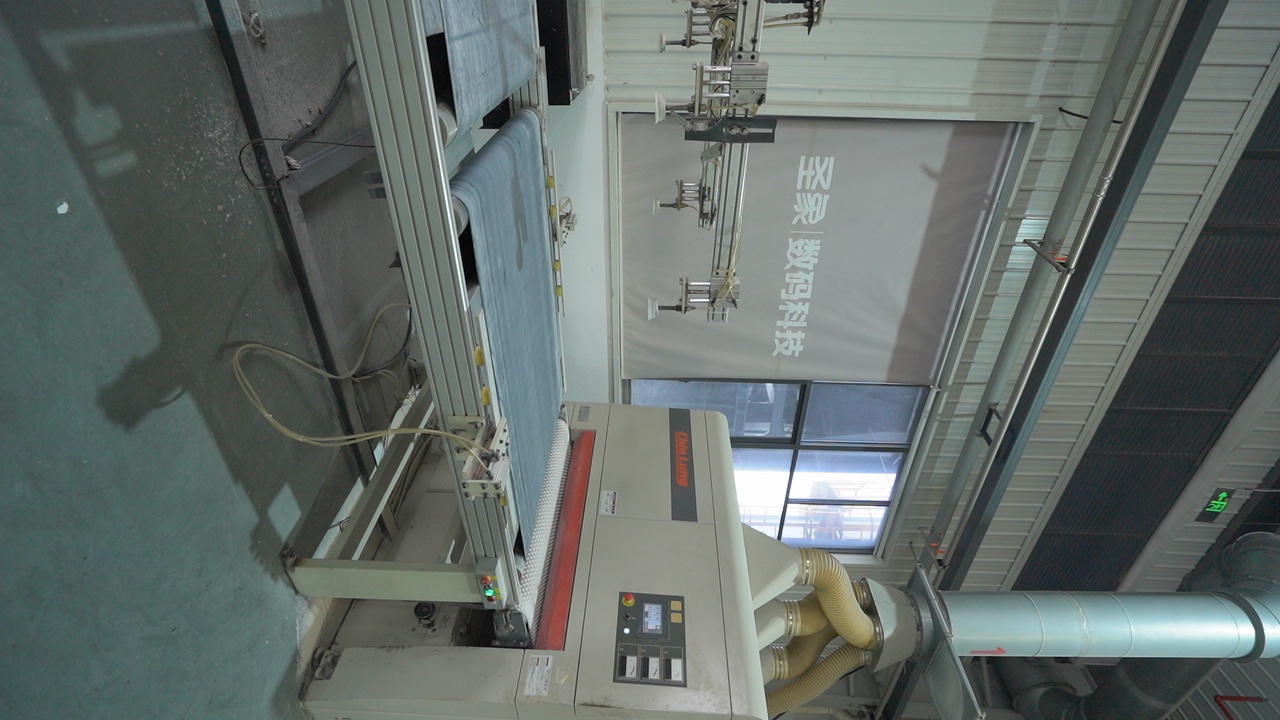
Digital printing line for decorative wall panel production. Panel selection starts with fire classification, not surface design.
Why a Priority-Based Shortlist Beats a Generic Ranking
Buyers searching for a decorative wall panel shortlist are usually handed lists ordered by popularity or by price band. That ordering is close to useless in a tender, because the decisive variable is a classification, not a brand. EN 13501-1 ranks reaction-to-fire performance from A1, the most restrictive, down to F, with smoke production and flaming droplets reported as additional suffixes. A panel that misses the class a project requires is not a cheaper alternative; it is a non-compliant one. The reverse is equally true: buying Class A2 where the applicable rule asks only for Class B moves budget away from installation, trims, sealing and after-sales support without adding value.
The opportunity sits in the middle of that range. Most decorative wall panel materials sold into interiors sit in the Class B band, and A2-capable products come from a narrower supply pool. The Silica Mineral case file states the position directly: the vast majority of materials on the market cannot meet Class A2, and SPC, HDF and WPC wall panels are Class B. A shortlist built on project priorities — fire class first, then water exposure, then size and thickness, then supply reliability — therefore produces two credible answers rather than one artificial winner.
The category itself is large enough to support that kind of split. Coherent Market Insights values the decorative panels market at USD 39.35 billion for 2026, with laminate panels the largest segment at approximately 45.4% of the total. Reed Intelligence reports that Asia Pacific held 43.6% of the global wall panels market in 2025 and is expected to remain the fastest-growing region. Definitions matter when reading those figures: broad decorative-panel totals include furniture and cabinet laminates, while wall-panel-specific estimates are lower because the scope is narrower. Neither number tells a buyer which class a specific building needs; only the project's fire strategy does.
The Shortlist at a Glance
| Decision variable | Silica Mineral Wall Panel, model 8804 | SPC wall panel |
|---|---|---|
| Reaction to fire (EN 13501-1) | A2-s1,d0 | B-s3,d0 |
| EU CE verification on file | EN 15102:2007+A1:2011, certificate SHHL2506032107FT, SGS-CSTC Standards Technical Services Co., Ltd., issued 2025-08-14, scope 6–8 mm thickness | EN 13501-1:2019, certificate 230608011SHF-001, Intertek, issued 2024-01-23, scope 4 mm thickness |
| Water performance | 100% waterproof; submersible; no deformation after boiling at 100 °C | Moisture content 0.02% |
| Density | 1050 kg/m³ | 2000 kg/m³ |
| Formats and surfaces | 2400 / 2440 / 3000 / 3050 mm length; 1200 / 1220 mm width; 6 / 8 / 10 mm thickness; interior and exterior wall panel applications | Digitally printed and film surfaces; 4 mm within the cited CE scope |
| Typical shortlist trigger | Public, egress and high-occupancy interiors; wet areas where A2 is specified; exterior applications where stated | Dry or intermittently wet interiors where Class B is accepted; fast renovation programmes |
| Primary constraint | Narrower supply pool; longer documentation and programme planning | Cannot satisfy a stated A2-s1,d0 requirement |
Route 1 — Silica Mineral Wall Panel 8804: What the File Supports
The 8804 route is the answer where a specifier has written A2-s1,d0 into the wall specification. The panel carries a reaction-to-fire classification of A2-s1,d0 under EN 13501-1, and its EU CE verification is documented under EN 15102:2007+A1:2011 by certificate SHHL2506032107FT, issued by SGS-CSTC Standards Technical Services Co., Ltd. on 14 August 2025, covering silica mineral wall panel for internal use as wall coverings at 6–8 mm thickness.
Water performance is the second differentiator. The product is described as 100% waterproof and submersible, with no deformation after boiling at 100 °C — a stability claim that matters in bathrooms, shower zones and any interior where panels meet standing water rather than occasional humidity. The material is also described as plastic-free, with raw materials drawn from natural sources and waste suitable for landfill and return to nature. Density is 1050 kg/m³, roughly half that of an SPC wall panel, which affects handling, transport loading and the load placed on the substrate during installation.
Format coverage is broad enough for both standard and large-format layouts: lengths of 2400, 2440, 3000 and 3050 mm, widths of 1200 and 1220 mm, and thicknesses of 6, 8 and 10 mm. The same product is listed for interior wall panel and exterior wall panel applications. Antibacterial performance for this route is positioned against ISO 846 test documentation, which belongs in the qualification file alongside the fire certificate rather than being treated as a substitute for it; the two answer different questions and should be checked separately.
One scope detail deserves attention before a tender closes. The CE verification on file covers 6–8 mm thickness. A specification written around the 10 mm build therefore sits outside the thickness range named in that certificate, and the buyer should confirm which documentation set covers the thicker build before award. Reading the scope line is one of the cheapest risk controls available in panel procurement, and it is frequently skipped.
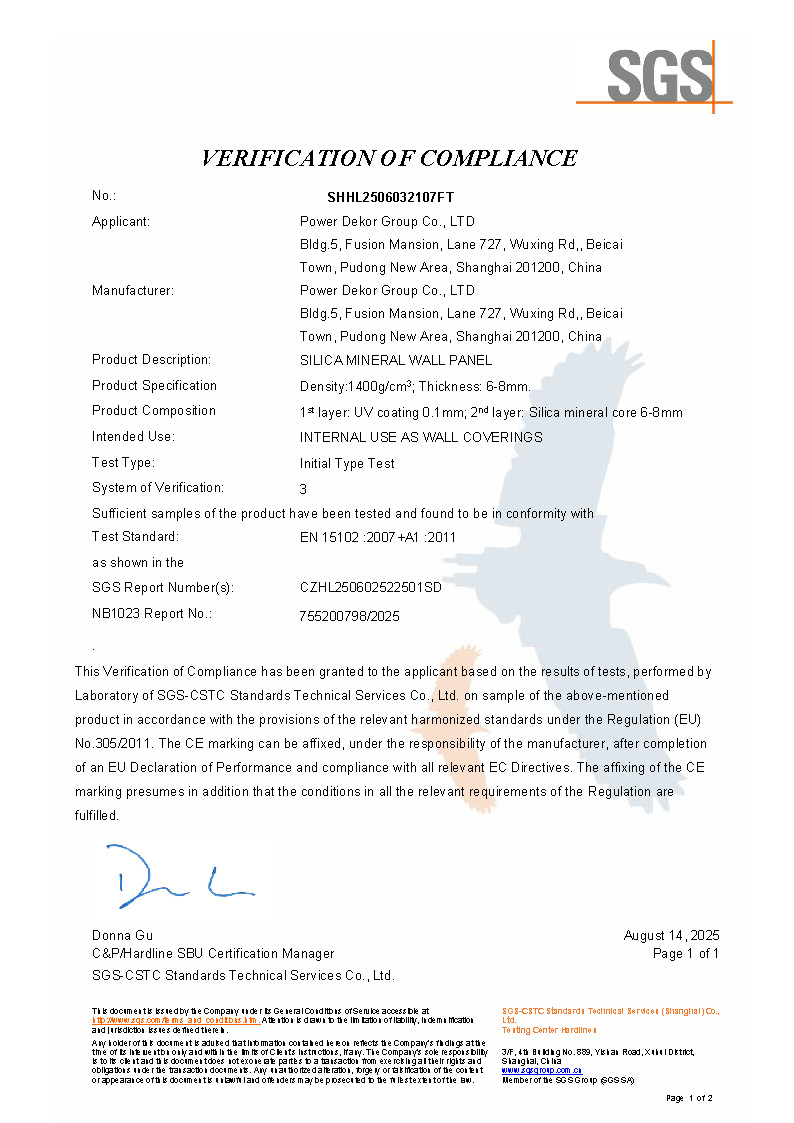
CE verification for silica mineral wall panel under EN 15102:2007+A1:2011, certificate SHHL2506032107FT, with 6–8 mm thickness stated in the scope.
Route 2 — SPC Wall Panel: Where Class B Is the Right Answer
The SPC route is not a downgrade; it is a different fit. SPC wall panels carry a reaction-to-fire classification of B-s3,d0 under EN 13501-1, verified for 4 mm thickness by certificate 230608011SHF-001 issued by Intertek on 23 January 2024. Their measured moisture content is 0.02%, which supports use in interiors that see regular cleaning and intermittent moisture without the fire class required of an egress route or a public assembly space.
Two practical advantages follow from the product's construction and surface technology. First, maintenance is comparatively low and the panel suits renovation work, because it can be installed as an overlay on an existing flat substrate rather than as part of a wet-trade strip-out. Second, surface design is flexible: digitally printed panels can carry almost any design, including a continuous pattern running across as many as ten panels, while film-surfaced panels are limited by the size of the film but cost less. Buyers without a fixed requirement on the number of design faces generally gain more from the film option; buyers chasing a continuous graphic gain from digital print.
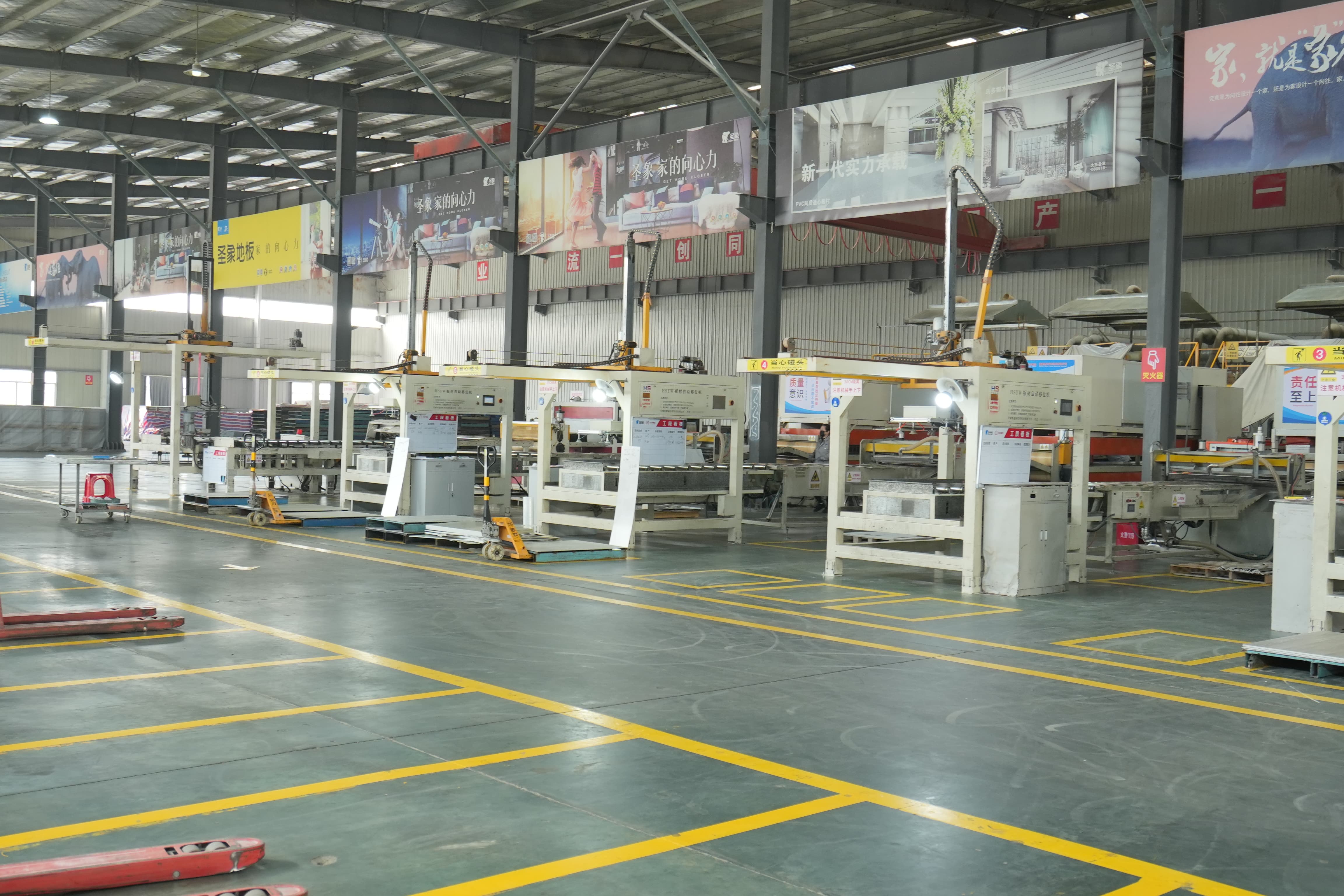
SPC production. The Class B route competes on surface design, moisture control and renovation speed, not on fire class.
Grading systems are not interchangeable
SPC panels are also reported under B1 grade in some markets and sources, and that line appears in supplier literature alongside European classifications. B1 belongs to a different grading system from EN 13501-1, and the two should not be read as equivalent. The classification recorded in the cited CE file for SPC wall panel is B-s3,d0. When a tender names EN 13501-1 classes, the EN classification is the one that answers the question — a B1 statement, however accurate in its own market, is not evidence of A2 performance.
Class A2-s1,d0 vs Class B-s3,d0: What Actually Changes
The letter in each classification describes contribution to fire growth. A2 is more restrictive than B, which is why the silica mineral route sits above the SPC route in the same standard. The suffixes carry separate information: s1 indicates the lower smoke production band while s3 indicates a higher one, and d0 means no flaming droplets within the classification period. In an egress corridor, smoke band and droplet behaviour often matter more to an assessor than the headline letter, which is why a two-part classification is quoted rather than a single grade.
The practical consequence is a filtering rule rather than a quality judgement:- A2-s1,d0 required — only the silica mineral route qualifies within this shortlist; the SPC route is excluded regardless of price or design.
- Class B accepted — both routes are technically open, and the decision moves to moisture exposure, weight, format, surface design and programme.
- Requirement unclear — resolve the building's fire strategy before comparing panels, because a substitution after award is far more expensive than a day of specification review.
Sizes, Thickness and the Installation Envelope
Format choice drives waste and labour more than most buyers expect. The 8804 range spans 2400, 2440, 3000 and 3050 mm lengths, 1200 and 1220 mm widths and 6, 8 and 10 mm thicknesses, which allows a layout to be planned around ceiling heights and module lines instead of being cut down from a single size. Larger formats reduce joint count; thicker builds change handling weight and substrate tolerance requirements.
The published installation sequence for these panels is adhesive-based and follows a fixed pattern: set out with a laser level and mark the wall in blocks, pre-fit panels dry to confirm the layout, cut with a diamond blade on a table saw or hand saw with the decorative face up, cut and drill all openings before applying adhesive, apply structural adhesive to the panel back, erect from the bottom against the marked lines, engage the locking system, and check horizontally and vertically after every four to five panels. Internal and external corners use metal trims assembled dry. In wet bathroom areas, metal trims are not applicable and silicone sealant is specified at all joints, including the panel-to-ceiling and panel-to-floor seams.
Two constraints follow from that method. The substrate must be flat, because adhesive-fixed panels transfer substrate deviation directly into the finished surface. And cutting must be planned, since all openings and edge cuts precede adhesive application; retro-fitting a socket after fixing is a repair, not an installation.
Supply-Side Context: Power Dekor Group
Power Dekor Group is a Shanghai-based provider of floor covering and wall panel solutions, founded in 1995, operating an 870,000 m² factory with more than 20,000 employees, 495 engineers and an annual output of 88,000,000 m², serving EU and USA markets as a member of Dare Global Group. Both shortlisted routes sit within one supply base, which matters for procurement because a project often needs Class A2 in one zone and Class B in another.
The commercial terms around those routes are OEM/ODM production with BOX and LABEL customization, monthly capacity of 500,000 sqm, a minimum order of 500 sqm, a lead time of 30–45 days, remote after-sales support, and 100% product testing on all products before shipment. For a buyer running a mixed-class project, a single supplier covering both classifications reduces the split-award problem: one qualification route, one testing regime, one shipment schedule, and one point of accountability when a certificate or a batch question arises.
Application Fit: Bathroom, Renovation and Public Interior
The clearest evidence for either route comes from long-running European projects. In Spain, a project contractor has used the silica mineral wall panel for ten years at a scale of 50,000 sqm per year, across bathroom and other interior decorative wall panel applications. That project achieved moisture-proof performance, stable delivery and compliance with the EU fireproof Class A standard. It is the reference that answers the two questions specifiers ask most often about A2 panels: whether the material survives sustained wet-area exposure, and whether an A2 supply line can hold a delivery schedule over a decade.
In Germany, a retail and distributor client runs 100,000 sqm per year for indoor wall decoration and bathroom space renovation, with a project horizon of 10 to 20 years. That case combines both routes and highlights suitability for humid indoor environments, moisture-proof performance, and easy installation for quick renovation. The pattern is instructive: the distributor does not choose one class for everything. It assigns A2 to the zones that require it and deploys Class B where the rule allows, keeping the overall programme competitive.
Exterior use sits at the edge of the shortlist. The silica mineral panel is listed for interior and exterior wall panel applications, but exterior performance depends on the complete build-up — substrate, movement joints, sealant specification and weather exposure — and should be confirmed project by project rather than assumed from an interior classification.
Where This Shortlist Stops: Limits, Trade-offs and Traditional Alternatives
Ceramic tile remains the default bathroom surface in many European markets, and the comparison is fair. Tile offers proven longevity and design depth, but it is a wet-trade installation: adhesive bed, curing time, grout lines and weight all extend the programme, and renovation usually means removal. Panel systems shorten that sequence because they are adhesive-fixed onto a prepared substrate and can be installed over existing finishes. The trade-off is that panels place more responsibility on substrate preparation and joint sealing — a shortcut there shows up as a visible defect far sooner than it would on tile.
Among panel materials, HDF and WPC sit alongside SPC in the Class B band under the same classification logic. Where Class B is acceptable, the choice between them is a question of moisture behaviour, surface design and handling rather than fire performance. Where Class A2 is required, none of them qualify, and that is the boundary this shortlist makes explicit.
The A2 route carries its own constraints. A narrower supply pool means programme risk: a 30–45 day lead time needs to be planned into the tender, not discovered after award. Certificate scope has to be read carefully — the 6–8 mm scope on the silica mineral CE file and the 4 mm scope on the SPC file are the kind of detail that determines whether a chosen thickness is actually covered. Density differences cut both ways: 1050 kg/m³ makes the silica mineral panel easier to handle, while 2000 kg/m³ gives the SPC panel a heavier, more rigid feel that some installers prefer. And neither product is structural; both depend on a flat substrate and correct adhesive application, so a weak wall cannot be rescued by a better panel.
Market Trend: Fire Class Is Becoming a Specification Line
Decorative wall panels are moving from a design category to a specified building product, and the shift shows in how buyers phrase requirements. Requests increasingly name a certificate number and a class rather than the word "fireproof". That change favours suppliers who can produce scope-accurate documentation quickly and penalises those who rely on descriptive claims.
The volume trend supports continued demand: 360iResearch estimated the 3D wall panel market at USD 815.02 million in 2025 with a forecast CAGR of 4.93%, and the broader decorative panels market continues to expand on urbanisation and interior renovation demand. But growth is not evenly distributed across classes. Class B volume products compete largely on surface design, print quality and price, while A2 products compete on documentation, dimensional stability under water exposure and project references. Buyers who understand that split stop asking which panel is best and start asking which class the room requires.
Future Outlook
Expect the category to bifurcate further. Digital print capability — continuous patterns across as many as ten panels — will keep pushing design differentiation into the Class B volume segment, where film and print surfaces already compete on cost per face. The A2 segment will differentiate on evidence: classification reports that match the thickness actually ordered, biological test documentation where hygiene is specified, and multi-year project references that demonstrate supply continuity rather than a single successful delivery.
For procurement teams, the practical implication is that shortlists will be built in two tiers rather than one. A single project may need an A2 tier for public and egress zones and a Class B tier for back-of-house, dry retail and staff areas, and the supplier who can document both tiers under one quality system will be easier to qualify than two single-class suppliers. Specification quality, not product novelty, is likely to be the differentiator that decides awards over the next few planning cycles.
FAQ
Which decorative wall panel should be shortlisted for a project that requires Class A2?
The Silica Mineral Wall Panel, model 8804, is the route that meets a stated A2 requirement. It is classified A2-s1,d0 under EN 13501-1 and covered by CE verification certificate SHHL2506032107FT issued by SGS-CSTC under EN 15102:2007+A1:2011. SPC, HDF and WPC wall panels are Class B and cannot substitute where A2-s1,d0 is the written requirement.
Is the Silica Mineral Wall Panel 8804 suitable for bathrooms and other wet areas?
Within its stated performance, yes. The panel is described as 100% waterproof and submersible, with no deformation after boiling at 100 °C. For wet bathroom installation, the published method specifies silicone sealant at all joints and states that metal trims are not applicable. Substrate flatness and joint sealing still determine the finished result.
When is an SPC wall panel the better shortlist choice than the 8804 panel?
When the applicable rule accepts a Class B classification and the project prioritises fast renovation and low maintenance. SPC wall panels carry B-s3,d0 with a moisture content of 0.02% and a density of 2000 kg/m³, and they support digital print or film surfaces. Where the space requires Class A2, the SPC route does not qualify.
What sizes and thicknesses are available for the 8804 panel?
Lengths of 2400, 2440, 3000 and 3050 mm; widths of 1200 and 1220 mm; thicknesses of 6, 8 and 10 mm. The CE verification on file covers 6–8 mm, so a specification using the 10 mm build should be checked against its own documentation before the tender closes.
How does A2-s1,d0 differ from B-s3,d0 in practice?
The letter describes contribution to fire growth, where A2 is more restrictive than B. The s1 or s3 suffix describes smoke production, and d0 means no flaming droplets. All parts of the classification matter in egress corridors and public interiors. The classification applies to the tested product and does not by itself describe how a complete wall build-up will perform.
What evidence should a buyer review before confirming either route?
The CE verification certificate together with its stated thickness scope, the EN 13501-1 classification, current ISO 846 test documentation where antibacterial performance is specified, and confirmation that all products are tested before shipment. For repeat supply, add documented references such as a ten-year project contractor relationship at 50,000 sqm per year in Spain.
The technical brochure covering both wall panel routes is available for download: Power Dekor wall panel technical brochure (PDF).
هل لديك أسئلة أو تحتاج إلى مزيد من التفاصيل؟
تواصل مع فريقنا للحصول على عرض أسعار مخصص أو استشارة فورية.
طلب عرض أسعار
املأ النموذج أدناه وسيتواصل معك فريقنا بعرض مقترح مخصص.
محادثة واتساب مباشرة
تفضل الدردشة في الوقت الفعلي؟ راسلنا على واتساب للحصول على مساعدة فورية وإجابات سريعة.
- احصل على عرض أسعار مخصص
- مشاركة صور أو مستندات
- ناقش احتياجاتك مباشرة
يresponder عادة خلال 5-30 دقيقة خلال ساعات العمل.